Article Contents:
- Why Color Matters: The Psychology of Unified Framing
- What is a Door Plinth and Why It's Often Misnamed
- MDF as a Material: Why It Dominates Door Framing
- Geometric Stability
- Perfect Surface for Coatings
- Precision Profiling
- Affordable price
- Framing Kits: What's Included and Why a System is Needed
- Basic Kit for One Door
- Extended Kit with Decoration
- Complete room finishing set
- Profile selection: from minimalism to classic
- Flat Rectangular Profile
- Profile with One Bead
- Classic Profile with Beads and Rolls
- Carved Profile
- Color Solutions: How to Match the Tone to Doors and Floor
- Tone-on-Tone with the Door
- Tone-on-Tone with Plinths
- Contrast with Door and Walls
- Natural Wood Color
- Kit Installation: Step-by-Step Technology
- Tools and Materials
- Opening preparation
- Marking and Trimming
- Installing Vertical Casings
- Installing Horizontal Casing
- Installing Door Plinth
- Finishing
- Where to Buy a Quality Kit: Supplier Selection Criteria
- Manufacturer of Own Products
- Availability of Collections
- Accuracy of Dimensions and Geometry
- Ecological certifications
- Sales Conditions
- Cost of Framing Kit in 2026
- Door Decor: How to Complement the Framing
- Moldings on Door Panels
- Carved Overlays
- Upper Cornice or Sandrik
- Capitals and Bases
- Mistakes in Selection and Installation: Learning from Others
- Trends 2026: What's Relevant in Door Framing
- Frequently Asked Questions About Door Framing
- Conclusion: An Investment in Interior Completeness

Have you ever seen a perfect room where every element seems like an extension of another? Where architraves flow into baseboards, colors match down to a half-tone, and textures create a unified symphony? This is no accident. It's the result of a thoughtful approach to material selection.MDF door casingA door set, complete with a door baseboard matched tone-on-tone, is the key to such a result. Let's understand why it's important to buy a set, how to correctly select elements, and where to find a supplier that won't make you assemble a mosaic from different manufacturers.





Why Color Matters: The Psychology of Unified Framing
You enter a room — what does your brain perceive in the first seconds? Harmony or chaos. Whendoor framingthe architraves are done in the same color as the floor baseboards, the gaze glides smoothly, not stumbling over visual dissonances. The vertical lines of the architraves logically transition into the horizontal lines of the baseboards, creating a frame for the space.
Imagine the opposite situation: light beige architraves, dark brown baseboards, white doors. Three different colors on one section of the wall. The eye darts around, trying to find logic. It doesn't find it. A feeling of incompleteness arises, of random material selection, as if the renovation was done at different times with whatever was available.
Professional designers know the rule: framing elements should work as a system. Architraves, baseboards, cornices, moldings — all in a unified color or in a strictly controlled color scheme. This creates architectural integrity, turning a set of separate elements into a finished composition.




What is a Door Baseboard and Why It's Often Misnamed
Debates about terminology can last for hours. What is a door baseboard?What is the plankunder the door called? Let's settle this once and for all.
A door baseboard is a plank installed at the junction of the wall and floor in the area of the door opening. It connects the floor baseboards on both sides of the door, covering the gap between the floor and the door frame. A second name is a threshold, although a threshold more often implies an element on the floor, not on the wall.
Some call this plank a stop strip, but that's a mistake. A stop strip is a completely different element; it's installed on the door frame at the point of contact with the door leaf, creating a sealed rebate. Confusion arises due to similar words, but the functions are different.
A third name is a door strip or simply a plank under the door. Less formal, but understandable to everyone.
Important: the door baseboard should match the floor baseboard in color, height, and profile. Ideally — when these are elements from the same manufacturer's collection. Then the transition is smooth, unnoticeable, creating the impression of a continuous frame around the entire room.
Our factory also produces:


MDF as a Material: Why It Dominates Door Framing
MDF architravesoccupy about 70 percent of the door joinery market. Not by chance. The material combines the advantages of wood and modern technology.
Get Consultation
Geometric Stability
MDF (Medium Density Fiberboard) — a board made of wood fibers, compressed under pressure of 25-40 MPa with the addition of binding resins. The density of the finished board is 720-870 kg/m³, higher than that of many wood species. The structure is homogeneous, without grain direction, knots, or voids.
The main advantage is the absence of internal stresses. Solid wood has grain direction, non-uniform density of annual rings, and natural moisture. Even wood dried to 8-10 percent reacts to changes in air humidity — it swells or shrinks. An MDF architrave maintains stable geometry, doesn't warp, doesn't twist, doesn't crack.
Perfect Surface for Coatings
The surface of MDF after sanding is absolutely smooth, without pores or irregularities. This is critical for high-quality application of decorative coatings. PVC film lays evenly, without bubbles or folds. Enamel gives a mirror-like smoothness without an orange peel effect. Veneer adheres without air pockets.
The texture of wood species is imitated with embossing on the film with high precision. From a distance, an MDF architrave under oak or walnut is visually indistinguishable from solid wood. Only a specialist will notice the difference upon close inspection.
Profiling accuracy
MDF milling produces an ideally clean cut without chips or tears. The profile is repeated with an accuracy of up to 0.1 mm along the entire length of the strip. When joining casings at a 45-degree angle, a tight connection without gaps is achieved.
Solid wood during milling produces micro-chips in the pore area and requires additional sanding. Fibers can tear, especially in softwood species. MDF is free from these problems — its homogeneous structure cuts cleanly, like butter.
Affordable price
The production cost of MDF moldings is lower than that of wooden ones. Raw materials are cheaper — woodworking waste instead of valuable solid wood. The process is more technological — board pressing, milling, coating application on automated lines.
MDF door casingcosts 150-500 rubles per linear meter compared to 800-1500 for wooden ones. Savings are multiple with a visually comparable result.
Framing kits: what they include and why a system is needed
Buying elements separately risks getting mismatched shades, profiles, textures. Even from the same manufacturer, batches may differ.Classic molding kitsolves the problem.
Basic kit for one door
Includes a minimal set of elements for complete framing:
-
Vertical casings — 2 pieces, length 2200-2400 mm
-
Horizontal (top) casing — 1 piece, length 900-1200 mm depending on the opening width
-
Door plinth — 1 strip, length 800-1000 mm for installation under the door
All elements are of the same color, profile, with identical decorative coating. The kit is designed for a standard door opening width of 700-900 mm and height of 2000-2100 mm.
Extended kit with decor
Adds decorative elements to create a more expressive framing:
-
Everything from the basic kit
-
Corner rosettes — 2-4 pieces for finishing casing joints
-
Top cornice or pediment — decorative overlay above the door
-
Capitals — crowning elements on vertical casings
Such a kit turns a simple opening into an architectural portal, suitable for classical and neoclassical interiors.
Complete room finishing kit
Systematic approach — all room moldings from one collection:
-
Casings for all doors
-
Floor skirting boards around the perimeter
-
Ceiling Cornices
-
Wall moldings (optional)
Unity of material, color, and profile creates an integral space. Vertical lines of casings flow into horizontal lines of skirting boards, which connect with ceiling cornices. The room gains architectural completeness.
Profile selection: from minimalism to classic
The casing profile determines the framing style and its compatibility with the interior.
Flat rectangular profile
The simplest option is a rectangular cross-section strip with rounded or beveled edges. Width 50-80 mm, thickness 10-15 mm. Minimalistic appearance, suitable for modern interiors, Scandinavian style, loft.
Advantages: inexpensive, versatile, easy to install. Disadvantages: visually simple, does not create architectural expressiveness.
Profile with a single bevel
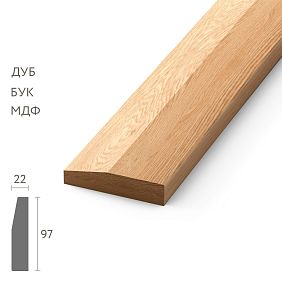
Strip with a concave groove along one edge. Creates a delicate play of light and shadow, adds elegance without excessive decorativeness. Width 60-90 mm.
Suitable for neoclassicism, transitional styles between modern and classical. A balance of simplicity and sophistication.
Classical profile with bevels and beads
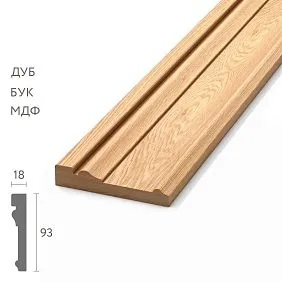
Complex shape with alternating concave fillets and convex beads. Width 80-120 mm, pronounced relief creates rich chiaroscuro. For classical interiors where decorativeness and historical continuity are valued.
Advantages: luxurious appearance, emphasizes status. Disadvantages: more expensive than simple profiles, requires a corresponding interior — looks alien in a minimalist setting.
Carved profile
The highest level of craftsmanship — a profile with ornamental carving or imitation carving by pressing. Floral motifs, geometric patterns, scrolls. Width 100-150 mm.
Only for luxurious classical interiors — Empire, Baroque, Victorian style. Price is high, installation requires experience — each joint must match the pattern.
Color solutions: how to match the tone to doors and floor
The color of the framing should logically connect the door, walls, and floor into a single composition.
Tone-on-tone with the door
A classic solution — architraves and door plinth exactly match the color of the door leaf. Visually, the door appears larger, the opening is perceived as a single element. Suitable when the door contrasts with the walls — a dark door on a light wall or vice versa.
Important: the tone must match perfectly; a half-tone difference is noticeable. Buy architraves from the same manufacturer as the doors, from the same collection. Or order painting of a door sample.
Tone-on-tone with baseboards
A logical solution — architraves and door plinth match the color of the floor baseboards. Creates a sense of a continuous frame around the room. The door can be a different color, but its framing is connected to the overall system.
Suitable when baseboards are contrasting — dark baseboards on a light floor or light on dark. Architraves support this contrast, creating a visual rhythm.
Contrast with the door and walls
A bold solution — architraves in a contrasting color. White architraves on a dark door, black on a white wall. Creates a graphic effect, emphasizes the geometry of the opening.
Requires impeccable taste and precise execution. The slightest curvature of lines, a gap in the joints — everything becomes noticeable. However, with proper execution, the result is impressive.
Natural wood color
For interiors where naturalness is valued — Scandinavian style, eco-style, country. Architraves made of MDF, covered with natural veneer of oak, ash, walnut with preserved texture. Or stained with transparent stains, through which the pattern of the wood-imitation film shows.
Color varies from light birch to dark wenge. The choice depends on the overall color palette of the interior.
Installation of the kit: step-by-step technology
Installing architraves and door plinth is a process accessible for DIY.
Tools and materials
You will need: a miter saw or miter box with a handsaw, tape measure, square, pencil, level, MDF adhesive or liquid nails, finishing nails 30-40 mm, hammer or pneumatic nail gun, putty, wax corrector in the color of the architraves.
Opening preparation
The door frame must be installed strictly vertically and horizontally — check with a level. The gap between the frame and the wall is filled with mounting foam, excess is cut flush with the wall. The wall surface around the opening is even, without large protrusions or depressions.
If the wall is uneven — the architrave will not fit tightly, gaps will form. In such places, you will have to putty or use wide architraves that will cover the unevenness.
Marking and trimming
Measure the height of the opening from the floor to the top of the door frame. Cut two vertical casings to this height plus 3-5 mm (the casing must stand on the floor or on the door plinth, not hang in the air). The top cut is trimmed at a 45-degree angle for joining with the horizontal casing.
Measure the width of the opening along the outer edge of the vertical casings. Cut the horizontal casing, taking into account that both ends are cut at 45 degrees.
Important: The 45-degree joints must be perfectly precise. Even a deviation of 1 degree will create a gap. Use a high-quality miter box or a miter saw with angle locking.
Installation of vertical casings
Apply glue in a thin bead along the back of the casing. Place it against the door frame, align it with the edge of the frame with a 3-5 mm offset (the offset is needed so the door opens freely without touching the casing). Press along the entire length.
Secure with finish nails spaced 300-400 mm apart. Drive the nails so that the heads are countersunk into the material by 1-2 mm. Fill these indentations later with putty or wax filler.
Check for verticality with a level. If the casing is deviating — adjust it before the glue sets.
Installation of horizontal casing
After installing the vertical ones, mount the horizontal one. Check the alignment of the 45-degree joints — they should be tight, without gaps. If there is a small gap — recut or fill with putty later.
Apply glue, place it, secure with nails. The horizontal casing should rest on the ends of the vertical ones, creating a smooth line.
Installation of door plinth
The door plinth is mounted under the door, connecting the floor plinths on both sides. Measure the width of the door opening at the bottom. Cut a strip to the required length.
The ends are cut at a 45-degree angle to join with the floor plinths. It is important that the height of the door plinth matches the height of the floor plinth — then the transition will be smooth.
Attach with glue and finish nails. If the floor is uneven — you may need to place thin shims under the plinth for a tight fit against the wall.
Final finishing
After the glue dries (24 hours), inspect all joints. Fill small gaps with acrylic putty matching the color of the casings. Fill nail holes with wax filler — it is matched exactly to the finish tone and is practically invisible after drying.
Carefully sand off excess putty after drying with fine sandpaper. Wipe with a damp cloth to remove dust.
Total installation time for one door set — 2-3 hours.
Where to buy a quality set: criteria for choosing a supplier
The millwork market is oversaturated. How to avoid making a mistake in your choice?
Manufacturer of its own products
Buying from a manufacturer offers several advantages. Factory price without intermediary markups — saving 30-50 percent. Full range of profiles, sizes, colors. Possibility to order non-standard lengths, custom coloring, modification of standard products.
The manufacturer controls quality at all stages — from purchasing MDF boards to packaging the finished product. There are technologists, designers, and a testing laboratory. The products are certified, with test reports available.
Availability of collections
A professional manufacturer releases products in collections. A collection is a system of elements in a unified style and color.Casings, plinths, cornices, moldingsfrom one collection perfectly match each other.
You buy casings from the 'Classic Oak' collection — you automatically know that the plinths and cornices from the same collection will match in color and profile. No need to guess, match by eye, or risk getting a mismatch.
Dimensional and geometric accuracy
Check several strips from the batch. The length should be the same with a tolerance of ±1 mm. Width and thickness are constant along the entire length. The profile is clear, without blurred edges or chips.
Ends are straight, perpendicular to the axis of the strip. A crooked end makes precise 45-degree joining impossible. Check with a square — place it against the end, there should be no gaps.
The coating is uniform, without missed spots, stains, or scratches. The film is adhered tightly, without bubbles or edge peeling. The enamel is free of drips and craters.
Ecological certifications
MDF contains binding resins. Quality manufacturers use resins with low formaldehyde content—emission class E1 or E0 according to European standards. This means formaldehyde emission is below the maximum permissible concentration, safe for residential spaces.
Request a sanitary-epidemiological certificate. It specifies the emission class and laboratory test results. A serious manufacturer will provide the documents without issue.
Terms of Sale
Minimum order quantity is an important parameter. A good supplier sells by the piece or from 1 linear meter. Requiring a purchase of 50-100 meters is inconvenient for private customers.
Cut-to-size is a useful service. You specify the required lengths, the manufacturer cuts precisely and packages. You save time and get guaranteed cutting accuracy.
Delivery—molding is long-length and requires careful transportation. Ensure the supplier uses special packaging that protects against breakage.
Cost of a door framing kit in 2026
Prices depend on material, profile, coating, and element width.
Basic MDF kit with PVC film:
-
Simple profile architraves (70 mm width): 150-250 RUB/m, for a 6-meter kit — 900-1500 rubles
-
Door plinth 1 meter: 150-250 rubles
-
Total: 1050-1750 rubles per kit
Mid-range MDF kit:
-
Classic profile architraves (90 mm width): 300-450 RUB/m, for the kit — 1800-2700 rubles
-
Door plinth: 300-400 rubles
-
Total: 2100-3100 rubles
Premium MDF kit with veneer:
-
Wide architraves with complex profile (120 mm width), oak-veneered: 700-1000 RUB/m, for the kit — 4200-6000 rubles
-
Veneered door plinth: 700-900 rubles
-
Total: 4900-6900 rubles
Extended kit with decor:
-
Basic mid-range kit: 2100-3100 rubles
-
Corner rosettes 4 pieces: 400-800 rubles
-
Top cornice: 500-1200 rubles
-
Total: 3000-5100 rubles
Add labor costs (if hiring a professional) to the material cost—800-1500 rubles for installing the architrave kit, 300-500 for the door plinth. Total cost with materials and labor—from 2000 to 8000 rubles depending on the class.
Door decor: how to complement the framing
Door Decoris not limited to architraves and plinths. Additional elements enhance the effect.
Moldings on the door leaf
Narrow decorative strips that form frames on a smooth door. They create the effect of a paneled construction without replacing the door. MDF moldings, matching the color of the architraves, are glued onto the door leaf, forming symmetrical rectangles or squares.
Carved overlays
Decorative Insertswith an ornament are mounted at the corners of door frames, above the door, or in the center of the horizontal architrave. Carved elements made of solid wood or polyurethane add luxury, transforming a simple door into a formal one.
Upper cornice or pediment
A horizontal element installed above the door on top of the architrave. Creates a portico effect, giving the opening architectural significance. The cornice can be a simple rectangle or complex with a pediment and moldings.
Capitals and Bases
Transform vertical casings into pilasters. The capital is installed at the top of the casing, the base at the bottom. Creates the impression of columns framing the door—a technique borrowed from classical architecture.
Mistakes in selection and installation: learning from others
Some solutions seem correct but lead to poor results.
Purchasing elements from different manufacturers. Architraves from one company, baseboards from another. Even if the color matches in catalog photos, in reality, there will be a color mismatch. Monitor calibration, lighting during shooting, printing—all distort the actual color.
Mismatch in baseboard height. Door baseboard 80 mm, floor baseboard 100 mm. The transition becomes a step, looks sloppy. The height should be the same or with a minimal difference of 5-10 mm.
Installing architraves without a gap from the edge of the frame. The architrave is mounted flush with the edge of the frame. The door, when opening, hits the architrave, scratches it, and over time loosens the fastening. A 3-5 mm gap is needed.
Joints at the wrong angle. Cut architraves at 43 or 47 degrees instead of 45. Gaps appear in the corners of the frame, or conversely, the elements don't meet. Angle precision is critical.
Installation on an uneven wall. A wall with bumps and dips. The architrave doesn't fit tightly, gaps form. Either level the wall or use wide architraves that flexibly adapt to the unevenness.
Driving nails without pre-drilling. In hard MDF, a nail can split the edge of the architrave. It's better to pre-drill a hole with a drill bit slightly smaller than the nail diameter.
Trends 2026: what's relevant in door framing
Fashion changes even in such conservative areas as architectural millwork.
Wide architraves. The trend for expansion—100-150 mm instead of the standard 70-80 mm. Wide framing visually enlarges the opening, creating a more imposing look. Relevant for spacious rooms with high ceilings.
Contrasting combinations. White architraves on colored walls, black on white. Graphic solutions emphasize geometry, creating a modern look. Require perfect execution—any inaccuracy is noticeable.
Hidden architraves. Special systems where the architrave is recessed into the wall, creating the effect of a door without framing. Complex installation, but the result is impressive—the door appears as if cut into the wall.
Painting in interior colors. Moving away from standard wood tones. Architraves are painted gray, blue, green, burgundy—matching the walls, furniture, or textiles. Creates a cohesive color environment.
Minimalist profile. Simple rectangular architraves without complex moldings. Clean lines, no decorative elements. Suitable for modern interiors where simplicity is valued.
Frequently asked questions about door framing
Is it necessary to buy architraves and baseboards from the same manufacturer?
Highly advisable, especially if precise color matching is important. Different manufacturers use different dyes, films, and coating application technologies. Even if the same shade is specified—'natural oak'—it may differ. With one manufacturer, all elements in the collection are guaranteed to match.
Can MDF architraves be installed on a wooden door?
Yes, no problem. The main thing is to match the color. MDF with a wood-grain film is visually indistinguishable from solid wood from a distance. Up close, the difference is noticeable, but overall, the combination works. The savings are significant—wooden architraves are 3-4 times more expensive than MDF.
What to do if the wall is very uneven?
Three options: level the wall with plaster or drywall (time-consuming, expensive, dusty); use flexible polyurethane architraves that adapt to unevenness; choose wide architraves 100-120 mm—they cover more irregularities.
Is a door baseboard mandatory or can it be omitted?
Mandatory if you want a finished look. Without it, there is a gap under the door, and the foamed gap between the frame and the wall is visible. Looks sloppy and incomplete. The baseboard covers this gap, creating a smooth transition from the floor baseboards.
How to choose a color if the door and floor are different shades?
Three strategies: architraves matching the door (the door is perceived as a single element with the framing); architraves matching the baseboards (creates a room frame, the door stands out); a middle shade between the door and floor (a compromise that works when the first two options seem too contrasting).
How long do MDF door casings last?
With proper use — 15-20 years minimum. MDF does not rot, does not swell from moisture (if the coating is intact), and does not crack. The main enemy is mechanical damage. A strong impact can chip a corner or dent the profile.
Can MDF door casings be repainted?
Yes, if they are paintable or have an enamel coating. Repainting PVC film is more difficult — paint adheres poorly, special primer is needed. Veneered casings can be re-stained with wood stain and varnished.
What's better — nails or glue?
Optimally — a combination. Glue holds across the entire contact area, nails secure while the glue dries. Glue alone is possible, but strong fixation is required during setting (props, weights, painter's tape). Nails alone are unreliable, gaps may form, and the casing may pull away from the wall.
Conclusion: An investment in the completeness of the interior
An interior is made up of details. You can invest millions in expensive furniture, exclusive finishes, designer lighting — but if doorways are framed haphazardly, with mismatched color elements and gaps at the joints, the overall impression will be ruined.
MDF door casingA door casing set with a matching door plinth in a unified color is not a luxury, but a basic necessity. The cost of a set is 2-7 thousand rubles — incomparable to the renovation budget, but its influence on the final result is enormous.
Choosing the material is simple: MDF dominates in terms of price-quality-practicality ratio. Solid wood is several times more expensive, offering advantages in tactile feel and prestige, but visually, high-quality MDF is almost indistinguishable.
The main thing is to buy sets from one manufacturer, from one collection. Then the colors will match perfectly, the profiles will be coordinated, and installation will proceed without surprises. Saving on mismatched elements will backfire — you'll waste time on selection, nerves on mismatches, and money on rework.
Company STAVROS has been producing for over twenty yearshigh-quality solid wood and MDF millworkfor professional builders, interior designers, and private clients across Russia and CIS countries. Our own production facility in the Moscow region is equipped with modern equipment: four-sided CNC milling machines ensure profile accuracy of ±0.1 millimeters, PVC film lamination lines guarantee uniform coating without bubbles or peeling, painting booths with automatic enamel application create a mirror-smooth surface. STAVROS has developed a system of collections whereCasings, plinths, cornices, moldingselements are perfectly coordinated in color, profile, and style — you buy a ready-made framing system where each element complements the other. The assortment includes over 150 casing profiles, from simple rectangular ones 50 millimeters wide to complex classical ones 120 millimeters wide, door plinths of all heights to coordinate with floor ones, and decorative elements for creating luxurious frames. The company works with premium raw materials: MDF boards with a density of 750-800 kg/m³ of European production with formaldehyde emission class E1, kiln-dried solid oak and beech with controlled humidity of 8-10 percent, natural veneer 0.6 millimeters thick for veneered casings. Each product undergoes multi-stage quality control: geometry measurement with templates, checking milling quality, visual inspection of the coating for defects. STAVROS offers ready-made framing kits for standard door openings with a guarantee of perfect color matching for all elements, as well as custom kits for non-standard sizes with precise cutting to size. Professional consultants will help select the profile and color to match the interior style, calculate the required amount of material including a margin for trimming, and provide installation recommendations for DIY installation or recommend trusted craftsmen. Showrooms in Moscow and St. Petersburg allow you to see the millwork in person, assess the quality of the coating, hold samples against doors to check color matching, and obtain samples for home testing. STAVROS organizes delivery across all of Russia with careful packaging in rigid film and cardboard boxes, protecting long items from breakage during transport. Direct sales from the manufacturer without intermediary markups mean savings of 30-50 percent compared to construction hypermarkets and retail stores. For designers, foremen, and wholesale buyers, partnership programs are available with progressive discounts of up to 20 percent and deferred payment. STAVROS fulfills orders of any volume: from a kit for one door to supplying millwork for a residential complex with hundreds of apartments, ensuring consistent quality regardless of project scale. Choosing STAVROS, you get not just materials, but a comprehensive solution: professionally developed collections with a guarantee of color unity, quality proven by tens of thousands of completed projects, technical support from selection to final installation, and confidence in a result that will delight with its flawless appearance for decades and become a source of pride for the homeowners.