Article Contents:
- Oak as the king of millwork: physical and aesthetic advantages
- Natural protection: tannins and durability
- Types of solid oak architraves: from minimalist to sculptural
- Size gradation: coordination with interior scale
- Manufacturing technology: from forest to finished product
- Profiling and sanding: surface creation
- Finishing oak architraves: from natural to painted
- Special techniques: patination and gilding
- Architraves and classic doors: coordination rules
- Architrave width and door scale
- Architraves and classic furniture: mutual status enhancement
- Functional role of architraves: completing the architectural theme
- Installation of oak architraves: professional installation rules
- Joint treatment and final finishing
- Care and durability of oak architraves
- Cost and value: investment in durability
- Conclusion: oak as the foundation of premium interiors

A door frame is an architectural element through which a person passes dozens of times daily, and the quality of its finishing forms the first impression of a room. In classic interiors, where durability, naturalness of materials, and craftsmanship are valued,Oak solid casingbecomes an essential element of premium finishing, transforming a utilitarian opening into an architectural detail. Oak—a material that has served kings and aristocrats for centuries—possesses a unique combination of mechanical and aesthetic characteristics unattainable by other species or synthetic materials. A density of 750-900 kilograms per cubic meter, hardness of 3.7-4.2 units on the Brinell scale, and expressive texture with clear annual rings and medullary rays create an architrave that will serve for decades without losing shape and beauty, becoming only more noble with age.
natural oak casingin combination with a classic door made from the same solid wood creates material unity of the door assembly, where all elements—the leaf, frame, architraves—are made from the same species, processed in the same way, and demonstrate coordinated texture and shade. This visual integrity is characteristic of palace and estate interiors, where every detail is verified, every element corresponds to the overall status of the space. In a room withclassic furnituremade of oak—a solid table, carved wardrobe, inlaid chest of drawers—oak architraves create a material dialogue, linking architectural elements with furnishings into a single composition where wood is present not fragmentarily, but as the dominant material of the interior.




Oak as the king of millwork: physical and aesthetic advantages
Among all wood species used in the production ofoak trimoccupies a special position thanks to a unique combination of properties critical for architraves. Mechanical strength is the first and fundamental advantage. The ultimate strength in static bending is 95-105 megapascals, which is two to three times higher than pine or linden. This means that an oak architrave withstands significant impact loads without chipping or cracking—an accidental impact when moving furniture, careless door opening hitting a wall will leave no visible damage on oak, whereas softer species will get dents or chips.
Oak hardness on the Brinell scale—3.7-4.2 units—ensures resistance to abrasion and indentation. An architrave is in a zone of intensive contact—it is touched by hands when passing through a door, brushed by bags, leaned against while waiting. Soft species in these places gradually wear down, the surface becomes uneven, and the coating gets damaged. Oak maintains geometric surface invariability for decades—even in zones of maximum contact, wear is practically unnoticeable. This is especially critical for entrance door architraves, where usage intensity is maximal.
Dimensional stability is the third key advantage of oak. Wood is a hygroscopic material that reacts to humidity changes by altering linear dimensions. Pine or birch can change width by 5-8 percent with humidity fluctuations from 8 to 15 percent. Oak, thanks to high density and tannin content, changes dimensions by only 2-4 percent in the same humidity range. For an architrave 80 millimeters wide, this is the difference between a change of 6 millimeters (pine) and 2 millimeters (oak). Smaller changes mean no visible gaps between the architrave and wall, preservation of tight corner joints, and absence of protective coating cracking.




Natural protection: tannins and durability
Oak wood contains 6-10 percent tannins—tanning substances that give characteristic astringency and provide natural protection from biological factors. Tannins are toxic to fungi, mold, and wood-boring insects, making oak practically invulnerable to biological degradation under normal operating conditions.Oak door trimdoes not require aggressive chemical impregnations, antiseptic treatments—natural protection is sufficient to ensure durability for centuries. Archaeological finds of oak structures that have lain in the ground for hundreds of years retain structural integrity precisely thanks to tannins.
Moisture resistance is another consequence of high density and tannin content. Oak does not absorb water quickly—its capillary structure is dense, with relatively small pores. Moisture that lands on the surface evaporates before penetrating deep into the wood. This is critical for door casings at entryways, where drafts with humid air and condensation due to temperature fluctuations are possible. Oak casings do not swell, warp, or lose their geometry even in high-humidity conditions where pine or beech casings would deform.
The color and texture of oak are aesthetic advantages, no less important than its mechanical properties. The natural shade of oak varies from light honey to rich brown with golden highlights, depending on growing conditions and sawing method. The texture is expressive—large open pores create tactile relief, annual rings form parallel lines on tangential cuts or arched patterns on radial cuts, and medullary rays produce characteristic shiny streaks, especially noticeable on radial cuts. This natural decorativeness makes even a simple flat oak casing visually interesting, whereas a casing made from uniform wood without expressive texture requires additional profiling or decoration for visual appeal.
Our factory also produces:


Types of solid oak casings: from minimalist to sculptural
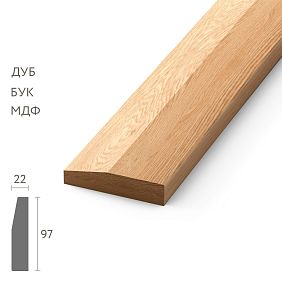
Flat casing—the simplest form, consisting of a rectangular-section board without profiling or carving. Typical dimensions: width 60-100 millimeters, thickness 12-18 millimeters. Edges can be sharp, chamfered at a 45-degree angle, or rounded with a radius of 2-3 millimeters. The simplicity of the form is compensated by the expressiveness of the oak texture—annual rings, medullary rays, and natural shade variations create visual interest without additional decoration. Flat casings are optimal for minimalist classic interiors where restraint is valued, or for modern interpretations of classic styles where the materiality of wood is more important than ornamentation.
Profiled casing—a board with a shaped profile where the surface is not flat but contains protrusions, grooves, and curves that create a play of light and shadow. The profile is formed by milling on CNC machines, ensuring identical geometry along the entire length of the product. A simple profile includes one or two grooves or protrusions—minimal articulation that adds volume without complexity. A complex profile contains multiple transitions—beads, coves, ogees, and fillets—creating an architecturally rich element characteristic of classicism and empire styles. The width of profiled casings is usually 70-120 millimeters, with a thickness of 18-25 millimeters to ensure sufficient relief depth.
Carved casing—the highest level of craftsmanship, where three-dimensional or pierced carving transforms a utilitarian element into a work of decorative art. Carving can cover the entire surface of the casing or be concentrated on specific areas—the top part, corners, or central fragment. Typical motifs for oak carving include plant ornaments with acanthus leaves, grapevines, and floral compositions; geometric patterns with meanders and braids; and architectural elements with Ionic volutes, rosettes, and cartouches. Carving on oak is particularly expressive due to the hardness of the wood—the finest details last for decades, do not wear down, break off, or lose their original clarity.
Get Consultation
Dimensional gradation: coordination with interior scale
Narrow casings with a width of 50-70 millimeters—a delicate framing suitable for low-ceilinged rooms with heights of 2.5-2.7 meters or for interior doors in small rooms where massive framing would visually overload the space. Narrow casings outline the door opening without dominating, fitting minimalist interiors where architectural decoration is minimized. The profile of narrow casings is usually simple—one groove or bead—since limited width does not allow for complex compositions of profile elements.
Medium casings with a width of 80-100 millimeters—a universal solution suitable for most interiors with standard parameters. The width is sufficient to accommodate a moderately complex profile with two to three levels of relief, creating an expressive play of light and shadow. Medium casings are visually balanced—they do not get lost against the wall nor dominate, creating a harmonious framing for the door opening. This is the optimal choice for classic interiors withclassic furnituremedium dimensions, where visual consistency of scale is important.
Wide casings with a width of 110-150 millimeters—a monumental framing for high-ceilinged rooms with heights of 3-3.5 meters or for grand entrance doors where the status of the opening needs to be emphasized. Wide casings allow for complex multi-stage profiles or extensive carving, turning the door framing into an architectural work. Such casings are typical for palace interiors, representative spaces, and premium-class private residences. Proportionality is critical—a wide casing in a low room creates visual heaviness, feels oppressive, and disrupts harmony.
Manufacturing technology: from forest to finished product
Selection of wood for casings begins with choosing high-quality raw materials. Oak aged at least 80-100 years is used, when the wood reaches an optimal balance of density and stability. Trunks from lowland forests are preferred, where trees grow slowly, forming dense, fine-grained wood—with annual ring spacing of 1-3 millimeters. Fast-growing oak with wide rings is looser, less dense, and prone to warping. Sections of the trunk without knots, rot, wormholes, or cracks are selected—defects are unacceptable for premium products.
Drying—a critically important stage determining the stability of the finished product. Freshly sawn wood contains 50-80 percent moisture, making it unsuitable for production—shrinkage would lead to significant deformation and cracking. Drying is carried out in two stages—air drying and kiln drying. Air drying lasts 12-24 months, with wood stacked in piles with spacers ensuring air circulation. Moisture content is reduced to 20-25 percent naturally. This is followed by kiln drying at temperatures of 50-70 degrees Celsius and controlled humidity, bringing the wood moisture content to 8-10 percent—the optimal value for products used in heated interiors.
Sawing of dried blanks is performed on machines with carbide-tipped saws, ensuring clean cuts without chipping. For casings, radial or semi-radial cuts are preferred, where the cutting plane passes through or near the heartwood. Such cuts yield boards with parallel annual rings and pronounced medullary rays—beautiful texture and maximum stability. Tangential cuts—where the cutting plane is tangent to the annual rings—yield boards with an arched ring pattern, less stable, prone to warping, but more economical in yield. For premium casings, radial or semi-radial cuts are used; for economy segments, tangential cuts are acceptable.
Profiling and sanding: creating the surface
Profile milling is performed on four-sided planers or CNC milling centers. The workpiece passes through a set of cutters that sequentially form profile elements—grooves, beads, coves. The feed rate for oak is lower than for softwoods—6-8 meters per minute compared to 10-15 for pine—since high hardness requires smaller material removal angles to prevent tear-out and burning. Cutters made of hard materials—tungsten carbide or carbide—ensure tool durability when processing hard oak.
Sanding—the final mechanical processing operation—is performed in several stages with progressively finer grit abrasives. Initial sanding with P80-P100 grit removes milling marks and levels the surface. Second sanding with P120-P150 creates smoothness. Third sanding with P180-P220 forms the finish surface, ready for coating application. Sanding along the grain prevents scratches across the texture, which would be noticeable after staining or varnishing. Sanding of profiled areas—grooves, curves—is done with sanding sponges or special profile attachments that match the profile geometry.
Carving is done either manually by experienced carvers or on CNC machines using 3D models. Hand carving is unique—each piece bears the marks of the master's individuality, with living nuances irreproducible by machines. This is the most expensive option, justified for exclusive projects. CNC carving is reproducible, precise, and allows for the creation of highly complex compositions but lacks the individuality of handwork. The hardness of oak requires extremely sharp tools—a dull cutter tears fibers instead of cutting, creating roughness unacceptable for quality carving.
Finishing oak casings: from natural to painted
Clear oil coating preserves and enhances the natural beauty of oak texture. Oil penetrates the wood structure to a depth of 1-3 millimeters without creating a surface film. The surface remains tactile—touch feels the wood, not a synthetic coating. Oil deepens the color, making it richer—golden oak becomes amber, brown becomes chocolate. Annual rings and medullary rays become more contrasted. Oil requires periodic renewal—every 2-3 years to maintain protection—but this is a simple operation performed without removing the casings.
Varnishing creates a durable protective film on the wood surface. Matte varnishes preserve the natural appearance, adding a silky feel to the surface. Semi-matte varnishes create a slight sheen that emphasizes texture depth. Glossy varnishes provide a mirror-like shine, maximizing color nuances and texture contrast but requiring perfect surface preparation—any scratch or imperfection will be visible. For oak casings, semi-matte varnishes are optimal, combining protection with a natural look. Varnishing is applied in three to four coats with intermediate sanding using fine P320-P400 grit abrasives.
Staining with wood stains changes the shade of oak while preserving texture visibility. Light stains—whitewashed oak—create Scandinavian aesthetics, where wood is present but does not dominate with color. Medium tones—walnut, cherry, mahogany—give oak shades of exotic woods while retaining its strength characteristics. Dark stains—wenge, ebony, fumed oak—create a dramatic look suitable for contrasting interiors. Stain is applied before varnishing, penetrating 0.5-2 millimeters depending on the application method—wiping with a cloth gives a lighter tone, spraying gives a darker and more even tone.
Special techniques: patination and gilding
Patination creates an effect of noble aging, where dark pigment accumulates in the recesses of the profile or carving, imitating natural darkening over time. A base coat is applied in a light tone—cream, beige, light gray. After drying, patina—dark paint based on bitumen or umber—is applied with a brush or sponge into the recesses. Excess patina is partially wiped from the raised areas with a soft cloth, creating a gradation from dark in the depths to light on the protrusions. The result is an effect of centuries-old use, where dust and time have created a characteristic distribution of shades.
Gilding of raised carving elements adds luxury to classic casings. After base painting in white, cream, or gray, the raised fragments of the carving are painted with gold paint or covered with gold leaf—the thinnest sheets of gold alloyed with other metals. Gold leaf gilding is a labor-intensive process requiring the application of special adhesive (size), careful placement of fragile gold sheets, and their smoothing and polishing. The result is a genuine metallic shine unattainable with gold paints. Gilding is used for top-class interiors where maximum luxury is required.
Brushing—texturing the surface with metal brushes that remove soft spring fibers of annual rings, leaving hard summer fibers. The surface becomes textured and tactilely expressive. Oak is ideal for brushing due to the pronounced difference in hardness between spring and summer growth zones. After brushing, the surface is stained with two colors—dark for recesses, light for protrusions—creating a contrasting texture that emphasizes the wood structure. Brushed casings are suitable for loft, rustic, and modern classic interiors where pronounced materiality is valued.
Casings and classic doors: coordination rules
Material unity—the first rule of harmonious combination. An oak door requires oak casings made from the same solid wood. Mixing species—an oak door with beech casings—creates visual dissonance, where differences in texture and shade are noticeable even with staining. An exception is painting with opaque enamels that completely hide the texture, making the wood species unimportant. But for classic interiors where the naturalness of wood is valued, material correspondence is critical.
Shade coordination is ensured by unified treatment. The door and casings are coated with the same type of oil or varnish, the same stain, and undergo identical finishing processes. Differences in shade—a door in natural oak, casings stained—visually break up the door assembly, turning it into a set of unrelated elements. Unity of shade creates monolithic integrity, where the door, frame, and casings are perceived as a single architectural detail.
The proportionality of the architrave profile and the door style requires consistency in decorativeness. A simple smooth door without panels and carving harmonizes with a flat or minimally profiled architrave—excessively decorated framing around a simple door creates imbalance. A paneled door with a complex panel profile requires a profiled architrave, where the complexity of the profile matches that of the door. A carved door with three-dimensional decorative elements pairs with a carved architrave, where the detail of the carving is comparable—in this case, the doorway becomes a sculptural composition where each element enhances the decorativeness of the whole.
Architrave width and door scale
A narrow door 600-700 millimeters wide—typical for bathrooms, pantries, small rooms—is framed with architraves of medium width, 70-80 millimeters. Wider architraves visually overwhelm a narrow door, creating disproportion. Narrower ones get lost and do not provide sufficient framing. The optimal proportion of architrave width to door width is 1:8 - 1:10—a door 700 millimeters wide is framed with architraves 70-90 millimeters wide.
A standard door 800-900 millimeters wide—the most common for interior openings—pairs with architraves 80-100 millimeters wide. This creates a visual balance where the framing is noticeable but not dominant. The profile can be moderately complex with two to three levels of relief, creating architectural expressiveness.
A wide double-leaf door 1200-1600 millimeters wide—a formal entrance to a living room, dining room, or representative spaces—requires wide architraves 110-150 millimeters wide. Narrow architraves around a wide door look disproportionate and do not provide sufficient visual weight. Wide architraves can have a complex multi-step profile or carving corresponding to the monumentality of the doorway.
Architraves and classic furniture: mutual enhancement of status
In a room withclassic furnituresolid oak furniture—tables, cabinets, dressers, armchairs—oak architraves create a material echo, linking architectural elements with furnishings. The doorway ceases to be a utilitarian hole in the wall, becoming part of the overall wooden environment, where natural material is present on a large scale—on the vertical planes of doors and architraves, on the horizontal planes of tabletops, on the volumetric forms of case furniture. This creates a visual theme that develops throughout the entire interior.
Carved architraves around doors echo the carved elements of furniture—cabinet pediments, facade overlays, carved table legs. If the carving contains plant motifs—acanthus leaves on architraves—similar motifs should be present on the furniture. Geometric carving on architraves requires corresponding geometric elements in furniture decor. A complete lack of connection between architrave carving and furniture carving creates an impression of randomness and the absence of a cohesive design concept.
The shade of oak architraves should coordinate with the shade of the furniture. Ideally, a complete match, where architraves and furniture are treated identically, demonstrating the same color. A gradational change is acceptable—architraves a tone lighter or darker than the furniture—creating slight variability while maintaining color harmony. A sharp contrast—light golden architraves and dark stained furniture—is unacceptable, as it destroys the visual unity of the space.
Functional role of architraves: completing the architectural theme
Architraves form vertical accents in the room's architecture, working in harmony with other vertical elements—pilasters, wall sections between windows, vertical sections of shelving. The verticality of the door framing is enhanced by tall, narrow architraves, visually elongating the opening and increasing the perceived height of the room. Horizontal elements of the architrave profile—shelves, cornices in the upper part—complete the vertical movement, creating an architectural capital, analogous to the top of a column or pilaster.
The color of architraves can support or contrast with the wall color. Dark oak architraves on light walls create a clear, graphic framing, where doorways become expressive elements of the composition. Light or wall-toned architraves create a delicate designation of the opening, where the door stands out and the framing blends with the wall plane. For rooms withclassic furnituredark oak furniture, contrast is optimal—dark architraves on light walls—creating consistency among the dark wooden elements: architraves, furniture, baseboards.
The number of architraves in a room—all door and window openings—creates a rhythmic structure that organizes the space. In a rectangular room with a door on one wall and two windows on the opposite wall, architraves form three vertical accents, creating a visual framework for the room. Consistency of all architraves in material, profile, and color is critical—differences between door and window architraves disrupt the rhythm and create chaos.
Installation of oak architraves: rules for professional installation
Preparing the door opening includes leveling the walls around the frame. Variations of more than 3-5 millimeters prevent the architrave from fitting tightly, creating visible gaps. Wall protrusions are cut off, depressions are filled with putty, and the surface is leveled. Priming improves the adhesion of the glue or mounting foam used to attach the architrave. Marking the position of the architraves is done considering the offset from the edge of the door frame—usually 5-10 millimeters—creating a visual boundary between the frame and the architrave.
Cutting corners is a critical operation that determines the quality of the corner joint. Architraves are joined at a 45-degree angle, forming a right angle. The precision of the cut determines the tightness of the joint—a deviation of even half a degree creates a visible gap. A miter saw with a rotating table is used for cutting, ensuring an accurate angle and a clean cut without chips. Oak requires sharp carbide-tipped saws and slow feed—rushing leads to burns and chips. For profiled and carved architraves, aligning the profile at the corner joint is critical—protrusions and grooves must transition from one architrave to the other without shifts.
Fastening is done in several ways depending on the wall type and appearance requirements. Finish nails 1.5-2 millimeters in diameter are driven through the architrave into the door frame or wall at intervals of 30-40 centimeters. The heads are countersunk 1-2 millimeters, and the indentations are filled with a wax corrector matching the wood tone. This is a traditional method that ensures reliability and the possibility of removal. Liquid nails or mounting adhesive are applied to the back of the architrave, the architrave is pressed against the wall and held with painter's tape until the adhesive sets. This method leaves no visible fasteners but makes removal difficult. Hidden fasteners—special clips or grooves—provide a perfectly clean front surface without traces of fasteners but require pre-installation of corresponding elements on the wall.
Treating joints and final finishing
Corner joints are filled with acrylic sealant matching the wood tone or special wood putty. The material is applied in a thin layer, and excess is removed with a damp sponge before it sets. Dried sealant creates an elastic connection that compensates for microscopic thermal expansion of the wood. For tinted or painted architraves, the sealant is matched exactly to the color; for those coated with varnish or oil—clear sealant is used or it is tinted with colorants.
The gap between the architrave and the wall, inevitable with imperfectly flat walls, is filled with white acrylic sealant or sealant matching the wall color. Sealant is applied from a gun, smoothed with a wet finger or spatula, and excess is removed. A neat line of sealant creates a visually clean transition from architrave to wall, hides irregularities, and prevents dust from entering the gap.
Final finishing includes light polishing with a soft cloth to remove fingerprints, dust, and installation marks. For oil finishes, applying a thin final layer of oil to areas subjected to mechanical impact during installation is possible. Wax correctors that filled nail indentations are polished with a soft cloth until they blend with the surrounding surface.
Care and durability of oak architraves
Oak architraves, with proper use, last for centuries without losing functional and aesthetic qualities. Regular care involves dry or damp wiping with a soft cloth to remove dust. Avoid aggressive cleaning agents with abrasives, solvents, or alkalis—they damage the protective coating. Use neutral wood care products—soap solutions, special cleaners.
Oil finishes require periodic renewal—every 2-3 years for architraves in high-traffic areas, every 5-7 years in rarely visited rooms. Renewal is simple—the surface is wiped free of dust, a thin layer of the same type of oil is applied, and excess is removed with a soft cloth after 10-15 minutes. The oil is absorbed, restoring protection and deepening the color. Varnished architraves do not require regular coating renewal—quality varnish lasts 10-15 years before showing signs of wear.
Mechanical damage—scratches, dents—on oak is minimal due to the hardness of the wood. Surface scratches on an oil finish are removed by local application of oil. Deep scratches or dents are sanded with fine abrasive, and the repair area is coated with oil or varnish. For tinted architraves, tinted oil or varnish matching the main tone is used.
Cost and value: an investment in longevity
Oak solid casingOak architraves cost 2-4 times more than pine or MDF counterparts, but this difference is repaid many times over by a significantly increased service life and unchanging aesthetics. A pine architrave wears down in contact areas over 10-15 years of use, darkens, the coating gets damaged, and replacement is needed. Oak architraves after 10-15 years look almost new, only acquiring a noble patina of time. Over 50-100 years—a typical building lifespan—pine architraves would be replaced 4-5 times, while oak ones remain original, becoming a historical element that increases the value of the interior.
The aesthetic value of oak does not decrease over time but increases. Old oak is more noble than young—the color deepens, the texture becomes more pronounced, a special warmth appears, unattainable with new wood. Antique oak furniture is valued higher than new precisely because of this quality. Oak architraves that have served for decades become part of the house's history, witnesses to the lives of generations, a material embodiment of continuity.
The status role of oak architraves in classic interiors is undeniable. Oak is the material of aristocracy, palaces, and estates of noble families. Its presence signals taste, prosperity, and an understanding of the value of true quality. In an era of mass production and imitations, choosing natural oak is a conscious preference for durability over fashion, quality over quantity, authenticity over imitation. It is a philosophy reflected in the material environment.
Conclusion: Oak as the Foundation of Premium Interiors
Oak solid casing— is not merely a door frame, but an architectural element that defines the character of a classic interior. Its strength, surpassing most other wood species, ensures durability measured in centuries. Dimensional stability guarantees the preservation of geometry under any climatic conditions. The expressive texture with distinct annual rings and medullary rays creates natural decorativeness, making even a simple flat casing visually interesting. Natural protection by tannins provides resistance to biological impact without aggressive chemical treatments. All this makes oak the unequivocal choice for premium door frame design in classic interiors.
STAVROS offers a full range ofnatural oak trim— from flat minimalist to complex profiled and carved. Products are made from select oak that has undergone proper two-stage drying to 8-10% moisture content, ensuring stability. Milling is performed on modern CNC equipment, guaranteeing profile consistency along the entire length and clean processing. Three-stage sanding creates a smooth surface ready for finishing. Various finishing options are available — clear oil, matte or semi-matte varnish, staining, patination, gilding — adapting the casings to the specific interior style.
oak trimfrom STAVROS includes not only casings but also skirting boards, cornices, and moldings from the same solid wood, enabling comprehensive room design in a unified material. Oak skirting boards, matching the casings in profile and finish, create material unity between the lower and vertical levels. Oak cornices complete the space from above, forming a three-level wooden environment — skirting, casings, cornice — characteristic of high-end classic interiors. The ability to purchase all trim elements in one place simplifies coordination and guarantees compatibility in material and shade.
Classic Furniturefrom the STAVROS collection — tables, chairs, cabinets, dressers made of solid oak — creates material unity with oak casings, forming a space where natural wood is present on a grand and systematic scale. Consistency in wood species, finish shade, and stylistic forms transforms architectural elements and furnishings into a cohesive composition where every detail enhances the impression of the others. Entrust the design of your classic interior to STAVROS — we understand that true quality is created by choosing the best materials, craftsmanship in processing, and attention to detail.Oak door trimfrom STAVROS — the foundation of a premium interior, where every element serves for centuries, where wood is not imitated but authentically present, where time does not destroy but ennobles.