Article Contents:
- What is a trim and why is it needed
- Trim Functions
- Door and Window Trim: Differences
- Trim Materials: Solid Wood vs. Veneer and MDF
- Solid Wood: Classic and Reliable
- Veneered MDF: Price and Quality Balance
- Painted MDF: Budget and Functionality
- Plastic (PVC): Practicality Without Naturalness
- Trim Profiles: From Simple to Complex
- Flat (Rectangular)
- Rounded (Semi-Circular)
- Decorative (Profiled)
- Telescopic
- Carved Trim: Art on Wood
- Types of Carving
- Ornaments and Motifs
- Russian Carved Trim: The Soul of Folk Architecture
- Trim for Different Interior Styles
- Classic and neoclassic
- Baroque and Empire
- Scandinavian Style
- Provence and Country Style
- Loft and Industrial
- Minimalism and modernity
- Modern
- Installing Door Trim
- Preparation
- Trim Cutting
- Mounting methods
- Corner Joints
- Filling Gaps
- Installing Facade Trim
- Preparation
- Fastening
- Maintenance
- Where to Buy Wooden Trim
- Specialized Door Stores
- Manufacturers of trim items
- Construction Hypermarkets
- Online stores
- Wood Carving Workshops
- Care for Wooden Mouldings
- Interior Trim
- Facade Trim
- Conclusion: The Frame Creates the Picture

Step into an old wooden house. Windows look out onto the street not just as glass rectangles. Each window is a work of art framed by carved trim. Acanthus leaves, grapevines, sun rosettes, birds — all nature, all folk symbols, embodied in wood. Trim protects gaps from cold, but most importantly — they create the face of the house, its character, its soul.
Now step into a modern apartment. Doors made of solid oak, parquet, classic furniture. And along door openings — strict trim, without carving, with a clear profile, tinted to match the doors. They don’t shout about themselves, but without them the interior would be incomplete. Trim creates a frame, structures space, adds graphic elements.
Wooden skirting board purchaseIt means to complete the installation of doors or windows, turning a technical element into an aesthetic one, protecting the joint from gaps and drafts, adding character to the interior or facade.
This article is a professional guide to the world of wooden casings, authored by an expert with fifty years of experience in classical architecture, wood carving, and the restoration of historical buildings. We will examine types of casings for doors and windows, discuss styles ranging from Russian carved classicism to modern minimalism, explain wood species profiles, installation, and finishing, and show how to choose a casing to match your interior or facade.
Ready to learn how casing creates beauty? Let's begin.


What is a trim and why is it needed
A casing is a decorative strip that frames a door or window opening from the outside (on the facade) or from the inside (in the interior). The name comes from the phrase 'on the face' — that is, visible, on the facade.




Functions of a casing
Closing the installation gap. Between the door frame (or window frame) and the wall, there is always a technological gap of 10-30 millimeters. This gap is necessary for installation and is filled with construction foam. However, foam is unattractive, fragile, and deteriorates under sunlight. The casing covers the gap, protecting the foam and creating a neat appearance.
Protection against drafts, dust, and moisture. Even a foamed gap allows air to pass (foam is porous). A casing, tightly pressed against the wall and frame, provides additional protection against drafts. On the facade, the casing protects the installation joint from rain, snow, and wind — extending the window's service life.
Visual completion of the opening. A door or window without a casing looks unfinished, like a painting without a frame. The casing frames the opening, creates a clear boundary, structures the space, and adds graphic elements. An interior with casings appears thoughtfully designed and harmonious.
Creating style. The shape, profile, and decoration of a casing are powerful stylistic markers. A carved casing with floral motifs clearly indicates a classical or Russian style. A simple rectangular casing suggests modernity and minimalism. A profiled casing with curves indicates neoclassicism or modernism.
Protection of the wall from damage. The wall area around a door opening is susceptible to impacts and scratches (doors are touched by hands, bags, or furniture during movement). The casing absorbs these damages, protecting the wall finish. A damaged casing is easier to replace than to repair the wall.
Our factory also produces:


Door and window casings: differences
Door casings are installed in the interior, framing interior doors (sometimes entrance doors from the inside). Usually installed on three sides of the opening (two vertical strips on the sides, one horizontal strip on top). A casing is not installed at the bottom — there, a skirting board is used.
Door casing sizes: width 60-120 millimeters (the wider the opening and the higher the ceiling, the wider the casing), thickness 10-25 millimeters.
Window casings can be facade (installed outside the building, framing windows) or interior (inside the room). Facade casings are larger, often carved, and more colorful — they create the face of the house, visible from afar. Interior casings are more modest, and are often not installed at all (replaced by window sills and jambs).
Facade casing sizes: width 100-300 millimeters (the larger the house, the wider the casing), thickness 30-50 millimeters (for strength on the facade).
This article focuses on door and facade window casings — the most common, decorative, and stylistically significant types.
Get Consultation
Casing materials: solid wood versus veneer and MDF
Solid wood: classic and reliable
Casing made from solid wood — a traditional material, proven over centuries.
Wood species:
Oak — a hard, durable species (density 700 kg/m³), expressive texture with clear growth rings, noble tones ranging from light straw to dark brown. Oak casings are the standard of quality, prestige, and longevity (they last for centuries). Strength allows creating thin profiles and carved elements without risk of chipping. Drawbacks — high cost (oak casing 70×10 mm — 600-1500 rubles/m), weight, and difficulty of processing.
Ash — similar in hardness to oak (density 700 kg/m³), texture similar but lighter with a grayish tint. Easily cut, milled, and holds carving well. Visually lighter than oak (light tones), suitable for modern and Scandinavian interiors. Price 15-25% lower than oak (ash casing 70×10 mm — 500-1200 rubles/m).
Beech — dense species (density 650 kg/m³) with fine, uniform texture, pink or yellowish-white color. Easily processed, milled, and creates a smooth surface. Often stained or painted (uniform texture ensures even coloring). Drawback — hygroscopic (absorbs moisture, may deform — not suitable for humid spaces without protection, for facades in damp climates). Price 30-40% lower than oak (beech casing 70×10 mm — 400-1000 rubles/m).
Spruce — soft coniferous species (density 520 kg/m³), the most affordable. Texture with bright resin streaks, light yellowish color. Easily processed, milled, and painted. Drawbacks — softness (easily dents from impacts), resinous nature (resin may appear on the surface, especially when heated), shorter lifespan. Suitable for budget interiors, paintable (paint hides resin streaks), for dry rooms. Low price (spruce casing 70×10 mm — 200-500 rubles/m).
Linden — soft deciduous species, ideal for carving. Linden is easily cut, allowing creation of delicate details and complex ornaments — leaves, flowers, scrolls with fine detailing. Does not crack or warp. Color is light cream, texture fine and unexpressive (often stained or painted). Traditionally used for church carvings, iconostases, and Russian-style carved casings. Drawbacks — softness (not suitable for door casings in high-traffic areas), requires protection from moisture and insects. Medium price (carved linden casing 100×20 mm — 1000-3000 rubles/m depending on carving complexity).
Walnut — premium species, beautiful texture with brown tones and wavy lines, medium hardness, easily cut. Walnut casings — luxury, elegance, uniqueness (each strip has a unique pattern). High price (walnut casing 70×10 mm — 1000-2500 rubles/m).
Advantages of solid wood:
-
Naturalness, eco-friendliness, pleasant wood scent
-
Strength, durability (especially hard species — oak, ash)
-
Unique texture (each strip is unique)
-
Repairability (can be sanded, repainted, restored)
-
Prestige (solid wood is associated with quality and luxury)
-
Carving capability (creation of unique carved elements)
Disadvantages of solid wood:
-
High price (especially for valuable species)
-
Reaction to humidity (wood absorbs and releases moisture, may deform under sudden changes — requires stable humidity 40-60%, protective coating)
-
Weight (heavy oak door casings can weigh kilograms)
-
Limited plank length (usually 2.2–2.5 meters — joints required for tall doors)
Plywood MDF: balance of price and quality
MDF core (medium-density fiberboard), covered with thin veneer (0.6–3 mm) of valuable species (oak, beech, walnut).
Advantages:
-
Price 40–60% lower than solid wood (oak veneered casing 70×10 mm — 300–700 rubles/m vs 600–1500 for solid wood)
-
Geometric stability (MDF does not react to humidity as strongly as solid wood — casing does not warp or twist)
-
Visually indistinguishable from solid wood (quality natural veneer of valuable species looks like solid wood — natural texture, color, grain)
-
Wide selection of species (can be veneered with any species, even exotic and rare)
-
Availability of long planks (MDF is sold in sheets — can produce planks up to 3–3.5 meters in length)
Disadvantages:
-
Lower repairability (thin veneer — deep sanding may expose the MDF)
-
MDF is afraid of water (swells and deforms when wet — not suitable for humid rooms or unprotected facades)
-
Lower bending strength than solid wood (MDF is brittle — may crack under strong impact)
-
No carving capability (cannot carve into veneered MDF — veneer is thin)
Application: optimal choice for quality casings at a moderate budget, for interiors where casing color must match doors made of veneered MDF.
Painted MDF: budget and functionality
MDF core, coated with primer and enamel (usually white, rarely colored).
Advantages:
-
Lowest price (painted MDF casing 70×10 mm — 150–400 rubles/m)
-
Perfectly even painted surface (factory painting in a chamber provides uniform coverage without streaks or runs)
-
Vast color selection (can be painted in any RAL color)
-
No additional finishing required (ready for installation)
-
Water-resistant (paint creates a waterproof film)
Disadvantages:
-
Artificial appearance (no wood texture, visible MDF)
-
Lower repairability (scratches and chips expose MDF — requires touch-up)
-
Lower prestige (painted MDF is associated with budget options)
Application: budget interiors, modern minimalist styles (where paint is preferred over wood texture), rooms with painted doors (mouldings in door color).
Plastic (PVC): practicality without naturalness
PVC mouldings with wood texture imitation (photoprint or embossing).
Advantages: absolute moisture resistance, does not rot or mold; low price (100-300 rub/m); lightweight, easy to install.
Disadvantages: artificial appearance (wood imitation is visible to the naked eye), low strength (plastic is brittle), zero repairability, ecological safety questionable (may release substances when heated).
Application: budget interiors, temporary finishes, technical rooms, plastic windows on facades (plastic moulding harmonizes with plastic windows).
For quality interiors, optimal are solid wood or veneered MDF mouldings. For budget projects or modern minimalist interiors — painted MDF. Plastic — only for technical rooms or temporary finishes.
Moulding profiles: from simple to complex
Moulding profile — the shape of its cross-section, visible from the end.
Flat (rectangular)
Moulding with rectangular cross-section without relief, with flat front surface.
For styles: minimalism, Scandinavian, loft, modern interiors (where simplicity and elegance are valued).
Advantages: easiest to manufacture (30-50% cheaper than decorative profiles), easy to paint, universal.
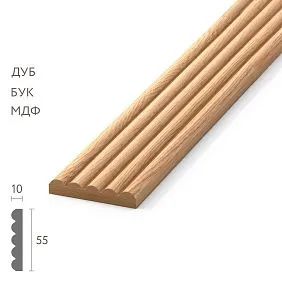
Sizes: usually thin — width 50-80 mm, thickness 8-12 mm.
Rounded (semicircular)
The front surface of the moulding has a smooth rounding (radius 10-30 mm).
Suitable for: neoclassicism, modern classicism, Scandinavian, Provence (soft lines, absence of aggressiveness).
Advantages: visual softness and smoothness; less dust accumulation (dust does not stick to rounded surfaces); pleasant to touch.
Sizes: width 60-90 mm, thickness 10-15 mm.
Decorative (profiled)
Moulding with complex relief profile — protrusions, recesses, curves, creating play of light and shadow.
Decorative profile elements: round (convex semicircular element), concave (concave element), shelf (horizontal surface), fillet (smooth transition), S-profile (S-shaped profile).
For styles: classic, neoclassic, modern (traditional styles where decorative relief is valued).
Advantages: visually richer than flat (relief creates volume, expressiveness, play of light and shadow); conforms to classical canons.
Disadvantages: 40-70% more expensive than flat (complex milling), harder to paint (paint must reach all recesses), dust accumulates (in relief recesses).
Sizes: width 70-120 mm, thickness 12-25 mm (decorative profile requires greater thickness for relief).
Telescopic
Moulding with longitudinal groove on the back, into which a filler (strip, extending door frame for thick walls) is inserted. Allows adjusting installation depth without trimming.
For doors: doors in thick walls (brick, block walls 200-400 mm thick), where standard frame does not cover wall thickness — a filler is required.
Advantages: easy installation (no need to trim moulding width — telescopic system is adjustable), possibility of removal without damage (for repair or replacement).
Disadvantages: 30-50% more expensive than standard, limited profile selection (usually simple shapes).
Carved Mouldings: Art on Wood
Carved Moulding — a moulding with hand or machine carving, creating a three-dimensional ornament, pattern, or narrative composition.
Types of Carving
Flat Relief Carving: The pattern protrudes from the background by 3–10 millimeters, creating a low relief. The background remains flat, while the pattern stands out. Characteristic of classical interiors and furniture.
Deep (Relief) Carving: The pattern protrudes from the background by 10–30 millimeters, creating a deep, expressive relief. The background is often recessed (chamfered), while the pattern is maximally three-dimensional. Characteristic of Russian carved mouldings and church carvings.
Through (Lace, Cut-Out) Carving: The pattern is cut through completely, with no background, creating a lace-like effect. Characteristic of Russian facade mouldings (especially 19th–early 20th centuries).
Contour Carving: The pattern is created by thin grooves cut into the wood to a depth of 2–5 millimeters. Similar to engraving. Characteristic of Scandinavian and Northern styles.
Ornaments and Motifs
Plant Motifs: The most common. Acanthus leaves (classic Greek and Roman architecture), grapevines with leaves and clusters (symbol of fertility and abundance), roses and other flowers, oak leaves with acorns (symbol of strength and longevity), laurel wreaths (symbol of glory and victory).
Geometric Ornaments: Meanders (continuous geometric pattern of broken lines), rosettes (circular symmetrical patterns), diamonds, stars, interlacing, braided patterns (imitation of weaving).
Symbolic Elements: Sun rosettes (symbol of life, light, fertility — central motif of Russian mouldings), birds (symbol of ancestral spirits protecting the home), snakes and dragons (protection against evil), anthropomorphic figures (faces, human forms — protection of the home).
Narrative Compositions: Rare on mouldings (require large surface area), but found on upper parts of facade mouldings — mythological scenes, biblical motifs, coats of arms.
Russian Carved Moulding: The Soul of Folk Architecture
Russian Carved Facade Moulding — a unique phenomenon of folk architecture, reaching its peak in the 19th–early 20th centuries. Wooden houses in Russian towns and villages were adorned with mouldings of such beauty and variety that each house became a work of art.
Structure of Russian Moulding:
Lower Part (Sill Board): A wide board under the window, often with simple carved ornament or none at all.
Side Parts (Vertical Stiles): Frame the window on the sides, usually with flat relief or deep carving (plant motifs, geometric ornaments).
Upper Part (Cockade, Headboard): The most decorative part, crowning the window. Often has a complex shape — semi-circular, triangular, multi-tiered. Adorned with rich through carving — sun rosettes, birds, plant patterns.
Colors: Traditionally, Russian mouldings were brightly painted — red, green, blue, yellow, white. Colors had symbolic meaning (red — life, sun; blue — sky, water; green — nature, fertility).
Modern Use: Russian carved mouldings are experiencing a revival. Owners of wooden houses and cottages order mouldings based on historical examples or with modern interpretations of traditional motifs. Mouldings transform a standard house into a unique, characterful, soulful one.
Manufacturing: Carved mouldings are made from linden (easy to carve for through and deep carving), pine (for simpler elements), oak (for durability, but harder to carve). First, the basic contours (for through carving) or base relief (for deep carving) are milled on a CNC router, then the master carver manually refines details, adds volume, and cleans lines. After carving, the moulding is sanded, treated with protective compounds against moisture and insects, painted or stained, and finished with varnish.
Price: Carved moulding is a custom-made item. A simple flat relief moulding from linden, 150 mm wide — 2000–5000 rubles/m. A complex deep or through moulding with rich ornament — 5000–15000+ rubles/m (depends on carving complexity, wood species, size).
Mouldings for Different Interior Styles
Classicism and neoclassicism
Classic Interiors require mouldings with shaped profiles (bosses, ovals, shelves), often with light carving (plant motifs, rosettes), made from noble woods (oak, ash, walnut), with natural finish (varnish highlighting wood texture) or toning in dark noble tones (walnut, stained oak).
Width: 80–120 mm (noticeable, proportionate to classic doors with panels).
Neoclassicism uses simplified profiles (rounded, with 1–2 simple elements instead of complex multi-tiered ones), often white or light paint (concealing texture, creating graphic clarity and clean lines).
Width: 70–100 mm (medium, not overwhelming modern space).
Baroque and Empire
Palace styles require wide mouldings (100–150 mm) with rich shaped profiles, often with carving (acanthus leaves, scrolls, rosettes), gilded or silvered patina. Woods — oak, walnut. This is maximum ornamentation, luxury, monumentality.
Scandinavian style
Simple mouldings with flat or slightly rounded profiles, narrow (50–70 mm), made from light woods (birch, ash, pine), with natural finish using oil or white paint. Minimal decoration, emphasis on material quality, naturalness, and clean lines.
Provence and country
Mouldings from natural wood with emphasized texture, simple profiles (flat or rounded), medium width (60–90 mm). Finish — white or pastel paint (blue, lavender, cream, olive) with aging effects (patina, wear), or natural oils highlighting texture.
Loft and industrial
Rough door casings made from solid timber without complex milling, sometimes from untrimmed boards with retained bark, knots, cracks, and unevenness. Finish — dark oil, staining (dark oak, wenge, black), sometimes brushing (selecting soft fibers, emphasizing texture), partial burning. Width may be substantial (80–120 mm) — solidity, industrial style. Or conversely — no casings (doors without casings, rough walls).
Minimalism and modernity
Simple flat casings, narrow (40–70 mm), often painted in neutral colors (white, gray, black), hiding wood texture. Emphasis on clean lines, minimalism, absence of decoration. Or hidden casings (casing recessed flush into the wall, only a thin joint line visible from outside). Or telescopic systems (casing and filler form a flat surface without visible fasteners).
Modern
Smooth curved lines, asymmetry, stylized plant motifs (lilies, irises, vines). Casings with wavy edges, modern-style carving, toning in natural or muted tones. Medium width (70–100 mm), profile is shaped but smooth, without sharp angles.
Installing door casings
Preparation
Wall flatness check: the wall around the door must be flat. If the wall is uneven (deviations over 3–5 mm), the casing won’t fit tightly — gaps will form. Solution — level the wall with spackling or use flexible sealants to fill gaps.
Cleaning: remove dust, dirt, and residual mounting foam from the frame and wall (casing is glued or nailed — surface must be clean).
Marking: mark installation lines on the frame (usually casing is installed with a 3–10 mm setback from the inner edge of the frame — this setback creates a visual frame).
Trimming architraves
Cutting angles: Trim pieces meet at 45-degree angles (like picture frame corners). Use a miter saw with an adjustable head set to 45 degrees. For decorative profiles, cutting is more complex — even a slight angle error creates a gap at the joint. Use a miter gauge or miter saw, and check wall angles with a protractor (angles in real rooms are rarely exactly 90 degrees).
Fitting: After initial cutting, place the trim in the opening and check the joints. If gaps exist, sand them down or re-cut with angle adjustment.
Using finish nails: Traditional, reliable method. Use finish nails (with small heads) 40–50 mm long, 1.5–2 mm in diameter. Nails are driven at 40–50 cm intervals, heads are pressed 1–2 mm into the trim with a nail set, and holes are covered with wood-tone wax pencil or acrylic putty. Advantages — secure, easy to remove (pull out nails). Disadvantages — fasteners are visible (though masked).
Methods of mounting
Using adhesive: Modern method for lightweight trim. Use "liquid nails" or MS-polymer based construction adhesive. Apply adhesive to the back of the trim using a zigzag motion, press the trim against the wall and frame, and hold for 30–60 seconds (setting time). Excess adhesive squeezed out along edges is wiped away immediately with a damp cloth. Advantages — hidden fastening (no visible fasteners from outside), fast. Disadvantages — requires a flat wall, difficult to remove (trim may tear off or break).
Combined (adhesive + nails): Most reliable method. Adhesive ensures tight fit along the entire length, while nails provide strong, long-lasting attachment that prevents the trim from peeling off over time.
Using special fasteners: For telescopic trim, use hidden latches or slots into which the trim is inserted and held without nails or adhesive. Convenient for removal, but more expensive.
Overview of wooden trim: Carved classic models, sleek modern variants, profile selection features, wood species, and finishes. Application of trim for harmonious door and window openings in various interior styles.
Jointing corners
Top ends of vertical casings and ends of horizontal casing are cut at 45 degrees, joined to form a right angle (90 degrees).
Joint check: after installing vertical casings, place the horizontal casing and check joints. There should be no gaps. If gaps exist — trim with a saw or sand them down.
Joint fixation: after installing all three casings, you can additionally fix corner joints — drive a thin nail through the top end of the vertical casing into the end of the horizontal casing (at an angle so the nail enters both casings). This prevents joints from opening over time.
Filling gaps
If small gaps exist between casing and wall (due to wall unevenness), fill them with acrylic sealant (white or matching casing color). Apply sealant into the gap, smooth with a wet finger or putty knife, remove excess. After drying, sealant can be painted to match the casing.
Installing facade casings
Facade casings are installed outside the building, framing windows. They are larger and heavier than interior casings, exposed to atmospheric conditions (rain, snow, sun, wind, temperature fluctuations), requiring stronger fastening and protection.
Preparation
Protective treatment: before installation, facade casing must be treated with antiseptic (protection against rot, mold, fungi, insects) and hydrophobic agent (protection against moisture). Treatment is applied in 2–3 coats with intermediate drying. Especially carefully treated ends (through ends, wood absorbs moisture most intensely).
Painting or toning: after antiseptic treatment, casing is painted or toned, then covered with protective varnish (marine varnish, exterior alkyd varnish) or exterior paint (acrylic facade paint). Coating must be weather-resistant, UV-resistant (won’t fade in sun), elastic (won’t crack under temperature changes).
Fastening
Using self-tapping screws: primary method for facade casings. Use galvanized or stainless steel self-tapping screws, 70–100 mm long, 4–5 mm diameter (depending on casing thickness and wall material). Screws are driven with 30–40 cm spacing (more frequent than for interior casings — facade casings experience wind loads). In wooden walls, screws are driven directly; in brick or block walls — through wall anchors. Screw heads are countersunk and masked with exterior-grade wood putty, then painted.
Sealing: joint between casing and wall must be sealed (protection against water ingress). Use exterior-grade silicone or MS-polymer sealant (weather-resistant, elastic, UV-resistant). Apply sealant around the entire perimeter of the casing in the gap between casing and wall, smooth, remove excess. Sealant must be paintable (if painting is planned) or matched to casing color.
Maintenance
Facade casings require regular maintenance:
-
Annual inspection: in spring, inspect the casing for cracks, peeling paint, rot. Address any defects immediately.
-
Coating renewal: every 3-5 years (depending on climate and facade orientation), the coating fades and thins, requiring renewal. Lightly sand, then apply a fresh coat of varnish or paint.
-
Repair: Fill cracks with wood epoxy putty, sand, and paint. Cut out rotten sections, insert matching wood patches, glue, sand, and paint.
Where to buy wooden casing
Specialized door stores
Stores selling interior doors usually offer a wide selection of casings (sold either as part of the door set or separately). You can select casings to match the door exactly (same wood species, same finish).
Manufacturers of trim items
Wooden skirting board purchaseDirectly from manufacturers of trim (baseboards, casings, cornices, moldings) — lower price (no middlemen), wide selection of profiles, wood species, finishes, ability to order non-standard sizes and custom tinting.
Construction hypermarkets
Leroy Merlin, Obi, MaxiDom, and others have casing sections. Selection is average (usually standard profiles, popular wood species), prices are average, you can see and buy in person.
Online stores
Convenience of ordering, wide selection, delivery. Minus — can't see in person (photos may distort color and texture). Study descriptions, dimensions, read reviews with photos, order samples for try-on.
Wood carving workshops
For carved casings (especially Russian facade or unique elements) — contact wood carving workshops. Custom design, handcrafted, unique. Production time 3-8 weeks, high price (carved casing 2000-15000 rubles/meter).
Care for wooden casings
Interior casings
Regular cleaning: once a month, wipe with a dry soft cloth to remove dust. For decorative profiles — use a soft brush in recesses.
Wet cleaning: every 3-6 months, wipe with a slightly damp (well wrung out) cloth and mild detergent. Avoid excess water.
Protection from damage: be careful when moving furniture or large items through doors (impacts may leave dents or chips on casings).
Coating renewal: every 10-15 years (varnish) or 5-8 years (oil), the coating wears out. Lightly sand with fine grit, then apply a fresh coat.
Repair: Minor scratches — use wax pencil or touch-up marker; deep scratches — fill with putty, sand, and repaint.
Facade casings
As described above in the "Facade Casing Installation" section — annual inspection, coating renewal every 3-5 years, repair defects.
Conclusion: the frame creates the picture
A casing is more than just a strip covering a gap. It is framing that creates completeness, structure, character. A door without a casing is an unfinished opening. A door with a properly selected casing becomes an architectural element, part of a harmonious interior composition.
From simple flat casings to carved works of art, from budget pine to premium oak, from Scandinavian minimalism to Russian carved classicism — your choice is determined by interior style, door type, your taste, and budget.
Company STAVROS — a leading manufacturer of wooden casings with over 25 years of experience — offers professional solutions for any interior and facade: solid wood door casings in oak, ash, beech, pine, over 50 models of all main profiles (flat, rectangular, rounded, semi-circular, decorative, classical, with beads, carved, shelf, telescopic, with grooves), widths from 50 to 120 millimeters, thicknesses from 8 to 25 millimeters, lengths 2.2 meters (standard) or custom up to 3 meters, veneered MDF casings with oak, ash, walnut, wenge veneer, over 40 models of all popular profiles at 50% lower price than solid wood, visually indistinguishable from solid wood, painted MDF casings in white and colored options, over 30 models with factory paint in a chamber for perfectly even coating in any RAL color, carved casings from linden and oak for interiors and facades, simple flat-relief carving and complex solid-through carving, floral, geometric, symbolic ornaments, Russian style, classic, modern, price 2000-15000 rubles per linear meter depending on carving complexity, facade casings for wooden houses, carved and smooth, Russian style, traditional motifs, sun rosettes, floral patterns, through carving with full protective treatment — antiseptic, tinting, painting, lacquering, ready for installation, custom manufacturing of casings of any size and profile according to customer’s sketches, drawings, photos, unique carved elements — coats of arms, monograms, narrative compositions, non-standard widths and lengths, production time 2-6 weeks.
Visit stavros.ru, browse the catalog with detailed photos, drawings, profile specifications, order samples for color and texture try-on, arrange delivery across Russia or visit our showroom in Moscow, where professional consultants will help you select casings perfectly matching your doors, interior style, provide installation and care recommendations — and complete your door openings with elements that will create harmony, beauty, and perfection in your home for decades to come.