Article Contents:
- What are furniture overlays: definition and functions
- Definition: overlay decor as a transformative element
- Functions: aesthetics, camouflage, individualization
- Types of Overlays: Classification by Form and Function
- By location: central, corner, linear
- By ornament motif: floral, geometric, figurative
- By size: rosettes, medallions, panels
- Decorative moldings: types and applications
- Baseboards: finishing walls and protecting joints
- Ceiling cornices: framing and visual height
- Moldings: frames and wall articulation
- Furniture transformation: practical schemes
- Wardrobe: from standard to individual
- Chest of drawers: adding prestige
- Kitchen set: from bland to stylish
- Unified style from floor to ceiling: a systematic approach
- Unity of ornament: repeating motifs
- Unity of material: wood as the foundation
- Unity of proportions: scaling details
- Overlay and molding materials: wood vs composites
- Solid wood: nobility and warmth
- MDF and polyurethane: practicality and economy
- Installation of overlays and moldings: transformation technology
- Surface preparation: foundation for success
- Marking: positioning accuracy
- Gluing: adhesive selection and technique
- Finishing: perfection of details
- Frequently Asked Questions
- Can overlays be installed on laminated furniture?
- What style of overlays to choose for a modern interior?
- How much do solid wood overlays cost?
- How to care for overlays?
- Can Overlays Be Removed Without Damaging the Facade?
- Conclusion: The Art of Transformation by STAVROS

Look at an ordinary IKEA cabinet — smooth MDF fronts, standard proportions, typical design, of which there are millions in apartments worldwide. Now add carvedsolid wood furniture overlayswith classic ornamentation, install cornices with carved profiles, replace baseboards withdecorative trimoak ones — and basic cabinet furniture transforms, gaining character, style, individuality, turning from a mass-produced item into a designer object. This is the magic of decorative elements — small details that change the perception of the whole, create visual value, and connect disparate items into a single composition from floor to ceiling.Furniture decorallows transforming the space without replacing all the furnishings, saving budget, preserving functionality, and adding aesthetics.
Why are decorative overlays and millwork especially relevant today? Because quality furniture is expensive — an Italian solid wood chest of drawers costs 300,000-500,000 rubles, a wardrobe 500,000-800,000. But the same basic cabinet furniture costs 50,000-80,000, and addingof solid wood— overlays, moldings, cornices — costs 15,000-30,000 rubles, turning a standard item into an individual, stylistically expressive one. The result is visually comparable to expensive furniture but achieved at one-third the price. Plus, the ability to adapt existing furniture that is functionally good but aesthetically outdated or doesn't fit the new interior concept.



What are furniture overlays: definition and functions
Before discussing transformation, it's important to understand what overlays are, what functions they perform, and what types exist.




Definition: overlay decor as a transforming element
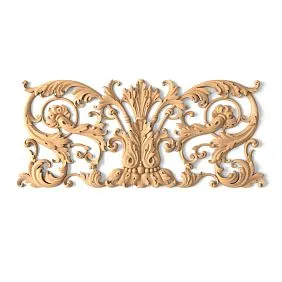
A furniture overlay is a three-dimensional decorative element made from solid wood or composite materials, mounted on the surface of furniture fronts, cases, or panels to create relief, ornamentation, and visual interest. Unlike integrated decor — carving done directly on the front — an overlay is produced separately and glued or screwed onto the base. This provides flexibility — you can add decor to finished furniture, change it, or replace it without damaging the base.
Overlay sizes vary from miniature rosettes 30-50 millimeters in diameter to large panels 500×800 millimeters and larger. Shapes — round, oval, rectangular, arbitrary, following the contours of the ornament. Relief — from flat bas-relief 3-5 millimeters high to high relief 15-25 millimeters, creating a dramatic play of light and shadow.
Material is often solid oak, beech, ash — hardwoods that hold carving details and are resistant to mechanical damage. Sometimes linden, aspen — softwoods that are easy to cut, suitable for complex ornaments requiring hand finishing. Composite overlays made of MDF, polyurethane are also used — cheaper, lighter, more moisture-resistant, but lack the nobility of natural wood texture.
Our factory also produces:


Functions: aesthetics, masking, individualization
Aesthetic transformation — the main function.solid wood furniture overlaysturn smooth, faceless fronts into relief, detailed surfaces. A simple cabinet with added carved overlays gains stylistic affiliation — classicism, empire, baroque, provence — depending on the ornament. Visual value increases — craftsmanship, detailing, and material are perceived as markers of quality.
Masking defects — a practical function. Scratches, chips, faded areas on old furniture fronts are hidden under overlays. Instead of restoring the entire surface — sanding, repainting — it's enough to glue an overlay covering the damage. Saves time, effort, and money while achieving an aesthetic result.
Individualization of standard furniture — a creative function. Mass-market serial furniture is identical for thousands of buyers. Adding unique overlays, chosen or custom-ordered, makes the item one-of-a-kind. You can compose a composition from several overlays, creating an original design that reflects the owner's taste.
Stylistic coordination of interior elements — a systemic function.Furniture decorrepeats the motifs of wall moldings, ceiling cornices, baseboards, creating a visual connection between the horizontals and verticals of the space. A unified ornament, repeated on furniture, doors, walls, and ceilings, turns a set of items into a cohesive composition.
Get Consultation
Types of appliqués: classification by shape and function
The variety of overlays is vast — manufacturers' catalogs list hundreds of models. Systematization helps navigate and choose suitable elements.
By location: central, corner, linear
Central overlays are located in the center of the front — wardrobe door, drawer front, door panel. Shape is often symmetrical — round rosette, oval cartouche, diamond-shaped palmette. Size varies depending on the scale of the front — from 80×80 millimeters for a small drawer to 300×400 millimeters for a double-door wardrobe.
A central overlay serves as a focal point, attracting the eye. Complex ornamentation — acanthus, floral composition, heraldic motif — concentrates attention, creating a sense of craftsmanship and detail. Placement is strictly symmetrical — the center of the overlay coincides with the geometric center of the front.
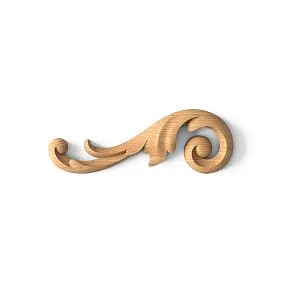
Corner overlays are installed at the corners of fronts, panels, frames. Shape is asymmetrical, adapted to corner placement — quarter rosette, corner acanthus scroll, stylized leaf. Size is usually smaller than central ones — 40×40 to 100×100 millimeters. Corner elements are sold in sets — four identical or mirror-symmetrical overlays for four corners.
Corner overlays frame the front, creating a framed composition. A combination of a central and four corner overlays is a classic scheme for decorating a paneled door or furniture front. Visually enhances the structuredness and orderliness of the surface.
Linear overlays — elongated elements placed along edges, joints, transitions. Shape — a strip with repeating ornamentation: meander, beads, egg-and-dart, plant border. Length varies — sold in segments of 1000-2400 millimeters, cut to the required size. Width 20-80 millimeters.
Linear overlays frame the edges of fronts, doors, divide zones, create frames. A combination of straight and corner linear elements forms a closed contour, inside which a central overlay or smooth surface can be placed. Function is similar to moldings, but overlays are thinner, more delicate.
By motif of ornament: floral, geometric, figurative
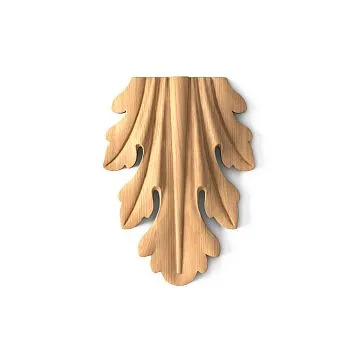
Plant-based ornaments are the most common category. Acanthus—a stylized leaf of a Mediterranean plant—forms the foundation of classical styles from antiquity to the Empire period. Acanthus leaves curve, intertwine, and form wreaths, cartouches, and corner scrolls. The carving is detailed, with visible veins, serrated edges, and three-dimensional curves.
Floral motifs — roses, lilies, daisies, lavender — are characteristic of Provence, country, and shabby chic styles. The carving is less deep than in acanthus, but delicate and recognizable. Flowers are gathered into bouquets, garlands, and wreaths. The size of overlays is usually medium — from 100×150 to 200×250 millimeters.
Grape clusters, fruit branches — motifs of abundance and harvest. Suitable for dining rooms, kitchens, wine rooms. Clusters with leaves and tendrils create a dynamic composition. Often combined with figures of birds and butterflies.
Geometric ornaments — meander, braid, rhombuses, rosettes, palmettes — date back to antiquity and the Middle Ages. Strict rhythm, symmetry, mathematical order. Geometry fits well into modern interiors, where classical detailing is combined with minimalist forms.
Figurative motifs — depictions of creatures, objects, symbols. Eagles, lions, griffins, sphinxes — heraldry, Empire. Cherubs (putti), masks, theatrical characters — Baroque, Rococo. Musical instruments — lyres, flutes, violins — interiors of music salons, living rooms. Figurative overlays are more complex to produce, more expensive, but create unique expressiveness.
By size: rosettes, medallions, panels
Rosettes — small round or polygonal overlays with a diameter of 30-120 millimeters. The ornament is radial — petals radiating from the center. Rosettes are universal — they decorate the centers of doors, corners, intersections of moldings. The simplest furniture transformation — adding a rosette to the center of a smooth facade.
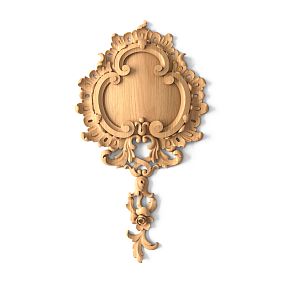
Medallions — medium-sized overlays of oval, round, rectangular shape, sized from 100×150 to 250×350 millimeters. The ornament is more complex than rosettes — multi-figure compositions, scenes, coats of arms. Medallions serve as the main decorative element of the facade, requiring sufficient area for the details to be perceived.
Panels — large overlays from 300×400 millimeters to 600×1000 and more. They represent complete compositions — a bouquet in a vase, a landscape, a heraldic composition, a complex ornament filling a rectangle. Panels are used on large surfaces — sliding wardrobe facades, bed headboards, buffet pediments, decorative screens.
Decorative millwork: types and application
decorative trim— linear products made of solid wood, sold by the meter, cut to the required length. Includes baseboards, cornices, moldings, architraves, planks. Installed on walls, ceilings, floors, doors, creating architectural division, framing, transitions.
Baseboards: finishing walls and protecting joints
Baseboard — a horizontal profiled element covering the joint between the wall and floor. Height 60-200 millimeters depending on ceiling height and interior style. Low ceilings 2400-2600 millimeters — baseboard 60-80 millimeters. Standard 2700-3000 — 80-120 millimeters. High 3200-3600 and above — 120-200 millimeters.
The baseboard profile defines the style. Simple rectangular — minimalism, Scandinavian style. Profiled with beads, coves — neoclassical. Carved with ornament — classic, Baroque.Solid Wood Itemsof oak, ash create a warm visual connection with parquet and wooden furniture.
The baseboard performs a protective function — it covers the thermal gap between the floor covering and the wall, protects the wall from damage during cleaning and moisture. A cable channel in the baseboard design allows hiding wires — internet, electrical, TV cables — preserving aesthetics.
The color of the baseboard is coordinated with the floor or walls. Matching the floor — the baseboard visually continues the floor covering, expands it, makes it inconspicuous. Matching the walls — the baseboard is perceived as part of the wall, visually increases the height of the room. Contrasting white baseboard on a dark floor or colored walls — an accent solution emphasizing the transition.
Ceiling cornices: framing and visual height
Ceiling cornice — a horizontal profile at the junction of the wall and ceiling. Width 40-200 millimeters, projection 30-150 millimeters. The cornice creates a clear boundary between the vertical of the wall and the horizontal of the ceiling, completing the wall composition.
The cornice profile affects the perception of height. A simple cornice with minimal projection is visually neutral. A cornice with a large projection, creating a visor, visually lowers the ceiling — suitable for excessively high rooms where coziness is needed. A cornice with lighting — an LED strip in a niche behind the cornice — creates a floating ceiling effect, increases visual height.
Carved cornice with ornament — a sign ofclassic furnitureand classical interiors. Ornament — egg-and-dart, bead-and-reel, meander, acanthus leaves, dentils — repeats motifs of ancient architecture. A cornice made of solid oak, painted or patinated, coordinates withfurniture decor, creating unity from floor to ceiling.
Gypsum or polyurethane cornices are lighter than wooden ones, cheaper, more diverse in forms. But wood creates warmth, tactile pleasantness, a connection with natural materials. In interiors with wooden furniture and parquet, a wooden cornice is logical, supporting the material concept.
Moldings: frames and wall division
Molding — a narrow profiled element installed on walls, doors, furniture to create frames, framing, and division of planes. Width 20-80 millimeters, sales length 2000-2400 millimeters. Profile from a simple semicircular bead to a complex one with several coves and shelves.
Wall moldings form frames on free walls. Rectangular frames sized 600×800, 800×1000, 1000×1400 millimeters are arranged symmetrically, creating an ordered composition. Inside the frames — a painted surface of a contrasting tone, wallpaper with a pattern, fabric upholstery. Frames visually structure the wall, adding architectural quality.
Moldings on doors turn smooth panels into paneled ones. A frame made of moldings, glued onto a smooth door, imitates a classic paneled construction. Inside the frame — a painted panel of a contrasting color. Adding a rosette to the center of the panel enhances the classical styling.
Moldings on furniture frame the facades, create frames aroundSolid wood furniture overlays. Combination: the molding forms a rectangular frame on the facade, with a central carved overlay inside. The molding visually separates the overlay from the background, enhancing the perception of relief.
Furniture transformation: practical schemes
The theory is clear, let's move on to practice — how exactly overlays and trim change furniture.
Wardrobe: from standard to individual
Basic two-door wardrobe — body made of laminated chipboard or MDF, smooth facades, standard dimensions 1000×2000 millimeters, price 30,000-50,000 rubles. Functionally good, aesthetically neutral, visually cheap.
Transformation begins with style selection. Classic requires symmetry, floral ornaments, warm tones. Provence — light colors, floral motifs, patina. Empire — geometry, strict lines, gilding.
For classic: facades are repainted in warm beige, gray-blue, olive. A central overlay — an oval medallion with acanthus leaves measuring 150×200 millimeters — is glued to each door. On the corners of the doors — four corner overlays with scrolls 50×50 millimeters. Handles are replaced with patinated brass ones. The top of the wardrobe is crowned with a cornice — a horizontal oak profile 80 millimeters wide with carved ornament.
Transformation cost: two central overlays — 6,000 rubles, eight corner overlays — 4,000, 2-meter cornice — 3,000, handles — 2,000, painting — 5,000. Total 20,000 rubles. Total cost with basic wardrobe — 50,000-70,000 rubles. The result is visually comparable to a solid wood wardrobe costing 200,000-300,000 rubles.
For Provence: facades are painted white with light patina — wear on edges, corners, creating the illusion of a hundred-year history. Central overlays — floral bouquets, roses with leaves 120×150 millimeters. Handles — ceramic with floral painting. The room's baseboard and wardrobe cornice are painted the same white, creating visual unity.
Chest of drawers: adding status
Basic chest of drawers — four rows of drawers, dimensions 800×900×400 millimeters, MDF, smooth facades, price 25,000-35,000 rubles. Functional, but visually simple.
Transformation: drawer fronts are painted dark brown, imitating mahogany. On each drawer front — a horizontal linear overlay with a meander ornament, length 600 millimeters, width 40 millimeters. Linearsolid wood furniture overlaysare positioned symmetrically in the center of the facades. Handles — patinated brass brackets.
The countertop is replaced with a marble slab — white marble with gray veins, thickness 30 millimeters. Marble adds luxury, visual weight, and is associated with expensive furniture. The chest of drawers' legs — simple rectangular — are framed with applied pilasters — vertical elements made ofdecorative trim, imitating columns.
Transformation cost: four linear overlays — 4,000 rubles, handles — 3,000, marble countertop — 8,000, pilasters — 4,000, painting — 4,000. Total 23,000 rubles. Total cost — 48,000-58,000 rubles instead of 150,000-200,000 for a similar solid wood chest of drawers.
Kitchen set: from faceless to stylish
Standard kitchen set — MDF facades, film coating, standard dimensions, price 150,000-250,000 rubles for 3 meters. Functionally good — pull-out drawers with soft-close mechanisms, quality hardware — but visually standard.
Transformation: the film coating is removed, facades are sanded, painted with enamel — white, cream, gray. On upper doors — central rosette overlays, diameter 100 millimeters, with floral ornament. On lower drawer fronts — linear overlays. Handles are replaced with classic ones — ceramic knobs or brass brackets.
The countertop remains artificial stone — practical for the kitchen — but the edge is finished with decorative beading — a narrow molding made ofof solid wood, painted to match the facades. The backsplash above the work area is framed with molding, creating a frame.
Kitchen baseboard — high, 120 millimeters, made of oak, coordinates with the living room parquet, visually unites the kitchen and living area in a studio apartment. The ceiling cornice repeats the baseboard profile, completing the composition.
Transformation cost for a 3-meter set: 15 rosettes for upper doors — 9,000 rubles, 10 linear overlays for drawers — 5,000, 25 handles — 7,500, painting — 20,000, countertop beading — 3,000, backsplash moldings — 2,000. Total 46,500 rubles. Result — a unique set, visually superior to mass-produced products.
Unified style from floor to ceiling: a systematic approach
Individual furniture pieces with overlays are good, but the maximum effect is achieved with a systematic approach, whereFurniture decorand architectural trim are coordinated, repeat motifs, and create a visual connection.
Unity of ornament: repeating motifs
Choose a basic ornament — meander, acanthus, floral border. Use it at different levels: baseboard with meander ornament, wall moldings with meander, linear overlays on the chest of drawers with meander, wardrobe cornice with meander. Repetition creates rhythm, recognizability, and visual unity.
Central furniture overlays can be more complex — acanthus medallions, floral compositions — but the linear elements framing them repeat the trim ornamentation. This creates a hierarchy: the base pattern ties the space together, while accent elements create focal points.
Symmetry is a key principle. If there are two molding frames on the wall, the dresser should have two rows of drawers with symmetrical overlays. If cabinet doors are decorated with overlays, the room doors repeat the scheme. Symmetry calms, creates order, and emphasizes the classical style.
Unity of material: wood as the foundation
Solid Wood Itemsof a single species — oak, ash — create material unity. Baseboards, cornices, moldings, and overlays made of oak in the same tone form a family of elements. The texture of the wood, its warmth, tactility — are common denominators.
Coloring is coordinated. If overlays are painted white with patina, moldings and cornices are painted identically. If overlays are natural stained oak, the trim is also stained the same shade. Color unity strengthens the connection.
Contrast of wood and walls. Light walls — beige, gray, white — serve as a background for wooden elements in a natural tone or painted in a contrasting color. Dark elements on a light background are clearly legible, creating graphic quality. Light elements on a dark background — an inversion, suitable for dramatic interiors.
Unity of proportions: scaling details
The height of the baseboard, the width of the cornice, and the size of the overlays should be proportional to the room and furniture. In a room with a height of 2600 millimeters, a baseboard of 60-80 millimeters, a cornice of 60-80 millimeters, and furniture overlays of 100-150 millimeters are commensurate and harmonious.
In a room with a height of 3500 millimeters, the same elements will look small. A baseboard of 120-150 millimeters, a cornice of 120-150 millimeters, and overlays of 200-300 millimeters are needed. Enlargement is proportional to the scale.
The thickness of the moldings is coordinated with the massiveness of the furniture.Classic Furniturewith thick countertops, wide cornices requires corresponding moldings on the walls — 50-80 millimeters wide. Light modern furniture — delicate moldings 20-40 millimeters.
Materials for overlays and trim: wood vs. composites
The choice of material affects visual perception, durability, cost, and processing capabilities.
Solid wood: nobility and warmth
solid wood furniture overlaysof oak, beech, ash — the benchmark of quality. Oak is hard, its texture is expressive with large pores, color ranges from light beige to brown. Carving in oak holds details, does not chip. Serves for decades, darkens with age, acquires patina.
Beech — light wood with a pinkish tint, texture fine, uniform. Beech cuts, polishes, and paints well. Beech overlays are 20-30% cheaper than oak, suitable for painted projects where the texture is hidden.
Ash — contrasting texture, light tone, strength. Ash overlays are modern, fresh, fit well into neoclassical, Scandinavian style with classical accents.
Linden, aspen — soft species, easy to cut, suitable for complex ornaments requiring hand finishing. Carvers prefer linden for authorial works. But softness is a drawback for furniture — overlays are easier to damage. Linden is good for ceiling elements, wall overlays, where there is no mechanical contact.
Solid wood coating — oil, varnish, wax, paint. Oil emphasizes the texture, creates a matte surface, pleasant to the touch. Varnish forms a durable film, protects maximally, but is visually less noble. Paint hides the texture, allows any color, patina effects. Wax creates a silky surface but requires periodic renewal.
MDF and polyurethane: practicality and economy
MDF overlays are milled on CNC machines, painted with enamel, polished. There is no wood texture, but the paint is even, any color. MDF is more stable than solid wood — does not deform with humidity changes, does not crack. Cost is 40-50% lower than solid wood.
MDF is suitable for painted projects where surface smoothness and dimensional accuracy are important. For overlays imitating plaster stucco — white, painted in pastel tones. For modern geometric elements.
Polyurethane overlays — lightweight, moisture-resistant, inexpensive. Molded in silicone forms, copying complex ornaments with high detail. Can be painted, gilded, patinated. Polyurethane does not swell from moisture — suitable for bathrooms, kitchens.
The drawback of composites — lack of warmth, tactility of wood. Polyurethane is cold to the touch, sounds dull when tapped. MDF — a composite, devoid of living texture. For those who value naturalness, solid wood is irreplaceable.
Installation of overlays and trim: transformation technology
The beauty of overlays is realized through proper installation. Installation errors negate the visual effect.
Surface preparation: the foundation of success
The surface of the facade or wall must be clean, level, degreased. Dust, dirt, grease interfere with adhesive adhesion. The surface is wiped with a solvent — alcohol, white spirit — to degrease.
Irregularities — dents, protrusions — are leveled with putty. An overlay glued onto an irregularity adheres partially, creates gaps, and may detach over time. A level surface is a mandatory condition.
Painting of the facade or wall is done before installing overlays. The overlay is installed on the finished painted surface. If the overlay is painted — it is installed ready. If natural — it is installed, then together with the facade, coated with varnish, oil, creating unity.
Marking: positioning accuracy
Center overlays are positioned exactly at the center of the facade. The width and height of the facade are measured, divided in half, and the center is marked. The overlay is placed, its center aligned with the facade's center, and its outline is traced with a pencil.
Corner overlays are positioned at an equal distance from the edges of the facade. The standard offset is 30-50 millimeters from the edge. The four corner overlays must be symmetrical—checked by diagonal measurement.
Linear overlays and moldings are set using a level. Horizontal elements must be strictly horizontal, vertical elements—vertical. A laser level or spirit level ensures accuracy.
Gluing: adhesive selection and technique
Adhesive forSolid wood furniture overlays— woodworking PVA, polyurethane, epoxy. PVA is a traditional woodworking glue, strong for wood-to-wood joints, inexpensive. Disadvantage—water-sensitive, not suitable for damp rooms.
Polyurethane adhesive—moisture-resistant, strong, bonds wood with MDF, laminated chipboard, painted surfaces. Suitable for kitchens, bathrooms. Setting time 30-60 minutes, allows for position adjustment.
Epoxy adhesive—maximum strength, bonds dissimilar materials, chemically resistant. Used for heavy overlays, panels where load is significant. Working time is limited—epoxy sets in 5-15 minutes, requires speed.
Technique: adhesive is applied to the back of the overlay in an even layer. The overlay is placed on the marked spot and pressed. Excess adhesive is immediately wiped off with a damp cloth. The overlay is fixed with a clamp, weight, or painter's tape for 24 hours until the adhesive fully cures.
Additional fixation with headless nails, finish pins—for heavy overlays, panels. Pins 20-30 millimeters long are driven with a pneumatic nailer, countersunk flush, holes are filled with putty and painted.
Finishing: perfecting the details
After installationFurniture decormay require finishing. Gaps between the overlay and the facade, if they appear due to unevenness, are filled with acrylic sealant matching the wood tone or paint. The sealant is applied, smoothed with a wet finger, creating a smooth transition.
Painting, patination are performed after installation if the overlay was installed in its natural state. The facade with the overlay is painted with a base color, then patinated—dark paint is applied with a brush, wiped off on the raised areas, remains in the recesses of the carving, emphasizing the relief.
Gilding of overlays—a luxurious option. Gold leaf is applied to an adhesive base, smoothed, polished. Gildedsolid wood furniture overlayson a dark background of mahogany, wenge—classic Empire, Baroque style.
Final coating with varnish, oil protects the overlays, evens out the sheen between the facade and decor, creates unity. Matte varnish—modern, restrained. Semi-matte—versatile. Glossy—solemn, classic.
Frequently asked questions
Can overlays be installed on laminated furniture?
Yes, but preparation is required. The laminated surface is smooth, adhesive does not adhere well. It is necessary to sand the installation area of the overlay with sandpaper P120-P180, creating roughness. Degrease. Use polyurethane or epoxy adhesive, which provide adhesion to laminate. Additional fixation with finish nails increases reliability.
What style of overlays to choose for a modern interior?
Modern interiors are paired with geometric overlays—meanders, diamonds, linear patterns. Simple rosettes without excessive detailing. Painting in the same tone as walls or furniture, or in contrasting black or white. Avoid lavish Baroque ornaments and gilding—they clash with minimalism. Neoclassicism allows for delicate plant motifs.
How much do solid wood overlays cost?
Rosettes with a diameter of 60-80 millimeters—300-800 rubles. Medallions 150×200 millimeters—1500-3000 rubles. Panels 400×600 millimeters—5000-12000 rubles. Linear overlays—800-2000 rubles per meter. Price depends on wood species, complexity of carving, size. Oak is 20-30% more expensive than beech, hand carving is 2-3 times more expensive than machined.
How to care for overlays?
Painted overlays are wiped with a damp soft cloth, avoiding excess water. Natural oil-finished ones require oil renewal once a year—a thin layer is applied, rubbed in, excess is removed. Varnished ones are wiped with a dry cloth, polished with furniture wax every few years. Avoid abrasives, aggressive cleaning agents.
Can overlays be removed without damaging the facade?
Depends on the adhesive and base. PVA adhesive softens with steam, a heat gun—the overlay is heated, carefully pried with a spatula, and separated. Polyurethane adhesive is stronger, removal is more difficult, damage is possible. Epoxy is practically impossible to remove without destruction. On a painted base, removal is possible with subsequent retouching. On laminate, veneer, the risk of damaging the coating is high.
Conclusion: the art of transformation by STAVROS
Transforming simple furniture into designer pieces—not magic, but the conscious application ofSolid wood furniture overlaysanddecorative trim, creating visual value, stylistic definition, individuality. Basic cabinet furniture gains character, plain facades become textured, standard interiors—unique. A systematic approach, whereFurniture decoris coordinated with baseboards, cornices, moldings, creates unity from floor to ceiling, turning a set of elements into a cohesive composition.
STAVROS is a leading Russian manufacturer ofof solid woodfor furniture and interior—offers over 400 models of carved overlays in various styles, sizes, and complexity levels. From miniature rosettes with a diameter of 30 millimeters to monumental panels 800×1200 millimeters. From simple geometric patterns for modern interiors to complex Baroque compositions with acanthus, putti, garlands forclassic furniture.
All overlays are crafted from selected solid oak, beech, and ash wood — kiln-dried timber with 8-10% moisture content, which does not warp after installation or crack. The carving is combined — the base shape is milled on CNC machines with an accuracy of up to 0.1 millimeters, then carvers manually refine the details, creating the lively expressiveness that distinguishes a crafted product from a stamped one.
The STAVROS catalog is structured by styles: classicism, empire, baroque, rococo, modern, provence, contemporary. Within each style — central, corner, linear elements, rosettes, medallions, panels. Filters by size, shape, and ornament type simplify the search for the right element.
Custom manufacturing is STAVROS's specialization. If catalog overlays do not fit in size, ornament, or style — production according to the customer's sketch is possible. Designers develop a 3D model, coordinate it, carvers create a sample, approve it, and launch production. The timeframe is 3-6 weeks depending on complexity.
STAVROS millwork products — baseboards, cornices, moldings, trims, battens — are made from solid oak, ash, and beech. Over 50 profiles from simple rectangular to complex multi-level with carved ornament. Supply length is 2000-2400 millimeters, cut to the required size at the factory or by the customer.
Consultations on decor selection are a free STAVROS service. Designers analyze photos of furniture and interiors, propose overlay and millwork options that align with the style. They calculate quantity, cost, and timelines. Help compose compositions from multiple elements.
Delivery across Russia and CIS. Overlays are packaged in protective film and corrugated cardboard to prevent damage during transportation. Millwork longer than 2 meters is delivered by freight transport. Delivery times to Moscow, St. Petersburg: 1-3 days, regions: 5-14 days.
Installation by STAVROS — an option for Moscow and St. Petersburg. Craftsmen arrive with overlays, millwork, adhesive, and tools. Perform marking, installation, and finishing. Guarantee installation quality, absence of gaps, symmetry, and durability.
Educational materials — videos, articles on the STAVROS website — assist with DIY installation. Step-by-step instructions with photos, recommendations on adhesive, tool, and technology selection. After viewing, even a non-professional can install overlays with quality.
STAVROS showrooms in Moscow and St. Petersburg display samples of overlays in all styles, millwork in all profiles. Visit, touch the carving, appreciate the detailing, compare oak and beech, natural finish and painted. Get a consultation, take samples, begin your interior transformation project.
Choosing STAVROS means choosing the quality of solid wood, the craftsmanship of carvers with years of experience, a variety of models, an individual approach, and manufacturer responsibility. Transform simple furniture into designer pieces, standard interiors into unique ones, create spaces wheresolid wood furniture overlaysanddecorative trimdetails unite into a symphony, resonating from floor to ceiling, where each element complements another, where the whole surpasses the sum of its parts, where handmade beautyof solid woodfills the home with the warmth of natural wood, the expressiveness of carved ornament, the nobility of forms tested by centuries.
Transformation begins with the small — one overlay on the central door of a cabinet. Then corner elements are added, linearFurniture decoron dresser drawers, an oak baseboard instead of plastic, a cornice with a carved profile instead of smooth polystyrene. Gradually, disparate items gain stylistic kinship, the space fills with details that delight the eye, create coziness, and speak of the owner's taste.
Investment insolid wood furniture overlaysanddecorative trim— is a long-term investment. Solid oak serves for decades, acquiring a patina with age, becoming more beautiful. Styles change slowly —Classic Furniturewith classic decor remains relevant for centuries. In five, ten, twenty years, your overlays will remain expressive, when trendy minimalist fashions give way to new trends.
Begin the transformation today. Visit the STAVROS website, explore the catalog, choose the first elements. Order samples, apply them to furniture, evaluate the effect. Consult with designers, create a plan for interior transformation. Take the first step — and in a month your home will change, gain character, individuality, beauty that will delight daily, greeting you in the morning and seeing you off in the evening in a space created by your hands with the help ofof solid woodfrom STAVROS.