Article Contents:
- What Are Soft Slat Panels and How Do They Differ from Rigid Ones
- Fabric Base: Why It's Used Instead of Other Solutions
- Semi-Circular Profile: Why Soft Light and Shadow Is Also 'Softness'
- Materials for Soft Slat Panels: Oak and MDF
- Solid Oak: Warmth, Naturalness, Tactility
- Painting-Grade MDF: Precise Geometry, Any Color
- Where and How Soft Slat Panels Are Applied
- Columns: From Structural Element to Architectural Accent
- Arches and Arch Spans
- Rounded Corners
- Wavy and S-Shaped Partitions
- Custom Furniture Fronts
- Spatial Effects of Soft Slat Panels
- Soft Slat Panels in Interior Styles
- Unified Finishing System: How Soft Slat Panels Combine with Other Elements
- Installation of Soft Slat Panels: Features and Rules
- Mistakes When Working with Soft Slat Panels
- Selection Parameters: What to Determine Before Purchase
- Where to Choose and Buy Soft Slat Panels
- About the Company STAVROS
- FAQ: Answers to Popular Questions

Imagine a surface that isn't afraid of curves. One that can run along a column, pass through an arch, wrap around a rounded corner—and it won't crack, split, or reveal an unsightly seam at the turn. This is exactly whatsoft slat panelsdo—they solve tasks that rigid constructions fail at. They didn't appear because someone decided to make 'the same thing, just softer.' They appeared because real interiors aren't always right angles and perfectly flat planes.
Discussing soft slat panels is discussing structural flexibility as an aesthetic tool. Because the ability to wrap around a radius without seams or breaks isn't a technical compromise. It's an architectural advantage that opens up an entire class of spatial solutions otherwise unattainable. Read this article to the end—and you'll understand that flexibility here doesn't mean softness in the sense of concession, but softness in the sense of natural plasticity. Like river water flowing around a stone—effortlessly, without fracture, with organic beauty.


What Are Soft Slat Panels and How Do They Differ from Rigid Ones
Let's start with definitions. This is important—to avoid confusing 'softness' in the sense of tactile delicacy of the profile with 'softness' in the sense of structural flexibility.
A rigid slat panel is a module where slats are fixed to a solid MDF backing. The backing doesn't bend. The panel maintains a flat plane and is installed on straight surfaces. This is a correct and excellent solution for 90% of standard tasks—flat walls, straight furniture fronts, rectangular partitions.
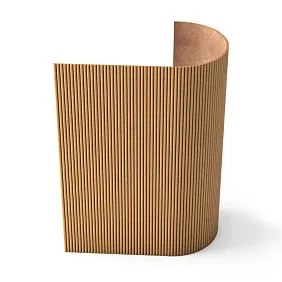
A soft (flexible) slat panel is a construction where slats are attached not to a rigid base, but to a fabric mesh base. The base creates a movable connection between the slats: the battens can change angle relative to each other within limits sufficient for bending. The panel wraps around curved surfaces—without deforming the slats, without breaking the pattern, without visible seams on the curvature.
The main thing to understand: the slats themselves don't become flexible. They remain rigid in cross-section—and this is what ensures the profile is preserved. Flexibility is provided by the fabric base: it allows the entire construction to bend like a single canvas.
This is a fundamental difference from attempting to 'bend a rigid panel'—which always results in substrate cracking, slat displacement, and defects.
Key differences between rigid and flexible slatted panels:
| Parameter | Rigid panel (MDF substrate) | Flexible panel (fabric base) |
|---|---|---|
| Surface shape | Only flat planes | Flat and curved surfaces |
| Minimum bending radius | Not applicable | From 100–150 mm |
| Seamless transition through radius | No | Yes |
| Installation speed on flat wall | High | High |
| Installation on column, arch, radius corner | Impossible without defects | Professional result |
| Application area | Standard interiors | Complex architecture, commercial projects |




Fabric base: why it's chosen over other solutions
Before moving forward—let's address a question many have: why fabric base, not thin MDF substrate, not veneer, not plastic?
The answer lies in bending mechanics. Any rigid material when bent experiences compression on one side and tension on the other. With sufficient radius—cracking is inevitable. The thinner the material—the smaller radius it can withstand, but this compromises load-bearing capacity.
Fabric base works fundamentally differently: it doesn't compress or stretch as a single body. Individual threads shift relative to each other—and the structure bends without internal stress. No stress—no cracks. This is the same reason why fabric can be folded, while cardboard cannot.
An additional bonus of fabric base—it doesn't add visible thickness from the front side. A module with fabric base on a curved surface looks the same as on a flat one. Monolithic, continuous slatted surface—without structural seams at transitions.
Our factory also produces:
Semi-circular profile: why soft chiaroscuro is also 'softness'
The word 'soft' applied to slatted panels has two completely legitimate meanings. We've covered the first—structural flexibility. Now the second.
Soft chiaroscuro is a visual effect created by the semi-circular profile of the slat. A bead with rounded cross-section diffuses light differently than a rectangular one. Where a rectangular slat produces sharp, rigid shadows with clearly defined boundaries—a semi-circular slat creates soft, smooth, diffused transition from light to shadow.
This changes the character of the entire surface. A wall or furniture facade with semi-circular beads appears warm, organic, naturally plastic. Not mechanical, not strict—alive.
Slatted panels made from semi-circular beads—are a separate class of solutions that aren't necessarily flexible in construction. Rigid panel on MDF substrate with semi-circular slats—flat wall, soft light. Flexible panel with semi-circular slats on fabric base—curved surface, soft light. Two different technical solutions united by one aesthetic result.
This is why the search query 'soft slatted panels' often implies both meanings simultaneously: both structurally flexible, and with soft visual texture thanks to the semi-circular profile.
Get Consultation
Materials for flexible slatted panels: oak and MDF
Material selection is choosing the language your surface speaks.
Solid oak: warmth, naturalness, tactility
Oak is a species with a density of 700–750 kg/m³, a pronounced grain pattern, and natural resistance to mechanical wear. Each slat carries a unique pattern that cannot be reproduced by film, veneer, or paint coating.
Soft oak slat panels create a multi-layered play of light and shadow under side lighting: the relief from the slat profile plus the natural texture of the grain. This is a living, warm, 'breathing' surface — especially with a semi-circular profile, which gently diffuses light across the rounded surface of each batten.
Oak stains open up a wide range of looks:
-
Light natural tone with oil — Scandinavian style, Japandi, Nordic aesthetic;
-
Gray — a cold, steely look for strict modern interiors;
-
Honey and golden — warm organic minimalism;
-
Tobacco, cognac — classic and neoclassical;
-
Dark: wenge, graphite, anthracite — loft and strict modern interior.
Wooden soft oak slat panels are the choice for those for whom natural material is the main theme. Where you need not an imitation of a living material, but the living material itself.
MDF for painting: precise geometry, any color
MDF with a density of 750–850 kg/m³ is a homogeneous engineered material with a perfect surface for painting. No natural defects, no variability: only precise geometry that accepts any color from RAL or NCS.
Soft MDF slat panels for painting are the right choice when:
-
A precise color is needed: a proprietary RAL for a commercial project, an agreed-upon NCS for a residential project;
-
A monochrome is needed: panels matching the wall color, relief only through shadow;
-
The interior style requires clean geometry without natural variability: minimalism, office, modern classic.
Soft MDF panels on a fabric base provide precise color even on curved surfaces. A column in a corporate brand color, an arch in neutral white, a radius corner in anthracite — all are achievable without loss of color accuracy or geometry.
Where and how are soft rack panels used
Columns: from a structural element to an architectural accent
A column is a challenge for any finisher. Cladding it with a smooth material is relatively simple. Cladding it with slat panels without visible seams around the perimeter is a task that cannot be solved without a flexible construction.
A rigid panel on an MDF backing will yield several inevitable results when attempting to wrap a column: either visible seams on each face, a backing rupture, or the need to fabricate several separate fragments with subsequent corner fitting. None of these options yields an architectural result.
A soft slat panel wraps around a column continuously. The fabric base allows the module to smoothly envelop the cylindrical surface — the slat pattern runs through the entire perimeter without breaks or step misalignment. The column transforms from a utilitarian structure into an architectural object with an expressive slatted surface.
This solution is in demand in hotel lobbies, shopping malls, office atriums, restaurant halls with columns — anywhere where load-bearing structures cannot be removed but need to be organically integrated into the interior.
Arches and arched spans
An arch is one of the most beautiful architectural forms. And one of the most difficult to finish with slat panels. The inner surface of an arched span is curved in two directions simultaneously.
Soft flexible slat panelson a fabric base smoothly navigate an arch — without cutting into fragments, without visible seams, without disrupting the rhythm of the slats. The slat pattern, which began on a straight wall, passes through the arched vault and continues on the opposite wall as a single, continuous surface.
This creates the sensation that the slatted 'shell' seamlessly envelops the space — without structural limitations. An effect that is fundamentally unattainable with rigid panels.
Rounded corners
A rounded internal corner is a standard task in apartments with non-standard layouts, in commercial projects with organic forms, in interiors with arched transitions between rooms.
With a rigid slat panel, a rounded corner is solved in one of two ways: either with a corner cap profile (always visible) or by cutting several fragments and attempting to join them on the radius (difficult and unreliable).
The flexible slat panel wraps around a rounded corner without additional elements. The fabric backing accommodates any radius from 100–150 mm — this allows treating a rounded corner as a smooth transition between two walls, rather than a structural joint.
Wavy and S-shaped partitions
This is the highest level of application for flexible slat panels. Partitions with smooth wavy or S-shaped forms create a sculptural architectural object within a space. They are used in restaurants for zoning without harsh visual separation, in showrooms as decorative screens, and in residential interiors as artistic zone dividers.
Cladding a wavy partition with slat panels without a flexible construction is a task with no proper solution. With flexible slat panels on a fabric backing — it's a standard installation with predictable professional results.
Custom furniture fronts
Radius furniture fronts — rounded corners of cabinets, curved sides of dressers, radius ends of kitchen islands. For standard fronts made of chipboard or MDF, rounding requires complex milling and postforming. For slat fronts — the flexible panel simply follows the specified radius.
Flexible slat panels for furniture fronts with radius elements — this is a solution for designer furniture with organic forms. Wardrobes with softly rounded corners, kitchen islands with smooth sides, built-in dressers with radius ends — the slat surface on all these objects looks monolithic and architecturally convincing.
Spatial effects of flexible slat panels
What happens to an interior when a flexible slat surface appears in it? Not abstractly — specifically.
A column with slat cladding stops 'sticking out' in the space. A structural element clad with a flexible slat panel becomes part of the room's architectural theme — with the same slat rhythm as on the walls. The space reads as cohesive, not as a 'hall with columns'.
An arched passage with a slat surface creates an architectural narrative. The slats start on the wall, pass through the arch vault, and continue on the other side. It's the feeling of passing through an architectural element, not a doorway.
A wavy slat partition divides — without closing off. Light and visual connection pass through the gaps between the slats. The boundary between zones is marked but doesn't create a feeling of enclosure.
Semicircular profile + soft lighting = organic natural surface. With side or diffused light, flexible slat panels made of semicircular battens create a surface that resembles not an industrial product, but a natural form. This is hard to describe in words — but it's what people feel standing before such a wall.
Flexible slat panels in interior styles
The flexibility of the construction allows flexible slat panels to work in spaces that rigid solutions cannot master. But they also find their place in 'ordinary' styles.
Organic minimalism — one of the most precise contexts. Smooth forms, natural materials, absence of mechanical geometry. Flexible slat panels made of oak with a semicircular profile on rounded walls and columns — the perfect embodiment of this style.
Japandi — oak with gray tinting on a flexible backing, semicircular profile, moderate spacing. Japanese philosophy of natural form + Scandinavian restraint. Here, flexible panels carry both the constructive and visual meaning of the word 'soft'.
Loft — dark slats of rectangular profile on columns and walls of rough concrete. The contrast between the soft slat surface and the hard, brutal background creates expressive tension.
Modern classical interior — flexible panels on arched spans and rounded columns. MDF for painting in a neutral warm tone, moldings around the perimeter made of coordinatedwooden trim. An architectural system that reproduces the logic of the classical order in a modern interpretation.
Restaurant design — wavy slat screen-partitions, slat surfaces on hall columns, arched spans with oak slats. All these are tasks for flexible slat panels on a fabric backing.
Unified finishing system: how flexible slat panels combine with other elements
A slat panel is part of a system. And the more precisely this system is coordinated, the more convincing the result.
Flexible slat panels and baseboard. A slat surface made of oak +Wooden baseboardmade from the same wood species = a unified material language from floor to slat. The baseboard completes the vertical axis of the slat facade, creating an architectural boundary between wall and floor.wooden skirting board purchasemade from solid oak means getting in one set a slat wall and a finishing element coordinated by wood species, tone, and production standard. For MDF panels —buy MDF skirting boardfor painting to match the tone of the entire system.
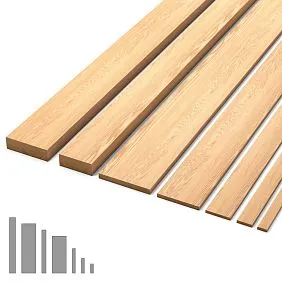
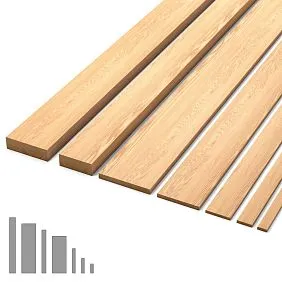
Flexible slat panels and wooden slats. If a slat panel creates a modular plane, then a separateWooden plankis used for point add-on elements — corner transitions, decorative trims, filling non-standard sections. Using slats from the same species as the main modules ensures visual integrity.
Flexible slat panels and moldings. A molding along the top edge of the slat panel — a horizontal 'cap' completing the relief surface. In a space with arched spans, the molding follows the arch's curve, creating architectural framing. A coordinatedwith a classic profile creates a sense of solidity, reliability.A bottom molding and top molding create a complete architectural frame around the slatted surface.
Soft slatted panels and furniture handles. Slatted furniture fronts +Furniture HandlesMade from natural wood or metal in a coordinated tone, this is a furniture piece with a consistent material language from slat to hardware. Wooden furniture handles next to oak slats create an organic, natural look. Metal handles provide an expressive material contrast.
Soft slatted panels in a classic interior. In spaces withclassic furnitureSlatted panels function as a modern interpretation of traditional wooden panels and lambrequins. The architectural logic is the same—decorative wall articulation, natural material—but the execution is laconic and contemporary.
Soft slatted panels and stair balusters. In spaces with wooden staircases, slatted panels on the walls of the stairwell create a unified vertical material narrative:balusters for staircases+ slatted wall = a coherent architectural system where wood speaks across the entire height from baseboard to railing.
Installation of soft slatted panels: features and rules
Installing a flexible slatted panel is no more difficult than a rigid one. But there are specifics you need to know in advance.
Surface preparation:
-
The surface must be clean, dry, without flaking fragments;
-
For curved surfaces (columns, arches)—the substrate must have a correct shape with even curvature, without local protrusions and depressions;
-
A column must be of correct cylindrical or conical shape—deviations from the form will create 'waves' on the panel.
Adhesive installation on curved surfaces:
-
Mounting adhesive or liquid nails is applied to the substrate in strips—not as a continuous layer;
-
The panel is pressed gradually, from the beginning of the curve to the end, without pressing the entire surface simultaneously;
-
To hold the panel until the adhesive sets—temporary fixation with tape or spacers.
Joining flexible modules on long surfaces:
-
On straight sections—butt joint, as with rigid panels;
-
On curved sections—the joint should be located at the point of minimal curvature, where panel deformation is least;
-
For a full wrap around a column—the panel is laid continuously, with one joint in the least noticeable place.
Slat orientation:
-
Vertical orientation of battens—standard and most common;
-
Horizontal—the panel is rotated 90° when ordering;
-
On a column, vertical slats visually 'elongate' it in height; horizontal ones create a sense of denser volume.
Mistakes when working with soft slatted panels
Attempting to 'bend' a rigid panel. This is the most common mistake—buying a rigid panel and trying to forcibly bend it on a column or in an arch. Result: cracked backing, deformed slats, defect. For curved surfaces—only flexible panels on a fabric base.
Unprepared substrate on a column. If a column has an irregular shape with local protrusions, the panel will 'bubble' in those places. Leveling the substrate is a mandatory step.
Too aggressive straightening when applying adhesive. A flexible panel cannot be 'straightened' with force on straight sections—the fabric base retains some residual curvature after storage in a roll. Before installation—let the panel lie flat at room temperature.
Incorrect joint position on a column. The joint of two modules when wrapping a column should be located in the least noticeable place—typically behind the column or in an area of minimal visual contact.
Uncoordinated trim. Flexible oak slatted panel on a column + white plastic floor baseboard at the column base. This is a visual break that destroys the integrity of the solution.wooden baseboardMade from the same wood species as the slats—a necessary finishing element.
Selection parameters: what to determine before purchase
Before ordering soft slat panels — answer these questions:
What is the minimum curvature of your surfaces? Column radius, arch arc, corner rounding — these numbers are needed to confirm the panel can handle the task.
What slat profile is needed? Semi-circular — for soft organic light. Rectangular — for a strict, graphic surface.
What material? Oak — for natural character and tactility. MDF for painting — for precise color and monochrome solutions.
What slat spacing? Small — dense, rich rhythm. Large — airy, monumental surface.
Is a coordinated trim system needed?and paint it to the desired shade — standard practice in modern design. It is important to use special wood finishes that allow the material to breathe. from the same wood species, moldings, wooden slats for additional elements — all this is determined at the selection stage, not after installation.
Where to choose and buy soft slat panels
Selection made — moving to action.soft slat panels on fabric base, panels made of semi-circular battens and rigid modules for flat surfaces are available in full assortment in the STAVROS catalog.
The system can be complemented with:
-
wooden skirting boardand, which covers the technological gap. The top edge may be detailed with a cornice or left open. from the same wood species;
-
wooden planks for additional and transition elements;
-
furniture handles made of natural wood or metal for furniture fronts with slat cladding;
-
balusters for staircases from the same solid wood for stair flights with slat walls.
About the company STAVROS
The plasticity of a curved surface covered with slat panels without a single visible seam — this is not accidental. Behind this lies production discipline: precision of the fabric base, stability of slat spacing, quality of end processing and coating.
STAVROS — Russian manufacturer of MDF and solid wood products for interior finishing and furniture production. The production program includes slat panels (rigid and flexible), trim products, furniture decor, hardware, stair elements — over 4000 models in 39 product groups.
STAVROS production standard: wood drying to normative humidity, two-level quality system (Standard and Prestige), manual processing of decorative elements, spacing accuracy control in each batch, controlled climate in production facilities.
Shipping from one piece. Delivery across Russia. Professional selection consultations — before placing an order.
FAQ: Answers to popular questions
What are soft slat panels — is it the same as flexible?
Yes, in most cases these terms are used as synonyms. 'Soft' — because of the flexible construction on fabric base, unlike rigid MDF backing. Also 'soft' refers to panels with semi-circular slat profile — for soft light and shadow character. Both meanings occur in practice.
What minimum bending radius can soft slat panels withstand?
Depending on slat width and spacing — from 100 to 150 mm. For standard columns 200–300 mm in diameter and larger — without limitations. Check with the manufacturer for specific products.
Can soft slat panels be installed on ceilings?
Yes, with frame installation considering load calculation. The fabric base holds slats in horizontal position, but the supporting frame must provide sufficient frequency of attachment points.
What adhesive to use when installing flexible slat panels?
Mounting acrylic or polyurethane adhesive compatible with wood and fabric base. Polyurethane-based liquid nails — one of the most common options. Do not use solvent-based adhesives — they may damage the fabric base.
How to store soft slat panels before installation?
In horizontal position, straightened out, in a room with normal humidity and temperature. Do not store rolled up — this creates residual curvature that will complicate installation on straight sections.
Can soft MDF slatted panels be painted after installation?
Professional results are only achieved by painting before installation in a workshop — using spray equipment. Painting with a roller or brush on installed slats produces an uneven coating due to gaps between the battens.
Does soft oak slatted paneling require special care?
Routine care — dry or slightly damp soft cloth. Oil finish is renewed locally every 3–5 years. Lacquer finish is more wear-resistant; local restoration for scratches. Curved sections are cared for the same way as straight ones.