Article Contents:
- Trend 2026: monumentality in details
- From minimalism to neoclassicism
- Grand scale without excess
- Material quality
- Wide skirting board 120-200 mm: visual power
- Historical Context
- Visual effect
- Height: selection rules
- Profiles of wide baseboards
- Floor mirror 180-200 cm: doubling the space
- Sizes and proportions
- Construction: freestanding vs wall-mounted
- Functions of a floor mirror
- Where to place a floor mirror
- Proportions for high ceilings 3+ m
- The problem of high ceilings
- Solution: scaling elements
- Vertical accents
- Horizontal boundaries
- Material: solid oak for strength
- Why oak
- Stability of oak
- Aesthetics of oak
- Durability
- Combination: wide mirror frame + wide skirting board
- Principle of scale correspondence
- Unity of Material and Finish
- Profiles: interplay of forms
- Placement: vertical and horizontal
- Neoclassicism and Modern Classicism
- Neoclassicism: 21st century classic
- Modern classic: balance of tradition and novelty
- Materials: naturalness and quality
- Details: where monumentality, where restraint
- Practical aspects of installation
- Installation of wide skirting board
- Installation of large mirror
- Questions and Answers
- For which ceiling heights is a 120 mm skirting board suitable?
- Will a wide skirting board visually reduce the room?
- How much does a floor mirror 100×200 cm weigh?
- Can wide skirting boards be installed on uneven walls?
- What type of wood is best for making wide skirting boards?
- Is a special frame needed for a large mirror?
- Where to buy wide oak skirting board 120 mm?
- Can skirting boards and frames be painted different colors?
- How much does wide oak skirting board cost?
- Are floor mirrors safe for children?
- Conclusion

Monumentality doesn't necessarily mean columns, moldings, and gilding. True spatial grandeur is created through proportions, where each element has sufficient scale to confidently assert itself.Wide Wooden Skirting Boardwith a height of 120-150 mm andfloor mirrors in frameswith a height of 180-200 cm — these are architectural solutions that restore to interiors the sense of solidity lost in the era of standard housing with its seven-centimeter skirting boards and 40×60 cm mirrors.
The 2026 trend — monumentality in details. Not palatial pomp, but thoughtful scale of elements creating visual weight while maintaining contemporary aesthetics.Wide wooden floor skirting boardforms the architectural base of the room, a visual plinth from which the walls rise.Large framed mirrorcreates a vertical dominant, a visual axis around which space is organized. Together they form an interior where proportions are precise, where each element corresponds to the scale of the room.


Trend 2026: monumentality in details
Interior fashion is cyclical. After decades of minimalism, where everything was reduced, simplified, and minimized, there emerged a demand for scale, solidity, and visual weight. Not a return to Baroque excess, but a new understanding of monumentality — through proportions, material quality, and thoughtful detailing.




From minimalism to neoclassicism
The minimalism of the 2010s reached the limit of reduction. Skirting boards 5-7 cm high, almost unnoticeable. Mirrors — functional rectangles without frames. Furniture — lightweight, on thin legs, seemingly floating. Result: visually light spaces, but psychologically unstable. Lacking grounding, solidity, the feeling that there's firm ground underfoot.
The neoclassicism of the 2020s brings back scale. Wide skirting boards 100-150 mm create a visual plinth, an architectural base. Large mirrors in massive frames — vertical accents, decorative dominants. Furniture — substantial, on stable legs or without them entirely, firmly standing on the floor. This is a return to the feeling of stability, reliability, and solidity.
Our factory also produces:


Scale without excess
The key difference between contemporary monumentality and historical monumentality is the absence of decorative excess. A wide skirting board can have a simple rectangular profile without intricate carving. A large mirror — a minimalist frame without gilding or ornaments. Monumentality is created by the scale of elements, their proportions, material quality, not by the quantity of decoration.
This is an approach combining classical proportions with contemporary aesthetics. Correct size ratios are taken from classicism (high skirting boards, large mirrors), but decorative excess (carving, gilding, ornaments) is removed. Result — interiors that are solid but not overloaded; monumental but not heavy; classical in spirit but contemporary in form.
Get Consultation
The responsible manufacturer provides complete information about the origin of the wood, drying methods, and processing. Quality and environmental certification confirm a serious approach to production.
Monumentality requires quality materials. A plastic skirting board 120 mm high looks absurd — too large for its lightweight material. A wooden skirting board made of solid oak of the same height looks dignified — the scale corresponds to the material.
The same with mirrors. A large mirror in a cheap plastic frame — tasteless. The same mirror in a solid wood frame — an interior object worthy of attention. Monumentality is impossible without quality. Scale without quality turns into vulgarity.
Wide skirting board 120-200 mm: visual power
A wide baseboard— not just an enlarged version of a standard one. This is an architectural element that changes the perception of a room's proportions, creating a visual foundation, a plinth from which the walls rise.
Historical context
In classical architecture of the 18th-19th centuries, high skirting boards (15-25 cm) were the norm for formal rooms. They visually connected walls with the floor, created architectural solidity, and protected the lower part of walls from mechanical damage. In palace interiors, skirting boards reached 30-40 cm, essentially turning into wooden panel-plinths.
With the advent of mass housing in the 20th century, skirting boards shrank to 6-8 cm — cheaper, faster to install, less material consumption. The function remained (to cover the gap between wall and floor), but the architectural role disappeared. The skirting board became an invisible, utilitarian element.
The return to wide skirting boards is a return to understanding the skirting board as an architectural element, not just a gap filler.Skirting board 120 mm highand more — this is a statement about the seriousness of the interior, attention to detail, and understanding of classical proportions.
Visual effect
A wide baseboard creates several visual effects simultaneously:
Visual solidity — a wide baseboard is perceived as an architectural plinth on which the walls stand. This creates a sense of stability, reliability, and solidity. A narrow baseboard does not create this effect — the wall seems to hang in the air.
Correct proportions — in rooms with high ceilings (3 meters and above), a narrow baseboard looks disproportionately small. A wide baseboard of 120-150 mm restores the harmonious ratio of wall height to baseboard height.
Visual wall elevation — paradoxically, a wide baseboard painted the same color as the walls visually makes the walls appear taller. It creates a strong horizontal base from which the wall's vertical line begins confidently, with a clearly defined starting point.
Wall protection — a practical function of a wide baseboard: it protects walls at a greater height from impacts from furniture, vacuum cleaners, feet, and splashes during cleaning. This is important for expensive wall coverings (wallpaper, decorative plaster, paint).
Height: selection rules
What height of baseboard should you choose? The main rule: the height of the baseboard should be proportional to the ceiling height and the size of the room.
Ratios:
-
Ceilings 2.5-2.7 m — baseboard 80-100 mm (wide, but not excessive)
-
Ceilings 2.8-3.2 m — baseboard 100-120 mm (optimal option)
-
Ceilings 3.3-4.0 m — baseboard 120-150 mm (large-scale, classical)
-
Ceilings over 4 m — baseboard 150-200 mm (monumental, palatial)
Additional factor — room area. In small rooms (up to 15 m²), a wide baseboard can visually overwhelm. In spacious rooms (from 25 m²) — a narrow baseboard gets lost and does not create the desired effect.
Profiles of wide skirting boards
A wide baseboardcan have different profiles, from simple rectangular to complex classical.
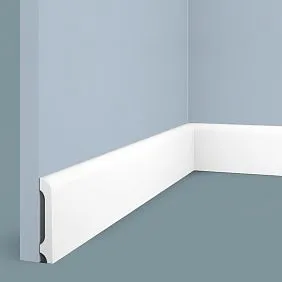
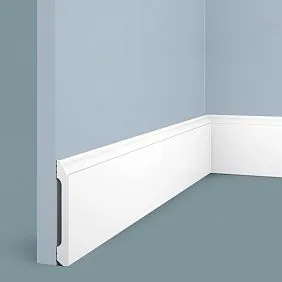
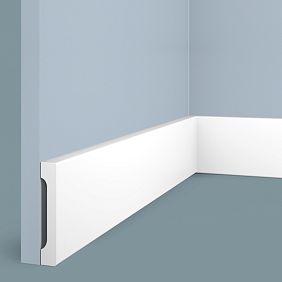
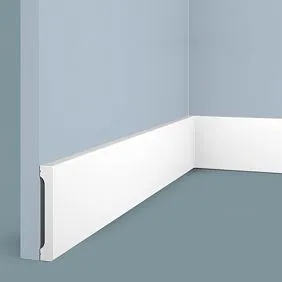
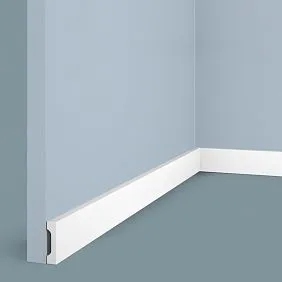
Rectangular profile — a smooth rectangular-section plank without relief. Modern, minimalist look. Monumentality is created solely by scale and material quality. Suitable for modern, minimalist, loft interiors.
Profile with a chamfer — the top edge of the baseboard is beveled at a 45-degree angle, creating a soft transition to the wall. Adds elegance without complication. Suitable for modern classic, Scandinavian interiors.
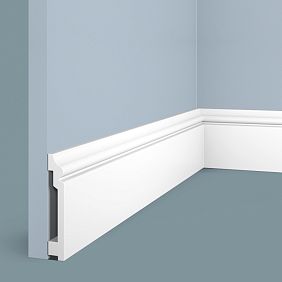
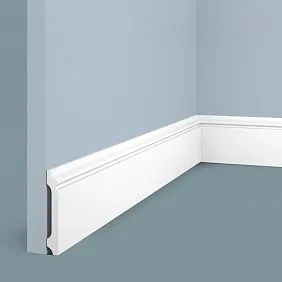
Classical profiled — a complex profile with protrusions, recesses, and curves, resembling the base of a column. Creates a play of light and shadow, visual richness. Suitable for classical, neoclassical, traditional interiors.
Multi-level — several protruding and recessed elements, creating architectural complexity. The most decorative option, maximally classical. Suitable for formal rooms, recreating historical interiors.
The choice of profile is determined by the interior style. For modern spaces — simple rectangular or with a chamfer. For classical — profiled or multi-level.
Floor mirror 180-200 cm: doubling space
A floor mirror is not just an enlarged version of a wall mirror. It is an independent piece of furniture, often on its own support, allowing you to see yourself full-length, creating a powerful visual effect of expanding space.
Dimensions and Proportions
of floor wooden skirtingof floor mirrors:
-
Minimum: 80×180 cm (allows you to see yourself from head to toe, standing 1.5 meters away)
-
Optimal: 100×200 cm (convenient size for dressing rooms, bedrooms, spacious hallways)
-
Large-format: 120×220 cm and more (for large rooms, creating a dramatic effect)
Proportions are important. A mirror that is too narrow (less than 60 cm with a height of 180 cm) looks like a slit and does not create an expansion effect. A mirror that is too wide (more than 150 cm with a height of 200 cm) becomes panoramic, more like a wall mirror than a floor mirror.
The optimal height-to-width ratio for a floor mirror: from 1:2 to 1:2.5 (height is 2-2.5 times greater than width). This creates a vertical dominance, visually raises the ceiling, and corresponds to human proportions.
Construction: freestanding vs wall-mounted
Floor mirrors come in two types by design:
Freestanding (free-standing) — a mirror in a frame with its own support (legs, stand), standing on the floor, leaning against the wall. Advantages: no installation required, can be moved, tilt angle can be changed. Disadvantages: requires free space from the wall (10-15 cm), less stable.
Wall-mounted with low attachment — a mirror in a frame attached to the wall, but the lower edge is 5-10 cm from the floor. Creates the effect of a floor mirror but is securely fixed. Advantages: stability, safety, no space required from the wall. Disadvantages: requires installation, cannot be moved.
For homes with children and pets, the wall-mounted option is preferable — eliminates the risk of tipping over. For rental housing — freestanding, requiring no wall drilling.
Functions of a floor mirror
In addition to the obvious function (seeing oneself full-length), a floor mirror serves several purposes:
Visually doubling the height of a room — a vertical mirror 200 cm tall creates the impression that the ceiling height is greater than it is. The brain perceives the reflection as an extension of the space upward.
Expanding narrow spaces — placed at the end of a long hallway or narrow room, a mirror creates the illusion of continuing space, visually doubling the length.
Multiplying light — a large mirror surface reflects light from windows, lamps, distributing it throughout the room. Especially effective in dark rooms.
Decorative accent — a large mirror in a striking frame becomes a focal point, attracting attention, creating a visual center.
Practical function for a dressing room — in dressing rooms, fitting rooms, bedrooms, a floor mirror is a necessity, allowing one to evaluate the entire outfit.
Where to place a floor mirror
Optimal placement locations:
-
Bedroom: against the wall opposite the bed (if you don't believe in feng shui) or to the side of the bed against the wall
-
Dressing room: opposite the storage system to see yourself while choosing clothes
-
Entryway: near the entrance to evaluate your look before leaving
-
Living room: against a free wall as a decorative element
-
At the end of a hallway: creates the illusion of continuing space
Important: check what is reflected in the mirror. A beautiful view, window, interesting furniture — good. A blank wall, clutter, unremarkable items — bad.
Proportions for high ceilings 3+ m
High ceilings (from 3 meters) — a luxury that requires proper use. Incorrectly chosen proportions of elements turn this luxury into a problem: the room seems empty, cold, disproportionate.
The problem of high ceilings
A typical mistake in rooms with high ceilings is using standard-sized elements: narrow 70 mm baseboards, small 60×80 cm mirrors, low furniture. Result: elements get lost in the volume, do not match the scale. The room seems uncomfortable, disproportionate, unfinished.
With a ceiling height of 3.5 meters and a 70 mm baseboard, the ratio is 1:50 (ceiling height is 50 times greater than baseboard height). This is disproportionate. The classic ratio: 1:20-1:25 (with a height of 3.5 m, the baseboard should be 140-175 mm).
Solution: scaling elements
Rule: the higher the ceilings, the larger the architectural elements should be. Not just slightly larger — significantly larger.
For a room with ceilings 3-3.5 m, it is recommended:
-
Baseboard: 120-150 mm in height
-
Mirrors: from 120 cm on the shorter side, floor mirrors — 200-220 cm in height
-
Doors: increased height (2.3-2.5 m instead of standard 2 m)
-
Furniture: either tall (ceiling-high cabinets) or visually massive
-
Decor: large-format paintings, large light fixtures
Large-scale elements fill the volume, create harmonious proportions, and use ceiling height as an advantage, not a problem.
Vertical Accents
Tall rooms require vertical accents — elements that lead the eye upward, utilizing the height. A floor mirror 200-220 cm tall is an ideal vertical accent. It creates a pronounced vertical axis, visually connects the floor and ceiling, emphasizes the height, turning it into an asset.
The mirror frame can enhance verticality: a narrow frame (5-8 cm) emphasizes the mirror's vertical format, a wide one (12-15 cm) adds monumentality without losing verticality.
Horizontal boundaries
Simultaneously with vertical accents, horizontal boundaries are needed — elements that divide the height into levels, creating structure. A wide baseboard is the lower boundary, a visual plinth. Molding at 2/3 of the wall height (with a 3.5 m ceiling — at 2.3 m) is the upper boundary. Between them is the wall area perceived as harmonious and proportional.
Without horizontal boundaries, a tall wall is just a large vertical plane, oppressive in volume. With boundaries, it is an architecturally organized surface where each level has meaning.
Material: solid oak for strength
Wide baseboards and large mirror frames require a strong, stable material. Solid oak is the optimal choice, combining strength, durability, beauty, and eco-friendliness.
Why oak
Oak is one of the hardest and most durable wood species used in joinery. Oak wood density is 700-800 kg/m³, Brinell hardness 3.7-4.0. This provides exceptional wear resistance, resistance to mechanical damage, and longevity.
Solid oak skirting boardA baseboard 120-150 mm high is a massive product weighing 1.5-2.5 kg per linear meter. It does not deform under its own weight, does not sag during installation, and does not crack from drying (with proper wood drying).
A frame for a large mirror made of solid oak can support the weight of the mirror panel (a 100×200 cm mirror weighs 25-30 kg) without deformation, cracks, or sagging. Oak is strong enough to maintain its shape even when creating wide frames (12-15 cm) without additional reinforcement.
Stability of oak
Oak is a stable species. With proper kiln drying to a moisture content of 8-10%, oak products minimally react to changes in air humidity. They do not swell from moisture, do not shrink in dry air, and maintain their geometry for decades.
This is critically important for wide baseboards. A 120 mm high baseboard made of unstable wood (pine, spruce without proper drying) can warp into an arc within a few months after installation. An oak baseboard made from properly dried wood will maintain perfect straightness for decades.
For large mirror frames, stability is even more important. A frame that deforms creates stress on the mirror panel, which can lead to mirror cracking. An oak frame is stable, does not create stress, and guarantees the mirror's preservation.
Aesthetics of oak
In addition to technical qualities, oak has an expressive, noble texture. The contrasting pattern of annual rings, expressive medullary rays (especially noticeable in radial cuts), and warm hue — all create a natural beauty that cannot be imitated by artificial materials.
A wide oak baseboard with a natural finish (oil, wax, clear varnish) is not just a functional element but a decorative strip of natural wood running along the room's perimeter. An oak frame is a framing worthy of a work of art, emphasizing the mirror's value.
Durability
Oak is one of the most durable species. Oak structures last for centuries without losing strength. Oak baseboards and frames are an investment for generations. They do not need replacement after 10-15 years (like MDF or pine products), can be restored (re-sanded, refinished), and acquire a patina over the years, becoming even more expressive.
In 18th-19th century houses, original oak baseboards still stand, retaining their strength and beauty. A modern oak baseboard from a manufacturer using quality wood and proper technology will last no less.
Combination: wide mirror frame + wide baseboard
When a wide baseboard and a large mirror in a wide frame are combined in an interior, visual harmony of large-scale elements is created. They resonate with each other, enhancing the effect of monumentality and creating integrity.
Principle of scale correspondence
The main design rule: interior elements should be proportionate to each other. A narrow 70 mm baseboard and a large mirror in a 15 cm wide frame — a mismatch. The baseboard gets lost, the frame seems excessive. A wide 120 mm baseboard and a mirror in a 12-15 cm frame — a harmonious combination, the scales correspond.
Practical recommendations:
-
If the baseboard is 80-100 mm — the mirror frame 8-12 cm
-
If the baseboard is 100-120 mm — the mirror frame 10-15 cm
-
If the baseboard is 120-150 mm — the mirror frame 12-18 cm
-
If the baseboard is over 150 mm — the mirror frame 15-20 cm or more
Matching scales creates visual integrity, a sense that elements belong to the same interior, were designed by one author, and follow a single logic of proportions.
Unity of Material and Finish
Harmony is enhanced if the baseboard and mirror frame are made from the same material with identical finishing. Both from solid oak with a natural oil finish — creates a unity of natural texture, warmth of wood, and eco-friendliness. Both from oak with a white enamel coating — creates a unity of color, smoothness, and modern aesthetics.
You can play with contrast: a wide baseboard made of natural oak, and a mirror frame painted black. The contrast highlights each element, creating graphic quality and modernity. But even in contrast, scale matching is necessary.
Profiles: Echoing Forms
If the baseboard has a profiled shape (with a chamfer, roundings, protrusions), the mirror frame can repeat elements of this profile. A baseboard with a classic ogee (concave rounding at the top) — a mirror frame with a similar ogee. This creates a visual echo, a unity of architectural language.
If the baseboard is a simple rectangle — the frame can be simple or, conversely, complex (for contrast). The combination of a simple baseboard and a complex frame creates a hierarchy: the baseboard is a background element, the mirror is an accent element.
Placement: Vertical and Horizontal
The baseboard is a horizontal element running along the perimeter of the room. A floor mirror is a vertical element, localized on one wall. Together they create a coordinate system: horizontal + vertical, defining the architecture of the space.
It is optimal to place a floor mirror so that its lower edge is at the level of or slightly above the upper edge of the baseboard (5-10 cm). This creates a visual connection: the baseboard as a base from which the vertical of the mirror grows. If the mirror is on a stand, its lower edge may touch the floor next to the baseboard — this also creates a connection.
Neoclassicism and modern classicism
The combination of wide baseboards and large mirrors is most organic in neoclassical and modern classic styles — directions that combine classical proportions with contemporary aesthetics.
Neoclassicism: The Classic of the 21st Century
Neoclassicism is not a recreation of historical interiors, but a reinterpretation of classical principles in a modern context. It takes correct proportions, symmetry, and quality materials from classicism, but removes decorative excess, simplifies forms, and modernizes the palette.
In neoclassicism, a wide baseboard may have a classic profiled profile but is painted not in gold leaf, but in a neutral gray, white, or natural wood color. A large mirror may have a wide frame, but without carving or gilding — simply a profiled frame made of natural oak or painted white.
Result: an interior that is classical in spirit (proportions, symmetry, quality) but modern in form (absence of excessive decor, contemporary palette, minimalism).
Modern classic: balance of tradition and novelty
Modern classicism goes further than neoclassicism in simplifying forms. Here, only proportions and material quality remain classical, while forms are maximally simplified.
A wide 120 mm baseboard, but with a simple rectangular profile without decor — modern classicism. A large 200 cm mirror in a frame 15 cm wide, but the frame is simple, without carving — modern classicism. Monumentality is achieved through scale and quality, not decor.
The palette of modern classicism: natural wood tones, neutral colors (white, gray, beige), deep dark shades (black, graphite, dark brown). Bright, garish colors are avoided — they destroy elegance.
Materials: Naturalness and Quality
Both styles are demanding of materials. There is no room for compromise here: either natural wood or nothing. MDF, plastic, cheap imitations destroy the concept. Neoclassicism and modern classicism are styles for those who value quality, are ready to invest in materials, and understand the difference between solid oak and plastic imitation.
A wide wooden oak baseboard, a large mirror in a solid wood frame— are essential elements of a quality neoclassical or modern-classical interior. Saving on these elements destroys the entire concept.
Details: Where Monumentality, Where Restraint
An important principle: not all elements need to be large-scale. A wide baseboard and a large mirror are accent elements that create monumentality. But everything else can be restrained: furniture of simple forms, minimal decor, calm colors. Monumental elements against a restrained background stand out and create the desired effect.
If everything is large — hierarchy is lost, the space becomes overloaded. If everything is small — scale is lost, the interior looks petty. Balance: a few monumental elements (wide baseboard, large mirror, possibly a large chandelier) + restrained surroundings = a harmonious neoclassical interior.
Practical Installation Aspects
Wide baseboards and large mirrors require professional installation. These are not elements that can be installed independently without experience.
Installation of a Wide Baseboard
A wide baseboard is heavier and more demanding in terms of installation quality than a standard one.
Features:
-
Perfectly even walls: a wide baseboard does not bend to follow the curvature of the wall. If the wall is curved, gaps will form between the baseboard and the wall. Before installing a wide baseboard, walls must be leveled with plaster or drywall.
-
Secure fastening: a wide baseboard is heavy (oak 120 mm weighs 2-2.5 kg/m). Adhesive fastening is insufficient; additional mechanical fastenings (screws, finishing nails) are needed. Fastening points — every 50-70 cm.
-
Precise miter cutting: connecting skirting boards at corners is done with a 45-degree miter cut. With a skirting board width of 120 mm, even a 1-degree error creates a noticeable gap. A miter saw with precise angle adjustment is required.
-
Sealing joints: after installation, joints and fastening points are filled with putty, sanded, and painted or varnished to match the skirting board. High-quality sealing makes joints invisible.
Installation of wide skirting boards is best entrusted to professionals who have experience, tools, and an understanding of the technology.
Installation of a large mirror
A 100×200 cm framed mirror weighs 40-60 kg. Falling of such a structure poses a real risk of injury and destruction of an expensive item.
Attachment methods:
-
French cleats: the most reliable mounting method. Two metal strips with opposing bevels: one is attached to the wall, the other to the frame. The mirror is hung, and the strips interlock, creating a strong connection. Supports loads up to 100 kg.
-
Special mirror hangers: metal brackets designed for heavy weight. Installed at four points (top corners of the frame), attached to the wall with powerful anchors.
-
Combined mounting: top - on hangers, bottom - on a support (console, floor). Reduces load on the mounts, increases stability.
Wall requirements: the wall must be load-bearing (brick, concrete, aerated concrete of sufficient density). Drywall partitions without reinforcement will not support the weight of a large mirror.
Installation of a large mirror is a job for professionals. Improper installation creates a risk of falling, which is dangerous and costly.
Questions and answers
For what ceiling height is a 120 mm skirting board suitable?
A skirting board with a height of 120 mm is optimal for ceilings 2.8-3.5 meters. For lower ceilings (2.5-2.7 m), it is better to choose 80-100 mm, for higher ceilings (3.5-4 m) - 140-150 mm.
Will a wide skirting board visually reduce the room?
No, if it is painted the color of the walls or slightly lighter. A wide skirting board the color of the walls extends the wall to the floor, visually making the walls taller. A dark contrasting skirting board can visually reduce wall height.
How much does a 100×200 cm floor mirror weigh?
The mirror glass weighs about 25 kg, a solid oak frame 12 cm wide adds another 15-20 kg. Total weight 40-45 kg. Reliable mounting is required.
Can a wide skirting board be installed on uneven walls?
Highly undesirable. A wide skirting board does not bend and does not follow curvature. Gaps form between the skirting board and the wall. Walls need to be leveled before installation.
What wood is best for making wide skirting boards?
Optimally - oak or beech. Durable, stable, wear-resistant species. Pine is cheaper but softer and easily damaged. For wide skirting boards, strength is important.
Is a special frame needed for a large mirror?
Yes, the frame must be reinforced: profile thickness at least 20 mm, mortise and tenon joints, additional reinforcement in the corners. A lightweight frame for a small mirror is not suitable - it will deform under the weight.
Where to buy a wide 120 mm oak skirting board?
From manufacturers of solid wood millwork. Company STAVROS offers oak skirting boards with heights of 80, 100, 120, 150 mm in various profiles.
Can the skirting board and frame be painted different colors?
Yes, this creates contrast. For example, white skirting board + black mirror frame - a graphic modern combination. Or natural oak skirting board + white frame - Scandinavian aesthetic.
How much does a wide oak skirting board cost?
Price depends on height and profile. A solid oak skirting board with a height of 100-120 mm costs 1200-2200 rubles per linear meter. Custom complex profiles are more expensive.
Are floor mirrors safe for children?
Freestanding mirrors can tip over, which is dangerous. For homes with children, it is better to choose mirrors with wall mounting or very stable freestanding structures with a wide base.
Conclusion
Monumentality in a contemporary interior is created not by excessive decor, but by correct proportions, the scale of key elements, and the quality of materials.Wide Wooden Skirting Boardwith a height of 120-150 mm forms the architectural base of the room, a visual plinth upon which the walls rise.Floor mirror in a framewith a height of 180-220 cm creates a vertical dominant, a visual axis that utilizes ceiling height as an advantage.
Wide wooden floor skirting boardmade of solid oak is not just a functional element covering the gap between the wall and floor. It is an architectural detail that creates proportions, structures the space, and adds visual weight and respectability. A height of 120 mm is the minimum to create a monumentality effect, 150 mm is optimal for high ceilings, and 180-200 mm is palatial, for historical reconstructions.
Large framed mirrormade of solid oak is not merely a utilitarian object. It is a decorative element capable of becoming the compositional center of a room, a visual dominant around which the rest of the space is organized. A wide frame (12-18 cm) corresponds to the scale of a large mirror, creates harmonious framing, and adds monumentality.
The combination of a wide baseboard and a large mirror creates a visual resonance: the horizontal of the baseboard and the vertical of the mirror form a coordinate system, an architectural framework within which the interior unfolds. The correspondence of scales (wide baseboard — wide frame) creates harmony, unity of the design concept, and a sense of integrity.
Material is critically important. Monumentality demands quality. Plastic baseboards or frames imitating wood destroy the concept — scale without quality turns into kitsch. Solid oak is a material that matches the scale: durable, stable, long-lasting, with a noble texture, eco-friendly. Oak elements last for decades without losing strength and beauty, can be restored, and acquire a patina over the years.
Stylistically, wide baseboards and large mirrors are most organic in neoclassical and contemporary classicism — styles that combine classical proportions with modern aesthetics. Here, monumentality is created not by decor, but by scale, quality of materials, and correct proportions. These are interiors for those who value solidity, understand architecture, and are ready to invest in quality to create a space that will serve for generations.
The company STAVROS has specialized for over two decades in the production of millwork and furniture from solid oak and beech. The STAVROS assortment includesbaseboards of all heights— from standard 80 mm to monumental 150 mm, all profiles — from simple rectangular to complex classical, all finishing options — from natural oil to enamel coatings in any colors.
STAVROS baseboards are made from selective, top-grade solid oak that has undergone kiln drying to 8-10% moisture content. The glued solid wood technology is used: 2-3 lamellas are glued under pressure, which increases stability, eliminates deformation, and allows for the manufacture of long planks (up to 3 meters) without joints. Each baseboard is milled on high-precision equipment ensuring perfect profile geometry, then sanded, primed, and coated with varnish or paint in factory conditions.
Mirror FramesSTAVROS are made from solid oak or beech in all sizes — from compact 40×60 cm to monumental 150×250 cm, all shapes — rectangular, oval, round, arched, all profiles — from minimalist 5 cm to wide classical 18 cm. Frame corners are joined with tenons, glued, and reinforced with metal brackets (for large frames), guaranteeing strength and preventing corner separation under the weight of the mirror.
Wide frames (12-18 cm) for large mirrors are made from thickened profile (25-30 mm thickness instead of standard 20 mm), ensuring rigidity and no sagging. It is possible to manufacture reinforced frames for mirrors of extreme sizes (over 200 cm on any side) with additional internal crossbars distributing the load.
STAVROS offers custom manufacturing of baseboards and frames according to customer sketches: non-standard heights, unique profiles, individual sizes, any finishing options. In-house production allows for flexible response to requests, creating products that precisely match the design concept and proportions of a specific room.
Consultations with STAVROS specialists help choose optimal solutions: determine baseboard height according to ceiling height, select a profile matching the interior style, choose the size and width of the mirror frame, calculate the required amount of material, and suggest options for mounting large mirrors considering wall type.
Create an interior where monumentality is created not by decor, but by proportions, wherea wide baseboard made of solid woodforms the architectural base, where a large mirror in a frame made of natural wood becomes a vertical dominant, where every element corresponds to the scale of the space, where material quality guarantees durability for decades. STAVROS is a partner in creating interiors where classical proportions meet a modern understanding of aesthetics, where traditions of woodworking craftsmanship are embodied in products worthy of being passed on to the next generations.