












































































Article Contents:
- Philosophy of material dualism in decor
- Wood: The Living Soul of Interior Design
- Polyurethane: the technological future
- Strategy of reasonable combination
- Color unification: linking the heterogeneous
- Monochromatic strategy: all in white
- Contrast strategy: wood versus paint
- Imitation strategy: polyurethane as wood
- Zonal distribution of materials by function
- High humidity zones: polyurethane is unrivaled
- Tactile contact zones: priority of wood
- Ceiling structures: the triumph of lightness
- Facade solutions: synthetic versus the elements
- Compositional techniques of integration
- Rhythmic repetition of forms
- Modular grid
- Symmetrical Pairs
- Hierarchy of accents
- Stylistic contexts of combining
- Classic: separation by hierarchy
- Neoclassical: contrasting play
- Modern classic: hidden mixing
- Scandi: practical minimalism
- Loft: industrial eclecticism
- Technical aspects of combined installation
- Installation of wooden elements
- Installation of polyurethane elements
- Jointing Different Materials
- Economic optimization through combination
- Budget calculation: wood monopoly
- Budget calculation: combined solution
- Budget calculation: polyurethane monopoly
- Golden mean
- Common mistakes when combining materials and how to avoid them
- First mistake: visible joint between different materials
- Second mistake: different surface gloss levels
- Third mistake: different color temperatures
- Fourth mistake: scale mismatch
- Fifth mistake: stylistic inconsistency
- Questions and Answers
- Can wood and polyurethane be combined in one room?
- How to make material differences unnoticeable?
- In which areas is wood best used?
- Where is polyurethane best applied?
- What paint to use for color unification?
- Is special permission or skills required for combined installation?
- How to calculate material quantity for a combined project?
- How long does combined installation take?
- How to care for combined elements?
- Can wood and polyurethane be combined on a facade?
- Which material is more eco-friendly?
- Does combining materials affect interior durability?
- STAVROS Company: master of combined solutions
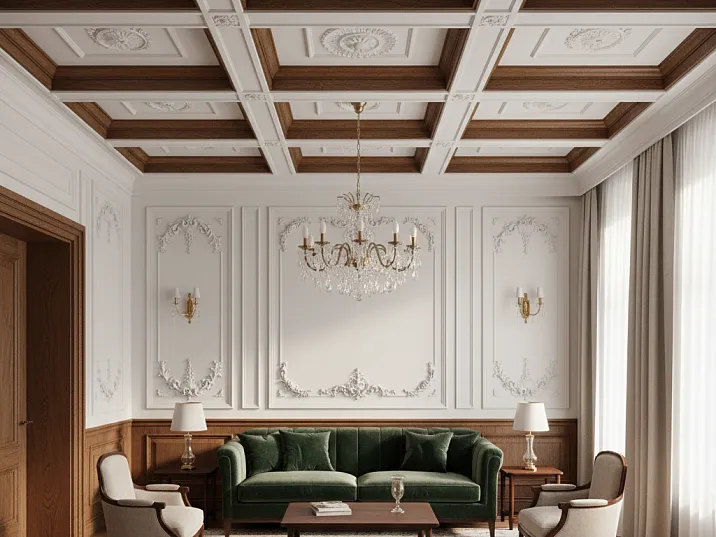
Imagine an interior where every line, every detail follows a unified concept, yet utilizes the strengths of completely different materials. Wood breathes with the warmth of natural fibers, polyurethane surprises with technological sophistication and form plasticity. It seems these worlds cannot intersect—yet it's precisely in their union that modern aesthetics are born, combining traditions of woodworking craftsmanship with possibilities of innovative composites.
When you decidebuy moldingsWhen designing a space, a strategic question arises: stick with one material or combine? Wood monopoly offers impeccable tactility and organic warmth but requires serious budgets and specific maintenance. Polyurethane provides price accessibility and application versatility, yet lacks that living energy emitted by solid wood. The answer lies in skillful combination: use each material where it demonstrates its best qualities.


Philosophy of material dualism in decor
The idea of combining materials is not a compromise born from budget limitations. It's a conscious design strategy that acknowledges universal solutions don't exist. Each material possesses character, history, physical properties that make it ideal for some tasks and problematic for others.




Wood: The Living Soul of Interior Design
Oak or beech solid wood isn't just a building material. It's a fragment of living nature, preserving within itself memory of decades of growth, seasonal changes, interaction with soil and climate. Each board is unique: grain pattern, shades, density—all this makes wooden elements irreplaceable.
The tactility of wood has no equal. Touch awooden molding—and you'll feel its temperature, texture, micro-relief. This physical connection with natural material creates emotional resonance that no synthetic can reproduce, however technologically advanced it may be.
Wood breathes, regulating room humidity. It absorbs excess moisture when humidity rises and releases it back when air is too dry. Solid wood creates a special microclimate beneficial for health and well-being.
But these advantages have a flip side. Wood reacts to temperature and humidity changes with expansion or contraction. It requires professional installation, regular maintenance, protection from moisture and ultraviolet light. Massive elements have significant weight, complicating installation of ceiling structures. And of course, price—quality oak or beech solid wood costs several times more than polyurethane alternatives.
Our factory also produces:

Polyurethane: the technology of the future
Polyurethane molding is a product of high technology, free from the shortcomings of natural materials. Dimensional stability, resistance to moisture, light weight, easy installation—this makes polyurethane a universal tool for creating complex decor.
Casting technology allows reproducing ornaments of any complexity with perfect precision. Detailing unattainable with hand wood carving becomes accessible thanks to precision molds. Every element is identical to the other—no deviations, no defects, no need for fitting.
buy decorative moldingsPolyurethane means obtaining a material that is not afraid of kitchen steam, bathroom humidity, or temperature fluctuations in an unheated cottage. It does not swell, dry out, crack, or deform. Its service life is measured in decades without loss of appearance.
Lightweight is another critical advantage. Large ceiling elements made of polyurethane weigh several times less than their wooden counterparts, simplifying installation and reducing the load on structures. Adhesive mounting eliminates the need for drilling, using screws, or concealing fasteners.
But there is also a downside: polyurethane remains a synthetic material. Despite its visual appeal, it lacks the tactile warmth of wood. Touching a polyurethane element, you will not feel the energy that solid wood provides. It is a visual material that works from a distance but loses out in close contact.
Get Consultation
Strategy of Reasonable Combination
Understanding the strengths and weaknesses of both materials allows building a strategy for their combination. The principle is simple: use wood where tactile contact is important, where a person interacts with elements within arm's reach. Use polyurethane where decor is out of touch range, where moisture resistance is critical, or where complex detailing is required on a limited budget.
The lower tier of the room—up to a height of 90-120 cm—is the zone for wooden decor. Here are baseboards, wall panels, door overlays, and furniture elements. A person often touches these surfaces, leans against them, or rests on them. Wood is indispensable here.
The middle tier—from 120 to 200 cm—is a transitional zone where materials can coexist depending on function. Moldings forming wall panels can be either wooden (if the budget allows) or polyurethane (if saving is important).
The upper tier—from 200 cm to the ceiling—is the realm of polyurethane. Ceiling cornices, rosettes, coffers, and friezes are out of tactile contact range. Here, visual qualities, ease of installation, and shape stability are important. Polyurethane performs ideally.
Color Unification: Binding the Heterogeneous
The main task when combining materials is to create an impression of integrity. Wood and polyurethane should be perceived as parts of a single ensemble, not as a random set of heterogeneous elements. Coloristic solutions become an integration tool.
Monochromatic Strategy: Everything in White
White is a universal unifier. Paint all elements—both wooden and polyurethane—white, and the differences in materials will fade into the background. What remains is the purity of lines, the play of volumes, and architectural geometry.
For wood, use opaque water-based enamels. They hide the texture, creating a perfectly smooth surface indistinguishable from polyurethane. Two to three coats with interlayer sanding will yield flawless results.
Polyurethane is painted with the same compositions. It is important to use the same paint for all elements—this guarantees an absolute match in shade. Not all whites are the same: warm and cool tones, matte and glossy surfaces create different impressions. Choose one option and stick to it throughout the project.
The result is an interior where material differences are erased, and architectural drama comes to the fore. This technique is ideal for classical interiors, Scandinavian style, minimalism—anywhere purity and clarity of composition are valued.
Contrast Strategy: Wood Versus Paint
The opposite approach is to emphasize the difference in materials, turning it into an artistic technique. Wooden elements retain their natural color and texture, coated with transparent oil or varnish. Polyurethane moldings are painted white or a contrasting shade.
Such a combination creates a rich material palette. The warmth of wood versus the coolness of paint, organic texture versus smooth surface, natural uniqueness versus perfect reproducibility. Contrast enhances expressiveness, making the interior multi-layered and interesting.
It is important to maintain stylistic logic. IfBeautiful moldings on wallspolyurethane is painted white, wooden elements should be in natural tones of oak or beech. If polyurethane is tinted to resemble wood, solid wood is better tinted in a similar shade to create a connection.
This technique is characteristic of neoclassicism, eclectic interiors, and modern classicism—styles that value material diversity and compositional complexity.
Imitation Strategy: Polyurethane Under Wood
The third way is to paint polyurethane elements to resemble wood, creating the illusion of a single material. Modern patination and tinting technologies allow imitating oak or beech texture with a high degree of realism.
The process is more complex than simple painting. First, a base tone corresponding to the main wood color is applied. Then, a darker shade is used to draw 'fibers'—imitating the wood grain. A final layer of varnish or wax provides protection and adds depth to the color.
The result is practically indistinguishable from natural wood at a distance. Polyurethane cornices and moldings visually merge with wooden baseboards and panels, creating the impression of a cohesive ensemble.
However, up close, the difference becomes noticeable. Polyurethane lacks the microtexture characteristic of solid wood. Therefore, such imitation works for elements located above human height—where detailed examination is impossible.
Zonal Distribution of Materials by Function
The logic for placing wooden and polyurethane elements is determined not only by aesthetics but also by practical considerations.
High Humidity Zones: Polyurethane is Unrivaled
Kitchen, bathroom, toilet, laundry room — areas where humidity periodically reaches 80-90%. Wood does not last long under such conditions: it swells, warps, becomes moldy, and loses its appearance. Even high-quality varnish protection does not guarantee durability.
Polyurethane is irreplaceable in these zones. Ceiling cornices, moldings around mirrors, niche frames — all these elements should be made of moisture-resistant material. Polyurethane does not absorb water, does not change dimensions, is easy to clean, and does not create a breeding ground for fungus.
Polyurethane elements can be painted to match the color of wood, creating a visual connection with wooden details in dry areas. From a distance, the difference is unnoticeable, while the practicality of the solution is obvious.
Areas of tactile contact: priority for wood
The lower part of walls where hands frequently touch surfaces, door and window casings that are regularly touched when opening, furniture elements that are constantly handled — here wood demonstrates its main advantage.
The warmth of solid wood, its pleasant texture, the noble feel under the fingers — this is something no imitation can replace. On a subconscious level, a person distinguishes between natural and synthetic materials through touch, and wooden elements in contact zones create a sense of quality and solidity.
Wooden moldings for furnitureform cabinet fronts, frame countertops, decorate dressers. These are elements that a person interacts with daily, so the material must be not only beautiful but also pleasant to the touch.
Baseboards are another element for which wood is preferable. Although they are rarely touched by hand, it is the baseboard that forms the 'foundation' of the interior, establishing the material basis. A solid wooden baseboard creates a sense of substance and permanence, unattainable with lightweight polyurethane.
Ceiling structures: the triumph of lightness
Everything located at a height of more than two meters falls into the zone of visual, not tactile, perception. Here, entirely different parameters are critical: visual expressiveness, ease of installation, shape stability, safety (a heavy element falling from the ceiling is dangerous).
Ceiling cornices, central rosettes, coffered constructions, decorative beams — all of these are optimally made from polyurethane. Low weight simplifies installation to a level accessible to a non-professional. Adhesive mounting is reliable and does not damage the surface. The ability to create complex, richly decorated forms at an affordable price makes polyurethane an ideal material for ceiling decor.
Even if wood dominates the lower tiers, polyurethane on the ceiling will not look alien with the right color solution. Paint it to match the wooden elements or, conversely, make it contrasting — in any case, the difference in materials at such a height is not conspicuous.
Facade solutions: synthetic vs. the elements
Exterior decor is a separate story. Operating conditions here are extreme: direct sunlight, rain, frost, temperature fluctuations from -30 to +40 degrees, mechanical impacts. Wood under such conditions requires serious protection and regular maintenance.
buy decorative moldingsPolyurethane for facades is a reasonable solution. Modern composites for exterior use contain UV stabilizers that prevent fading and degradation under the sun. They do not absorb moisture, are not susceptible to biological damage, and are not afraid of thermal expansion.
Polyurethane facade molding reproduces the classic forms of historical plaster decor but lacks its fragility and massiveness. Window casings, keystones, pilasters, cornices, friezes — the entire arsenal of architectural ornamentation is available in a lightweight and durable material.
Wooden decor on facades is appropriate in certain stylistic contexts — Russian terem, Alpine chalet, Scandinavian house. But even here, it is necessary to choose resistant species (larch, cedar) and provide multi-layer protection with oils and glazes.
Compositional techniques of integration
It is not enough to simply place wooden and polyurethane elements in the same room. They need to be compositionally linked so that they are perceived as parts of a single concept.
Rhythmic repetition of forms
Choose a basic profile — for example, a torus with a fillet — and use it in elements made of both materials. A wooden baseboard and a polyurethane ceiling cornice, executed in the same profile, create a vertical connection, framing the space from below and above.
The size of the profile may vary (the cornice is usually larger than the baseboard), but the basic shape remains recognizable. The eye catches the repetition, and a sense of thoughtfulness and systematic composition arises.
Wall moldings can duplicate elements of the baseboard profile, creating a recurring theme. Even if the materials are different, the unity of form unites them.
Modular grid
Develop a modular grid that determines the sizes and placement of decorative elements. Let the width of panels framed by moldings be a multiple of the width of door casings. Let the height of the ceiling cornice correlate with the height of the baseboard.
Such a mathematical connection creates hidden harmony. A person may not consciously realize it, but subconsciously perceives the space as ordered and balanced.
Symmetrical Pairs
Use symmetry to link heterogeneous elements. Wooden door casings to the left and right of the central axis of the room echo polyurethane overlays symmetrically placed on the opposite wall.
The central axis, vertical or horizontal, becomes the organizing core of the composition. Elements made of different materials, positioned symmetrically relative to it, unite into a coherent picture.
Hierarchy of accents
Identify primary and secondary elements. Primary elements are made from materials that align with the stylistic dominant of the interior. If the concept is a 'natural, eco-friendly home,' primary elements are wooden. If it's a 'practical, modern interior,' they are polyurethane.
Secondary elements complement the primary ones but do not compete with them. A large wooden baseboard as the primary element of the lower tier is complemented by more modest polyurethane moldings on the walls. Or vice versa: an expressive polyurethane ceiling cornice with rich ornamentation dominates, while simple wooden trims play a supporting role.
Stylistic contexts of combination
Different interior styles have different approaches to combining materials.
Classic: hierarchy-based separation
Classical interiors are built on a hierarchy of elements. Formal areas—living room, library, dining room—receive richer decor made from solid wood. Service areas—kitchen, bathrooms, hallways—are finished with polyurethane.
Within formal rooms, wood is used at eye level and below: wall panels, trims, furniture. Ceiling decor—cornices, rosettes—can be polyurethane, painted white, which is typical for classical interiors.
This distribution is economically justified and historically accurate. In historical interiors, wooden wall paneling coexisted with plaster stucco on ceilings—the modern combination of wood and polyurethane continues this tradition.
Neoclassical: contrasting interplay
Neoclassical interiors favor clean contrasts and clear structures. Snow-white polyurethane stucco on walls and ceilings contrasts with dark wood flooring, doors, and window frames.
Wooden elements retain their natural color, emphasized by staining in dark, noble shades—wenge, fumed oak, walnut. Polyurethane is painted pure white, creating maximum contrast.
Forms are restrained, geometric, without excessive ornamentation. Straight moldings, simple cornices, strict rosettes. Beauty arises from the interplay of materials, colors, and proportions, not from decorative complexity.
Modern classic: subtle blending
A style balancing tradition and modernity uses both materials but blurs visible distinctions. Everything is painted in a single color—white, gray, beige. The material nature of the elements is concealed, bringing the purity of lines and architectural geometry to the forefront.
Wood and polyurethane are unified coloristically but differ in placement and function. Wooden elements are in contact zones; polyurethane elements are on ceilings and upper wall sections. The difference is invisible to the eye but perceived through tactile experience.
Scandi: practical minimalism
Scandinavian style values functionality and simplicity. It is appropriate to use light-colored wood species (beech, pine, ash) in natural finishes for lower-tier elements—baseboards, trims, furniture.
Polyurethane decor is used minimally: a simple cornice along the ceiling perimeter, possibly a few moldings for wall zoning. Everything is painted white or light gray, creating a neutral backdrop for wooden accents.
Ornamentation is absent; forms are extremely simple. Beauty arises from material quality and precision of execution, not from decorative complexity.
Loft: industrial eclecticism
Loft allows for the most unexpected combinations. Rough wooden ceiling beams can coexist with elegant polyurethane stucco on walls. The contrast of industrial brutality and classical refinement creates the tension characteristic of loft style.
Wooden elements are deliberately rough—unplaned beams, boards with visible texture, signs of aging. Polyurethane stucco, in contrast, is perfectly smooth, often painted in unconventional colors—black, graphite, metallic.
This play of opposites requires boldness and good taste, but the result is always unique and memorable.
Technical aspects of combined installation
Combining different materials requires understanding the specifics of working with each.
Installation of wooden elements
Wood is fastened mechanically—with screws, nails, or brackets. Before installation, elements must acclimate in the room for at least 48 hours to reach equilibrium moisture content. This prevents subsequent deformation.
The ends of wooden elements are cut at precise angles using a miter saw. Joints are coated with wood glue for additional strength. Fasteners are countersunk, holes are filled with putty and sanded smooth.
When painting wood with opaque enamels, the surface is pre-primed to equalize absorbency. When staining with oils or wood stains, a test application is done on an inconspicuous area to assess the final shade.
Installation of polyurethane elements
Polyurethane is glued with specialized compounds—polyurethane or acrylic adhesives. The surface is prepared: cleaned, degreased, primed. Adhesive is applied in a wavy line or dots to the back of the element.
The element is pressed against the surface and held for 20-30 seconds for initial fixation. Large parts are temporarily secured with painter's tape or supports until the adhesive is completely dry (12-24 hours).
Joints between elements are filled with acrylic sealant, which is smoothed with a wet spatula. After drying, the joints are sanded with fine sandpaper, making them invisible.
Joining different materials
The most delicate moment is the meeting point of wood and polyurethane. If they are joined directly (for example, a polyurethane ceiling cornice transitions into a wooden casing in a corner), careful fitting is required.
Both elements are cut at precise angles, the joint is coated with sealant matching the paint color. After drying, the joint is painted with a fine brush, smoothing the visual transition.
It is often better to avoid a direct joint by separating zones of different materials with a small gap or using a third element—a corner overlay that conceals the transition point.
Economic Optimization Through Combining
A skillful combination of wood and polyurethane allows for a significant reduction in the project budget without losing visual quality.
Budget calculation: wood monopoly
Decorating a 25 sq.m. living room with only wooden elements: baseboard (16 l.m. × 1000 rub. = 16,000), ceiling cornice (16 l.m. × 1500 rub. = 24,000), wall panel moldings (40 l.m. × 700 rub. = 28,000), casings (8 pcs. × 3000 rub. = 24,000). Total: 92,000 rubles for materials only, excluding installation.
Budget calculation: combined solution
The same living room with a combination of materials: wooden baseboard (16 l.m. × 1000 rub. = 16,000), polyurethane ceiling cornice (16 l.m. × 600 rub. = 9,600), polyurethane panel moldings (40 l.m. × 300 rub. = 12,000), wooden casings (8 pcs. × 3000 rub. = 24,000). Total: 61,600 rubles.
Savings amount to 30,400 rubles (33%) without noticeable loss of visual quality. The ceiling cornice and moldings are located at a height and distance where the material difference is not perceptible. Wooden elements remain in the tactile contact zone—baseboard and casings—which is critical for the perception of quality.
Budget calculation: polyurethane monopoly
For comparison—a fully polyurethane solution for the same living room: baseboard (16 l.m. × 400 rub. = 6,400), ceiling cornice (16 l.m. × 600 rub. = 9,600), moldings (40 l.m. × 300 rub. = 12,000), casings (8 pcs. × 800 rub. = 6,400). Total: 34,400 rubles.
Minimum budget, but loss of tactile quality in contact zones. The interior looks budget upon close inspection, although it may look fine from a distance.
Golden mean
A combined solution is the optimal balance of price and quality. You save a third of the budget compared to a fully wooden option but retain the feeling of quality thanks to the use of solid wood in critical zones.
Common mistakes when combining and how to avoid them
First mistake: visible joint of different materials
Direct joining of wooden and polyurethane elements often reveals the difference in materials, even if they are painted the same. Textures, gloss level, and micro-relief differ, and this becomes noticeable at the joint.
Solution: avoid direct joints. Separate material zones with space or an intermediate element. If a joint is unavoidable, place it in an inconspicuous location—an inner corner, behind furniture, at a height above human eye level.
Second mistake: different surface gloss
Wooden elements are coated with matte oil, polyurethane elements with glossy paint. Even with identical color, the difference in light reflection reveals the inconsistency.
Solution: use finishing coatings with the same gloss level. If wood is coated with matte oil, paint polyurethane with matte paint. If wood is under glossy varnish, polyurethane should be glossy enamel.
Third mistake: different color temperature
Wooden elements have a warm hue (yellowish, reddish), polyurethane elements are painted in cold white (with a bluish undertone). A temperature dissonance arises.
Solution: if wood retains a warm natural color, paint polyurethane in warm shades of white (cream, ivory). If polyurethane is cold white, tint the wood in cool gray-brown tones, neutralizing its natural warmth.
Fourth mistake: scale mismatch
A massive wooden baseboard 15 cm high neighbors a thin polyurethane cornice 5 cm wide. The scale mismatch destroys the composition.
Solution: maintain proportions. If the baseboard is large, the cornice should also be expressive. If the decor is delicate, all elements should be proportionally small.
Fifth mistake: stylistic mismatch
A classic carved wooden casing with rich ornamentation coexists with a laconic polyurethane cornice without decoration. The stylistic mismatch is obvious.
Solution: choose elements in a unified style. If the wood is carved, the polyurethane should also have ornamentation. If the wood is smooth, the polyurethane should also be laconic.
Questions and answers
Can wood and polyurethane be combined in one room?
Yes, this is not only possible but recommended for budget optimization and leveraging the strengths of each material. The main thing is to maintain color unity and stylistic consistency of the elements.
How to make the difference in materials unnoticeable?
Paint all elements in one color using opaque paint that hides the wood texture. Use finishing coatings with the same level of gloss. Position elements made of different materials at a distance from each other, avoiding direct joints.
In which areas is it better to use wood?
Wood is optimal for the lower tier of a room (baseboards, wall panels up to a height of 90-120 cm), door and window casings, furniture elements—anywhere tactile contact is possible and the natural warmth of the material is important.
Where is it better to use polyurethane?
Polyurethane is ideal for ceiling decor (cornices, rosettes, coffers), upper wall sections (moldings above 200 cm), wet areas (kitchens, bathrooms), facades—anywhere moisture resistance, lightness, or elements located outside the tactile contact zone are critical.
What paint should be used to unify the color?
Water-based acrylic or latex paints are suitable for both materials. For wood, apply a primer beforehand to equalize absorbency. Choose one paint for all elements to guarantee matching shade and gloss.
Is special permission or skills required for combined installation?
No, installation is accessible for DIY. Wooden elements are attached mechanically (screws, nails), polyurethane ones—with adhesive. Basic tools: miter saw, screwdriver, level, tape measure, glue gun. The technology is detailed in the manufacturer's instructions.
How to calculate the amount of material for a combined project?
Measure the room perimeter for linear products (baseboards, cornices, moldings), count piece elements (casings, rosettes, overlays). Determine which elements will be wooden, which—polyurethane. Add a 10% reserve for cutting and possible defects.
How long does combined installation take?
For a 25 sq.m living room with DIY installation: installing wooden baseboard—4-6 hours, polyurethane ceiling cornice—3-4 hours, wall moldings—5-7 hours, casings—2-3 hours per unit. Total: 20-30 hours of work, spread over 3-4 days considering adhesive drying time.
How to care for combined elements?
Wipe wooden elements with a slightly damp cloth, avoiding excess water. Polyurethane ones can be washed more actively, as they are not afraid of moisture. For both materials, use mild cleaning agents without abrasives. Repainting—every 5-7 years as needed.
Can wood and polyurethane be combined on a facade?
Yes, but considering operational specifics. Wooden elements require treatment with protective compounds (oils, glazes) with regular renewal. Polyurethane for facades must contain UV stabilizers. Combination is possible in regions with moderate climate, without extreme temperatures and humidity.
Which material is more eco-friendly?
Wood is a natural renewable material, 100% eco-friendly. Polyurethane is a synthetic polymer, but modern compositions are inert, do not emit harmful substances, and have safety certificates. For maximum eco-friendliness, use wood in living areas, polyurethane—in technical rooms.
Does combining affect the durability of the interior?
No, with proper installation, both materials last for decades. Wood requires careful handling regarding humidity, polyurethane is absolutely stable. Combined interiors, with proper distribution of materials by zones, are even more durable than fully wooden ones, as polyurethane in problematic zones (humidity, height) lasts longer than solid wood.
STAVROS Company: Master of Combined Solutions
When it comes to creating harmonious interiors that combine the nobility of natural wood and the technological advantages of modern materials, STAVROS company stands as a recognized expert. For over two decades, STAVROS has specialized in producing wooden and polyurethane decorative products, offering clients everything needed to implement combined projects.
The STAVROS catalog features extensive collectionsof wooden moldingsmade of solid oak, beech, ash—from laconic modern profiles to richly decorated classic forms. Simultaneously, the company produces a full line of polyurethane decor: cornices, moldings, rosettes, overlays, baseboards—everything required for comprehensive interior design.
The special value of STAVROS lies in understanding the specifics of material combination. Profile systems are developed so that wooden and polyurethane elements can be joined without visual dissonance. Color charts include shades that allow unifying different materials. Technical support helps clients calculate the optimal distribution of wood and polyurethane in a specific project.
STAVROS doesn't just sell materials — the company offers comprehensive solutions. Designers will help select elements, visualize the project, and calculate the budget. Production capabilities allow for custom elements to be manufactured according to individual drawings. Logistics ensures delivery across all of Russia with guaranteed cargo safety.
By choosing STAVROS, you get not just quality materials, but expert support at all stages — from concept to final installation. Create an interior that combines the timeless beauty of natural wood with the practicality of modern technologies. Start with the catalogof wooden moldings and millwork— and discover the world of possibilities of combined decor.
The combination of wood and polyurethane in interior decor is not a compromise, but a conscious strategy that leverages the strengths of both materials. The naturalness and tactile warmth of solid wood in contact zones, the technological sophistication and moisture resistance of polyurethane in functional areas — such distribution creates interiors that are simultaneously practical, aesthetic, and economically justified. Competent color solutions, adherence to stylistic unity, and an understanding of compositional principles transform the combination of heterogeneous materials into a cohesive, well-thought-out ensemble. Your home deserves the best of both worlds — and now you know how to unite them.


