Article Contents:
- What is a Wooden Molding: Function, Shape, Significance
- Three Roles of One Profile
- Where Furniture Molding is Applied
- Types of Furniture Moldings: Profiles, Cross-Sections, Width
- By Profile Shape
- By Width and Proportions
- STAVROS Moldings Catalog: Actual Items
- How to Attach Moldings for Furniture: Complete Guide
- Glue or Nails: Selection Principle
- Installing Molding on Furniture Front: Step-by-Step
- Installing Molding on Walls: Wall Panel System
- Wooden Molding vs Polyurethane: What's the Real Difference
- Wooden Molding: Living and Eternal
- Polyurethane Molding: Lightweight and Moisture-Resistant
- Final Comparison
- Finishing Treatment of Molding: Painting, Toning, Oil
- Choosing a Coating System: Key Questions
- Transparent finishes: oil, wax, varnish
- Opaque Coatings: Enamel in White or RAL
- Toning: Change Color, Preserve Texture
- Molding MLD-019: Characteristics of the Reference Mini-Profile
- Care for Wooden Moldings
- FAQ: Answers to Questions About Wooden Moldings
- STAVROS: Solid Wood Moldings — 30+ Profiles Constantly in Stock

There are details that go unnoticed — and there are details without which everything falls apart. Molding is exactly such a detail. A thin strip of wood that frames a cabinet front, divides a wall panel, outlines a mirror, or finishes a door opening. Remove it — and the furniture becomes just a set of planes. Restore it — and architecture appears in the room.
Wooden molding— is a profiled lineal strip made of solid oak, beech, or MDF. It seems like a modest element. But it is precisely this that distinguishes handmade furniture from conveyor production, and a professional interior from a random collection of items. In this article — a complete breakdown: what furniture molding is, what types exist, how to attach it to fronts and walls, why wooden is better than polyurethane, and how to correctly choose the finishing treatment.



What is a Wooden Molding: Function, Shape, Significance




Three Roles of One Profile
wooden molding— performs three roles simultaneously, and that is precisely what makes it indispensable.
First role: constructive. Molding conceals technological gaps and joints—between the frame and panel in a furniture front, between wall panels, between decorative inserts and the main surface. It's not just about 'covering a gap'—it's about ensuring the cleanliness and precision of the connection, which in good furniture is instantly apparent.
Second role: aesthetic. Molding creates volume and shadow. Even the thinnest profile, 10–15 mm wide, forms relief: the side edges cast a shadow that brings the surface to life. A flat front without molding is just a surface. A front with molding is architecture.
Third role: style-defining. The profile shape—straight, rounded, stepped, carved—determines the style of the entire piece of furniture or room. A simple rectangular molding is minimalism. A quarter-round is soft classic. Multi-stepped with a fillet is neoclassical. Carved with acanthus is Baroque.
Our factory also produces:


Where furniture molding is used
The range of applications is broader than it seems:
-
Furniture fronts (cabinets, kitchen sets, wardrobes) — framing panels and glass inserts
-
Inter-front transitions — concealing joints
-
Wall panels and boiserie — horizontal and vertical framing elements
-
Mirror framing — replacing a classic frame
-
Fireplace portals — decorative fillets and framing
-
Ceiling rosettes and medallions — in combination with cornices
-
Door and window openings — paired with architraves
Get Consultation
Types of furniture molding: profiles, cross-sections, width
Let's examine the key measurement—the shape of the cross-section. It determines everything: style, shadow, application.
By profile shape
Quarter-round molding (cove) — cross-section in the shape of a quarter circle. One side is vertical, the other horizontal, with a rounded surface between them. This is the most universal profile: suitable for furniture of any style, from classic to contemporary. Creates a soft shadow at the inner transition.
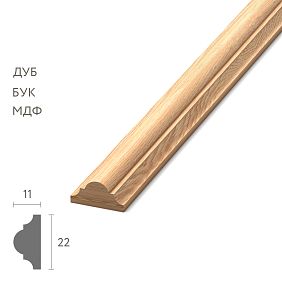
This exact profile is found on theMLD-019 moldingfrom STAVROS: 17×12 mm cross-section, quarter-round. Compact, yet flawless in precision.
Rectangular molding (bead, glazing bar) — a clean rectangle. Sharp or slightly rounded edges. For Scandinavian style, minimalism, loft. Creates a clear, geometrically strict boundary.
Stepped molding — several horizontal ledges in the cross-section. Each ledge is an additional shadow line. Used in neoclassical, modern classic styles. For framing large fronts of kitchen sets or bedroom cabinets.
Molding with a cavetto — a concave arc instead of or in addition to convex elements. A concave profile creates a 'dark shadow'—a deeper relief, characteristic of classic styles.
Molding with fillets and coves — a complex cross-section combining several elements: flat sections, cavettos, straight edges. This is a high-detail profile—for formal furniture, libraries, studies.
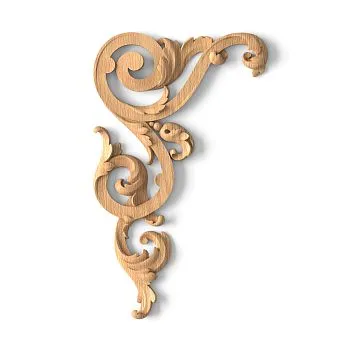
Carved molding is a base profile with applied ornamentation: egg-shaped forms (ovolos), acanthus leaves, rosettes, dentils. This is no longer just millwork—it is sculptural decor. Suitable for Baroque, Renaissance, and Neo-Russian styles.
By width and proportions
Molding width — from 10 to 150+ mm. Selection principle: the width of the molding should be proportional to the area of the framed element.
| Molding width | Application | Style |
|---|---|---|
| 10–20 mm | Thin framings, small furniture details | Minimalism, classic |
| 20–40 mm | Cabinet fronts, wall panels | Modern Classic |
| 40–70 mm | Large fronts, mirrors, mantel shelves | Neoclassical |
| 70–100 mm | Wall panels in high-ceiling rooms | Classicism, Empire |
| 100–150 mm | Architectural elements, columns | Baroque, formal classicism |
STAVROS Molding Catalog: actual items
In the catalogof wooden moldingsSTAVROS — 30+ standard items:
| Article | Price from | Characteristic |
|---|---|---|
| MLD-001 | 210 р. | Basic thin profile |
| MLD-027 | 340 р. | Classic minimalist profile |
| MLD-004 | 330 р. | Thin universal profile |
| MLD-002 | 420 р. | Profile with a curve |
| MLD-020 | 490 р. | Medium profile |
| MLD-059 | 530 р. | Profile with detailing |
| MLD-056 | 560 р. | Compact classic profile |
| MLD-003 | 600 р. | Medium complexity profile |
| MLD-019 | 600 р. | Quarter-round 17×12 mm |
| MLD-018 | 620 р. | Profile with a bead |
| MLD-051 | 670 р. | Expressive profile |
| MLD-057 | 670 р. | Profile with relief |
| MLD-014 | 690 р. | Profile with detailing |
| MLD-012 | 710 р. | Molding with ornamental relief |
| MLD-026 | 700 р. | Architectural profile |
| MLD-038 | 760 р. | Profile with multi-stage cross-section |
| MLD-011 | 880 р. | Representative profile |
| MLD-028 | 920 р. | High-detail profile |
| MLD-046 | 960 р. | Extended profile |
| MLD-015 | 1 050 р. | Complex profile molding |
| MLD-054 | 1 190 р. | Profile with rich relief |
| MLD-016 | 1 320 р. | Wide architectural profile |
| MLD-055 | 1 040 р. | Medium complexity profile |
| MLD-024 | 2 430 р. | Wide complex profile |
| MLD-060 | 2 150 р. | Representative molding |
All products are made from solid oak or beech, moisture content 8–12%, in white acrylic primer. MDF — upon request.
How to attach furniture moldings: complete guide
Glue or nails: selection principle
Moldings for furnitureare attached in two main ways — with glue and mechanically. The choice depends on load, base material, and need for disassembly.
Adhesive attachment — the main method for furniture fronts, wall panels, decorative frames. Used:
-
PVA D3 — for interior applications, wood to wood or wood to MDF. Tensile strength after curing — 8–12 MPa.
-
Polyurethane adhesive — for wood to concrete/drywall joints, in high humidity conditions.
-
"Liquid nails" (construction adhesive) — for decorative wall moldings: fast, reliable, no clamps needed.
Mechanical attachment — in cases requiring high strength or disassembly capability:
-
Pneumatic pins (micro pins 0.6×10 mm) — for thin moldings on fronts: invisible, fast.
-
Countersunk head screws — for mounting larger profiles through the back wall of the element.
-
Hidden clips — for moldings on wall panels that are intended to be removable.
Mounting molding on furniture front: step by step
Step 1: Front preparation. The front surface must be flat, clean, free of grease and dust. If the front is MDF or chipboard — lightly sand the gluing area with P180 abrasive for better adhesion. Mark the molding position with a pencil.
Step 2: Corner cutting. For rectangular frames (panel framing) — cut ends at 45° on a miter saw. Accuracy: ±0.1°. Profiles are checked with dry assembly (without glue) before fixing — "fitting".
Step 3: Applying glue. PVA is applied in a thin, even layer to the molding end and the front surface in the contact area. Polyurethane adhesive — in a zigzag along the profile length. "Liquid nails" — in dots every 150–200 mm (or zigzag for long runs).
Step 4: Fixing. Press the molding to the surface for 10–15 seconds, then remove and let the glue "open" for 3–5 minutes (for construction adhesive). Press firmly into final position. When using PVA — secure with clamps for 1–2 hours.
Step 5: Corners. After glue curing — check corner joints. Small gaps (up to 0.5 mm) are filled with wood putty of matching tone.
Mounting molding on walls: wall panel system
furniture moldingsin interior applications create classic boiserie — panel systems with frame compositions.
Mounting algorithm:
-
Mark a horizontal line at 900–1000 mm from the floor — this is the "chair rail", dividing the wall.
-
Select rectangular section size: width 500–900 mm, height — according to actual lower zone height.
-
Apply marking for each frame on the wall using a laser level.
-
Cut moldings at 45° for each of the four sides of the frame.
-
Mount using construction adhesive or 'liquid nails'.
-
After drying — fill the joints with putty, sand, final painting.
Wooden Molding vs Polyurethane Molding: What's the Real Difference
This question arises for everyone choosing molding for an interior. The honest answer — each material has its own niche.
Wooden Molding: Living and Eternal
Solid oak or beech is a material with soul. Under a transparent finish, it lives: changes shade depending on the light angle, shows the grain pattern, breathes. This is something no artificial material can replicate.
Wooden molding can be restored: scratched — sanding, repainting. It holds screws and nails — anywhere, without breaking. It can be cut with any tool: saw, router, chisel — and the result will be precise. Service life with proper care — 30–50 years or more.
Limitations: sensitive to humidity (especially beech), costs more than PU alternatives, requires acclimatization before installation.
Polyurethane Molding: Lightweight and Moisture-Resistant
Polyurethane is a synthetic material based on foamed PU. Lightweight, moisture-resistant, does not react to temperature fluctuations. Optimal for facade application, for bathrooms, for rooms with unstable climate.
Main limitation: polyurethane cannot be restored by sanding — only by painting. It does not hold mechanical fasteners (screws, nails) — only adhesive. Under load, it deforms. Tactilely and visually — synthetic: no living texture, no warmth of wood.
Final Comparison
| Parameter | Wooden Molding | Polyurethane Molding |
|---|---|---|
| Durability | 30–50 years | 15–20 years |
| Restorability | Yes, multiple times | Only repainting |
| Moisture resistance | Medium (oak is better) | High |
| Tactile | Warm wood | Synthetic |
| Living texture | Yes (under clear varnish) | No |
| Fastening | Adhesive + mechanical | Adhesive only |
| Outdoor application | Limited | Yes |
| Price | Medium–high | Low–medium |
| Ecological | Natural material | Synthetic |
Conclusion: for interior furniture and wall panels in residential spaces — definitely wooden molding. For facade decor and wet areas — polyurethane. STAVROS produces both options:solid wood millworkandfull catalog of polyurethane decor.
Molding finish options: painting, staining, oil
Choosing a coating system: key questions
Before opening a paint can — three questions. First: do you want to preserve the wood grain? Second: what color to paint — white, wood-tone stain, or RAL color? Third: usage conditions — kitchen, bathroom, bedroom?
Transparent finishes: oil, wax, varnish
Oil — penetrates wood pores, nourishes fibers, creates a matte finish. Maximally emphasizes the grain. The surface "breathes," localized repair if damaged. Renew every 2–3 years.
Application technique: dust removal → applying oil with brush or cloth → wait 15–20 minutes → remove excess → dry 24 hours.
Oil-wax — adds a protective layer. Velvety, matte surface. Ideal for furniture that is touched by hand.
Polyurethane varnish — film-forming coating. Maximum protection against moisture and mechanical damage. Sheen — from matte to high gloss. For oak molding, preliminary shellac-based sealer (blocks tannins that bleed through light varnishes).
Technique: dust removal → shellac sealer (for oak) → sanding P320 → first coat of varnish → dry 4–6 h → sanding P400 → second coat → dry 24 h.
Opaque coatings: enamel in white or RAL
White enamel — the most popular option for classic moldings in modern interiors. Oak or beech molding under white enamel looks just like polyurethane — but lasts three times longer and holds fasteners five times better.
Proper painting technique for wooden molding under enamel:
-
Surface dust removal
-
Shellac sealer (mandatory for oak, recommended for beech)
-
Sanding P240
-
First coat of acrylic enamel — diluted 10% with water for penetration
-
Drying 4–6 hours
-
Sanding P320
-
Second final coat undiluted
-
Drying 24 hours
Staining: change color, preserve grain
Stains (water-based, alcohol-based, oil-based) penetrate wood and change its tone without hiding the pattern. Oak stains excellently: from light "natural oak" to dark "wenge" — with equal uniformity. Beech — neutral, accepts any stain without streaking.
Important: wood can only be darkened, not lightened. If a lighter tone than natural is needed — only enamel.
After staining — must be sealed with varnish or oil: stain itself provides no protection, only color.
MLD-019 Molding: characteristics of the reference mini-profile
The MLD-019 profile deserves special attention — it illustrates what a "precision tool" is in the world of wood millwork.
Characteristics: Cross-section 17×12 mm, quarter-round profile. Material: oak, beech, or MDF. Length: 2,400 mm (beech, MDF), 2,600 mm (MDF). Geometry tolerance: ±0.2 mm. Moisture content: 8±2%.
What this molding is optimal for:
-
Framing small furniture panels (frame width up to 40 mm)
-
Closing the gap between the facade and glass insert
-
Rounding internal transitions in case furniture
-
Creating thin decorative lines on wall panels
-
Restoration of historical furniture with authentic profiles
Additional option: rabbet selection according to technical specifications (for orders from 100 pcs., cost 185 rub./pc.) — this allows creating precise seating for glass or plywood inserts.
Caring for wooden moldings
Properly cared for wooden molding requires nothing extraordinary. Weekly wiping with a soft, dry cloth. Wet cleaning — with a slightly damp cloth, without aggressive agents. For moldings with oil finish — applying a thin layer of care oil with a brush or cloth once a year.
If scratches appear: sanding with 320 grit, applying a finishing coat. The lifespan of oak molding with proper finish is 30–50 years.
FAQ: answers to questions about wooden moldings
What is the difference between molding and casing?
Casing — a linear profile for framing door and window openings. Molding — a more versatile decorative element: can be used anywhere — on furniture, walls, ceilings, framing mirrors. In shape and size they often coincide — in the STAVROS catalog, a number of items are directly designated as 'molding/casing'.
Can molding be glued to drywall?
Yes — with mounting polyurethane adhesive ('liquid nails'). Load per linear meter with such installation — up to 8–10 kg on a proper surface. For heavy moldings (wider than 80 mm) — additionally, a hidden screw into the drywall every 400 mm.
Does wooden molding need to be primed before installation?
It all depends on the finishing plan. If the molding will be painted together with the surface after installation — priming can be done after. If the molding is painted separately and then installed — prime before installation, finish after installation (to close the joints).
Which molding to choose for a kitchen set?
For kitchens — preferably MDF or oak with polyurethane varnish. Beech is slightly less stable in the humid kitchen environment. Profile width — according to the scale of the facades: for standard facades 300–600 mm wide — molding 20–40 mm.
How to calculate the number of moldings for a wall panel system?
Break down each wall into rectangular sections. Perimeter of each section = (width + height) × 2. Sum the perimeters of all sections. Add 15% for corner cuts. Divide by the profile length (usually 2.4 m) — you'll get the number of pieces.
What are 'Standard' and 'Prestige' in the STAVROS catalog?
'Standard' — machine sanding, ready for finishing. 'Prestige' — additional hand sanding up to P240 grit: the product requires no additional processing before painting. For furniture production with high surface requirements — 'Prestige'.
Can I order molding with a non-standard cross-section?
Yes. STAVROS accepts orders for non-standard profiles with a run of at least 50 linear meters. Production time for an individual profile — 10–14 working days.
STAVROS: solid wood moldings — 30+ profiles constantly in stock
STAVROS — a manufacturer with a history that began in 2002 with a workshop for carved products and grew into a full-scale production of architectural decor. In its portfolio — reconstruction of the Konstantinovsky Palace, work with the Hermitage, Alexander Palace, Trinity-Izmailovsky Cathedral. These are not just marketing facts — this is an understanding of what detailed accuracy and stylistic unity mean.
In the catalog — 30+ itemsof wooden moldingsfrom 210 to 2,430 rubles. Oak, beech, MDF — in white acrylic primer. Two quality classes of sanding: 'Standard' and 'Prestige'. Two types of regluing: 'for enamel' and 'for tinting'.
In addition to moldings:Wooden skirting boardsfor floor transitions,Ceiling cornicesfor the upper wall zone,decorative battensfor accent walls,balusters and stair componentsfor a unified wooden house system,Wooden Furniture Handlesas a final accent for furniture in classic or modern style. Shipping from 1 piece. Delivery across Russia. Showrooms in Moscow and Saint Petersburg.