Article Contents:
- Density of elements and visual weight
- Planks and sanded strips — rough geometry
- Laying — fine geometry
- Stud — control of micro-level
- Wooden profile — dynamics of lines
- Beech and oak: combination of densities
- Skirting as final stabilizer
- Compositions for different room scales
- Conclusion: STAVROS system for multi-level compositions

The interior acquires visual logic when elements of different scales are organized into a hierarchical system.wooden boards and beams, Planed wooden strip, Decorative wooden molding, Oak veneer, wooden trim, Wooden profile, Oak timber beam, Wooden railsandWooden baseboard— these are elements of different installation density, creating a visual composition ranging from large structural accents to the finest details that control the perception of space.


Density of elements and visual weight
What is the density of elements in the context of interior finishing? It is not a physical characteristic of wood measured in kilograms per cubic meter, but a visual parameter — the number of linear elements per unit area of wall or volume of room. Large density — when elements are installed with large intervals, creating a sparse structure dominated by voids. Small density — frequent installation of elements with minimal gaps, forming a dense structure dominated by material.
Visual weight is determined not only by the size of individual elements, but also by the density of their placement. Three massivebeech beamswith a cross-section of 100×100 millimeters, installed on a 4-meter-long wall with an interval of 120 centimeters, create large density and light visual weight due to large gaps. Twenty thin strips with a cross-section of 20×40 millimeters, installed on the same wall with an interval of 20 centimeters, create small density and heavy visual weight, despite the smaller cross-section of individual elements.
Density controls the perception of scale. Large density (large elements with large intervals) creates a monumental scale, suitable for spacious rooms with high ceilings. Medium density (medium elements with medium intervals) forms a human scale, typical for standard-sized living rooms. Small density (thin elements with small intervals) creates an intimate scale, working in compact spaces — offices, bedrooms, boudoirs.
Visual weight is distributed in space through a combination of elements of different densities. The lower part of the wall is finished with large density —Wooden baseboard— vertical strips with a cross-section of 40×60 millimeters spaced 80 centimeters apart. The upper part — small density, thinWooden railsdecorative wooden lathes— form a frequent grid under the ceiling.— form a frequent grid under the ceiling.
Such distribution creates a visual pyramid, where mass is concentrated at the bottom, gradually lightening towards the top. This corresponds to the natural logic of construction — foundations are heavier than walls, walls heavier than roofs. Even in interiors where there is no real structural necessity, this visual logic works on a psychological level, creating a sense of stability and reliability of space.
Inverted pyramid — heavy elements at the top, light at the bottom — creates visual tension characteristic of avant-garde interiors. A massive cornice 150 millimeters wide with a thin skirting board 40 millimeters high creates a sensation of floating, lightness, but requires careful detailing to avoid the impression of instability.
The density of elements should correspond to the scale of the room. In a small apartment with 2.5-meter ceilings, large density of massive elements will create visual overload — the space will be perceived as cramped, squeezed between large objects. Small density of thin elements in such a space will create visual lightness, expanding the perception of volume. In a spacious room with 3.5–4-meter ceilings, small density of thin elements will be perceived as insignificant detail. Large density of massive elements will create a scale corresponding to the volume.




Planks and sanded strips — rough geometry
wooden boards and beamsandPlaned wooden strip— these are elements of rough geometry that form the basic composition structure. Rough geometry is not primitiveness or low-quality processing, but large-scale elements and simple forms that create expressive tectonics.
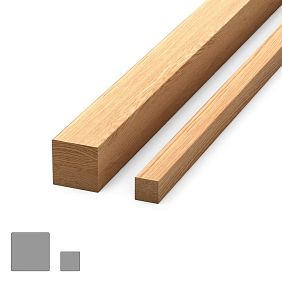
A block is a plank with a square or nearly square cross-section: 40×40, 50×50, 60×60, 80×80, 100×100 millimeters. A square cross-section creates visual stability — the element is perceived as massive, constructive, capable of bearing load.wooden boards and beamswith a cross-section of 80×80 millimeters, installed vertically with a spacing of 150 centimeters, create a support structure that visually supports the ceiling.
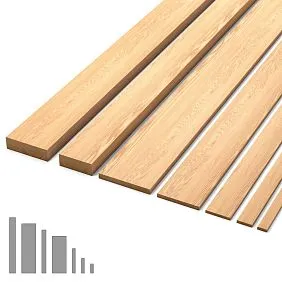
A planed board is a plank with a rectangular cross-section with a side ratio from 1:1.5 to 1:3: cross-sections of 40×60, 50×80, 40×120 millimeters.Planed wooden stripcreates directional geometry — vertical installation (narrow face against the wall) emphasizes height, horizontal installation — width. A planed surface ensures a clean edge without burrs or irregularities, which is critical for elements installed in visible locations.
Rough geometry works through the contrast of mass and void. Massive blocks create zones of material concentration — vertical or horizontal strips that attract the eye. Gaps between blocks form voids, perceived as air, space, lightness. The ratio of mass to void determines the character of the composition.
Ratio 1:1 — the width of the block equals the width of the gap. A 80 mm block with an 80 mm gap creates a balanced structure where material and air are equal. Such a composition is perceived as harmonious, without dominance of density or sparsity. Ratio 1:2 — a 60 mm block with a 120 mm gap forms a light structure with dominance of void. Ratio 2:1 — a 100 mm block with a 50 mm gap creates a dense structure with dominance of material.
The rough geometry of blocks is emphasized by wood texture.Oak timber beamwith its fine-grained, uniform texture, creates a calm surface where form dominates over pattern. A oak block with pronounced annual rings forms an active surface, where texture competes with form for visual attention. A planed block (with selected soft fibers) acquires a relief surface, enhancing materiality.
Block attachment to the wall is done discreetly — on metal brackets, anchors, or adhesive with mechanical fixation. Visible fastening disrupts the purity of rough geometry. The block should be perceived as a constructive element, not as a decorative overlay nailed with nails.
Functionality of rough geometry —wooden boards and beamscan serve not only as decorative but also as utilitarian elements. Shelves, lights, and hooks for clothing are mounted on vertical blocks. Horizontal blocks function as cornices, thresholds, or guides. Rough geometry combines visual expressiveness with practical utility.
Our factory also produces:


Layout — fine geometry
Decorative wooden moldingandOak veneer— are elements of fine geometry that create detail in the structure defined by the rough geometry of blocks. Fine geometry — planks 20–40 millimeters wide and 6–12 millimeters thick — form a graphic layer of the composition.
Layout works like a line on a drawing — it marks a boundary, divides a plane, creates a contour, but does not form a volumetric mass. A thickness of 6–10 millimeters is insufficient to create an expressive relief, but sufficient to form a thin shadow line under side lighting. This shadow line turns a flat plank into a visual accent.
Oak veneerdue to contrasting texture, creates visual weight disproportionate to its physical cross-section. A fine oak layout 30 millimeters wide with pronounced annual rings attracts attention as effectively as a massive 60×60 mm block made of wood with an unpronounced texture. Texture compensates for scale.
Fine geometry creates grids — rectangular, square, diagonal. Vertical layouts divide the wall into vertical sections 80–120 centimeters wide. Horizontal layouts divide each section into horizontal tiers 60–90 centimeters high. This results in a modular grid, where each cell can be filled with contrasting color, texture, or material.
Layout aligns with rough geometry through proportions. If the basic structure is created by blocks with a cross-section of 80×80 millimeters, then layouts should have a width equal to 1/2, 1/3, or 1/4 of the block’s width: 40, 27, or 20 millimeters. This proportion creates visual harmony, where fine geometry is perceived as detail of rough geometry, not as an independent layer.
The profile of the layout affects the character of fine geometry. A flat rectangular layout creates a strict graphic line, characteristic of modern minimalist interiors. A beveled layout (angled edge at 45 degrees) adds dynamism, creating a transition from the wall’s plane to the layout’s plane. A rounded layout (convex rounded edge) forms a soft plasticity, characteristic of classical interiors.
Layout installation requires precise marking. Thin elements do not tolerate deviations — a 3–5 millimeter displacement is noticeable to the eye and disrupts the visual logic of the grid. Layouts are attached with adhesive or finishing nails 25–30 millimeters long, which are sunk 1–2 millimeters below the surface and spackled. Visible fastening is not allowed — it turns a graphic line into a technical detail.
The color of the layout determines its role.Decorative wooden moldingin tone with the wall works delicately, creating subtle division through shadow lines. Contrasting layout (dark on light wall, light on dark wall) works as an active graphic element, emphasizing the composition’s geometry.
Get Consultation
Sticker — control at the micro-level
wooden trim— is an element of minimal cross-section (usually 10×12 or 12×15 millimeters) that operates at the micro-level of composition, fixing small details and creating clean execution. If blocks are large-scale, layouts are medium-scale, then the sticker is micro-scale, completing the hierarchy of elements.
Micro-level control — the ability to manage details less than 20 millimeters, critical for the perception of finish quality. A 2 mm gap between the panel and the facade frame, a 3 mm gap between glass and casing, a 1 mm misalignment at a corner joint — all these are micro-defects that destroy the impression of expensive finishing. The sticker solves these problems.
The main function of the sticker is to fix thin inserts (glass, mirror, panel) in grooves of frames and profiles. A panel 6–8 mm thick is inserted into a groove (slot) of a frame made ofoak layoutFrom the front, the panel is fixed by the sticker, which presses it and simultaneously creates a decorative border 10–12 mm wide. Without a sticker, the panel holds only in the groove, which is unreliable — under vibration, it may fall out.
The sticker for glass works similarly. Glass 4–6 mm thick is inserted into a groove of a door frame or window frame with a 2–3 mm gap around (to compensate for wood expansion). The sticker presses the glass through a soft gasket (silicone sealant, rubber tape), distributing pressure evenly. The sticker is fastened with finishing nails 20–25 mm long or adhesive.
Visual micro-level control — the sticker creates a neat contour around glass and panel inserts, completing the composition. Without a sticker, the edges of the panel or glass are visible, creating a sense of incompleteness. A 10–12 mm wide sticker forms a frame that visually separates the insert from the frame, emphasizes the boundary, and creates clean execution.
The profile of the sticker can be simple (rectangular cross-section with a rounded front face for softer contact) or decorative (with a rounded edge, bevel, or groove). A decorative sticker creates a more expressive contour, suitable for classical interiors. A simple sticker works in modern minimalist styles, where restraint in details is important.
A hardwood stopper — oak or beech — possesses the necessary strength for secure fixation. An oak stopper does not bend when pressed against glass, ensuring even pressure along its entire length and retaining its shape for decades. A stopper made of softwood (pine, linden) may deform, leading to weakened fixation and gaps.
Micro-level control applies to all joints and connections. Corner joints of layouts, profile junctions to skirting boards, vertical and horizontal element connections — all these are nodes where execution quality is determined to the precision of fractions of a millimeter. The stopper, used to cover technological gaps and fix elements, ensures this precision.
Wooden profile — line dynamics
Wooden profile— is an element of variable cross-section that creates line dynamics through shape variation along its length or through complex cross-sectional geometry. Unlike constant rectangular-section battens and strips, the profile has curved edges — rounds, ridges, bevels, chamfers — that form a pliable surface.
Line dynamics is created through the interplay of light and shadow on the profiled surface. The convex part of the profile (ridge, chamfer) catches light, forming a bright stripe. The concave part (round, groove) is immersed in shadow, creating a dark line. The alternation of light and shadow along the profile’s length forms visual motion that directs the gaze along the element.
Wooden profile— is used to create transitions between planes — from wall to ceiling (ceiling cove), from wall to floor (profiled skirting), from door frame to wall (door casing), from one wall level to another (horizontal divider profile). The profile softens the rigidity of right angles, creating smooth visual transitions.
Dynamics is created not only through profiling but also through changes in installation orientation. A horizontal profile at 90 centimeters from the floor creates horizontal dynamics, expanding the space. A vertical profile at room corners forms vertical dynamics, increasing perceived height. A diagonal profile (rare but effective) creates directional movement, characteristic of avant-garde interiors.
The profile coordinates with other elements through repetition of plastic motifs. IfWooden baseboard— has a chamfer at the top, the ceiling cove may have a similar chamfer at the bottom, creating a visual frame for the room. IfOak veneer— has a bevel, the door profile must also have a bevel of the same angle.
Profile width determines the strength of dynamics. A narrow profile of 30–50 millimeters creates a delicate dynamic line, suitable for modern interiors. A wide profile of 80–120 millimeters forms powerful dynamics, characteristic of classical styles with active architectural plasticity.
The profile can be installed as a surface-mounted element (adhered to wall or furniture surfaces) or as a structural element (part of the construction, e.g., door frame). Surface-mounted profiles function as decorative layers, while structural profiles serve as both structural and decorative elements.
Beech and oak: combination of densities
Oak and beech are the two main wood species for manufacturing interior elements, each with its own physical density (mass per unit volume) and visual characteristics. The physical density of oak is 650–750 kg/m³ at 12% moisture, beech — 680–720 kg/m³. Similar density values ensure comparable performance characteristics — strength, hardness, resistance to deformation.
Visual density refers to the texture characteristic that determines the richness of the visual pattern. Oak has a contrasting texture with pronounced annual rings and medullary rays (radial light bands on tangential cuts), creating a visually dense, rich surface.Oak timber beam— has a fine-grained, uniform texture without sharp contrasts, forming a visually sparse, calm surface.
— with a 40×60 mm cross-section forms visually sparse filling with a calm surface.beech beamsThe contrast of densities creates visual hierarchy without altering the physical scale of elements.
Color contrast enhances the distinction of densities. Natural oak has tones ranging from golden-brown to dark chocolate depending on growing conditions. Beech ranges from light rose to cream-beige. Dark oak against light beech creates maximum contrast, emphasizing texture differences. Oak and beech tinted in similar shades work through subtle texture differences within a unified color palette.
Functional combination — oak elements are used in high-load and high-humidity zones (skirting, door frames, countertops), while beech elements are used in decorative zones with lower load (layouts, vertical battens on walls, furniture facades). Oak has greater moisture resistance due to tannins in its structure, while beech is more hygroscopic and requires careful moisture protection.
Surface treatment reveals density differences. Oak treated with oil reveals the full depth of texture — annual rings become raised, medullary rays glow. Beech treated with oil retains uniformity, creating a silky surface without sharp contrasts. Brushed oak (with selected soft fibers) acquires a pronounced relief of 1–2 mm depth, enhancing visual density. Brushed beech gives minimal relief due to its uniform structure.
Density combination is built on the principle of balance. If visually dense oak dominates (more than 60% of area), the interior is perceived as rich, active, and attention-demanding. If visually sparse beech dominates, the space becomes calm, neutral, and comfortable for prolonged stay. Equal proportion (50/50) creates a balanced composition where activity and calm are balanced.
Skirting as final stabilizer
Wooden baseboard— is not merely a technical element covering the gap between wall and floor. It is the final stabilizer of the composition, linking all vertical elements (battens, strips, layouts, profiles) into a unified system, grounding them, and creating visual support.
Stabilization is achieved through several mechanisms. Physical stabilization — skirting protects the lower ends of vertical elements from mechanical damage, moisture, and dirt.wooden boards and beams— installed vertically from the floor, have a lower end that contacts the floor and is subject to wear from cleaning, vacuum cleaner impacts, and moisture during wet cleaning. A 80–100 mm high skirting covers the lower part of verticals, creating a protective barrier.
Visual stabilization — skirting creates a horizontal base line from which all upper elements are measured. VerticalWooden rails— installed on the wall without skirting, appear suspended in air, lacking support. The same battens, installed from skirting upward, appear to stand on a solid base, creating a sense of stability.
Compositional stabilization — skirting completes the vertical composition, creating the lower boundary. Without skirting, the composition is open at the bottom, incomplete, requiring continuation. Skirting closes the composition, telling the viewer: 'here ends the vertical, and here begins the horizontal floor.' This creates visual calmness and a sense of completion.
Skirting height determines the strength of stabilization. A wide skirting of 100–150 mm height creates a powerful support, suitable for compositions with massive elements —wooden boards and beamsProfiles with a cross-section of 80×100 millimeters require a proportionally matching skirting board. A narrow skirting board with a height of 40–60 millimeters creates a light support for compositions with thin elements —Decorative wooden moldingA width of 30 millimeters matches a minimalist skirting board.
The skirting board profile must match the profiles of other elements. If the verticalWooden railshave a bevel, the skirting board must also have a bevel of the same angle. IfWooden profilehorizontal elements have a chamfer, the skirting board may have a chamfer at the top, creating visual continuity.
The color of the skirting board as a stabilizer can be of three types. In the floor tone — the skirting board visually expands the floor plane, making the room appear wider. In the wall tone — the skirting board visually increases the wall height, making the room appear taller. Contrasting — the skirting board acts as a graphic accent, clearly separating vertical and horizontal planes.
Stabilization is completed with final finishing.wooden skirting board purchaseIt can be left unfinished for subsequent painting or tinting on the object. Or with factory-applied final finish (oil, varnish, paint), ready for installation. A unified final finish on the skirting board and vertical elements enhances the stabilizing effect — all elements are perceived as parts of a single structure.
Compositions for different room scales
The room scale determines the selection of elements and their installation density. A small-scale room (area up to 15 square meters, ceiling height 2.5 meters) requires a composition of elements with fine and medium density.Planed wooden stripWith a cross-section of 30×40 millimeters, installed vertically with a 60-centimeter spacing, creates a light rhythm that does not overload the space.Decorative wooden moldingWith a width of 25 millimeters, forms a delicate grid that details the wall without visual pressure.Wooden baseboardWith a height of 60–70 millimeters, creates a basic line that does not consume height.
A medium-scale room (area 15–30 square meters, ceiling height 2.7–3 meters) allows using elements of medium and large density.wooden boards and beamsWith a cross-section of 50×50 or 60×60 millimeters, installed with a 100–120 centimeter spacing, creates an expressive structure.Oak veneerWith a width of 35–40 millimeters, forms a grid with 80×100 centimeter cells.Wooden baseboardWith a height of 80–100 millimeters, creates a solid support.
A large-scale room (area over 30 square meters, ceiling height from 3.5 meters) requires elements of large density.wooden boards and beamsWith a cross-section of 80×80 or 100×100 millimeters, installed with a 150–200 centimeter spacing, creates a monumental structure.Oak timber beamWith a cross-section of 100×100 millimeters, acts as a column, forming an architectural scale.Wooden baseboardWith a height of 120–150 millimeters, creates a plinth zone proportional to the room height.
Combined composition — combining elements of different densities in one room — creates visual hierarchy. Accent walls are treated with large density — massivewooden boards and beamswith a cross-section of 80×80 millimeters at a 120-centimeter spacing. Other walls — medium density, verticalWooden railswith a cross-section of 40×60 millimeters at an 80-centimeter spacing. Detailing — fine density,Decorative wooden moldingcreates a grid over the battens.
Vertical density gradation — from bottom to top, elements become thinner and more frequent. Lower tier (up to 90 centimeters) — large density, massiveWooden baseboardand vertical beams with a cross-section of 80×80 millimeters. Middle tier (90–210 centimeters) — medium density, battens with a cross-section of 50×60 millimeters. Upper tier (210 centimeters to ceiling) — fine density, thin battens form a dense grid. Such gradation creates visual lightness at the top while maintaining solidity at the bottom.
Horizontal density gradation — from center to periphery, elements become thinner. Central part of the wall (width 150–200 centimeters) is treated with large density — massive vertical elements form a focal zone. Side parts — medium and fine density, creating a background. The gaze is fixed on the center, where visual weight is concentrated.
Conclusion: STAVROS system for multi-level compositions
Creating compositions of different densities requires a coordinated system of elements of all scales — from massive beams to the thinnest skirting boards. STAVROS company offers a full range of materials:wooden boards and beamscross-section from 40×40 to 100×100 millimetersPlaned wooden striprectangular cross-sectionDecorative wooden moldingwidth of 20–40 millimetersOak veneerfor contrasting solutionswooden trimfor the micro-levelWooden profilefor dynamic linesOak timber beamand oak beams for structural accentsWooden railsof various speciesWooden baseboardas a compositional stabilizer
Production of trim elementsSTAVROS ensures consistent cross-sections — a critical parameter for creating compositions with precise geometry. Each element is manufactured on CNC machines with a deviation of no more than 0.3 millimeters, guaranteeing perfect alignment during assembly. The wood undergoes kiln drying to a moisture content of 10–12 percent, minimizing deformation after installation.
wooden skirting board purchasein STAVROS, you can choose from various profiles and heights — from minimalist 40 millimeters to classic 150 millimeters.Buy wooden planksavailable in standard lengths of 2.1–3 meters or custom lengths up to 6 meters. All elements from the same batch of wood ensure matching color and texture.
The company offers consultation from specialists in designing multi-level compositions, material calculation for a complete set of elements of all scales, recommendations for installation and finishing. Custom cross-sections for individual projects are also possible.
Compositions of different densities — this is architectural thinking, where each scale has its place, and each element has its role in shaping the space. STAVROS creates materials for such thinking, transformingwood trim itemsinto tools for creating interiors where structure and decoration are inseparable, where visual weight is controlled, and where every line — from massive beams to delicate strips — contributes to forming a cohesive composition.