Article Contents:
- New Reality: What Has Changed Over the Past Three Years
- Numbers That Speak for Themselves
- Import Substitution: From Shortage to Abundance
- Materials: Revolution in Board Material Production
- Solid Wood: Renaissance of a Traditional Material
- Oak and Beech: Kings of Russian Furniture Production
- Solid Wood Furniture Decor: From Utility to Art
- Carving Technologies: From Handcraft to Digital Design
- Case Furniture 2026: Smart, Flexible, Personalized
- Production Digitalization: From Order to Delivery
- Sustainability: From Marketing to Real Practice
- Carbon Footprint: Local Production Beats Import
- Design: From Copying to Creating Own Language
- Premium Segment: Growing Demand for Exclusivity
- Regional Development: Furniture Clusters of Russia
- Export: Russian Furniture on the Global Market
- Challenges and Risks: What Could Slow Growth
- Future Technologies: What Will Define the Market in 2027-2030
- STAVROS's Role in the New Reality of the Russian Furniture Market
- Import Substitution in Action
- STAVROS Furniture 2026
- Frequently Asked Questions
- Conclusion: The Era of Russian Furniture

The Russian furniture industry is experiencing a moment that can be called historical without exaggeration.Furniture Market 2026is radically different from what it was just five years ago. Geopolitical shifts, disruption of familiar supply chains, sanctions pressure — all of this could have become a catastrophe for the industry. Instead, something incredible happened: Russian manufacturers not only survived, they became stronger, smarter, more technological. Import substitution transformed from a forced necessity into a development strategy, and local production proved its ability to compete with global leaders in all parameters.


New Reality: What Has Changed Over the Past Three Years
Three years ago, the Russian furniture market was deeply integrated into global supply chains. Italian hardware, German machinery, Chinese components, Polish particleboard — all of this seemed like an unshakable foundation of the industry. The events of 2022-2023 destroyed this system in a few months. Logistics collapsed, prices skyrocketed, familiar suppliers disappeared from the market.
The first reaction was panic. Many small manufacturers closed, unable to adapt. But large and medium players did what a strong organism always does in a crisis — they evolved. Investments poured into Russian production. Machinery that previously seemed too expensive suddenly became economically justified. Technologies that previously had no time for implementation became critically necessary.
The result exceeded expectations. By early 2026, Russia had not merely replaced imports—it had created its own furniture ecosystem capable of producing world-class products.Solid Wood Items, case furniture,Furniture decor, hardware—all of this is now produced domestically, with quality often surpassing imported counterparts.




Numbers that speak for themselves
The volume of Russian furniture production grew by 34% in 2025 compared to 2022. Furniture exports increased by 18%—Russian products are going to CIS countries, Asia, and the Middle East. The share of imports in total consumption decreased from 42% to 19%. Investments in production modernization reached a record 87 billion rubles.
These numbers are not statistics for the sake of statistics. This is real money, real jobs, real quality that the end consumer receives. The Russian furniture industry created over 45,000 new jobs in three years, opened 230 new production sites, and launched 1,200 new product models.
Our factory also produces:


Import Substitution: From Shortage to Abundance
The first stage of import substitution was painful. Replacing imported components with Russian counterparts often meant compromises in quality. Drawer slides were louder, hinges wore out faster, laminated chipboard had less durable finishes. But this did not last long.
Russian manufacturers of hardware and components received a powerful incentive for development. Money that previously went abroad remained within the country and was reinvested in technology. New factories for producing furniture hinges, slides, and lifting mechanisms emerged. The level of technology grew rapidly.
By 2026, Russian furniture hardware matches European in reliability and functionality. Moreover, it often surpasses imports in adaptability to Russian conditions. For example, mechanisms for sofa beds are designed for more intensive use—Russian consumers transform furniture more often than Europeans. Hardware for kitchens accounts for the specifics of Russian cuisine with its abundance of steam and high temperatures.
Get Consultation
Materials: A Revolution in Panel Material Production
Laminated chipboard, MDF, plywood—these materials form the basis of case furniture. Previously, a significant portion of panel materials was imported or produced on imported equipment with imported resins and films. Today, the picture is different.
Russian enterprises have established production of E0.5 class laminated chipboard—with minimal formaldehyde emission, meeting the strictest European standards. The quality of lamination has reached a level where the patterns of Russian laminated chipboard are indistinguishable from Austrian or German ones. The color palette has expanded to 500+ patterns, including imitations of exotic wood species, stone, concrete, and fabrics.
Russian-produced MDF is now used not only in budget but also in premium furniture. High-density MDF for milled fronts, moisture-resistant MDF for kitchens and bathrooms, ultra-light MDF for transformable furniture—all of this has been mastered and is produced in Russia.
Solid Wood: The Renaissance of a Traditional Material
Paradoxically, the technological leap in case production is accompanied by a renaissance of the most ancient material—solid wood. In 2026, demand for furniture and decor made from natural solid wood is growing at an accelerated pace. Why?
First, fatigue from synthetics. Decades of dominance by chipboard and plastic have created a demand for naturalness, tactility, and the liveliness of a material. Wood breathes, smells, ages nobly—it is alive. This is something no composite can provide, no matter how high-quality it is.
Second, environmental awareness. The consumer of 2026 is informed and demanding. They know about formaldehyde in chipboard, microplastics in synthetic coatings, and the carbon footprint of imported materials. Solid wood from Russian forests means a short logistics chain, minimal chemicals, and a renewable resource with proper forest management.
Third, processing technologies.Modern Furniture made from solid wood are not crude rustic tables. These are high-precision products created on CNC machines, with perfect geometry, complex joinery, and exquisite finishing. Technologies for drying, gluing, and wood protection have reached a level where solid wood does not warp, crack, and lasts for decades without changing shape.
Oak and Beech: The Kings of Russian Furniture Production
Oak is the undisputed leader among species used in Russian furniture production. Its share in the total volume of solid wood used for furniture and decor exceeds 60%. The reasons are clear: oak grows throughout Russia, its wood is exceptionally strong, its grain is expressive, and its color range is wide—from light honey to dark chocolate.
Beech is the second most popular. Softer, with a fine-grained texture, easy to work with, ideal for carved elements, bent parts, and elegant furniture. Beech forests in Russia grow in the Caucasus and Crimea, which creates certain logistical challenges, but demand justifies the costs.
Ash, walnut, larch, cedar—these species are used less frequently, in the premium segment, for exclusive projects. But they too have been mastered by Russian producers, with technological chains established from harvesting to finishing.
Furniture Decor from Solid Wood: From Utility to Art
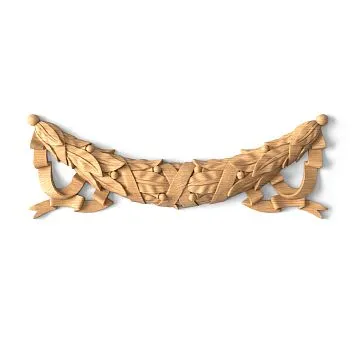
The market for furniture decor—carved overlays, legs, handles, columns, pilasters, cornices—deserves separate mention. Just five years ago, 80% of this product was imported from Italy, Spain, and China. Today, Russian manufacturers control over 70% of the domestic market and are actively entering export markets.
Furniture decor made from solid wood is where technology meets art. CNC machines carve the most complex three-dimensional forms with precision to a tenth of a millimeter, but the final finishing, sanding, and patination are often done by hand. This is hybrid production, where automation creates the foundation, and human craftsmanship adds soul.
Demand for decorative elements made from solid wood is growing not only in classic interiors. Neoclassical, modern classic, eclectic—these styles actively use carved details, but in a more restrained, laconic interpretation. Even in minimalist interiors, accent elements made of wood are appearing—handles, furniture legs, decorative inserts.
Carving Technologies: From Handwork to Digital Design
Traditional hand carving has not disappeared but has transformed. A master carver today often works not with a chisel and gouge, but with a tablet, creating a digital model of the future ornament in a 3D program. This model is sent to a CNC machine, which carves the element from solid wood with fantastic precision. After that, the carver manually refines the part—removes tool marks, adds nuances that cannot be programmed.
This hybrid approach offers the best of both worlds: the speed and accuracy of automation plus the uniqueness and expressiveness of manual work. Costs are reduced, timelines are shortened, but quality and artistic value remain high.
Case Furniture 2026: Smart, Flexible, Personalized
Case furniture — cabinets, dressers, shelving units, kitchen sets — constitutes the main volume of Russian furniture production. And here, radical changes have occurred, related not so much to materials as to the philosophy of production.
Previously, case furniture was produced in large series of standard models. A factory would release a catalog, and the consumer would choose from what was offered. If the dimensions didn't fit — that was the consumer's problem. Today, the logic has flipped: production has become flexible, modular, and personalized.
Most large and medium-sized case furniture manufacturers have implemented configurator systems — programs that allow the consumer, either independently or with a designer's help, to design furniture for a specific space and tasks. To choose dimensions, the number of shelves and drawers, type of fronts, color, and hardware. All of this is transmitted to production, where CNC machines cut parts precisely according to the project.
Digitalization of Production: From Order to Delivery
Digitalization has covered the entire chain — from the first contact with the client to the delivery and installation of the furniture. The client visits the website, creates a project in the configurator, receives a 3D visualization, sees the price, and places an order online. Data is automatically transmitted to production, where the management system initiates cutting, drilling, edge banding, and packaging.
Logistics are also automated: the system calculates the optimal delivery route, and the client receives real-time order tracking. Installers arrive with all the tools and precise instructions, assembling the furniture in a few hours. No errors, no missing parts, no size mismatches.
Such a system requires huge investments in IT infrastructure, personnel training, and integration of different software platforms. But those who have made these investments gain a competitive advantage that cannot be quickly copied.
Sustainability: From Marketing to Real Practice
In 2026, sustainability has ceased to be a marketing slogan and has become a real competitive advantage. Consumers check certificates, ask questions about the origin of materials, and are interested in the carbon footprint. Manufacturers who cannot provide transparent information lose customers.
Russian furniture factories are massively transitioning to eco-friendly technologies. Water-based varnishes and paints instead of solvent-based ones. Formaldehyde-free adhesives. E0.5 and higher class particleboard. Recycling of production waste — sawdust is used to make fuel briquettes, particleboard scraps are shredded and reused.
Solid wood is purchased from suppliers with FSC certification, confirming the legality of harvesting and sustainable forest management. This is not just a piece of paper — it's a guarantee that the tree grew in a forest where logging is compensated by planting, where environmental standards are observed, and where ecosystems are not destroyed.
Carbon Footprint: Local Production Beats Import
One of the most powerful environmental arguments in favor of local production is the carbon footprint of transportation. When furniture is shipped from China or Italy, thousands of kilometers of sea, rail, and road transport create a huge carbon footprint. Furniture produced in Russia from Russian materials and sold to a Russian consumer has a carbon footprint dozens of times smaller.
This argument is especially strong in the premium segment, where buyers are willing to pay more for sustainability. Manufacturers are starting to indicate the product's carbon footprint on labels, creating a new selection criterion.
Design: From Copying to Creating Its Own Language
For many years, Russian furniture design was derivative of European design. Italian, German, and Scandinavian models were copied with minor adaptations. There was virtually no independent design school.
The situation is changing. In 2026, over 300 professional furniture designers work in Russia, many of whom received education at leading European schools but returned to work in their homeland. They create furniture that considers the specifics of the Russian lifestyle, climate, and cultural code.
Collections are emerging, inspired by Russian avant-garde, constructivism, and early 20th-century modernism. Motifs from traditional wooden architecture are used — carving characteristic of northern huts, geometric patterns, natural forms. But all of this is reinterpreted through the lens of modernity, devoid of excessive decorativeness, and functional.
Premium Segment: Growing Demand for Exclusivity
The Russian premium furniture market is growing at an accelerated pace — 22% per year. These are clients for whom price is not paramount, but quality, uniqueness, and service are critical. They want furniture that no one else has, created specifically for them, reflecting their individuality.
For this segment, Russian manufacturers offer a full cycle of individual design. A designer visits the site, studies the space, discusses the client's lifestyle and preferences with them, and creates several concepts. After concept approval, a detailed project is created with 3D visualization, drawings, and specifications. The furniture is manufactured by hand or on CNC machines, but each part undergoes thorough quality control.
Such projects can last for months, cost millions of rubles, but the result is furniture that lasts for decades, is unique, and becomes part of family history.
Regional Development: Russia's Furniture Clusters
Furniture production in Russia has traditionally been concentrated in several regions: Moscow Oblast, St. Petersburg and Leningrad Oblast, Voronezh Oblast. But in recent years, new furniture clusters have emerged.
Tatarstan is actively developing case furniture and upholstered furniture production, investing in modern equipment, and creating educational programs for personnel training. Krasnodar Krai specializes in solid wood furniture, using local beech wood. Altai Krai produces furniture from cedar and larch.
These regional clusters create jobs, develop related industries, and build expertise. The state supports them through subsidized loan interest rates, preferential electricity tariffs, and assistance in promoting products for export.
Export: Russian Furniture on the Global Market
In 2026, Russian furniture is exported to 47 countries. Main destinations are Kazakhstan, Belarus, Uzbekistan, Kyrgyzstan (CIS countries account for 68% of exports), China, Mongolia, Iran, UAE, Turkey. Supplies to Europe have appeared — Serbia, Hungary — where Russian products compete with local ones thanks to a better price-quality ratio.
What do they buy abroad? In the premium segment — solid wood furniture,Classic Furniture, carved decor. In the mid-range segment — case goods, kitchens, upholstered furniture. Russian products are valued for reliability, use of natural materials, and reasonable prices.
Export potential is enormous. Russian furniture production can meet not only domestic demand but also a significant portion of demand in neighboring regions. The obstacles are logistics and certification. But these barriers are gradually being overcome.
Challenges and risks: what could slow growth
Not all is rosy. The Russian furniture industry faces serious challenges that could hinder its development.
The first challenge — a personnel shortage. Machines are available, technology is available, orders are available, but there is a lack of skilled workers and engineers. Young people are not drawn to manufacturing, preferring offices and IT. The average age of a worker at a furniture factory is 47 years. In 10-15 years, these people will retire, and who will take their place?
The second challenge — dependence on imported equipment. Yes, machines are available, but they are Italian, German, Austrian. Spare parts, maintenance, modernization — all of this requires imports. Sanctions could complicate access to critical components. Russia's own machine tool industry has been practically destroyed; restoring it in a short time is impossible.
The third challenge — economic volatility. The ruble exchange rate, the Central Bank's key rate, inflation — all of this affects purchasing power, and therefore the demand for furniture. Furniture is not a necessity; during a crisis, people postpone purchases.
The fourth challenge — competition from China. Chinese furniture is 20-30% cheaper than Russian. Yes, the quality is lower, but for price-sensitive consumers, this is not always critical. If Chinese logistics improve (through Kazakhstan, Mongolia), the flow of cheap furniture could undermine the position of Russian manufacturers in the budget segment.
Future technologies: what will define the market in 2027-2030
Let's look a bit further into the future. What technologies will define the development of the Russian furniture market in the next 3-5 years?
First — artificial intelligence in design. Programs are already emerging that generate dozens of furnishing options based on a photo of a room and specified parameters. AI learns from millions of interior images, understands principles of composition, ergonomics, and stylistic harmony. Soon, a designer will become not an author, but a curator of options proposed by AI.
Second — production robotization. Robotic manipulators are already used for edge banding, packaging, and palletizing. The next step is autonomous mobile robots that will move parts between machines, store finished products, and prepare orders for shipment. This will radically reduce the need for workers, solving the personnel shortage problem, but creating a social problem of unemployment.
Third — new materials. Composites based on natural fibers — flax, hemp, bamboo — mixed with biodegradable polymers. They are stronger and lighter than traditional board materials, fully eco-friendly, but currently expensive. As production scales, the price will decrease.
Fourth — augmented reality in sales. A client puts on AR glasses and sees how furniture will look in their apartment, can change color, size, configuration in real time. This will radically change the sales process, make it more interactive, and reduce the number of returns due to unmet expectations.
The role of STAVROS in the new reality of the Russian furniture market
How does a specific manufacturer fit into the described trends? Let's consider the example of STAVROS — one of the leaders in the Russian market for decor and solid wood furniture.
STAVROS — 23 years of history, over 150 employees, production area of 6000 square meters, 19 CNC machines, its own quality control laboratory. But the numbers don't convey the main thing — the company's philosophy, which perfectly aligns with the market trends of 2026.
First — focus on solid wood. While many competitors chased volume, stamping furniture from particleboard, STAVROS bet on solid oak and beech. This seemed risky — solid wood is more expensive, production is more complex, the cycle is longer. But today, when demand for natural materials is growing explosively, this bet has paid off completely.
Second — technological advancement. STAVROS invested in the most modern equipment — Italian and German CNC machines, allowing for the most complex three-dimensional carving, precise milling, perfect sanding. At the same time, manual finishing is preserved — patination, tinting, final assembly are done by hand by highly skilled craftsmen.
Third — breadth of assortment. STAVROS produces not only furniture, but the entire rangeof decorative elements made of solid — moldings, cornices, baseboards, carved overlays, furniture legs, handles, balusters, posts, columns. This allows designers to create holistic interiors where furniture and architectural decor are executed in a unified style, from one material, by one manufacturer.
Import substitution in action
STAVROS is a vivid example of successful import substitution. Before 2022, a significant portion of decor in Russia was imported from Italy and Spain. Prices were high, delivery times were 6-8 weeks, customization options were minimal. STAVROS created an alternative that matches European counterparts in quality but surpasses them in delivery speed, flexibility, adaptation to Russian standards, and prices.
STAVROS baseboards and cornices are made from selected oak and beech of Russian origin. Geometric precision is achieved through modern planing and milling machines. The finish — water-based varnishes and oils from leading European manufacturers — ensures durability and eco-friendliness. The result is a product that satisfies the most demanding clients, from private customers to elite hotels and restaurants.
Furniture of 2026 from STAVROS
Furniture of 2026 from STAVROS is a combination of classical forms and modern functionality. A classic bed with a carved headboard has built-in lighting and USB ports for charging gadgets. A Baroque-style chest of drawers is equipped with a soft-close drawer system and hidden compartments. A solid oak dining table has an extension mechanism that allows increasing its length by 60 centimeters.
This is modern classicism — respect for the traditions of form, carving, proportions, but also consideration for the realities of modern life. Furniture must be not only beautiful but also convenient, functional, adapted to modern needs.
Frequently asked questions
Is Russian furniture really not inferior to imported furniture now?
In the mid-range and premium segments — yes, it's on par. Russian manufacturers use the same equipment, the same technologies, and often the same materials (hardware, varnishes, fabrics). The price difference is not due to quality, but to the absence of logistics, customs, and exchange rate expenses. In the budget segment, Chinese furniture is still cheaper, but inferior in quality to Russian furniture.
What is E0.5 class particleboard and why is it important?
It is laminated particleboard with minimal formaldehyde content — less than 0.5 mg per 100 g of material. Formaldehyde is a carcinogen released from the resins that bind the wood chips. The lower its content, the safer the furniture. E0.5 is the strictest European standard, and Russian manufacturers are widely transitioning to it.
Why is solid wood furniture more expensive than particleboard furniture?
Solid wood is a solid material requiring lengthy drying, careful selection, and complex processing. Particleboard is a composite made from woodworking waste, produced quickly and cheaply. Furthermore, working with solid wood requires higher skill from craftsmen. But solid wood lasts for decades, whereas particleboard lasts 7-10 years. In the long term, solid wood is more economical.
Can furniture be ordered to custom sizes?
Most medium and large Russian manufacturers offer customization. You can change the dimensions of a standard model, add or remove elements, choose a different color or hardware. Fully custom design is more expensive and time-consuming, but is also available.
How to check furniture quality when purchasing?
Pay attention to: material thickness (wardrobe side panels should be at least 16 mm), edge banding quality (it should be perfectly glued, without gaps), smooth operation of drawers and doors, absence of a strong chemical odor. Request material certificates, especially for formaldehyde emission class.
What is better — varnish or oil for solid wood furniture?
Varnish creates a protective film on the surface, oil penetrates into the wood. Varnish is more durable, easier to maintain, but hides the tactile feel of the wood. Oil preserves the natural texture, feels pleasant to the touch, but requires periodic renewal (every 1-2 years). For tables and countertops, varnish is better; for decorative furniture — oil.
How long does solid oak furniture last?
With proper care — for decades. Oak furniture from the 17th-18th centuries is still used in European castles and museums. Modern oak furniture, with proper drying and treatment, is not inferior to antique pieces in durability. The main thing is to avoid humidity fluctuations and direct sunlight.
Is it true that Russian furniture is now being exported?
Yes, in 2025 Russia exported $240 million worth of furniture, mainly to CIS countries, but also to China, Iran, Turkey, and even some European countries. Exports are growing by 15-20% annually. Russian furniture is competitive due to good quality and reasonable pricing.
What trends will define the furniture market in 2027-2028?
Increased eco-friendliness (biodegradable materials, carbon neutrality), further personalization (AI in design), smart furniture (built-in sensors, app control), modularity (furniture that grows and changes with needs), enhanced aesthetics of natural materials.
Should one buy Russian-made furniture or is it better to wait for the return of imports?
A return of imports to previous volumes is unlikely. Global supply chains have been reconfigured, logistics have become more expensive, and the ruble exchange rate is unstable. Russian production has made a huge leap in three years and today offers products comparable in quality to imports, but more affordable in price and delivery time. There is no point in waiting.
Conclusion: The Era of Russian Furniture
The Russianfurniture market of 2026— is a success story that has yet to be fully realized. What seemed impossible three years ago has become reality: Russian manufacturers create world-class furniture and decor, compete on equal terms with European and Asian brands, form their own design language, and enter export markets.
Challenges remain — a shortage of skilled personnel, dependence on imported equipment, economic volatility. But the trajectory is set, momentum has been gained, and an ecosystem has been created. The Russian furniture industry will no longer return to an import-dependent model. It will develop, become more complex, more technological, and more eco-friendly.
The consumer is the main beneficiary of these changes. They get a wider choice, better quality, more reasonable prices, and more opportunities for personalization. Furniture ceases to be a faceless commodity and becomes an object that reflects the owner's individuality, their values, their taste.
The company STAVROS sees itself as part of this new era of the Russian furniture industry. Over 23 years of operation, STAVROS has evolved from a small workshop to a modern, high-tech production facility capable of executing orders of any complexity.Solid Wood Itemsoak and beech,Modern Furnitureand classic,Furniture decorhandcrafted — all of this is created at the STAVROS production facility in St. Petersburg by craftsmen passionate about their work. Investments in equipment, technology, personnel training, and quality control allow STAVROS to create products that are on par with the best global examples, yet remain accessible to the Russian consumer. STAVROS is an example of how local production can be high-tech, eco-friendly, and aesthetically perfect. It is proof that the future of the Russian furniture industry is not just bright — it has already arrived.