












































































Article Contents:
- Style Matrix: Anatomy of Aesthetic Systems
- What is a Style Matrix
- Hierarchy of Details in Interior Design
- Classic: Language of Symmetry and Nobility
- Forms and Proportions
- Materials and Finishes
- Classic Style Nuances
- Neoclassicism: Dialogue Between Tradition and Modernity
- Simplification of Forms While Preserving Nobility
- Play of Contrasts
- Material Pairs and Combinations
- Modern: Freedom of Line and Experiment
- Curvilinear Forms and Asymmetry
- Material Palette of Modern Design
- Color Palette
- Minimalism: Philosophy of Invisibility
- Integrated Solutions
- Geometric Purity
- Materials and Finishes
- Color solutions
- Texture: Language of Surfaces
- Smooth Surfaces
- Matte and Textured
- Patina and Artificial Aging
- Metal Color: Shade Palette
- Warm Tone
- Cool Tone
- Neutral Tone
- Forming Pairs: Systems Thinking
- Handles + Door Hardware
- Handles + Plumbing Fixtures
- Handles + Lighting Fixtures
- Handles + Cornices and Textile Hardware
- Practical Recommendations for Selection
- Stage 1: Defining the Style
- Stage 2: Inventory of Metals
- Stage 3: Choosing Specific Models
- Stage 4: Agreeing on Quantities
- Frequently Asked Questions
- Can Warm and Cool Metals Be Mixed in One Interior?
- Which Metal is Most Practical for the Kitchen?
- Should Cabinet and Drawer Handles Be Identical?
- How to Choose Handle Size?
- Is It Worth Saving on Furniture Hardware?
- How to Care for Different Types of Metals?
- Can Door Handles Be Used as Furniture Handles?
- How Quickly Do Trends Change in Furniture Hardware?
- Is a Designer Needed to Choose Handles?
- Where to Buy Furniture Hardware?
- Conclusion
- About the Company STAVROS

The detail that the hand touches dozens of times a day forms the tactile memory of space.Furniture Handles— these are not just functional elements, but keys to the interior’s stylistic identity. Incorrectly chosen hardware destroys even the most thoughtfully designed space: gilded accents on minimalist facades look out of place, brutal black metal in neoclassicism appears vulgar, chrome gloss in Provence is absurd. Classicism demands symmetry and noble metals, neoclassicism plays on contrasts and refinement, modernism allows asymmetry and experimentation, minimalism insists on invisibility or geometric purity. Surface texture, metal color, pairing with other elements — each decision either reinforces the style matrix or destroys it. In this article — a coordinate system for error-free hardware selection, where aesthetics meet function, and details create cohesion.


Style Matrix: Anatomy of Aesthetic Systems
Before choosing a specific handle, it is necessary to understand the logic of the style in which the interior exists. Each style is not a set of decorative techniques, but a complete aesthetic system with internal rules, proportions, and material hierarchy.




What is a Style Matrix
Style matrix — a system of interconnected elements forming a recognizable visual code. It includes spatial proportions, material palette, line character, ornamental vocabulary, color scheme. Each interior element must correspond to this matrix, reinforce it, and not contradict it.
Violation of the matrix creates a stylistic dissonance — a sense of mismatch that is intuitively perceived, even if the person cannot articulate the cause of discomfort. A handle that deviates from the stylistic logic becomes a visual irritant, destroying the harmony of the space.
Adherence to the matrix does not mean literal copying of historical samples. Modern interpretation of classicism allows simplification of forms, adaptation of scales, but preserves key principles: symmetry, defined proportions, character of decoration. This is a fine line between stylization and parody.
Eclecticism — intentional mixing of elements from different styles — requires even more nuanced understanding of matrices. Here it is important to find unifying elements: common color palette, material logic, scale of forms. Furniture handles in an eclectic interior become either neutral mediators or intentional accents playing on contrast.
Our factory also produces:


Hierarchy of Details in Interior Design
Not all interior elements are visually equal. Architectural elements — walls, ceilings, floors — form the base. Large furniture — sofas, cabinets, tables — define functional zones. Textiles, lighting, decor create atmosphere. Hardware — handles, hinges, knobs — complete the picture, working on detailing.
Hardware is at the final level of hierarchy, but this does not diminish its importance. It is precisely the details that create the sense of thoughtfulness, completeness, and quality of execution. Expensive furniture with cheap, unremarkable hardware loses its status. Simple furniture with well-chosen, stylistically appropriate hardware elevates to a higher level.
The number of hardware types in the interior should be limited. Ideally, 2-3 types of handles: for the kitchen, bedrooms, entryway/closet. Using a dozen different handles creates visual chaos and destroys stylistic unity. Repetition of elements enhances the perception of wholeness.
Get Consultation
Classic: Language of Symmetry and Nobility
Classic style — heir to European palaces and estates of the 17th-19th centuries. Its foundations: symmetry, clear proportions, noble materials, moderate ornamentation. Furniture handles in classicism — not just function, but elements of status representation.
Forms and Proportions
Button on a round base — basic element of classical hardware. Diameter 25-40 mm, protrusion height 15-25 mm ensure comfortable grip and visual proportionality. Base may be smooth or decorated with ornament — acanthus leaves, rosettes, geometric motifs.
Handle with decorative plates — for drawers of commodes, cabinets, kitchen facades. Length 96-128 mm for standard facades, up to 160 mm for wide ones. Plates oval or rectangular with relief decoration frame mounting points. Handle curve may be smooth or twisted, round or oval cross-section.
Handle with volutes — S-shaped scrolls at ends — characteristic element of Baroque and Rococo. Asymmetric curves create dynamism, soften the rigidity of classical furniture. But in strict classicism, preference is given to symmetrical forms.
Ring with lion head or mask — historical motif borrowed from ancient architecture. Ring is movable, attached to decorative plate-mask. This is more decorative than functional, used for accent furniture items.
Materials and Finishes
Brass is a traditional metal of classic hardware. Its warm golden hue, noble patina, strength, and durability make it the optimal choice. Modern brass is coated with protective lacquers that prevent oxidation while preserving its natural color.
Bronze is a darker, richer metal with reddish or brownish tones. It is associated with antiquity, monumentality, and seriousness. Bronze hardware is heavier than brass, creating a sense of solidity. Patinated bronze with artificially aged surfaces is a popular choice for classic styles.
Gilding is the pinnacle of luxury in classic hardware. True gilding applied by galvanization is expensive and requires maintenance. A modern alternative is PVD gold coating, resistant to wear and oxidation. Matte gold is preferable to glossy — it appears more noble and does not look like cheap imitation.
Silver or nickel plating — for cool-toned interiors. Silver tones are less traditional for classic styles but are appropriate in neoclassical interpretations. Avoid chrome shine — it is too modern and undermines the historicity of the style.
Combined solutions — brass with porcelain inserts, bronze with bone, metal with semi-precious stones — for exclusive furniture. Porcelain buttons with Meissen or Sèvres-style painting are a genre classic. Such hardware transforms furniture into a work of art.
Stylistic nuances of classicism
Empire demands strictness, monumentality, and military symbolism. Handles are minimalist, with clear geometry, often adorned with laurel wreaths, eagles, and torches. Material — bronze, patinated to a dark, rich tone. Gilding is used sparingly, for accents.
Baroque loves excess, opulence, and curvilinear forms. Handles are curved, adorned with volutes, shells, and plant scrolls. Gilding is abundant and shiny. Appliqués are large and relief-like. This is a style where 'more' means 'better'.
Neoclassicism — a balance between the strictness of Empire and the ornamentation of Baroque. Symmetry is mandatory, ornamentation is present but orderly. Handles are proportional and elegant, without excess. Materials are noble, finishes are high-quality but not ostentatious.
English classicism — restraint, functionality, quality of materials. Handles are sturdy, often made of solid brass, without fragile decorative elements. Buttons are round, hinges are simple but perfectly finished. Patina is natural, acquired over time, not artificially applied.
Neoclassicism: dialogue between tradition and modernity
Neoclassicism is not a reproduction of classical models, but a reinterpretation from a modern perspective. Symmetry, proportions, and material culture are preserved, but forms are simplified, ornamentation is reduced, and minimalism emerges.
Simplification of forms while preserving nobility
A handle-hinge with a simple profile and no appliqués — a basic element of neoclassicism. Section is round or rectangular, without scrolls or complex curves. Length is standard 96–128 mm, but the arc may be flatter and less convex than in classicism. This creates modernity without breaking the link to tradition.
A button without ornament, but with a clear silhouette — hemisphere, cone, cylinder. Geometry is pure, proportions are precise. Diameter may be larger than classic — 40–50 mm — creating modern scale. Material and craftsmanship compensate for the absence of decoration.
An inset handle — profile milled into the facade or a surface-mounted strip with a recess for fingers. This is a minimalist solution, visually unobtrusive on the facade, yet retaining functionality. Used selectively in neoclassicism for minimalist zones — kitchens, closets.
Rail handle — a long profile mounted horizontally across the full width of the facade or vertically along the door height. Creates graphic impact and modernity. Material — brass, bronze, stainless steel with noble metal finishes. Section is round 12–16 mm or rectangular 10x20 mm.
Play of contrasts
Dark furniture — light hardware, light furniture — dark hardware. Contrast emphasizes form and creates graphic impact. On dark walnut or wenge, brass, light bronze, matte gold look striking. On white or light facades — patinated bronze, black nickel, aged brass.
Matte finishes are preferable to glossy. They appear more noble, do not reflect light, and create tactile pleasure. PVD coatings of the latest generation allow achieving any shade — from light gold to deep black — with an ideally matte surface.
Combining metals — a bold approach in neoclassicism. Brass handles + bronze hinges, nickel handles + brass lockholes. The key is to maintain unity in warm or cool tones, not to randomly mix golden and silver hues.
Material pairs and combinations
Handles combine with other metallic interior elements: lamps, faucets, door handles, cornices. In neoclassicism, material unity is important. If brass dominates in the interior — furniture handles are brass. If nickel-plated fixtures — furniture hardware is in cool tones.
Wood + metal — a classic material pair.wooden furniture handlesCombined with metallic inserts or trim, they blend the warmth of wood with the gleam of metal. This works in neoclassical interiors where tactile quality and natural materials are important.
Stone + metal — for luxurious interiors. Handles with inserts of marble, onyx, or semi-precious stones in metallic settings. Expensive, exclusive, requires appropriate surroundings. But in the right context, it creates uniqueness.
Modern: freedom of line and experimentation
The modern style (art nouveau) emerged as a reaction against historicism and eclecticism at the end of the 19th century. Rejection of straight lines, asymmetry, natural motifs, new materials — principles still relevant today. Furniture handles in modern style — experimentation, exploration, individuality.
Curvilinear and asymmetrical forms
Smooth curved lines — the hallmark of modernism. Handles have no straight sections, everything is in motion, in curves, in waves. S-shaped curves, opposing scrolls, flowing forms create dynamism. This is not chaos, but a precisely composed arrangement of curves.
Asymmetric handles — a violation of classical balance. One side may be longer than the other, the profile thickness varies along the length, the decoration is offset from the center. This creates tension, intrigue, and demands a refined sense of proportion. Asymmetry must be justified, not random.
Plant motifs — stylized flowers, leaves, stems — are organically integrated into the handle's form. Not mere surface decoration, but the shape itself replicates natural curves. Lilies, irises, climbing plants — popular motifs. Stylization is more important than naturalism.
Zoomorphic elements — dragonflies, butterflies, birds, rarely larger animals. They are not realistic but decorative, incorporated into the overall handle shape. This is play, fantasy, suggestion, not literal depiction.
Material palette of modernism
Metal with patina — preferably polished. Copper, brass, bronze with greenish, brownish, black patina create a sense of noble age. Modern chemical patinas allow for diverse shades mimicking natural aging.
Wrought metal or its imitation — for brutalist interpretations of modernism. Handles appear as if forged by a blacksmith: irregularities, hammer marks, deliberate artificiality. This contrasts with the smoothness of mass-produced items, returning to artisanal individuality.
Glass and stained glass — characteristic materials of modernism. Glass buttons with internal color, stained glass inserts in metal frames, frosted glass with engraving. The material’s fragility demands care, but the visual effect is unique.
Porcelain and ceramic with modernist painting — floral motifs, flowing lines, muted colors. Technically, these are buttons with ceramic front parts in metal casings. For modernism, hand-painted decoration is essential, not machine-printed.
Wood with carving or inlay — for furniture in the style of Gaudí or Viennese modernism. Wooden handles are carved with deep relief, sometimes inlaid with metal, mother-of-pearl, or colored wood. Each is a piece of applied art.
Color palette
Muted natural colors — greens, browns, ochres, blue-greens. Bright chemical colors are alien to modernism. Patinated copper gives greenish tones, oxidized bronze — brown, blackened brass — gray-black.
Multicolored within the natural palette. A handle may combine a copper body, green patina, blue enamel, white porcelain. But all colors are muted, harmonious, not glaring. These are the colors of autumn forests, seaside shores, fading gardens.
Contrasting combinations — black with gold, dark green with copper — for graphic interiors. But contrast is softened by patina and matte finishes. Glossy sheen destroys modernist aesthetics.
Minimalism: the philosophy of invisibility
Minimalism — philosophy of invisibility
Integrated solutions
Handle-profile, milled into the facade — radical solution. The top or side edge of the facade is milled to create a finger recess. Outside — smooth surface without protruding elements. Works for hinged doors and drawers with soft-close mechanisms.
Hidden handle with Push-to-Open mechanism — facade opens by pressing, handle is not visible. Ideal for minimalism: absolute surface purity. Requires high-quality hardware and precise adjustment. Not suitable for all furniture types — heavy cabinet doors are inconvenient to open by pressing.
Horizontal or vertical profile spanning the entire facade length/height. Handle-rail becomes an extension of the structure, a graphic element, not decoration. Grip possible anywhere along the length. Material — anodized aluminum, stainless steel, black metal.
End handle — thin metal profile mounted on the end of a door or drawer. When furniture is closed, the handle is not visible from the front, only from the side. Opens with side movement. Dramatic but specific solution requiring side access.
Geometric purity
If the handle is visible, its form must be perfectly geometric. Square, rectangle, circle, cylinder, strip — no rounding, transitions, or decoration. Sharp lines, precise angles, perfect surface finish.
Square button 30x30 or 40x40 mm, thickness 10-15 mm. Edges sharp or with minimal chamfer. Surface absolutely flat or with barely noticeable geometric pattern relief. Material — metal, wood, composite.
Rectangular bracket 10x20 mm, length 128-320 mm. No curves, only straight lines and right angles. Mounting on ends or with minimal, inconspicuous plates. Color — black, gray, white — neutral.
Round button-cylinder diameter 20-30 mm, protrusion 15-20 mm. Perfect circle, smooth surface, precise perpendicular mounting to facade. This is minimalism in its purest form.
Materials and Finishes
Matte black metal — the most popular choice for minimalism. Powder coating RAL 9005 gives deep black without gloss or reflections. Surface is velvety, pleasant to the touch. Black is universal, pairs with any facade colors.
Matte stainless steel — cold, industrial, durable. Natural gray color without coatings. Can be polished to a light satin sheen or left completely matte. Suitable for kitchens where hygiene and moisture resistance are important.
Anodized aluminum — lightweight, strong, available in various shades. Black, gray, bronze, gold — anodizing colors the metal deeply, coating does not wear off. Surface matte or slightly iridescent.
White or gray composite — for handles integrated with facades. If the facade is glossy white, the handle may be matte white — barely noticeable contrast. Composite materials — dense plastic, mineral compositions — modern, practical.
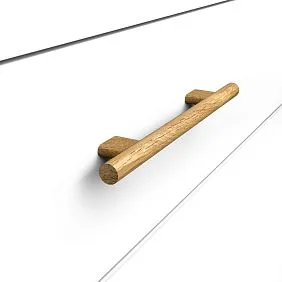
Wood — unexpected, but works in minimalism. Handle from solid oak, ash, walnut with rectangular cross-section, no treatment, only sanding and oil. The tactile warmth of wood softens the coldness of minimalism, adding naturalness.Buy furniture handlesWooden handles are suitable for minimalist interiors with an ecological accent.
Color Solutions
Monochrome is the foundation of minimalism. Black, white, gray — basic colors. Black handles on white fronts — classic. White on black — the reverse, but equally valid option. Gray on gray — tone on tone, the handle is perceived by its shape, not color.
Natural material tones — if wood is used, its color is natural, without staining. Metal — its natural color: gray steel, warm aluminum, cool nickel. Artificial coloring is minimal.
Accent color — rarely, but possible. One bright detail in a neutral space. Handles in saturated blue, terracotta, or mustard — the only color spot in a black-and-white interior. But this is a game on the edge, requiring boldness and taste.
Texture: the language of surfaces
The texture of the handle surface is no less important than its shape and color. Tactile sensations form subconscious attitudes toward the object, space, and craftsmanship quality.
Smooth surfaces
Polished metal — mirror shine, reflections, gloss. Associated with luxury, but requires constant care — fingerprints are visible instantly. In classic styles, polishing is appropriate for chrome and nickel, but not for brass and bronze — their matte finish is preferable.
Satin metal — soft silk-like sheen, not mirror-like, but noticeable. The surface is treated with abrasive, creating micro-relief. Fingerprints are less noticeable, the sensation is more pleasant. The golden middle ground between polishing and matte finish.
Lacquered metal — protective lacquer creates a smooth surface, but without mirror shine. Matte or semi-matte lacquer preserves the natural metal color, protecting against oxidation. Preferred for brass, bronze, and copper.
Matte and textured
Powder coating — perfectly matte, velvety surface. Fine-grained, uniform texture, pleasant to the touch. Any RAL catalog color. High durability, excellent resistance to abrasion. Optimal for modern styles.
Brushed metal — surface treated with a brush, creating directional texture. Fine parallel lines are visible. This adds complexity, making the material more tactile. Works well in minimalism, loft, and industrial styles.
Sandblasted finish — matte, rough surface, as if dusted. Tactilely interesting, visually restrained. Fingerprints are practically invisible. Applied to glass and metal, creating an effect of noble simplicity.
Wrought texture — irregularities, tool marks, deliberate handmade appearance. Mimics handcrafted work or is genuinely handcrafted for exclusivity. Each handle is unique, no two are identical. Suitable for modern, loft, and eclectic styles.
Patina and artificial aging
Natural patina — result of metal oxidation. On copper — greenish, on bronze — brown or black, on brass — dark golden. The process takes years, but can be accelerated with chemical compounds. Patina emphasizes relief, creates depth, and conveys the nobility of age.
Artificial aging — complex treatments imitating wear over time. Scratches on protruding parts, darkening in recesses, light corrosion on the surface. Should not look like theatrical makeup — subtlety and moderation are critical.
Multi-layer coatings — base dark layer, top light layer, partially worn, revealing the lower one. Creates an illusion of long-term use. Popular for classic and neoclassic hardware.
Metal color: shade palette
Metal is associated with silver or golden tones, but modern technologies have expanded the palette many times. Choosing the metal color — a key decision, defining the character of the hardware.
Warm tone
Gold — from light lemon to deep reddish. Different gold alloys produce different shades. PVD coatings allow achieving any gold tone. For classic styles, matte or slightly satin gold is preferable, not shiny.
Brass — natural warm yellow-gold color. Polished brass is too shiny, matte finish is more noble. With age, it darkens, acquiring brownish tones. Ideal material for neoclassicism.
Bronze — from light brown to nearly black. Depends on alloy composition and treatment. Dark patinated bronze creates seriousness, monumentality. Light bronze — softness, warmth.
Copper — reddish-orange metal, bright and warm. Pure copper is rarely used — too soft, quickly oxidizes. Copper coating on steel base — compromise between durability and aesthetics. Patinated copper with green patina — suitable for modern and loft styles.
Rose gold — gold alloy with copper, giving a delicate pinkish tone. Trend of recent years. Works well in neoclassicism, modern classicism, and feminine interiors. Coordinates with marble, pastel tones, and white fronts.
Cool tone
Silver — from white to gray-blue. Silver plating is expensive and requires protection against tarnishing. Nickel plating or PVD alternatives are more affordable and practical. Matte silver is nobler than shiny.
Nickel — a steel-gray hue with a slight yellow tint. Polished nickel is shiny; satin nickel is soft. Practical, hygienic, non-oxidizing. Preferred for kitchens and bathrooms.
Chrome — the most shiny metal, mirror-like surface. Associated with plumbing, cars, medical equipment. Works well in high-tech and modern styles. In classic interiors, it is inappropriate — too 'chemical'.
Black nickel or black chrome — a modern finish providing a deep black color with a metallic sheen. Not as flat as powder coating, more noble. Suitable for neoclassicism, minimalism, and loft styles.
Graphite — dark gray with a slight sheen. Intermediate between black and steel. A complex, deep color, not cliché. Works in modern interiors where restraint without boredom is needed.
Neutral palette
Stainless steel — natural gray color without coatings. Can be matte, satin, or polished. Industrial, durable, practical. Standard for kitchens in modern styles.
Aluminum — light gray with a slight bluish tint. Anodizing allows coloring in any shade while preserving metallic luster. Lightweight, modern, affordable.
White metal — powder-coated white finish on a steel base. Looks like ceramic or plastic, but stronger. Suitable for minimalism and Scandinavian styles, where lightness and subtlety are needed.
Formation of pairs: systemic thinking
Handle fittings do not exist in isolation. They form pairs and groups with other interior elements. A systemic approach to choosing hardware ensures stylistic coherence.
Handles + door fittings
Handles for interior doors and furniture handles should match. Ideally — from the same collection, manufacturer, material, and finish. If doors are brass, furniture should also be brass. If doors are matte black, furniture should match accordingly.
Decorative level should match. If door handles are ornate, furniture handles can also be decorative. If doors are minimalist, furniture should be similarly minimalist. Contrast between ornate door handles and simple furniture handles creates imbalance.
Shape language — matching is not mandatory, but desirable. If door handles are classic rosettes with buttons, furniture buttons should support the style. If doors are modern bars, furniture should be hooks or profiles.
Handles + plumbing fixtures
Kitchen and bathroom — spaces where furniture hardware meets plumbing fixtures. Faucets, shower systems, accessories (towel bars, soap dishes) should match the color palette of furniture handles.
Gold faucets require gold or brass furniture handles. Chrome plumbing fixtures — chrome or steel hardware. Black faucets (a trendy choice) — black handles. Violating this rule creates visual conflict.
Matte or glossy finish should also match. Matte faucet + glossy handles look mismatched. Polished elements or matte elements — overall coherence.
Handles + lighting fixtures
Metallic elements of lighting fixtures — casings, brackets, suspensions — form the metallic palette of the interior. If chandeliers are brass, support this with furniture hardware. If fixtures are black — match accordingly.
Stylistic coherence is required. Classic chandeliers with scrolls require classic hardware. Minimalist lighting fixtures — simple handles. Industrial pendant lights in loft style — rugged metallic hardware.
The amount of metal in the interior should be balanced. If there are many large metallic light fixtures, furniture hardware can be more restrained, not overwhelming the space. If lighting is subtle, furniture handles can be accent pieces.
Handles + valances and textile hardware
Valances for curtains, tie-backs, grommets — elements often overlooked in planning but affecting overall cohesion. Their metal should match furniture hardware.
Brass valance + brass handles create harmony. Matte black valance is supported by black furniture hardware. This does not mean absolute identity, but tonal matching is desirable.
In classic interiors with lots of textiles, decorative elements of curtains (tassels, fringe, tie-backs) often have metallic details. Gold or silver — their tone sets the direction for choosing furniture hardware.
Practical Recommendations for Selection
Theory is important, but practice requires concrete actions. Algorithm for choosing furniture handles for a real interior.
Stage 1: Defining the style
Honest answer: what interior style? Not 'I like everything', but specifically: classic, neoclassic, minimalism, modern, eclectic. If unsure — analyze the furniture, architecture, decor. Symmetry and ornamentation — classic. Minimalism and clean lines — minimalism. Smooth curves and natural motifs — modern.
Collect references — photos of interiors you like. Not scattered images, but complete spaces. Pay attention to details: what handles are used there. This will indicate the direction.
Consulting a designer is useful if budget allows. A professional sees the style as a whole and will help avoid mistakes. An hour-long consultation can save thousands on incorrect purchases.
Stage 2: Inventory of metals
Make a list of all metallic elements in the room: door handles, faucets, light fixtures, moldings, radiators (if visible), decor. Determine the dominant metal: warm (gold, brass, bronze, copper) or cold (steel, nickel, chrome, silver).
If the interior is new or planned — choose the base metal immediately. This will set the direction for all other decisions. Mixing warm and cold metals is possible, but requires skill. It’s safer to stick to one palette.
Count the amount of metal visible in the space. If there is a lot (large chandeliers, faucets, radiators), furniture hardware can be more modest. If there is little — hardware can become an accent.
Stage 3: Choosing specific models
Go to the showroom with photos of your interior, a list of metals, and an understanding of the style. Don’t choose handles in isolation, based only on 'it looks nice'. Evaluate them in the context of your project.
A tactile test is mandatory. Grab the handle and assess the feel. Comfortable grip, pleasant temperature, sufficient depth — all of this matters. A handle that looks nice but is uncomfortable will annoy you daily.
Order samples if possible. Many suppliers offer samples for several days. Bring them home, attach them to furniture, evaluate under your lighting. What looks perfect in the showroom may not suit your actual interior.
Check quality: evenness of coating, absence of defects, reliability of fasteners. Cheap hardware saves money now but disappoints quickly. Quality handles last for decades.
Stage 4: Agreeing on quantity
Calculate the exact number of handles: for each drawer, each cabinet door, each cabinet. Remember that wide cabinet doors require two handles, not one. Add a 10% reserve for defects or future replacements.
Uniformity saves money. If you can use one model for the entire kitchen, do so. Different handles for each module increase cost and create visual chaos.
Group purchasing or bulk orders often provide discounts. If renovation is happening in multiple rooms, combine your order. Savings can reach 15-20%.
Frequently asked questions
Can warm and cold metals be mixed in one interior?
Theoretically yes, practically difficult. Requires a delicate sense of balance. It’s safer to choose one palette. If mixing — let one metal dominate (70-80%), the other accent (20-30%). Chaotic mixing creates visual clutter.
Which metal is most practical for the kitchen?
Stainless steel or black nickel coating. Resistant to moisture, grease, and temperature changes. Brass and bronze also work, but require protective lacquer coating. Polished chrome is impractical — all fingerprints are visible.
Should cabinet and drawer handles be identical?
In classic and neoclassic styles, traditionally: knobs for drawers, hinges for cabinet doors. But from the same collection, same material. In minimalism — identical for uniformity. The key is stylistic unity, not literal identity.
How to choose handle size?
Depends on facade size. For 30-40 cm facades, 96 mm handles are suitable. For 45-60 cm — 128 mm. For 60+ cm — 160-320 mm. Knobs are universal for any size, if proportionally matched to the overall furniture mass.
Should you save on furniture hardware?
No. Cheap hardware wears out quickly, coating peels, mechanisms break. Handles are high-use elements. Mid-range quality hardware lasts 10-15 years, premium — 20+ years. Savings result in replacement every 2-3 years.
How to care for different types of metal?
Brass and bronze: wipe with soft cloth, treat with colored metal care product every six months. Steel and nickel: damp cleaning, regular cleaning agents. Black coatings: avoid abrasives, dry wipe. Gold plating: only soft dry cloth, no chemicals.
Can door handles be used as furniture handles?
Technically yes, but they are usually larger, heavier, and more expensive. For large cabinets or special items — why not. But for standard furniture, it's excessive. Furniture and door hardware are stylistically similar but not fully interchangeable.
How quickly do trends change in furniture hardware?
Basic solutions (brass, black, steel) are timeless. Trendy accents (rose gold, colored finishes) last 3-5 years. Choose either classic, always current, or be prepared to update every few years. For rental properties — only neutral solutions.
Is a designer needed to choose handles?
Not necessary, but helpful. If you understand style, have clear references, and know compatibility rules — you can handle it yourself. If unsure — a designer consultation (3000–5000 rubles) saves thousands on mistakes.
Where to buy furniture hardware?
Specialized showrooms allow you to touch, compare, and get consultation. Online is cheaper, but there’s a risk of mismatching expectations. Optimal: choose in a showroom, buy online from a verified supplier. Or order samples before the main purchase.
Conclusion
Choosing furniture handles is the final touch, determining the overall integrity of the interior. Classic style demands noble metals, symmetrical forms, moderate decoration. Neoclassicism plays with contrasts, simplifies forms while preserving material culture. Modern style experiments with curves, asymmetry, natural motifs. Minimalism strives for invisibility or pure geometry, excluding everything unnecessary.
Surface texture creates tactile impressions: smooth polish, velvety matte, relief texture, noble patina. Metal color forms a palette: warm golds, cool silvers, neutral steel tones. Coordinating pairs with door hardware, plumbing, lighting, and textile elements ensures systemic integrity.
Furniture HandlesNot a minor detail chosen at the last minute by default. It’s a thoughtful decision made within the context of stylistic matrix, material palette, and functional requirements. The right choice completes the interior, making it harmonious and convincing.
About the company STAVROS
STAVROS is a leading manufacturer of furniture hardware and decorative elements made from solid wood and metal for creating stylistically refined interiors. The assortment includes a wide selection of furniture handles in all stylistic directions: from classic engraved knobs to minimalist profiles.
STAVROS collections are developed according to stylistic matrices. Each series includes several types of handles (knobs, hinges, rails), unified by a common aesthetic. This simplifies selecting hardware for comprehensive styling — all elements are guaranteed to match.
Materials include solid wood of premium species (oak, beech, ash, walnut), brass, bronze, stainless steel. Finishes: natural oils and waxes for wood, electroplated gold and patinas for metal, powder coatings in any RAL shade. Combined solutions — wood with metal inserts, metal with ceramic — expand possibilities.
Production technology ensures geometric precision and processing quality. Wooden handles are made on CNC turning and milling machines, hand-sanded, and coated in multiple layers. Metal handles are cast or forged, processed on precision equipment, and coated with durable compounds.
Each handle comes with quality fasteners made of stainless steel or brass. Screw lengths are selected for standard door panel thicknesses of 16–19 mm. For non-standard thicknesses, fasteners are supplied separately upon request.
Consultation support helps choose handles tailored to a specific interior style. STAVROS specialists analyze room photos, consider existing hardware (doors, plumbing, lighting), and suggest optimal options. Sample orders for real-world evaluation are possible.
Custom production is available for unique projects. Handles made to client sketches, non-standard sizes, special finishes. Production time ranges from two weeks to a month depending on complexity. Minimum order — 10 sets.
In addition to handles, the STAVROS catalog includes components for creating cohesive interiors:Furniture legs, Decorative Inserts, Moldings, balusters for staircases, polyurethane moldingThe ability to equip all elements from one supplier in a unified style simplifies design.
Loyalty program for designers and architects provides special conditions: increased discounts, priority production for custom orders, free samples for portfolios, participation in exclusive presentations of new collections.
Delivery to Moscow and St. Petersburg is handled by our own logistics. To regions — via transport companies with careful packaging, preventing damage. Self-pickup from the warehouse is available daily from 9:00 to 20:00.
STAVROS product warranty is 24 months for manufacturing defects. Wooden handles last 15–20 years with proper care; metal handles — 25–30 years. This is a long-term investment in quality and interior aesthetics.
Choosingfurniture handlesSTAVROS, you receive not just functional hardware, but elements contributing to the interior’s stylistic integrity. Each handle is thoughtfully designed for ergonomics, aesthetics, and durability. STAVROS is a partner in creating spaces where every detail is in its place, every touch brings pleasure, and every element enhances overall harmony.


