












































































Article Contents:
- Why solid wood for furniture handles
- Tactility: touch as a daily experience
- Aesthetics: texture as a unique pattern
- Eco-friendliness: material without chemicals
- Strength and durability
- Wood selection: the beginning of quality
- Wood procurement: geographical preferences
- Chamber drying: material stabilization
- Board sorting: selecting the best sections
- 3D milling technology: from digital model to physical product
- 3D model development: design meets technology
- Processing programming: creating a control program
- CNC milling machine: accuracy to hundredths of a millimeter
- Precision and repeatability: product identity
- Post-milling processing: from rough draft to perfection
- Sanding: seven levels of smoothness
- Dust removal and cleaning
- Final finishing: protection and aesthetics
- Oil: breathable protection
- Varnish: durable coating
- Staining and patination
- Quality control: seven levels of inspection
- First level: incoming raw material control
- Second level: control after milling
- Third level: control after sanding
- Fourth level: control after finishing
- Fifth level: functional control
- Sixth level: visual control by packer
- Seventh level: selective QC inspection
- How to choose and buy wooden handles: navigating the assortment
- Defining Interior Style
- Selection of center distance
- Choosing Wood Species
- Choosing Finishing
- Where to buy and how to order
- Frequently Asked Questions
- How long do solid wood furniture handles last?
- Can wooden handles be installed in the kitchen?
- What are the differences between oak and beech handles?
- Can wooden handles be painted?
- How to care for wooden handles?
- What certifications do STAVROS handles have?
- Conclusion: when technology serves quality
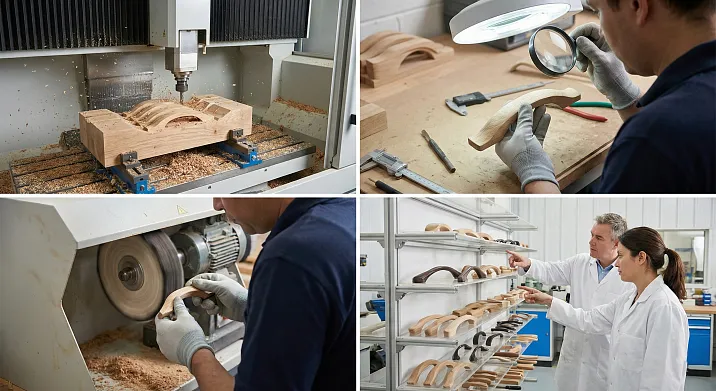
A handle on a kitchen cabinet. Dozens of touches daily — in the morning for a cup, in the evening for a plate, in the rush of breakfast, in the calm of dinner. The hand feels the shape, texture, temperature.Solid wood handlewarm, silky after sanding, anatomical — as if created for the palm. A plastic handle is cold, slippery, faceless. The difference is like between a handshake and touching a mannequin.wooden furniture handlesSTAVROS production is the result of a technological chain where high-precision 3D milling is combined with manual quality control, where eachwooden itemundergoes seven stages of inspection before reaching the customer. Let's examine the production process from the inside — from board to packaging, from machine programming to final polishing by a master.


Why solid wood for furniture handles
Handles can be made from anything: plastic, metal, MDF, composites. Why does wood remain in demand in the era of synthetic materials?




Tactility: touch as a daily experience
A person touches furniture handles 50-100 times a day (kitchen cabinets, dressers, wardrobes, cabinets). This is not a conscious action, but tactile memory records every touch. Wood is warm (thermal conductivity is 10 times lower than metal), pleasant to the touch (microscopic fiber texture massages the skin), non-slip (natural roughness provides grip even with a wet hand).
Plastic is colder than wood, slippery, feels artificial. Metal is even colder, icy in winter, scorching in the sun in summer.Wooden handlesmaintain a comfortable temperature year-round.
Our factory also produces:


Aesthetics: texture as a unique pattern
EachWooden Handleis unique. Even in a batch of one hundred handles of the same model, the wood texture varies — the arrangement of annual rings, shade, pattern intensity. This is not a defect, but a feature of natural material. Wood is alive, even after processing.
Oak provides an expressive, large texture with contrasting stripes. Beech — a fine, uniform structure with a pinkish tint. Ash — a sharp contrast of dark and light lines. The choice of wood species determines the visual character of the handle.
Get Consultation
Eco-friendliness: material without chemicals
Wood is a renewable resource, biodegradable, non-toxic. In the era of eco-awarenessWooden items— the choice of those who care about family health and the planet. Plastic decomposes over 500 years, releasing microplastics. Wood returns to the natural cycle in 10-20 years.
Strength and Durability
Qualitysolid wood furniture handlelasts for decades without loss of functionality. Oak and beech are hardwoods (3.7-3.8 on the Brinell scale), resistant to wear, dents, and chips. A plastic handle breaks after 5-7 years (material brittleness, fatigue from cyclic loads). A metal handle is eternal in strength but prone to corrosion, scratches, and tarnishing.
Wood selection: the beginning of quality
Productionwooden handlesbegins long before the machine — with the selection of raw materials.
Wood procurement: geographical preferences
STAVROS purchases oak and beech from the Caucasus — a region with optimal growing conditions for these species. Caucasian oak grows slowly (temperate climate, cool winters), the wood is dense, hard, with a uniform structure. Fast-growing oak from warm regions is porous, soft, less durable.
Mountain beech is preferable (grows at an altitude of 600-1200 meters) — it is denser than valley beech, with lower moisture content, more stable during drying.
Edged boards are purchased (already sawn, without bark) with a moisture content of 18-22% (natural moisture after one year of air drying). Transportation is via closed trucks, protecting from rain and direct sunlight.
Kiln drying: material stabilization
Boards arrive at the warehouse, are stacked in piles with spacers between layers (for air circulation), and acclimatize for 1-2 weeks (equalizing temperature and humidity with workshop conditions).
Then comes kiln drying. Boards are loaded into a drying kiln where temperature, humidity, and air circulation are controlled automatically. The regime is gentle (temperature 50-60°C, humidity decreases gradually) — this prevents cracking, warping, and internal stresses.
Drying lasts 14-21 days (depending on board thickness and wood species). Target moisture content is 8-10% (standard for furniture production in heated premises). Moisture control is done with a moisture meter with needle electrodes (inserted into the board, measuring electrical resistance proportional to moisture content).
Board sorting: selection of the best sections
After drying, boards are sorted manually by a master sorter. Selection criteria forfurniture handle production:
Absence of knots. A knot is the point where a branch attaches to the trunk; the wood around it is figured and may fall out during processing. Only knot-free sections are suitable for handles.
Uniform color. Sharp shade variations (light and dark spots) indicate uneven structure. Uniformity is needed for handles.
Straight grain. The grain should run along the board. Cross-grain (angled grain) reduces strength; the handle may split under load.
Absence of cracks, rot, wormholes, fungal stains. Any defect is a reject.
Boards that pass sorting are marked (sections for cutting are marked with chalk or pencil) and sent to the finished raw material warehouse.
3D milling technology: from digital model to physical product
Milling is the process of machining a workpiece with a rotating cutter (a cutting tool with multiple teeth). 3D milling is three-dimensional machining, where the cutter moves along all three axes (X, Y, Z), creating volumetric shapes.
3D model development: design meets technology
Each modelof the furniture handlestarts as a 3D model in a CAD program (computer-aided design system — SolidWorks, Fusion 360, Rhinoceros). The designer creates the handle geometry considering:
Ergonomics. The handle must fit comfortably in the palm, not press on fingers, and provide a secure grip. Optimal thickness is 25-35 mm (too thin cuts into the hand, too thick cannot be grasped by fingers). Fillet radii — minimum 3-5 mm (sharp edges are unpleasant).
Aesthetics. The shape must be harmonious, proportional, and stylistically consistent (classic, modern, minimalist, Scandinavian). Smooth lines, elegant curves, balance of mass and air.
Manufacturability. The model must be producible on a milling machine. Undercuts that are too deep (areas the cutter cannot reach), walls that are too thin (will break during milling), sharp internal corners (the cutter is cylindrical and cannot create an angle sharper than its radius) — all are corrected at the modeling stage.
The finished 3D model is exported to a format readable by CAM software (computer-aided manufacturing system — programs the machine).
Machining programming: creating the control program
The CAM engineer loads the 3D model into the software (Mastercam, PowerMill, ArtCAM — depends on the machine) and sets machining parameters:
Tool selection (type and diameter of cutter). For rough machining (removing the main bulk of excess wood), large cutters with a diameter of 10-16 mm are used. For finishing (forming the final geometry) — small ones, 4-8 mm. For detailing (small elements, recesses) — end mills 1-3 mm.
Spindle rotation speed (20,000-24,000 RPM for wood — high RPM provides a clean surface without chipping).
Feed rate (speed of cutter movement relative to the workpiece — 3-6 m/min for finishing, 8-12 m/min for roughing).
Depth of cut per pass (for wood 2-5 mm — too great a depth overloads the cutter, breaking it or tearing the wood).
Cutter movement trajectory. The software automatically calculates the optimal path, minimizing machining time and tool wear.
The software generates G-code — a sequence of commands for the machine (movement coordinates, speeds, spindle on/off). The G-code is written to a USB drive or transferred over the network to the machine.
CNC milling machine: accuracy to hundredths of a millimeter
STAVROS uses CNC (Computer Numerical Control) milling centers of European production (Germany, Italy) — industrial-grade equipment providing an accuracy of ±0.05 mm.
Machine design:
Work table (the workpiece is fixed onto it — with screws, vacuum cups, or clamps).
Gantry (a moving structure carrying the spindle) — moves along the Y-axis (forward-backward).
Spindle (the rotating unit that clamps the milling cutter) — moves along the Z-axis (up-down) and X-axis (left-right, together with the gantry).
CNC system (computer with controller) — reads G-code, controls movements, monitors spindle speed, cooling (if present).
Milling processwooden handle:
The workpiece (a block with a cross-section of 40×60 mm, length 20-30 mm longer than the finished handle — allowance for end trimming) is fixed on the table.
The operator starts the program. The machine automatically changes cutters (if a tool magazine is installed), processes the workpiece according to the trajectory.
Rough machining removes the bulk of material — the workpiece acquires the approximate shape of the handle.
Finish machining forms the final geometry — all curves, transitions, details.
Processing time for one handle — 8-15 minutes (depends on model complexity). The machine operates without human involvement, the operator monitors, changes workpieces, controls tool condition.
Accuracy and repeatability: product identity
The advantage of 3D milling is absolute repeatability. Each handle in a batch is geometrically identical (deviations ±0.05 mm — imperceptible). This is critical for furniture production: if a kitchen has 20 cabinets with handles, all handles must look the same. Manual carving does not provide such repeatability (each handle is unique — beautiful for one-off pieces, unacceptable for series furniture).
Accuracy is important for mounting holes.furniture handleIt is fastened with two screws, the distance between hole centers (center-to-center distance) must be precise (96 mm, 128 mm, 160 mm — standard sizes). A deviation of even 0.5 mm leads to misalignment during installation, the screw does not enter the hole. CNC milling guarantees accuracy.
Post-milling processing: from rough to perfect
After milling, the handle has the correct geometry, but the surface is rough (marks from cutter teeth are visible), ends are untidy, there may be burrs (small wood fibers raised during cutting).
Sanding: seven levels of smoothness
Sanding — sequential removal of micro-irregularities with abrasive materials (sandpaper, sanding sponges) transitioning from coarse to fine grit.
Sanding stageswooden handlesat STAVROS production:
Coarse sanding (grit P80-P100). Removes cutter marks, major irregularities. Performed with an orbital sander (the pad vibrates eccentrically, not leaving circular scratches).
Intermediate sanding (P120-P150). Smoothes scratches from the previous stage, the surface becomes even but not yet smooth.
Moistening. The handle is slightly moistened with water (sprayer or damp sponge). Water raises wood fibers (nap) which are invisible when dry but feel like roughness. The handle dries for 1-2 hours.
Sanding the raised nap (P180). Removes the raised fibers, the surface becomes smooth.
Fine sanding (P220-P240). Preparation for finish coating (oil, varnish) or the final stage for handles without coating.
Finish sanding (P320-P400). Performed only for premium-class handles or for polishing. The surface is silky, almost polished.
Super-finish sanding (P600-P1000). For exclusive models. The wood acquires a slight shine, the grain is revealed to the maximum.
Hand sanding (the craftsman feels the slightest imperfections inaccessible to a machine) and machine sanding (for flat and cylindrical areas). Sanding time for one handle is 10-20 minutes (depending on the complexity of the shape).
Dust removal and cleaning
After sanding, the handle is covered with wood dust that clogs the pores. The dust is removed:
With compressed air (compressor with a spray gun, pressure 3-4 bar) — blows dust out of recesses and relief.
With a tack cloth (special cloth with a sticky coating) — wiped over the surface, collects fine dust.
With a vacuum brush (vacuum cleaner with a soft attachment) — for coarse dust.
The cleaned handle is ready for finishing.
Finish: protection and aesthetics
Wooden itemsWithout a protective coating, they darken from dirt, absorb moisture, and lose their appearance. Finishing protects the wood and emphasizes its beauty.
Oil: breathable protection
Wood oil — a mixture of natural oils (linseed, tung) or synthetic (modified) oils with the addition of waxes, driers (drying accelerators). The oil penetrates the wood pores to a depth of 2-4 mm, polymerizes (hardens), creating protection from within.
Advantages of oil:
Preservation of texture and tactile feel. The wood remains wood — the grain is visible, warmth and naturalness are felt.
Easy renewal. After 2-3 years, the oil wears off in areas of intensive contact. It is sufficient to reapply the oil without removing the handle.
Eco-friendliness. Natural-based oils are safe and do not emit toxins.
Disadvantages:
Low water resistance. Oil slows down water absorption but does not block it completely.
Frequent renewal (every 2-3 years for kitchen handles, every 5-7 years for handles in bedrooms, living rooms).
Oil application technology:
Oil is applied with a brush, pad, or by dipping (the handle is immersed in an oil bath).
Left for 10-15 minutes (the oil is absorbed into the pores).
Excess is removed with a dry cloth (the surface should be matte, not wet).
Drying for 24-48 hours (depends on the type of oil). Some oils require applying 2-3 coats with intermediate drying.
Varnish: a durable film
Varnish — a solution of polymer resins that forms a hard, transparent film on the surface.Handles with a varnish coatingare more durable than oiled ones and do not require frequent renewal.
Types of lacquers:
Water-based acrylic. Eco-friendly, odorless, fast-drying (2-4 hours). Sufficiently durable for furniture handles.
Polyurethane. Maximum durability, wear resistance, water resistance. More expensive than acrylic, more difficult to apply.
Nitrocellulose lacquer. Fast-drying (30 minutes), bright gloss. Toxic (contains acetone), less durable. Outdated technology.
Coating is applied in several thin layers with intermediate sanding using fine-grit sandpaper. Each layer must be fully dry before applying the next. The number of layers depends on the type of coating and surface quality requirements.
Varnish is applied with a spray gun (pneumatic or electric) — even, thin coating without drips.
First coat — primer (thin varnish or special primer). Drying for 1-2 hours.
Intermediate sanding (P320) — removes raised fibers, evens the surface.
Second coat — finish coat. Drying for 4-6 hours.
Optional third layer (for premium handles) — adds coating depth, enhances shine.
Full polymerization — 24-48 hours. After that, the handle is ready for packaging.
Staining and Patination
Tinting compounds are used to change wood color or create an aged effect.
Stain (tinting compound with water, alcohol, or oil base). Applied before oil or varnish, penetrates wood, changes color while preserving visible grain. Oak can be tinted to walnut, wenge, gray. Beech — to rosewood, cherry.
Patina (dark paint rubbed into relief recesses). Raised parts remain light, recesses — dark. Creates an aged effect, emphasizes relief. Used for classic carved handles.
Quality control: seven inspection levels
Quality is not accidental, but the result of systematic control at every stage.
First level: incoming raw material control
Each batch of boards after kiln drying is checked by a QC inspector (Quality Control Department):
Moisture content (with moisture meter — must be 8-10%).
Defects (visual inspection — knots, cracks, rot — rejected).
Geometry (deviation from plane, curvature — no more than 2 mm per meter).
Boards failing inspection are returned for sorting or scrapped as defective.
Second level: control after milling
Machine operator spot-checks (every 10th handle) geometry with calipers:
Center-to-center distance of mounting holes (tolerance ±0.1 mm).
Thickness, width, length (tolerance ±0.3 mm).
Relief depth (for carved handles).
If deviation exceeds tolerance — machine is stopped, program or tool is adjusted.
Third level: control after sanding
Master sander checks each handle tactilely (runs palm over surface — irregularities felt by skin) and visually (under bright light, scratches, missed spots are visible). Poor sanding — rework.
Fourth level: control after finishing
Inspector checks coating quality:
Uniformity (no spots, missed areas, varnish runs).
Shine (for varnished handles — gloss or matte according to specification).
Absence of defects (dust particles, bubbles, orange peel texture).
Handle with finishing defects — re-sanding and reapplication of coating.
Fifth level: functional control
Handle is checked for functionality:
Mounting holes (M4 or M5 screw must fit freely, without jamming).
Strength (the handle withstands compression of 50-70 kg — simulating the load when opening a heavy door — must not crack or deform).
Surface smoothness (no splinters or sharp edges).
Sixth level: visual inspection by packer
Before packaging, each handle is inspected by the packer. Any noticed defect (scratch, chip, stain) — the handle is removed, sent for rework or to scrap.
Seventh level: random sampling by QC
From the finished batch, 2-5% of handles are randomly selected and undergo full inspection in the QC laboratory:
Geometry (measuring all dimensions with precision tools).
Coating (varnish film thickness, adhesion — tape test, hardness — pencil test).
Wood moisture content (re-check — wood must not absorb moisture during finishing).
If random sampling reveals defects — the entire batch is inspected.
How to choose and buy wooden handles: navigating the assortment
STAVROS furniture handles catalog offers over 150 models. How not to get lost in the variety?
Interior style definition
Classic interior (carved furniture, moldings, luxurious fabrics) requires handles with relief, curves, decorative elements.
Modern minimalism (smooth facades, neutral colors, no decor) requires concise handles — straight lines, simple geometric shapes, no carving.
Scandinavian style (light tones, natural materials, functionality) requires handles made of light wood (beech, ash) with oil or clear varnish.
Loft and industrial (brick, metal, rough textures) pairs better with metal or combined handles (wood + metal).
Choosing the center-to-center distance
Center-to-center distance — the distance between the centers of mounting holes. Standard sizes: 32 mm, 64 mm, 96 mm, 128 mm, 160 mm, 192 mm, 224 mm, 256 mm.
For small doors (bathroom cabinet, bedside table) — 32-64 mm.
For standard kitchen fronts — 96-128 mm.
For wide doors (wardrobes, walk-in closets) — 160-256 mm.
Measure the distance between existing holes (if replacing handles) or plan new holes based on aesthetics (the handle should occupy about 1/3-1/2 of the door width).
Wood species selection
Oak — expressive grain, high hardness, dark brown or golden color (depends on tinting). Suitable for classic and rustic interiors.
Beech — fine uniform grain, pinkish hue, high hardness. Suitable for modern and Scandinavian interiors.
Ash — contrasting grain, light with dark stripes, maximum hardness. Suitable for modern interiors where expressiveness without excess is needed.
Finish selection
handles without coating (natural wood after sanding). Maximum tactile feel, eco-friendliness. Require protective oil treatment by yourself (every 1-2 years).
Handles with oil coating. Protected, retain naturalness. Do not require immediate treatment, but after 2-3 years it is advisable to refresh the oil.
Handles with a varnish coating. Maximum protection, no maintenance required for 5-7 years. Tactile feel is lower (film is noticeable), but visually beautiful (gloss or matte).
Tinted handles. Wood color changed to walnut, wenge, gray oak. Suitable for matching with furniture color.
Where to buy and how to order
Buy STAVROS wooden handlesAvailable:
Manufacturer's online store. Full catalog, current prices, delivery across Russia and CIS. Option to order custom sizes (made-to-measure production within 2-4 weeks).
Regional dealers. Dealer network covers major Russian cities. You can see the handles in person, touch them, assess their tactile feel.
Furniture showrooms and construction hypermarkets (Leroy Merlin, OBI). Limited assortment, but readily available.
For orders of 50 pieces or more (for furniture factories, wholesalers), discounts are provided, customization is possible (changing dimensions, shape, color).
Frequently asked questions
How long do solid wood furniture handles last?
With proper use and care — 15-25 years. Oak and beech are hardwoods, resistant to wear. The finish (oil, varnish) is periodically renewed (oil — every 2-3 years, varnish — every 5-7 years). The wood itself lasts for decades.
Can wooden handles be installed in the kitchen?
Yes, but considering the specifics. The kitchen is an aggressive environment (moisture, grease, temperature fluctuations). Use handles with a varnish finish (more resistant to water) or an oil finish (renew it regularly). Avoid installing handles directly above the sink or stove (direct contact with steam). Regularly wipe handles to remove grease (it soaks into the wood, darkening it).
What is the difference between oak and beech handles?
Oak: coarse, expressive grain, dark brown or golden color, hardness 3.7 on the Brinell scale. Associated with monumentality, tradition.
Beech: fine, uniform grain, pinkish or cream color, hardness 3.8 (even higher than oak). Associated with elegance, modernity.
Functionally, they are equivalent. The choice is a matter of aesthetic preference and interior color.
Can wooden handles be painted?
Yes. Handles without a finish or with an oil finish are easily painted with acrylic, alkyd, or oil-based paints. Process: light sanding (P220 — for paint adhesion), priming (acrylic primer), two coats of paint with intermediate drying. Any color can be chosen — from white to black, from pastels to bright ones.
Painting varnished handles is more difficult — the varnish needs to be removed by sanding (labor-intensive) or special primers for varnish must be used.
How to care for wooden handles?
Daily: wipe with a dry or slightly damp cloth (to remove dust, dirt).
Weekly (for kitchen handles): wipe with a mild detergent (to remove grease), then with a dry cloth.
Every 2-3 years (for oiled handles): apply a new coat of oil (surface is lightly sanded with P320, oil is applied, rubbed in, excess is removed).
Every 5-7 years (for varnished handles): assess the condition of the varnish, if necessary — re-varnishing (sanding, applying new varnish).
Avoid: aggressive chemicals (chlorine, acetone, solvents), abrasive powders, excess water.
What certificates do STAVROS handles have?
The products are certified: GOST conformity certificate (confirms compliance with technical requirements), sanitary-epidemiological conclusion (confirms safety for health — absence of toxic emissions), fire safety certificate (wood is treated with fire-retardant compounds — flammability group G2-G3).
Conclusion: when technology serves quality
Solid wood furniture handle— is not just hardware, but an element interacted with daily. Every touch is a moment of contact with the material, shape, texture. A low-quality handle is irritating (roughness, sharp edges, inconvenient shape), a high-quality one is unnoticeable but subconsciously pleasant.
Qualitywooden handles— is the result of a technological chain where high-precision 3D milling combines with manual craftsmanship, where automation serves repeatability, and the human serves control and finishing. Seven levels of quality control at the STAVROS production facility guarantee: only flawless products reach the customer.
STAVROS company has specialized in the production ofsolid wood products— for interiors. The production facility is located in St. Petersburg, covering an area of 3500 m², equipped with a full cycle of equipment — from drying chambers to final packaging.
CNC milling centers — German and Italian (Homag, Biesse, SCM), ensuring precision of ±0.05 mm. The machine park includes 12 milling centers (4-5-axis), capable of processing up to 5000 handles per day. Software — professional CAD/CAM (Mastercam, ArtCAM), allowing the creation of models of any complexity.
Sanding department — a 400 m² area where 15 master sanders work. Orbital sanders (Festool, Mirka) and premium abrasives (Mirka, 3M) are used, ensuring a scratch- and streak-free surface finish.
Finishing department — a painting booth with ventilation and filtration, HVLP spray guns (high volume, low pressure — minimal material loss, even coating). Osmo oils (Germany) and Sayerlack varnishes (Italy) are used — eco-friendly, wear-resistant, time-tested.
QC laboratory — equipped with measuring tools (calipers, micrometers, moisture meters), strength testing stands. Each batch undergoes random sampling inspection, results are documented.
The company works with furniture factories (supplying handles in batches from 500 pieces), interior designers (custom orders for projects), and retail customers (via online store and dealer network).
For large customers, STAVROS provides custom model development service. The designer provides a sketch or description of the desired handle — STAVROS engineers create a 3D model, program machining, and produce a sample. After approval, serial production begins. Minimum batch for a custom model — 50 pieces. Development and production time — 4-6 weeks.
Logistics is organized throughout Russia. Delivery to Moscow and St. Petersburg — by courier or pickup. To regions — by transport companies (SDEK, PEK, Business Lines). Packaging protects handles during transportation — individual wrapping in kraft paper, placement in cardboard boxes with soft filler.
Buy STAVROS wooden handles— means choosing quality, tested by time, technology, and control. Each handle is the result of master craftsmanship, machine precision, and a quality system that guarantees:wooden item, which you will receive, is impeccable.


