Article Contents:
- Anatomy of vertical rhythm: what is a slatted partition
- Structure of a slatted partition
- Functions of a slatted partition
- Materials and finishing of slats
- Handles as an extension of verticality: choosing shape and proportions
- Vertical bar handles: direct repetition of the motif
- Recessed handles: vertical slots in the facade
- Buttons and short handles: when verticality is not needed
- Material unity: wood of slats and wood of handles
- Wood species: exact match
- Tone: absolute color match
- Coating: oil, varnish, or paint
- Handle placement: vertical dominance on the facade
- Vertical mounting of long handles
- Multiple handles: vertical colonnade
- Asymmetry and exceptions
- Color and contrast: how to play with verticals
- Tone on tone: complete fusion
- Contrast: highlighting handles
- Metal under wood: industrial twist
- Application examples: from kitchen to bedroom
- Kitchen-living room with a slatted partition
- Hallway with a slatted partition and a chest of drawers
- Bedroom with a slatted partition behind the headboard
- Bathroom with a slatted decorative wall
- Technical aspects of installing vertical handles
- Center-to-center distance: non-standard sizes
- Strength of long handle mounting
- Vertical alignment: critical precision
- Frequently Asked Questions
- Is it necessary to use wooden handles if the slats are wooden?
- What handle length is optimal for a vertical effect?
- Can vertical and horizontal handles be combined in one room?
- What to do if furniture has already been purchased with horizontal handles?
- Does the principle of vertical rhythm work with a horizontal slatted partition?
- How much does a set of vertical wooden handles cost?
- How to care for wooden handles?
- Can recessed handles be used on all furniture?
- How to choose handles if the partition was installed several years ago?
- Are vertical handles suitable for classic interiors?
- Conclusion: rhythm as the foundation of spatial perception

Verticality is not just a direction in space. It is an archetype of aspiration, upward movement, structuring chaos. In interior design, vertical rhythm is created through repeating elements: columns, pilasters, doorways, tall cabinets. But the most expressive vertical element of modern design is theSlatted partition, a set of parallel solid wood slats creating a light, airy wall that zones space without heaviness or solidity. WhenFurniture Handlesin the same room repeat the vertical motif of the slatted partition—elongated slats instead of round knobs, narrow rectangles instead of oval brackets—the interior gains rhythmic integrity, where hardware does not conflict with architecture but continues its theme at the detail level.
This principle works at a deep level of perception. The eye reads the vertical slats of the partition as the dominant graphic motif of the space. When handles on dressers, kitchen fronts, and cabinet doors are also vertical, narrow, and elongated—an echo, a resonance of forms arises. This is not literal copying (the handle does not have to be an exact copy of the slat) but stylistic kinship: the same proportion (length significantly exceeds width), the same orientation (vertical), the same materiality (wood or metal under wood). When three out of three such coincidences occur, the interior reads as professionally designed, where every detail is consciously selected and connected to others.
Why is vertical rhythm important? Because it controls the perception of room height. Horizontal lines expand space widthwise but bring ceilings down. Vertical lines elongate, create a feeling that ceilings are higher than they actually are.Slatted partitionwith slats 40-60 mm wide and spacing of 80-120 mm forms a strong vertical rhythm, which can either be supported through hardware (verticalFurniture Handles), or disrupted (round knobs, horizontal brackets). Support enhances the effect, disruption creates visual noise, a conflict of directions.


Anatomy of vertical rhythm: what is a slatted partition
Before discussing the connection between handles and partitions, it is necessary to understand the structure of the slatted construction itself.




Structure of a slatted partition
A slatted partition consists of two main components: a supporting frame and decorative slats.
The frame is a hidden structure of horizontal beams or metal profiles fixed to the floor and ceiling (sometimes only to the ceiling for a floating partition effect). The frame provides rigidity and maintains geometry. The distance between horizontal frame elements is usually 80-120 cm.
Slats are visible vertical planks made of solid wood (oak, beech, ash, pine), MDF, or metal with wood veneer. Slat cross-section: from 20×40 mm (thin, delicate) to 60×80 mm (massive, architectural). Slat length equals room height minus a 2-5 cm gap at the top and bottom for wood's thermal and moisture movement.
Slat spacing is the distance between the axes of adjacent planks. Standard: 80-150 mm. Close spacing (80-100 mm) creates a dense structure, almost visually impermeable, although physically visible through and light passes through the partition. Wide spacing (120-150 mm) creates lightness, graphics, minimalism.
Our factory also produces:



Functions of a slatted partition
Zoning space is the main task. The partition separates the living room from the kitchen, the hallway from the corridor, the work area from the sleeping area, but does not create a solid wall. Visual connection is preserved, light passes through the gaps between slats, the space remains unified but structured.
Vertical rhythm is a secondary but critical effect. A series of vertical lines creates a graphic pattern that the eye reads as dominant. If a slatted partition with 100 mm spacing stands in a room 3 meters wide, there are 30 vertical lines. This is a powerful rhythm that suppresses all horizontals.
Light transmission and airiness are physical properties. Unlike a solid wall or glass partition, a slatted one allows air to pass through (important for ventilation), some light (the area behind the partition remains illuminated), but creates a visual boundary.
Get Consultation
Materials and finish of slats
Wood is a classic. Solid oak or beech — strength, durability, noble texture. Solid pine or ash — cost-effectiveness, ease of processing. MDF with natural veneer — imitation of solid wood at a lower price.
Slat finishing: natural oil (highlights the texture, keeps the wood tactile), varnish (creates a protective coating, adds shine), paint (completely hides the texture, creates a monochrome surface — white, black, gray).
Color is critical for rhythm. Light slats (natural oak, white paint) create a soft, unobtrusive rhythm. Dark slats (fumed oak, wenge, black paint) create a contrasting, rigid, graphic rhythm that dominates the space.
Handles as an extension of the vertical: choosing shape and proportions
When a slatted partition sets a vertical rhythm,Furniture Handlesshould not conflict with it, but support it.
Vertical bar handles: direct repetition of the motif
The most obvious choice is vertical bar handles 150-400 mm long, 10-20 mm wide, 8-15 mm thick. These are long, narrow rectangles mounted vertically on drawer fronts, cabinet doors, kitchen modules.
Proportions are critical. The length-to-width ratio should be at least 10:1 (a 200 mm long handle with a 20 mm width) to create a pronounced vertical. Less — the handle reads as a short bracket, doesn't create a vertical effect.
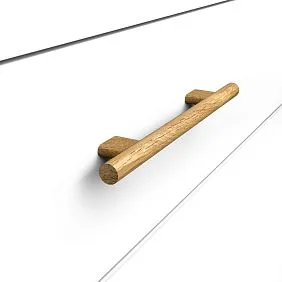
Material:Wooden Handlemade of solid oak or beech — direct material kinship with the wooden slats of the partition. Metal handle (stainless steel, aluminum, brass) — stylistic kinship through form, but contrast in material, which works in industrial or mixed styles.
Handle cross-section: rectangular or square. Rectangle 10×15 mm — elegant, suitable for light furniture, kitchens in Scandinavian style. Square 15×15 mm — universal, suitable for most cases. Rectangle 20×8 mm — a flat handle that almost merges with the front, creates minimalism.
Recessed handles: vertical slots in the front
An alternative to surface-mounted handles is recessed handles, where a vertical slot 15-25 mm deep, 100-300 mm long, 20-40 mm wide is milled into the front. Fingers go into the slot, pull — the door or drawer opens.
A recessed handle creates an even cleaner vertical than a surface-mounted one: it's not a separate element, but part of the front, a vertical line cut into the plane. When there are several such slots (on four drawers of a chest, on six doors of a kitchen set), they create a vertical rhythm that directly echoes the slats of the partition.
Technology: CNC milling for dimensional accuracy and slot cleanliness. Manual milling is possible, but harder to control depth and straightness. For MDF or plywood fronts 18-22 mm thick, a 15 mm deep slot leaves 3-7 mm of material on the back — enough for strength. For solid wood, slots can be deeper (20-25 mm).
Buttons and short handles: when vertical is not needed
It's not always necessary to support the vertical rhythm. If the slatted partition is an accent, but not dominant (e.g., a small partition 1.5 meters wide in a corner of the room), furniture can have neutral hardware: round or oval buttons 30-40 mm in diameter, short horizontal brackets 96-128 mm.
But if the partition is large (3-5 meters in width, floor to ceiling), sets the main rhythm of the space, ignoring it when choosing handles means creating a visual conflict. Round buttons against a background of vertical slats look random, alien.
Rule: the stronger the vertical rhythm of the partition (the larger its area, the closer the slat spacing, the more contrasting their color), the more important it is to support this rhythm in the handles.
Material unity: wood of the slats and wood of the handles
Form is the first level of connection between handles and the partition. Material is the second, even deeper level.
Wood species: exact match
If the partition slats are made of solid oak,Wooden handleson the furniture should be oak. Oak has a characteristic large-pored texture, contrasting annual rings that cannot be confused with beech or ash.
Beech — a more uniform, fine-pored texture, pinkish hue. Beech slats require beech handles. Mixing species (oak slats + beech handles) is noticeable even after the same staining — the texture gives it away.
Ash is similar to oak, but lighter, with less contrasting rings. Ash slats + ash handles — harmonious. Ash slats + oak handles — acceptable with strong staining that hides textural differences.
Pine — softwood with pronounced resin canals (knots, streaks). Pine slats — a budget solution for partitions, usually painted white or light tones that hide the texture. Pine handles are rarely used (softness of wood, low wear resistance), alternative — metal handles or handles made of hardwoods, painted the same color as the slats.
Tone: absolute match of shades
Natural oak without staining has a light golden hue. Staining with wood stain changes the color: walnut gives a medium brown, wenge — dark brown almost black, whitewashed oak — gray-white.
Slats and handles must be in the same tonal range, accurate to within a semitone. A difference in shade of even 5-10% is noticeable: light walnut slats and medium walnut handles will contrast, disrupting unity.
Solution: order slats and handles from the same manufacturer, preferably from the same batch of wood, stained with the same stain. This guarantees a match. If the slats are already installed and the handles are ordered later, provide the handle manufacturer with a sample of the slat (a 10-15 cm piece) for precise shade matching.
Finish: oil, varnish, or paint
Partition slats are usually coated with a protective finish: oil (Osmo, Biofa — emphasizes the grain, leaves the wood matte), varnish (polyurethane, acrylic — creates a hard film, provides a finish from matte to glossy), paint (acrylic enamel — completely hides the grain, creates a colored surface).
Furniture Handlesmust have the same finish. Oiled slats + varnished handles — different tactile sensations (oil is silky, varnish is smooth), different visual sheen. The eye and hand notice this.
If the slats are painted (white, gray, black), the handles should also be painted in the same RAL or NCS color. It is acceptable to use metal handles of the same color (matte black metal handles for black painted slats) — here the contrast of materials is compensated by the match in color and style.
Handle placement: vertical dominance on the facade
Not only the shape of the handle is important, but also its orientation on the facade.
Vertical mounting of long handles
A long bar handle can be mounted vertically or horizontally. To support the vertical rhythm of the partition — only vertically.
On the front of an 80 cm wide, 20 cm high dresser drawer, a 200 mm vertical handle is mounted at the center of the width, extending the full (or almost full) height of the front. This creates a vertical line that echoes the slats of the partition visible in the same room.
On a 60 cm wide, 180 cm high cabinet door, a 300-400 mm vertical handle is mounted on the edge of the door (closer to the hinge or farther from the hinge, depending on the opening direction). A long vertical handle on a tall door enhances the door's verticality, creating a graphic quality.
Multiple handles: a vertical colonnade
If a room has a dresser with four drawers stacked on top of each other, four vertical handles (one on each drawer) form a vertical colonnade, repeating the logic of the slatted partition.
Critical: the handles must be on the same vertical axis. If the handle on the first drawer is offset 2 cm to the left relative to the handle on the second drawer — the colonnade is broken, the rhythm is lost. Marking before installation must be precise, using a level and measuring tools.
For a kitchen set with 10-15 fronts, vertical handles create a frequent vertical rhythm that can compete with the rhythm of the partition. Balance is important here: if the partition slats are dark and contrasting, the handles can be light and less noticeable. If the slats are light, the handles can be contrasting (black metal, dark wood).
Asymmetry and exceptions
Not every handle has to be vertical. On very wide drawers (120-150 cm, for example, in a sideboard or dresser), a single vertical handle in the center can look lost. Solution: two vertical handles symmetrically, 30-40 cm from the edges. This preserves the vertical motif but duplicates it, creating symmetry.
On upward-opening doors (fronts of upper kitchen cabinets with a lift mechanism), a vertical handle at the bottom of the front is logical (the hand pulls upward). On side-opening doors, a vertical handle on the side (on the hinge side or opposite side) is logical (the hand pulls toward you).
Color and contrast: how to play with verticals
Matching form (vertical handles for vertical slats) and material (wood) does not mean everything has to be monochrome.
Tone-on-tone: complete fusion
Light oak slats + light oak handles on light furniture = minimalism, where the handles are almost invisible, blending with the fronts. The vertical rhythm is supported but not accentuated. Suitable for interiors in Scandinavian, muji, minimalism styles, where purity of lines without decorative load is important.
Contrast: highlighting handles
Light slats + dark (fumed oak, wenge) handles on light furniture = contrast, where the handles stand out, creating vertical accents on the fronts. This works if there are few handles (4-6 on one piece of furniture), and their vertical lines do not conflict with the slats but complement them, creating a second layer of vertical rhythm.
Dark slats + light handles = reverse contrast, rarely used but effective in black-and-white interiors. Black slatted partition + white wooden handles on white furniture = graphics, where black verticals (partition) and white verticals (handles) alternate, creating a complex rhythm.
Metal to match wood: an industrial twist
Wooden slats + metal handles — contrast of materials, but preservation of form. If the handles are narrow vertical bars made of stainless steel, brass, or black metal, they support the vertical rhythm but add an industrial note.
This works in loft, industrial minimalism, contemporary interiors, where mixing natural and industrial materials is the norm. Oak partition slats + matte black steel handles on kitchen fronts — a combination of the warmth of wood and the severity of metal.
Application examples: from kitchen to bedroom
Let's consider specific spaces where the connection between handles and slatted partitions works.
Kitchen-living room with a slatted partition
Open-space kitchen-living room, where zones are separated by a slatted partition 3 meters wide, 2.7 meters high, with slats 40×60 mm, spacing 100 mm, natural oak with oil finish.
Kitchen unit 4 meters long, 12 fronts (upper and lower modules). VerticalWooden handlesoak handles 250 mm long, cross-section 12×15 mm, oil finish — matching the slats. Handles are mounted vertically on each front, creating a frequent vertical rhythm that echoes the rhythm of the slatted partition.
Visual effect: the eye reads the verticals of the partition, transfers to the verticals of the handles, perceives the space as unified, structured by vertical lines. The ceiling appears higher, the space — more organized.
Hallway with a slatted partition and a chest of drawers
Hallway, where the entrance area is separated by a slatted partition 1.5 meters wide, slats 50×50 mm, spacing 120 mm, beech stained walnut.
Chest of drawers in the hallway 100 cm wide, 85 cm high, four drawers. Vertical handles made of beech, walnut stain, length 180 mm, cross-section 15×15 mm. Handles aligned along the central axis, creating a vertical colonnade of four elements.
Additionally: wall-mounted coat rack with vertical hooks made of the same beech in walnut stain. The vertical of the partition is continued in the vertical of the handles and the vertical of the hooks — triple repetition of the motif, creating a strong stylistic connection.
Bedroom with a slatted partition behind the headboard
Bedroom, where a decorative slatted partition is installed behind the bed headboard, 2 meters wide, floor-to-ceiling height, slats 30×50 mm, spacing 80 mm, bleached ash.
Bedside tables with two drawers each, fronts white MDF. Recessed handles — vertical slots 150 mm long, 25 mm wide, 20 mm deep, no additional elements. The slots create clean vertical lines that rhyme with the slats behind the bed.
Wardrobe in the bedroom with four doors, each 60 cm wide, 240 cm high. Vertical plank handles made of bleached ash, length 400 mm, cross-section 20×10 mm, mounted on the edge of the door. Four tall vertical lines of handles enhance the verticality of the doors, echoing the slats of the partition.
Bathroom with a slatted decorative wall
Bathroom, where one wall is decorated with vertical wooden slats (moisture-resistant wood — larch, coated with yacht varnish) cross-section 40×60 mm, spacing 100 mm.
Bathroom furniture (vanity unit, tall cabinet) with fronts made of moisture-resistant MDF, painted dark gray. Vertical metal handles matte black, length 200 mm, cross-section 10×10 mm. Contrast: warm wood of the slats + cold metal of the handles, but the form is unified (vertical planks), creating a stylistic connection despite the material difference.
Technical aspects of installing vertical handles
Installing long vertical handles has its specifics.
Center-to-center distance: non-standard sizes
Standard furniture pull handles have a center-to-center distance (distance between screw mounting points) of 96, 128, 160, 192 mm. These are horizontal dimensions, for which two holes are drilled horizontally in the fronts.
For vertical handles 200-400 mm long, the center-to-center distance is vertical: 180, 220, 280, 320 mm and more. This is non-standard, factory-made furniture usually does not have pre-drilled holes for such distances.
Solution: either order furniture for specific handles (inform the furniture manufacturer of the center-to-center distance, they will drill holes at the required height), or drill holes yourself after receiving the furniture, using a template (jig) for accuracy.
Strength of long handle mounting
A long handle (300-400 mm) creates a greater lever when opening than a short one (96-128 mm). If the front is made of 16 mm MDF or 16 mm chipboard, an M4 or M5 screw, screwed to a depth of 12-14 mm, may become loose over time.
Reinforcement: use M6 screws instead of M4, screw to a depth of 20-25 mm (for this, the front must be thicker — 22-25 mm, or use an additional internal reinforcing strip). Alternative: threaded inserts — metal bushings with internal threads, which are pressed into the hole in the front, providing secure screw fastening even in soft MDF.
Vertical alignment: critical precision
A vertical handle must be strictly vertical. A deviation of even 1-2 degrees is noticeable to the eye, especially if there are vertical slats of a partition nearby for comparison.
When marking holes, use a laser or bubble level to ensure the line between the two mounting points is strictly vertical. When drilling — use a jig that ensures the holes are perpendicular to the front plane and the line between them is vertical.
Frequently Asked Questions
Is it necessary to use wooden handles if the slats are wooden?
Not mandatory, but desirable for complete material unity. Metal handles work if their shape (narrow vertical slats) repeats the shape of the slats, and the color harmonizes (black metal for dark wood, light metal for light wood).
What handle length is optimal for a vertical effect?
Minimum 150 mm for drawers, 200-300 mm for doors of standard height (180-220 cm), 350-400 mm for tall doors (240 cm and above). The longer the handle, the stronger the vertical effect, but there is an ergonomic limit: a handle longer than 450 mm is inconvenient to use.
Can vertical and horizontal handles be combined in one room?
Yes, but zoning is required. For example, in a kitchen-living room, kitchen fronts have vertical handles (to match the slatted partition), while living room furniture (chest of drawers, TV stand) has horizontal handles or knobs (a different zone, a different logic). But mixing within a single zone creates chaos.
What to do if the furniture is already purchased with horizontal handles?
Option 1: Replace the handles with vertical ones. If the center-to-center distance is standard (96, 128 mm), you can find short vertical handles with the same distance and simply rotate them vertically during installation. Option 2: Leave them as is, but adddecor for furniturevertical overlays on the sides of the handles, creating an illusion of verticality.
Does the principle of vertical rhythm work with a horizontal slatted partition?
Yes, but in reverse. Horizontal slats of the partition require horizontal bar handles on the furniture. However, horizontal partitions are used less frequently (they visually ground the space), so the demand for horizontal handles is also less common.
How much does a set of vertical wooden handles cost?
Ready-made handles from the catalog: 400-1200 rubles per piece (oak, beech, length 180-250 mm). Custom manufacturing for a specific length and cross-section: 800-2000 rubles per piece. A set of 12 handles (for a kitchen): 5000-15000 rubles depending on wood species, length, complexity.
How to care for wooden handles?
Wipe with a dry or slightly damp cloth once a week. Renew oil finish every 1-2 years (apply a thin layer of oil, let it absorb, remove excess). Lacquer finish does not require renewal for 5-7 years. Avoid aggressive cleaning agents, abrasives.
Can recessed handles be used on all furniture?
Yes, this creates maximum minimalism. But recessed handles require that the fronts be thick enough (minimum 18 mm), and are not suitable for framed fronts (where the frame thickness is 20-30 mm, but the inner panel is 8-10 mm thick). Also, recessed handles are less convenient for people with limited finger mobility.
How to choose handles if the partition was installed several years ago?
Take a sample of a slat (if there is a leftover piece from installation) or photograph the slat close-up with a ruler (for scale) and a color scale (Pantone, RAL). Send the photo to the manufacturerfurniture handles, ask them to select the closest possible wood species, tint, finish. A perfect match may not be possible (wood changes shade over time), but a close one is achievable.
Are vertical handles suitable for classic interiors?
Depends on the type of handle. Simple straight slats are for modern classic, neoclassical, minimalism. For traditional classic, baroque, empire styles, handles with decoration are needed: chamfers, light carving, patina. Vertical carved handles exist, but are rare - classic styles gravitate towards horizontal brackets and round knobs.
Conclusion: Rhythm as the foundation of space perception
An interior is not a collection of objects, but a system of interrelationships. Rhythm is one of the main tools for creating this system. A vertical rhythm, set by aslatted partition, can remain a local phenomenon (a beautiful partition, but not connected to the rest of the space) or become the basis for the visual organization of the entire room, if it is supported through details - primarily throughFurniture Handles.
When handles repeat the vertical shape of the slats, are made of the same wood, in the same tone, with the same finish - that elusive integrity arises, which distinguishes a professionally designed space from a random assortment of purchased furniture and elements. The eye reads the verticals of the partition, transfers to the verticals of the handles, perceives the room as a single whole, where architecture anddecor for furniturespeak the same language.
This does not require large budgets. Replacing handles on furniture is a simple, accessible, inexpensive procedure. But the effect is disproportionate to the investment. Twelve vertical wooden handles on kitchen fronts cost 6000-8000 rubles, but can transform the perception of an entire 40-square-meter kitchen-living room, if there is a slatted partition there.
The principle is universal: any dominant graphic motif in a space (horizontal stripes, circles, diagonals) can and should be repeated in details - in the shape of handles, in textile patterns, in the shape of light fixtures. The vertical rhythm of slats and handles is just one example, but one of the most striking and easily implemented.
STAVROS is a company that creates bothWooden itemsfor slatted partitions and furniture handles, allowing the principle of rhythmic unity in interior design to be implemented in practice. Since 2002, STAVROS has been manufacturing wooden interior elements from solid oak and beech: slats, battens, trims for partitions, furniture handles of all shapes and sizes, decorative overlays, moldings - all at its own factory in St. Petersburg.
The STAVROS collection includes over 80 models of solid wood furniture handles, a significant portion of which are vertical strips ranging in length from 120 to 400 mm and in cross-section from 10×15 to 25×25 mm, perfectly suited to support the vertical rhythm of slatted partitions. All handles are available in 12 standard finishes: from natural light oak to stained black, allowing for precise color matching to existing slats.
Comprehensive selection service: the client sends a project of the room with a slatted partition (dimensions, wood species, tone), and STAVROS designers select furniture handles that will support the vertical rhythm—by shape, material, and shade. The client receives a visualization (3D render or photomontage) showing how the handles complement the slats and can adjust the selection.
STAVROS production is equipped with 19 CNC machines, including lathes (for handles with cylindrical cross-sections), milling machines (for handles with rectangular cross-sections, for slats), and grinding machines (for finishing). Each product undergoes a four-stage quality control: geometry check (with digital calipers and micrometers), grinding check (tactile and under a magnifying glass), coating check (uniformity, absence of drips), and packaging check (protection against damage during transport).
STAVROS logistics covers all of Russia and CIS countries. Furniture handles and partition slats are packaged in individual bags with bubble wrap, placed in reinforced cardboard boxes, and shipped by transport companies with a guarantee of safety. For Moscow and St. Petersburg—courier delivery with floor-level delivery. Delivery time across Russia is 3-7 days from the date of shipment.
STAVROS prices are competitive: ready-made oak furniture handles 200 mm long—from 480 rubles per piece, 300 mm long—from 780 rubles. Partition slats with a cross-section of 40×60 mm, length 2700 mm—from 890 rubles per piece (price per linear meter about 330 rubles). This is 1.3-1.5 times lower than European counterparts (Germany, Italy, Sweden) with comparable or superior quality.
Custom manufacturing: if the catalog does not have a handle of the required length or cross-section, STAVROS will manufacture it to order. Minimum order—10 pieces (a set for one kitchen or a furniture set). Production time is 2-3 weeks. The cost of custom handles is 20-30% higher than catalog prices, but you get products tailored precisely to your project.
Choosing STAVROS, you get not just individual elements (slats, handles), but a system for creating a rhythmically cohesive interior. A system where the vertical of the slatted partition continues in the verticals of the furniture handles, where the wood speaks the same language throughout the space, where details do not conflict but enhance each other. This is professional design—not randomness, but a deliberate composition where every element is in its place. And STAVROS provides all the tools to create such a composition.