












































































Article Contents:
- Material philosophy: why wood should be unified
- Wood species as the foundation of unity
- Finish tonality: from light to dark
- Finish type: oil, varnish, wax
- Wooden floor skirting: the foundation of vertical rhythm
- Skirting height: proportions that decide everything
- Skirting profile: from straight to shaped
- Skirting length and joint rhythm
- Furniture handles: the midline in the verticality of space
- Handle size: correspondence to the scale of furniture and skirting
- Handle shape: echoing the skirting profile
- Handle placement: vertical coordinate
- Wooden cornice: the upper boundary of the wooden triad
- Ceiling cornice: the boundary between wall and ceiling
- Wall curtain cornice: function and aesthetics
- Furniture cornice: finishing the top of cabinets
- Creating a unified line: practical steps
- Step 1: choosing the wood species
- Step 2: choosing the tonality
- Step 3: choosing the finish type
- Step 4: coordinating dimensions and proportions
- Step 5: coordinating profiles and shapes
- Composition examples: from minimalism to classic
- Scandinavian minimalism: light wood and purity of lines
- Modern classic: oak in medium tones
- English classic: dark oak and monumentality
- Technical aspects: how to ensure precise matching
- Shade matching: problem and solution
- Finish match: matte and gloss
- Accounting for wood aging: the patina of time
- Common Mistakes and How to Avoid Them
- Mistake 1: mixing wood species
- Mistake 2: different tones
- Mistake 3: scale mismatch
- Mistake 4: different finishes
- Questions and Answers: Everything You Need to Know
- Can wood be combined with other materials in handles and baseboards?
- How to choose between oak and beech for a unified line?
- Do wooden elements need to be painted white for Scandinavian style?
- How much does it cost to create a unified wooden line?
- How to care for a wooden line?
- Can wooden baseboards and handles be purchased from different manufacturers?
- How long does a unified wooden line last?
- What to do if the room is already finished, but you want to add a unified line?
- Is a unified wooden line suitable for modern interiors?
- How to integrate doors into a unified wooden line?
- Conclusion: the unified line as an interior philosophy

Interior is a language where every element speaks its own word. The problem with most spaces is not the lack of quality things, but that these things do not talk to each other.Furniture Handlesof light-toned oak against dark wengeof floor wooden skirting— is a visual conflict, a break in material logic. Style is born when the wood of the handles echoes the wood of the baseboards, when the texture of beech on furniture continues in the texture of beech at the wall-floor junction, when the finish tone is uniform from the lowest to the highest point of the room. Creating such a unified wooden line is not just a design technique, but a fundamental principle for building a harmonious space.
Why are these two elements—handles and baseboards—key in creating a wooden line? Because they are at the boundaries. The handle is the point of contact between a person and furniture, the place where the hand feels the material daily.Floor wooden skirting— is the boundary between the vertical wall and the horizontal floor, the line that runs along the entire perimeter of the room, creating a continuous contour. When these boundaries are made of the same material, in the same tone, with the same processing philosophy—the space gains internal logic.
The third element of this triad isWooden cornice, completing the composition from above. If the baseboard works at the bottom, the cornice closes the volume of the room at the top, and the furniture handles are distributed across the central zone at hand and eye level. Three horizontal wooden lines—lower, middle, upper—create a vertical structure of space, read subconsciously but working flawlessly.


Material philosophy: why wood should be unified
The question is not whether to use wood in the interior—that is obvious to anyone who values natural aesthetics. The question is how to use wood so that it works systematically, not sporadically.




Wood species as the basis of unity
Oak on furniture handles and oak on baseboards is not just a coincidence of species, it is a coincidence of the material's physical characteristics. Oak wood density is 700-750 kg/m³, Brinell hardness 3.7-4.0, expressive texture with large pores and contrasting annual rings. These qualities manifest equally in a 15 cm long handle and a 2.5 meter long baseboard. When you look at an interior where all wooden elements are made of oak, the eye reads the unity of texture, even if the elements are in different parts of the room.
Beech—an alternative to oak for lighter, softer interiors. Density 650-680 kg/m³, hardness 3.5, fine-pored, uniform texture with a pinkish hue. Beech handles on beech baseboards create a delicate, warm atmosphere, suitable for bedrooms, children's rooms, living rooms in Scandinavian style. Unity of species is especially important here because beech's texture is subtle, and mixing with other species (e.g., beech handles on oak baseboards) immediately jars the eye.
Ash—a third option, occupying an intermediate position between oak and beech. Hardness 4.0-4.1, expressive texture, but lighter and more contrasting than oak. Ash handles and baseboards create a light, energetic interior with clear wood grain graphics.
Our factory also produces:


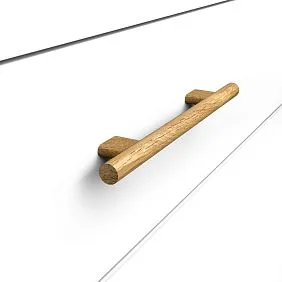

Finish tone: from light to dark
Wood species is the base, but the finish tone sets the mood. Untreated natural oak has a light golden hue. A walnut stain gives a warm medium-brown tone. A wenge or fumed oak stain results in an almost black color. Critical: all wooden elements must be in the same tone.
Imagine:wooden skirting boardsare stained dark walnut, while the furniture handles are natural light oak. Visually, this creates a disconnect that cannot be compensated for by any design tricks. The eye registers the mismatch, and the interior's integrity is compromised.
Solution: choose a single manufacturer for all wooden elements. Only this way can you guarantee that the staining is done with the same composition, using the same technology, with the same result. Different manufacturers use different stains, different varnishes, different drying regimes — and the final color, even if named the same, will differ.
Get Consultation
Finish type: oil, varnish, wax
The finish coating determines the visual and tactile characteristics of wood. Oil creates a matte, slightly silky surface that emphasizes the texture but doesn't provide shine. Varnish creates a glossy or semi-matte surface with a protective film. Wax is an intermediate option, giving a slight shine and tactile warmth.
If handles are oiled, baseboards and cornices must also be oiled. Mixing finishes (oiled handles + varnished baseboards) creates visual dissonance: handles are matte, warm; baseboards are shiny, cool. This is especially noticeable in interiors with a lot of light, where varnish reflects light and oil absorbs it.
Wooden floor baseboard: the foundation of vertical rhythm
A baseboard is not just a protective strip hiding the gap between the wall and floor. It is a horizontal line that runs the entire perimeter of the room, creating a visual foundation for the entire space.
Baseboard height: the proportions that decide everything
heightof floor wooden skirtingis determined by ceiling height. For standard ceilings of 2.6-2.8 meters, an optimal height is 80 mm. For low ceilings of 2.4-2.6 meters, 60-70 mm is sufficient. For high ceilings from 3.0 meters, wide baseboards of 100-120 mm are needed. Incorrect baseboard height ruins proportions: too narrow gets lost, too wide feels oppressive.
Why is this important for the connection with furniture handles? Because the baseboard height creates the visual weight of the lower part of the room. If the baseboard is massive (120 mm of dark oak), the furniture handles should also be massive, large, and expressive. Thin, minimalist handles against such a baseboard will get lost. Conversely, a narrow 60 mm baseboard requires elegant, thin handles that won't overload the composition.
Baseboard profile: from straight to shaped
Straight profile — modern aesthetics, clean lines without decoration. Such a baseboard pairs with minimalist furniture handles of geometric shapes: rectangular bars, simple ovals without carving. This is the language of modern classic or Scandinavian style.
Shaped profile with coves (concave arcs) and projections — traditional classic. Such a baseboard requires corresponding handles: oval with light carving, with relief edges, possibly with patination. This is the language of English or French classic interior.
Profile with a chamfer (beveled top edge) — a compromise between modernity and classic. It's not as strict as straight, but not as decorative as shaped. Suitable for transitional styles, where furniture can be modern but with classic notes.
Baseboard length and the rhythm of joints
wooden skirting boardsmade of solid wood are usually supplied in lengths of 2.0-2.5 meters. This means there will be joints in the room, creating vertical breaks in the horizontal line. Professional installation makes these joints minimally noticeable, but they exist.
How is this connected to handles? The rhythm of baseboard joints can echo the rhythm of furniture placement. If there are three identical dressers with identical handles at equal distances in a room, the baseboard joints can be positioned to align with the gaps between the dressers. This creates an additional layer of structure, invisible but working on the level of subconscious perception.
Furniture handles: the middle line in the verticality of space
If the baseboard is the bottom, the cornice is the top, thenFurniture Handlesis the middle zone, located at the level of a person's hands and eyes. This is the most active zone of interaction.
Handle size: correspondence to the scale of furniture and baseboards
The length of a furniture pull handle should be proportional to the size of the front. For drawers 40-60 cm wide, a 10-12 cm handle is optimal. For fronts 80-100 cm — handles 15-18 cm. For large cabinet doors — 20-25 cm or two handles of 12-15 cm symmetrically.
But the handle size must also consider the baseboard height. If wide baseboards of 100-120 mm are installed in a room, this creates a visual scale. Small 10 cm handles against such a baseboard will look disproportionately tiny. Handles of 15-20 cm are needed, which correspond to the enlarged scale of the interior.
Conversely, if the baseboard is narrow at 60 mm, it sets an intimate, chamber scale. Large handles of 20-25 cm will look excessive. Handles of 10-15 cm are needed, corresponding to the delicacy of the lines.
Handle shape: echoing the baseboard profile
Rectangular bar handles with sharp edges pair with a straight baseboard profile. Both forms speak the language of geometry, strictness, modernity. This is stylistic unity.
Oval handles with smooth curves require a baseboard with a chamfer or light coves. A rectangular bar handle against a shaped baseboard is a stylistic disconnect that jars the eye of a professional designer.
Carved handles with floral ornamentation (leaves, scrolls) require a shaped baseboard with decorative elements. Sometimes a baseboard can have a carved overlay in the corners or along the center of long walls, which echoes the carving on the handles. This creates ornamental echoes that link the bottom (baseboard) and middle (handles) into a single composition.
Handle placement: vertical coordinate
Handles on drawers are usually positioned in the center (by drawer height). Handles on hinged doors are in the upper third (for wall cabinets) or in the center (for floor-standing units). These rules define the vertical position of handles in space.
An interesting technique: if there are several pieces of furniture in a room (chest of drawers, wardrobe, cabinet), position their handles at the same height from the floor. For example, 90 cm from floor level. When you enter the room, the eye sees a horizontal line of handles that runs across all the furniture. This line is located between the bottom line of the baseboard (0-10 cm from the floor) and the top line of the cornice (near the ceiling). The three horizontals create the structure of the space.
Wooden cornice: the upper boundary of the wooden triad
wooden cornicecompletes the vertical composition. If the baseboard works at the bottom, the cornice works at the top, creating a frame for the space.
Ceiling cornice: the boundary between wall and ceiling
A ceiling cornice is installed at the junction of the wall and ceiling, similar to how a baseboard is installed at the junction of the wall and floor. This is mirror symmetry: the bottom and top are framed by wooden lines.
For unity with the baseboard and handles,Wooden corniceshould be made from the same wood species and in the same tone. An oak baseboard stained walnut requires an oak cornice in the same walnut shade. Natural beech handles require a beech cornice without staining.
Cornice width (projection from the wall) is typically 50-100 mm. The wider the cornice, the more monumental the room appears. Wide cornices of 80-100 mm require wide baseboards of 100-120 mm for balance. Narrow cornices of 50-60 mm pair with narrow baseboards of 60-70 mm.
Wall-mounted curtain cornice: function and aesthetics
A wall-mounted curtain cornice is a horizontal line positioned just above the window opening. If there are several windows in a room, several cornices create parallel horizontals at a level of 2.0-2.5 meters from the floor.
These cornices should also be made from the same wood species as the baseboards and handles. Oak handles, oak baseboards, oak curtain cornices — complete material unity. Even if window cornices are partially hidden by curtains, they are visible at the edges of the window and create wooden accents in the upper part of the wall.
Furniture cornice: finishing the top of cabinets
A furniture cornice is installed on the top part of cabinets, buffets, kitchen units. It is a decorative element that makes the furniture visually taller, more monumental, and more finished.
A furniture cornice should be made from the same wood as the handles on that furniture. A cabinet with oak handles should have an oak cornice on top. This creates material unity within a single piece of furniture. When there are several such pieces in a room, all with wooden handles and cornices from the same species, a richness of wooden lines emerges — at the bottom (baseboards), in the middle (handles), at the top (furniture cornices and ceiling cornices).
Creating a unified line: practical steps
How to technically implement a unified wooden line from baseboards to handles and cornices?
Step 1: choosing the wood species
Determine which species will be the main one. Oak — for interiors where strength, expressiveness, and tradition are valued. Beech — for lighter, softer, more modern spaces. Ash — for energetic, contrasting interiors.
Critical: one species for all elements. Mixing species (oak baseboards + beech handles) is possible only in the hands of an experienced designer who knows how to work with contrasts. For independent design, unity of species is recommended.
Step 2: choosing the tone
Determine which wood shade you need. Natural (unstained) — the lightest, warmest, showing the texture in all its glory. Medium tones (walnut, chestnut) — universal, suitable for most interiors. Dark tones (wenge, stained oak) — for dramatic, contrasting spaces.
After choosing the tone, all elements (baseboards, handles, cornices) should be in this tone.to buy wooden baseboardBaseboards, handles, and cornices are best purchased simultaneously from one manufacturer to guarantee matching shades.
Step 3: choosing the type of finish
Oil — for those who value tactility, matte finish, naturalness. Oil emphasizes texture, makes wood warm to the touch, but requires periodic renewal (every 1-3 years depending on load).
Varnish — for those who value gloss, protection, durability. Varnish creates a durable film that protects wood from moisture, scratches, and dirt. But varnish makes the surface colder, less natural.
Having chosen the type of finish, apply it to all wooden elements. Oiled baseboards require oiled handles and cornices. Varnished — varnished.
Step 4: coordinating dimensions and proportions
The height of the baseboard determines the scale. Fix the height (e.g., 80 mm for a standard 2.7 m ceiling). Select the handle size to match this height: for an 80 mm baseboard, handles 12-18 cm long are optimal. The cornice width should be proportional: for an 80 mm baseboard, a cornice 70-90 mm wide is suitable.
These are not strict rules, but recommendations based on visual balance. Professional designers intuitively feel these proportions; for independent work, calculations help.
Step 5: Coordination of profiles and forms
If a straight baseboard is chosen, select rectangular or simple oval handles without threading, and a straight cornice without decoration. If a shaped baseboard with coves is chosen, select oval handles with light relief and a shaped cornice with a corresponding profile. If a carved baseboard is chosen (rare, but found in luxurious interiors), select carved handles and carved cornices with echoing ornamentation.
Profile unity creates stylistic coherence, which the eye perceives as harmony.
Composition examples: from minimalism to classic
How does a unified wooden line work in different styles?
Scandinavian minimalism: light wood and purity of lines
Species: beech or light ash. Tone: natural, without tinting, white paint possible. Finish: oil (to emphasize texture) or matte varnish.
wooden skirting boards60-70 mm high, straight profile without decoration. Furniture handles — rectangular planks or simple ovals, length 10-15 cm. Curtain cornices — round, diameter 28-35 mm, made of the same light wood. Ceiling cornice is absent or minimal (cove 40-50 mm).
Result: a light, airy space where wooden elements create subtle lines that structure but do not dominate. Here, wood is a delicate accent, not the main character.
Modern classic: oak in medium tones
Species: oak. Tone: walnut or natural oak with light tinting. Finish: oil-wax (semi-matte) or semi-matte varnish.
Wooden floor baseboard 80-100 mm high, profile with chamfer or light coves. Furniture handles — oval, length 15-20 cm, possibly with light carving along the edges. Curtain cornices — oval or profiled, width 60-80 mm. Ceiling cornice — profiled, width 70-90 mm.
Result: a balanced interior where wood is noticeably present, creating a warm, noble atmosphere without being overwhelming. This is a universal style suitable for most living spaces.
English classic: dark oak and monumentality
Species: oak. Tone: dark walnut or stained oak. Finish: glossy or semi-matte varnish.
Baseboard 100-120 mm, shaped profile with pronounced coves and protrusions. Furniture handles — oval or carved, length 18-25 cm, possibly with gold patination. Curtain cornices — double-row, profiled, with decorative elements. Ceiling cornice — wide (80-120 mm), shaped, with carved inserts in the corners.
Result: a monumental, respectable space where wood dominates, creating the atmosphere of an old English estate. An abundance of wooden lines (wide baseboards, large handles, massive cornices) creates a sense of solidity, tradition, and capital.
Technical aspects: how to ensure precise matching
The theory of a unified wooden line works only with precise technical execution.
Matching shades: problem and solution
Even if you order baseboards, handles, and cornices from the same wood species from one manufacturer, there is a risk of shade mismatch. Reasons: different batches of wood (wood is a living material, each board is unique), different production times (stain and varnish change chemical composition over time), different drying conditions.
Solution: order all elements simultaneously, from one production batch. Ask the manufacturer to make baseboards, handles, and cornices from boards sawn from adjacent logs, stain them with one stain from the same container, and coat them with varnish from the same can. This guarantees maximum matching.
If the order is split over time (baseboards first, handles six months later), keep a sample of the first batch (a piece of baseboard) and provide it to the manufacturer when ordering handles. The sample can be used to select the closest possible shade.
Matching finish: matte and gloss
The degree of matte or gloss finish is critical for visual unity. There is a gloss scale: matte (gloss 5-10%), semi-matte (gloss 20-40%), semi-gloss (gloss 50-70%), glossy (gloss 80-95%). A difference of 10-20% in gloss is noticeable to the eye, especially under good lighting.
Solution: require the manufacturer to use the same varnish (with manufacturer and article number specified) for all elements. If baseboards are coated with Sayerlack semi-matte varnish (gloss 30%), handles and cornices should be coated with the same varnish.
For oil finishes, it's simpler: oil usually has a stable degree of gloss (10-20%), which depends more on the wood species than on the oil itself. But here too, you need to use one brand of oil (e.g., Osmo or Biofa) for all elements.
Accounting for wood aging: the patina of time
Wood darkens over time. Oak yellows, acquiring a golden-brown hue. Beech turns pinkish. Ash grays. This is a natural oxidation process under the influence of light and air.
Problem: if you install skirting boards and cornices today, and add furniture with handles a year later, the shade of the new handles will be lighter than that of the skirting boards and cornices, which have been aging for a year. This is visually noticeable.
Solution: when adding new elements after some time, artificially age them before installation. Leave them in the sun for several weeks or treat them with a UV lamp. This accelerates oxidation and brings the shade closer to the already installed elements. Alternative: initially plan all wooden decor and install it simultaneously.
Common mistakes and how to avoid them
Even understanding the principles of a unified wooden line, it's easy to make mistakes.
Mistake 1: mixing wood species
Oak skirting boards + beech handles may seem like an acceptable option (both species are light, hard). But the texture of oak (large-pored, contrasting) and the texture of beech (fine-pored, uniform) differ so much that mixing them immediately catches the eye. Oak looks somewhat rough, expressive. Beech looks delicate, even. Together they conflict.
Solution: one wood species for all elements. Exception: intentional contrast, when a designer deliberately juxtaposes two species (e.g., dark oak at the bottom + light ash at the top), but this requires professional flair.
Mistake 2: different tonalities
Floor wooden skirtingSkirting boards tinted dark walnut, handles — natural light oak. This is one of the most common mistakes. Visually: bottom dark, middle light. No logic, no transition, only a break.
Solution: strict adherence to a unified tonality. If you want contrast, use two shades, but systematically: e.g., dark skirting boards and cornices, light handles. Bottom and top dark, middle light — this is symmetrical contrast that works.
Mistake 3: scale mismatch
Wide 120 mm skirting boards + small 8-10 cm handles. The skirting board is massive, creating an impression of monumentality. The handles are thin, almost invisible. Visual imbalance: bottom heavy, middle light.
Solution: scale coordination. Wide skirting boards require large handles 15-20 cm. Narrow 60 mm skirting boards pair with elegant handles 10-12 cm.
Mistake 4: different finishes
Oil-finished skirting boards (matte, warm) + lacquered handles (shiny, cool). Visually: skirting board natural, handles artificial. Tactilely: skirting board warm, handles cool. A break in perception.
Solution: unified finish. Oil for all elements or lacquer for all.
Questions and Answers: everything you need to know
Can wood be combined with other materials in handles and skirting boards?
Yes, but carefully. Wooden baseboards + wooden handles with metal inserts (for example, brass rosettes) are acceptable if the metal plays an accent role. But the base should remain wooden. Fully metal handles against the background of wooden baseboards break the unified line.
How to choose between oak and beech for a unified line?
Oak — if you value expressive texture, durability, traditional classic style. Beech — if you prefer softness, uniformity, modern aesthetics. Both options are equally valid; the choice depends on personal preferences and interior style.
Is it necessary to paint wooden elements white for Scandinavian style?
Not necessarily. Natural light wood (beech, ash without tinting) is already close to Scandinavian aesthetics. White paint makes wood more graphic, hides texture, creates purity. The choice depends on whether you want to see the wood texture or prefer monochrome.
How much does creating a unified wooden line cost?
Depends on the room area, wood species, profile complexity. Approximately: oak skirting board 80 mm — 1500-2500 rub/linear meter, oak handles 15 cm — 300-600 rub/piece, oak cornice 70 mm — 2000-3000 rub/linear meter. For a 20 m² room (perimeter about 18 m) with 6 furniture items (3 handles each): skirting board 18 m × 2000 rub = 36000 rub, handles 18 pcs × 400 rub = 7200 rub, ceiling cornice 18 m × 2500 rub = 45000 rub. Total about 88000 rub. This is a premium solution, but it creates an interior for decades.
How to care for a wooden line?
Oil finish: dry cleaning, wipe with a damp cloth and mild detergent once a year, renew the oil finish every 2-3 years. Lacquer finish: wet cleaning, avoid abrasives, lacquer lasts 5-10 years without renewal. General rule: avoid excessive moisture, sharp temperature fluctuations, direct sunlight (they accelerate aging).
Can you buy wooden skirting board and handles from different manufacturers?
Technically possible, but the risk of shade mismatch is high. Even if both manufacturers use oak, the 'walnut' tinting is unique to each. Result: skirting boards slightly redder, handles slightly greener. A 5-10% difference in shade may seem small, but on the wall it's noticeable. Recommendation: one manufacturer for the entire wooden line.
How long does a unified wooden line last?
Oak elements last 30-50 years with proper care. Beech — 25-40 years. This is longer than most other finishing materials. Wood can be restored: sanded, re-coated with oil or lacquer, and it looks like new. This is an investment that pays off with durability and the possibility of renewal.
What to do if the room is already finished, but you want to add a unified line?
Start by replacing the handles on the furniture. This is the simplest: unscrew the old ones, screw on new wooden ones. Then add wooden skirting boards, after removing the old ones. Cornices can be added last. Phased implementation allows you to spread the costs over time, gradually approaching the ideal.
Is a unified wooden line suitable for modern interiors?
Absolutely. Modernity does not mean rejecting wood. Scandinavian minimalism, Japanese minimalism, eco-style — all actively use wood. The difference lies in the profiles (straight, without decoration) and shades (light, natural), but the principle of a unified line works everywhere.
How to integrate doors into a unified wooden line?
Doors are another vertical element that should be made from the same wood. Oak doors with oak baseboards, handles, and cornices create a total wooden space. If replacing doors is not possible (expensive, complicated), add wooden door architraves made from the same species as the baseboards. This will create a visual connection.
Conclusion: the unified line as an interior philosophy
The concept of a unified wooden line is not a set of technical requirements, but a philosophy where the interior is viewed as an integral system, not a collection of disparate elements. Furniture Handlesfrom oak,Floor wooden skirting made from the same oak, Wooden cornice also oak — this is not a random coincidence, but a thoughtful strategy for creating harmony.
Wood is a material that connects humans with nature, the past with the present, function with aesthetics. When this material runs through the entire space — from the floor through the hand level to the ceiling — a sense of rootedness, stability, and continuity is created. You don't just live in a room with different objects, but in a space that speaks the same language.
Implementing a unified wooden line requires planning, coordination, and professional execution. But the result is worth the effort: an interior that does not become outdated, does not become tiresome, but only gains value over the years, like a good wine.
STAVROS — a company that understands the philosophy of the unified wooden line and embodies it in production. Since 2002, STAVROS has been creating wooden interior elements from solid oak and beech: baseboards, cornices, moldings, furniture handles, overlays, balusters. Everything is produced at its own factory in St. Petersburg, on CNC equipment, with manual finishing and quality control at every stage.
The philosophy of STAVROS is material unity. When you order baseboards, handles, and cornices from STAVROS, they are made from wood of the same batch, stained with the same stain, and coated with the same varnish or oil. This guarantees matching shades, textures, and gloss levels. You receive a ready-made system of elements that perfectly complement each other.
The STAVROS collection includes over 400 items of wooden elements: 8 baseboard profiles with heights from 60 to 120 mm, 18 cornice profiles with widths from 50 to 120 mm, 32 models of furniture handles with lengths from 8 to 25 cm. Each element is available in 12 standard finishes (from natural oak to stained) and in any custom shade according to the RAL or NCS catalog.
STAVROS technologies combine traditional carpentry craftsmanship with modern capabilities. High-precision CNC milling machines cut profiles of any complexity with an accuracy of up to 0.1 mm. Multi-stage sanding (from 80 to 600 grit) creates a perfectly smooth surface. The final finish is done with premium-class compositions: Osmo oils (Germany), Sayerlack varnishes (Italy).
STAVROS services include not only production but also consulting support. STAVROS designers will help you select baseboards, handles, and cornices for your project, calculate the quantity, and suggest optimal solutions. Technologists will advise on installation, select fasteners, and explain the nuances of setup.
STAVROS logistics cover all of Russia. Its own warehouse in St. Petersburg with an area of 2000 m² ensures the availability of popular items for shipment on the day of order. Delivery is organized through trusted transport companies with reinforced packaging that prevents damage. For Moscow and St. Petersburg — courier delivery with floor lifting.
STAVROS prices are honest, without brand markups. to buy wooden baseboard made from oak 80 mm can start from 1950 rubles per linear meter. Oak furniture handles 15 cm — from 380 rubles per piece. Wooden cornice 70 mm — from 2270 rubles per meter. This is 1.5-2 times lower than European analogues with comparable quality.
By choosing STAVROS, you get not just wooden elements, but a system for creating a unified line of wood in the interior. A system where every detail is connected to others by a common material logic, where baseboards, handles, and cornices speak the same language, creating a space that will delight you for decades. Because true harmony is when everything is in its place, in the right material, in the right shade, in the right proportions. And STAVROS knows how to achieve this.


