












































































Article Contents:
- Main Handle Shapes: Classification and Application
- Handle-Clips (Rail Handles)
- Button Handles
- Inset Handles (Rack Handles, Profiles)
- Rail Handle-Clips
- Center-to-Center Distance: Standards and the 32mm System
- Standard System: Multiples of 32mm
- How to Measure Center-to-Center Distance
- Selecting Size Based on Door Panel Width
- Calculating Hole Positions on the Door Panel
- Grip Ergonomics: Anatomy of a Comfortable Handle
- Anatomy of Grip: How the Hand Holds the Handle
- Key Parameters of Ergonomic Handle-Clips
- Ergonomics of Button Handles
- Special Ergonomic Requirements for Different Types of Furniture
- Handle Installation: Practical Aspects
- Marking Hole Positions
- Drilling Holes
- Mounting the Handle
- Furniture Handle Materials: Impact on Ergonomics and Durability
- Conclusion: When the Handle Serves, Not Hinders

A furniture handle is something touched dozens of times daily. Opening a cabinet in the morning, taking out a cup, pulling out a drawer, closing a bedside table before bed. Every action begins with contact between the hand and the handle. And if this contact is uncomfortable — the handle is too small, or too sharp, or positioned where it shouldn’t be, or the shape doesn’t suit the grip — discomfort accumulates. Not immediately, not dramatically, but daily, unnoticed, turning a simple action into a frustrating effort.
Most people choose furniture handles based on appearance. Looks good — we buy it. But after a week of use, it becomes clear: the handle is uncomfortable. Or it doesn’t fit the size — the holes on the door panel don’t match the mounting points, requiring drilling again. Or the length is insufficient — fingers don’t fit, requiring to pull with two fingers, which is inconvenient and unreliable. All of this is the result of ignorance of three key parameters: shape, center-to-center distance, and grip ergonomics.
This article examines furniture handles systematically. What shapes exist and which furniture they suit. What is center-to-center distance, what standards are applied, how to measure and how to choose the correct size. What is grip ergonomics, what parameters make a handle comfortable, how to consider hand anatomy. After reading, you will be able to choose handles not only for their beauty, but also for their functionality, creating furniture that is convenient to use for years.


Main Handle Shapes: Classification and Application
Handle shape determines the grip method, ease of use, and visual perception of furniture. There are several main categories, each with its own logic of application.




Handle-Clips (Rail Handles)
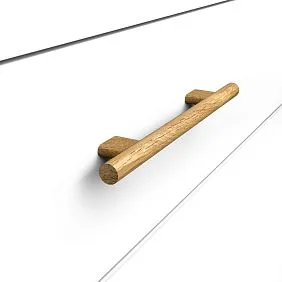
The most common type — an arched construction with mounting at two points. The shape varies from a simple arc to complex decorative curves. Mounting via two holes with M4 or M5 screws.
Advantages of Clips:
-
Comfortable grip with four fingers
-
Load distribution over two mounting points (high reliability)
-
Universality (suitable for cabinet doors, drawers, any furniture)
-
Wide range of styles (from minimalism to classic)
Where they are applied:
Kitchen fronts — primary application. Clips with center-to-center distance 96–128 mm are optimal for standard doors 300–600 mm wide. Convenient grip when opening a door or pulling out a drawer with one hand, often with the other hand occupied (holding a plate, food).
Cabinets and chests — 128–160 mm clips for wide doors and deep drawers. Long clips allow pulling heavy drawers with two hands, distributing effort.
Office furniture — 96 mm clips for desks, cabinets, table drawers. Neutral appearance, comfort, durability.
Materials:
Stainless steel — classic for kitchens, resistant to moisture and cleaning agents. Aluminum — lightweight, modern look, often with matte anodizing. Brass — for classic interiors, with polishing or patina. Wood combined with metal — for eco-style, Scandinavian interiors.
Our factory also produces:


Button Handles
Compact elements with single-point mounting. Shape: round, square, cylindrical, mushroom-shaped, decorative. Mounting with one screw through the central hole.
Advantages of Button Handles:
-
Compactness (suitable for narrow fronts where clips won’t fit)
-
Easy installation (one hole instead of two)
-
Design variety (ceramic, glass, wood, metal, combinations)
-
Space-saving (do not protrude significantly from the front)
Where they are applied:
Small drawers — 200–300 mm wide. Clips are excessive here; buttons are optimal. Diameter 25–35 mm ensures comfortable grip with thumb and index finger.
Children’s furniture — buttons are safer than clips (no sharp corners, no risk of catching clothing). Bright colors, interesting shapes (stars, animals, geometry) attract children and teach them to open drawers independently.
Classic furniture — brass, bronze, painted ceramic, porcelain buttons. Traditional element of antique chests, secretaire, buffets.Classic-style furniture hardwareemphasizes the nobility of natural materials.
Doors with profile — if the door has a profiled frame with a recess, the button is installed in the center of the recess, creating a minimalist look.
Ergonomics of Button Handles:
Diameter of at least 25 mm for comfortable grip by an adult hand. Less — uncomfortable, fingers slip. Button height from the front 15–30 mm — sufficient for finger grip, but not excessive protrusion.
Get Consultation
Inset Handles (Rack Handles, Profiles)
Handles embedded in the front — recesses into which fingers enter. Can be horizontal (slot along the top or bottom edge of the front) or vertical (along the side edge).
Advantages of Inset Handles:
-
Minimalist appearance (front remains flat)
-
Safety (nothing to catch on, no protrusions)
-
Space-saving (furniture can be placed close to walls, passages)
-
Modern design (characteristic of minimalism, high-tech)
Where they are applied:
Kitchens without handles — trend of recent years. Top fronts open by pressing (push-to-open systems), bottom fronts — with inset handle at the top edge of the front. Hand enters the slot and pulls inward.
Narrow passages — if the kitchen or furniture is placed in a narrow corridor, protruding clips obstruct passage and catch clothing. Inset handles solve this problem.
Sliding cabinets — profiled handles embedded in the door end, allowing convenient door movement without protruding elements.
Ergonomics of Inset Handles:
Recess depth at least 25 mm to allow fingers to enter freely. Recess width at least 100 mm for four-finger grip. Recess edges must be rounded or have a protective profile — sharp edges cut fingers with frequent use.
Rail Handle-Clips
Long horizontal handles in the form of a round or rectangular tube. Mounting at two points, but length significantly exceeds standard clips — from 300 to 700 mm and more.
Advantages of Rails:
-
Convenience for wide facades (can be pulled from any point)
-
Modern industrial look
-
Strength (thick pipe withstands heavy loads)
-
Ability to grip with two hands (for heavy doors, pull-out baskets)
Where they are applied:
Wide kitchen facades — 600 to 900 millimeters. Standard 128 mm hinges here look disproportionately small. Railings of 436–512 mm provide visual balance and convenience.
Oven and dishwasher — built-in appliances are often equipped with rail-mounted handles. They withstand the force required to open heavy oven doors.
Closet cabinets — tall sliding doors, hinged closet cabinets. A long vertical rail handle allows opening the door by gripping at any height — convenient for people of different heights, including children.
Dimensions:
Pipe diameter: 12–20 mm for round section, 12x20–20x30 mm for rectangular. Distance from facade to pipe (overhang) 40–60 mm — sufficient for hand grip.
Center-to-center distance: standard and system 32 mm
Center-to-center (center-to-center) distance — key parameter for handles with two mounting points. This is the distance from the center of one hole to the center of another, measured in millimeters.
Standard system: multiples of 32 mm
Modern furniture and hardware manufacturers adhere to a unified system where all dimensions are multiples of 32 mm. This is due to the modular production system for cabinetry, where the basic marking step is 32 mm.
Standard center-to-center distances:
-
32 mm — minimum size, for very narrow drawers, children’s furniture
-
64 mm — small boxes, narrow fronts 150–200 mm wide
-
96 mm — standard kitchen drawers, facades 250–400 mm wide
-
128 mm — most universal size, suitable for facades 400–600 mm wide
-
160 mm — wide drawers, tall cabinets, facades 600–750 mm wide
-
192 mm — large facades, sliding cabinets
-
224, 256 mm — very wide doors
-
320, 352, 464, 512 mm — rail handles for wide facades
The system works simply: each next size is 32 mm larger than the previous. This allows standardizing production, simplifies handle replacement (new handles fit into existing holes if center-to-center distance matches), ensures compatibility between hardware from different manufacturers.
How to measure center-to-center distance
If you need to replace handles on existing furniture, you must accurately measure the center-to-center distance of the existing holes.
Tools:
Metal ruler with millimeter scale or caliper (for maximum accuracy).
Measurement method:
Align the ruler with the facade so that zero coincides with the center of the first hole. Note where the center of the second hole is. This is the center-to-center distance.
If the holes are not round (for example, if broken holes remain from old handles), measure from the geometric center of each hole — approximately in the middle.
Accuracy is important:
According to manufacturer requirements, the allowable deviation of the center-to-center distance must not exceed plus or minus half a millimeter. If you measure 127.5 or 128.5 millimeters, this is still the standard 128 millimeters. But if you get 125 or 132 — this is not standard; handles with a 128 mm center-to-center distance will not fit, and the holes will need to be reworked.
Selecting size based on facade width
Choosing center-to-center distance is not arbitrary. There are recommendations based on proportions and ergonomics.
Rule:
The center-to-center distance should be approximately one-third to two-fifths of the facade width. This ensures visual balance and ease of grip.
Examples:
Facade width 300 mm: one-third is 100 mm. Optimal center-to-center distance is 96 mm. The handle does not appear too small or too large.
Facade width 450 mm: one-third is 150 mm, two-fifths is 180 mm. Optimal center-to-center distance is 128–160 mm. For kitchen cabinet doors of this width, 128 mm is usually chosen.
Facade width 600 mm: two-fifths is 240 mm. You can use a 192 mm bracket or a 436 mm rail handle (for horizontal installation along the facade).
Facade width 200 mm (narrow cabinet, bottle holder): one-third is 67 mm. A 64 mm bracket will fit, but for such narrow facades, buttons are often used — they do not visually overload the design.
Exceptions:
Minimalist interiors — handles are intentionally made small (64 mm center-to-center on a 400 mm facade), creating a restrained effect. But this is a sacrifice of convenience for aesthetics.
Classic interiors — handles can be larger than recommended proportions, emphasizing the solidity and sturdiness of the furniture.
Calculating hole positions on the facade
When you choose the center-to-center distance, you must properly mark the facade for drilling.
Horizontal handle placement (standard for doors):
Holes are positioned on the same horizontal line. Height from the bottom edge of the facade is usually 50–70 mm for lower cabinets (convenient to open from top to bottom) or 50–70 mm from the top edge for upper cabinets (convenient to pull from bottom to top).
The distance from the first hole to the side edge of the facade is calculated by the formula:
X = (Facade width − Center-to-center distance) / 2
Example: Facade width 450 mm, center-to-center distance 128 mm.
X = (450 − 128) / 2 = 322 / 2 = 161 mm.
First hole at 161 mm from the left edge. Second hole — 128 mm to the right, i.e., 161 mm from the right edge. Symmetrical.
Vertical placement (for tall narrow doors):
Holes are stacked vertically. Center-to-center distance is measured vertically. Horizontal position — centered on the facade width or offset toward the edge (if the door opens and the handle should be closer to or farther from the hinges).
Ergonomics: anatomy of a comfortable handle
Ergonomics is the science of adapting tools and objects to the anatomy and physiology of the human body. For furniture handles, this means: shape, dimensions, and position must correspond to the structure of the hand, ensuring a comfortable grip without excessive effort.
Anatomy of grip: how the hand holds the handle
When opening a door or pulling out a drawer, the hand performs a grip:
Grip with four fingers (bracket): Four fingers (index, middle, ring, pinky) go under the bracket, the thumb rests on the facade from above or wraps over the bracket from above. Force is distributed among the four fingers pulling downward and the thumb stabilizing the hand position. This is the strongest and most comfortable grip for opening heavy doors or pulling out deep drawers.
Two-finger grip (button): The thumb and index finger grip the button from both sides and pull it toward themselves. Less powerful grip, suitable for light doors and drawers. Requires greater precision — fingers must land precisely on the button.
Palm grip (rail handle): The hand wraps around a long rail handle tube, fingers close around the tube, and the palm presses down. This is the most reliable grip, allowing maximum force application. Used for opening heavy doors (oven, refrigerator, large cabinets).
Ergonomic handle-clip key parameters
Grip length (center-to-center distance):
Minimum for an adult hand — ninety-six millimeters. This allows four fingers to comfortably fit under the clip. With a shorter length, fingers are cramped, making the grip uncomfortable.
Optimum — one hundred twenty-eight millimeters. Fingers fit freely with room to spare. Convenient for most people, including those with large hands.
For very wide facades and for two-handed grip (heavy drawers) — one hundred sixty to two hundred millimeters and more.
Handle diameter or thickness:
For circular cross-section, optimal diameter is twelve to eighteen millimeters. This is the thickness that is comfortable to grip — not too thin (cuts fingers), nor too thick (hand cannot wrap around).
For rectangular cross-section, optimal thickness (shorter side) is ten to fifteen millimeters, width (longer side) is fifteen to twenty-five millimeters.
Projection from facade (distance between handle arc and facade):
Minimum thirty millimeters, so fingers can fit under the clip without touching the facade with knuckles. Optimum thirty-five to forty-five millimeters. More than fifty millimeters — excessive, handle protrudes too much and may interfere.
Arc shape:
Classic semicircular arc — universal and convenient. Fingers naturally position without strain.
Angular arc (with notches and edges) — less comfortable for prolonged use, angles press on fingers. Suitable for furniture used infrequently or where aesthetics outweigh ergonomics.
Asymmetric arc (curved, wavy) — may be convenient if the shape matches the anatomical curve of the fingers. However, such handles are often designer-oriented and not always ergonomic.
Material and surface finish:
Smooth metal (polished stainless steel, chrome) — aesthetically pleasing but slippery, especially if hands are wet or greasy (kitchen). Matte metal (satin, brushed steel) — better, with slight friction.
Textured surface (ribbed, grooved, abrasive finish) — maximum friction, hand does not slip. However, dirt accumulates in the texture, requiring frequent cleaning.
Combined handles (metal + wood, metal + plastic with soft-touch finish) — warm to the touch, non-slip, pleasant. Wood is eco-friendly and tactilely comfortable.Solid wood productsCreate a unique atmosphere of naturalness in the interior.
Ergonomics of button handles
Diameter:
Minimum twenty-five millimeters for an adult hand. Less than this — fingers slip, difficult to grip.
Optimum twenty-eight to thirty-five millimeters. Convenient to grip with thumb and index finger.
More than forty millimeters — large buttons, accentual, for wide facades or decorative effect.
Projection height from facade:
Minimum fifteen millimeters, so fingers can catch the button. Optimum twenty to twenty-five millimeters. More than thirty millimeters — button protrudes too much, risk of catching clothing, inconvenient in narrow passages.
Top shape:
Flat or slightly convex — convenient, fingers do not slip. Spherical (ball-shaped button) — may be slippery, especially if polished smooth. Conical or pointed — uncomfortable, presses on fingers.
Ergonomic requirements for different types of furniture
Kitchen furniture:
Higher requirements — hands are often wet, greasy, and occupied. Handles must be non-slip (matte surface), sufficiently long (minimum 96 mm center-to-center for hooks), easy to grasp with one hand. Materials resistant to detergents and corrosion — stainless steel, quality chrome plating, anodized aluminum.
Children's furniture:
Safety is paramount. No sharp corners or cutting edges. Buttons with rounded shapes, hooks with smooth curves. Handle sizes slightly smaller than adult ones — designed for a child’s hand. Center-to-center distances of 64–96 mm for hooks, button diameters of 25–30 mm. Bright colors and interesting shapes attract attention and encourage children to develop independence.
Furniture for elderly people and people with disabilities:
Maximum ease of grip. Long hooks (128–160 mm), thick (diameter 15–20 mm, easier to grasp with weak fingers or arthritis). Contrasting handle color relative to the facade (easier to locate for people with poor vision). Non-slip, warm-to-the-touch materials (wood is preferable to cold metal).
Office furniture:
Neutral appearance, durability, resistance to frequent use. Hooks 96–128 mm from stainless steel or aluminum. Matte surface (does not show fingerprints, unlike polished surfaces). Simple forms without excessive decoration.
Handle installation: practical aspects
Even a perfectly chosen handle will not work properly if installed incorrectly. Precision of installation is critical.
Drill hole marking
Use a template (guide plate) — a plate with holes at standard center-to-center distances. Place it against the facade, mark the centers through the template holes, then drill. This guarantees accuracy and symmetry.
If no template is available — manual marking. Calculate hole positions using the formula (see above), measure with a tape measure, mark with a pencil. Check with a level (for horizontal installation, the line between holes must be strictly horizontal).
Important: Even a two- to three-millimeter deviation is visually noticeable — the handle will stand crooked. Check the marking twice before drilling.
Drilling holes
The hole diameter for M4 screws is 5 mm, for M5 — 6 mm. Use a drill bit of the corresponding diameter for wood (for wooden and MDF facades) or metal (for metal handles in metal frames).
Drill strictly perpendicular to the facade. An angled hole will cause the screw to enter crookedly, and the handle will stand unevenly.
Place a wooden block or thick cardboard under the facade — this prevents chipping on the opposite side as the drill bit exits.
Drilling depth: facade thickness plus 2–3 mm allowance.
Handle mounting
The handle is placed against the facade from the front side, and screws are tightened from the back. Sometimes a decorative strip (rose) is placed between the handle and the facade — it covers the hole and adds an additional decorative effect.
Screw length:
Calculated as facade thickness plus handle strip thickness (if any) plus 8–10 mm for threaded connection.
Example: Facade thickness 18 mm, handle strip 3 mm. Screw length: 18 + 3 + 10 = 31 mm. Purchase screws of 30 or 35 mm length.
Too short a screw will not ensure reliability — the handle will loosen. Too long — it will protrude from the back of the facade and may damage the contents of the cabinet.
Tightening:
Tighten screws evenly, alternately — several turns of the first, several turns of the second. This ensures even handle seating, tight without misalignment.
Do not over-tighten — may strip the threads in plastic or MDF, crack ceramic or glass handles. Tighten until fully seated, but without excessive force.
Materials of furniture handles: impact on ergonomics and durability
Material determines not only appearance but also tactile feel, durability, and resistance to operating conditions.
Stainless steel: Classic for kitchens and bathrooms. Does not rust, does not oxidize, resistant to moisture, acids, and alkalis. Polished steel is beautiful but cold and slippery to the touch. Matte (satin or brushed) finish — warmer, non-slip, and hides fingerprints. Lasts for decades.
Aluminum: Lightweight, corrosion-resistant, modern look. Often anodized (protective coating that imparts color — silver, black, gold). Less strong than steel — may bend under strong impact. But sufficient for household use.
Brass and bronze: Traditional materials for classic furniture. Heavy, warm to the touch, noble. Over time, they patina (darken, develop a surface layer), giving a vintage look. Require polishing to maintain shine or special treatment to fix the patina. Expensive, but durable and prestigious.
Wood: Warm, pleasant to the touch, eco-friendly.Wooden elements in interior designCreates coziness and naturalness. Handles made of solid oak, ash, walnut suit eco, Scandinavian, and country styles. Require protective coating (varnish, oil) for moisture resistance and protection against dirt. Less durable than metal, but repairable — can be sanded and re-coated.
Plastic: Budget material, variety of colors and shapes. Quality ABS plastic, polypropylene — strong, fade-resistant, moisture-resistant. Cheap plastic is brittle, yellows, and cracks. Cold to the touch, less pleasant than metal or wood. Suitable for temporary furniture and budget projects.
Ceramic and glass: Decorative materials for classic, vintage, and Provencal interiors. Ceramic knobs with painted designs, glass with faceting — beautiful and unique. But fragile — may shatter from impact. Cold to the touch. Used where furniture is handled carefully, where aesthetics matter more than functionality.
Conclusion: when the handle serves, not hinders
Furniture handle — a small detail that determines daily comfort. Correct shape makes opening easy and natural. Correct center-to-center distance ensures compatibility with fronts, visual proportions, and replacement without modifications. Proper ergonomics turns the grip into a comfortable action without effort, strain, or discomfort.
Choose handles not only by catalog images. Hold a sample in your hand — feel the weight, temperature of the material, and comfort of the grip. Check dimensions — measure center-to-center distance on existing fronts or calculate optimal for new ones. Consider operating conditions — kitchens require stainless steel, children’s areas — safe shapes, classic interiors — noble materials.
Company STAVROS has been working with natural materials for over twenty years, offering qualitySolid wood productsfor creating harmonious interiors. In addition to wooden planks, moldings, and decorative molding, the assortment includes:furniture legs, balusters, decorative appliqués.
STAVROS consultants will help select hardware for your project, calculate required quantities, and recommend optimal materials. Custom manufacturing is possible — creating unique wooden handles matching the style of your furniture and interior.
Create furniture that is convenient to use. Where every door opening is a smooth motion, not an effort. Where handles serve for decades without losing appearance or functionality. Where details are thought out, and the result delights daily. STAVROS provides materials and expertise to realize such projects.


