Article Contents:
- Sculptural Design: When the Handle Becomes a Work of Art
- Biomorphic Forms: Inspiration from Nature and Organic Shapes
- Personalization Through Hand-Made: Uniqueness in Every Detail
- Materials and Technologies: From Solid Wood to Combined Solutions
- Color Solutions: From Natural Tones to Bold Experiments
- Sizes and Proportions: From Miniature Buttons to Monumental Handles
- Stylistic solutions: from classic to avant-garde
- Classic style: symmetry and elegance
- Scandinavian minimalism: simplicity and functionality
- Loft and Industrial Style: Brutality and Contrasts
- Boho and Eclecticism: Boldness and Uniqueness
- Ergonomics and Comfort: How the Handle Affects Comfort
- Installation and Mounting: Technical Nuances
- Care and Maintenance: How to Preserve the Beauty of Wood
- How to Choose the Perfect Furniture Handles: Practical Tips
- Frequently Asked Questions About Furniture Handles
- Conclusion: An Investment in Details That Shape the Home’s Character

Furniture hardware is no longer a secondary detail in interior design. In 2026, furniture handles become full-fledged art objects capable of transforming the appearance of any item — from kitchen cabinets to vintage chests. The upcoming season dictates new rules: moving away from sterile minimalism toward expressiveness, shifting from mass production to the uniqueness of handcrafted work, replacing rigid geometry with smooth biomorphic lines. Wooden handles are back in popularity, but no longer as nostalgic elements, but as embodiments of modern aesthetics, where natural texture combines with sculptural form, and each handle tells its own story.
The market responds to consumer demand, tired of faceless uniformity and craving individuality. Wooden handles, crafted by hand or using proprietary finishing techniques, become markers of status and taste, indicating that the owner values craftsmanship, materials, and uniqueness. Buying wooden handles today means investing in durability, eco-friendliness, and aesthetic perfection that won’t become outdated with the seasons.


Sculptural Design: When the Handle Becomes a Work of Art
Sculptural design is the key concept of furniture design in 2026. The handle no longer serves merely as a functional element but transforms into a miniature sculpture that invites contemplation and tactile pleasure. Three-dimensional forms, complex reliefs, interplay of light and shadow on the surface — all of this turns opening a cabinet or drawer into a tactile delight and aesthetic experience.
Sculptural furniture handles are inspired by art, architecture, and natural forms. Some models resemble abstract compositions of contemporary artists, others — ancient reliefs, and others — organic structures found in nature: tree branches, seashells, mineral crystals. Such a handle does not merely open a door — it becomes an accent that draws the eye and sets the mood for the entire interior.
A wooden handle in sculptural form demonstrates the skill of a carver or turner. Solid oak, ash, walnut is processed by hand or on modern CNC machines, allowing the realization of the most complex forms with micron-level precision. The surface may be smooth and polished, highlighting the noble wood grain, or intentionally rough, brushed, preserving tool marks and creating a handcrafted effect. Choosing wooden handles with sculptural forms can completely change the character of furniture — from strict classicism to avant-garde expressionism.
Long sculptural handles are especially in demand for tall facades, penalti cabinets, wardrobe systems. The vertical line visually elongates space, making furniture slimmer and adding architectural expressiveness. Such handles can reach 600–960 mm in length, becoming the dominant element of the facade. Working with proven suppliers, where quality wooden item manufacturingensures the durability and flawless finish of every detail.




Biomorphic Forms: Inspiration from Nature and Organic Shapes
Biomorphic design is a trend gaining momentum and becoming defining in 2026. Biomorphism implies using forms inspired by living nature: smooth curves, asymmetry, absence of sharp angles, fluid lines. Such forms are perceived by humans as friendly, safe, and comfortable — unlike rigid geometry, which may feel cold and detached.
Biomorphic furniture handles replicate the outlines of natural objects: pebbles smoothed by seawater; a leaf bent by the wind; a plant stem; a river wave. These forms lack sharp edges and straight lines; they flow into one another, creating a sense of movement and life. Touching such a handle is pleasant — it fits perfectly in the palm, its shape is inherently ergonomic, as nature is always functional.
A wooden handle with a biomorphic form emphasizes the naturalness of the material. Wood itself is an organic material with a unique grain pattern, knots, and color transitions. When the handle’s form is also organic, it creates a harmonious unity between material and design. Wood can be stained with natural oils, highlighting the texture, or painted in natural tones — from beige and terracotta to deep brown and graphite.
Biomorphic forms are especially relevant in interiors designed in biophilic, Scandinavian minimalism, Japanese wabi-sabi, and eco styles. They soften the geometry of a space, making it cozier, more inviting for rest and relaxation. Buying wooden handles with biomorphic forms means bringing a piece of nature into the home, creating a connection with the natural environment, even in an urban apartment. A company specializing in handleoffers a wide range of shapes and textures.
Our factory also produces:



Personalization through hand-made: uniqueness in every detail
Hand-made, artisanal work — this is not just a production technology, but a philosophy opposing mass production and uniformity. In an era when any product can be ordered online and receive an identical copy of millions of others, value is found in the unique, handcrafted item, bearing the mark of individuality. Handcrafted furniture handles are an investment in exclusivity — something no one else will have exactly the same detail in their home.
Handcrafted work implies human involvement at every stage of handle creation: from selecting the blank to final finishing. The artisan selects a piece of wood with an interesting grain, turns it on a lathe or carves it by hand, sands, oils or waxes, and polishes. Each handle becomes unique — even when repeating the same shape, the wood grain pattern, tone, and fine surface nuances will differ. This is the main value of hand-made.
Handcrafted wooden handles allow for the realization of the boldest ideas: wood carving with botanical ornaments, metal or stone inlays, combinations of different wood species in one handle, creation of asymmetrical original forms. The artisan can manufacture a handle according to the customer's individual sketch, taking into account preferences regarding size, shape, color, and finish. Such a handle becomes not just a furniture element, but a part of the home's history, passed down from generation to generation.
Personalization is also the possibility of engraving initials, symbols, patterns, transforming the handle into a personal artifact. Engraving, burning, painting — techniques that make each handle recognizable and unique. In 2026, more and more people choose wooden handles with customization elements reflecting the owner's personality, values, tastes. When contacting the manufacturer where production of solid wood itemsyou can order handles taking into account individual preferences.
Get Consultation
Materials and Technologies: from solid wood to combined solutions
Choosing material for a furniture handle is not only choosing aesthetics, but also tactile sensations, durability, and eco-friendliness. Wood remains the leader among materials due to its naturalness, warm texture, and workability and finishability. Solid oak, ash, beech, walnut, cherry — each species has unique properties: hardness, texture, color, resistance to moisture and mechanical damage.
Oak is the classic of furniture making, symbolizing strength and durability. Oak handles withstand intensive use, do not lose shape, do not scratch. Oak's texture is expressive, with large pores that can be emphasized by brushing or toning. Ash is lighter than oak, but does not fall short of it in strength, has a lighter tone and elegant wood grain pattern. Beech is a dense, uniform wood, ideal for turning and creating complex shapes. Walnut is a noble species with a warm chocolate tone, associated with the premium segment.
Combined solutions expand design possibilities. A wooden handle can be combined with metal — brass or copper inlays, which add an industrial touch and contrast. Wood and leather — a combination creating aristocratic elegance, suitable for classic and vintage interiors. Wood and stone — an unusual but effective solution, where a natural mineral cut or polished marble is embedded into a wooden base.
Processing technologies also influence the final appearance of the handle. Turning allows creating symmetrical rotational forms — cylinders, spheres, cones, complex profiles. CNC milling enables the realization of any three-dimensional shapes with perfect accuracy. Hand carving — a technique requiring skill and time, but creating unique patterns and reliefs. Brushing creates an effect of aged wood, emphasizing texture. When working with wooden handlesit is important to consider not only shape, but also manufacturing technology.
Color Solutions: from natural tones to bold experiments
The color of a furniture handle is an accent that can either delicately complement the overall interior palette or become a striking contrast, drawing attention. In 2026, both strategies are relevant, and the choice depends on the space's concept and personal preferences.
Natural wood tones remain unbeatable for those who value organic aesthetics and connection with nature. Light wood — ash, maple, birch — creates a sense of freshness and lightness, suitable for Scandinavian and minimalist interiors. Medium tones — oak, beech, cherry — are universal, compatible with most color palettes, adding warmth. Dark wood — walnut, wenge, stained oak — is associated with luxury, suitable for classic and art deco interiors.
Toning and patination expand the palette. Wood can be stained with any shade — from bleached white to deep black — while still preserving visible wood grain texture. Patina — a technique creating an effect of noble aging, where recesses in the texture retain darker tones, while raised areas remain lighter. This adds volume and depth, emphasizing the handle's relief.
Bold color solutions — a trend for those who are not afraid of experimentation. Wooden handles painted in bright colors — emerald, sapphire, terracotta, mustard — become the main accent of furniture. Such handles transform an ordinary chest or kitchen set into an art object, adding playfulness and individuality. Matte finish creates noble restraint, glossy finish — brightness and dynamism. Gradient coloring, transitioning from one shade to another — an avant-garde solution suitable for modern and eclectic interiors.
Metallic finishes — gold, silver, bronze, copper — add luxury and glamour to handles. They are especially relevant in art deco, maximalist, and glamorous interiors. The wooden base is covered with metallic paint or foil, creating an illusion of a solid metal handle, while preserving the warmth and lightness of wood. Buying wooden handles with metallic finishes means obtaining a compromise between the naturalness of wood and the shine of metal. The company STAVROS offers a wide selection of wooden handlesin various shades and finishes.
Sizes and Proportions: from miniature buttons to monumental brackets
The size of a furniture handle affects not only usability but also the visual perception of furniture. Small button handles are delicate, do not draw attention, suitable for furniture with many drawers, where overall composition matters more than individual elements. Large brackets and long handles, on the contrary, become accents, define character, emphasize vertical or horizontal lines.
Miniature buttons with a diameter of 20-30 mm are ideal for small drawers in chests, bedside tables, secretaire. They create a vintage charm, suitable for classic, Provence, and shabby chic interiors. A wooden button handle can be turned, with relief, carved, painted, or with natural texture. Despite their modest size, such a handle can set the mood for the entire piece of furniture.
Medium-sized handles — brackets 64-128 mm — are a universal option, suitable for most cabinets, kitchen sets, wardrobe systems. They are convenient to use, provide a secure grip, and match various styles. The bracket can be straight or curved, smooth or with relief, symmetrical or asymmetrical. A wooden handle of medium size — this is a balance between functionality and aesthetics.
Long handles 300-960 mm — a 2026 trend, especially relevant for tall facades and minimalist interiors. Such a handle visually elongates furniture, making it slimmer, adding architectural expressiveness. A long wooden handle can be rectangular, cylindrical, asymmetrical, or with variable cross-section. It can be mounted vertically or horizontally, becoming a dominant element of the facade. For tall cabinets, whose height exceeds 2 meters, long handles are not only stylish but also functional — they ensure convenient opening at any height.
The proportions of the handle must correspond to the size of the furniture. A large bracket on a small chest will look out of place, while a miniature button on a large wardrobe will be lost. The rule of proportionality — the key to harmonious design. When working with an assortment where Furniture HandlesIn various sizes, you can select the perfect option for any piece of furniture.
Stylistic Solutions: From Classic to Avant-Garde
Classic style: symmetry and elegance
Classic style in furniture handles means adherence to traditions, symmetry of forms, use of natural materials, restrained luxury. Wooden handles for classic interiors are often precisely shaped — balusters, pears, cylinders with relief bands. They can be painted in dark noble tones or coated with varnish that highlights the texture of valuable wood — walnut, mahogany, oak.
Classic handles are often complemented by metallic elements — brass inlays, rings, which add a sense of grandeur. Carved wood with floral ornaments, scrolls, acanthus leaves — characteristic decoration of classic handles. Such handles suit antique furniture, modern sets in classic style, bookcases, office furniture. They create an atmosphere of stability, respect for traditions, timeless elegance.
Scandinavian minimalism: simplicity and functionality
Scandinavian style values simplicity, functionality, natural materials, light tones. Furniture handles in Scandinavian interiors are maximally minimalist — simple geometric shapes, absence of decoration, natural wood texture. A wooden handle may be cylindrical, rectangular, teardrop-shaped, carved from light wood — birch, beech, pine.
Color palette — natural tones or white, gray, pastel shades. Surface is usually matte, covered with oil or wax, pleasant to the touch. Scandinavian handles do not draw attention, but create a sense of quality, durability, attention to detail. They perfectly match light furniture, textiles made of natural fabrics, minimalist decor.
Loft and industrial style: brutality and contrasts
Loft — a style celebrating industrial aesthetics, rough textures, contrasts. Wooden handles in loft interiors are often combined with metal — black steel bases, chains, pipes. Wood may be intentionally rough, brushed, with an aged effect, painted in dark shades or left natural with emphasized knots and cracks.
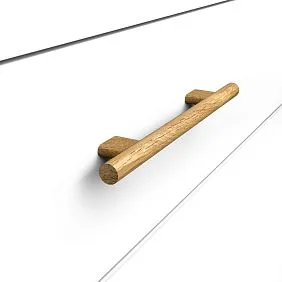
Handle shape is minimalist — straight brackets, cylinders, T-shaped handles resembling industrial hardware. Such handles suit furniture made of rough wood, metal, concrete, open shelves, industrial cabinets, loft-style kitchens. They create a brutal, masculine atmosphere, emphasizing the character of the space.
Boho and eclectic: boldness and uniqueness
Boho and eclectic — styles where rules don’t apply, where boldness, individuality, mixing of eras and cultures are valued. Furniture handles in such interiors can be very different — from vintage carved ones to avant-garde asymmetrical ones. A wooden handle may be hand-painted, inlaid with colorful stones, decorated with brushes or textiles.
Uniqueness is important — each handle may differ from the other, creating an eclectic mix. Buying wooden handles for boho interiors means choosing the most unusual, original models that tell stories, inspire, surprise. Such handles turn furniture into a gallery, where each element is an exhibit.
Ergonomics and comfort: how a handle affects comfort
Beauty is an important, but not the only criterion for choosing a furniture handle. Ergonomics, ease of use, tactile sensations play an equally important role, especially for furniture used daily. A wooden handle should fit comfortably in the hand, provide a secure grip, not slip, not press on the palm.
Handle shape affects comfort. Brackets with smooth curves, mimicking the shape of the palm, are more comfortable than straight ones. The diameter of a cylindrical handle is optimal in the range of 25–35 mm — such a handle is easily grasped by fingers. Buttons should have sufficient diameter (at least 25 mm) to be comfortably grasped. Long handles are universal — they can be grasped at any point, which is especially important for tall facades.
Handle surface also affects comfort. A smooth polished surface is pleasant, but may slip in wet hands. A slightly textured, matte surface provides better grip. Wood covered with oil or wax creates a warm, silky texture, pleasant to the touch. Wooden handles with natural texture provide a tactile experience impossible with plastic or metal.
Handle weight also matters. A handle that is too light may feel flimsy, too heavy — create stress on fittings. Wood has optimal weight — lighter than metal, heavier than plastic, creating a sense of solidity and quality. Working with products where the production of furniture hardware is carried outfurniture hardware productionyou can be sure of thoughtful ergonomics.
Mounting and fastening: technical nuances
Correct installation of a furniture handle ensures its longevity, reliability, and aesthetic appearance. There are several ways to mount handles, each with its own characteristics.
Inset handles are installed into pre-fabricated recesses on the facade. This method creates a minimalist look — the handle does not protrude from the surface, but is flush or recessed. Inset handles require precise fitting, but the result is worth the effort — the furniture looks monolithic and modern. A wooden handle can be fully or partially inset, creating an interesting play of depth.
Surface-mounted handles are attached to the facade using screws that pass through the handle and are screwed into the door from the back. This is the most common method, ensuring secure fixation. The distance between holes (center-to-center distance) is standardized — 32, 64, 96, 128, 160 mm, etc. When replacing handles, it is important to consider this distance so that new handles fit in place of old ones without additional drilling.
Adhesive mounting is used for decorative handles or knobs on lightweight doors. The handle is glued to the facade with a special adhesive that withstands load. This method is suitable for handles that do not experience significant force when opening, or for decorative elements. The advantage is the absence of visible fasteners on the back of the facade.
When mounting, use quality fasteners — stainless steel screws that do not rust or break. Screw length should match facade thickness — too long screws will protrude from the back, too short ones will not provide secure fixation. Pre-drilling holes of smaller diameter prevents wood cracking. Working withwooden handleshandles from reputable manufacturers, you can get a quality fastener set.
Care and maintenance: how to preserve the beauty of wood
Wooden handles require minimal, but regular care to maintain their beauty and functionality for decades. Wood is a living material that reacts to humidity, temperature, mechanical impacts. Proper care extends the lifespan of handles and preserves their appearance.
Regular cleaning is the foundation of care. Wipe handles with a soft damp cloth, removing dust and dirt. Do not use abrasive cleaners, stiff brushes, aggressive chemicals — they may damage the finish, scratch the surface. For wood covered with oil or wax, water is sufficient; for varnished handles, you can use mild cleaning agents.
Periodic reapplication of finish is necessary for handles covered with oil or wax. Every one to two years, apply a thin layer of oil or wax, rub in with a soft cloth, remove excess. This nourishes the wood, protects against moisture, refreshes color, highlights texture. Varnished handles do not require reapplication of finish, but if scratches appear, you can sand the damaged area and apply a new layer of varnish.
Protection from moisture is especially important for kitchen cabinets, bathrooms. Avoid prolonged contact of wooden handles with water, wipe off splashes immediately. Wood treated with oil or varnish is resistant to short-term moisture exposure, but constant dampness may lead to deformation or darkening. For humid areas, choose handles made from moisture-resistant species — oak, teak, larch.
Preventing mechanical damage. Wooden handles are sufficiently strong but may scratch or chip when struck by hard objects. Handle furniture carefully, do not strike the handles, and do not hang heavy bags on them. Minor scratches can be masked with a retouching marker or wood wax. Deep damage requires sanding and reapplication of finish.
With proper care, wooden handles serve for decades, preserving both beauty and functionality. Over time, wood develops a patina — a noble sheen that testifies to a long history. Many appreciate this effect, making handles even more unique. By purchasing products from the company STAVROS, you get not only beautifulFurniture Handles, but also care recommendations for them.
How to choose ideal furniture handles: practical tips
Choosing furniture handles is a process requiring consideration of multiple factors: interior style, type of furniture, personal preferences, budget. Following a few simple recommendations, you can select handles that will become the perfect complement to your furniture.
Determine the style. Handles must match the overall interior style and furniture. For classic interiors, choose precisely crafted handles from dark wood with carving or metallic elements. For Scandinavian — minimalist shapes in light wood. For loft — combinations of wood and metal. For boho and eclectic — unique, custom-designed handles with decoration.
Consider furniture dimensions. Handle proportions must match furniture dimensions. For small chests and nightstands, buttons and short handles 32-96 mm are suitable. For kitchen sets and cabinets — medium handles 96-160 mm. For tall drawers and wardrobes — long handles 300-960 mm.
Assess ergonomics. Hold the handle in your hand before purchasing. It should lie comfortably, not slip, and not press on your palm. Pay attention to shape, diameter, and surface texture. A wooden handle with matte finish is usually more comfortable than a smooth polished one.
Choose material and wood species. For heavily used furniture (kitchen sets, wardrobes), choose strong species — oak, ash, beech. For decorative furniture (chests, secretaries), you can use softer species — pine, birch. Consider wood color and texture, their compatibility with furniture.
Decide on color. Handles can match furniture color, creating a monochromatic composition, or contrast, becoming an accent. Natural wood tones are universal; painted handles add individuality. Matte finish is more practical; glossy finish is more decorative.
Check quality. The handle must be well-sanded, free of burrs, chips, or cracks. The finish must be even. Mounting holes must be precisely drilled. Quality wooden handles from reliable manufacturers serve for decades. It is better to buy wooden handles from companies specializing in woodworking, such as STAVROS.
Calculate quantity. Count how many handles you need, keeping in mind that some doors (wide, heavy) may require two handles. Purchase with a small surplus for replacement or adding furniture.
Consider budget. Handmade wooden handles are more expensive than mass-produced ones, but their uniqueness and quality justify the price. Solid oak handles are more expensive than pine, but last longer. Evaluate price-to-quality ratio, invest in what will serve for years.
Frequently asked questions about furniture handles
What makes wooden handles better than metal or plastic ones?
Wooden handles are eco-friendly, pleasant to touch, create a warm atmosphere, do not heat up or cool down like metal. Wood is a natural material with unique texture; each handle is individual. Wooden handles are durable with proper care and easy to restore. Unlike plastic, wood does not emit toxic substances and does not generate static electricity.
Can wooden handles be used in the kitchen?
Yes, wooden handles are suitable for kitchen sets if they are coated with a protective finish — oil, wax, or lacquer. Choose moisture-resistant species — oak, ash, beech. Regularly wipe handles to remove splashes and grease, periodically renew the finish. Properly treated wooden handles serve in the kitchen for decades.
How to replace old handles with new ones?
Replacing handles is a simple procedure. Unscrew the screws that attach old handles to the front panel. Align new handles with the holes. Screw in the screws from the back of the panel. If the center-to-center distance of new handles does not match old holes, you will need to drill new ones. Fill and paint old holes.
What center-to-center distance to choose?
Center-to-center distance (distance between mounting hole centers) depends on door size. For small doors 300-400 mm, 64-96 mm is suitable. For medium-sized 500-700 mm — 96-128 mm. For wide doors from 800 mm — 128-160 mm and more. Long handles for tall panels may have a distance of 300-600 mm.
Can handles be made to order?
Yes, many manufacturers specializing in woodworking offer custom handle production. You can order a unique shape, size, wood species, color, and finish type. Handles with carving, inlay, or painting are crafted by masters for specific projects. The company STAVROS offers the possibility ofcustom manufacturingwooden elements.
How to care for wooden handles?
Regularly wipe handles with a damp soft cloth to remove dust. Do not use abrasives or aggressive chemicals. Every one to two years, apply oil or wax to renew the finish. Protect from prolonged water contact. For scratches, use wood wax or marker. With proper care, wooden handles serve for decades.
Which wood species are best for furniture handles?
For strength and durability, choose hard species — oak, ash, beech, walnut. For humid areas — moisture-resistant species — oak, larch, teak. For decorative furniture, softer species — pine, birch, cherry are suitable. Exotic species — mahogany, rosewood, zebrawood — create a premium look.
The cost depends on the type of wood, complexity of shape, type of finish, and manufacturer. Simple turned handles from pine cost from 200-300 rubles each. Handles from oak or ash — from 500-800 rubles. Complex sculptural handmade handles — from 1500-3000 rubles and more. Long handles for tall facades — from 2000-5000 rubles. Custom designer handles may cost 5000-15000 rubles.
Conclusion: Investment in details that create the image of a home
Conclusion: Investment in details that create the image of a home
Wooden handles embody these values perfectly. Natural material with unique texture, warm to the touch, eco-friendly, durable — wood remains unmatched. Wooden handles, handmade or crafted using modern processing technologies, become markers of taste, status, and respect for quality. Buying wooden handles means investing not only in furniture, but also in the atmosphere of the home, in those small details that create a sense of comfort, individuality, and care.
Choosing a wooden handle means choosing a connection with nature, craftsmanship traditions, an aesthetic that never becomes outdated. You choose tactile pleasure from touching natural material, visual beauty of natural texture, confidence in durability and eco-friendliness. In a world where much is mass-produced and faceless, a wooden handle is a small but important step toward individuality, toward creating a home that reflects your personality.
Company STAVROS —
Company STAVROS —manufacturer of decorative wooden elements, offering a wide range offurniture handlesdifferent shapes, sizes, wood species, styles. Here you can find both classic turned handles and modern sculptural models, from minimalist Scandinavian solutions to luxurious carved pieces. STAVROS works with the best wood species, uses proven processing technologies, and guarantees the quality of each item.
In the company's assortment are also availabledecorative elements for furniture, Solid Wood Items, which allow creating unique interiors. By consulting with professionals with years of experience, you get not just a product, but a solution thought out in detail, aligned with trends and your individual needs. Furniture handles from STAVROS — an investment in beauty, quality, and durability, which pays off every day when you touch your furniture and feel pleasure from the perfection of details.