












































































Article Contents:
- Anatomy of a Furniture Leg: Construction and Terminology
- Cabriole: Baroque Elegance and Sculptural Complexity
- Origin and Flourishing of the Cabriole
- Cabriole Construction: A Challenge for the Craftsman
- Cabriole Decor: The Knee and Foot
- Cabriole in Modern Interiors
- Turned Legs: The Classical Harmony of Balusters and Flutes
- History of Turning: From Antiquity to the Industrial Revolution
- Elements of a Turned Profile: Balusters, Rings, Flutes
- Stylistic Variations of Turned Legs
- Turning Today: Traditions and Technologies
- Tapered Legs: Neoclassical Elegance and Visual Lightness
- Neoclassicism: The Birth of the Tapered Leg
- Structural Advantages of Tapering
- Decor of Tapered Legs: Minimalism with Accents
- Tapered Legs in Modernity
- Carved Legs: Victorian Opulence and Handcrafted Mastery
- Leg Carving Techniques: Relief and Three-Dimensional
- Stylistic Features of Carved Legs
- Carved Legs Today: Restoration and Exclusivity
- Minimalist Legs: Modernity and Functional Geometry
- Mid-Century Modern: The Cult of Functional Form
- Scandinavian Minimalism: The Warmth of Simplicity
- Industrial Style: Metal and Rough Wood
- How to Repeat Leg Motifs in Other Decor Elements
- Stair Balusters: A Direct Analogy
- Columns and Pilasters: An Architectural Echo
- Carved Appliqués: Duplicating Ornaments
- Furniture handles: shape and proportions
- Mirror and picture frames: framing space
- Ceiling Cornices: Completing the Vertical Line
- Manufacturing technologies for solid wood furniture legs
- Wood selection: oak and beech as standards
- Lathe turning: from blank to profile
- Milling: grooves and flat faces
- Hand-finishing: soul of the piece
- Finish: protection and aesthetics
- Practical aspects of choosing furniture legs
- Load and strength
- Height and proportions
- Leg attachment: connection reliability
- Style and compatibility with interior
- Frequently Asked Questions
- Which legs are better for a dining table?
- Can legs be replaced on old furniture?
- How to care for wooden legs?
- Which material is stronger: oak or beech?
- Can wooden legs be painted?
- Which legs are suitable for Scandinavian-style furniture?
- How to calculate the number of legs for a table?
- Can cabriole legs be used in modern interiors?
- How to repeat leg motifs in other interior elements?
- Where to buy quality wooden legs?
- Conclusion: legs as a philosophy of space

Furniture stands on legs. A banal truth we don't notice until we start talking about style. Because a leg is not just a support lifting the body above the floor. It's a key element defining the character of an object, its belonging to an era, its cultural identity. Look at a curved cabriole leg—and Baroque, palaces, the opulence of the 18th century immediately come to mind. A straight turned leg with fluting—Classicism, strictness, symmetry. A tapered leg with square cross-section—Neoclassicism, laconicism, elegant restraint.Solid wood furniture legs—is the invisible foundation of style that forms the visual language of an interior, connecting disparate objects with a unified aesthetic logic.
Why do professional designers pay so much attention to legs? Because they create the visual mass of furniture—its heaviness or lightness, monumentality or airiness. Furniture without legs is a box lying on the floor—heavy, grounded. Furniture on tall, slender legs is an object floating in space—visually light, open. The shape of legs determines how we perceive the object as a whole, what emotions it evokes, what style it fits into.
In this article, we'll examine how different leg shapes relate to styles, what technologies are used to create them, and how to repeat leg motifs in other decorative elements to create a cohesive, thoughtful interior. We'll discuss cabriole legs for Baroque, turned legs for Classicism, tapered legs for Neoclassicism, carved legs for Victorian style, minimalist legs for modernity. We'll see howSolid Wood Itemsbecome the foundation of style, invisible yet defining.



Anatomy of a furniture leg: construction and terminology
Before discussing styles, let's examine the structure of a leg. It consists of several parts, each with a name, function, and impact on visual perception.
Base (foot, sole)—the lower part contacting the floor. This can be a simple cut (round, square), an expanded platform (for stability), or a decorative element (ball, animal paw, scroll). The base determines the support area, furniture stability, and visual completion of the leg.
Shaft (stem, body)—the middle part bearing the main load. The shaft can be straight (cylindrical, tapered, square) or curved (cabriole, S-shaped, wavy forms). The shaft determines the leg's style—its shape, profile, decorative elements (fluting, balusters, carving).
Top (capital, attachment)—the upper part connecting to the furniture body. It can be simple (straight cut, mounting platform) or decorative (carved capital, expansion with ornament). The top is hidden under the tabletop or furniture body, but in some styles (Colonial, Victorian) it's visible, becoming a decorative accent.
Leg height determines the position of furniture relative to the floor. Low legs (50-150 mm) make furniture grounded, massive, and stable. Medium legs (150-400 mm) are universal, suitable for most types of furniture. High legs (400-750 mm) make furniture airy, visually light, and open up space under the body.
Leg cross-section is the shape in profile. Round cross-section (cylindrical leg) is classic, universal, and technological (made by turning). Square cross-section is more strict, architectural, characteristic of neoclassicism and minimalism. Figural cross-section is complex, combining round and flat sections, characteristic of carved legs.




Cabriole: Baroque elegance and sculptural complexity
Cabriole is the most recognizable, most complex, most decorative form of furniture leg. The name comes from the French 'cabriole' — jump, leap, which accurately describes the dynamic curved shape. Cabriole imitates an animal's leg (most often a goat, deer, or lion): the upper part curves outward (thigh, knee), the middle part inward (shin), and the lower part outward again, ending in a foot or paw.
Our factory also produces:


Origin and flourishing of the cabriole
The cabriole appeared in late 17th-century France, reached its peak during the Baroque and Rococo eras (1680-1780). It embodied the rejection of Renaissance straight lines, transitioning to dynamic, lively, organic forms. Baroque valued movement, drama, expression — the cabriole embodied these principles in furniture.
In the 18th century, the cabriole spread throughout Europe, with each country contributing its own variations. French cabriole is elegant, with soft curves, ending in a scroll or hoof. English cabriole is more massive, with carved knees (acanthus leaves, shells), ending in a lion's paw or ball. Italian cabriole is the most decorative, with an abundance of carving, gilding, and mascaron.
Get Consultation
Cabriole construction: a challenge for the craftsman
Cabriole is the most complex form to manufacture. A straight leg can be turned on a lathe in minutes. Cabriole requires manual work or multi-axis CNC machining.
Traditional method: a blank is cut from a thick board (60-100 mm) using a template. It is crucial that the wood grain runs along the leg's curves, otherwise it will break at the thinnest point (the shin). After cutting, the shape is processed by hand: rasps form the volumes, chisels carve the details (knee, paw), and sanding finishes the surface.
Modern method: a 3D model of the cabriole is processed on a 4-5-axis CNC machine. Cutters sequentially remove material, forming the complex three-dimensional shape. After machine processing, the craftsman manually refines details that the machine cannot cut (deep undercuts, thin carving elements).
Cabriole decoration: knee and foot
Two sections of the cabriole are traditionally decorated with carving:
The knee (upper curve) is decorated with acanthus leaves, shells (rocaille), mascarons, volutes. Carving on the knee visually enhances the transition point from vertical to curve, adding lushness and luxury. In Baroque, the knee can be completely covered with carving; in Rococo, it is lighter and more delicate.
The foot (lower termination) can be:
-
A scroll (curl, snail) — a soft, elegant termination, characteristic of French Rococo
-
An animal's paw (lion's, eagle's, goat's) — a strong, sculptural termination, characteristic of English and German Baroque
-
A ball (sphere on a flat platform) — a universal termination, found in all variations
-
A hoof — a naturalistic termination, emphasizing the zoomorphic nature of the form
Cabriole in modern interiors
Today, cabriole is perceived as a marker of classicism, luxury, and palace aesthetics. It is used in Baroque, Rococo, Victorian, and French Empire interiors. Cabriole requires an appropriate context: high ceilings, moldings, heavy fabrics, gilding. In a minimalist interior, cabriole looks alien, creating dissonance.
Modern interpretation of cabriole: simplified curves without carving, smooth surface painted in monochrome colors (white, gray, black). This preserves the form but reduces decorativeness, adapting it to modern aesthetics.
Turned legs: classical harmony of balusters and flutes
Turned legs are a universal, technological, historically ancient type. Turning is the processing of a cylindrical blank on a lathe with cutters that form the profile. Turned legs are characteristic of Classicism, Empire, Neoclassicism, Colonial, and Victorian styles. They combine functionality (ease of manufacture, strength) with decorativeness (variety of profiles, rhythmic elements).
History of turning: from antiquity to the industrial revolution
The lathe is one of the oldest woodworking devices, known since antiquity. Roman craftsmen made turned legs for triclinia (dining couches), stools, and tables. The Middle Ages continued the tradition; turned balusters adorned cathedral pulpits, royal thrones, and aristocratic furniture.
The flourishing of turning occurred in the 17th-18th centuries, when lathes were improved, precise measuring tools appeared, and craftsmen learned to create complex profiles. Turned legs became mass-produced, accessible, used in middle-class furniture, not just royal.
Elements of a turned profile: balusters, rings, flutes
A turned leg is a sequence of elements alternating along the vertical:
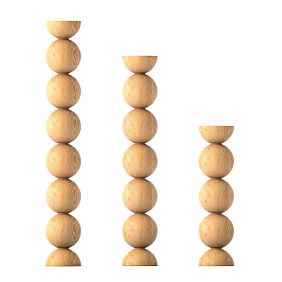
Baluster — a convex element of spherical, egg-shaped, or barrel-shaped form. A baluster creates volume, visually thickens the leg, and adds decorativeness. One leg can have one large baluster (central, dominant) or several small ones (rhythmic, repeating).
Ring (bead) — a narrow convex cylindrical element protruding from the main shaft. Rings create rhythm, divide the leg into sections, and add detailing. Groups of rings (two or three in a row) are characteristic of Classicism.
Flute (fluting) — a concave vertical element running along the shaft. Flutes can be continuous (along the entire length of the leg) or segmented (on separate sections). They visually elongate the leg, add architectural quality, and reference classical columns.
Cone (taper) — a section where the diameter of the leg smoothly decreases from top to bottom or vice versa. Tapering creates dynamism, lightens the visual mass, and is characteristic of Neoclassicism.
Cylinder (shaft) — a straight section of constant diameter, smooth or textured. The cylindrical section is the base on which decorative elements are placed.
Stylistic variations of turned legs
Classicism (1760-1830) uses turned legs with clear, rational profiles. Straight shafts with regularly placed balusters and rings, vertical flutes, symmetry. Legs often taper towards the bottom (conical), ending with a simple base (cylinder or square). Decoration is restrained, emphasizing the structure rather than masking it.
Empire (1800-1830) adds monumentality. Legs are more massive, balusters are larger, and carved elements often appear (laurel wreaths, palmettes, military trophies). Legs are painted in dark colors (black, dark green), contrasting with gilded overlays.
Victorian (1837-1901) complicates the profile. Many small elements: rings, beads, twisted sections, carved inserts. Turned legs of the Victorian era are detailed, excessive, and decorative to the limit. This reflects the Industrial Revolution: lathes allowed the creation of the most complex profiles quickly and cheaply.
Neoclassicism (late 19th — early 20th century) returns to restraint. Turned legs become laconic again: straight, with minimal elements, often conical. Emphasis on proportions, not on the abundance of details.
Turning today: traditions and technologies
Modern production of turned legs uses CNC machines, copying lathes, but the principles remain the same.Solid wood furniture legsThey are turned from a solid blank of oak or beech, dried to a moisture content of 8-10%. The machine reproduces the specified profile with an accuracy of tenths of a millimeter, ensuring the identity of a series of legs.
After turning, the legs are sanded (grit 150-320), cutter marks are removed, and the surface becomes smooth. Then a coating is applied: oil (for a natural look), varnish (for protection and shine), stain (to change the color), patina (for an aging effect).
Tapered legs: Neoclassical elegance and visual lightness
A tapered leg is a straight leg with a constant taper from top to bottom (less often the opposite). The cross-section can be round (conical cylinder) or square (truncated pyramid). Tapering creates visual dynamism: the leg appears lighter, more elegant, despite its straight form.
Neoclassicism: the birth of the tapered leg
The tapered leg became popular in the late 18th century, when Neoclassicism was displacing Baroque and Rococo. Rejection of curved lines, return to geometry, symmetry, rationality. The tapered leg embodied these principles: straight (rational), tapering (elegant), without excessive decoration (restrained).
Neoclassical designers (Robert Adam in England, Charles Percier in France) actively used tapered legs in tables, chairs, consoles. Legs were often made with a square cross-section, with flutes on the faces, and finished with bronze tips (sabots) — functional (protection from wear) and decorative (the shine of metal contrasted with the matte wood).
Structural advantages of tapering
The conical shape is not only aesthetic but also structurally justified. Tapering towards the bottom reduces the mass of the leg, saves material, and visually lightens the furniture. At the same time, the upper part (where it attaches to the body) remains thick, ensuring the strength of the connection. The lower part (smaller diameter) reduces the contact area with the floor, which is useful on uneven surfaces.
Square tapered legs are technologically efficient: they are made not by turning, but by planing on a four-sided moulder. The blank is fed through the machine, knives cut the material at an angle, forming the taper. This is faster and cheaper than turning, making tapered legs accessible for mass production.
Decoration of tapered legs: minimalism with accents
Tapered legs rarely have abundant decoration — their beauty lies in the purity of form, proportions, and geometry. However, some elements are found:
Flutes — vertical grooves on the faces of a square leg or around the circumference of a round one. Flutes are architectural, reference ancient columns, visually elongate the leg, and add depth.
Inlay — thin lines of contrasting material (brass, ebony, mother-of-pearl) running along the leg. Inlay adds sophistication without compromising laconicism.
Carved capital — a decorative finish at the top of the leg (where it attaches to the tabletop). The capital can imitate ancient orders (Doric, Ionic), have acanthus leaves, rosettes. This is the only area where abundant decoration is allowed.
Metal tip (sabot) — a bronze, brass, or steel cap on the lower end of the leg. The sabot protects the wood from wear, adds shine, and contrast. In Neoclassicism, sabots often have the shape of a lion's paw, hoof, or ball.
Tapered legs in modernity
Tapered legs are one of the few classical elements that organically fit into modern interiors. Their geometricity, laconicism, and lack of excessive decoration combine with minimalism, Scandinavian style, and mid-century modern.
Modern tapered legs are made from light woods (ash, birch), painted in pastel or monochrome colors (white, gray, black), and often combined with metal fittings.Solid Wood Itemswith tapered legs easily adapt to any style by changing color and finish.
Carved legs: Victorian excess and handcraftsmanship
Carved legs are sculpture integrated into furniture. Carving covers the entire surface of the leg or its individual sections, transforming a functional element into an artistic object. Carved legs are characteristic of Baroque, Rococo, Victorian, and Gothic Revival styles—where decorativeness is valued above functionality.
Carving techniques for legs: relief and three-dimensional
Carving on legs comes in two types:
Relief carving—an ornament carved on the surface of a cylindrical or square leg. The background is cut away to a depth of 3-15 mm, and the ornament protrudes. This can include plant motifs (acanthus leaves, grapevines, flowers), geometric patterns (meanders, braids), or figurative compositions (putti, mascaron, animals).
Three-dimensional (full-round) carving—a three-dimensional sculpture where the leg is fully carved in the shape of a figure: a column with a capital, a caryatid (female figure), an atlas (male figure), a snake coiling around a trunk, or intertwined branches. Three-dimensional carving is the most complex, requiring sculptor's skill, knowledge of anatomy, and many hours of work.
Stylistic features of carved legs
Baroque uses carved legs with large, lush forms: acanthus leaves covering the entire surface, mascarons with open mouths, volutes intertwining in complex compositions. The carving is deep (15-40 mm), creating dramatic shadows and volume. Legs are often gilded, enhancing theatricality.
Rococo makes carving lighter, more airy. Small scrolls (rocaille), shells, floral garlands, asymmetrical compositions. Carving is shallow (5-15 mm), delicate, playful. Colors are light (white, cream, pastels), gilding is thin, accenting rather than solid.
Victorianism combines elements of all previous styles. Carved legs of the Victorian era are eclectic: Gothic motifs (pointed arches, trefoils) coexist with Baroque (acanthus), Renaissance (grotesques), and Eastern (dragons). Abundance of detail, complexity, demonstration of craftsmanship and wealth.
Carved legs today: restoration and exclusivity
Modern production of carved legs is limited: hand carving is expensive (dozens of hours of a master's work), CNC carving does not reproduce all details (especially undercuts, deep grooves, thin protruding elements). Carved legs today are either restoration of antique furniture or exclusive orders for palace interiors, museums, collectors.
Furniture decorwith carved elements can complement simpler legs: carved overlays on the upper part of a turned leg, carved capitals on a square leg. This is a compromise: the functional leg remains technologically sound, decoration is added with separate elements.
Minimalist legs: modernity and functional geometry
Modern furniture rejects excessive decoration. Legs become laconic: straight cylinders, square rods, metal rods with wooden tips. Form is determined by function, material is not disguised, construction is honest.
Mid-century modern: cult of functional form
The mid-20th century brought a revolution in furniture design. Designers (Charles Eames, Arne Jacobsen, Hans Wegner) created furniture where legs are not decoration, but construction. Thin tapered legs, splayed at an angle (splayed legs), creating visual lightness, stability, and dynamism.
Materials are combined: wooden legs with metal fittings, metal rods with wooden tips (ferrules). Colors are natural: light wood (teak, ash, oak), black metal, less often painted wood in bright colors (red, yellow, blue).
Scandinavian minimalism: warmth of simplicity
Scandinavian furniture retains minimalism but adds warmth. Legs are simple (straight, tapered, cylindrical), but made of light wood (birch, pine), with visible texture, sometimes with light grooves. Leg height is medium (200-350 mm), proportions are harmonious, without extremes.
Philosophy of Scandinavian design: a leg should be functional, durable, aesthetically pleasing, but not attract excessive attention. Furniture on such legs is stable, cozy, and does not overload the space.
Industrial style: metal and rough wood
Loft and industrial style use metal legs (steel pipes, black rods, welded structures) or roughly processed wooden ones (thick beams, unplaned lumber).furniture framesmade of solid wood in industrial style are deliberately functional: connections, fasteners, and material texture are visible.
Legs are thick, massive, brutal. No decoration, no carving, no grooves. Shape is simplest: square beam, round pipe, H-shaped frame. Color: black metal, natural unfinished wood, less often painted in dark colors.
How to repeat leg motifs in other decorative elements
A holistic interior is not a random collection of items, but a thoughtful composition where elements are connected by common motifs, rhythms, and forms. The shape of furniture legs can be repeated in other decorative elements, creating visual harmony and stylistic unity.
Stair balusters: a direct analogy
If furniture has turned legs with balusters, rings, or grooves, the same shapes should be repeated in stair balusters. This creates a direct visual connection between furniture and architecture, turning the interior into a whole.
The profile of the balusters mirrors that of the legs: the same balusters, the same rings, the same rhythm of elements. The diameter of the balusters is usually larger (50-80 mm compared to 40-60 mm for the legs), but the proportions are maintained. The material is identical: if the legs are oak, the balusters are oak; if the legs are painted white, the balusters are also white.
Columns and Pilasters: Architectural Echo
If furniture has tapered legs with fluting, the same motifs are repeated in pilasters (flat decorative columns on walls), door frames, and fireplace surrounds. The fluting (flutes) on the pilasters echoes the fluting on the legs, creating a sense that the furniture and architecture are executed in a unified style.
The capitals of pilasters can replicate the carved capitals of the legs: the same acanthus leaves, the same rosettes, the same proportions. This is a technique of classical interiors, where furniture is perceived as small-scale architecture, adhering to the same principles as the building.
Carved Appliqués: Duplication of Ornaments
If furniture has carved legs with acanthus leaves, the same leaves appear on carved appliqués on the facades, on cornices, and on mirror frames.Furniture decorand the decor of the legs is coordinated: identical depth of relief, identical detailing, identical carving style.
This creates visual unity: the eye, moving from a leg to an appliqué on the facade, recognizes familiar forms, senses a connection, a harmony. The interior is perceived not as a sum of disparate elements, but as a composition where every detail is in its place.
Furniture Handles: Form and Proportions
The shape of furniture handles can echo the shape of the legs. If the legs are turned with balusters, the handles are also turned, with miniature balusters. If the legs are carved with acanthus, the handles are carved with the same leaves. If the legs are minimalist cylindrical, the handles are simple cylindrical rods.
The material of the handles is identical to the material of the legs: oak to oak, beech to beech. The finish is the same: if the legs are oiled, the handles are oiled; if the legs are patinated, the handles are patinated. This creates material unity, a feeling that the furniture is made from a single piece of wood by a craftsman who understands form.
Mirror and Picture Frames: Framing Space
Mirror and picture frames can replicate the profile of the furniture legs. If the legs have convex balusters, the frame has a convex profile (oval, barrel-shaped). If the legs are flat with fluting, the frame is flat with the same fluting. This creates rhythmic unity, where the verticals (legs) and horizontals/verticals (frames) are coordinated.
Ceiling cornices: finishing the vertical
The profile of ceiling cornices can echo elements of the legs. If the legs have rings and balusters, the cornice features the same forms, repeated in a horizontal border. This creates a visual connection between the floor (where the legs stand) and the ceiling (where the cornice runs), unifying the space vertically.
Manufacturing Technologies for Solid Wood Furniture Legs
The quality of legs is determined not only by design but also by manufacturing technology.Solid Wood Itemsrequire proper material selection, precise processing, and high-quality finishing.
Wood Selection: Oak and Beech as Standards
Oak is a hardwood (density 700-800 kg/m³), strong, durable, with a pronounced grain. Oak legs withstand heavy loads, do not deform, and age beautifully (darken, acquire a noble patina). Oak is ideal for solid furniture (tables, cabinets) where legs bear significant weight.
Beech is a medium-hardwood (density 650-700 kg/m³), uniform, with a fine grain. Beech legs are easier to process, cheaper than oak, and take stains well. Beech is ideal for mass-produced furniture where price-to-quality ratio is important.
Wood moisture content is critical: blanks are dried in kilns to a moisture content of 8-10%. At higher moisture content, legs will shrink after manufacturing, deform, and crack. At lower moisture content, the wood becomes brittle and prone to chipping.
Turning: From Blank to Profile
Turned legs are manufactured on lathes: a blank (square timber or cylinder) is secured between centers, rotates, and cutting tools remove material, forming the profile. Modern lathes are equipped with copying devices or CNC, reproducing the specified profile automatically.
Processing speed depends on profile complexity: a simple cylindrical leg is turned in 5-10 minutes, a complex one with multiple balusters and rings takes 20-40 minutes. After turning, the leg is sanded directly on the lathe (with sanding belts or paper), removing tool marks, making the surface smooth.
Milling: Fluting and Flat Facets
Square and tapered legs are manufactured by milling. The blank passes through a four-sided planer, where knives cut the material at the required angle. Special cutters (V-shaped, U-shaped) are used to create fluting, running along the facets.
CNC milling allows for creating complex shapes: cabriole legs, carved legs, non-standard profiles. Multi-axis machines (4-5 axes) process the blank from all sides, forming a three-dimensional sculpture. After machine processing, a craftsman manually refines details that the machine cannot cut.
Hand-finishing: the soul of the piece
Even machine-made legs undergo manual refinement. The craftsman sands hard-to-reach areas (recesses between balusters, inner parts of carvings), removes sharp edges, and checks symmetry. For carved legs, manual work constitutes 50-80% of the manufacturing time.
Manual refinement adds individuality: two legs that come out of the machine identical become slightly different after manual processing. This is not a defect but a value—the trace of a human hand, a liveliness that distinguishes a quality product from a mass-produced one.
Finishing: protection and aesthetics
Finished legs are coated with protective finishes:
Oil — penetrates the wood, highlights the grain, creates a matte surface. Oil is eco-friendly, easy to renew, and creates a tactilely pleasant surface.
Wax — creates a semi-matte sheen, protects from moisture, highlights the wood's color. Wax is applied after oil, enhancing protection.
Varnish — creates a glossy or matte film on the surface, reliably protects from moisture and mechanical damage. Varnish is durable but less tactilely pleasant.
Stain (beize) — changes the wood's color while preserving the grain. Stain allows imitation of expensive wood species (oak under walnut, beech under mahogany), creating designer colors.
Patina — artificial aging that creates an antique furniture effect. Patina is applied in carving recesses and on protruding areas, imitating natural darkening over time.
Practical aspects of choosing furniture legs
How to choose legs for a specific project? What parameters to consider? What to pay attention to?
Load and strength
Legs must withstand the weight of the furniture and its contents. For light furniture (coffee tables, bedside tables), legs with a diameter of 30-50 mm are sufficient. For medium furniture (dining tables, dressers) — 50-70 mm. For heavy furniture (cabinets, wardrobes) — 70-100 mm.
Material affects strength: oak legs with a diameter of 50 mm can handle a load that requires 60 mm for beech legs. Shape is also important: a straight leg is stronger than a curved one (cabriole), as stresses occur at the bends.
Height and proportions
Leg height determines the visual character of the furniture. Low legs (50-150 mm) make furniture grounded, massive, stable. Medium legs (150-400 mm) — universal, suitable for most types. High legs (400-750 mm) — make furniture airy, visually light, open up space under the body.
The proportion between leg height and body size is critical. Rule: leg height should be 15-30% of the total furniture height. Too short legs make furniture grounded, too long — unstable, disproportionate.
Leg attachment: reliability of the connection
Legs are attached to the furniture body in several ways:
Screw attachment — the leg has a threaded stud (built-in or screw-on) that screws into a nut installed in the body. Reliable, detachable, allows height adjustment.
Bolt attachment — the leg is attached with bolts through a mounting plate. Sturdy, suitable for heavy furniture.
Adhesive connection — the leg is glued into a socket in the body. Non-detachable but maximally sturdy, used for stationary furniture.
Corner mounting plate — the leg is attached to a corner plate, which is fixed to the body with screws. Universal, suitable for any type of legs.
Style and compatibility with the interior
Legs must match the style of the furniture and interior.Classic FurnitureClassical furniture requires classic legs: turned, tapered, cabriole, carved. Modern furniture — minimalist: straight cylinders, square rods, tapered without decoration.
Mixing styles is possible but requires caution. Baroque cabriole legs in a minimalist interior create dissonance. Minimalist cylinders on a Baroque chest of drawers look absurd. The style should be consistent, or the mixing should be conscious, thoughtful, balancing on the edge.
Frequently asked questions
What legs are best for a dining table?
A dining table needs sturdy legs with a diameter of 60-80 mm, capable of bearing the weight of the tabletop and dishes. Shape depends on style: turned for classic, tapered for neoclassical, straight cylindrical for modern. Height 710-750 mm (standard dining table height).
Can legs be replaced on old furniture?
Yes, replacing legs is a popular method of furniture restoration and updating. New legs are attached in place of the old ones if the fastening systems are compatible. If not, new fasteners are installed. Replacing legs changes the character of the furniture, allowing it to be adapted to a new interior style.
Wipe with a dry or slightly damp cloth to remove dust. Every 6-12 months, treat with wood oil or wax (if the finish is oil or wax). Protect from direct sunlight (wood fades), excessive humidity (swells), mechanical impacts (chips). Sand scratches with fine sandpaper, renew the finish.
Wipe with a dry or slightly damp cloth to remove dust. Every 6-12 months, treat with wood oil or wax (if the finish is oil or wax-based). Protect from direct sunlight (wood fades), excessive humidity (swells), and mechanical impacts (chips). Sand scratches with fine sandpaper and renew the finish.
Which material is stronger: oak or beech?
Oak is stronger (density 700-800 kg/m³ vs. 650-700 for beech), harder, more durable. But beech is easier to work with, cheaper, and has a more uniform grain. For heavy furniture, oak is preferable; for medium and light furniture, beech is optimal in terms of price and quality ratio.
Can wooden legs be painted?
Yes, wood is easy to paint. To change the color while preserving the texture, use a stain. For a solid, opaque finish, use enamel or acrylic paint. Before painting, sand the surface (220-320 grit), apply a primer (for better adhesion), then apply the paint in 2-3 coats. A final protective coat of varnish is recommended.
Which legs are suitable for furniture in Scandinavian style?
Scandinavian style uses simple legs made of light wood (birch, ash, pine): straight cylindrical, tapered, with minimal decoration. The height is medium (200-350 mm), with harmonious proportions. The finish is natural (oil, wax) or painted in white, gray, pastel colors while preserving the wood grain.
How to calculate the number of legs for a table?
Standard tables have 4 legs (at the corners). Long tables (over 2 meters) require additional supports (5-6 legs) to prevent the tabletop from sagging. Round and oval tables can have a central support (one massive leg or a pedestal). Trapezoidal and asymmetrical tables require load distribution calculations.
Can cabriole legs be used in a modern interior?
Yes, but with caution. Simplified cabrioles (without carving, painted in monochrome colors) fit into eclectic interiors that mix classic and contemporary styles. Traditional baroque cabrioles with carving and gilding require an appropriate context (high ceilings, moldings, heavy fabrics), otherwise they look out of place.
How to repeat the leg motif in other interior elements?
Use the same profile in stair balusters, wall pilasters, mirror frames, furniture handles, and ceiling cornices. The material and finish should be identical: if the legs are oak with oil, all repeating elements should be oak with oil. This creates visual unity, harmony, and a sense of a well-thought-out interior.
Where to buy quality wooden legs?
Contact specialized manufacturers working with solid wood. Check the quality of the wood (moisture content 8-10%, no knots or cracks), the precision of processing (symmetry, surface smoothness), and the availability of certificates. Avoid cheap mass-market products—they often use low-grade wood, poor drying, and rough processing.
Conclusion: Legs as the Philosophy of Space
Furniture stands on legs, but legs are not just supports. They are a philosophical statement about how an object interacts with space. Low legs say: I am here, I stand firmly, I am massive. High legs say: I float, I am light, I do not weigh down the space. Curved legs say: I am dynamic, I am alive, I refuse linearity. Straight legs say: I am rational, I am functional, I do not need excess.
Solid wood furniture legs— is a tool for creating style, an invisible foundation on which the visual character of an interior is built. By choosing the shape of legs, we choose an era (Baroque or Art Nouveau), a cultural affiliation (European classicism or Scandinavian minimalism), an emotional tone (luxury or restraint).
A cohesive interior is not an accident but the result of deliberate decisions. Repeating leg motifs in other decorative elements (balusters, pilasters, carved overlays, handles, frames) creates visual harmony, where each element is connected to others by a common aesthetic logic. This requires attention to detail, knowledge of styles, and a sense of proportion.
Modern technology (CNC machining, multi-axis machines, copying devices) has made the production of quality legs accessible but has not devalued craftsmanship. Hand finishing, knowledge of wood properties, and understanding of construction remain critical.Solid Wood Itemsrequire respect for the material, professionalism, and time.
The company STAVROS has specialized in the production of solid oak and beech furniture legs for over two decades. The range includes over 130 models, covering all styles from Baroque to minimalism: turned legs with balusters and fluting, tapered square and round legs, carved legs with ornaments, modern cylindrical legs, curved cabrioles, high legs for bar counters, low legs for coffee tables.
Each STAVROS leg is made from selected wood, dried to a moisture content of 8-10%, processed on modern machines, hand-finished, and coated with protective compounds (oil, wax, varnish, stain, patina). Quality is controlled at all stages: selection of blanks, processing precision, surface smoothness, symmetry, and fastener strength.
STAVROS works with both private clients (designers, homeowners, restorers) and furniture factories (serial production, exclusive collections, custom solutions). The company offers unfinished legs (for custom finishing to suit a specific project) and legs with factory-applied finishes (ready for installation).
In addition to legs, STAVROS producesfurniture frames, stair balusters, pilasters, cornices, moldings,Furniture decor— everything needed to createclassic furnitureor to style a modern interior as classic. This allows for the implementation of comprehensive projects where all elements are coordinated in style, material, and finish.
By choosing STAVROS furniture legs, you choose quality, durability, and aesthetics tested by time. You invest in details that shape the character of an interior, create style, and transform a space from a collection of objects into a holistic composition. Because it is the details—the invisible foundation—on which everything else stands.


