Article Contents:
- Classification of wooden furniture legs: conical, lathe-turned, square, with threading
- Conical legs: mid-20th century geometry
- Lathe-turned legs: classic and neoclassical
- Square straight legs
- Carved and decorative legs
- Legs with metal plates and adjustable supports
- Standard leg heights for sofas, armchairs, beds, cabinets
- Sofa and sofa chair: seat height
- Armchair: seating features
- Bed: height from floor to frame
- Bedside table and TV stand
- Coffee table: relaxation zone
- Summary table of standard heights
- Wood species: oak and beech for heavy sofas, birch for light furniture
- Oak: load-bearing wood for heavy furniture
- Beech: precision and versatility
- Birch: light furniture and economy segment
- Mounting thread: M8, M10 — how to check compatibility
- Furniture leg thread standards
- How to check existing thread in a sofa frame
- Insert nuts — installation in a new location
- How to replace sofa legs — removal and installation of new ones
- Preparation: what you need
- Step one: removal of old legs
- Step two: checking the sockets
- Step three: installation of new legs
- Step four: checking and leveling
- Adjustable supports with metal insert — floor leveling
- Leg finish: lacquer, oil, stain — matching the furniture tone
- First principle: tone matching
- Stain: tinting to match wood species
- Polyurethane varnish: maximum protection
- Oil-wax: tactile beauty
- White enamel: trendy option
- How to match legs to interior style — practical guide
- Scandinavian style and mid-century modern
- Classic and neoclassic
- Loft style and industrial design
- Provence and romantic style
- Purchase and assembly: what to consider when ordering
- FAQ - answers to popular questions
- About the Company STAVROS

There are details that everyone notices, but only a few truly perceive.furniture legs— is one of them. Enter any living room: the gaze glides over the sofa, coffee table, armchair — and somewhere on the periphery of consciousness registers something that makes the furniture look 'expensive' or 'cheap,' 'light' or 'heavy,' 'familiar' or 'alien.' In nine cases out of ten, it's precisely the furniture supports. Four points of contact between the object and the floor — and they decide everything.
Wooden furniture legs— is not hardware in the traditional sense. It's an architectural element that completes the visual logic of the object. A tapered leg for a sofa evokes the mid-20th century — Scandinavian modernism, lightness, air under the furniture. A turned carved support with a twisted profile — classic, Empire, the dense structure of the 19th century. A square straight leg — minimalism, clean line, nothing superfluous. Choosing a furniture leg is choosing the language in which the interior speaks.
This article is a practical yet expert guide to wooden furniture legs. Classification, sizes, wood species, carving, fastening, replacement technology, finish — everything you need to know to make the right decision and avoid redoing things.


Classification of wooden furniture legs: tapered, turned, square, carved
Before discussing specific models — let's define the typology. The market offers hundreds of options, but all the variety boils down to several basic categories.




Tapered legs: mid-20th century geometry
A tapered leg is a straight truncated cone, narrowing from the base to the floor. No knots, no relief, no profile sections — only pure geometry. It is this type of support that became a symbol of Scandinavian design in the 1950s–60s: simplicity, functionality, the warmth of natural wood.
Tapered legs for sofas and armchairs are the most in-demand type for modern and Scandinavian styles. Their taper creates optical lightness: the sharper the cone angle, the more 'airy' the furniture piece appears. The standard taper angle is 3–5° from the vertical axis. Legs with a 7–10° angle are more pronouncedly slanted, characteristic of mid-century modern design.
In the STAVROS catalog, tapered furniture supports are available in heights of 100 mm, 150 mm, 200 mm, 250 mm. Base diameter (at the top) — 40–55 mm, floor diameter — 25–35 mm. Wood species — oak or beech, surface sanded for finishing.
Our factory also produces:


Turned legs: classic and neoclassic
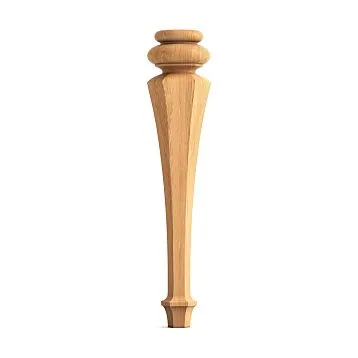
Turned legs are the broadest class. These are supports made on a lathe: the workpiece rotates around its longitudinal axis, and a cutting tool removes material according to a given profile. The result is a symmetrical shape with alternating expansions (nodes) and narrowings (necks).
The profile pattern determines the style: two large nodes with smooth transitions — moderate classic; several small nodes with sharp transitions and fluting — Baroque; one node in the lower third with straight lines above — Neo-Renaissance. Turned legs for coffee tables, armchairs, cabinets — a universal choice that works across a wide range of styles.
Heights in the catalog: 60 mm (for cabinets and low case furniture), 100 mm, 150 mm, 200 mm, 250 mm, 300 mm, 350 mm, 400 mm and above — for high tables and consoles.
Get Consultation
Square straight legs
A square leg is a straight rectangular or square-section parallelepiped. No turning, no nodes — only straight edges and, optionally, chamfers along the edges. This is a minimalist, graphically clear form for loft, contemporary style, industrial design. Square wooden legs for cabinets are one of the most popular options for modern case furniture.
Cross-section: 40×40 mm, 45×45 mm, 50×50 mm, 60×60 mm — depending on load and scale of the piece.
Carved and decorative legs
Carved furniture supports are the highest decorative class. Three-dimensional carving along the entire height of the leg, acanthus leaves, spiral fluting, grapevine motifs — this type is used in formal Baroque, Empire, and Rococo furniture. Produced on CNC milling centers with 3–5-axis machining.
Carved legs are an element of expensive custom furniture. They are not swapped onto an IKEA sofa — they are ordered when making an armchair, table, or sideboard 'to specification.'
Legs with metal mounting plate and adjustable feet
A separate subclass consists of furniture legs with a built-in metal mounting plate (flange) at the top. These are legs for heavy furniture: beds, sofas, massive tables. The metal flange measuring 60×60 mm or 80×80 mm with four screw holes provides a significantly larger support area when attaching to the furniture frame compared to a single threaded stud.
Adjustable furniture feetwith a metal insert allow for leveling floor irregularities: a metal nut with a thread is installed at the bottom of the leg, into which an adjustment bolt with a plastic support foot is screwed. The adjustment range is 15–25 mm. This is a practical solution for rooms with uneven floors or for case furniture requiring precise leveling.
Standard leg heights for sofas, armchairs, beds, cabinets
Leg height is not primarily a matter of aesthetics. It is a functional parameter that determines the seat height, seating comfort, and the overall proportions of the furniture piece.
Sofa and sofa armchair: seat height
The standard sofa seat height is 420–460 mm from the floor. Seat height = leg height + thickness of the spring block (or foam base) + thickness of the padding + height of the upholstery.
With a spring block height of 200 mm and padding of 40 mm: leg height 420 − 240 = 180 mm. With a foam block of 160 mm and padding of 20 mm: leg height 420 − 180 = 240 mm. This explains why tapered wooden sofa legs are most often ordered in heights of 150–200 mm.
Important: a seat height that is too low (less than 400 mm) is inconvenient for people with knee problems and the elderly. A height that is too high (more than 500 mm) is uncomfortable for children and people of short stature.
Armchair: seating specifics
The optimal armchair seat height is 420–440 mm. However, unlike a sofa, an armchair has a nuance: the backrest tilt angle. With a reclined backrest (more than 100°), the seat height can be reduced to 400 mm — this creates a more relaxed posture. Turned wooden legs for armchairs with a height of 120–160 mm are the most common option.
Bed: height from floor to frame
The optimal height of the upper edge of the mattress is 560–600 mm. The height of the mattress with its base is 200–280 mm. Bed leg height = 560 − (200–280) = 280–360 mm. Wooden bed supports in the 250–350 mm height range are the most relevant. Legs lower than 150 mm create a problem: there is no space left under the bed for storage or for vacuuming.
Bedside table and TV stand
Bedside table: standard — top surface height 500–560 mm (level with the top edge of the mattress). The cabinet body is typically 400–450 mm. Wooden legs for bedside tables: 60–100 mm.
TV stand: top surface height — 450–550 mm (the center of the screen when wall-mounted should be at eye level in a seated position). Legs for TV stands — 80–150 mm.
Coffee table: relaxation zone
Coffee table height — 380–460 mm (0–60 mm below the sofa seat level). Wooden legs for coffee tables — 200–300 mm, depending on the tabletop thickness (18–40 mm).
Summary table of standard heights
| Furniture item | Seat / surface height | Recommended leg height |
|---|---|---|
| Sofa | 420–460 mm | 150–200 mm |
| Chair | 400–440 mm | 120–160 mm |
| Bed (to mattress) | 560–600 mm | 250–350 mm |
| Coffee table | 380–460 mm | 200–300 mm |
| Bedside table | 500–560 mm | 60–100 mm |
| TV stand | 450–550 mm | 80–150 mm |
| Dining table | 720–760 mm | 400–450 mm |
Wood species: oak and beech for heavy sofas, birch for light furniture
The wood species in a furniture leg is not just about appearance. It is primarily about load-bearing capacity, resistance to stress, and performance under use.
Oak: load-bearing species for heavy furniture
Oak is the benchmark for strength in furniture production. Density 680–750 kg/m³, Brinell hardness 3.7–4.0 units. Legs for heavy sofas (load up to 200–300 kg), for dining tables, for beds — that's oak.
A special property of oak is its high tannin content, which provides natural resistance to moisture and biological decay. An oak leg will not swell during wet cleaning and will not dry out when the heating system is operating.
Oak texture is large, expressive, with noticeable vascular channels. Under a transparent finish (oil, varnish), an oak leg always looks 'prestigious'. When stained, oak absorbs color deeply and evenly.
Beech: precision and versatility
Beech is the ideal turning wood. Density 650–700 kg/m³, uniform fine-grained texture without a pronounced pattern. On a lathe, beech yields minimal size variation: a batch of 100 legs will be practically geometrically identical. This is what makes beech the primary species for serial production of furniture legs.
Beech takes paint well — it applies evenly, without 'stains' from tannic acids (as can sometimes happen with oak). White legs, light gray, cream — the best result is on beech. For furniture in white or light tones — beech is definitely preferable to oak.
Limitation of beech: it is more hygroscopic than oak. In rooms with unstable humidity (a dacha without constant heating) — beech may exhibit slight warping. For an apartment with a stable climate — this is not a significant factor.
Birch: light furniture and economy segment
Birch is softer than oak and beech (density 600–650 kg/m³, hardness 2.5–3.0 units). Well-suited for light furniture: children's tables, bedside tables, light consoles. For a heavy sofa or massive dining table — birch legs are not recommended: under prolonged high load, deformation is possible.
Birch stains well in dark tones, imitating more valuable wood species. This is a common practice in mass furniture production.
Mounting thread: M8, M10 — how to check compatibility
A technical detail that is often overlooked — and then time and money are spent on rework. Threaded furniture legs are attached via a metal nut (a screw-nut, T-nut, or insert nut) installed in the furniture frame. The thread size in the leg must exactly match the size of the insert nut in the frame.
Furniture leg thread standards
M8 (diameter 8 mm, pitch 1.25 mm) — the most common standard for medium-weight furniture: chairs, sofas, cabinets. An M8 stud, screwed into an M8 insert nut in a wooden frame, withstands a pull-out load of up to 800–1,200 N — more than enough for standard furniture.
M10 (diameter 10 mm, pitch 1.5 mm) — for heavy furniture: massive dining tables, beds, large sofas. M10 is used where the load per leg exceeds 50–80 kg.
M12 (diameter 12 mm) — for particularly heavy structures: massive 200×200 cm beds, large dining tables made from slabs. A rare standard in household furniture.
How to check the existing thread in a sofa frame
Step one: turn the sofa (or cabinet) over. If legs are already screwed in — carefully unscrew one. An insert nut (or threaded socket) will be visible in the frame.
Step two: measure the internal diameter of the thread. The simplest way is to try screwing in an M8 bolt, then an M10 bolt. The correct one will go in without force for the first 3–4 turns.
Step three: measure the length of the stud on the existing leg. The stud length on the new leg must match: one that is too long will hit the bottom of the socket, one that is too short will not provide a secure connection. The standard stud length is 35–45 mm.
Insert nuts — installation in a new location
If you are installing legs on furniture where nuts were not originally provided (e.g., a frameless chair, a DIY construction), a T-nut is installed into a prepared hole with a diameter of 9–11 mm by pressing it in with a hammer or a special tool. For wooden frames — use an M8 T-nut with four spikes that dig into the solid wood during pressing.
How to replace sofa legs — removal and installation of new ones
Replacing sofa legs with wooden ones is a task you can do yourself in 20–30 minutes. No special tools, no upholstery disassembly — just two operations.
Preparation: what you need
-
New wooden furniture legs (4 or 6 pieces depending on the sofa)
-
Gloves (to avoid getting dirt under your fingernail when turning the leg)
-
An assistant or several cushions — to lift and hold the sofa
Step one: removal of old legs
Turn the sofa over or lift one side, placing it on seat cushions. Unscrew each leg by turning counterclockwise. If a leg is too tight — use a strap (wrap it around the leg, pull on the end) or a rubber jar opener.
Do not use pliers without a protective pad — the metal jaws will leave marks on the wood. Remove the legs carefully, keeping the threaded sockets intact.
Step two: checking the sockets
Check the threaded sockets (insert nuts) in the sofa frame. If a nut is loose or damaged — replace it. To do this, knock out the old T-nut from the inside with a hammer blow, install a new one.
Step three: installing new legs
Apply a small amount of linseed oil or furniture wax to the thread of the new leg's stud — this will make screwing easier and protect the thread from 'seizing' during tightening.
Screw the leg in clockwise by hand until it stops. For the final quarter turn — apply slight force. Do not overtighten: the wood at the base of the leg may crack. The optimal tightness is when the leg stands without play, does not wobble, and does not turn when checked by hand.
Step four: checking and leveling
Place the sofa in its working position, check for level. If one leg is slightly higher than the others due to uneven tightening — loosen it by a quarter turn. If the floor is uneven — use adjustable feet with a range of ±10–12 mm.
Adjustable feet with a metal insert — floor leveling
Floors in real homes are not perfect. Even in a new building, floor level variation within a single room is 3–8 mm. Case furniture on rigid legs on such a floor will stand 'askew' — wobble under load, putting stress on the frame due to misalignment.
Adjustable furniture feet solve this problem. Construction: a wooden leg with an M8 or M10 metal nut screwed into its bottom end, into which a bolt with a wide plastic foot is screwed. By turning the bolt, the leg can be lowered or raised by 10–25 mm.
Leveling technique: place the furniture in position, put a level on the top surface (tabletop or cabinet top). Adjust each leg individually — starting from the corner on the low point, turn counterclockwise (lowering the bolt raises the leg). Aim for the level's bubble to be centered.
Adjustable feet are especially relevant for heavy case furniture: bookcases, wardrobes, kitchen tall units. With a cabinet 'leaning' by 5 mm, its doors start to open and close with resistance — hinges work under overload.
Leg finish: varnish, oil, stain — to match the furniture
The finish of a furniture leg is the final step, determining whether the new element will blend into the existing furniture piece or look like a 'patch'.
First principle: matching the tone
A new oak leg in its natural color and a sofa with upholstery on a dark walnut frame — that's not style, that's a mismatch. The rule: legs and the furniture frame should be in the same tone or in a deliberate contrast (if it's a design element).
For color matching: remove one of the old legs, take it to a hardware store and select a stain based on the sample. Or photograph the leg in daylight — digital color matching technologies provide accuracy within ±5% shade.
Stain: tinting to match the wood species
Stain (water-based or oil-based) penetrates the wood structure and colors it from within. It does not hide the grain—on the contrary, it enhances the contrast of the fibers. For beech legs that need to be "aged" or tinted "to resemble walnut," "wenge," or "teak"—stain is the primary tool.
Technique: apply with a brush or pad in one direction along the grain, let sit for 3–5 minutes, remove excess with a clean cloth. The tone intensifies with layers: one layer—light, two layers—darker, three—deep tone. After drying (2–4 hours)—apply a finishing varnish or oil.
Polyurethane varnish: maximum protection
Varnish is the most wear-resistant coating for legs. A leg on the floor constantly contacts the flooring and is subjected to load. Two to three layers of polyurethane varnish with intermediate sanding using P400 create a hard film resistant to mechanical impact.
For kitchen chairs and high bar stools, where legs are systematically slid across the floor—only varnish. Oil in this area will wear off within 6–12 months.
Oil-wax: tactile beauty
Oil coating is for legs that do not experience intensive mechanical impact: sofa legs, armchair legs, bedside table legs. Oil penetrates the wood structure, preserving the matte finish and tactile feel of the natural material. A leg under oil "lives"—you want to touch it.
Oil is applied in two to three layers with mandatory polishing of the last layer with a soft cloth until it "shines." The interval between layers is 12–24 hours.
White enamel: a trendy option
White wooden legs are a stable trend in recent years. A white sofa on white legs in a Scandinavian interior is not a lack of decor; it is a precise stylistic statement. The technique for painting white: primer-sealer (prevents yellowing and "bleeding" of oak tannins) → first layer of white acrylic enamel → sanding with P400 → finishing layer.
For beech legs—white comes out especially clean. For oak—a high-quality shellac or acrylic primer-sealer is mandatory.
How to choose legs to match the interior style—a practical guide
The right choice is not just "liked." It is the correspondence of forms, proportions, and material to the overall stylistic system of the space.
Scandinavian style and mid-century modern
Tapered legs 150–200 mm, straight taper without decor, oak or beech in natural oil or light tint. A sofa on four conical supports with characteristically splayed outward legs (so-called "A-shaped" stance) is a recognizable image of this style.
Additionally—woodenoverlays for furniture frontsmade from the same wood species for the coffee table: unity of material in one space.
Classicism and neoclassicism
Turned legs with two to three nodes, height 100–160 mm (for cabinets, armchairs) and 400–450 mm (for consoles, mantel shelves). Wood species—oak or beech. Coating—dark stain "walnut," "dark oak," or "wenge" with finishing varnish.
Legs should be coordinated withwooden moldingsanddecorative inlayson the fronts. The system "leg + molding + overlay" from one catalog, in one tone—is no longer just decor; it is interior architecture.
Loft style and industrial design
Square straight legs, cross-section 50×50 mm. Wood species—beech or birch, coating—tint to "graphite" or "matte black." Alternative—wood in combination with metal: wooden leg with metal overlays on the edges or with a metal base-plate.
Provence and romantic style
Turned legs with soft rounded profiles, low height (80–120 mm for cabinets). Coating—white enamel with light patina on the edges (crackle or a thin layer of dark stain, wiped off before drying from the protruding parts). Aged wood is the hallmark of the Provence style.
Purchase and assembly: what to consider when ordering
When the parameters are determined, the final step remains—to place the order correctly. Several practical details that will help avoid mistakes.
Quantity of legs. Sofa—typically 4 legs (sometimes 6 if length exceeds 200 mm). Bed—4, 6, or 8 depending on the frame design. Cabinet—4. Coffee table—4. Armchair—4. Order with a surplus of +1–2 pieces: if one leg is damaged during transportation or during painting—a replacement will be at hand.
Batch consistency. Order all legs from the same batch from one manufacturer. Even with identical nominal sizes, legs from different batches may differ by 1–2 mm in diameter—this will be noticeable upon close inspection.
Surface for coating. Clarify: legs are supplied sanded (for customer's coating) or with a finishing coating already applied. For self-tinting to the desired tone—order "for coating."
FAQ — answers to popular questions
How to find out what standard thread my sofa has?
Unscrew one leg, take it to a hardware store, and ask them to check the thread with M8 and M10 bolts. The correct one will fit without force. If neither fits — measure with calipers: M8 is 8 mm in diameter, M10 is 10 mm.
Can wooden legs be installed on furniture that originally had no legs?
Yes, if there is a wooden frame inside. For this, an M8 T-nut is installed into the frame (hammered into a d=9 mm hole). If there is no frame (foam frameless products) — a wooden base stand is needed, to which the legs are attached.
What is the maximum load per M8 leg?
With a properly installed M8 T-nut in solid oak — shear and pull-out load up to 1,200–1,500 N (120–150 kg). For a standard sofa weighing 60–80 kg plus the load of two adults (160 kg) — total 240 kg on 4 legs = 60 kg/leg. The safety margin is more than double.
Is special treatment needed for legs installed in a kitchen?
For kitchen chairs and bar stools — varnish coating is mandatory. Oil in the area where legs are regularly moved across the floor will wear off quickly. Polyurethane varnish in 2–3 coats is the optimal option.
How to eliminate play in a loosely screwed leg?
Apply 1–2 layers of Teflon plumbing tape (PTFE tape) to the stud thread, then screw the leg back in. The tape fills the thread gap — the leg will hold without play.
Can two out of four legs be replaced, leaving the other two old ones?
Technically — yes. But if the old legs are a different shade or height — the sofa will stand crookedly or look uneven. It is recommended to replace as a set.
Which legs are suitable for children's furniture?
For children's furniture — legs made of oak or beech with a varnish coating (not oil-based): resistant to moisture when washing floors. Leg height for a children's chair — 80–100 mm, for a children's bed — 100–150 mm. Avoid sharp edges and chamfers — fully rounded bottom ends are preferred.
About the company STAVROS
A furniture leg — a small part behind which stands significant production. Lathe machining precision of 0.1 mm. Calibrated thread without play. Surface sanding to a state where coating adheres in one layer without primer. All this does not happen by itself — it is the result of production culture and choosing the right manufacturer.
STAVROS — a Russian manufacturer of wooden products for furniture and interiors. Catalog offurniture legs made of solid oak and beech— over 130 models: tapered, turned, square, carved, with metal plate, adjustable. Height range — from 60 to 450 mm. Thread standards M8 and M10. Surface — sanded for customer's coating, wood moisture content 8–10%.
In addition to legs, STAVROS produces a full range ofdecorative overlays for furniture, molding and cornices, balusters and components for stairs, pilasters and columns. Everything from one production, from the same wood species, with unified quality standards. Orders from 1 piece. Delivery across Russia.
Legs are points of support. Choose those you can rely on.