Article Contents:
- Anatomy of the leg: what makes perfection
- Typology: one, two, three, four
- Shape in space: geometry of beauty
- Material: the soul of the leg
- Wood: material with history
- Oak: The King Among Species
- Beech: a warm alternative
- Ash: elastic strength
- Birch: light elegance
- Types of tables and their legs: the right pair
- Dining table: solidity
- Coffee table: lightness of being
- Desk: ergonomics
- Kitchen table: practicality
- Constructions: more than four legs
- Table base: hidden strength
- Mounting methods: invisible reliability
- Styles: speaking the language of eras
- Classicism: Strict Harmony
- Baroque: opulence and decoration
- Modern: natural lines
- Modern minimalism: purity of form
- Practical aspects: what you need to know
- Load calculation: physics of stability
- Size selection: proportions of beauty
- Installation: from theory to practice
- Care and restoration: preserve beauty
- Daily care
- Repairing damage
- Conclusion: the foundation on which style stands

A table without legs is simply a tabletop lying on the floor. Absurd? Definitely. But have you ever considered how important these four legs are, on which the entire structure rests?table legIt is not just a functional element providing height and stability. It is an architectural base defining the character of the furniture, its style, proportions, visual lightness or heaviness.
Imagine two absolutely identical tables with identical noble wood tops. But one has thick square legs, rough and sturdy, solid. The other has elegant, finely turned legs with smooth curves, light, almost airy. These are two completely different tables. The first is for a rustic-style country house, for family gatherings, for a sense of reliability. The second is for a classic interior, for elegance, for showcasing taste. The difference is only in the legs.
Choosing a furniture leg is an art. You must consider the weight of the tabletop, the load during use, the interior style, material, proportions, and mounting method. A mistake is costly. Too thin legs under a heavy marble tabletop — risk of collapse. Too heavy legs under a light glass tabletop — visual imbalance, clumsiness. Wrong style — dissonance, destroying interior harmony.
In this article, we will dive into the world of furniture legs. We will examine types, materials, constructions, styles. We will learn how to choose the right legs that do not just hold the table, but transform it into a finished piece of furniture art.


Anatomy of Support: What Makes Perfection
It seems there could be no simpler solution: four legs screwed to the tabletop. But as is known, the devil is in the details. And when it comes to furniture legs, there are many details.




Typology: one, two, three, four
Four legs — classic, tested over millennia. Installed at the corners of the tabletop, they create maximum stability and evenly distribute the load. This is the standard for dining, writing, and coffee tables. A universal solution that is almost impossible to spoil.
But four legs are not dogma. Three legs provide absolute stability on uneven floors. A triangle is the most stable geometric shape. A table on three legs will never rock, even if the floor has unevenness. The downside — smaller support area, which requires wider leg spacing.
Two massive legs — a solution for long tables. Installed not at the corners, but closer to the center of the long sides. They create a sense of monumentality and solidity. Classic — dining tables in old halls, where two carved legs support a multi-meter tabletop. Advantage — freedom for seated legs, no corners to hit with knees.
One central leg — an elegant solution for round and small square tables. The leg is installed precisely at the center of gravity, ensuring balance. Usually, this is not a simple leg, but a structure — a column that widens at the bottom into a cross or round base. Visually lightens the table, creating the impression that the tabletop floats in the air.
Our factory also produces:


Shape in space: geometry of beauty
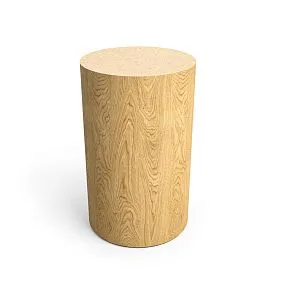
Straight cylindrical legs — minimalism in its purest form. Circular cross-section, constant diameter along the entire length. Minimalism, strictness, modernity. Ideal for Scandinavian interiors, lofts, minimalist spaces. Easy to manufacture, universally applicable.
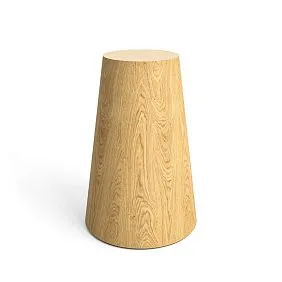
Conical legs — tapering toward the bottom or top. Tapering downward creates visual lightness and elegance. Such legs are characteristic of furniture from the 1950s–1960s, mid-century modern style. Tapering upward is rarer, creating a sense of stability and fundamentality.
Turned legs — classic craftsmanship. Made on a lathe, they have a complex profile — alternating thickening and undercutting, bulges and grooves. Each element carries both function and aesthetic meaning. The base (thickening at the bottom) ensures stability. The body with decorative elements creates visual interest. The neck (upper part) ensures transition to the tabletop.
Square and rectangular legs — straight lines, geometric clarity. Square cross-section gives visual stability and solidity. Such legs are characteristic of Shaker-style furniture, modern classicism, and constructivism. Can have beveled edges, grooves on faces, decorative inlays.
Cabriole — curved leg resembling an animal’s leg. The upper part curves outward, the middle inward, the lower part outward again, often ending in a stylized paw. Cabriole is the hallmark of Baroque, Rococo, and Queen Anne. Extremely decorative, requires skill to make, creates luxury and refinement.
Carved legs — sculptures of art. Adorned with reliefs, ornaments, images. Acanthus leaves, grapevines, geometric patterns, figures — all can be embodied in wood. Carved legs transform a table into a unique object, showcasing craftsmanship and taste.
Get Consultation
Material: the soul of the leg
Solid wood — classic, enduring value. Oak, beech, ash, walnut, birch — each species has its own character. Wood is warm, alive, with unique texture. Woodenlegs for a table to buymeans choosing nature, eco-friendliness, longevity.
Metal — modernity, industrialism, strength. Steel, cast iron, aluminum create a completely different aesthetic. Metal legs can be chrome-plated — shiny, futuristic. Or matte black — brutal, loft-style. Or forged — with decorative swirls, patterns, for traditional interiors.
Combined — wood plus metal. Wooden upper part transitioning into a metal lower part. Or metal frame with wooden inlays. Combination provides the strength of metal and warmth of wood, combines aesthetics, creates interesting visual effects.
Wood: material with history
When talking about furniture legs, wood remains unmatched. Metal is strong but cold. Plastic is cheap but artificial. Wood is a material humanity has worked with for millennia, a material that never becomes outdated.
Oak: The King Among Species
Weight. This is the first thing you feel when holding an oak detail. Density 700–800 kg per cubic meter. Hardness by Brinell around 4 units. This means exceptional strength, ability to withstand enormous loads without deformation.
Table legsMade of oak — a choice for decades. They won’t bend under the weight of a heavy stone or thick wooden tabletop. Won’t crack from impact. Won’t wear down from constant contact with seated legs. Oak retains strength for centuries — in old castles and estates, furniture on oak legs serves for 200–300 years.
Oak’s texture is expressive. Clear annual rings on tangential cuts. Characteristic silver rays on radial cuts — medullary rays, creating a unique decorative effect. Color varies from light honey for young oak to dark brown for seasoned oak. Weathered oak, lying underwater for decades, has a noble gray-black hue.
Oak’s stability is legendary. Wood reacts less to humidity changes than others. Oak legs don’t crack in winter when heating dries the air. Don’t swell in summer when humidity rises. Maintain geometry, joints remain secure.
Beech: a warm alternative
Beech is often underestimated, considered 'oak for the poor.' Unfair. In terms of density, beech does not fall short of oak — 700–720 kg per cubic meter. Slightly softer in hardness. But there are features making beech preferable in certain cases.
Beech’s structure is uniform. No sharp transitions between early and late wood, characteristic of oak. This creates a calm, even texture without a pronounced grain. Beech legs look elegant, restrained, not drawing attention to themselves.
Beech’s color — pink-beige, warm, cozy. Ideal base for light-toned interiors. Beech takes staining beautifully — from bleached wood to dark wenge. You can match the tone precisely to the tabletop or, conversely, create contrast.
Beech’s elasticity is higher than oak’s. A beech leg can slightly bend under load and return to its original state without cracking. For tables frequently moved or transported, this is an important property — less risk of damage during transport.
Beech turns out excellently. It produces legs with a perfectly smooth surface, clear details, and smooth transitions. Carving on beech is also expressive. The wood is pliable, holds fine details, and does not chip.
Ash: elastic strength
Ash is a species deserving greater recognition. By mechanical properties, it surpasses oak. Its bending strength is 15-20% higher. Its elasticity is exceptional. Ash is used for sports equipment and tool handles — where viscosity and the ability to bend without breaking are required.
Fortable legsThis means reliability. An ash leg withstands impact loads, lateral pressure, without cracking or breaking. Especially valuable for tables in heavily used areas — kitchens, dining rooms, where people may lean on or accidentally hit the table.
Ash's texture resembles oak, but lighter, softer in contrast. Clear annual rings create an expressive pattern, but not as sharp. Color — from light gray to light brown. Ash whitens well, which is relevant for Scandinavian and modern interiors.
Ash processes excellently. Turning, milling, carving — all yield clear results. The surface is naturally smooth, requiring no lengthy sanding. Ash legs are pleasant to the touch, which is important for tables where legs are frequently touched.
Birch: Light elegance
Birch is unfairly considered inferior. Yes, it is softer than oak — density 600-650 kg per cubic meter. But for tables with moderate load, birch is more than sufficient. And its light color and uniform texture make it ideal for certain styles.
Birch wood is light, almost white, with a slight yellow or cream tint. Texture is understated, uniform. This is an ideal base for painting. Birch legs are often coated with enamel — white, black, or colored. The wood holds paint well, doesn't show through, doesn't create stains.
Birch turns and cuts well. Tools do not dull, work proceeds quickly. Complex profiles and numerous details can be created. Birch legs appear elegant and light, which is ideal for tables in small spaces, where visual lightness is important.
Birch's price is significantly lower than oak or ash. This allows creating quality furniture within a limited budget. With proper processing and finishing, birchFurniture legsserves for decades.
Types of tables and their legs: the right pair
Different tables require different legs. What is ideal for a coffee table is completely unsuitable for a dining table. Understanding this is key to making the right choice.
Dining table: solidity
The dining table is the center of the home, the place where the family gathers. It must be strong, stable, and inspire confidence. Legs here are a critically important element.
Load — the first factor. The tabletop may weigh 30-50-100 kilograms depending on material and size. Plus dishes, food, elbows of people leaning on it. Legs must withstand all this without any signs of deformation. Recommended cross-section for wooden legs of a dining table — minimum 60×60 mm for square, 60 mm in diameter for round. Better — larger.
Height — standard 72-75 cm from floor to tabletop. This is optimal for comfortable seating. The height of the leg depends on the tabletop thickness — subtract it from the total height.
Style — for classic interiors, choose turned legs with traditional profiles. For modern — straight, conical, square. For rustic — massive, simple, with minimal processing. For baroque and empire — carved, cabriole, with gilding.
Placement — four legs at the corners — classic. But for large tables, it's better to place them slightly inward, 10-15 cm from the corners. This prevents knees of seated people from hitting the legs. Alternative — two massive legs closer to the center of long sides, leaving space at the ends.
Coffee table: lightness of being
A coffee table is the opposite of a dining table in function and aesthetics. Here, excessive strength is not needed, but visual lightness, elegance, and the ability to not overwhelm space are important.
Height — usually 40-50 cm, to make it convenient to take items while sitting on a sofa or in a chair.Legs for coffee tablesrespectively lower than dining tables.
Cross-section — thinner, more elegant. 40-50 mm for round, 40×40 for square. Load is minimal — books, coffee cup, remote — massive legs here are unnecessary and visually heavy.
Design — here there is room for experimentation. Conical legs at an angle create dynamism and modernity. Thin cylindrical — minimalism. Elegant turned — retro charm. Metallic — industrial style.
Mobility — coffee tables are often moved. Legs must be securely fastened, but the table should not be too heavy. Lighter woods — birch, pine — are preferable to heavy oak.
Desk: ergonomics
A desk, work table — this is not only function, but also prolonged use. Incorrect legs may cause discomfort and interfere with work.
Legroom — critical factor. Legs should not interfere with free leg placement. Ideal — two legs on the sides, leaving the center free. Or four legs angled toward the corners, but with sufficient distance between front legs.
Stability — the table should not wobble when typing on the keyboard, writing, or resting on the tabletop. Legs must be sufficiently massive and well-secured. For desks, it is recommended to add a crossbar between legs — a brace that increases structural rigidity.
Height — standard 72-75 cm, but adjustable depending on user height. Some manufacturers produce legs with height adjustment — telescopic or with a set of spacers.
Aesthetics — for home offices, where the desk is part of the interior, leg style is important. They should match the overall concept. Classic offices require traditional turned or carved legs. Modern office spaces — strict geometric shapes.
Kitchen table: practicality
The kitchen table experiences intensive use. Cooking, eating, food preparation — all of this creates stress and risks of damage.legs for kitchen table to buyIt must be considered in light of these factors.
Moisture resistance — the kitchen is a humid zone. Spilled water, steam from cooking, damp cleaning — all of this affects wood. Legs must be made of moisture-resistant species (oak, larch) or treated with protective finishes — varnishes, oils with water-repellent properties.
Ease of cleaning — smooth legs without complex reliefs are easier to clean. Carved, multi-recessed legs accumulate dirt and grease, are harder to clean. Simple forms are preferable for kitchens.
Strength — the kitchen table is used actively. Heavy pots are placed on it, cutting and pressing occur. Legs must withstand this without damage. Cross-section — no less than 60×60 millimeters.
Material — wood must be hard and non-absorbent of odors. Oak and beech are optimal. Pine, softer and more porous, absorbs moisture and odors, is less preferable.
Constructions: more than four legs
The table is not just a tabletop on legs. It is a structure where each element plays a role.
Substructure: hidden strength
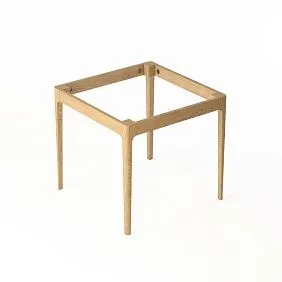
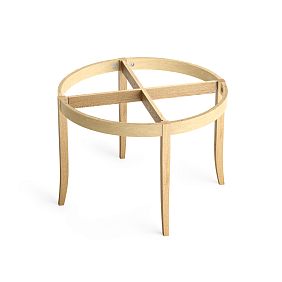
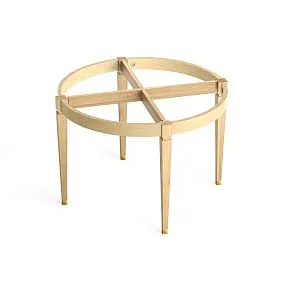
Buy table base— this is the frame connecting legs to each other and to the tabletop. It can be hidden, located under the tabletop, or open, forming a visible frame.
Cargue — horizontal plank connecting legs. Positioned under the tabletop along the perimeter. Function — increasing structural rigidity, preventing leg loosening. The cargue transforms four separate legs into a single rigid frame.
Cargue height — usually 10-15 centimeters. It must be sufficiently thick for strength, but not overly bulky visually. The cargue can be smooth or decorated — with routing, carving, profiling.
Transom — lower connector joining legs at a height of 15-25 centimeters from the floor. Further increases stability, especially important for tall tables and bar counters. The transom also serves as a footrest, which is convenient.
Cross-brace — element connecting opposite legs diagonally. Forms an X-shaped structure. Maximally increases rigidity, prevents tilting. Characteristic for tables on two supports, where the cross-brace connects the bases of the supports.
Methods of attachment: invisible reliability
How legs are connected to the tabletop — critically important question. It determines strength, durability, and possibility of disassembly.
Cargue attachment — legs are connected to the cargue, forming a substructure-frame. This frame is attached to the tabletop from below. Advantage — the tabletop can be removed, replaced, or transported separately. High reliability, rigid structure.
Direct attachment — legs are attached directly to the tabletop. Various methods are used. Dowels — wooden rods inserted into the leg and tabletop. Self-tapping screws — screwed through brackets fixed to the leg into the tabletop. Threaded rods — metal rods with threads passing through the leg, screwed into special bushings in the tabletop.
Detachable attachment — for tables that need to be disassembled for transport or storage. Special furniture fasteners — corner plates, clamps, screw connections are used. Allows quick assembly and disassembly of the table without tools.
Adhesive attachment — for permanent structures not intended for disassembly. Legs are glued into the cargue or tabletop. Maximum reliability, but disassembly is impossible without destroying the connection.
Styles: speaking the language of eras
Each era developed its own language of forms. Table legs are part of this language. Choosing leg style makes a statement about which aesthetic tradition you belong to.
Classicism: strict harmony
Classic legs — symmetry, proportions, repetition. The profile is mathematically precise. Base, body, neck in strict proportion. Ornament is minimal or absent.
A classic leg can be extremely simple — a cylinder with slight thickening. Or slightly more complex — with grooves, bulges. But everything is governed by logic, rhythm, harmony. No random elements, everything is meaningful.
Color — natural or subtly tinted. Classicism avoids bright colors, preferring the nobility of wood. Finish — transparent varnish or oil, highlighting the texture.
Baroque: opulence and decoration
Baroque legs — opposite of classical restraint. Abundance of carving, complexity of forms, desire to impress. Cabriole in full glory — curved, ending in a foot, adorned with carved leaves.
Acanthus leaves, volutes, shells, mascarons — all are present. Forms are dynamic, twisted, creating movement. Gold is abundant, emphasizing relief.
Baroque legs require space. In a small room, they are excessive. But in a spacious country dining room, a table on baroque legs becomes a central element, showcasing luxury.
Modern: natural lines
Modernist legs reject classical symmetry. Forms are asymmetrical, flowing, fluid. Straight lines are replaced by curves that mimic natural ones — stems, waves.
Ornament — stylized plants. Irises, lilies, grapevines. Everything is generalized, decorative, with characteristic modern lines — flowing, continuous.
Color can be unexpected. Tinting in unusual shades, contrasting combinations. Modernism allows experimentation, as long as overall organic harmony is preserved.
Modern minimalism: purity of form
Modern legs — maximum simplicity. Often this is simply a rectangular beam or a cylindrical leg of constant cross-section. No decoration, no complications.
But simplicity does not mean primitiveness. The quality of processing must be flawless. Geometry must be ideal. Surface must be smooth. When there is no decoration to distract attention, every detail is visible.
Material can be natural — wood with an open texture. Or painted — matte enamel in white, black, gray. Minimalism values material honesty, absence of imitations.
Practical aspects: what you need to know
Theory is important, but practice determines the result. A few critically important questions that need to be resolved before purchasing.
Load calculation: physics of stability
The weight of the tabletop — the first factor. A solid oak tabletop of 200×100×5 cm weighs about 80-100 kilograms. Marble of the same size — 150-200 kilograms. Light veneer — 15-20 kilograms. Legs must withstand this weight.
Operational load — what will be on the table. For dining — dishes, food, elbows of seated people. At peak load — 30-50 kilograms. For writing — monitor, books, papers — 20-30 kilograms. For a workbench — tools, heavy parts — may be 100+ kilograms.
Safety factor — legs must withstand not just the calculated load, but at least a two- to threefold safety margin. This ensures longevity, prevents deformation, and provides confidence.
Calculation formula — for four legs, the load is distributed approximately equally. Each leg carries a quarter of the total weight. But unevenness must be considered — if someone leans on a corner, the load on that leg increases. Therefore, safety factor is critical.
Selecting dimensions: proportions of beauty
Height — standard for dining and writing tables is 72-75 centimeters. But it can vary depending on user height. Formula: height = (height × 0.43) + 2 centimeters. For a person 180 centimeters tall, optimal height is 77-78 centimeters.
Cross-section — depends on height and load. Rough rule: for legs 70 centimeters high and 100 kilograms load distributed over four legs, minimum square oak leg cross-section is 50×50 millimeters. For round legs — diameter 50 millimeters. The higher the leg and the greater the load, the thicker the cross-section must be.
Proportions — visual. Legs should not appear either too thin or too bulky relative to the tabletop. For thin tabletops (2-3 centimeters) elegant legs are suitable. For thick ones (5-10 centimeters) — more substantial legs.
Installation: from theory to practice
Tools — for installing legs you need: drill for drilling holes for fasteners, screwdriver or drill for tightening screws, level for checking verticality, square for checking right angles, pencil and tape measure for marking.
Marking — critical stage. Points for leg installation are marked on the tabletop. For four legs at the corners — 5-10 centimeters from the edge. Marking must be symmetrical, distances from edges equal. Asymmetrically installed legs will cause tilting, and the table will rock.
Mounting — depends on the chosen method. With a frame mounting, the base is assembled first — legs are connected to the frame, forming a frame. Joints are glued and reinforced with dowels or screws. Then the frame is mounted to the tabletop from below using brackets or metal plates.
With direct mounting, each leg is fitted with an angle bracket or mounting plate. The leg is placed against the tabletop at the marked position, and screws are screwed into the tabletop through holes in the fastener. It is important to control verticality — the leg must stand strictly perpendicular to the tabletop.
Adjustment — after installing all legs, the table is placed on the floor and stability is checked. If it rocks — possibly legs of different lengths or uneven floor. Adjustable shims — plastic or metal elements with threads — are used to adjust the height of each leg by several millimeters.
Care and restoration: preserve beauty
Wooden legs require care. Not complicated, but regular.
Daily Care
Wiping — wipe once a week with a dry soft cloth, removing dust. Once a month — slightly damp, well wrung out. Never use a wet cloth — excess moisture is harmful to wood.
Scratch protection — never drag the table across the floor. Lift or place soft pads under legs. Scratches on legs are inevitable with careless handling.
Fastener inspection — check screw and bolt tightness every six months. Fasteners may loosen due to vibrations and loads. Tighten as needed.
Damage Repair
Minor scratches — sanded with fine sandpaper (grit P320-P400). Movements along the grain, light, without pressure. After sanding, the area is stained or coated with varnish.
Deep scratches are filled with wood putty. The putty is matched to the color and applied with a rubber spatula, excess is removed immediately. After drying, the area is sanded, stained, and varnished.
Cracks are filled with epoxy glue or a special wood repair compound. If the crack is through, the leg may have lost strength — better to replace it.
Loss of gloss — over time, the varnish coating dulls and scratches. Restoration: light sanding with fine grit, dust removal, application of a fresh varnish layer. The legs will shine again.
Conclusion: the foundation on which style stands
A table is more than just furniture. It is a place where books are written, destinies are decided, families gather. It is a horizontal surface on which life unfolds. And beneath this surface — supports. Four verticals holding everything at the right height.
table leg— not just a functional element. It is an architectural base defining character, proportions, style. It is the first thing a person sees when approaching the table. It is a detail by which taste, understanding of harmony, and attitude toward quality are judged.
Correctly chosenfurniture legstransform the table into a finished artwork. Incorrect ones — create dissonance, disrupt balance, spoil the impression. Choosing legs is an art requiring understanding of styles, materials, constructions, and proportions.
Solid wood remains unmatched. Oak, beech, ash, birch — each species has its own character and advantages. Turned, carved, straight, conical — forms are infinitely varied. From classic baroque cabrioles to modern minimalist cylinders — there is an ideal solution for every style.
Construction is no less important than aesthetics. Proper apron, secure fastening, accurate load calculation — all this ensures longevity, stability, and safety. The table must not only look beautiful but also serve reliably for decades.
Company STAVROS has been creatingFurniture Legs and Supportsmade from solid wood. In-house production in Saint Petersburg is equipped with modern CNC turning and milling machines, allowing creation of legs of any complexity with precision down to fractions of a millimeter.
STAVROS offers over 130 leg models — from simple cylindrical to complex carved. Classic turned and modern geometric. Elegant for coffee tables and robust for dining tables. Made from oak, beech, ash, birch — to suit any requirements and budgets.
Each leg undergoes strict quality control. Wood moisture is checked — 8–12%, no more. Geometry is controlled — diameters and lengths must match the drawing to the millimeter. Surface quality is assessed — smoothness, absence of defects, scratches, cracks.
STAVROS masters — professionals with years of experience. Many have worked on the restoration of palaces, churches, historical buildings. They understand wood, feel it, know how to reveal the beauty of its texture, how to create the ideal shape, and how to ensure longevity.
Custom manufacturing by sketches is possible. If you have a unique idea for a table — STAVROS designers will help bring it to life. They will create a 3D model of the legs, calculate the construction, produce a prototype. Technicians will develop the optimal production process. Masters will realize it in wood.
Also in the assortmentbuy wooden table base— available ready-made or custom-sized. Complete structures made of legs and aprons, forming a strong frame ready for tabletop installation. This simplifies table creation, guarantees element compatibility, and ensures reliability.
For those creating dining tables, specializedsupports for dining tables— reinforced, designed for heavy loads, with thoughtful ergonomics. For coffee tables — elegant low legs creating lightness. For writing desks — optimally positioned, not obstructing feet.
Delivery is organized throughout Russia. Legs are securely packaged — in corrugated cardboard and air bubble wrap. Carved elements are additionally protected by rigid pads. This guarantees preservation during transport over any distance.
Self-pickup is available from warehouses in Saint Petersburg and Moscow. You can come, see samples, talk to specialists, and get consultation. Experienced managers will help calculate the required number of legs, select the appropriate style, and advise on mounting options.
STAVROS prices are competitive. Working directly with the manufacturer eliminates intermediary markups. At the same time, quality remains high — tested materials, refined technologies, strict control.buy legs for a tableSTAVROS means getting the optimal price-to-quality ratio.
Technical support is available at all stages. Before purchase — consultations on selection, load calculation, mounting recommendations. After purchase — assistance with installation, care advice, and option to purchase additional parts.
legs for furniture to buySTAVROS — this is choosing proven quality, professional service, wide possibilities. The company helps create tables that serve for decades, without losing strength or beauty. Tables that become favorite pieces of furniture, around which families gather, and memories are created.
Furniture supports — this is the foundation on which style stands. These are verticals holding the horizontal of life. These are details that transform a simple structure into a piece of furniture art. Choosing qualityFurniture Supportsfrom STAVROS means choosing reliability, aesthetics, longevity. You are creating a table worthy of your home and your life.