












































































Article Contents:
- Solid wood as material: properties and possibilities
- Classic profile: tradition of turned legs
- Leg geometry: straight, conical, curved
- Base: frame construction as an alternative to individual legs
- Diagonal connections: physics of spatial stiffness
- Load calculation: statics and dynamics
- Leg cross-section: geometry and load-bearing capacity
- Table height and ergonomic leg design
- Leg attachment to tabletop
- Leg finishing and protection
- Leg styles: from classic to modern
- Production: from lathe to finished product
- Custom manufacturing and restoration
- Frequently Asked Questions
- Conclusion

Table — not just a horizontal surface on legs, but a complex engineering-artistic system, wheretable legthe table leg becomes the point of intersection between functional requirements and aesthetic ambitions. Solid wood dictates its own rules: texture, density, grain direction determine not only the appearance, but also the load-bearing capacity, durability, resistance to deformation. The aesthetics of solid wood legs — this is not arbitrary ornamentation, but the result of centuries of woodworking experience, where every curve, every thickening has a constructive justification. Stiffness calculation — not abstract mathematics, but a practical necessity, guaranteeing that the table withstands loads, does not bend, does not loosen, and will serve for decades. The synthesis of aesthetics and engineering produces a piece of furniture that is both beautiful and reliable.


Solid wood as material: properties and possibilities
even after being transformed intoLegs for tablesIt reacts to air humidity, expanding or contracting across the grain, while maintaining stability along the grain. Annual rings create not only a visual pattern, but also zones of different density: late wood is harder than early wood, creating anisotropy of properties. Knots, swirls, and cross-grain — not just defects, but features that influence strength, workability, and the aesthetics of the finished product.
Oak — the standard species for table legs. Density of seven hundred to eight hundred kilograms per cubic meter provides high load-bearing capacity with relatively thin cross-sections. Hardness of 3.5 to 4 Brinell units makes the surface resistant to abrasion, impacts, and dents. The texture is expressive, with large annual rings creating a distinctive pattern. Oaktable legsdarken over time, acquiring a noble patina, which is perceived not as aging, but as the maturation of the material.
Beech competes with oak in density but surpasses it in structural homogeneity. Fine-grained wood without large vessels provides a smooth surface, ideal for turning. Turned beech legs result in clear profile details, without fuzziness, with a silky surface after sanding. Color is light pink or yellowish, texture is calm, not distracting from the form. The drawback — hygroscopic nature, tendency to warp under humidity fluctuations. Requires high-quality kiln drying to 8–10% moisture content and stable operating conditions.
Ash is elastic and tough, making it preferable for legs subjected to dynamic loads. The modulus of elasticity is higher than that of oak, at comparable density. This means that an ash leg deflects less than an oak leg under equal cross-sections. The texture resembles oak, but is lighter, with more contrasting annual rings. Processing is more complex due to the swirling grain, but the result is worth it — strong, elastic, visually lightTable legs.
Walnut — a premium species with chocolate tone and distinctive pattern with dark veins. Density is medium, but workability is excellent — walnut cuts, turns, and sands easily, accepting fine detailing of carving. For designer furniture, where aesthetics matter more than maximum strength, walnut is ideal. Cost is high, but the visual effect justifies the expense.




Classic profile: tradition of turned legs
turnedFurniture legs— the quintessence of joinery art, where the lathe transforms a cylindrical blank into an architectural element. The classic profile evolved over centuries: alternation of thickening and narrowing is not random, but governed by laws of mechanics and optical perception. The base — thickening at the bottom — increases the bearing area, creating visual stability. The shaft — the main load-bearing element — has a cross-section calculated to withstand loads. The capital — the upper decorative part — ensures transition to horizontal structural elements, distributing forces.
Balusters are a characteristic element of classical turned supports. The shape of a vase, cup, or column with entasis — variations of profile, each carrying stylistic information. Renaissance balusters are massive, with clear edges between elements. Baroque balusters abound in curves and convexities, creating a dynamic, almost sculptural form. Neoclassical balusters strive for classical rigor, repeating the proportions of order systems.Balusters for staircaseand table legs are often executed in a unified style, creating architectural unity in the interior.
Turning requires skill and understanding of the material. The gouge removes wood, forming the profile, but the direction of the grain affects the process. Along the grain, the gouge moves easily, leaving a smooth surface. Across the grain, chips may occur, requiring special care. The speed of the workpiece rotation, the gouge’s feed angle, and the depth of cut — parameters determined by experience. Hand turning on a traditional lathe creates items with individuality — small deviations make each leg unique. Copy-turning machines ensure series identity, important for furniture sets.
Modern CNC turning expands the possibilities of shaping. Complex profiles with variable element spacing, asymmetrical forms, integration of turned sections with non-turned areas — all this is accessible under program control. But the soul of handcrafting is lost, that unique quality valued by connoisseurs of traditional furniture craftsmanship. Choosing between hand and automated turning — a question of project philosophy, budget, and requirements for serial production.
Our factory also produces:
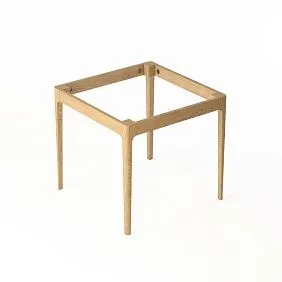


Support geometry: straight, conical, curved
A straight support of constant cross-section — the simplest geometry, but not primitive. A square or round block, installed vertically, provides maximum stiffness with minimal material consumption. Compression is the most favorable mode for wood. If the support’s axis coincides with the load direction, stresses are evenly distributed across the cross-section, minimizing the risk of instability.Table legsStraight profiles are typical for minimalism, Scandinavian style, constructivism — directions valuing material honesty and form logic.
A conical support — tapering from top to bottom or vice versa — creates visual dynamism. The upper thickening is structurally justified: maximum stresses occur in the area of attachment to the tabletop, where a larger cross-section is needed. Tapering toward the bottom lightens the structure, saves material, and creates a sense of lightness, almost levitation of the tabletop. Reverse conicality — thickening toward the bottom — increases the bearing area, enhances stability, but visually adds weight. Used for heavy tables where monumentality is important.
Curved supports — the pinnacle of furniture art. Cabriole — an S-shaped curve, characteristic of Rococo and Victorian styles — elegant and complex to manufacture. Wood is cut from a block so that the grain follows the curve, ensuring strength. An alternative — bent wood, steamed and formed into a mold. Famous chairs by Thonet proved the viability of bending technology. Bentfurniture legsare organic, smooth, free of the angularity of straight forms.
Variable cross-section along height optimizes material distribution. The bending moment diagram shows where stresses are maximum, requiring a larger cross-section. Computer modeling allows calculating the optimal shape, minimizing weight for a given stiffness. Result — a support where every millimeter of material works efficiently, with no excess or deficiency. Such engineering aesthetics are characteristic of modern design, where beauty is the result of functional logic.
Get Consultation
Base: frame construction as an alternative to individual legs
For tables longer than 1.5 meters, individual legs are insufficient. RequiredPedestal— a spatial frame uniting supports into a rigid system. Carriages — horizontal blocks connecting legs around the perimeter — transform four individual legs into an unbreakable frame. The load from the tabletop is distributed not on four points, but on the entire perimeter of the frame. The tabletop rests on carriages, not on the ends of legs, reducing stress concentration.
Carriages work under tension-compression under uneven tabletop loading. If a load is placed on one end of the table, the opposite carriage is stretched, preventing the structure from tipping over. The cross-section of carriages is calculated for forces arising in extreme usage scenarios. For dining tables, where heavy dishes may be placed simultaneously on one end, carriages must be strong enough to prevent deformation.
Connecting carriages to legs — a critical joint. Dowel joint with glue — a traditional technique proven over centuries. The dowel on the carriage’s end fits into a slot in the leg’s body, and glue secures the connection. The glued area determines strength: the longer the dowel, the more reliable the joint. Additional reinforcement — wooden dowels or metal bolts passing through the joint. For disassemblable furniture, threaded bolts — screws driven through the leg into the carriage’s end — ensure strength and allow disassembly.
Transverse braces — additional horizontal connections located below carriages, closer to the floor. They increase structural rigidity, prevent loosening, and create additional visual rhythm. Transverse braces are especially important for tall tables — bar stools, where long legs act as cantilevers prone to bending. A transverse brace installed at a height of 40–50 cm from the floor divides the leg’s length, multiplying the system’s rigidity many times over.
Diagonal braces: physics of spatial rigidity
A rectangular frame of four rods connected by hinges is deformable — it becomes a parallelogram under lateral load. Rigid corner connections prevent deformation, but are insufficient: joints weaken over time, causing play. A diagonal connecting opposite corners transforms the deformable quadrilateral into two unchangeable triangles. A triangle — the only geometric figure unchangeable by definition. Any three points connected by rods form a rigid system.
Diagonal braces inthe base for a tablework under tension-compression under lateral loads. When a person leans on the edge of a table, a horizontal force arises, attempting to shift the tabletop. Without diagonals, the base deforms, and the table rocks. The diagonal running from the loaded corner to the opposite corner works under compression, resisting deformation. The second diagonal, perpendicular to the first, stretches, complementing the system’s work.
Cross braces — two diagonals intersecting at the center — create maximum rigidity. This configuration is typical for historical furniture, where reliability is more important than minimalism. A single diagonal — a compromise between rigidity and visual lightness — is used in modern design. The diagonal is installed in the plane most susceptible to deformation — usually longitudinal, where the table’s length creates a large lever arm.
The visual function of diagonals is no less important than their structural function. Intersecting beams create a graphic pattern, add complexity to the form, transforming the base into a standalone decorative element. In country, rustic, and traditional English styles, diagonals — a characteristic feature. In minimalism, they are avoided, sacrificing a small amount of rigidity for line purity. Hidden diagonals — metal rods installed on the inner side of carriages, invisible from the outside — a compromise between structural necessity and aesthetic requirements.
Load calculation: statics and dynamics
The static load on a table is the sum of the tabletop’s own weight and useful load — dishes, food, and items placed on its surface. A dining table for six people during a meal carries thirty to forty kilograms of dishes and plates plus the tabletop’s weight — for a solid oak slab 4 cm thick and 1.5 m² in area, this is about thirty kilograms. Total seventy kilograms are distributed across fourFurniture Supports— 17.5 kilograms each under uniform distribution.
But distribution is rarely uniform. Heavy dishes are placed at the center of the table, light dishes — at the edges. One side may be loaded more heavily than the other. The calculation scheme assumes the worst-case scenario: all the load is concentrated on one half of the table. In this case, the two nearest supports carry up to seventy percent of the total weight — twenty-five kilograms each. Plus the tabletop’s own weight, distributed proportionally. Total about thirty-five kilograms per support.
Dynamic loads arise from impacts, vibrations, and sudden movements of objects. A dish placed on the table with a swing creates a short-term load, many times exceeding static load. A child leaning on the table’s edge with full weight creates a cantilever load, bending the tabletop and supports. The dynamic coefficient — a multiplier accounting for these effects — is taken as 1.5–2 for household furniture. The calculated load on a support increases to fifty to seventy kilograms.
The safety factor further increases the calculated load. For solid wood furniture, a safety factor of 1.5–2 is considered reasonable. This means that a support, calculated to carry seventy kilograms, must withstand one hundred to one hundred forty kilograms without failure. This safety margin accounts for wood’s heterogeneity, possible defects, wear over time, and unpredictable overloads.Furniture supportDesigned with a safety margin, it will last for decades without losing reliability.
Support cross-section: geometry and load-bearing capacity
A round section with a diameter of fifty millimeters made of oak can withstand an axial compressive load of about one ton — far beyond what is required for dining table legs. But a table works not only under compression. Bending is a more dangerous mode. A long, slender support under lateral load deflects, creating tensile stresses on one side and compressive stresses on the other. The strength under bending is lower than under compression.
Moment of inertia of the section — a geometric characteristic determining resistance to bending. For a circular section, the moment of inertia is proportional to the fourth power of the diameter. This means that doubling the diameter increases stiffness by sixteen times. A small change in diameter sharply affects strength.Table legA forty-millimeter diameter leg is twice less stiff than a fifty-millimeter one, all else being equal.
A square section with equal area has a greater moment of inertia than a circular one. A forty-by-forty millimeter square is stiffer than a forty-five-millimeter diameter circle. However, a square section is anisotropic — the moment of inertia varies in different planes. If bending occurs along the diagonal of the square, stiffness decreases. A circular section is isotropic — identical stiffness in all directions, which is preferable for supports subjected to loads from different sides.
A rectangular section, with the longer side oriented in the direction of the main load, is more effective than a square. A thirty-by-sixty millimeter section, with the sixty-millimeter side perpendicular to the plane of bending, provides stiffness comparable to a fifty-by-fifty millimeter square, using less material. This is used in table bases where the direction of the main load is predictable.
Hollow section — a tube — provides high stiffness with less weight. The material is concentrated at the periphery, where bending stresses are maximal. The central part, where stresses are minimal, is removed. A wooden tubular support is technically complex but possible. More common are metal tubular supports for tables in industrial and loft styles. For solid wood, a solid section is preferred, ensuring easier processing.
Table height and ergonomic support
The standard height of a dining table — seventy-two to seventy-six centimeters from floor to tabletop — is an anthropometric constant ensuring a comfortable position for hands and back for a seated person of height 165–180 cm. With a tabletop thickness of four centimeters, the height of the legs should be sixty-eight to seventy-two centimeters. A deviation of two to three centimeters affects comfort: a too-low table forces one to hunch over, while a too-high table causes shoulders to be raised.buy table legsThe height of the table legs should be sixty-eight to seventy-two centimeters. A deviation of two to three centimeters affects comfort: a too-low table forces one to hunch over, while a too-high table causes shoulders to be raised.
A writing or computer workstation has the same height as a dining table. However, requirements for legroom are stricter. Legs installed at a height of sixty centimeters from the floor interfere with free leg placement, causing discomfort during prolonged work. Either lower the legs by ten to fifteen centimeters, or use a T-shaped base, where the central support is connected to a horizontal beam, and the legs are spaced widely at the edges, freeing up space under the table.
A coffee table is lower — forty to forty-five centimeters in total height.Legs for coffee tablesShorter, but stability requirements are the same. A low center of gravity makes the structure more stable, but a small lever arm under lateral load requires sufficient leg spacing. A coffee table sixty by one hundred twenty centimeters with legs at the corners is stable, but a table of the same size on a central support requires a heavy base or floor anchoring.
Bar tables at a height of one hundred five to one hundred ten centimeters pose special challenges for supports. Long, slender legs act as cantilevers, easily bending under lateral loads. A larger cross-section or the use of braces — cross braces or diagonals — is required. A bar table on four legs without additional braces will wobble even with the slightest touch. A cross brace at a height of forty to fifty centimeters transforms long legs into short segments, significantly increasing stiffness.
Support attachment to the tabletop
The method of connection to the tabletop determines the reliability and longevity of the entire structure. A solid tabletop expands and contracts across the grain with changes in humidity. The annual amplitude — up to five millimeters per meter of width for oak. Rigid connections that prevent movement create stresses leading to cracks. The structure must account for wood movement.furniture legDowel joint — a traditional method for solid wood tables. The dowel at the end of the leg fits into a socket in the tabletop or in a frame-base glued to the tabletop. The dowel direction — along the grain of the tabletop — allows the tabletop to expand freely across the grain without damaging the joint. PVA or polyurethane glue creates a strong joint capable of enduring decades of use. Reinforcement with a wooden dowel passing through the dowel perpendicularly further secures the joint.
Metal plates — an alternative to dowel joints. An angle or T-shaped plate is screwed to the leg and tabletop with screws. For a solid tabletop, screws are inserted into elongated holes in the plate, oriented across the grain. As the wood expands, the screw moves along the hole, not creating stresses. This is called a floating connection, allowing the tabletop to "breathe".
Threaded fasteners provide disassemblability. A metal bolt passes through the leg, screws into a threaded bushing installed in the tabletop. The connection is strong and allows multiple assembly/disassembly cycles, convenient for transport. However, for solid tabletops, compensation for temperature and humidity deformations is required — either the bushing is installed in an intermediate frame, or an elastic gasket is used between the leg and tabletop.
Legs screwed from within the tabletop through elongated holes form a frame to which the legs are attached. The tabletop rests on the frame but is not rigidly connected to it — screws in elongated slots allow movement. Legs are connected to the frame with dowels or bolts — the joint is independent of tabletop deformation. This construction is typical for traditional solid wood tables.
The legs, fastened to the countertop from the inside through elongated slots, form a frame to which the legs are attached. The countertop rests on the legs but is not rigidly connected to them — screws in elongated slots allow movement. The legs are connected to the legs via tenons or bolts — the joint is independent of countertop deformation. Such a construction is typical for traditional solid wood tables.
Finishing and protection of supports
Unfinished wood is vulnerable to moisture, dirt, and mechanical damage. Protective coating extends service life, preserves aesthetics, and simplifies maintenance.Wooden wall decorand furniture elements require finishing appropriate to the conditions of use and interior style.
Varnish creates a hard, transparent film protecting wood from moisture, abrasion, and contamination. Polyurethane varnishes are most durable — withstand wet cleaning, resistant to scratches, long-lasting. Water-based acrylic varnishes are eco-friendly, odorless during application, suitable for residential spaces. Nitrocellulose varnishes dry quickly but are less durable, requiring renewal every few years. Sheen level — from matte to glossy — is chosen according to aesthetic preferences.
Oil finish penetrates into the wood, not forming a surface film. Oil enhances texture, adds depth to color, preserves the tactile quality of wood.Legs for chairsOil-finished surfaces feel pleasant to the touch and look natural. The drawback — lesser resistance to moisture, need for periodic renewal. Oil is applied once a year or two, maintaining protective properties and fresh appearance.
Wax finish — a traditional finish creating a soft silk-like sheen. Wax is applied over oil or on bare wood and polished to a matte luster. Protective properties are moderate, but the visual effect is noble. Wax finish is typical for antique furniture, restoration projects, and interiors in historical styles.
Staining with stains changes the color of the wood while preserving the visibility of the texture. Light beech can be stained to resemble walnut, and unremarkable birch can be made to look like oak. Stains penetrate into the wood structure, coloring it from within. A protective finish — varnish, oil, or wax — must be applied over the stain. StainedChair legsallow creating a set of furniture in a single color from different wood species.
Painting with covering paints hides the texture, creating a uniform color. Used for inexpensive species or when the design requires a specific color. Acrylic paints are eco-friendly, alkyd enamels are durable. Before painting, the wood is primed, sanded, and painted in two to three coats. Result — a smooth colored surface where the wood species is irrelevant.
Leg style: from classic to modern
Classic style requires symmetrical turned legs with characteristic elements.Wooden balustersand table legs are executed in a unified style, creating architectural unity. The profile is complex, with alternating convexities and concavities, creating play of light and shadow. Material — noble species, finish — natural, highlighting the texture, or patinated, imitating aging.
Baroque takes decorative elements to the extreme. Legs are curved, carved, and heavily ornamented. Gilding, patina, and carved plant motifs transform the leg into a sculptural element.Buy Baroque furnituremeans immersing oneself in the atmosphere of palace opulence. Functional construction yields to decorative elements, although strength remains sufficient for real use.
Modern style uses smooth curved lines, natural motifs, and asymmetry. Legs have the shape of plant stems, bending and widening toward the base like roots.Carvedelements are stylized, graphic, and differ from the naturalistic carving of Baroque by greater stylization. Color is dark or contrasting, emphasizing the silhouette.
Minimalism requires extreme simplicity. Straight prismatic or cylindrical legs, smooth surface, no decoration. Beauty is achieved through proportions, material quality, and precision of execution.Legs for a stool to buygeometric shapes — typical choice. Color is neutral — light-colored natural wood or painted white, gray, or black.
Scandinavian style combines simplicity of form with warmth of natural wood. Legs are conical, slightly tapering toward the base, made from light species — birch, ash, pine. Finish is natural — oil or light varnish, preserving texture and color.Wooden boards in interiorand furniture elements create an atmosphere of light, purity, and coziness.
Loft and industrial styles combine wood with metal. Wooden tabletop on a metal frame, or massive rough wooden legs with preserved traces of processing.Wooden beamon the ceiling and brutal table legs create an atmosphere of converted industrial space.
Production: from lathe to finished product
Manufacturingfurniture legsbegins with selecting wood. Boards from kiln-dried wood with 8–10% moisture are inspected for defects. Knots, cracks, rot — grounds for rejection. Grain direction must be longitudinal relative to the future leg, ensuring maximum strength. Rough cuts are made with allowance for finishing.
Turning on a lathe — main operation for round legs. The blank is secured in the chuck and tailstock, rotating at 1,000–2,000 rpm. The turner brings the tool to remove wood, forming the profile. Copy-turning lathe works according to a template, ensuring series uniformity. CNC lathe executes a program created in CAD, reproducing complex profiles with accuracy to tenths of a millimeter.
Milling is used for legs with non-circular cross-sections. CNC milling machine processes the blank, creating edges, grooves, decorative elements. Milling capabilities exceed turning: square, polygonal, or custom-shaped legs. Threads inaccessible to lathes are milled by the tool according to a program or manually by a skilled turner.
Sanding refines the surface to smoothness. A sander with sandpaper grit from 120 to 300 removes tool marks, leveling the surface. Manual sanding of hard-to-reach areas — threads, grooves — requires patience and skill. Result — silky surface, ready for finishing.
Finishing — final operation. Staining, oiling, varnishing, or painting is performed in special chambers with controlled temperature and humidity. Spray application from an airless sprayer ensures even coating. Each layer dries, is sanded with fine sandpaper, and the next is applied. For varnish finish, three to four layers — standard. Final polishing creates gloss or matte finish as required.
Custom manufacturing and restoration
Mass-producedfurniture legscover most needs, but sometimes a unique item is required. Designer furniture project with original leg shapes, restoration of an antique table where a lost leg must be reproduced — tasks for custom manufacturing. Client provides drawings, sketches, photos, sample. Master analyzes, develops technology, manufactures.
Restoration requires not only technical skill but also understanding of historical styles and traditional techniques. An antique table with a lost leg requires an exact replica of the remaining parts. Master takes measurements, studies the profile, determines the wood species, analyzes the mounting method. Turns a new leg, striving for maximum similarity. Patination and artificial aging make the new part indistinguishable from the old.
Structural reinforcement during restoration — a sensible practice. If original supports were insufficiently strong, you can increase the cross-section, add connections, use a more durable wood species. Historical accuracy yields to practical feasibility — furniture must serve. Hidden reinforcements — metal rods inside wooden legs, additional glue joints — are not visible from the outside but significantly increase reliability.
Manufacturing according to the designer's sketches — a creative process. The designer draws the form, the craftsman realizes it in the material. Sometimes the sketch requires adjustments based on technological capabilities and strength requirements. The dialogue between designer and craftsman produces an optimal solution, where aesthetic intent is realized without compromising functionality.Base for Dining TablesCustom project — the central element of a unique interior.
Frequently asked questions
What cross-section of supports is needed for a solid wood dining table?
For an 80x160 cm table on four legs, the minimum diameter of round oak or beech supports is 45 mm. For square cross-section — 40x40 mm. If the table is longer than two meters, you need six supports or a base with rails distributing the load. The calculation takes into account the weight of the countertop, useful load, and a safety factor of two.
What is the advantage of a base over individual legs?
A base — a frame structure where legs are connected by rails — provides spatial rigidity. The countertop rests on the entire perimeter of the frame, not on four points. This prevents sagging of long countertops, eliminates loosening, and allows using thinner supports. For tables longer than 1.5 meters, a base is preferable to individual legs.
Why are diagonal braces needed in the base?
Diagonals transform a deformable rectangular frame into an unchangeable system of triangles. Under lateral loads — when a person leans on the edge of the table — diagonals work in tension-compression, resisting deformation. Without diagonals, the table rocks, joints loosen. One diagonal or cross braces significantly increase the structure's rigidity.
Which wood species is best for dining table supports?
Oak is optimal for heavy tables — maximum hardness and strength. Beech is good for turned supports due to uniform structure. Ash is elastic and suitable for dynamic loads. Walnut is beautiful but expensive, used for designer furniture. Birch and pine — budget options for light tables. The choice depends on load, style, and budget.
How to attach supports to a solid wood countertop considering its mobility?
Solid wood expands and contracts across the grain with humidity changes. The attachment must allow movement. Mortise joints are oriented along the countertop's grain. Metal plates with elongated holes allow screws to shift. The countertop can rest on rails via spacers, not rigidly screwed. Such a floating attachment prevents cracks.
Is additional treatment needed for solid wood supports?
Yes, mandatory. Unfinished wood absorbs moisture, gets dirty, loses appearance. Lacquer creates a protective film, resistant to abrasion and moisture. Oil enhances texture, requires periodic renewal. Wax gives a noble sheen but is less durable. Staining changes color, paint hides texture. The choice of finish depends on usage conditions and aesthetic preferences.
Can turned supports be used in modern interiors?
Yes, if the profile is minimalist. Simple turned forms without excessive decoration match modern aesthetics. Conical legs with smooth tapering are typical for Scandinavian and mid-century modern styles. Avoid complex baroque profiles in minimalist interiors. Color and finish also matter — natural light tones or monochrome finishes are preferable to dark lacquer.
How much does manufacturing supports according to an individual sketch cost?
Custom manufacturing is 2-4 times more expensive than mass production. A simple non-standard height support — plus 20-30% of the standard price. A complex unique profile with carving — triple the cost. Delivery time ranges from two weeks to a month depending on complexity. For exclusive furniture, these are justified expenses — the result is a unique item precisely matching the concept.
Conclusion
table legSolid wood supports — not just a functional element, but a manifestation of the balance between aesthetics and engineering, where form arises from constructive logic, and strength does not exclude beauty. Turned profiles, refined by centuries of tradition, geometric forms dictated by modern aesthetics, frame structures with rails and diagonals — all are variants solving one task: create a table that is reliable, comfortable, long-lasting, and at the same time pleasing to the eye, harmonizes with the interior, carries character and style. Rigidity calculation guarantees that beautiful form will not be fragile, and massive construction will not be excessive. Professional approach to designing and manufacturing table supports combines knowledge of materials, mastery of technologies, understanding of styles, respect for traditions, and openness to innovations.
classic turned profiles, modern geometric forms, hand-carved elements.Furniture Legs and Supportsready-madetable bases for tablesof various sizes with rails, aprons, diagonal braces, ensuring maximum structural rigidity. Hardwood species — oak, beech, ash — are air-dried to 8-10% moisture, guaranteeing dimensional stability and absence of deformation. In-house production on CNC turning and milling machines allows manufacturing both mass production and custom orders according to customer sketches. Various finishing options are available: polyurethane lacquering, oil treatment, wax polishing, staining in any shades, custom color painting. For restoration projects, precise copies of historical supports with patina and artificial aging are available. Technical department provides consultation on load calculations, cross-section selection, and attachment methods, ensuring that selected supports meet the requirements of a specific project. STAVROS works with furniture manufacturers, woodworking workshops, design studios, and private clients, offering professional service and quality products. Moscow warehouse ensures availability of popular models for urgent orders, delivery across Russia is organized through reliable logistics partners. In addition to table supports, the company producesbalusters for staircases, Decorative brackets, carved appliqués, Baseboards, Crown Molding, Moldings made of polyurethaneallowing to implement comprehensive interior design projects in a unified style. One-year warranty confirms the manufacturer's confidence in product quality.Table supports from solid woodTable supports from STAVROS — a synthesis of traditional craftsmanship and modern technologies, where the aesthetics of form are inseparably linked to calculated rigidity, creating furniture that serves generations.


