Article Contents:
- The Essence of Baroque Style: When Forms Acquire Movement
- Characteristic Baroque Furniture Items
- Moldings as the Foundation of Baroque Interior Design
- Color Palette: Contrasts and Saturation
- How to Properly Combine Furniture with Moldings
- Rosettes and Their Role in Composition
- Cornices: The Finishing Touch of Composition
- Creating a Baroque Interior: Step-by-Step Algorithm
- Common Mistakes and How to Avoid Them
- Baroque in Modern Life: Adapting the Style
- Conclusion: When a Home Becomes a Palace
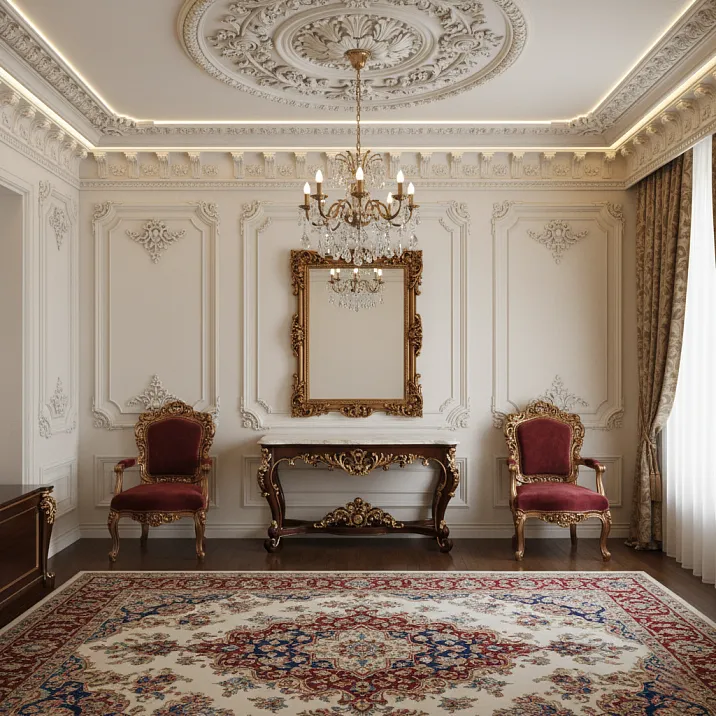
Baroque is not just a style. It is a manifesto of luxury, a theater of forms, a symphony of gold and velvet. When you enter a Baroque interior, you are not entering a room, but a palace hall, where every element — from a massive carved chair to a ceiling rosette with cherubs — works to create an atmosphere of grandeur. And if you decidedBuy Baroque furnitureIt is important to understand: furniture is only part of the composition. It must exist within the context of architectural decoration — moldings, cornices, rosettes, moldings — which transform the space into a single work of art.
Baroque emerged in Italy at the end of the 16th century as a reaction to the strictness and rationalism of the Renaissance. The Church, royal courts, and aristocracy sought a way to demonstrate power, wealth, and might. And Baroque became that method. Dynamic forms, curved surfaces, abundance of decoration, contrast of light and shadow, drama — all of this are tools to affect the viewer. Baroque does not ask — it demands admiration. It does not whisper — it proclaims.


The Essence of Baroque Style: When Forms Acquire Movement
What makes Baroque Baroque? Several key principles that must be understood before integrating furniture of this style into an interior.
First principle — rejection of straight lines. Baroque has no place for strict geometry. Here, curves, waves, spirals, ovals prevail. Furniture legs are not straight, but curved. Chair backs are not vertical, but reclined backward with a wavy top edge. Cabinet facades are not flat, but convex or concave. This curvilinear quality creates a sense of movement, life, energy.
Second principle — abundance of decoration. Baroque furniture is not a functional item adorned with decoration. It is decoration that has function. Carving covers every surface — legs, armrests, backs, facades. Carvings depict acanthus leaves, grapevines, shells, cartouches, volutes, cherub heads, drapery. This is high-quality handwork, where the craftsman invests months of labor into one chair.
Third principle — gilding and luxurious materials. Wood is only of noble species: walnut, oak, mahogany. But it rarely remains in its natural form. It is often covered with gilding — mercury gold applied to lacquer, polished to a mirror finish. Or painted white with gilded protruding details. Upholstery is velvet, silk, embroidered tapestry. Colors are rich — burgundy, emerald, royal blue, purple.
Fourth principle — scale and grandeur. Baroque furniture is large, massive, dominant. Chairs with high backs, wide seats, powerful armrests. Tables on carved supports, marble or inlaid wood tops. Two-door cabinets, reaching ceiling height, with cornices resembling architectural pediments. This furniture is for spacious halls with high ceilings, where it does not overwhelm, but matches the scale of the space.
Fifth principle — symmetry and composition. Despite the dynamism of forms, Baroque strictly follows the laws of symmetry. Pair of chairs are placed mirror-symmetrically relative to the central axis. Cabinet facade has symmetrical division. Carved decoration is also symmetrical — if a volute is on the left, its mirror reflection is on the right. This symmetry creates order amid the exuberance of decoration.




Characteristic Baroque Furniture Items
When you decideto buy Baroque furnitureit is important to know which items are authentic to this style.
Chairs and Stools. High carved backs, curved legs, reclined backs, elongated seats. Upholstery in velvet or tapestry with pattern. Armrests wavy, carved. Legs in the form of curved feet, ending in gilded claws. Chairs often come in pairs or sets of six to eight pieces.
Sofas. Wide, low, with wavy top edge of the back. Can be three-seater or even larger. Upholstery luxurious, often with embroidery or appliqué. Carved legs and armrests. Sometimes sofas have asymmetrical shape — chaise longue with one high and one low armrest.
Tables. Dining tables massive, on carved supports or central column with curved legs. Top made of marble or inlaid wood with geometric or floral patterns. Console tables wall-mounted, with marble tops and carved base, often in the form of interlaced volutes or sculptural figures.
Cabinets and Commodes. Two-door cabinets with convex or concave facades. Top finished with cornice with carved details. Doors decorated with carved panels, inlays, gilding. Commodes with drawers, facades having wavy shape. Legs carved, curved. Hardware — bronze handles in the form of mascarons, rosettes, leaves.
Beds. Heavy, with high headboards and footboards adorned with carving. Often with a canopy on carved columns. Headboard upholstery in expensive fabric, sometimes with tufting (cushioning). Canopy made of heavy brocade or silk with tassels and drapery.
Mirrors. Large floor or wall-mounted mirrors in heavy carved frames with gilding. The frame is a separate work of art, often more complex and expensive than the mirror itself. Carvings depict shells, volutes, cartouches, angels.
Ottomans and benches. Low seats with carved legs, upholstered in velvet. May have round, oval, or rectangular shapes. Used as additional seating or as decorative elements.
All these items share one thing — they were created not for modest apartments, but for palaces. And to prevent them from looking out of place in a modern interior, you need to create the proper architectural context for them.
Our factory also produces:


Cornice as the basis of Baroque interior
Baroque furniture without Baroque architectural context — it's a costume without a stage. And the main element of this context —Polyurethane moldingsThe molded decoration in Baroque — not an accent, but the basis of composition.
Ceiling cornices. In Baroque interiors, the cornice is not a narrow molding, but a powerful architectural element, 20–30 cm wide or more. The profile is complex, multi-tiered, with moldings, fluting, ornamentation.Ceiling cornicemay include several tiers — main cornice, frieze below it, supporting modillions or consoles.
The cornice is often gilded or painted white with gilded protruding details. It creates a transition from wall to ceiling, emphasizes the height of the room, frames ceiling frescoes or molded decoration on the ceiling.
Ceiling rosettes. In the center of the ceiling, at the point where the chandelier is attached, a rosette — a round or oval molded element with rich relief — is installed.decorative rose outletsIn Baroque style, they depict plant motifs — acanthus leaves, roses, laurel wreaths, intertwined with volutes and cartouches. In the center of the rosette — a hole for the chandelier hook. The diameter of the rosette can reach 100–150 cm in large halls.
The rosette is painted white or gold, sometimes with a combination — white background, gold details. It creates a visual center on the ceiling, emphasizes the chandelier, and links it to the architecture of the room.
Walls in Baroque are never left smooth. They are dividedpolyurethane moldingsby moldings, creating frames, panels, pilasters. Moldings run vertically from floor to ceiling, horizontally at different levels, forming a complex grid.
Within the frames created by moldings, wallpapers with patterns, fabric upholstery, frescoes, mirrors are placed. The moldings themselves have a complex profile — moldings, fluting, ornamentation of leaves and flowers. The width of moldings is 10–15 cm, they are sufficiently heavy to be noticeable, but not overwhelming the space.
Pilasters and half-columns. Vertical elements imitating columns, but not bearing real load. Pilasters are installed at room corners, along door and window openings, at regular intervals along long walls. They have a base at the bottom, a shaft (often fluted) and a capital at the top.
The capital in Baroque is a separate work of art. It may be Corinthian (with acanthus leaves), composite (with volutes and leaves), or entirely free-form with angels, mascarons, drapery. Pilasters visually support the cornice, create vertical rhythm, divide the wall into sections.
Friezes and panels. Between the cornice and the main part of the wall runs a frieze — a horizontal band with relief decoration. The frieze may depict garlands of flowers and fruits, mythological scenes, geometric ornaments. The width of the frieze is 30–50 cm.
On walls, separate molded panels — oval or rectangular compositions with relief imagery — are also placed. These may be allegorical figures, landscapes, still lifes, coats of arms. Panels are framed by carved frames made ofmoldings for walls.
Door and window frames. Doors and windows in Baroque — are portals, not just openings. They are framed by wide moldings with ornamentation, topped with sashings — cornices on consoles, resembling pediments of ancient temples. The sashing may be straight, triangular, or arched (in the shape of a curve).
Above doors, a cartouche — a decorative element in the shape of a shield or scroll with a coat of arms, monogram, or date — is often placed. The cartouche is framed by volutes, drapery, and supported by angels or griffins.
All this molding creates an architectural framework into which furniture is then fitted. Without molding, Baroque furniture looks excessive and out of place. With proper molded decoration, it becomes part of a unified composition.
Get Consultation
Color palette: contrasts and saturation
Baroque does not know pastels. Here, saturated, deep colors, contrasting combinations, and the play of gold and silver prevail.
Main wall and ceiling colors. White, cream, ivory — for creating a light background. Or saturated dark tones — burgundy, emerald green, royal blue, purple, deep brown. Black is sometimes used as a contrast to gold.
The ceiling may be white, frescoed, or covered with fabric. In Baroque, coffered ceilings — divided into squares or rhombuses by beams, each square decorated with a rosette — are popular.
Color of molding. White molding on colored walls — a classic solution. The contrast of pure white against a saturated wall color creates a clear structure. An alternative — gilded molding. Ceiling cornices, rosettes, moldings are covered with leaf gold or gold paint, creating a luxurious effect.
Sometimes a combination is used — white background, gold details. For example,Polyurethane Decorthe surface is painted white, and the protruding relief elements — leaves, volutes, beads — are gilded. This creates detail, emphasizes the intricacy of carving.
Furniture color. Baroque furniture rarely remains in the natural wood color (although walnut and polished redwood also occur). More often it is painted white, cream, or bone-colored with gilded carved details. Or it is fully covered in gold leaf — the pinnacle of luxury.
Furniture upholstery should match the overall color palette of the interior. If the walls are burgundy, upholstery may be gold, green, or cream. If the walls are white, upholstery is rich — blue, red, emerald. Often, a multi-colored tapestry with interwoven interior colors is used.
Textiles. Drapes are heavy, multi-layered — tulle, main drapes, valances with fringe and drapery. Fabrics — velvet, silk, brocade, tapestry. Colors are rich, often with gold threads. Drapes hang from heavy cornices with carved finials.
Bed canopies, tablecloths, decorative pillows — all made of expensive fabrics, with embroidery, fringe, and appliqué. Rugs on the floor — oriental or European with thick pile and large patterns.
How to properly combine furniture with moldings
When you have baroque furniture and baroque moldings, the task is to unite them into a harmonious composition. This is not simply arranging furniture along the walls. It is creating a dialogue between objects and architecture.
Proportional correspondence. The size of the furniture should correspond to the scale of the molding decoration. If the cornices are wide, rosettes are large, moldings are massive — the furniture should also be large. An elegant rococo chair will disappear in a space with powerful baroque moldings. Conversely, a massive baroque cabinet will overwhelm an interior with delicate moldings.
Stylistic unity. The profiles of moldings and furniture carving should speak the same language. If the moldings depict acanthus leaves, shells, volutes — the furniture should have the same motifs. If the moldings are more formal, with geometric ornaments — the furniture should also be more restrained.
This does not mean everything must be identical. But the ornamental vocabulary must match. Examine the carving on the furniture and the relief of the moldings — if you see recurring motifs, stylistic unity exists.
Color harmony. The color of the furniture should harmonize with the color of the moldings and walls. The most common schemes: white moldings, colored walls, white furniture with gilding — all connected by white. Or: gold moldings, white walls, gold furniture — all connected by gold. Or: white moldings, white walls, dark furniture (walnut, redwood) — contrast between dark and light.
Compositional axes. Furniture placement should consider the architectural axes created by moldings. If a wall is divided by pilasters into three sections, furniture is arranged according to this division. The central section — sofa or console with mirror. The side sections — chairs or cabinets.
If there are molded frames on the wall, furniture may either be placed within the frames (for example, a console in the center of the frame, with a mirror above it), or between the frames (chairs between the frames, the frames remaining for decorative panels or wallpaper).
Vertical accents. Tall furniture items — cabinets, tall mirrors, high-backed chairs — should correspond to vertical molding elements — pilasters, vertical moldings. If pilasters are spaced two meters apart, a cabinet, tall mirror, or console with a tall mirror above it can be placed between them.
Symmetry. Baroque loves symmetry. If a fireplace is centered on the wall, chairs or consoles are placed on either side. If a window is centered, cabinets or display cases are placed on either side. If a central molded panel is on the wall, wall sconces are placed on either side, with consoles below.
Symmetry creates order, grandeur, and ceremonial elegance. But this is not a rigid rule — in baroque, some asymmetry is allowed if it is motivated by function or creates dynamism.
Rosettes and their role in composition
Ceiling rosettein a baroque interior — is not simply a place to mount a chandelier. It is a compositional center, a point from which the entire room layout is built.
In a classical baroque hall, the rosette is positioned strictly at the center of the ceiling. From it, axes of symmetry radiate. The chandelier hanging from the rosette — the most expressive decorative element, visible from any point in the room. It is a crystal or bronze structure with multiple arms, sconces, and crystal pendants.
Furniture is arranged according to the center marked by the rosette. Under the chandelier, a dining table (in the dining room), a central seating group (in the living room), or a bed (in the bedroom) may be placed. Alternatively, the center remains free, and furniture is arranged along the walls, leaving space under the chandelier for movement.
The size of the rosette should correspond to the size of the room and chandelier. In a room of thirty square meters, the rosette is fifty to seventy centimeters in diameter. In a large hall of fifty to sixty square meters — the rosette is one hundred to one hundred twenty centimeters in diameter.
The rosette may not be a single element. In very large halls, additional smaller rosettes are used, symmetrically positioned relative to the central one. They frame wall sconces or simply serve as decorative elements.
The color of the rosette — usually white or gold. A white rosette on a white or colored ceiling stands out due to its relief. A gold rosette on a white ceiling — a bright accent. Sometimes a combination is used — white background, gold details.
The rosette connects the ceiling with the rest of the interior. Motifs depicted on the rosette (leaves, flowers, volutes) correspond with carving on furniture, cornice relief, and moldings. This creates stylistic unity, an impression that everything in the interior was created by one hand.
Cornices: crowning the composition
Wooden cornicesor cornices made of polyurethane in a baroque interior — are not simply transitions from wall to ceiling. They are architectural elements that crown the composition, creating a visual completion of the vertical.
In baroque, cornices are massive. They project from the wall twenty to thirty centimeters, have a complex profile — several steps, each with its own ornament. The lower part of the cornice may have fluting, the middle — a bead with beads, the upper — an ovolo or meander. All this creates a rich play of light and shadow.
Cornices are often supported by modillions or consoles — projecting elements arranged at regular intervals along the cornice. Modillions take the form of scrolls, volutes, or depict grotesques, leaves. They are not only decorative but also create a visual impression that the cornice actually bears the weight of the ceiling.
In large rooms, the cornice can be multi-level. The main cornice is at the junction of the wall and ceiling; below it, 30-50 cm from the ceiling, is a frieze with ornamentation; even lower is an additional cornice or shelf. This multi-layered structure creates depth, complexity, and richness of composition.
Cornice color is traditionally white or gold. A white cornice is universal and suits any wall color. A gold cornice is an accent, luxury, and grandeur. A combination of white and gold — white background with gold protruding details — adds detail and emphasizes relief.
The cornice connects walls and ceiling, but also connects vertical elements — pilasters. Pilasters 'support' the cornice, and their capitals rest on it. This creates a logical architectural composition where everything is interconnected.
Furniture should relate to the cornice in height. Tall items — cabinets, high-backed chairs, mirrors — should not hit the cornice, but should be tall enough to compositionally balance its mass. Low furniture under a heavy cornice will disappear.
Creating a Baroque interior: step-by-step algorithm
If you have decided to create an interior in the Baroque style, whereBuy Baroque furnitureand integrate it with stucco, follow this algorithm.
Step one: assess the room. Baroque requires space. Minimum ceiling height — three meters, preferably three and a half. Room area — no less than twenty-five square meters, ideally forty or more. In a small room with low ceilings, Baroque will overwhelm and create a feeling of confinement.
Step two: develop the concept. Determine which Baroque style you want — Italian (more dynamic, with abundant sculpture), French (more restrained, elegant), Russian (more massive, with Byzantine influence). Choose a color palette — light (white, cream, gold) or dark (burgundy, green, blue with gold).
Step three: design the stucco decoration. Start with the ceiling. Determine the position of the central rosette (usually the geometric center of the room). Choose the rosette size and style. Then choose the ceiling cornice — width, profile, color. If pilasters are planned, determine their placement — in corners, along openings, spaced along walls.
Draw a wall scheme with moldings. Determine what frames will be created, their size, and their placement. What will be inside the frames — wallpaper, fabric, panels, mirrors. Plan door and window frames.
Step four: select and order stucco.You can buy ready-made stucco matching the Baroque style. Calculate the quantity: linear meters of cornices and moldings, number of rosettes, pilasters, consoles, corner elements. Add a ten to fifteen percent allowance for trimming.You can choose ready-made items in baroque style. Calculate the quantity: linear meters of cornices and moldings, number of rosettes, pilasters, consoles, corner elements. Add a reserve of ten to fifteen percent for trimming.
Step five: prepare surfaces. Walls and ceiling must be perfectly flat. Baroque stucco highlights any imperfections. Level surfaces with plaster, sand, and prime. Paint walls and ceiling with the chosen base color.
Step six: install stucco. Start with the ceiling cornice, then install the rosette, pilasters, wall moldings, door and window frames. Use special polyurethane adhesive. Fill all joints with acrylic sealant, sand smooth. If stucco will be gilded, apply gold leaf (or gold paint).
Step seven: finish wall decoration. Within the molding frames, place the chosen finish — apply patterned wallpaper, stretch fabric, apply decorative plaster, hang mirrors.
Step eight: install lighting. Hang the central chandelier on the rosette. Install wall sconces — beside mirrors, between moldings, above consoles. Lighting must be multi-level, creating play of light and shadow on the relief surface of the stucco.
Step nine: select and place furniture. Now that the architectural environment is ready, choose furniture.Furniture legsand elements must match the stucco style. Arrange furniture according to compositional axes created by the stucco. Maintain symmetry. Do not overcrowd space — Baroque loves air.
Step ten: add textiles and accessories. Hang heavy drapes, lay rugs, place decorative cushions. Add accessories — vases, sculptures, paintings in gilded frames, candelabras, clocks. Each accessory must be luxurious and match the style.
Typical mistakes and how to avoid them
Creating a Baroque interior is a complex task where it's easy to make mistakes. Let's consider common errors.
Error one: mismatch in scale. Large Baroque furniture in a room with delicate stucco or vice versa — heavy stucco and small furniture. Everything must be proportionate. If you have wide cornices and large rosettes, furniture must be substantial.
Error two: mixing styles. Baroque furniture combined with stucco in the Empire or Classicism style. Although these styles are related, each has its own ornamental vocabulary. Baroque — shells, asymmetrical volutes, lush floral motifs. Classicism — strict geometric ornaments, symmetrical forms. Mixing creates dissonance.
Error three: excess. Baroque is luxurious, but overloading kills the effect. If every surface is covered with carving, every wall with moldings, every item with gilding, the eye has no rest. Pauses are needed — smooth wall sections, simple surfaces that give the eye a rest.
Error four: wrong color. Baroque requires rich colors or pure white with gold. Pastel tones, muted shades make Baroque dull and strip it of drama. If you choose a light palette — let white be pure, gold bright. If dark — let colors be deep and saturated.
Error five: cheap materials. Baroque is a style of luxury. Plastic moldings, cheap particleboard furniture with 'wood' laminate, synthetic upholstery — all of this kills the style. Better to have fewer but quality items than many cheap imitations.
Error six: lack of symmetry. Baroque loves symmetry. If it is broken without good reason, the composition collapses. Paired elements must be truly paired — identical in shape, size, finish.
Error seven: incorrect lighting. Baroque interiors require dramatic lighting — bright central chandelier, wall sconces, directional light on stucco and furniture. Flat, even lighting deprives Baroque of volume and makes it dull.
Error number eight: ignoring architectural axes. Furniture is arranged chaotically, disregarding the divisions of walls with moldings. A cabinet covers a molding, a chair stands in the middle of a decorative frame. Furniture should either fit within the architectural grid or be placed between its elements.
Baroque in modern life: adaptation of the style
A full baroque interior requires large spaces, high ceilings, and a significant budget. However, elements of baroque can be adapted to modern conditions.
Baroque in one room. It is not necessary to make the entire house in the baroque style. One can create a single baroque hall — a living room, dining room, or bedroom. Other rooms can be styled neutrally. This creates contrast, making the baroque space special and grand.
Baroque light. A lighter version of the style — main features are preserved, but intensity is reduced. Moldings are present, but more restrained. Baroque furniture is present, but not all — one or two accent pieces (carved chair, console with mirror), the rest of the furniture is neutral. Colors are baroque, but not all surfaces are decorated.
Baroque and minimalism. A bold combination — baroque furniture in a minimalist space. Smooth white walls without moldings, simple ceiling, neutral floor. And against this backdrop — one luxurious baroque chair, gilded, with velvet upholstery. The contrast creates a dramatic effect, and the chair becomes an art object.
Baroque accents. Not the entire interior, but individual elements. A baroque mirror in a carved gilded frame on a neutral wall. A baroque chandelier on a simple ceiling. A baroque commode in a modern living room. These accents add a note
of luxury, without overloading the space.
Neo-baroque. A modern interpretation of the style — baroque forms and motifs, but modern materials and colors. A chair of baroque shape, but upholstered in bright synthetic acid-colored fabric. Moldings on the wall, but painted black or metallic. This is a play with tradition, creating something new based on the old.
Any of these approaches works, as long as the main principle is followed — understanding the essence of the style, respecting its form, and attention to quality execution.
Conclusion: when the home becomes a palace
Buy Baroque furniture— it is not simply purchasing decorative items. It is making a choice in favor of luxury, grandeur, theatricality. It is a decision to live not in an apartment, but in a space where every detail — from the carved leg of a chair to the ceiling rose — contributes to creating a palace atmosphere.
Baroque requires boldness. Boldness to choose a style that does not whisper, but proclaims. That does not hide, but demonstrates. That does not ask, but demands admiration. But if you are ready for this boldness, if you understand the essence of the style, if you are ready to invest resources and attention — the result will exceed expectations.
Baroque furniture does not exist in a vacuum. It requires context — architectural decoration, which is createdwith polyurethane moldings, wooden cornices, on the walls, creating a complete classical composition., moldingsThese elements transform the room into a hall, walls into an architectural composition, and the ceiling into a work of art.
The correct combination of furniture and moldings is an art of composition. Scale must match, styles must align, colors must harmonize, axes must be aligned. When everything is done correctly, the interior achieves unity — it stops being a collection of objects and becomes a single organism.
The company STAVROS has helped create interiors worthy of palaces for more than twenty years. The STAVROS assortment includes everything needed to create a baroque space:ceiling molding, wall, Crown Molding, Outlets, pilasters, consoles, Moldings.
All STAVROS products are made from high-quality materials.polyurethane moldings— produced from dense polyurethane, ensuring strength and relief detail.Wooden elements— from selected solid oak, beech, and ash with air-drying.
The STAVROS catalog features items of various styles, including baroque. Ornamented cornices with acanthus leaves, shells, volutes. Rosettes with angels, floral garlands, complex compositions. Pilasters with Corinthian and Composite order capitals. Consoles in the form of sculptural figures intertwined with plant motifs.
In addition to moldings, STAVROS offersfurniture componentsandstairs— legs, supports, balusters, appliqués, which can be used when creating or restoring baroque furniture.
STAVROS specialists are ready to consult on selecting elements for your project. They will help calculate the required amount of material, select profiles and ornaments matching the style of your furniture, and recommend optimal color solutions.
The company works with private clients as well as with designers, architects, and construction companies. Standard items can be delivered from stock or custom-made according to individual drawings for unique projects.
Create the interior of your dreams. Let your home become a place where baroque luxury combines with the comfort of modernity. Wherebaroque furnitureexists in harmony witharchitectural decoration, creating a space worthy of kings. STAVROS provides the tools — your creativity will turn them into a work of art.