Article Contents:
- Evolution of Interior Design: How Planks Changed the Rules of the Game
- Psychology of Perceiving Lattice Structures
- Technological Breakthrough in MDF Production
- Variety of Applications: From Classic to Avant-Garde
- Scandinavian Minimalism: Philosophy of Simplicity
- Modern Classic: Elegance in Details
- Loft and industrial aesthetics
- Technical Aspects: Science Behind the Beauty
- Engineering Calculations of Load-Bearing Capacity
- Temperature and humidity deformations
- Acoustic Characteristics
- Practical Solutions for Different Rooms
- Living Spaces: Creating the Atmosphere of Home
- Living Rooms: The Art of Making an Impression
- Kitchens and Dining Rooms: Practicality Above All
- Installation Technologies: From Idea to Realization
- Preparation Stage: The Foundation of Success
- Frame Systems: Reliability of Construction
- Direct Mounting: Simplicity and Reliability
- Innovative Solutions: The Future is Already Here
- Integration of smart technologies
- Ecological innovations
- Adaptive Materials
- Economic Aspects and Long-Term Benefits
- Analysis of Investments in Quality
- Impact on property value
- Operational Economy
- Trends in Development and Forecasts
- Personalization and customization
- Integration with smart home systems
- Ecological responsibility
- Conclusion
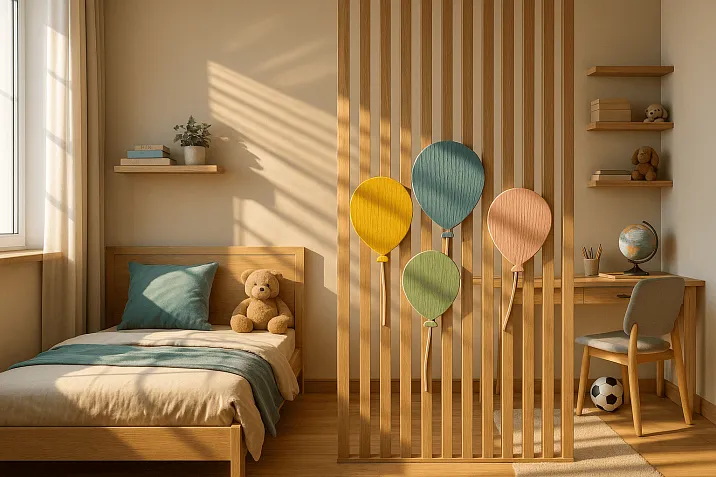
Every interior tells a story. And when this story requires a special expressive language, help comes from MDF slat for interior – material that has transformed from a simple decorative element into a full-fledged tool of architectural creativity. Imagine: one solution can radically change the perception of space, add depth, character, and a unique style.
But what lies behind this popularity? Why exactly MDF planks have become the number one choice for designers around the world? The answer lies in the unique combination of technological perfection and boundless creative possibilities that this material offers to anyone striving to create a truly special space.


Evolution of Interior Design: How Planks Changed the Rules of the Game
Modern interior design is undergoing a true revolution. If ten years ago the focus was primarily on furniture and textiles, today the main characters are architectural elements capable of transforming space itself. MDF material opened unprecedented opportunities for designers to create volumetric compositions playing with light and shadow.




Psychology of Perceiving Lattice Structures
The human eye is structured in such a way that linear elements exert a powerful influence on the perception of space. Vertical planks visually raise the ceiling, creating a sense of grandeur and majesty. Horizontal compositions expand the room, making it simultaneously more spacious and cozy.
Interesting fact: the distance between planks directly affects a person's emotional state in a room. A frequent rhythm with gaps of 10-20 mm creates a sense of protection and intimacy. Wide gaps of 50-100 mm form a feeling of freedom and openness. That is why professional designers carefully calculate the proportions of lattice compositions.
Our factory also produces:


MDF Production Technological Breakthrough
Modern technologies have enabled the creation of a material that surpasses natural wood in many parameters. The density of high-quality MDF ranges from 750-900 kg/m³, ensuring ideal shape stability under any climatic conditions. Unlike solid wood, MDF does not warp, crack, or form resin pockets.
The production process involves grinding wood into fibers measuring 0.1-3 mm, creating an absolutely uniform structure without defects. E0-grade binders guarantee full ecological safety, making the material suitable even for children's rooms.
Get Consultation
Versatile applications: from classic to avant-garde
Versatility MDF planks It manifests in the ability to adapt to any interior style. This material looks equally organically at home in strict Scandinavian minimalist homes and luxurious classical mansions, in brutal lofts and refined art deco spaces.
Scandinavian minimalism: philosophy of simplicity
Northern aesthetics find their ideal embodiment in light MDF planks. Shades of bleached oak, birch, and pine create an atmosphere of purity and naturalness. Horizontal installation with wide gaps of 30-50 mm imitates traditional log walls, linking modern interiors with historical roots.
A distinctive feature of the Scandinavian approach is using planks not as decorative elements, but as functional parts of space. Behind plank structures hide storage systems, heating radiators, and engineering utilities. Beauty arises from functionality — the main principle of northern design.
Modern classicism: elegance in details
use MDF interior planks for creating a modern interpretation of traditional wall panels — boiserie. Noble shades of oak, walnut, and redwood combined with gold moldings form an atmosphere of aristocratic luxury.
Classical panel proportions are calculated according to the golden ratio. The lower section height is approximately 1/3 of the room’s total height, creating harmonious proportions and emphasizing connection with historical traditions. The upper section is finished in lighter tones, visually lightening the structure.
Loft and industrial aesthetics
Industrial romance of lofts finds the ideal counterpoint in dark MDF planks against rough brick and concrete textures. Shades of charred wood, graphite, and metal add warmth to the brutal environment, creating cozy zones in spacious industrial spaces.
A characteristic feature of loft applications is intentional roughness of finish, visible fastening elements, and asymmetrical compositions. Planks can run at angles, create complex geometric patterns, and combine with metallic elements.
Technical aspects: science behind beauty
Structural load calculations
Designing plank structures requires precise engineering calculations. For a 20×40 mm section plank, 2700 mm long, the maximum uniformly distributed load is 12-15 kg/m. Moment of inertia I = 26667 mm⁴ ensures deflection of no more than 3 mm under calculated load.
The critical buckling load for a freely supported plank is calculated using Euler’s formula: Pkr = π²EI/l², where E is the modulus of elasticity of MDF (2800-3200 MPa), I is the section’s moment of inertia, and l is the element’s length. For a standard plank, this value is 35-42 N.
Temperature and humidity deformations
The linear expansion coefficient of MDF is 8-15×10⁻⁶ 1/°C, which is 2-3 times less than that of natural wood. A 3000 mm long plank will change its length by only 0.6-1.1 mm when the temperature changes by 25°C. This allows creating structures without visible compensating joints.
Humidity deformations are more significant: 0.2-0.4% for every 10% change in relative air humidity. Stabilizing the material’s moisture content at the factory to 6-9% minimizes these deformations during operation.
Acoustic characteristics
Plank structures have pronounced sound-absorbing properties. The sound absorption coefficient depends on frequency and ranges from 0.3-0.8 in the 125-4000 Hz range. Resonant frequencies are calculated using Helmholtz’s formula, taking into account gap sizes and air layer depth.
For optimal acoustic effect, it is recommended to fill the space behind planks with sound-absorbing material 50-100 mm thick. This increases the sound absorption coefficient to 0.85-0.95 in the speech frequency range.
Practical solutions for various rooms
Living spaces: creating the atmosphere of home
In bedrooms Decorative MDF rails are most often used to decorate the headboard zone. Vertical compositions visually raise the ceiling, creating a sense of spaciousness even in small rooms. Integrated backlighting turns the wall into a source of soft, diffused light, ideal for evening reading.
Children’s rooms require special attention to material ecological safety. MDF class E0 with formaldehyde emission less than 0.05 mg/m³ is completely safe for children’s health. Bright color solutions — green, blue, yellow — create a cheerful atmosphere conducive to child development.
Living rooms: art of making an impression
The living room is the face of the home, the place where owners meet guests and spend time with family. Plank structures allow creating expressive accent walls, zoning space, and integrating multimedia equipment.
A popular solution is media zone decoration. Planks frame a TV or projector, creating a complete composition. Behind the structure hide cables, audio systems, and smart home control elements. Functionality combines with aesthetics.
Kitchens and dining rooms: practicality above all
Kitchen spaces impose special requirements on finishing materials. Moisture-resistant MDF grades with paraffin content of 0.8-1.2% withstand high humidity and temperature fluctuations. Special coatings ensure resistance to grease, stains, and easy cleaning.
Plank structures in kitchens serve not only decorative but also functional roles. Behind them are exhaust ducts, pipes, and electrical cables. Removable elements ensure access for servicing engineering systems.
Installation technologies: from idea to realization
Preparation stage: the foundation of success
Quality installation begins with careful preparation of the base. Walls must be level with deviations no more than 3 mm per linear meter. Base moisture is checked with an electronic moisture meter — no more than 4% for mineral surfaces, no more than 12% for wooden surfaces.
Marking is performed using a laser level with ±1 mm accuracy. Base lines are marked with a plumb line and checked with a metal ruler. Marking accuracy is critically important — an error of 2-3 mm will be noticeable in the finished structure.
Frame systems: structural reliability
When the base has significant unevenness or when installing engineering communications, a frame installation system is used. The frame is made from wooden beams 40×20 mm or CD-60 metal profiles.
The spacing of frame elements is determined by the size of the beams and the expected load. For standard interior beams, a spacing of 400-600 mm is recommended. The frame is installed strictly level using adjustable brackets.
Direct mounting: simplicity and reliability
On flat bases Finishing MDF rails can be installed using direct mounting. Use 6×40 mm anchors for mineral bases or 3.5×35 mm self-tapping screws for wooden structures.
Clamp systems provide concealed mounting without visible elements on the surface. Clamps are routed into the end of the beam to a depth of 8-12 mm. This method requires high manufacturing precision but ensures an ideal appearance.
Innovative solutions: the future is already here
Integration of smart technologies
Modern beam systems are becoming carriers of digital technologies. Built-in temperature, humidity, lighting, and air quality sensors transform decorative elements into building management system components.
LED lighting of the new generation allows creating dynamic lighting scenarios. RGB+W color backlighting with mobile app control opens up limitless possibilities for creating ambiance. The system can automatically adapt to time of day, weather, and user mood.
Ecological Innovations
New-generation MDF is produced using biodegradable binders based on plant proteins. Soy and casein-based adhesives provide strong bonding while ensuring full ecological safety. The complete biodegradation cycle takes 3-5 years depending on conditions.
Antibacterial coatings with silver nanoparticles suppress the growth of pathogenic microorganisms on surfaces. This is especially important in medical facilities, kindergartens, and food production. Effectiveness is maintained throughout the coating’s service life.
Adaptive materials
Developments in smart materials have led to coatings capable of changing properties depending on external conditions. Thermochromic compositions change color with temperature changes, photochromic ones — depending on lighting.
Self-healing coatings contain microcapsules with repair compounds. When a scratch appears, the capsules rupture, releasing a polymer that polymerizes and fills the damage. The surface restores its original appearance without human intervention.
Economic aspects and long-term benefits
Investment analysis in quality
Initial costs for quality MDF beams range from 800 to 2000 rubles per square meter of finished surface, depending on project complexity. This is comparable to other premium finishes but surpasses them in durability and functionality.
The service life of quality beams in interior conditions is 20-25 years without loss of decorative properties. The possibility of partial repair and replacement of individual elements extends the overall service life to 30-40 years.
Impact on property value
Professionally executed beam-based finishing increases property market value by 10-18% depending on the market segment. In the luxury segment, this effect is more pronounced due to high appreciation of individuality and style.
Unique design becomes a competitive advantage when selling or renting out. Objects with original finishes attract more attention from potential buyers or tenants, reducing time on the market.
Operational economy
Low operational costs — an important advantage of MDF beams. Regular maintenance is limited to dry or wet cleaning with soft cloth. Special cleaning agents are not required due to the durability of modern coatings.
Energy efficiency is demonstrated by the ability to integrate low-energy LED lighting. Power consumption is 8-15 W/m compared to 40-60 W/m for traditional lighting systems. Energy savings offset additional integration costs within 2-3 years.
Trends and forecasts
Personalization and Customization
Advancements in digital printing technology allow creating unique textures and patterns tailored to specific projects. Each element can have an individual design, opening up limitless possibilities for interior customization.
3D printing is gradually being adopted in the production of complex architectural elements. This enables creating beams with curved profiles, integrated functional elements, and unique geometric shapes.
Integration with Smart Home Systems
The future belongs to intelligent materials capable of interacting with building management systems. Rails become part of a unified ecosystem controlling lighting, climate, security, and multimedia.
Voice control via virtual assistants makes interaction with interiors more intuitive. Commands like "dim the lights in the living room" or "turn on romantic lighting" become a natural part of daily life.
Ecological responsibility
Growing consumer environmental awareness stimulates the development of sustainable manufacturing technologies. Carbon-neutral production, use of renewable energy, and closed-loop recycling become industry standards.
LCA lifecycle certification evaluates a product's environmental impact from raw material extraction to disposal. Manufacturers invest in eco-friendly technologies to obtain green certifications.
Conclusion
The world of interior design is rapidly evolving, and MDF slat for interior is at the forefront of these changes. It has ceased to be merely a decorative material, transforming into a tool for creating smart, adaptive, emotionally rich spaces.
Technological sophistication in modern manufacturing ensures consistent material quality and predictable characteristics. Environmental safety meets the strictest international standards, while innovative developments open new application horizons.
Economic efficiency is evident not only in reasonable initial cost but also in long-term benefits: durability, ease of maintenance, and upgradeability. Investments in quality finishes pay off through increased property value and improved quality of life.
Design possibilities are virtually limitless due to the variety of sizes, textures, colors, and installation methods. From minimalist simplicity to luxurious classicism — every style finds its embodiment in rail compositions.
The future belongs to intelligent materials capable of adapting to user needs, conserving resources, and creating healthy living environments. MDF rails already embody many of these principles today, becoming the foundation for tomorrow’s interiors.
The professional design community highly values the potential of this material for creating outstanding interiors. The combination of technology, aesthetics, and functionality makes MDF rails an indispensable tool of modern design.
The industry is moving toward integration of digital technologies, increased eco-friendliness, and expanded functional capabilities. Personalization, customization, smart features — all of this is already a reality today.
STAVROS Company, with its rich experience and relentless drive for innovation, continues to lead in the development and production of next-generation interior materials. Every STAVROS product embodies advanced technologies, flawless quality, and limitless creative expression potential, forming the material basis for interiors that are not only beautiful but also intelligent, eco-friendly, and functional — becoming an indispensable part of modern life and a daily source of inspiration.