Article Contents:
- Attention to Detail: Why a Sloppy Joint Can Ruin the Impression of an Expensive Renovation
- The Psychology of Perceiving Incompleteness
- Corner Protection: Using Wooden Corner Beads to Protect External Wall Corners in High-Traffic Areas
- Structure and Functions of a Wooden Corner Bead
- Where Corner Beads Are Especially Necessary
- Installation of Wooden Corner Beads
- Zoning with Battens: How to Create a Visual Partition or Accent Using a Simple Wooden Batten
- Vertical Slat Partitions
- Horizontal Batten Panels
- Curvilinear Batten Structures
- Painting and Finishing Battens
- Lower Perimeter: Choosing a Floor Baseboard as the Foundation of Visual Stability in an Interior
- Architectural role of baseboards
- Baseboard Material and Profile
- Baseboard Installation and Fastening
- Cable Channel in Baseboard
- Special Case: Features of Joint Finishing in a Country House
- "Breathing" of Wooden Walls
- Shrinkage of Frame Houses
- Mounting Technologies: Professional Solutions
- Moisture Protection
- Details That Define Style
- Classic Interior
- Modern style
- Scandinavian Style
- Loft and Industrial Style
- Frequently Asked Questions
- Why Are Wooden Corner Beads Needed If Corners Can Simply Be Painted?
- Which Wood Is Better for Baseboards — Oak or Pine?
- Can Battens Be Used for Zoning in a Small Apartment?
- How to Choose a Baseboard Color — Matching the Floor or Walls?
- Do Wooden Elements Need to Be Treated with Protective Compounds Before Installation?
- What height should a baseboard be in a standard apartment?
- Can Wooden Elements Be Installed in a Bathroom?
- How Much Does It Cost to Finish a Room with Molding Elements?
- Neatness of Details as a Sign of Professional Design
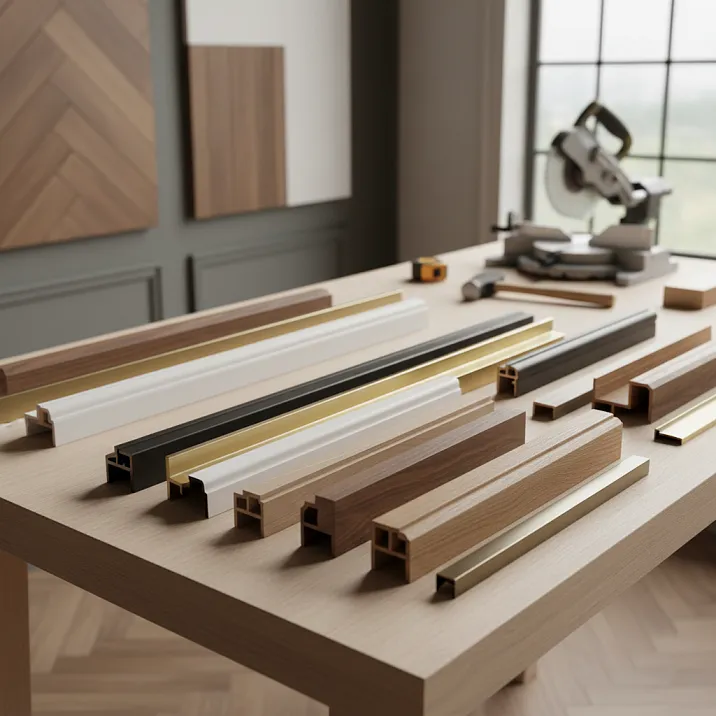
Have you ever noticed how one sloppy joint can ruin the impression of a flawlessly executed renovation? The eye catches a crooked corner, a gap between the baseboard and the wall, a chipped edge of a slope — and all the splendor of expensive wallpaper, quality paint, and exquisite furniture fades. Because the devil, as we know, is in the details. And in interior design, these details have specific names:Wooden corner bracket, Wooden plank, wooden baseboard.
These elements may seem secondary only to the uninitiated. In reality, they are what form the geometric logic of a space, create visual completeness, and protect vulnerable areas from damage. A professional designer knows: an interior begins with a concept, develops through the main finishes, but is completed precisely with molding elements. Without them, even the most brilliant idea looks unfinished, raw, amateurish.
The art of finishing is the ability to see space as a single organism, where every line, every transition, every joint matters. It is the understanding that protecting corners is not just a practical necessity, but an architectural gesture. That zoning with battens is not a clever trick, but the creation of an additional dimension. That a correctly chosen skirting board is the foundation of the visual stability of the entire interior.


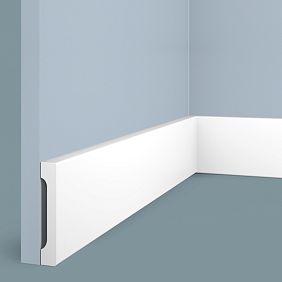
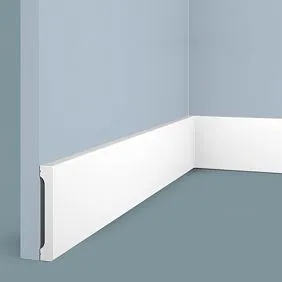
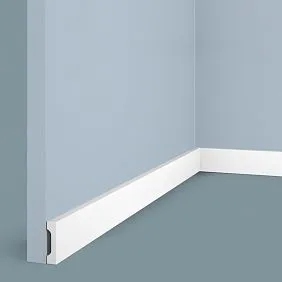
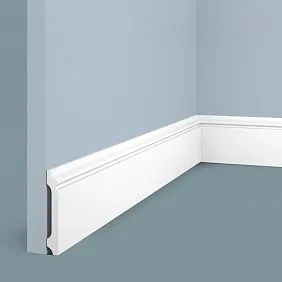

Attention to detail: why a sloppy joint can ruin the impression of an expensive renovation
Imagine the situation. You've invested colossal funds into a renovation. Italian tiles in the bathroom, designer wallpaper in the living room, solid oak parquet, custom-made furniture. Everything is precise, everything is thought out, everything is expensive. And so you bring guests, expecting admiration — and someone suddenly notices: 'Oh, your corner here is a bit chipped.' Or: 'The skirting board isn't quite flush, see?' And that's it — the magic is destroyed. Instead of delight — a sympathetic look. Instead of recognition of taste — a silent acknowledgment: the craftsmen weren't very good.
Why does this happen? Because human perception is structured in a special way. The brain seeks harmony, symmetry, completeness. When it finds it — it experiences pleasure. When it stumbles upon dissonance — it experiences discomfort. Moreover, the discomfort from a minor defect can outweigh the pleasure from many correct decisions. This is an evolutionary mechanism: our ancestors had to notice the slightest anomalies to survive. Today, this same mechanism makes us notice a crooked joint in an interior.
Professionals know: the last five percent of the work determines eighty percent of the impression. These are the very finishing elements that bring the space together into a whole.Wooden anglesprotecting the external corners of walls, protect not only the finish itself from mechanical damage, but also your psychological peace from constant tension: 'Oops, we might accidentally bump it, it'll chip again.'
Battens, creating structure on a wall or dividing space into zones, work like graphic lines in painting — they guide the gaze, create rhythm, organize chaos. Skirting boards are the visual foundation of walls, without which vertical planes seem detached from the floor, suspended in air.




Psychology of perceiving incompleteness
Research in the field of neuroaesthetics shows: the brain experiences physical discomfort when looking at incomplete forms. This is called the Zeigarnik effect — incomplete tasks occupy more mental space than completed ones. Applied to interiors, this means: a room without skirting boards, with unfinished corners, with open joints is subconsciously perceived as an incomplete task. You are not consciously aware of it, but being in such a space, you experience a vague anxiety.
Properly finished joints and transitions 'close' these mental gaps. The brain receives a signal: everything is in order, everything is complete, you can relax. This is one of the reasons why it is more comfortable to be in well-finished interiors, even if you are not consciously analyzing the details.
Neatness is respect. For yourself, for your home, for the people who will be in this space. Carelessness in details conveys carelessness in attitude. Impeccability of details conveys attention, care, professionalism.
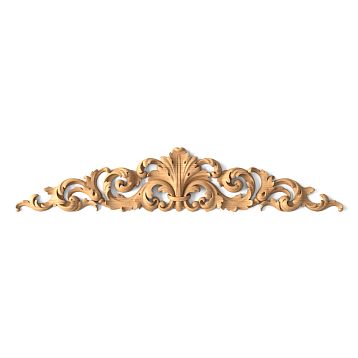
Our factory also produces:


Corner protection: using wooden corner beads to protect the external corners of walls in high-traffic areas
External wall corners are the Achilles' heel of any interior. This is precisely where two planes meet at ninety degrees, forming a sharp edge. This is precisely where the maximum mechanical impact occurs: bumped while moving furniture, caught with a vacuum cleaner, hit with a hip while passing with bags. Children play, animals run, guests turn around with umbrellas in narrow hallways — and all of this concentrates on the fragile edge of the corner.
If the corner is not protected, the plaster chips, the wallpaper tears, the paint peels. Six months to a year after a fresh renovation, the corners look worn, especially in high-traffic areas — hallways, foyers, near doorways. You can, of course, re-glue wallpaper, touch up paint, fill chips. But that's an endless fight against symptoms. Or you can eliminate the cause — installWooden angle.
Get Consultation
Construction and functions of a wooden corner bead
A wooden corner bead is a linear molding product with an L-shaped cross-section. Two flanges meet at a right angle. The width of the flanges varies from 15 to 50 millimeters depending on the task. Thickness — from 8 to 20 millimeters. Material — solid hardwood: oak, beech, ash, larch.
The functions of the corner bead are multifaceted. Protective — the first and obvious one. Wood with a hardness of 600-800 units on the Brinell scale (oak, beech) withstands impacts that would instantly destroy plaster. The corner bead takes on the mechanical load, cushions the impact, protects the fragile finish. Even if the corner bead itself gets damaged — a scratch, a dent — it's not critical. A wooden element can be sanded, repainted, or in the worst case — replaced. This is much simpler and cheaper than restoring a destroyed wall corner.
Decorative function — the second in importance.The corner bead formsa clear geometric line at the junction of planes. It emphasizes the architecture of the space, makes the corners graphic, expressive. Painted in a contrasting color relative to the walls, the corner bead becomes an accent. Painted to match — it subtly structures the space without attracting excessive attention.
Concealing function — the third. It is not always possible to make the joint of two planes perfectly even. Minor irregularities, cracks, chips — all of this is hidden under the corner bead. It visually evens out what technically remained imperfect.
Where corner beads are especially necessary
High-traffic areas — hallways, foyers, entryways — places with maximum foot traffic and, accordingly, maximum risk of damage. Here, protecting corners with corner beads is not a whim, but a pressing necessity. Especially in homes with children or pets. Activity in such homes is an order of magnitude higher, the risk of damage increases many times over.
Staircases — another critical zone. On stair flights, people hold onto walls, lean when climbing. The corners of steps, the corners of walls along the staircase are constantly subjected to mechanical impact. The corner bead here performs a dual function: it protects the finish and ensures safety by rounding the sharp edge.
Door and window reveals — the place where different planes meet, often made of different materials. The joint of drywall and window frame, the joint of plaster and door frame — all these are potential points of stress and destruction. The corner bead fixes these joints, prevents cracking, creates a neat frame.
External corners of columns, pilasters, decorative wall projections — everywhere there is a protruding edge, a corner bead is appropriate and useful. It emphasizes the architectural form, protects it, completes the composition.
Installation of wooden corner beads
Installing a corner bead requires precision but is not an overly complex task. The surface of the corner must be even, clean, dry. If there are significant irregularities, they need to be leveled with filler and sanded.
The corner bead is fixed with adhesive and mechanical fasteners. Adhesive — special for wood, ensuring strong adhesion to the mineral base (plaster, drywall). The adhesive is applied to both flanges of the corner bead in a thin bead. The corner bead is pressed against the corner, fixed with painter's tape until the adhesive sets.
Additional fixation with screws or finishing nails increases the reliability of the fastening. Fasteners are installed at intervals of 30-40 cm, countersunk flush or slightly below the surface. The fastener locations are filled, sanded, and become invisible after painting.
Corner joints in room corners are cut at a forty-five-degree angle. This requires precision and good tools—a miter saw with the ability to set the cutting angle. The joined ends must fit together without gaps. Any gap is noticeable and spoils the impression.
The final finishing of the corner—painting, varnishing, or oiling—is done after installation and puttying of the fastening points. If the corner is to be painted, it is primed beforehand. Paint is applied in two to three coats with intermediate sanding. If the natural wood texture is to be preserved, it is coated with oil or varnish that highlights the wood grain.
Zoning with battens: how to create a visual partition or accent using a simple wooden batten
In the era of open floor plans, where the kitchen flows into the living room and the living room into the dining area, a problem arises: how to divide the space without destroying its integrity? Solid walls are out—they kill the sense of spaciousness. Glass partitions are expensive and fragile. Textile curtains look temporary. Butwooden rakes for zoning—is an elegant, functional, and aesthetic solution.
Wooden plank—is a rectangular-section strip, typically from 20x40 to 50x70 millimeters. The material is solid softwood or hardwood. The surface is planed, sanded, and ready for finishing. The battens are installed vertically or horizontally at a specific spacing, forming a permeable structure. This structure divides the space visually but maintains transparency, allowing light and air to circulate.
Vertical slatted partitions
Vertical battens are the most common zoning option. They are installed from floor to ceiling (or to a height of 2-2.5 meters) with a spacing of 5 to 15 centimeters. The smaller the spacing, the denser the partition and the less through visibility. The larger the spacing, the more airy the structure and the greater the visual connection between zones.
Vertical battens create rhythm, direct the gaze upward, and visually elongate the space. They are ideal for rooms with low ceilings—making them appear taller visually. For rooms with high ceilings, vertical battens emphasize this height, making the space more slender and graphic.
Structurally, vertical battens are attached to horizontal guides—at the top and bottom. The guides can be concealed (recessed into the floor and ceiling) or visible (as square-section bars). The battens are fixed in the guides using grooves, tenons, or metal fasteners.
Functionally, a batten partition separates, for example, the hallway from the living room. You enter the house—and immediately understand: here is the entry zone, and beyond the battens begins the living space. At the same time, the gaze freely passes through the battens, and the space is not fragmented. Light from the living room windows penetrates into the hallway, which often lacks natural lighting.
Another example: separating the kitchen and dining area. The battens mark the boundary but do not isolate. The hostess in the kitchen is not cut off from the family in the dining area; communication continues. But visually, the zones are clearly defined: here is where cooking happens, there is where eating happens.
Horizontal batten panels
Horizontal battens on a wall—not so much zoning in the literal sense, but rather creating an accent, a focal point. Horizontal lines expand the space, making it more stable and calm. They are suitable for narrow rooms—visually pushing the walls apart.
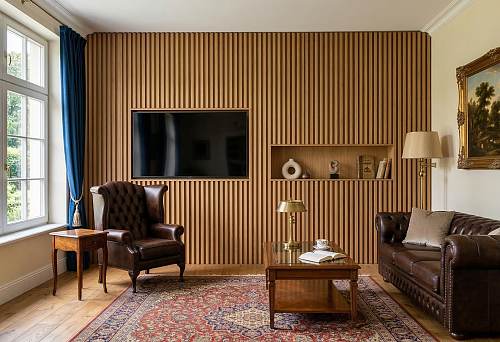
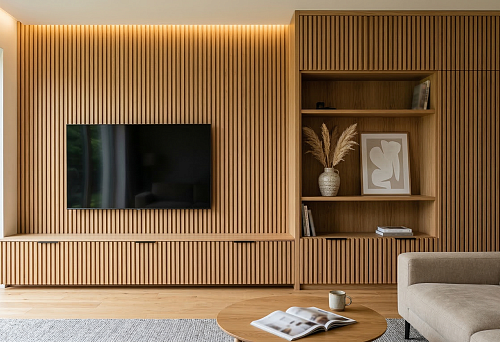
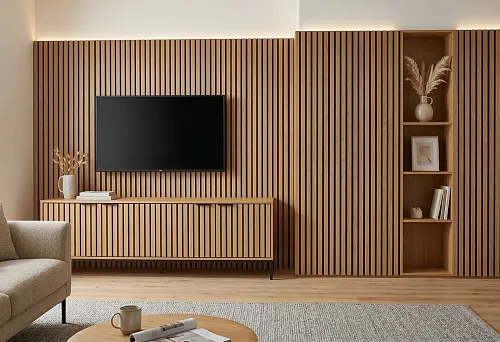
Horizontal battens are often used on an accent wall—for example, behind the sofa in the living room, behind the bed in the bedroom, in the TV area. The battens are mounted directly on the wall with a specific spacing—from 5 to 20 cm depending on the desired effect. There can be a contrasting background between the battens: dark paint with light battens, dark battens with a light background.
This technique creates volume, texture, and depth. A flat wall turns into an architectural element. Light falling at an angle creates a play of shadows between the battens, enhancing the three-dimensionality.
Curvilinear batten structures
For advanced users—curvilinear partitions made from bent battens. They require special manufacturing technologies but create an incredible effect. A smooth wave of vertical battens curving around the space. Or a spiral structure rising from floor to ceiling. Such solutions turn functional zoning into an art object.
Curvilinear forms visually soften the space, add dynamism, and create a sense of movement. They work excellently in modern interiors, where non-standard, artistic approaches and moving away from right angles are valued.
Painting and finishing of battens
The final finish of the battens determines their visual impact. Natural wood under oil or varnish—warm, natural, Scandinavian or eco-direction. Painting white—freshness, cleanliness, minimalism. Painting black or dark gray—graphic quality, modernity, contrast. Toning in walnut, wenge—classic, solidity, tradition.
You can combine: some battens one color, others another. Or one side of the batten one color, the other side another (if viewed from different sides, the partition looks different). Such color play adds complexity and multi-layered perception.
Integrated lighting is another level. An LED strip installed behind the battens or between them creates light lines, emphasizes the structure, and turns the partition not just into decor but into a light object. In the evening, when the main lighting is dimmed, illuminated battens create an intimate, cozy atmosphere.
Lower perimeter: choosing a baseboard as the foundation of visual stability in an interior
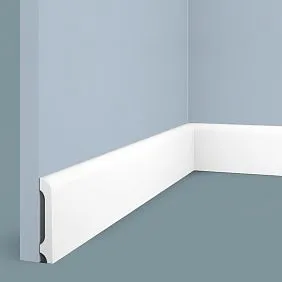
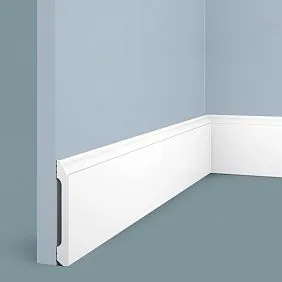
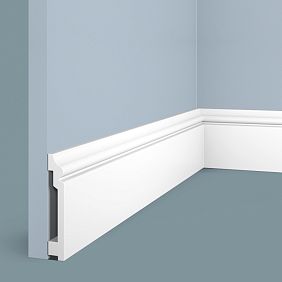
Baseboard—an element that many perceive as a technical necessity. After all, something needs to cover the joint between the wall and floor, hide unevenness, protect the lower part of the wall from cleaning. All correct, but that's only part of the truth.wooden baseboard—is the foundation of the visual composition of an interior. It is the baseline from which the walls grow. It is the frame that borders the floor. It is an element that can either enhance or destroy the integrity of the space.
Architectural role of baseboard
Architects and designers know: the higher the baseboard, the more solid, foundational the interior looks. A low baseboard of 30-50 mm—minimalism, lightness, modernity. A medium baseboard of 80-100 mm—balance, versatility, moderate classicism. A high baseboard of 120-180 mm—tradition, aristocracy, monumentality.
The baseboard creates a visual plinth for the wall. It makes the transition from the horizontal floor to the vertical wall not abrupt but smooth, logical. Without a baseboard, the wall seems detached from the floor, hanging. With a baseboard, the wall gains a foundation, becomes stable, reliable.
The color of the baseboard is critically important. A baseboard matching the floor color visually expands the floor area, makes the room more squat, stable. A baseboard matching the wall color visually elongates the walls, makes the room taller. A contrasting baseboard (dark with light walls and floor, or light with dark) creates a graphic accent, clearly marking boundaries.
Material and profile of the baseboard
Wooden baseboard made from solid wood—a premium choice. Oak, beech, ash—species that last for decades without losing their appearance. A wooden baseboard can be renewed multiple times—sanded, repainted, restored. It is durable, eco-friendly, and pleasant to the touch.
MDF skirting board is an alternative for those who want the aesthetics of wood on a smaller budget. Quality E1 class MDF is geometrically stable, holds paint well, and is durable. Primed MDF skirting board for painting allows you to choose any color that perfectly matches the interior.
The profile of a skirting board is its face. A simple rectangular profile means minimalism, Scandinavian style, modern. A profile with a slight rounding at the top is universal, suitable for most interiors. A complex classical profile with protrusions and recesses means tradition, classic, empire style.
The height of the skirting board should relate to the ceiling height and the scale of the room. In an apartment with 2.6 m ceilings, a 150 mm skirting board will look inappropriately massive. The optimum is 60-80 mm. In a house with 3-3.5 m ceilings, a 60 mm skirting board will get lost. Here you need a 100-150 mm skirting board, proportionate to the volume.
Skirting board installation and fastening
Installationwooden baseboardrequires care. Walls must be even. If there are significant irregularities, the skirting board does not fit snugly, gaps form. Before installation, walls are leveled, and if necessary, the lower part is filled with putty.
Skirting board is fastened with adhesive or mechanically. Adhesive fastening provides invisible fixation but requires perfectly even walls. Mechanical fastening (screws, dowel-nails) is more reliable but leaves fastener marks that need to be filled with putty.
A modern solution is a clip system. Plastic or metal clips are attached to the wall, and the mating part is attached to the skirting board. The skirting board snaps onto the clips. This is convenient: the skirting board can be removed if necessary (for example, to replace wiring laid in the skirting board's cable channel) and reinstalled.
Skirting board corners are a critical point. Internal corners are cut at a forty-five-degree angle on each side and joined. External corners (on wall protrusions, columns) are cut similarly. Cutting accuracy is critical: even a millimeter gap is noticeable.
Joints of straight sections of skirting board are also cut at an angle, not butt-to-butt. This gives a neater connection, less noticeable to the eye. Joints can be additionally glued with wood glue for strength.
Cable channel in skirting board
Modern high skirting boards often have a built-in cable channel - a cavity on the back side where wires can be laid. This is incredibly convenient: there is no need to chase walls, hide wires in corrugated tubing, or figure out how to run a cable to an outlet on the other side of the room. Everything is hidden in the skirting board. The cable channel is covered from above with a removable strip (usually snapping), maintaining access to the wires.
For laying a large number of cables (network, telephone, internet, audio), special skirting boards with a wide cable channel - up to 50-60 mm deep - are produced. A bundle of wires will fit there. At the same time, the skirting board looks normal from the outside, with no hint of technical internals.
A special case: features of finishing joints in a country house
Wall finishing in a house, especially a country, wooden, frame, or timber house, has specifics that cannot be ignored. Houses "breathe" - wood expands and contracts depending on humidity and temperature. Frame houses settle. Timber houses "move" in the first years of operation. All this creates dynamic loads on the finish, and joints are the first place where problems appear.
"Breathing" of wooden walls
Wooden walls made of timber or logs change size throughout the year. In winter, when heating is on and the air is dry, wood dries out, walls become slightly lower. In summer, especially humid, wood absorbs moisture, swells, walls rise. The amplitude of these fluctuations can reach several millimeters per meter of height. For a wall 3 meters high, that's a centimeter or more.
If the finish is done rigidly, without considering these movements - it gets destroyed. Skirting boards come off, corner pieces crack, joints separate. Therefore, in wooden houses, special techniques are used:
Floating installation of skirting boards. The skirting board is attached to the floor (if the floor is wooden, fixed) or to the bottom wall framing, but not to the walls themselves. Or elastic fastenings are used, which allow the skirting board to move with the wall but not come off.
Sliding fastenings for corner pieces. Corner pieces protecting external wall corners are fastened using longitudinal grooves, allowing the element to shift when the wall moves. Or elastic adhesive is used, which compensates for deformations.
Compensation gaps. Gaps of 5-10 mm are left between fixed elements (door frames, window frames) and moving walls, which are covered with elastic trim. The trim is attached either to the frame (but not to the wall) or to the wall (but not to the frame), compensating for movement.
Settlement of frame houses
Frame houses also settle, although less than timber houses. The main settlement occurs in the first 6-12 months after construction. During this period, it is not recommended to perform final finishing with rigid fixation of elements. It is better to wait for the end of active settlement.
If finishing is done immediately, sliding fastenings, elastic materials (sealants instead of rigid putties in joints), height allowance (for example, when installing door frames, a gap is left at the top, temporarily closed with removable trim) are used.
Temperature deformations
In country houses, especially those not permanently occupied (dachas), temperature fluctuations between heated and unheated periods can be huge - from minus 20 in winter to plus 25-30 in summer. That's a 50-degree difference. Materials with different coefficients of thermal expansion deform differently.
Therefore in
Therefore in finishing of private housesthe advantage lies with natural materials - wood, working in harmony with the wooden structure of the building.
Protection from moisture
In country houses, humidity is often higher than in city apartments with central heating. Especially in houses near bodies of water, in forested areas. Wood in humid conditions can be affected by mold, fungus, blue stain.
All wooden finishing elements in a country house must be treated with protective compounds - antiseptics, fire retardants (if there are fire safety requirements), water-repellent impregnations. Final finish - oil, varnish, paint - also creates a protective barrier.
Baseboards that come into contact with the floor where condensation can accumulate (especially near entrance doors where snow is tracked in) require particularly thorough protection. Sometimes larch or oak baseboards are used—species that are naturally moisture-resistant.
Details that define the style
Choosing the profile, size, and color of millwork elements—corners, battens, baseboards—is not a technical task. It is a design decision that defines the interior style.
Classic interior
In classic style, baseboards are tall—100-150 mm, with a complex profile: protrusions, recesses, roundings. Color—either matching the walls (white, cream) or a contrasting dark color (matching doors and furniture). Material—solid wood of noble species or high-quality MDF with a final enamel finish.
Corners in a classic interior are also profiled, with decorative chamfers. They not only protect corners but also decorate them, adding detail. Corners are often combined withmoldings, creating framed compositions on the walls.
Battens are rarely used in classic style, but if they are—they are used in the form of wainscoting, panel systems where battens (trims) form frames around panels.
Modern style
In modern interiors, baseboards are laconic—simple rectangular profile, often with concealed installation, where the baseboard is recessed into the wall and creates a shadow gap. Height is small—40-70 mm. Color either matches the walls (visually making walls appear taller) or is a contrasting graphic color.
Corners in modern style are minimalist—thin, with sharp edges, often metal (anodized aluminum) or wooden with a square cross-section. They perform a protective function but do not dominate visually.
Battens—the star of modern style. Vertical batten partitions, horizontal batten panels on walls, volumetric batten ceilings—all are actively used. Battens are thin—20-40 mm, with clear geometry, painted in monochrome or with the natural texture of light wood.
Scandinavian style
Scandinavia—light wood, simple shapes, functionality. Baseboards of medium height—60-80 mm, simple profile, made of light species (pine, birch, ash), coated with oil or white paint. Corners are thin, delicate, often absent altogether—Scandinavians value minimalism.
Battens—natural wood in light tones, vertical or horizontal placement, creating rhythm and structure. Scandinavian interiors love air and light, battens support this lightness, dividing space without overloading it.
Loft and industrial style
In loft style, baseboards may be completely absent or be maximally utilitarian—a simple square-section block, unpainted or coated with dark stain. Or, conversely, deliberately massive baseboards made of roughly processed wood, emphasizing industrial aesthetics.
Corners—metal, welded, with visible fasteners. Or wooden, but rough, with preserved traces of processing, knots, uneven toning.
Battens in loft style—often not decoration, but structure: beams, posts, frame elements, deliberately left exposed. They create the industrial character of the space, emphasizing its utilitarian origin.
Frequently asked questions
Why are wooden corners needed if corners can simply be painted?
Painting corners does not protect them from mechanical damage. The first impact—and the plaster chips. A wooden corner takes the impact itself, preserving the integrity of the finish. Additionally, a corner creates a clear geometric line, emphasizes architecture, adds completeness.
Which wood is better for baseboards—oak or pine?
Oak is stronger, more durable, has an expressive texture, but is more expensive. Pine is more affordable, easier to process, but softer, easier to scratch. For living rooms with moderate load, pine is suitable. For high-traffic areas, hallways, commercial spaces, oak or beech is better. A compromise—birch: stronger than pine, cheaper than oak.
Can battens be used for zoning in a small apartment?
Yes, and it's recommended. A batten partition does not physically consume space (construction thickness 5-10 cm), but divides it visually. In a studio or one-room apartment, battens can separate the sleeping area from the living room, creating intimacy without the heaviness of a solid wall. The main thing—choose the correct batten spacing: in a small space, larger spacing (10-15 cm) is better to maintain airiness.
How to choose the color of a baseboard—matching the floor or walls?
There is no universal rule. A baseboard matching the floor visually expands the floor, makes the room more squat, stable. Good for low ceilings. A baseboard matching the walls visually elongates the walls, makes the ceiling appear higher. Good for low rooms. A contrasting baseboard creates an accent, works as a graphic frame. The choice depends on the room's proportions and the desired effect.
Do wooden elements need to be treated with protective compounds before installation?
Yes, especially in country houses and rooms with high humidity. Antiseptics protect against fungus, mold, wood-boring insects. Water-repellent impregnations prevent swelling and deformation. Treatment is performed before installation when all surfaces of the element are accessible, including the back. After installation, it will not be possible to treat it completely.
What height should the skirting board be in a standard apartment?
For apartments with ceilings 2.5-2.7 m, the optimal baseboard height is 60-80 mm. This is proportional to the room, functionally sufficient (protects walls, hides joints, can accommodate cable channels), aesthetically harmonious. Baseboards taller than 100 mm in a standard apartment look bulky, unless it is part of a special design concept (e.g., classic style with a high plinth).
Can wooden elements be installed in a bathroom?
With caveats. In areas of direct contact with water (shower cabin, near the bathtub), wood is not recommended. But in the dry area of the bathroom (near the entrance door, under the ceiling), wooden decor is quite appropriate. Use moisture-resistant species (larch, oak), treat with moisture-protective compounds, coat with waterproof varnish or oil. Ensure good ventilation so the wood is not constantly in a humid environment.
How much does it cost to finish a room with millwork elements?
The cost consists of material price and labor. Solid oak baseboard—from 800 to 2500 rubles per linear meter depending on profile and height. MDF baseboard—150-500 rubles. Wooden battens—100-500 rubles per linear meter depending on cross-section and species. Corners—200-800 rubles per linear meter. Installation work—approximately equal to the cost of materials. So for a 20 sq.m room, the budget for baseboards with installation is 15,000-50,000 rubles depending on the choice.
Precision of details as a sign of professional design
What distinguishes a professional designer from an amateur is precisely attention to detail. An amateur thinks about big things: wall color, furniture style, layout. A professional sees the whole but builds it through details: joints, transitions, trims, finishes.
A neat joint is respect for the material, for the space, for the people who will live here. It's a demonstration of skill: I can work precisely, I bring things to perfection, I don't settle for 'good enough.' It's value creation: an interior executed at this level is expensive not because the materials are costly (though that too), but because immense labor, attention, and expertise are invested.
Wooden trim— corner pieces, battens, baseboards — are tools for creating this neatness. They structure space, protect vulnerable areas, create transitions, frame surfaces. Without them, an interior remains unfinished, like a painting without a frame, like a book without a binding.
Choosing quality materials is the first step. Proper installation is the second. Finishing is the third. Each stage is important; skipping any reduces the result.
For over twenty years, STAVROS has been creating elements that complete interiors.Wooden corner piecesmade of solid oak and beech, protecting corners and adorning walls.railsof various cross-sections for zoning and accentuation.floor skirting boardswith a wide range of profiles and sizes. All made from select wood, with precise geometry and professional processing.
In-house production on modern equipment ensures consistent quality. Chamber drying of wood to 8-10% moisture guarantees no deformation. Multi-stage quality control eliminates defects. A wide assortment allows selecting elements for any style — from classic to modern, from Scandinavian to loft.
STAVROS works both with professionals — designers, architects, construction companies — and with private clients doing renovations themselves or with hired craftsmen. Company consultants will help select elements for your project, calculate quantities, and provide installation recommendations. The logistics service ensures delivery to any region in Russia and the CIS. Service support continues even after purchase — if questions arise, STAVROS specialists are always available.
By choosing STAVROS, you choose quality tested by time. You choose materials that will last for decades without losing their appearance. You choose a partner who understands the importance of details and helps bring your interior to perfection.
Because perfect spatial geometry is created not by grand gestures, but by the mastery of finishing. A corner piece protecting a corner. A batten dividing space. A baseboard finishing a wall. Three elements that turn renovation into an interior. Three details that say: professionals worked here. Beauty is respected here. Quality is valued here.