Article Contents:
- Staircase as Exhibition Space: The Philosophy of Approach
- Why the Staircase is the Ideal Place for Decoration
- From Emptiness to Substance: The Concept of Transformation
- Gallery Styling: From Classic to Modern
- Polyurethane Panels and Appliqués: Elements of Composition
- Types of Decorative Elements
- Material and Its Advantages for Staircase Zones
- Choosing the Scale of Elements
- Creating Composition: From Sketch to Installation
- Planning and Visualization
- Symmetry or Asymmetry
- Vertical Zoning
- Rhythm and Repetition
- Selecting Ornament to Match Baluster Profile
- Principle of Visual Affinity
- Scale Correspondence
- Color Coordination
- Stylistic Families
- Lighting for Staircase Gallery
- Role of Light in Perceiving Relief
- Wall Sconces: Placement and Types
- Integrating Lighting into Decoration
- Accent Lighting
- Color Temperature of Light
- Practical Cases: Before and After
- Case 1: Classic Hall – From Emptiness to Luxury
- Case 2: Modern Apartment – From Boredom to Graphic Design
- Case 3: Country House – From Provincialism to Elegance
- Installing Polyurethane Decor: Technology
- Surface Preparation
- Marking and Fitting
- Adhesive and Application Technique
- Element joints
- Final finishing
- Care for polyurethane decor
- Regular Cleaning
- Protection against damage
- Recoating
- Repairability and replacement of elements
- Project economics: budgeting
- Material Costs
- Cost of work
- Cost vs quality
- Inspiration and Ideas
- Thematic galleries
- Integration with photos and paintings
- Seasonal and festive accents
- Conclusion

You pass by the staircase every day — up in the morning, down in the evening. How many times a year? Thousands. And each time you see before you... an empty wall. White, indifferent, boring. But the staircase is not just a functional structure. It is a vertical gallery, a space with great potential that can be transformed into a real exhibition. A place where architecture meets art, wherepolyurethane wall decorcreates volume, depth, character.
Imagine: as you ascend the steps, a composition unfolds around you — relief panels, elegant appliqués, framed zones. Light from wall sconces glides over the relief, creating a play of shadows.Wooden balustersThey harmonize with the ornaments on the wall — one rhythm, one style, a unified picture. This is no longer just a staircase. It is a journey, movement through a thoughtfully designed space, where every detail contributes to the overall impression.
How to achieve such an effect? Which elements to use? How to choose a decor pattern to match the baluster profile? Where to place the lights? And most importantly — how will it look before and after? Let’s walk through the entire transformation path of the staircase landing from an empty wall to a gallery.




Staircase as exhibition space: approach philosophy




Why the staircase is an ideal place for decor
The staircase landing possesses unique characteristics that make it an ideal canvas for decorative solutions. First, this space is always visible, yet not used for placing furniture or appliances. The wall alongside the staircase is free — and this is rare in modern homes, where every square meter is occupied.
Second, the staircase sets movement. People do not stand still — they ascend or descend, their gaze glides along the wall, perceiving decor dynamically. This allows creating compositions that unfold gradually, layer by layer, like pages of a book. On the first level — one set of elements, higher up — others, on the landing — the climax.
Third, the staircase landing often has a large height — 3–4 meters and more. This allows working with verticality, creating large-scale compositions that are impossible in a room with 2.7-meter ceilings. A high wall requires appropriate treatment — otherwise, it presses with emptiness.
Our factory also produces:


From emptiness to content: transformation concept
Typical 'before' picture: a smooth painted wall alongside the staircase, possibly with a single painting or photograph. Minimal attention, maximum missed opportunities. The space does not work, does not create an impression, does not stick in memory.
‘After’ picture: a structured wall with reliefpolyurethane wall decor, where each element is in its place. Panels form a rhythm, moldings create frames, appliqués add accents. Lighting highlights the relief. The staircase balusters are visually connected with the wall decor. The result is a unified composition that transforms a utilitarian space into a work of art.
The key principle of transformation — not simply hanging decorative elements on the wall, but creating a thoughtfully designed system where everything is interconnected: the decor shape with the baluster profile, the element scale with the room height, the accent placement with the staircase movement trajectory.
Get Consultation
Gallery style: from classic to modern
A staircase gallery can be executed in various styles, each offering its own solutions. A classical gallery uses symmetrical compositions, botanical ornaments, gilded frames. Here, relief rosettes, cartouches with monograms, moldings with complex profiles are appropriate.
Neoclassical gallery is more restrained: geometric panels framed by simple moldings, minimalist appliqués with classical motifs, black-and-white palette. Elegance without excess.
A modern gallery plays with form and light: abstract volumetric panels, asymmetrical compositions, minimalist frames. HereMoldings made of polyurethanethey become graphic lines, creating geometry on the wall.
Art Deco gallery combines luxury and geometry: fan shapes, zigzags, trapezoids, combination of relief with mirrored inserts, contrasting colors (black, gold, white).
Polyurethane panels and appliqués: elements of composition
Types of decorative elements
polyurethane wall decorincludes several categories of items, each serving its own function in the composition.
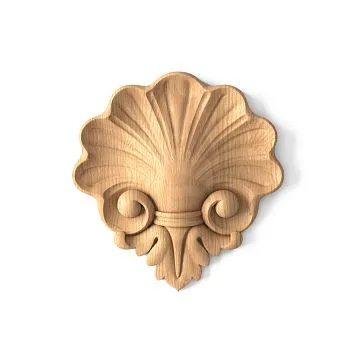
Appliqués are three-dimensional decorative elements of various shapes: rosettes, cartouches, corner elements, plant motifs. Their sizes vary from small (15-20 cm) to large (50-80 cm). Appliqués are used as accent points — where attention needs to be drawn, creating a focal point.
Panels are rectangular or square panels with relief imagery. These can be classical ornaments, geometric patterns, plant compositions, abstract forms. Panel sizes are usually substantial — from 40x60 cm to 100x150 cm. They become central elements of the composition, around which everything else is arranged.
Moldings are strips of various widths and profiles, creating frames, borders, dividers. With their help, wall panels are formed, zones are highlighted, architectural structure is created. Moldings are the skeleton of the composition, its structural base.
Corner elements are special details for finishing intersections of moldings, corners of panels. They complete the composition, make joints elegant, add detail.
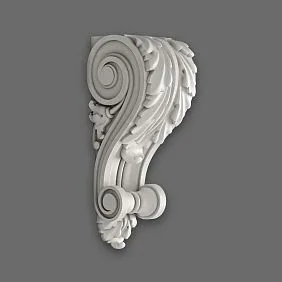
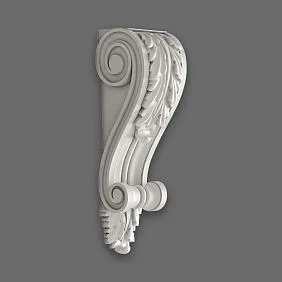
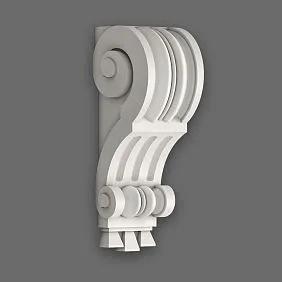
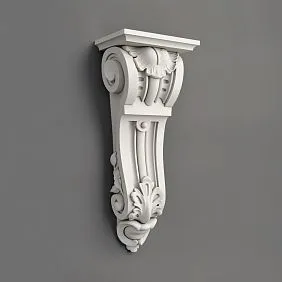
Brackets and consoles are three-dimensional elements that can protrude from the wall, creating additional relief. They are sometimes used as bases for placing small decorative objects, candles, vases.
Material and its advantages for stairwell zones
Polyurethane is the optimal material for decorating stairwell walls for several reasons. It is lightweight (5-8 times lighter than plaster), which is critical when mounting on a vertical surface of great height. Heavy plaster elements on a 4-meter-high wall create a risk of detachment, requiring complex mounting.
Polyurethane is impact-resistant — unlike fragile plaster, which can crack from a random blow (relevant on stairs, where furniture is carried or large items are moved). Minor damage to polyurethane can be restored with putty and paint.
The material is not afraid of humidity and temperature fluctuations. In stairwell areas, especially leading to entrance doors, temperature differences and drafts are common. Plaster in such conditions may crack or crumble. Polyurethane remains stable.
Polyurethane decor is easily painted in any color with acrylic paints. It is possible to create effects of patina, gilding, aged wood, metal. It can be repainted multiple times, changing the style of the space without dismantling the elements.
Selection of element scale
The size of decorative elements should correspond to the scale of the staircase and the height of the wall. In a compact stairwell with a wall height of 2.5-3 meters, large panels of 100x150 cm would overwhelm and occupy all space. Here, medium-sized panels of 40x60 cm or compositions of several small appliqués are appropriate.
In a tall, spacious hall with a staircase, where the wall height is 4-5 meters, small elements will be lost and not readable from below. Large forms are needed — panels of 80x100 cm, wide moldings (15-20 cm), large rosettes with a diameter of 60-80 cm.
Rule: when viewed from below upward, a decorative element should visually occupy approximately 1/5–1/4 of the wall height. If the panel occupies less, it will be lost. If it occupies more, it creates overloading.
It is also important to consider the relationship between decoration and the size of the staircase steps. If the staircase is wide (120–150 cm), the decoration on the wall should be proportionally large. A narrow staircase (80–90 cm) requires more delicate decoration.
Creating a composition: from sketch to installation
Planning and visualization
Before beginning work, create a sketch of the future composition. Measure the wall along the staircase: height at different sections (at the bottom of the flight, in the middle, at the top, on the landing), length. Photograph the wall in its current state from several angles.
Based on photographs or measurements, create a layout for placing elements. You can use a graphic editor or draw by hand on a printed photo. Place on the layout the proposed panels, appliqués, moldings. Check symmetry (if the concept is symmetrical), rhythm of repeating elements, balance between filled and empty areas.
Important point: consider the line of sight. When a person ascends the staircase, they view the wall at a certain angle. The central element of the composition should be visible from the middle of the flight — this is the key viewing point. When descending, the upper part of the wall is visible — there should also be visual interest.
Symmetry or asymmetry
The classical approach implies symmetry. The central axis (usually passing through the middle of the staircase) becomes the axis of symmetry. Identical elements are placed on both sides — mirrored reflection. This creates order, harmony, grandeur.
The modern approach allows for asymmetry. Elements are placed freely, but with visual balance — if a large panel is on the left, several small appliqués on the right can balance it by mass. Asymmetry creates dynamism, modernity, surprise.
Mixed approach: the overall structure is symmetrical (moldings form identical frames on both sides), but within the frames, elements are arranged asymmetrically. This is a compromise, providing both order and liveliness.
Vertical zoning
A high wall along the staircase logically divides into vertical zones. The lower zone (from floor to 120–150 cm height) is the level of direct contact, where decoration is visible up close. Here, detailed elements with fine relief are appropriate, interesting to observe up close.
The middle zone (150–250 cm) is the main one, where the main compositional elements are placed. Large panels, accent appliqués, central rosettes — all of this is here. This zone is visible both when ascending and descending, and from the landing.
Upper zone (from 250 cm to ceiling/second-floor platform) - finishing. Here you can place frieze elements, cornices, light ornamental appliqués. They are visible from afar, so they must be sufficiently large and contrasting to be readable.
Rhythm and Repetition
Composition becomes harmonious when it has rhythm - repetition of elements at a certain interval. For example: moldings create identical rectangular frames along the entire stair run (three to four frames), each containing a panel of the same size but with different ornamentation. Repetition of frames creates rhythm, variation of ornamentation - diversity.
Or: along the stair run, at equal intervals (every 80-100 cm vertically), identical rosettes are placed. They form a vertical chain directing the gaze upward. This is a simple but effective technique.
Rhythm can be regular (equal intervals) or progressive (intervals increase or decrease as you ascend). Progression creates acceleration or deceleration of movement - an interesting psychological effect.
Ornament selection according to baluster profile
Principle of visual affinity
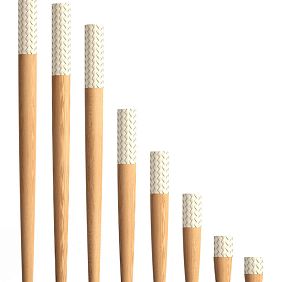
Wooden balustersStairs have a certain shape, profile, stylistic character. Wall decoration must match them, creating visual affinity. This does not mean copying - it is sufficient to have a general character, correspondences in details.
If balusters are classical, turned, with moldings and balusters - wall appliqués should have curved forms, rounded shapes. Rosettes with concentric circles, cartouches with volutes, vegetal ornaments with scrolls - all of these correspond to the turned forms of balusters.
If balusters are modern, square in cross-section, with beveled edges - wall decoration should be geometric. Rectangular panels with abstract patterns, moldings with simple profiles, angular appliqués - this will create stylistic unity.
If balusters are carved with vegetal motifs (leaves, grapevines, flowers) - wall panels and appliqués with the same motifs are suitable. Exact correspondence is not necessary, but the general theme should be consistent: if balusters have oak leaves, wall decorations may feature laurel wreaths or acanthus scrolls - all belonging to the vegetal family.
Scale correspondence
The thickness of balusters (diameter of turned or cross-section of square) sets the scale of vertical elements in space. The width of wall moldings should correspond to this scale. If balusters are 8-10 cm in diameter, moldings 10-15 cm - proportionally. If balusters are thin, 5-6 cm, moldings should also be elegant, 6-8 cm.
Appliqué size is chosen so that they are proportional to the height of balusters (usually 80-90 cm). An appliqué with diameter or height of 30-50 cm against the vertical balusters looks naturally - this is approximately 1/2 or 1/3 of height, creating a harmonious proportion.
Color correspondences
If balusters are made of natural wood and have a pronounced texture (oak, ash), wall polyurethane decoration is usually painted in neutral colors - white, beige, light gray. This creates contrast: warm wooden balusters against a cool light wall background with white decoration.
If balusters are painted (e.g., white), wall decoration may be the same white color - creating a monochromatic composition where all architectural elements (balusters, handrail, wall decoration) merge into a single whole. Or decoration may be contrasting - gold, silver, dark - then it becomes an active accent.
Interesting technique: if balusters have decorative elements of a certain color (e.g., gilded capitals of columns), the same gilding is applied to individual elements of wall decoration - creating a color rhyme that links the staircase and the wall.
Stylistic families
Classic family: turned balusters with balusters + wall rosettes with acanthus leaves + moldings with complex profiles (flutes, beads, Ionic) + panels with symmetrical vegetal ornaments.
Neoclassical family: simplified-profile turned balusters + minimalist rosettes with geometric rays + moldings of medium complexity + panels with bas-relief classical motifs (meander, palmettes).
Modern family: square balusters with beveled edges + rectangular panels with abstract reliefs + simple flat moldings + minimalist geometric-form appliqués.
Art Deco family: balusters with trapezoidal or fan-shaped elements + appliqués with zigzag ornaments + moldings with stepped profiles + panels with symmetrical geometric compositions.
Lighting of the staircase gallery
Role of light in perceiving relief
Relief decoration exists due to light and shadow. Without proper lighting, even the most beautiful panels and appliqués appear flat, losing their volume. Light should fall at an angle so that protruding parts cast shadows onto recesses - this creates a play of forms, making the relief expressive.
Frontal flat lighting (when the light source is directed perpendicularly onto the wall) kills the relief - everything becomes evenly lit, shadows disappear. Side or diagonal lighting (light falls at 30-60 degree angles) - optimal for emphasizing volume.
Light coming from top to bottom creates dramatic shadows, emphasizing upper edges of relief. Light coming from bottom to top (contre-jour) provides soft glow, highlights contours, creating a romantic atmosphere. Combined lighting (from top, bottom, and sides) ensures full exposure of all decorative details at different times of day and under various scenarios.
Wall sconces: placement and types
Classic solution for staircase lighting - wall sconces along the stair run. They are placed at intervals of 1.5-2 meters vertically, creating a chain of light. Installation height - usually 160-180 cm from the step (at eye level or slightly above).
Types of sconces for stairs:
Classic - with horns, candle-like imitations, fabric or glass shades. They emit soft, diffused light, creating a cozy atmosphere. Suitable for interiors in classic, neoclassical, and Provencal styles.
Modern - minimalist geometric shades, metallic or glass. Emit directional or diffused light (depending on construction). Suitable for modern, Scandinavian, and loft interiors.
Rotatable spotlights - fixtures with adjustable beam direction. Allow precise targeting of light onto decorative elements, backlighting panels or appliqués. Highly functional, but require thoughtful placement to avoid looking overly technical in a residential interior.
Decorative wall sconces - fixtures that are themselves works of art. Ornamental brackets, artistic glass, unusual shapes. They not only illuminate but also decorate. Suitable for eclectic and bohemian interiors.
Integration of lighting into decor
Modern approach - built-in fixtures integrated into polyurethane decor. For example, molding with a special profile that includes a groove for LED strips. Light emanates from the molding, illuminating the wall above or below. Or a socket with a recess in the center, where a spot light is embedded - it becomes not only a decorative element but also a light source.
Such integration creates the effect of floating, glowing forms. Especially striking at night, when main lighting is off and only decorative backlighting is active. The staircase transforms into a mystical space where reliefs emerge from half-darkness.
For installing LED backlighting into moldings, narrow LED strips (6-8 mm wide) with a power adapter are used. The strip is glued into the molding groove, wires are concealed behind decor or within the wall. Control is via a standard switch or dimmer for brightness adjustment.
Accent lighting
If there is a particularly significant element in the composition - a large panel, an eye-catching appliqué, a group of several sockets - it can be highlighted with accent lighting. This is a separate light fixture (spot, directional spotlight, hidden backlighting) that illuminates only this element.
Accent lighting creates hierarchy: the main element is brightly illuminated and draws attention, secondary elements are softly lit, and the background remains in half-shadow. This theatrical technique transforms the staircase into a stage, where decor is the actor and light is the director.
It is important not to overdo accents. One or two brightly lit elements along the entire flight are sufficient. More than that, and attention becomes scattered, losing focus.
Color temperature of light
For classic interiors with wooden balusters and traditional decor, warm light (2700-3000K) is suitable. It highlights the warmth of wood, creates a cozy, homey atmosphere, and makes golden and beige tones of decor more saturated.
For modern interiors, neutral white light (4000K) is appropriate. It provides clarity and graphic contrast, emphasizing the purity of white surfaces and the contrast of black-and-white compositions.
Cold light (5000K and above) is rarely used, mainly in ultra-modern high-tech interiors with metallic and glass surfaces. For staircases with wooden elements and polyurethane decor, it is too harsh, making the space feel cold and unwelcoming.
Practical cases: before and after
Case 1: Classic hall - from emptiness to luxury
Initial situation (BEFORE): Two-story house, hall with a grand staircase. Staircase width 140 cm, wall height along the staircase 4.2 m. Wall painted beige, completely smooth, without decor. Balusters are oak, turned, classic profile, dark stain. Handrail is solid. Two wall sconces hang on the wall, emitting dim light. Overall impression: an expensive staircase in an empty space, incompleteness, lack of connection between elements.
Transformation concept: Create a classic gallery with symmetrical composition, usingpolyurethane wall decorin the Empire style. Introduce plant motifs (acanthus, laurel) that echo the classic forms of the balusters.
Implementation (AFTER): A system of four large rectangular panels (80x120 cm each), framed by wide profiled moldings (15 cm wide), is installed on the wall. Panels are arranged vertically along the staircase with 90 cm spacing. Inside each panel - a large panel with relief: laurel wreath, acanthus scrolls, symmetrical plant composition.
Decorative appliqués-sockets with 40 cm diameter, concentric circles and acanthus leaves, are placed between panels. Corner elements with volutes are installed at panel corners. The entire composition is painted white (matte acrylic paint), raised relief parts are highlighted with gold patina.
Lighting is enhanced: two additional wall sconces (now four on the staircase) are added, rotatable spotlights are installed under the ceiling, directed at the upper panels. The central panel (at the landing level) is illuminated by a separate hidden light fixture from above.
Result: The empty wall has transformed into a luxurious gallery. The white relief decor contrasts with the beige wall and dark oak balusters, creating a classic triad of colors. The gold patina adds richness without veering into kitsch. Lighting highlights every detail of the relief. As you ascend the staircase, you see the change of panels - each with its own narrative, yet all unified in style. The staircase has become the centerpiece of the interior, a grand element making an impression.
Case 2: Modern apartment - from boredom to graphic design
Initial situation (BEFORE): Two-level apartment in minimalist style. Staircase with metal frame, steps made of whitewashed oak, glass railing. Wall along the staircase is white, smooth, 3.5 m high. Lighting - built-in ceiling fixtures. Space is functional but sterile, cold, lacking character.
Add graphic elements and texture using geometricPolyurethane wall decorwhile preserving minimalism. Asymmetrical composition, black-and-white palette, emphasis on form rather than ornament.
Implementation (AFTER): Six square panels (50x50 cm) with abstract geometric relief - concentric squares creating an optical illusion of depth - are mounted on the wall. Panels are arranged asymmetrically: three at the bottom of the staircase (forming a triangle), three at the top (scattered freely), with empty space between them, providing visual breathing room.
The panels are framed by thin flat moldings (width 6 cm) that do not protrude but create a shadow outline. The entire composition is painted white, like a wall, but the moldings are matte black. This creates black graphics on a white background.
Three narrow vertical moldings (width 4 cm, height from floor to ceiling) are placed between the panels, running parallel to each other with a 40 cm interval. They create a vertical rhythm, directing the gaze upward and visually increasing the height of the space.
Lighting is supplemented: LED backlighting is installed inside the panels (behind the relief), creating soft illumination that highlights the geometry of forms at night. The backlighting is controlled by a dimmer, allowing adjustment of intensity.
Result: The sterile white wall has acquired character. Black molding lines create clear graphics, structuring the space. Relief panels add texture and tactility. Asymmetry makes the composition dynamic and modern. Backlighting transforms decor into an art object at night. The staircase, from a functional element, became an artistic statement, demonstrating taste and sense of style.
Case 3: Country House — from provincialism to elegance
Initial Situation (BEFORE): Country house in undefined style. Wooden staircase (pine), simple square balusters, painted white enamel. Wall along the staircase covered with small floral wallpaper (attempt to create coziness, but result — provincialism). Wall height 3 m. Lighting — single chandelier above and floor lamp below. Impression: attempt to make it "beautiful" without understanding style, disjointed elements.
Transformation Concept: Bring to a unified neoclassical style, usingMoldings made of polyurethaneto create panels that will enhance the wall and conceal the unsuccessful wallpaper. Light, elegant, restrained composition.
Implementation (AFTER): Wallpaper partially preserved (full house re-covering not within budget), but a panel system using moldings was mounted on it. The wall is divided into three large rectangular panels (each 100x180 cm), framed by medium-width (10 cm) classic-profile moldings.
Panels are arranged vertically along the staircase. Inside each panel — wallpaper, but now perceived as fill within a frame, not as a dominant element. The moldings themselves are painted white, creating contrast with the colored wallpaper.
A decorative rose center (diameter 30 cm) with neoclassical ornament (palmettes, rays) is added to the center of each panel. The rose centers are also white. At the corners of the panels — small corner inserts.
Small neoclassical-style wall sconces are installed at the top and bottom of each panel (at molding level) — six fixtures total for three panels. They provide soft diffused light, highlighting the relief of moldings and rose centers.
Result: Provincial floral wallpaper, enclosed in strict white frames, unexpectedly appeared as silk panels in a classical interior. Moldings structured the chaos, established order. White balusters are now visually connected with the white panel frames — unity. Lighting became even, each panel illuminated. The staircase acquired elegance and style, without requiring major renovation or large expenses.
Installation of polyurethane decor: technology
Surface preparation
The wall must be flat, clean, dry, and primed. Irregularities exceeding 3–5 mm must be removed — spackled and sanded. Polyurethane elements are flexible and can accommodate minor irregularities, but large distortions will be noticeable — molding will run in waves, panels won’t adhere tightly.
Surface is cleaned of dust, dirt, grease stains. If the wall is painted with glossy paint or coated with varnish — sanding is required to create roughness, otherwise the adhesive won’t bond. Then, a deep-penetration primer is applied — it strengthens the base and improves adhesive bond.
Marking and Fitting
Before installation, precise marking is done on the wall. Use a laser level to draw horizontal and vertical lines. Mark the centers of future panels, medallions, and inserts. Measure distances, ensure symmetry (if the composition is symmetrical).
Decor elements are placed "dry" against the wall before gluing — checking how they look, whether the size and placement are correct. If anything is wrong — correct it at this stage. After gluing, changes will be difficult.
Adhesive and application technique
For polyurethane, use polymer mounting adhesive (liquid nails) based on synthetic resins. Good results with compositions like Titan, Moment Mounting, Tytan. Adhesive must be fresh (not expired), stored at room temperature.
Adhesive is applied to the back of the element in a zigzag pattern (for molding strips) or in dots of 3–5 cm diameter with 10–15 cm spacing (for medallions and inserts). Do not apply adhesive excessively — excess will squeeze out along the edges, requiring cleanup.
Element is pressed onto the marked spot on the wall, pressed evenly across the entire surface, held for 30–60 seconds until initial adhesive bond forms. Lightweight elements (moldings, small inserts) will hold themselves after this. Heavy elements (large medallions) require additional fixation with painter’s tape or temporary attachment with self-tapping screws (which are later removed, holes spackled).
Element Joints
Moldings are joined edge-to-edge. Edges must be cleanly cut at the required angle (90 degrees for straight joints, 45 degrees for corners). Use a miter saw or a circular saw for precise cutting. Polyurethane cuts easily with a fine-toothed hacksaw or a construction knife.
After gluing the joining elements, a small gap (0.5–2 mm) remains between them — this is normal. The gap is filled with white acrylic sealant. Sealant is squeezed from the tube into the gap, smoothed with a damp putty knife or finger, excess is wiped away with a damp cloth. After drying, the joint is invisible.
For corner joints of moldings (internal and external corners), it is better to use ready-made corner elements from the same decor collection — this simplifies installation and provides an ideal result.
Final finishing
After installation and filling the joints, the decor is ready for painting. Polyurethane already has a white surface, but for durability and aesthetics, it must be painted. Water-based acrylic paint is used — matte, satin, or semi-gloss (depending on desired effect).
Before painting, decor is primed with acrylic primer (for plastic or universal). This improves paint adhesion and reduces paint consumption. Primer is applied with a brush or roller, dries in 2–4 hours.
Paint is applied in two to three coats with intermediate drying (4–6 hours between coats). For complex reliefs, use a brush — it penetrates all recesses. For flat areas, a short-pile roller can be used.
If special effects (patina, gold leaf, silvering) are needed — they are applied after base painting. Patina is applied with a sponge or dry brush, rubbed into the relief. Gold leaf — with a fine brush, highlighting raised parts of the ornament.
Care for polyurethane decor
Regular cleaning
Relief decor collects dust, especially in ornament recesses. Weekly dry cleaning — wiping with a soft microfiber cloth or a special plaster brush (with long soft bristles). A vacuum cleaner attachment with a brush can be used on low power.
Monthly wet cleaning - wiping with a slightly damp (not wet) cloth using a mild detergent. Polyurethane is not afraid of water, but excessive moisture may damage the paint or cause detachment of elements (if the adhesive has not fully dried or was applied poorly).
For deep recesses with many small details, compressed air (a cleaning canister) can be used - it blows dust out of inaccessible areas without contact.
Protection against damage
Polyurethane is stronger than plaster, but it can also be damaged by strong impacts. On staircases where furniture and large items are moved, there is a risk of damaging the decor. Protect protruding elements (corners of moldings, protruding parts of appliqués) with temporary cardboard or polystyrene shields when moving bulky items.
If damage has occurred (chips, dents), it can be restored. Small chips are filled with acrylic putty, sanded with fine sandpaper after drying, and touched up. Large damages may require replacing the element - this is one of the advantages of modular decor systems.
Recoating
Colored polyurethane decor may gradually lose its color freshness over time, especially in areas of active lighting (fading) or dirt accumulation. It is advisable to repaint every 5-7 years.
The procedure is simple: cleaning the decor from dust and dirt, light sanding with a matting sponge (creating roughness for better adhesion of new paint), applying a fresh layer of paint. You can change the color - this is a way to refresh the interior without replacing the decor.
If the decor had effects (patina, gold leaf), these effects must be restored after repainting the base layer. Or you can choose to omit them, opting for a simpler monochromatic solution.
Repairability and replacement of elements
The modularity of polyurethane decor is a major advantage. If one element is irreparably damaged, it can be replaced without affecting the others. The damaged appliqué is carefully removed (cut with a construction knife along the perimeter, detached from the wall), the area is cleaned of adhesive residue, and a new appliqué from the same collection is adhered.
It is important to purchase a small reserve (one or two elements of each type) when initially buying decor, in case of damage or installation errors. If replacement is needed several years later, the same collection may no longer be available for sale (manufacturers update their assortments). The reserve solves this problem.
Project economics: budgeting
Cost of materials
Polyurethane decor has a wide price range depending on the complexity of the item, size, and manufacturer. Simple moldings - from 200 to 800 rubles per linear meter. Medium-complexity appliqués and panels - from 500 to 2000 rubles per piece. Complex large elements with detailed ornamentation - from 2000 to 8000 rubles per piece.
For decorating a wall along a staircase 3-4 meters long and 3-4 meters high, you will need (approximately for a medium-complexity composition):
-
Moldings for panel framing - 15-20 linear meters: 6000-12000 rubles
-
Panels or appliqués - 4-6 pieces: 4000-12000 rubles
-
Corner elements - 12-16 pieces: 2000-4000 rubles
-
Adhesive, sealant, primer, paint - 3000-5000 rubles
Total materials: from 15000 to 33000 rubles.
Add light fixtures (wall sconces) - from 3000 to 15000 rubles per unit (depending on quality and design); for a staircase, you need 3-4 sconces - that’s another 9000 to 60000 rubles.
Total cost of materials for the project: from 24000 to 93000 rubles (the variation is due to the choice of decor and light fixture collections).
Cost of work
Installation of polyurethane decor costs 30-50% of the material cost. If materials cost 30000 rubles, labor will cost 9000-15000 rubles. If materials are expensive and complex, labor may be more expensive.
Decor painting - from 150 to 300 rubles per square meter of painted surface (depends on the complexity of the relief). For a project with 10-15 sq. m. of decor surface, this is 1500-4500 rubles.
Electrical work (installing additional sconces, running wiring) - from 1500 to 3000 rubles per point (light fixture). For 3-4 sconces, this is 4500-12000 rubles.
Total labor cost: from 15000 to 31500 rubles.
Total project budget (turnkey): from 39000 to 124500 rubles.
Cost-saving vs. quality
You can save money by choosing simpler decor shapes, fewer elements, budget-friendly light fixtures. Minimal project (3-4 molding panels, several simple appliqués, 2 sconces, DIY installation) - around 25000-30000 rubles.
Premium project (complex relief panels, many details, designer sconces, professional installation and painting with effects) - 150000 to 200000 rubles and more.
The golden mean - a thoughtfully composed design with moderately complex elements, quality materials, and professional installation - 60,000 to 80,000 rubles. This is a sensible investment in transforming the staircase space, yielding aesthetic pleasure and increased interior value.
Inspiration and Ideas
Thematic Galleries
A staircase gallery can be thematic. For example, a botanical gallery uses decor with plant motifs: leaves, flowers, fruits. Each panel features a different plant (rose, lily, grape, oak leaves). This creates a natural theme, especially suitable for country homes.
A historical gallery uses classical motifs from different eras: ancient rosettes, Renaissance cartouches, baroque volutes, neoclassical wreaths. Ascending the staircase, you embark on a journey through architectural history.
A geometric gallery is built on abstract forms: circles, squares, triangles, polygons. Panels and appliqués feature various geometric compositions. This is modern, intellectual, and suitable for lovers of minimalism and constructivism.
Integration with Photographs and Paintings
Polyurethane decor combines beautifully with photographs and paintings on the wall. Moldings create frame-panels, within which images are hung. This results in double framing: a polyurethane frame on the wall + a picture frame. This is a classic museum approach.
You can alternate between decorative panels and image panels. One panel is a relief panel, the next is a framed photograph, the next is again a relief panel, and so on. The rhythm of alternation creates an interesting dynamic, combining three-dimensional decor with flat images.
For modern interiors, an interesting approach is to hang photographs directly on polyurethane panels without frames — the image becomes part of the panel. This creates layering, play of planes and volumes.
Seasonal and Festive Accents
Polyurethane decor is a permanent element, but it can be enhanced with seasonal accents. For example, during New Year, lightweight Christmas ornaments and garlands can be hung on appliqués and rosettes. In summer — live or artificial flowers in small brackets integrated into the composition. In autumn — garlands made of leaves.
These temporary additions do not damage the main decor (they attach via thin hooks, string, or removable clips), but they refresh the space, making it lively and ever-changing.
Conclusion
The staircase ceases to be merely a path from the first to the second floor when the wall alongside it acquires content.polyurethane wall decorIt transforms utilitarian space into a gallery, where architectural forms become art. Each ascent and descent is a journey through a composition of reliefs, ornaments, light, and shadow.
The key to success is thoughtfulness. You cannot simply hang beautiful elements on the wall and wait for magic. A concept is needed: the connection between decor and formwooden balusters, scale matching the room’s height, rhythm and balance in element placement, proper lighting that highlights relief. When all these components are combined, a cohesive artwork is created.