Article Contents:
- Philosophy of Unity: Why balusters and handrails must be a composition
- Rhythm and proportions
- Form Unity
- Staircase Styles 2026: From Classic to Avant-Garde
- Classic Composition: Baroque and Neoclassicism
- Scandinavian minimalism: purity of lines
- Loft and industrial style: contrast of materials
- Biophilic Design: Nature in the Interior
- Wood Species: Choosing for Composition Unity
- Oak: For Grand Staircases for Centuries
- Ash: For Light Modern Interiors
- Beech: Smoothness and Economy
- Larch: For Humid Spaces
- Diameters and Proportions: The Mathematics of Harmony
- Handrail: Standard 50 mm
- Balusters: Ratio with Handrail
- Baluster height
- Installation: Creating a Strong and Beautiful Structure
- Preparation: Marking and Calculation
- Attaching Balusters to Steps
- Handrail Installation
- Joining Long Handrails
- Finishing and Coating: Protection and Beauty
- Sanding
- Finishes
- Company STAVROS: Comprehensive Solutions for Staircases
- FAQ: Staircase with Wooden Balusters and Handrails
- Are balusters and handrail necessarily made from the same wood species?
- What is the safe baluster spacing for children?
- Can wooden balusters be combined with a metal handrail?
- How to care for a wooden staircase?
- How much does a wooden staircase with balusters and handrail cost?
- Can balusters and handrail be installed by oneself?
- Conclusion: Staircase as a Symphony of Wood

Staircase in the house is not just a functional structure for moving between floors. In 2026, the staircase becomes a sculpture, an architectural statement, a central interior element that sets the tone for the entire space. And if thirty years ago staircase design was reduced to choosing between wood and metal, today we speak of creating a harmonious composition, whereWooden balusters, round handrails for stairsand the entire railing system works as a single organism — visually, tactilely, functionally.
Imagine: you enter the home hall, and the first thing that catches your eye is the smooth line of the staircase rising to the second floor. The rhythm of verticalcreates visual music — either a classical symphony with precisely shaped baroque forms, or a minimalist melody of cylindrical Scandinavian-style balusters, or a jazz improvisation of carved Art Deco elements. Your hand glides over the warm wooden handrail with a round cross-section of fifty millimeters in diameter — ergonomics perfected over centuries, a secure grip, a confident hold. Every step, every baluster, every centimeter of the handrail — this is part of a thoughtfully composed whole, where there are no random elements, where everything serves a single concept.In this article, we will consider how to create such a harmonious staircase composition in 2026: how to combine
In this article, we will consider how to create such a harmonious staircase composition in 2026: how to combinehandrails balusters woodeninto a unified system, which styles are current, which wood species to use, how to ensure not only beauty but also safety and durability. From design philosophy to practical recommendations for selecting elements — everything for creating a staircase that will become a work of art in your home.


Philosophy of Unity: Why Balusters and Handrails Must Be a Composition
The mistake many make when designing a staircase — they perceive balusters, handrails, and steps as separate elements, chosen independently. They select preferred balusters from a catalog, add a handrail of suitable diameter, install it — and wonder why the staircase looks disjointed, why the elements don’t merge into a single whole.
A handrail fifty millimeters in diameter made of oak requires oak balusters — not because other species are structurally unsuitable, but because visual and tactile unity of the material creates a sense of wholeness. The oak texture on the handrail and balusters, color, density — all of this is perceived by the eye and hand, creating the impression that the staircase grew from a single piece of wood, not assembled from disparate parts.round wooden handrailsdiameter of fifty millimeters made of oak requires oak balusters—not because other species are structurally unsuitable, but because visual and tactile unity of the material creates a sense of wholeness. The texture of oak on the handrail and balusters, color, density—all of this is perceived by the eye and hand, creating the impression that the staircase grew from a single piece of wood, rather than assembled from disparate parts.




Rhythm and Proportions
The vertical rhythm of balusters sets the musicality of the staircase. The spacing between balusters (distance between their centers) is usually one hundred to one hundred fifty millimeters — this is the rhythm’s frequency. Frequent balusters (one hundred millimeters) create dense filling, a sense of protection, tradition. Sparse balusters (one hundred fifty millimeters) create lightness, modernity, visual lightness.
The diameter of balusters should correspond to the diameter of the handrail. If the handrail is fifty millimeters, round balusters are optimally forty to sixty millimeters at their widest point (if turned — the central part-vase may be fifty to seventy millimeters). Too thin balusters (thirty millimeters) with a massive handrail look flimsy, do not create visual balance. Too thick (eighty to one hundred millimeters) with a thin handrail look heavy, disproportionate.
Our factory also produces:



Unity of Form
Round handrail harmonizes with:
-
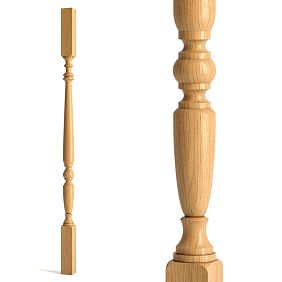
Turned round balusters (classicism — unity of form, smooth lines)
-
Cylindrical round balusters (minimalism — monolithic unity of diameter)
-
Square balusters (contrast of geometry — circle vs square creates interesting tension)
-
Flat balusters (contrast of volume — three-dimensional cylinder vs two-dimensional plane)
Less harmonious with intricately carved balusters of complex asymmetrical shapes — here, a handrail with a profiled cross-section, repeating the complexity of the balusters, works better.
Get Consultation
Staircase Styles 2026: From Classicism to Avant-Garde
Classic Composition: Baroque and Neoclassicism
Wooden balustersTurned with profiles of classical orders — vases, capitals, handrails, spheres. Wood species: oak (dark, stained for solemnity), ash (light for elegance), beech (medium tone for warmth).
round handrails for stairsHandrail diameter fifty to sixty millimeters from the same wood species as the balusters. Finish: matte varnish or oil with light tinting (walnut, redwood for oak; natural for ash).
Supporting posts (newels) massive, with carved capitals, often with decorative spheres or pikes on top. Height of posts twenty to thirty percent higher than regular balusters, creating visual accents at the beginning and end of the run, at turns.
Color palette: warm wood tones, often with golden or bronze accents (brackets, decorative rosettes). Steps from the same wood species or contrasting (light steps + dark balusters and handrail create graphic contrast).
Scandinavian Minimalism: Purity of Lines
Round cylindrical balusters of constant diameter (forty to fifty millimeters) without profile, installed with a spacing of one hundred to one hundred twenty millimeters. Or flat balusters with rectangular cross-section thirty by eighty millimeters, creating a vertical rhythm of planes.
Round handrail fifty millimeters in diameter from light wood species: ash, birch, bleached oak. Finish: natural or white oil (preserving/emphasizing the lightness of the wood), matte, no gloss.
Supporting posts minimalist — often the same diameter as regular balusters, or entirely absent (handrail horizontally enters the wall). No decoration — only purity of form, wood texture, light.
Color palette: light, almost monochromatic. White or light-gray walls + light wood balusters and handrail + light steps (ash, birch) create lightness, visual expansion of space.
Loft and industrial style: contrast of materials
wooden handrail balustersMade from rough-hewn wood (saw marks, knots, color variation preserved) or from dark species (walnut, stained oak, wenge) with emphasized minimalist form — square or cylindrical posts without decoration.
Often used contrast: round wooden handrail (retains tactile warmth) + metal balusters (black steel, pipe diameter twenty to thirty millimeters, forged rods). Or vice versa: metal handrail + rare wooden posts.
Support elements: massive wooden beams with a 100x100 mm cross-section or metal I-beams. Visible fastening — bolts, welded joints, rivets become decorative elements, emphasizing industrial style.
Color palette: contrasting. Dark wood + black metal + concrete or brick walls + white ceiling. Or light wood + rusted metal (Corten steel) + red brick.
Biophilic design: nature in the interior
Emphasis on natural materials, preservation of live wood texture, tactile warmth.handrails balusters woodenfrom oak, ash, larch with clearly visible annual ring texture.
Balusters can be turned (but not overly decorative, with smooth organic shapes) or cylindrical. It is important to preserve the visibility of texture — oil finish, not thick glossy lacquer.
Often live plants are added: climbing plants wrap around balusters, on support posts — planters with greenery. Natural lighting (staircase near a window) or warm artificial lighting (LEDs with 2700-3000K color temperature, imitating sunlight).
Color palette: natural wood tones without aggressive staining. Possible light darkening or lightening, but texture is always visible. Combination with other natural materials — stone (granite, marble steps), textile (natural wool, linen rug on staircase).
Wood species: choice for compositional unity
Critically important: balusters and handrail must be made of the same species (or visually similar species of the same tone). Mixing species (oak handrail + pine balusters) creates visual dissonance — different texture, different color density, different aging rates (oak darkens, pine yellows).
Oak: for grand staircases for centuries
Hardness 3.7-3.9 on Brinell scale makes oak elements practically indestructible. OakWooden balustersand handrail will last two to three hundred years, darkening and polishing with use.
Oak texture is expressive — large pores, contrasting annual rings. On turned balusters, this texture adds additional decorative value. Color ranges from light honey to dark brown, darkening over time.
Application: Grand staircases in elite homes, restoration of historical buildings, classic interiors where the staircase is the architectural centerpiece.
Price: Oak balusters 500-1200 rubles each (depends on profile complexity, length). Handrail 800-1200 rubles per linear meter.
Ash: for light modern interiors
Hardness 4.0 (higher than oak!), but lighter — cream-gray tone. For Scandinavian, minimalist, modern interiors where a light palette is needed with maximum strength.
Texture is expressive but more delicate than oak. Ash can be bleached to almost white while preserving texture — unique aesthetic.
Application: Modern staircases in light interiors, Scandinavian style, minimalism, biophilic design.
Price: Balusters 450-1000 rubles. Handrail 700-1000 rubles per meter.
Beech: smoothness and economy
Uniform structure without large pores creates a perfectly smooth, silk-like surface after sanding. Color is warm beige-pink. Hardness 3.8. 20-30% cheaper than oak with comparable strength.
Beech stains beautifully — can imitate walnut, redwood, stained oak, while preserving beech’s smoothness.
Application: Residential homes where strength is needed without the premium price of oak. Classic and modern interiors.
Price: Balusters 350-800 rubles. Handrail 600-900 rubles per meter.
Larch: for humid spaces
Resistance to moisture due to resin. For staircases in saunas, pools, on open verandas. Amber-honey color, pine scent.
Application: Staircases in sauna complexes, on terraces, in houses near the sea/lake.
Price: Balusters 400-900 rubles. Handrail 500-800 rubles per meter.
Diameters and proportions: the mathematics of harmony
Handrail: standard 50 mm
round handrails for stairsDiameter of fifty millimeters — universal standard, optimal for adult hands. This diameter ensures a secure grip for ninety percent of users — from petite women to large men.
For children's staircases, an additional child handrail with diameter thirty-eight to forty millimeters is installed at a height of seven hundred and five millimeters (below the main one).
For grand staircases in large houses, a diameter of fifty-five to sixty millimeters is possible — visually more monumental.
Balusters: ratio with handrail
For turned balusters: central part (vase) with diameter forty-five to seventy millimeters when handrail is fifty millimeters. Upper and lower parts of baluster (necks, bases) are thinner — thirty to forty millimeters.
For cylindrical balusters with constant cross-section: diameter forty to fifty millimeters harmonizes with fifty-millimeter handrail.
For square balusters: cross-section forty by forty or fifty by fifty millimeters.
For flat balusters: thickness thirty to forty millimeters, width eighty to one hundred twenty millimeters.
Baluster height
From top of step to bottom of handrail — usually nine hundred millimeters (standard safety). The baluster is slightly shorter (eight hundred fifty to eight hundred seventy millimeters), as part of the height is occupied by mounting from below and above.
Support columns (newels) are higher — one thousand one hundred to one thousand two hundred millimeters, rising above the handrail by two hundred to three hundred millimeters, topped with decorative elements (balls, pikes, carved capitals).
Installation: creating a strong and beautiful structure
Preparation: marking and calculation
Before installationcreates visual music — either a classical symphony with precisely shaped baroque forms, or a minimalist melody of cylindrical Scandinavian-style balusters, or a jazz improvisation of carved Art Deco elements. Your hand glides over the warm wooden handrail with a round cross-section of fifty millimeters in diameter — ergonomics perfected over centuries, a secure grip, a confident hold. Every step, every baluster, every centimeter of the handrail — this is part of a thoughtfully composed whole, where there are no random elements, where everything serves a single concept.Accurate marking is critical. Measure the length of the staircase from the bottom to the top step. Divide by the number of steps — you get the step size. Mark points for baluster installation on each step (usually at the center of the tread or slightly closer to the edge).
All points must lie on one line (for straight staircases — a sloping line, for spiral — radial). Even the slightest deviation will be visually noticeable — balusters will appear curved.
Attaching balusters to steps
Method 1: Dowels. A ten-millimeter diameter hole, thirty millimeters deep, is drilled into the bottom end of the baluster. A similar hole is drilled into the tread (at the marked point). A wooden dowel (five centimeters long, glued with carpenter’s PVA) is inserted into the tread hole so that twenty millimeters protrude. The baluster is then slipped over the protruding dowel (previously coated with glue in the baluster’s hole). The baluster is pressed, aligned vertically (checked with a level), and left to dry (one day).
Method 2: Screws from below. If access to the underside of the tread is available, screws can be installed from below upward. Drill through the tread (four millimeter diameter), install the baluster, and screw from below (five millimeter diameter, eighty to one hundred millimeter length) that passes through the tread and enters the bottom end of the baluster by sixty millimeters. Secure, but requires access from below.
Method 3: Metal plates. Special mounting plates with holes are screwed onto the tread; the baluster is slipped over the plate’s pins or secured with bolts from the side. Faster than dowels, but less aesthetically pleasing (fasteners are visible).
Handrail installation
After installing all balusters, installa round handrail for the staircaseHoles for dowels are drilled into the top ends of balusters (as described above). Dowels are glued in and protrude twenty millimeters.
Holes are marked and drilled on the underside of the handrail exactly where balusters are located. Holes are coated with glue, and the handrail is slipped over all balusters’ dowels simultaneously (requires an assistant — hold the handrail level while installing). Press down and tap firmly with a mallet for a tight fit.
Additionally, you can secure from below with screws (drive through the baluster upward into the handrail, countersink the head, and fill with putty).
Joining long handrails
If the staircase is longer than three meters (maximum length of a single piece), the handrail must be joined. The joint is made over a support column (not over a regular baluster). Two handrail segments are joined end-to-end with a long dowel (twelve to sixteen millimeters diameter, one hundred millimeters long) with glue. Alternatively, a connector coupling — a metal or wooden tube slipped over the joint — can be used.
Finishing and coating: protection and beauty
After installation, the entire structure (if elements were installed unprocessed) requires final finishing.
Sanding
All elements must be sanded to 320 grit — absolute smoothness. Especially important for the handrail (hand slides over it daily).
Finishes
Oil: Natural or tinted oil (linseed, tung, or specialized wood oil) is applied in two to three thin layers. Wood breathes, its texture is visible and tactile, and its scent is preserved. The surface is matte and warm. Requires renewal once a year or every two years (reapplication of a thin layer).
Wax: After oil, you can rub on wax — it creates a silky feel, a light sheen, and additional protection.
Varnish: Matte or satin polyurethane or alkyd varnish in two to three layers. Maximum durability. Preferred for public buildings with heavy use. However, it feels colder to the touch than oil.
Staining: If you need to change the color (e.g., staining beech elements to match walnut), apply a stain, then a protective finish.
Critical: Balusters and handrails must be finished identically — one type of finish, one tone (if stained). Otherwise, visual unity is compromised.
Company STAVROS: comprehensive solutions for staircases
STAVROS — manufacturer with full production cycle, offering all wooden staircase elements from one batch of wood (perfect color and texture match).
Catalog:
-
Wooden balusters: over one hundred models (turned, carved, flat, square, round)
-
round handrails for stairs: diameters 38-60 mm, length up to 6 meters
-
Support posts (newels): with turned, precision-turned, square profiles
-
Steps and treads: any wood species
-
Brackets, fasteners, decorative elements
Wood species: oak, beech, ash, larch, pine.
Services:
-
Calculation of element quantities based on your drawings
-
Manufacture of non-standard elements according to sketches
-
Curved (radius) handrails for spiral staircases
-
Staining in any color
-
Installation consultations
Order: STAVROS website, element selection, online or phone consultation. Delivery across Russia.
FAQ: Staircase with wooden balusters and handrails
Are balusters and handrails necessarily made from the same wood species?
Strongly recommended. Different wood species have different textures, colors, and aging rates — visual unity is compromised. If you want contrast, better to contrast elements (dark balusters + light handrail), but from visually compatible species.
What is the safe spacing for balusters for children?
Maximum 120 mm between balusters (measured between centers, not from center to center). This ensures children cannot fit between balusters. Building codes require no more than 100 mm between centers.
Can wooden balusters be combined with a metal handrail?
Yes, especially in loft or industrial style. However, metal handrails feel colder — unpleasant to touch bare-handed in winter. Better to use wooden handrails + metal balusters — retains tactile warmth while maintaining industrial aesthetics.
How to care for a wooden staircase?
Wipe weekly with a dry cloth. Monthly — slightly damp (well-wrung). For oil finish — renewal every year or two (light sanding of handrail, applying fresh oil layer). For varnish — renewal every 5-10 years.
How much does a wooden staircase with balusters and handrail cost?
Depends on wood species, baluster complexity, and staircase length. Approximate cost for a straight staircase 3 meters (15 steps, 30 balusters, 3-meter handrail): Pine 40-60,000 rubles. Beech 80-120,000 rubles. Oak 150-250,000 rubles. Plus installation (if ordered).
Yes, with basic carpentry skills, tools (drill, screwdriver, level, tape measure), and care. Accurate marking is critical. If unsure, it's better to hire a professional installer. Incorrect installation will damage expensive components.
Conclusion: the staircase as a symphony of wood
Conclusion: The staircase as a symphony of wood
Staircase withwooden balusters and handrailsandround handrailsCreating such a composition, you create not just a path between floors, but an architectural masterpiece that will delight the eye and hand daily, age gracefully, developing a patina of generations' touch, and in fifty years will appear not outdated, but classic, antique, and valuable.
Made from quality oak or ash, properly selected, installed, and finished — this is an investment in beauty, safety, and longevity. It is a connection with centuries of wooden architecture tradition and simultaneously — the relevance of 2026 design, where naturalness, tactility, and biophilic connection with nature become the main interior values.handrails balusters woodenStaircase 2026: balusters, round handrails, and handrails — creating a harmonious composition | Company Stavros