












































































Article Contents:
- The problem of color variation: why it's critical
- Technical reasons for color variation
- Advantages of a single supplier: not just color
- Uniformity of quality and technology
- Planning comprehensive decor: from concept to implementation
- Working with a designer or independent selection
- Ceiling decor: cornices, rosettes, coffers
- Coffered ceilings and complex compositions
- Wall decor: moldings, panels, frames
- Creating accent walls using moldings
- Baseboards: completing the floor and wall composition
- Tall baseboards as a decorative element
- Installation of comprehensive decor: sequence and nuances
- Puttying joints and finishing
- Budget calculation: savings through a single supplier
- Long-term savings when additional purchases are needed
- Frequently Asked Questions
- Conclusion: a comprehensive approach to decor with STAVROS
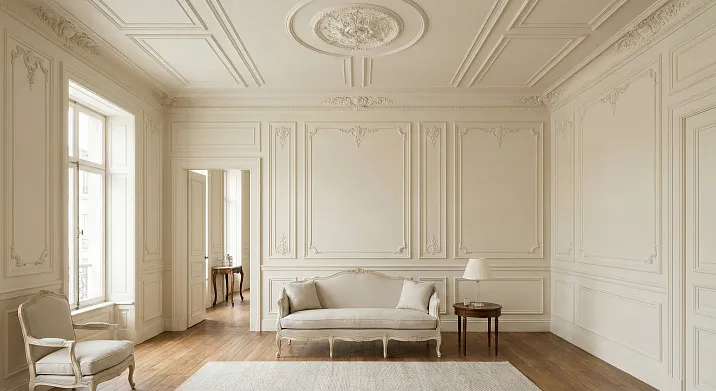
Have you ever encountered a situation where decor purchased from different stores turns out to be different shades of white? One cornice has a cool, almost bluish undertone, another has a warm creamy tone, and a third is neutral. In the warehouse under artificial lighting, the differences are unnoticeable, but after installation in your apartment under natural light, the wall turns into a patchy surface with color variation. You have to repaint everything, losing time and money.
Professional designers have long understood a simple truth: wall moldings and ceiling decor should be from the same manufacturer. Not just from the same material, but specifically from one brand, from the same production line. Only this guarantees identical color, surface texture, and material density. When ceiling moldings and wall moldings were cast in the same molds, from the same batch of polyurethane, and painted in the same chamber—they become a single whole, creating a harmonious space.


The problem of color variation: why it's critical
Why does a seemingly insignificant difference in shades create such a serious problem? The human eye is incredibly sensitive to differences in close tones. If there are two items of different colors in the interior—a red chair and a blue vase—the brain perceives this as an intentional color solution. But when two elements that should be identical are placed next to each other and they slightly differ—the brain registers this as an error, a defect.
Moldings of different shades create visual dissonance. A ceiling cornice with a cool tone combined with a warm wall molding makes the eye stumble at the boundary between them. This creates a subconscious feeling of incompleteness, sloppiness, randomness. The interior looks assembled from disparate elements, not designed as a cohesive composition.
The problem worsens when using white—the most popular color for moldings. There are many shades of white: cool ultra-white with a blue undertone, neutral pure white, warm with a creamy or yellowish tint, grayish white, greenish white. Under artificial lighting in the store, these differences are barely noticeable. But in daylight, especially near a window, all nuances appear with merciless clarity.




Technical reasons for color variation
Why do different manufacturers produce products of different shades? The first reason is raw materials. Polyurethane is made from various chemical raw materials, which may have their own base shade. One supplier uses components with a warmer tone, another with a cooler tone. Even with the same supplier, different batches may vary slightly.
The second reason is production technology. The temperature regime of casting, curing speed, presence of additives—all this affects the final color of the product. Two factories using the same raw materials but different production regimes will produce products with varying shades.Polyurethane ItemsProducts from one manufacturer undergo a unified processing cycle, guaranteeing identity.
The third reason is surface treatment. Some manufacturers apply primer to products, others leave polyurethane untreated. The primer can be white in different shades, adding variability. Even the thickness of the primer layer affects the final color—a thick layer hides the base tone of the material, a thin layer allows it to show through.
Our factory also produces:


Benefits of a single supplier: not just color
Color identity is the main, but not the only reason to choose all decorative molding from one manufacturer. Stylistic compatibility is the second most important advantage. Professional manufacturers develop collections where all elements harmoniously complement each other. Ceiling cornice, wall molding, rosette, baseboard — each has a similar ornamental character, repeating motifs, and proportional details.
moldings, cornices, baseboardsElements from a unified collection create visual cohesion in the space. The ornament of the ceiling cornice echoes the ornament of the wall molding. The proportions of the profiles are coordinated — if the cornice is 150 mm wide, the molding will be 100 mm, and the baseboard 80 mm. This creates a harmonious hierarchy where elements do not compete but complement each other.
Size compatibility is the third advantage. The standard length of linear products from one manufacturer is uniform — 2 or 2.4 meters. This simplifies the calculation of the required quantity and minimizes waste during cutting. Corners, connecting elements, and end caps are specifically designed for particular profiles. By purchasing everything from a single supplier, you get a complete set of matching parts.
Get Consultation
Uniformity of quality and technology
The quality of finishing varies among different manufacturers. One produces items with a perfectly smooth surface that requires no additional sanding. Another — with roughness that needs refinement before painting. When elements of different surface quality are placed on the same wall, even after identical painting, they look different — one matte, the other semi-glossy due to texture differences.
Installation technology can also differ. One manufacturer assumes installation exclusively with adhesive, another recommends additional mechanical fastening. One uses water-based adhesive, another — polyurethane-based. When elements requiring different installation technologies are mixed in one project, it complicates the installers' work and increases the risk of errors.
Polyurethane Ceiling MoldingsElements from a single manufacturer are installed using a uniform method. Same material density, same weight, same requirements for surface preparation, same adhesive composition. Installers work faster and better when all elements are predictable, when the technique perfected on the first cornice is flawlessly applied to all subsequent ones.
Planning comprehensive decor: from concept to implementation
How to properly plan room decoration to ensure unity of all elements? Start by defining the style. A classic interior requires rich decor with ornaments — ceiling rosettes with floral motifs, cornices with molded garlands, moldings with relief patterns. A modern style implies conciseness — simple profiles without ornaments, clear geometric shapes, minimal detailing.
Make a list of necessary elements. For a standard room of 20 square meters, you will need: ceiling cornice around the perimeter (about 18-20 linear meters), floor baseboard (the same amount), possibly wall moldings to create decorative panels (depends on the design), a ceiling rosette for the chandelier (one, 400-600 mm in diameter), possibly door trims (according to the number of doors). Having a complete list makes it easier to select elements from a unified collection.
Study the catalog of the chosen manufacturer. Pay attention to the availability of collections — systematic sets of elements designed for joint use.Polyurethane ceiling rosettesRosettes should stylistically match the chosen cornices. If the cornice has a classic acanthus leaf ornament, the rosette should continue this theme, not introduce new motifs.
Calculate the quantity with a margin. Polyurethane elements produce waste when cut. Corners require precise fitting, which can lead to defects. Order 10-15% more linear products than calculated. This ensures there is enough material even if something goes wrong. Buying later is more difficult — it may be out of stock, or you might receive products from a different batch with slight differences.
Working with a designer or independent selection
A professional designer simplifies the task of choosing uniform decor. They know the assortment of leading manufacturers, understand which elements combine, and can quickly assemble a kit for the entire project. The designer will also consider the room's proportions — in a room with a height of 2.7 meters, a massive 200-millimeter cornice should not be used, while in a hall with 3.5-meter ceilings, a miniature 50-millimeter one will be unnoticeable.
Independent selection requires time but is quite feasible. Start by choosing one key element — usually the ceiling cornice, which sets the tone for all decor. Find a cornice you like that matches the interior style and room proportions. Then select the remaining elements based on it.Wall moldingshould be in the same style but on a smaller scale.
Use manufacturer consultations. Serious companies provide element selection services. You describe the room, desired style, budget — a specialist suggests a ready-made kit of matching products. This is a free service aimed at helping the customer make the right choice. Do not hesitate to seek help; it saves a lot of time and prevents mistakes.
Ceiling decor: cornices, rosettes, coffers
Ceiling molding creates volume, visually increases room height, and adds architectural expressiveness. The ceiling cornice is the basic element framing the junction of the ceiling and wall. The cornice width is chosen based on ceiling height: for 2.5-2.7 meters, 50-100 mm cornices are optimal; for 3-3.5 meters — 100-150 mm; for high ceilings from 3.5 meters — 150-250 mm and more.
The cornice profile can be simple and smooth or with ornament.Polyurethane moldings for ceilingsOrnamented cornices with rich relief suit classic interiors — Baroque, Rococo, Empire. Simple profiles with minimal detailing are appropriate in modern styles — minimalism, Scandinavian, contemporary. There are also transitional options — concise forms with restrained ornamentation for neoclassicism.
Ceiling rosettes are installed at the points of chandelier and pendant light fixture attachment. The rosette diameter should relate to the size of the light fixture — the rosette should be 20-30% larger than the diameter of the chandelier base. For miniature fixtures 300-400 mm in diameter, rosettes of 400-500 mm are suitable. For large multi-arm chandeliers 800-1000 mm in diameter, rosettes of 1000-1200 mm are needed.
The rosette ornamentation should match the cornice ornament. If the cornice is decorated with acanthus leaves, the rosette should contain the same motif. If the cornice has a geometric ornament, the rosette should be geometric. By purchasing the rosette and cornice from one manufacturer from the same collection, you automatically get this compatibility — the manufacturer's designers have already considered the combinations.
Coffered ceilings and complex compositions
Coffers are recessed decorative panels on the ceiling formed by intersecting beams. Creating a coffered ceiling requires many elements: beams (wide cornices or special profiles are used), corner rosettes at beam intersections, central rosettes in each coffer, possibly additional decorative elements. All these details must be perfectly coordinated in style and color.
Sculptural decorationsElements for a coffered ceiling are better ordered as a ready-made kit from the manufacturer. Some companies offer special sets for creating coffers — a complete set of profiles, rosettes, corners, calculated for a specific ceiling area. This guarantees that all elements will match, and you won't have to select compatible parts yourself.
Complex multi-level ceilings require even more attention to decor unity. Each level is framed with cornices, transitions between levels are decorated with moldings, and each level center may have a rosette. The number of elements increases manyfold. The slightest differences in shades between elements will become noticeable and spoil the impression. Only products from a single manufacturer guarantee the integrity of such a complex composition.
Wall decor: moldings, panels, frames
Wall molding serves both decorative and structural functions. Moldings divide the wall into zones, creating frames for wallpaper, paintings, and mirrors. The installation height of wall moldings depends on the proportions of the room. The classic scheme divides the wall into three parts: the lower part (from the floor to 70-90 cm), the middle part (the main section of the wall), and the upper part (near the ceiling).
Horizontal moldings at a height of 70-90 cm from the floor visually divide the wall, creating a classic panel finish. The area below the molding is often painted a darker color or finished with a different material. The molding conceals the joint between different finishing materials, creating a sense of completeness in the composition. The width of such molding is typically 40-80 mm—enough to be noticeable but not dominant.
Vertical moldings create vertical panels on walls. A classic solution is a series of rectangular frames formed by moldings. Inside the frames, there is patterned wallpaper; outside, there is smooth paint. Or vice versa. Moldings for such panels are narrow, 20-40 mm—they create a frame without drawing excessive attention to themselves.Combining moldings, baseboards, and cornicesrequires consistency in profiles.
Door and window frames are another application of wall moldings. The opening is framed with molding around the perimeter, creating a decorative portal. This is especially effective for wide openings without doors—arches between rooms, passages into hallways. The molding accentuates the opening, giving it architectural significance. The width of the framing molding depends on the width of the opening—for a standard door of 700-800 mm, a molding of 60-80 mm is sufficient.
Creating accent walls with molding
An accent wall is a wall highlighted by decor, color, or material.Molding decorallows you to create an expressive accent wall without using expensive materials. A composition of moldings forms a geometric pattern on the wall. These can be rectangles, squares, rhombuses, octagons—any shapes that align with the overall interior style.
Central composition—a large decorative frame in the center of the wall with overlays at the corners. Inside the frame—contrasting finish, mirror, panel, television. The molding forms a portal, drawing attention to the center of the composition. This solution is characteristic of classic interiors, where symmetry and central composition are key principles.
Asymmetric compositions in modern interiors also use wall molding. Moldings of different lengths create a dynamic pattern that guides the eye. This can be a group of horizontal lines of varying lengths, offset relative to each other, or a staircase of vertical elements. It is important that all moldings in the composition are from the same collection—identical profiles create visual cohesion among disparate elements.
Baseboards: completing the composition of floor and walls
Floor baseboard—an element that completes the room's design from below. It conceals the joint between the floor and wall, protects the lower part of the wall from damage, and hides wiring behind it. The height of the baseboard is chosen based on the ceiling height and the scale of the decor. For standard rooms with a height of 2.5-2.7 meters, baseboards of 60-100 mm are optimal.
The baseboard profile should align with the ceiling cornice. If the cornice has a complex multi-tiered profile with ornamentation, the baseboard should replicate this complexity but on a smaller scale. If the cornice is simple and smooth, the baseboard should be equally concise.Baseboards and cornicesfrom a single collection already have this consistency, selected by the manufacturer's designers.
The color of the baseboard is an important decision. The classic approach—baseboard in the color of the ceiling cornice, creating a visual frame for the room. The top and bottom of the room are designed similarly, with the walls enclosed in a decorative frame. The modern approach—baseboard in the color of the walls, almost blending with them. This creates a seamless surface effect, where the floor seems to grow out of the wall.
The material of the baseboard should ideally be the same as that of the ceiling cornice. If the cornice is made of polyurethane, the baseboard should also be polyurethane. This ensures identical surface texture, the same reaction to painting, and compatibility of installation technologies. Mixing materials (polyurethane cornice and wooden baseboard) is possible but requires careful color and style matching.
Tall baseboards as a decorative element
Tall baseboards—a trend in recent years. Baseboards with a height of 150-200 mm, and sometimes 300 mm, create a substantial framing for the room, emphasize ceiling height, and add solidity to the interior. Such baseboards are appropriate in rooms with a height of 3 meters or more—in standard rooms, they look disproportionate.
A tall baseboard can have a complex multi-tiered profile, essentially representing a wall panel. It creates a strong visual foundation for the room, from which all other decorative elements take off. In classic interiors, tall baseboards are combined with massive cornices, creating a powerful frame within which the main space develops.
Consistency of the tall baseboard with the rest of the decor is critical. It should not conflict with wall moldings, door frames, or the ceiling cornice. Purchasing all elements from one manufacturer guarantees that designers have already considered these combinations. Baseboard, cornice, and moldings from the same collection automatically create a harmonious system.
Installation of comprehensive decor: sequence and nuances
How to properly install all molding decor for a flawless result? The installation sequence matters. The correct order: first the ceiling cornice, then wall moldings, then the floor baseboard, and finally—rosettes and overlay decorative elements. This sequence is determined by the logic of element joining.
The ceiling cornice is installed around the perimeter of the room, creating the upper boundary. Corners are cut at 45 degrees and joined with maximum precision. Gaps between elements are carefully filled with putty. At this stage, it is important to use high-quality polyurethane adhesive, applied in an even layer over the entire back surface of the cornice. Additionally, the cornice can be secured with finishing nails or screws, which are later concealed with putty.
Wall moldings are installed after the cornice. If the molding joins the cornice (e.g., a vertical molding from the ceiling to the middle of the wall), the joint must be perfectly fitted. Moldings from the same collection as the cornice are easier to join—their profiles are designed with possible connections in mind. Moldings from different manufacturers may have incompatible profiles, creating gaps at the joints.
The floor baseboard is installed last among the linear elements. It adjoins the floor and wall, concealing irregularities in both surfaces. If vertical wall moldings reaching the floor are installed in the room, the baseboard is trimmed to fit them, creating a neat joint.Ceiling molding made of polyurethane and cornicerequire professional installation.
Joint puttying and finishing
After installing all elements, the puttying stage follows. All joints between elements, areas adjacent to walls and ceilings, and fastener indentations are filled with acrylic putty. The putty should be elastic and not shrink upon drying. After drying (typically 6-12 hours), the puttied areas are sanded with fine sandpaper until smooth.
Priming all moldings before painting is a mandatory step. Primer improves paint adhesion, evens out surface absorbency, and prevents stains. Acrylic primer applied with a brush or roller is used. Special attention is paid to the recesses of the relief—the primer must penetrate all details of the ornament.
Painting is done with high-quality interior paint. Matte or semi-matte paints are optimal for moldings—they emphasize the relief through the play of light and shadow. Glossy paints smooth out the relief, making it less expressive. Paint is applied in two to three coats with intermediate drying. The first coat can be slightly diluted with water for better penetration into the material's pores.
It is precisely at the painting stage that all the advantages of using decor from a single manufacturer become apparent. Elements made from the same material, with the same surface, absorb primer and paint equally. After painting, they have absolutely identical shade, texture, and degree of gloss.molding in interiorlooks like a single whole, not like a set of disparate elements.
Budget calculation: savings through a single supplier
Purchasing all decor from one manufacturer can be more economically advantageous than buying from different suppliers. Many manufacturers offer discounts on comprehensive orders. By purchasing cornices, baseboards, moldings, and rosettes simultaneously, you can expect a 10-15% discount on the total amount. This is significant savings, especially for projects with a large volume of decor.
Reducing transportation costs is another factor for savings. One delivery of the entire kit costs less than several deliveries from different suppliers. Delivery time is also reduced—there's no need to wait for elements from different sellers or coordinate multiple schedules. Everything arrives as a single kit at an agreed time.
Savings from avoiding rework is a hidden but significant factor. When elements from different manufacturers show color variations after installation, everything has to be repainted. This means additional costs for paint, painters' labor, and time. If differences in profiles create unsightly joints, additional puttying, adjustments, and sometimes even dismantling and replacement of elements are required. By using decor from a single brand, you avoid these problems from the start.
Long-term savings when additional purchases are needed
Imagine a situation: a year after the renovation, you decide to decorate another room in the same style. Or you need to replace a damaged decor element. If the original decor was from a large manufacturer with a consistent range, you simply order the needed elements—they will be exactly the same as a year ago. The color, profile, and size are identical.
If the original decor was from a small manufacturer or has been discontinued, problems arise. The needed profile is no longer available. You have to search for a similar, but not identical, one. After installation, the differences become noticeable. Or you need to redo all the decor in the room using a new profile. Large manufacturers maintain their core collections for years, guaranteeing the availability of elements for future purchases.
Frequently asked questions
Is a single manufacturer really that important, or is just white polyurethane sufficient?
Critically important. The white color of polyurethane varies among different manufacturers—from cool to warm shades. After installation and painting, these differences become fully apparent. Professionals always choose a single manufacturer precisely for this reason.
Can all moldings be painted the same color to hide differences?
Yes, but this involves additional time and money costs. Quality painting requires priming and applying 2-3 coats of paint. If decor from a single manufacturer is used from the start, sometimes one coat of paint is enough for finishing—the base shade is already uniform.
What to do if the needed element is not available from the chosen manufacturer?
Look for an alternative manufacturer with a full range or order the missing elements individually. Some companies offer custom manufacturing services based on sketches—more expensive but guarantees stylistic unity.
How much does comprehensive decoration for a standard room cost?
For a 20-square-meter room with a ceiling height of 2.7 meters: ceiling cornice (18 linear meters)—approximately 15-25 thousand rubles, floor baseboard (18 linear meters)—10-18 thousand, ceiling rosette—3-8 thousand, wall moldings (if used, about 30 linear meters)—15-30 thousand. Total from 43 to 81 thousand depending on profile complexity and brand prestige.
How long does polyurethane molding last?
With proper installation and care—30-50 years or more. Polyurethane does not rot, dry out, or crack from humidity fluctuations. The only thing that may be needed is repainting every 7-10 years.
Is it mandatory to paint the moldings, or can the base color be left?
Painting is recommended. It protects the material from dirt, UV rays, and mechanical damage. A painted surface is easier to clean and maintains an attractive appearance longer. The base color of polyurethane is not suitable for all interiors; painting allows adapting the decor to your color scheme.
Can polyurethane and wooden moldings be mixed?
Yes, but with caution. Wood and polyurethane have different textures, react differently to humidity, and differ tactilely. If mixing, do so zonally—polyurethane on the ceiling and upper part of walls, wood at touch level. Uniform painting is mandatory for visual compatibility.
How to check the quality of polyurethane moldings before purchase?
Inspect the surface—it should be smooth, without cavities, chips, or deformations. Check the clarity of the relief—ornament details should be well-defined. Check the geometry—the element should not be bent or twisted. Smell it—high-quality polyurethane has a faint odor or no odor at all; a sharp chemical smell indicates low-quality raw materials.
Which brands of polyurethane moldings are the most reliable?
Choose manufacturers with a full production cycle, their own collections, and a long-standing history. Pay attention to the availability of quality certificates, warranties, and service support. Large companies value their reputation and control product quality more strictly than small resellers.
Does polyurethane molding require any special care?
No, care is minimal. Dry cleaning with a soft brush once every 1-2 weeks to remove dust. Periodic wet wiping in rooms with increased soiling. Repainting every 7-10 years as fading or soiling occurs. Avoid impacts with hard objects—polyurethane is durable but can deform under strong blows.
Conclusion: A comprehensive approach to decor with STAVROS
Purchasing a full decor set from a single manufacturer is not a perfectionist's whim but a rational solution guaranteeing a quality result. Color identity, profile coordination, stylistic unity, and installation technology compatibility—all this is achieved automatically when wall molding and ceiling molding come from the same production line, are designed by a single team of designers, and are cast from the same batch of polyurethane.
The economic feasibility of this approach is obvious. Discounts on comprehensive orders, reduced shipping costs, no rework due to element incompatibility, and the possibility of purchasing identical elements in the future—all this creates long-term benefits. The initial savings from buying from different suppliers are deceptive—they are often consumed by additional costs to fix compatibility issues.
The quality of an interior created with comprehensive decor from a single brand is incomparably higher. The space looks cohesive, well-thought-out, and professionally designed. Every element is in its place, all details are coordinated, and there are no visual dissonances distracting the eye. This creates an atmosphere of harmony, comfort, and completeness—exactly what decoration is undertaken for.
The company STAVROS specializes in comprehensive solutions for interior decoration. An extensive catalog includes all necessary elements:Ceiling Molding, wall moldings, floor skirting boards,ceiling rosettes, decorative overlays, columns, pilasters, brackets. All products are organized into stylistic collections where elements harmoniously combine with each other.
STAVROS production uses high-quality European raw materials, modern equipment, and strict quality control. Each batch of products undergoes multi-stage inspection—dimensional accuracy, surface quality, relief clarity, and material strength are controlled. This guarantees that every element, whether a cornice, rosette, or molding, meets the highest standards.
The STAVROS customer support service helps select a decor set for your project. Specialists advise on the stylistic compatibility of elements, calculate the required amount of material, and offer optimal solutions within your budget. If necessary, custom elements are developed based on your sketches—unique rosettes, capitals, overlays that will harmoniously fit into the standard assortment.
STAVROS logistics ensures timely delivery across all of Russia. Products are carefully packaged to protect against damage during transportation. Order consolidation is possible—you receive everything needed for room decoration at once, without having to gather elements from different sources. The delivery schedule is coordinated with the start of installation work so that materials arrive exactly when needed.
By choosing STAVROS, you choose reliability, quality, and professionalism. This is a company that understands the importance of details, knowing that the true beauty of an interior is composed of a thousand small things coordinated into a single whole. This is a partner you can trust to create the decorative design of your home, knowing that the result will exceed expectations. Visit the STAVROS website, explore the collections, get a consultation—begin your journey to creating a truly harmonious interior.


