Article Contents:
- Why Wall Molding in Interior Design is Back in the Spotlight
- Architectural Quality as a New Value
- Why It's Not Just About Classic Style
- What Role Does Molding Play in Wall Architecture
- What Counts as Wall Molding: A Complete Breakdown of Elements
- Molding: The Foundation of the Entire System
- Decorative Frames: The Most Popular Technique
- Overlays and Ornaments: Focal Points That Draw the Eye
- Pilasters: Vertical Dynamics
- Panels (Wainscoting): Complete Architectural System
- Wall Ornaments and Panels
- Materials for Wall Molding Decor: What to Choose
- Polyurethane: The Standard for Modern Residential Interiors
- Plaster: Tradition and Limitations
- MDF and Wood: For Textured Wall Panels
- Polystyrene: An Honest Assessment
- Wall molding in different interior styles
- Classic: Opulence Requiring Space
- Neoclassical: A Style That Works Today
- Modern Classic: Freedom and Structure
- Calm modern interior
- Minimalism with architectural character
- Where does wall molding look best in a house or apartment
- Living room: the first and main candidate
- Bedroom: delicacy and intimacy
- Hallway: decor from the first step
- Study: decor as a symbol of a professional environment
- Dining room: academicism at the table
- Hall and staircase area in the house
- Popular wall molding design scenarios
- Symmetrical frame system: a classic of the genre
- Accent central composition
- Molding around the mirror
- Headboard wall
- Niche design
- Doorway and projection finishing
- How to choose scale, rhythm, and pattern: practical criteria
- Ceiling height determines everything
- For a small room
- For high ceilings
- For light, calm interiors
- For a formal space
- What to pair wall molding with: materials and interior details
- Paint and decorative plaster
- Textiles
- Sconces and accent lighting
- Mirrors
- Furniture
- What to choose for a specific task
- Light decor with minimal investment
- Accent wall for the living room
- Premium project for the entire room
- Budget-friendly start without mistakes
- Modern project without overload
- Common mistakes when working with wall molding
- Choosing based on a beautiful picture without considering geometry
- Too complex pattern in a small room
- Overload of details
- Mismatch with Furniture Style
- Ignoring lighting
- Scale error
- Selection algorithm: where to start if you have no experience
- FAQ: Answers to Common Questions About Wall Molding in Interior Design
- About the Company STAVROS
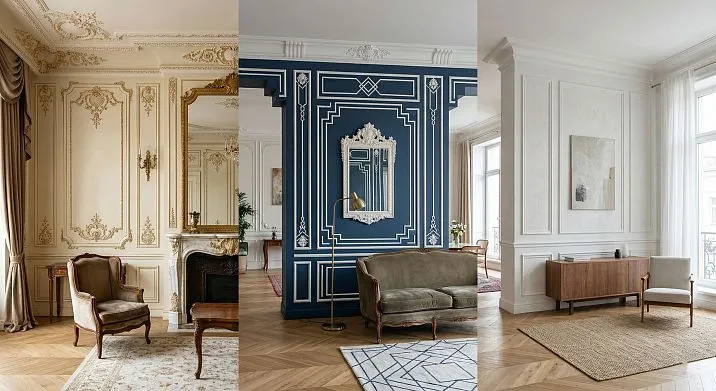
There are things in interior design that work regardless of the era. Wall molding is one of them. It has survived all design revolutions: constructivism, functionalism, Scandinavian minimalism, loft. And today, in 2026, it returns not as nostalgia for palace halls, but as a conscious architectural tool that can work in a wide variety of interiors—from strict neoclassicism to calm contemporary spaces.
But this is precisely what creates the difficulty: too wide a choice. Moldings or overlays? Plaster or polyurethane? One accent wall or the entire room? Frames in the wall color or contrasting ones? This article answers all these questions sequentially and specifically—without fluff and without unnecessary pomp.


Why Wall Molding in Interior Design is Back in the Spotlight




Architectural Quality as a New Value
Over the past five years, there has been a noticeable shift in what people want from their apartments. Minimalism with bare white walls has grown tired of itself. In its place has come a demand for 'architectural quality'—the feeling that a space is designed, not just painted. It is this demand thatdecorative wall moldingsatisfies better than any other finishing technique.
A wall with moldings ceases to be a background. It becomes a structured surface: with rhythm, with relief, with logic. Even simple frames made of smooth profiles transform the wall—adding a depth that neither paint nor wallpaper can provide.
Our factory also produces:




Why It's Not Just About Classic Style
A common misconception: plasterwork is only for classic interiors with antiques, bronze chandeliers, and herringbone parquet. That's not true. ModernPolyurethane wall moldingoffers profiles without ornamentation, geometric overlays, monochrome molding systems — all of this works perfectly in contemporary interiors. Plasterwork today is a language with a very broad vocabulary.
Get Consultation
What role does plasterwork play in wall architecture
A wall without decoration is a flat surface. A wall with moldings is already a system: rhythm, division, scale. Three functions that plasterwork performs simultaneously:
-
Structures — divides the wall into sections, creates visual order;
-
Accentuates — highlights a key area (fireplace, mirror, headboard, television);
-
Scales — a properly chosen molding can visually raise a low ceiling or make a wide wall less monotonous.
What is considered plasterwork on a wall: a complete breakdown of elements
Not everything that is glued to a wall is the same. Each type of plaster decoration has its own role in the interior, its own logic of application.
Molding: the foundation of the entire system
Moldings for walls— these are linear profiles with a specific cross-section. Any wall decor system is built from them: frames, divisions, trims. Molding can be smooth (without ornament), with a groove (a recess that creates shadow), or with a relief pattern along the surface.
The width of the molding is selected according to the scale of the room: from 15–20 mm for small rooms and delicate details to 80–120 mm for tall, formal spaces.
Decorative frames: the most popular technique
Frames made from moldings — rectangular or square outlines that divide the wall into panels. This is the most in-demand technique for wall decor in modern interiors. It is simultaneously simple to install, versatile in style, and foolproof in results.
Frame variations:
-
Simple rectangular — uniform height and width across the entire wall;
-
Tiered — lower frames are narrower than upper ones (a classic solution);
-
Asymmetrical — frames of different proportions in one scheme (a modern interpretation);
-
With overlays — corner blocks at the corners of frames, medallions or ornamental inserts in the center.
Overlays and ornaments: focal points for the eye
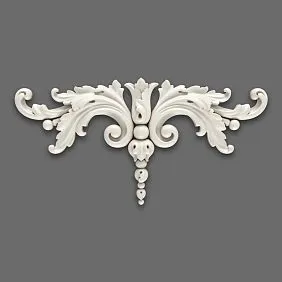
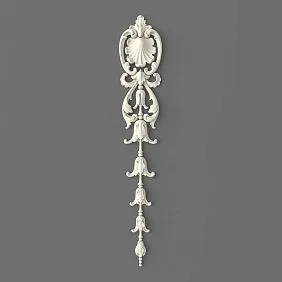
DecorativePolyurethane appliqués— individual relief elements: corner blocks, medallions, ornamental plates, cartouches, floral motifs. They do not create the structure themselves but fill it with content. Where molding creates form, overlays create character.
Corner blocks at frame intersections are the most common technique. They provide completeness to the intersection of two molding lines and add detailing without complicating the system.
Pilasters: vertical dynamics
A pilaster is a flat vertical element that imitates an architectural column. Pilasters are installed on the sides of fireplaces, doorways, niches, in the TV area, in the study behind the desk. They create a powerful vertical rhythm—a wall with pilasters reads as an architectural structure, not just a plastered surface.
Pilasters are especially effective in combination withwith complex stucco decoration: when wall decor is coordinated with the ceiling cornice and the overall room scheme.
Panels (boiserie): a complete architectural system
STAVROS wall panels— full-fledged architectural systems, including moldings, carved overlays, pilasters, cornices, and baseboards in a unified stylistic solution. These are not separate elements—this is a holistic wall cladding that creates the effect of an aristocratic interior.
Such decor requires a more serious approach to design: it is necessary to calculate the division of the wall, the height of zones, and the scale of pilasters. But the result is in the category of 'an interior you want to photograph.'
Wall ornaments and panels
A separate category is decorative ornamental panels: relief paintings, friezes, medallions with floral or geometric patterns. They function as decorative art pieces on the wall—independently, without a molding system.
Materials for wall stucco decor: what to choose
Material selection is not just a budget issue. It's a matter of technology, durability, and visual outcome.
Polyurethane: the benchmark for modern residential interiors
Polyurethane moldingstoday—the quality standard for most residential and commercial projects. Here's why:
Technical advantages:
-
Light weight—a 2-meter wall molding weighs 300–700 g compared to 3–8 kg for a plaster equivalent;
-
Moisture resistance—suitable for kitchens and bathrooms;
-
Perfectly smooth finished surface—accepts any paint without multi-layer priming;
-
Easy processing—cut with a knife or handsaw, joins at any angle;
-
Installation without special skills—mounting adhesive + anchors for heavy elements.
Visual result:
Polyurethane reproduces relief with an accuracy of 0.1 mm. This means that an ornament copied from a plaster original looks the same — only 10–15 times lighter and 3–5 times cheaper.
Plaster: Tradition and Limitations
Plaster stucco decor is a material with history. It is chosen for restoration projects, formal halls with ceilings from 4 m high, and objects with authenticity requirements. The feel in the hand, density, warmth of the surface — plaster has all this, and polyurethane only approximates it.
Limitations: weight, fragility, sensitivity to moisture, labor-intensive installation, high cost of work. For a typical city apartment, plaster is an excessive solution.
MDF and wood: for wall panels with texture
wooden wall panelsand MDF moldings with white enamel or natural veneer finish — for interiors where a living texture is needed. Wood provides what polyurethane cannot: the warmth of a natural material, a unique grain pattern, and scent. In modern classic style, combining wooden panels with polyurethane moldings around the perimeter is one of the strongest design techniques.
Polystyrene: an honest assessment
Polystyrene profiles are the cheapest option. Suitable for very limited budgets. But one must be honest: the relief is unclear, the material is fragile, and it paints poorly. This cannot be called stucco in the architectural sense. If the goal is to create an interior that will look good in 5–10 years, polystyrene is not your choice.
Wall stucco in different interior styles
Classic: richness requiring space
In a classic interior, wall stucco is not a decoration; it is a structural necessity. The system includes: base molding (along the lower edge of the wall above the baseboard), frame panels, horizontal frieze, ornamental overlays, pilasters. Ornamental key: acanthus, meander, volutes, cartouches, garlands.
Requirements for implementing a classic system: ceiling height of at least 3 m, room area from 20 sq. m, properly selected furniture and lighting. In more modest spaces, classic stucco creates excessive formality.
Neoclassicism: a style that works today
Neoclassicism is the most in-demand style for wall stucco decoration today. It retains the architectural structure of classicism (rhythm, symmetry, tiering), but the ornament is simplified or removed entirely. Moldings have a moderate profile or are smooth. Frames are without overlays or with minimalist corner blocks. Color is monochrome.
Result: an interior that looks both expensive and modern simultaneously. This is exactly what most people are looking for when they say 'I want stucco on the wall in my apartment interior.'
Where to Buy Moldings for Wall Decoration— polyurethane and wooden STAVROS moldings for neoclassical projects.
Modern classic: freedom and structure
Modern classic allows mixing materials and not following strict rules. Wooden panels + polyurethane moldings around the perimeter. Smooth profiles without ornament in the wall color. Geometric frames on an accent wall with a complete absence of decoration on the other three. This is the most flexible style — it accepts different levels of detail.
Calm modern interior
In neutral, airy modern spaces, stucco works as a 'quiet accent': one horizontal molding at chair rail level, several frames in the wall color, a minimal cornice. No ornament. The effect is not in saturation, but in presence: the space gains architectural justification.
Minimalism with architectural character
Here, stucco is not 'decoration' in the usual sense. It is geometry. Strict straight profiles, right angles, no curves or ornaments. Monochrome. Minimum elements. Maximum precision in proportions. This approach requires impeccable installation skill — any unevenness is immediately visible.
Where in a house or apartment does wall molding look best
Living room: the first and main candidate
The living room is a space with maximum 'viewing' distance. It is here that wall decor is perceived to its fullest: a person sitting on the sofa sees the opposite wall entirely—from floor to ceiling.
Three main scenarios for the living room:
-
Wall behind the sofa—frames made of moldings, often with overlays, in the color of the wall. Side sconces create chiaroscuro in the relief.
-
TV area—a molding frame around the television. On the sides—symmetrical pilasters or vertical moldings. The television integrates into the wall architecture.
-
Fireplace wall—portal, pilasters, cornice above the fireplace. The most solemn solution.
Wall panels INT-020—an elegant solution for the living room using carved overlays, cornices, and STAVROS moldings.
Bedroom: delicacy and intimacy
The bedroom does not tolerate formality. Here, wall moldings work through restraint: one accent wall behind the bed headboard with frames matching the wall color, a monochrome solution, soft sconce light revealing the relief. This creates a sense of coziness and thoughtfulness without the pressure of excessive decor.
Accent zone in the bedroom with moldings— a practical guide to creating an intimate, architectural headboard.
Entrance hall: decor from the first step
In the entrance hall, moldings solve an important psychological task: they create the first impression of the apartment. Vertical moldings on the end wall visually elongate the narrow space. Molded frames in a classic hallway create a sense of scale. One or two panels with structure—and the hallway ceases to be 'just a corridor.'
Study: decor as a symbol of a professional environment
In a home study, wall moldings shape the atmosphere: framed panels on the walls, pilasters on the sides of book niches, horizontal molding at the level of the work surface. This is an interior where you want to work—because it creates a sense of seriousness and orderliness.
Dining room: academicism at the table
The dining room is a space where maximum 'programmatic' decor is appropriate. If the ceiling allows (from 2.9 m), a full system can be implemented here: pilasters, framed panels, baseboard molding. On the wall by the dining table, this creates the effect of a restaurant with history—in a good sense.
Hall and staircase area in the house
In a private home, the hall and staircase area are a separate stage for stucco decoration. High ceilings allow for large-scale solutions: full-height wall panels, large pilasters, wide moldings. This is a space with a maximum vantage point—and it is here that the decor makes the greatest impression.
Popular scenarios for decorating a wall with stucco
Symmetrical frame system: a classic of the genre
Uniform rectangular frames arranged in one or two rows across the entire wall. Stable rhythm, predictability, calmness. Perfect for bedrooms, studies, and hallways. The question of proportions: frames should be either noticeably elongated vertically or have a 2:3 or 3:2 ratio. Square frames—only with very high ceilings.
Accent central composition
A central frame—larger and/or richer in detail, with side frames being secondary. The eye immediately goes to the center. This scenario is ideal for a wall with a TV, mirror, fireplace, or painting—where a clear focal point is needed.
Molding around a mirror
One of the most beautiful interior ideas is a mirror set into a molding frame so that the frame looks like part of the wall, not a store-bought frame. The molding goes inward, creating an architectural context. Corner blocks at all four corners. Sconces on the sides. The result is a mirror that doesn't hang but lives in the interior.
Wall at the head of the bed
Creating an accent zone in the bedroom—is when the headboard of the bed becomes an architectural object. Several frames in the color of the wall, sometimes—one vertical 'arched' frame above the center. No overlays. Everything—in the same tone. The relief is revealed only by light.
Niche design
A niche framed with molding along the contour and corner blocks turns from a construction flaw into a design solution. If the inside of the niche has a different color or lighting, the effect doubles.
Doorway and projection finishing
A doorway in a molding frame is a quick and easy way to give architectural completeness to a room entrance. Wall projections (columns, pylons) with applied moldings transform from a 'strange structural feature' into an intentional decorative element.
How to choose scale, rhythm, and pattern: practical criteria
Ceiling height determines everything
| Ceiling Height | Molding (width) | Character of decor |
|---|---|---|
| up to 2.6 m | 15–28 mm | Delicate, monochrome |
| 2.6–2.9 m | 28–45 mm | Moderate, with corner blocks |
| 2.9–3.5 m | 45–70 mm | Expressive, with ornament |
| over 3.5 m | 70–120 mm | Representative, full-fledged system |
For a small room
Monochromatic — molding and wall in the same color. Thin moldings. Frames with elongated vertical proportions (this visually raises the ceiling). No pilasters, no ornamental overlays. One level of decor — only frames.
For high ceilings
The higher the ceiling, the more the decor needs vertical support. Pilasters are indispensable: they 'hold' the space, creating a connection between the floor and the ceiling. Three-part division of the wall: plinth zone — main field with frames — frieze. Moldings with a large profile and ornament.
For light, calm interiors
Molding in the color of the wall is a foolproof solution. Relief works only through light and shadow. No contrasts, no saturated ornaments. This technique is universal: it suits any style, any budget, and any area.
For a formal space
Contrast is acceptable. White moldings on saturated dark walls — a powerful graphic solution. Or tinted molding (bronze, gold, patina) on a neutral background. Ornamental overlays, pilasters, full-fledged panels. This is a space that makes a statement.
What to combine wall molding with: materials and interior details
Paint and decorative plaster
Monochromatic solution: the entire surface — wall, molding, cornice — in one tone. This always works. Decorative plaster inside frames and moldings around the perimeter — a duo that provides rich texture. The main thing: do not overload the wall with two different 'textural' techniques simultaneously.
Textiles
Soft textiles — curtains, upholstery — balance the rigidity of molding geometry. Velvet, linen, matte-woven cotton: they 'dampen' excessive architecturality. Glossy textiles, on the contrary, enhance solemnity.
Sconces and accent lighting
This is not an option — it's a necessity. Moldings live in light. Sconces on either side of an accent wall — a standard, proven solution. Lighting behind a cornice — a more modern technique. Built-in LED strips behind molding frames — a current trend creating 'glowing' panels.
Mirrors
A mirror in a molding frame is one of the most sought-after elements in modern interiors. It simultaneously solves three tasks: expands the space, creates an accent on the wall, and completes the decorative system.
Furniture
The most common mistake: a mismatch between the language of the moldings and the furniture. Ornamental classical moldings require corresponding furniture — or its complete absence. Geometric moldings without ornamentation work with any furniture. This rule helps choose the type of molding even before the renovation begins.
What to choose for a specific task
Light decor with minimal investment
One horizontal molding at a height of 90–110 cm from the floor (classic chair rail) + optionally several frames below it. Monochrome. Polyurethane moldings 25–35 mm wide. Installed in one day by yourself. Result — a wall with character.
Accent wall for the living room
A system of frames on one wall (4–6 rectangular frames in two rows) + corner blocks + possibly a central overlay. All in the wall color. Side sconces. This scenario is the most 'photogenic' and recognizable.
A prestigious project for the entire room
wall panels INT-024— a complete system with skirting boards, moldings, carved overlays, and cornices made of natural wood. For formal spaces with ceilings from 3 m and full classical or neoclassical decor.
Budget-friendly start without mistakes
Start with one wall. Choose a simple smooth molding 30–40 mm. Draw a diagram of frames with dimensions on paper. Check the proportions. Paint everything one color—the molding and the wall. This is the minimal and error-free scenario.
Modern project without overload
Geometric frames without ornament + neutral color palette + one or two point overlays (only in central frames). No pilasters. No frieze. Only rhythm and proportions.
Common mistakes when working with wall moldings
Choosing based on a beautiful picture without considering geometry
‘I like how it looks in the photo’ is insufficient justification. The photo was taken in a specific room with specific proportions. Transfer principles, not solutions: rhythm of frames, color approach, ratio of decor to empty zones.
Too complex ornament in a small room
Rich baroque decor in a 14 sq. m room does not create luxury—it creates claustrophobia. The rule is simple: the smaller the room, the more laconic the decor should be.
Overload of details
Molding frames + overlays + ornamental frieze + sconces + textured wallpaper in frames + large mirror — this is not a decor system, it's visual noise. A good wall has one dominant element and supporting elements. No more.
Mismatched furniture style
Moldings with acanthus ornament paired with loft furniture — a disaster. Geometric frames without ornament paired with baroque gilded consoles — also a disaster. Wall decor should speak the same language as the furniture.
Ignoring lighting
Beautiful relief under top diffused lighting looks almost flat. Wall stucco in an interior only 'comes to life' with side directional lighting. Plan sconces simultaneously with choosing moldings.
Scale error
80 mm molding with a 2.5 m ceiling — a gross violation of proportions that is immediately noticeable. Use the ratio table above.
Selection algorithm: where to start if you have no experience
If you want stucco in your interior but don't know where to start — here is a sequence that works:
-
Determine the style — classic requires ornament, neoclassic and modern classic — moderate profile, contemporary interior — smooth.
-
Measure the ceiling — height determines the width of the molding and the scale of the frames.
-
Choose one accent wall—don't start with all walls at once.
-
Draw a layout of frames—quantity, placement, spacing, proportions. Without a sketch—don't start installation.
-
Decide on the color—monochrome is safer than contrast if you're doing this for the first time.
-
Choose the material—polyurethane for most tasks. For natural texture—wood or MDF.
-
Plan the lighting—sconces should appear before or at the same time as the molding, not after.
FAQ: answers to common questions about wall molding in interior design
What type of wall molding suits a modern interior?
Smooth moldings without ornament, geometric frames, monochrome color scheme. Geometric overlays—only in key points. All decor—in the same tone as the wall.
What's better: moldings or ready-made decorative elements?
Moldings create structure (frames, divisions), decorative overlays—character and accents. The best result comes from combining: moldings as the base, overlays in key points.
Is molding suitable for a small room?
Yes. Thin, smooth moldings, frames with elongated vertical proportions, and monochrome—this combination works in any small space and visually raises the ceiling.
What molding is best for a living room?
Depends on the style: for neoclassicism—framed panels with corner blocks on an accent wall. For a modern interior—geometric frames without ornament in the wall color. For classic—pilasters, friezes, a full system.
Can molding be installed by oneself?
Polyurethane moldings—yes. They are cut with a handsaw and attached with mounting adhesive. For long cornices and heavy elements—additionally, dowels. A professional craftsman is only needed for complex systems (boiserie, coffers).
How to choose the color of moldings?
Monochrome (molding matching the wall color)—always works, subtly. White molding on a colored wall—expressive, but requires confidence in the wall color. Tinted molding (bronze, coffee)—prestigious, but only for classic interiors.
How many elements are needed on one wall?
3–6 frames are enough. The principle: the more complex the ornament, the fewer elements. The simpler the profile, the more frames can be used without overloading.
Can polyurethane moldings be combined with wooden panels?
This is one of the most effective modern techniques. Wooden panels with polyurethane molding framing—a duo of two materials working in a unified architectural language.
Is a special base needed for installation?
The wall must be dry, clean, and even. Plaster, drywall, concrete — all are suitable. Heavy gypsum elements require anchor fastening.
About the company STAVROS
Discussing wall molding in interior design is not abstract theory. Behind every beautiful interior stands a specific manufacturer with specific product quality.
STAVROS is a St. Petersburg-based company founded in 2002. Full-cycle production facility spanning 6,000 sq. m. Over 4,000 product items: moldings of all profiles, decorative overlays, ornaments, pilasters, wall panels, cornices, rosettes. Production is carried out on 19 CNC machines with manual finishing — this ensures relief accuracy of 0.1 mm and complete surface readiness for painting.
STAVROS products are supplied to 15+ countries worldwide, including the USA, Canada, the UK, and France. The company has been awarded the title of 'Industry Leader of Russia'.
The STAVROS catalog allows for the implementation of any scenario — from delicate decoration of a single wall to full-fledged classic boiserie with pilasters and cornices.Polyurethane wall molding, wall decor and solid wood panels, boiserie wall systems— all these solutions are available in one place, with direct supply from the warehouse in St. Petersburg and delivery throughout Russia.