Article Contents:
- Art Nouveau aesthetics: rejecting dogma in favor of the living
- Symbolism and metaphorical forms
- From classic to modern: the evolution of taste
- Paradigm shift: from imitation to creation
- Art Nouveau decorative elements: typology and application
- Manufacturing materials: wood and polyurethane
- Application of Art Nouveau stucco in interior design
- Color solutions for Art Nouveau stucco
- Combining Art Nouveau with other styles
- Art Nouveau in contemporary interpretation
- Practical aspects of selection and purchase
- Where and how to buy Art Nouveau decor
- Wall stucco installation: mounting technology
- Finishing and painting
- Art Nouveau stucco care: preserving beauty
- Protection against damage
- Frequently Asked Questions
- Conclusion: discover a new aesthetic

Tired of endless acanthus leaves, intrusive Ionic volutes, predictable symmetrical rosettes? Weary of the monotony of classical interiors where every cornice screams about the 18th century, and every pilaster reminds of Greek temples? It's time to discover a completely different decorative language—fluid, organic, mesmerizing. Art Nouveau stucco is not just an alternative to classicism; it's a philosophy of naturalness embodied in architectural forms.
The Art Nouveau style burst into European architecture at the turn of the 19th-20th centuries like a breath of fresh air after centuries of historical style dominance. Art Nouveau in France, Jugendstil in Germany, Liberty in Italy, Russian Modern—despite all national differences, the essence remained the same: rejection of straight lines in favor of curved ones, geometry in favor of organic forms, repetition of ancient models in favor of creating something new. A wall with Art Nouveau stucco transforms into a living canvas where forms flow into each other, creating a sense of continuous movement.


Art Nouveau aesthetics: rejecting dogma in favor of the living
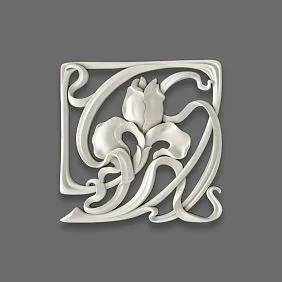
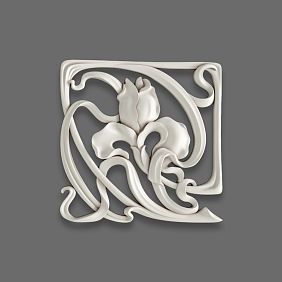
What makes Art Nouveau so recognizable and appealing? Asymmetry as a compositional principle. Classicism is built on mirror reflection and predictable balance. Art Nouveau breaks these rules, creating dynamic, evolving compositions. A decorative wall element in Art Nouveau style might start as a thin stem at the bottom, unfold into a bud in the middle, and dissolve into swirls at the top—and it looks absolutely natural.
Plant motifs dominate Art Nouveau ornamentation, but these aren't stylized acanthus leaves of classicism. These are real plants—irises, lilies, poppies, bindweeds, algae. They are depicted recognizably, with botanical accuracy, yet simultaneously transformed into ornament, becoming part of the architecture. Stems flow into molding lines, petals form capitals, roots entwine column bases.
Fluidity of lines is another characteristic feature. In Art Nouveau, there are almost no right angles or sharp transitions. Everything is smooth, everything flows. Lines guide the eye across the surface, creating continuous movement. This connects Art Nouveau with natural forms—waves, tongues of flame, curves of growing shoots.Wall moldingArt Nouveau stucco never looks static—it lives, breathes, evolves.




Symbolism and metaphorical forms
Art Nouveau is deeply symbolic. Behind the external decorativeness lie philosophical meanings. A growing shoot symbolizes development, renewal, vitality. A blooming flower represents the unfolding of potential, reaching maturity. Winding lines signify the continuity of existence, the interconnectedness of all things. This metaphorical quality makes Art Nouveau stucco decor intellectually rich, inviting contemplation.
Female imagery is another important motif. Girls with flowing hair, mermaids, nymphs often become central elements of Art Nouveau compositions. They personify natural elements, the beauty of naturalness, the unity of humans and nature. Unlike classical goddesses, Art Nouveau female figures are earthly, realistic, full of movement and emotion.
Exotic motifs are also characteristic of the style. Japanese art had a tremendous influence on the formation of Art Nouveau aesthetics. Asymmetrical compositions, refined simplicity of forms, attention to line—all this came from ukiyo-e. In Art Nouveau decor, you can encounter images of peacocks, butterflies, dragonflies, dragons—creatures embodying exotic beauty.
Our factory also produces:


From classic to modern: the evolution of taste
Why does classical stucco begin to tire? Because it's the same everywhere. Enter a luxury apartment, a respectable company's office, a premium restaurant—everywhere the same Ionic capitals, the same garlands, the same rosettes. Classicism has become a cliché, lost its individuality. When the neighboring apartment has exactly the same cornices as yours, the sense of uniqueness disappears.
Modern offers diversity. There are no two identical elements in the Art Nouveau style — every curl is unique, every rosette is one-of-a-kind.Modern Collectionincludes dozens of decorative element options, but even among them you won't find exact copies. Asymmetry and organic forms do not allow mechanical reproduction.
Fatigue from symmetry is a natural reaction of modern humans. We live in a world where symmetry is artificial. Nature is asymmetrical — a tree does not grow with mirror-identical branches, a cloud does not have a regular shape, a seashore does not repeat itself. Classical symmetry is beautiful but alienated from the living world. Art Nouveau returns architecture to natural principles.
Get Consultation
Paradigm shift: from imitation to creation
Classicism always looked back — to antiquity, to the Renaissance, to historical models. Art Nouveau looked forward, striving to create something new. It is a style of creativity, not imitation. A decorative wall element in the Art Nouveau style is the result of an author's vision, not copying a pattern from an order book. This novelty refreshes, inspires, and stimulates the imagination.
Integration with modernity is another advantage of Art Nouveau. Classical decor conflicts with modern technologies, materials, and lifestyles. Antique columns look strange next to a plasma panel, Baroque cornices clash with minimalist furniture. Art Nouveau organically combines with modernity — its organic forms and natural lines easily integrate into contemporary interiors.
Art Nouveau decorative elements: typology and application
What exactly is included in the range of Art Nouveau molding?carved appliqués— flat or relief elements with plant and floral motifs. Sizes range from miniature 100x100 mm to large-scale panels 600x800 mm. Shapes are asymmetrical—vertical sprout, diagonal curl, circular movement of petals. Overlays are attached to walls, doors, furniture, creating accent zones.
Rosettes in the Art Nouveau style are fundamentally different from classical ones. Instead of concentric circles and radial symmetry — a free composition of intertwining stems and flowers. The center may be offset, edges uneven, the shape may be elongated or asymmetrical. Such rosettes turn the chandelier mounting point into an independent decorative panel.
Art Nouveau brackets and consoles do not imitate architectural structure like classical ones. They become sculptural objects — curved stems supporting a shelf, a female figure serving as a cornice support, an intertwining of branches carrying a balcony. Function combines with high decorativeness, creating expressive accents.
Molding and trim in the Art Nouveau style are used for framing panels, creating decorative frames on walls, and decorating door and window openings. Profiles are asymmetrical, with characteristic curves and plant motifs. Unlike straight classical trim, Art Nouveau elements often have a wavy form, creating dynamic framing.
Manufacturing materials: wood and polyurethane
Carved wooden decorationis ideal for embodying the aesthetics of Art Nouveau. The organic nature of wood resonates with the organic nature of the style. Flowing carving lines naturally convey the movement of plant forms. Deep relief creates a play of light and shadow, emphasizing the volume of compositions. Wood allows for fine detailing — the thinnest leaf veins, delicate petals, graceful curls.
polyurethane moldingsoffers its own advantages. Moisture resistance allows the use of decor in bathrooms, kitchens, and on facades. Lightweight simplifies installation, does not require wall reinforcement. Cost is lower than wooden analogues with comparable detailing. Polyurethane allows creating large elements without seams, which is important for large-scale compositions.
Combining materials yields the best result. The main volume of decor is polyurethane elements: cornices, baseboards, background overlays. Accent details are wooden carvings: central panels, unique brackets, frames. This approach optimizes the budget while maintaining high aesthetics. Wood brings tactile warmth and natural texture, polyurethane provides practicality and cost-effectiveness.
Application of Art Nouveau molding in interiors
How to use a decorative wall element in the Art Nouveau style to create a harmonious interior? An accent wall is the most popular technique. Choose one wall in the room, decorate it with a composition of Art Nouveau overlays. This could be the wall behind the bed headboard in a bedroom, the wall with the TV in a living room, the wall opposite the entrance in a hallway.Wall claddingcreates a focal point, sets the style for the entire room.
Decorating door openings turns a utilitarian element into an artistic object. Art Nouveau overlays frame the door with an asymmetrical composition — a growing stem on one side, a blooming flower above the opening, cascading leaves on the other. This creates the effect of a living portal, natural gates leading to another space.
Decorating furniture is a way to integrate the Art Nouveau style without major renovation. Overlays are attached to cabinet fronts, dresser doors, bed headboards. Standard furniture gains individuality, turns into designer pieces. This works especially effectively on monochrome furniture with simple forms — a minimalist base becomes a canvas for modernist decor.
Ceiling compositions in the Art Nouveau style create a unique atmosphere. Instead of a traditional central rosette — an asymmetrical panel from which thin molded branches radiate. They creep across the ceiling, descend onto walls, creating a three-dimensional composition that unites all surfaces of the room. This technique visually erases boundaries between planes, creates an illusion of unified space.
Color solutions for Art Nouveau molding
The traditional approach is painting to match the main surface color. A wall with molding of the same tone creates a bas-relief effect, where the decor is perceived through the play of light and shadow on the relief. This is a restrained, elegant option suitable for any interiors. The color can be anything — from classic white to deep dark shades.
Contrast painting emphasizes the ornament, makes it graphic and noticeable. White molding on a dark wall — a classic contrast creating clear forms. Dark molding on a light wall — a modern inversion giving the decor weight. Colored molding on a neutral background — a way to introduce an accent, support the interior's color scheme.
Patination and toning create an effect of antiquity and nobility. A base color is applied to the entire surface, then a contrasting shade — gold, bronze, copper, silver — is rubbed into the recesses of the relief. This emphasizes the depth of carving, creates a rich, multi-layered surface. This works especially effectively on wooden carvings, where patina highlights the wood texture.
Combining Art Nouveau with other styles
Can Art Nouveau molding coexist with classical elements? Yes, but caution is required. The key to success is zoning. In one room — classic, in the adjacent — Art Nouveau. Or within one room, different zones are decorated differently — a classical fireplace but modernist window framing. Direct mixing of classical and modernist elements on one surface creates visual conflict.
Combining Art Nouveau with contemporary styles is more organic. Minimalism with its clean planes becomes an ideal backdrop for Art Nouveau accent elements. Loft with its industrial brutality receives an elegant counterpoint in the form of organic molding. Scandinavian style with its naturalness naturally accepts Art Nouveau's plant motifs.
Art Nouveau molding and classicdiffer so radically that combining them requires a professional approach. Work with a designer if you plan complex combinations. A properly implemented combination creates a rich, multi-layered interior. An unsuccessful one looks like a collection of random elements.
Art Nouveau in a contemporary interpretation
Historical Art Nouveau of the early 20th century was lush and decoratively rich. Every surface was covered with ornaments, every element was abundant in details. The contemporary interpretation of the style is more restrained. Characteristic motifs and recognizable forms are used, but in moderate quantities.Art Nouveau style decortoday is more about accents than total decoration.
The principle of selective use: do not cover all walls with moldings, but create several bright accents. One large-scale panel is better than many small overlays. One expressive mirror frame is more effective than a scattering of decorative elements. Contemporary Art Nouveau values air, space, and pauses between decorative episodes.
Integration with technology is a necessity of modernity. Behind Art Nouveau plaster decor, you can hide wiring for concealed lighting, audio system speakers, and smart home sensors. The organic forms of the decor naturally mask technical elements without creating a sense of artificiality. This allows combining historical aesthetics with modern comfort.
Practical aspects of selection and purchase
How to correctly choose Art Nouveau moldings for your project? Start by determining the scale. In small rooms, use miniature overlays and thin profiles. Large decor in a small room creates a feeling of tightness, feels oppressive, and overloads the space. In spacious rooms, on the contrary, small decor gets lost and fails to make an impression—here, large-scale elements are needed.
Maintain stylistic unity. If you choose floral motifs with irises, use them in all elements. Mixing different plant motifs (irises on one wall, poppies on another) creates inconsistency. It's better to vary the scale and placement of one motif than to combine different ones. Unity of ornamentation links the elements into a cohesive composition.
Consider the material when choosing. For wet rooms—only polyurethane. For living rooms, you can use wood, which creates a special tactile warmth. For large wall panels, polyurethane is preferable due to its lighter weight. For accent small details—wood, which allows for maximum carving detail.
Where and how to buy Art Nouveau decor
Decor collectionsfrom professional manufacturers is a reliable source of quality products. Here you will find a systematic assortment where elements are selected by style, scale, and compatibility. By purchasing from one collection, you guarantee visual compatibility of all details.
Ordering online is convenient but has limitations. You cannot assess the quality of carving, depth of relief, or texture of the material. Request additional photos of specific items you plan to buy from the seller. Clarify the possibility of return if the product does not meet expectations upon receipt. Read reviews from other buyers—they provide a realistic idea of quality.
Visiting a showroom or production facility allows you to see and touch the products. Assess the carving quality—clarity of lines, absence of chips, uniformity of relief. Check the geometry—overlays should be flat, without deformations. Inquire about the possibility of ordering elements according to custom sizes or sketches—this expands design possibilities.
Installation of wall moldings: installation technology
How to properly install wall moldings so they last for decades? Surface preparation is a critical stage. The wall must be clean, dry, and strong. Remove peeling paint and crumbling plaster. Fill cracks, level significant unevenness. Treat the surface with a deep-penetration primer—this will improve the adhesive's adhesion.
Marking the position of elements requires precision. Use a level to check horizontality and verticality. Mark the contours of future overlay placement with a pencil. When creating symmetrical compositions, find and mark the central axis. For asymmetrical ones—determine key points from which the composition develops.
The choice of adhesive depends on the material. For wooden elements—carpenter's PVA or polyurethane glue. For polyurethane overlays—special polyurethane glue or acrylic mounting adhesive. Avoid solvent-based adhesives—they can damage polyurethane. Apply a thin layer of adhesive to the back of the overlay, press it to the wall, and secure it during the setting time.
Additional mechanical fastening is necessary for large and heavy elements. Use thin finishing nails or screws, sinking them into the wood. Fill the holes with wood filler, sand after drying. For polyurethane, use screws with washers, also with subsequent filling of the screw heads.
Finishing and painting
Filling joints and fastening points creates a monolithic surface. Use acrylic filler, filling all gaps and depressions. After drying, sand with fine sandpaper until smooth. Quality filling makes connection points invisible, creating the illusion of a solid product.
Priming before painting is mandatory. Primer evens out surface absorbency, improves paint adhesion, and reduces its consumption. For wooden elements, use wood primer; for polyurethane ones—universal acrylic primer. Apply a thin layer and let it dry completely before painting.
Perform painting with quality interior paints. Acrylic paints are universal and suitable for any surfaces. Apply with a medium-sized brush, thoroughly painting all relief depressions. For an even color, 2-3 coats with intermediate drying will be needed. The first coat can be slightly diluted with water for better penetration into the material's pores.
Caring for Art Nouveau moldings: preserving beauty
How to maintain a decorative wall element in perfect condition? Regular dry cleaning prevents dust accumulation. Use a soft brush or natural bristle broom. Gently go over the relief, removing dust from depressions. Frequency—once every 1-2 weeks for living spaces, more often for rooms with increased dustiness.
Wet cleaning is necessary in rooms where dirt accumulates—in the kitchen, hallway. Wipe the moldings with a damp soft cloth with a small amount of soapy solution. Avoid excessive moisture on wooden elements. Polyurethane overlays can be washed more intensively—they are not afraid of moisture.
Repainting is required every few years. Even quality paints lose saturation over time, fade, and get dirty. Refresh the color by applying a fresh coat of paint. This will restore the moldings' original brightness and hide minor damage. Before painting, clean the surface of dust and dirt.
Protection against damage
Mechanical damage is the main threat to wall moldings. Be careful when moving furniture, especially tall pieces. Sharp corners of cabinets and protruding parts can catch and damage overlays. During repair work, protect the decor with film or cardboard.
Wooden carvings can crack over time due to humidity fluctuations. Maintain a stable microclimate—temperature 18-25°C, humidity 40-60%. Use humidifiers in winter when heating dries the air. This will preserve the wood and prevent cracks.
Polyurethane elements practically require no special care. They are not afraid of humidity, do not crack, and do not deform. The only precaution—avoid impacts from heavy objects that can leave dents. Minor damage is easily repaired with filler followed by touch-up painting.
Frequently asked questions
Is modern molding suitable for small apartments?
Yes, but with caveats. In small spaces, use small overlays, create local accents rather than full wall coverage. One or two expressive elements on the wall will create a stylish accent without overwhelming the space. Avoid large-scale compositions—they will visually shrink the room.
Can wooden and polyurethane modern elements be combined?
Yes, and it's recommended. Use wood for accent elements that are at eye level and within reach for touch. Polyurethane is for background elements placed high or in large quantities. After painting in a single color, material differences are visually unnoticeable, but wood provides pleasant tactile sensations.
How much does it cost to decorate one wall with modern molding?
Depends on material, element size, composition complexity. Simple decoration with polyurethane overlays—from 15-20 thousand rubles for a 3x2.5 meter wall. Complex composition with wooden carving—from 50-80 thousand. Custom manufacturing of unique elements from a sketch—from 100 thousand and above.
Can modern molding be used on facades?
Yes, but only from materials resistant to atmospheric influences. Polyurethane facade elements are ideal—they are not afraid of moisture, frost, ultraviolet light. Wooden carving on facades requires special treatment with protective compounds and regular coating renewal.
How to choose a color for painting modern molding?
Three main approaches: matching the wall color (creates relief through light play), contrasting color (emphasizes the ornament, makes it graphic), natural shades (greens, browns, coppers—support the plant theme). Avoid overly bright unnatural colors—they conflict with the organic nature of the style.
Is special equipment required for installation?
No, a standard set is sufficient: level, tape measure, pencil, brushes for glue and paint, spatulas, sandpaper. For wooden elements, a saw for trimming may be needed. For mechanical fastening—drill, screws. No specialized expensive equipment is required.
Can molding be installed on wallpaper?
Not advisable. Wallpaper is not a sufficiently strong base; the glue holds the overlay not on the wall but on the wallpaper. Over time, under the weight of the decor, wallpaper may peel off along with the overlays. It's optimal to mount molding on plastered or painted walls. If you still mount on wallpaper—use only lightweight polyurethane elements and high-quality glue.
How long does wall molding last?
With proper installation and care—decades. Wooden carving lasts 30-50 years or more, polyurethane elements—up to 50-70 years. Key durability factors: material quality, correct installation, stable microclimate, regular care. In historical buildings, modern molding from the early 20th century has been preserved—over 100 years.
Are there ready-made kits for wall decoration?
Some manufacturers offer ready-made compositional solutions—sets of matching elements to create complete panels. This simplifies selection and guarantees stylistic compatibility. However, individual selection of elements for a specific room provides a more personalized result.
Can custom manufacturing of unique elements be ordered from one's own sketch?
Yes, many manufacturers offer custom manufacturing services. You provide a sketch, the manufacturer creates a mold, casts or cuts the required number of products. This is more expensive than buying standard elements but allows creating a truly unique interior with no analogues.
Conclusion: Discover a new aesthetic
If classic has become boring, if you want freshness, organicity, naturalness—modern molding will open new horizons in interior design. This is not just a change of ornaments, it's a change in the philosophy of decor. From rigid symmetry to free compositions, from geometry to organic forms, from imitation to creativity.wall moldingModern molding turns a room into a living space where decor breathes, evolves, tells stories.
Modern decoration collectionModern molding includes elements for any task—from miniature accents to large-scale wall compositions. The variety of shapes, sizes, motifs allows implementing any design concept. Combining wooden and polyurethane elements provides an optimal blend of aesthetics and practicality.
Company STAVROS offers an extensivecollection of modern decor, including carved overlays, brackets, rosettes, moldings. Products are made from solid wood of valuable species and high-quality polyurethane. Each element undergoes strict quality control ensuring dimensional accuracy, relief clarity, and absence of defects.
STAVROS is not limited to standard assortment. The company offers custom manufacturing services for elements based on author's sketches. A team of experienced carvers and technologists will implement any idea, create unique decorative compositions with no analogues. From simple adaptation of standard element sizes to development of completely original forms—all this is within STAVROS's capabilities.
Technical support includes consultations on element selection, development of compositional schemes, calculation of required material quantities. STAVROS specialists will help select elements harmoniously matching your interior, suggest optimal placement options, provide recommendations for installation and finishing. If necessary, supervision or training of your craftsmen is organized.
Choosing STAVROS, you get not just decorative elements, but a comprehensive solution for creating a unique interior. High material quality, craftsmanship, professional support at all stages—the company ensures a result that will delight for decades. Discover the beauty of modern style with STAVROS—your reliable partner in the world of architectural decor.