












































































Article Contents:
- The Material of the Future with the Face of the Past: What is Polyurethane
- Polyurethane vs. Plaster: The Battle of Materials
- Cornices: The Line That Defines Space
- Sizes and Profiles: From Delicate to Monumental
- Hidden Lighting: The Cornice as a Light Source
- Rosettes: Symmetry Around Light
- From Modest Medallions to Luxurious Compositions
- Installing a Rosette: Easier Than It Seems
- Moldings: Lines That Create Wall Architecture
- Wall Panels: Geometry vs. Chaos
- Decorative Overlays: Accents on Moldings
- Ceiling Molding: From Modest Cornices to Coffered Systems
- Coffers: Depth on a Flat Surface
- Beams: Industrial Aesthetics from Polymer
- Capitals and Pilasters: Vertical Architecture
- Pilasters: Columns Living in the Wall
- Capitals: The Crown of the Vertical
- Molding Decor in Different Interior Styles
- Classicism: Strict Symmetry and Antique Motifs
- Baroque: luxury without limits
- Art Deco: Geometry and Glamour
- Modern Minimalism: Molding Without Ornament
- Installing Polyurethane Molding: Accessible to Everyone
- Surface Preparation: Cleanliness is the Key to Reliability
- Choosing Adhesive: Specialized or Universal
- Installation Process: Press and Wait
- Painting: The Final Touch
- Where to Buy Polyurethane Molding: Criteria for Choosing a Manufacturer
- Polyurethane Density: The Foundation of Quality
- Relief Detailing: Art in Every Curl
- Surface: Smoothness Without Flaws
- Geometry: straight lines without curvature
- Assortment and availability: unlimited choice
- Frequently Asked Questions About Polyurethane Moldings
- Is polyurethane safe for residential spaces?
- Can polyurethane molding be used in a bathroom?
- How long does polyurethane stucco last?
- Can polyurethane molding be painted?
- Does polyurethane differ visually from plaster?
- Is it difficult to install polyurethane molding yourself?
- Can polyurethane molding be used on stretch ceilings?
- How much does polyurethane molding cost?
- Is polyurethane flammable?
- Does polyurethane molding require special care?
- Conclusion: technology in the service of beauty

Plaster is dead. A bold statement? Perhaps. But face the truth: a heavy, fragile, finicky-to-install, expensive material that has been used for centuries to createmoldingsis giving way to a revolutionary alternative.Polyurethane moldingsis not a compromise, not a cheap imitation, but a technological breakthrough that preserves all the aesthetics of classical decor while eliminating all its shortcomings.
Do you still think that true luxury is only possible with plaster? That polymers are about cheap plastic fakes? Then it's time to rethink your ideas about materials. Modern polyurethane compositions create detailing that is unattainable even for an experienced plasterer by hand. They weigh ten times less than plaster, last for decades without cracks or chips, are installed in hours, not days, cost many times less—and yet look absolutely identical to classical molding.
Let's figure out whyBuy moldingswhich thousands of apartment and country house owners are striving for today, made of polyurethane has become the main trend in interior decor for 2026.
The material of the future with the face of the past: what is polyurethane
Polyurethane is a family of polymers obtained through a chemical reaction of polyols and isocyanates. Sounds complex and chemical? In reality, it's a high-tech material that surrounds us everywhere—from shoe soles to automotive parts, from medical implants to construction insulation.
For the production of decorative molding, a special two-component high-density polyurethane is used. This is not the foamed material used in insulation. The density of polyurethane for molding is 600-800 kg/m³—comparable to the density of some types of wood. The material is hard, durable, elastic, yet significantly lighter than plaster.
The production process looks like this: a master model of an element (rosette, cornice, overlay, capital) is hand-carved from wood or molded from plaster with maximum detail. This is the author's work of a sculptor, where every curl, every acanthus leaf, every bead is worked out with jewelry precision. Then a silicone mold is taken from the master model, capable of conveying the smallest nuances of the relief.
A liquid mixture of polyurethane components is poured into this mold. A chemical reaction occurs, the material hardens, expands, filling the mold, precisely replicating every microscopic detail. After hardening, the element is extracted—and before us is a perfect copy of the master model, absolutely identical in relief, but made from a modern material.
The key advantage of casting is repeatability. Hundreds and thousands of identical elements can be produced from a single mold. Moreover, each will be absolutely identical—the same relief height, the same line clarity. This is impossible with hand-molded plaster, where each element is unique but also unpredictable in quality.




Polyurethane versus plaster: the battle of materials
Let's honestly compare the two materials by key parameters.
Weight. A polyurethane rosette with a diameter of 800 millimeters weighs about 1.5-2 kilograms. A similar plaster one—15-20 kilograms. A tenfold difference. This is critical for installation on suspended ceilings, drywall constructions, thin partitions. Heavy plaster requires reinforced fasteners, anchors, professional installation. Light polyurethane is glued with ordinary mounting adhesive.
Strength. Plaster is fragile. An impact during transportation—a chip. Careless installation—a crack. Building settlement—destruction. Polyurethane is elastic. It absorbs impacts, does not crack under deformations, withstands significant loads without damage.
Moisture resistance. Plaster is hygroscopic. It absorbs moisture, becomes soggy, loses shape. Plaster molding cannot be used in bathrooms, kitchens with high humidity, swimming pools. Polyurethane is absolutely moisture-resistant. It is not afraid of water splashes, steam, condensation.Wall moldingsbathroom molding made of polyurethane is a common solution in elite projects.
Installation. Plaster molding is installed by professionals. Heavy elements require fasteners, reinforcement, precise fitting. The process takes days. Polyurethane is installed with adhesive in hours. This is accessible even to a non-professional with basic repair skills.
Price. Handmade plaster molding costs from 5000 rubles per linear meter of cornice. Polyurethane—from 300 rubles. A 15-20 times difference. Moreover, only a specialist up close can visually distinguish them.
Detailing. Here, plaster was traditionally considered beyond competition. But modern polyurethane casting technologies provide detailing down to fractions of a millimeter. Silicone molds convey the smallest nuances of the master model's relief. The result is polyurethane molding with line clarity, perfect symmetry, absolute repeatability of details.
The conclusion is obvious: polyurethane surpasses plaster in all practical parameters, yielding only in one aspect—the aura of 'genuine material.' But this aura is an illusion. After installation and painting, distinguishing plaster from polyurethane is impossible. And the advantages of polyurethane remain forever.
Our factory also produces:


Cornices: the line that defines space
Ceiling Molding— the most common type of molding. They frame the perimeter of the ceiling, creating a transition from the vertical plane of the wall to the horizontal plane of the ceiling. It might seem like a utilitarian function—to conceal the joint. But it is precisely the cornice that defines the character of the room.
Get Consultation
Sizes and profiles: from delicate to monumental
The height of the cornice is the key parameter determining visual impact. Thin cornices 30-50 millimeters high are a delicate touch, barely noticeable but creating completeness. They are suitable for small rooms with ceilings 2.5-2.7 meters high, where a wide cornice would visually reduce the already limited height.
Medium cornices 70-120 millimeters are a universal solution for most living spaces with ceilings 2.8-3.2 meters high. They are noticeable enough to structure the space but do not overwhelm it. Such cornices are appropriate in living rooms, bedrooms, dining rooms.
Wide cornices 150-300 millimeters are monumental decor for spacious rooms with high ceilings from 3.5 meters and above. Large halls, foyers, stairwells, executive offices require proportionate decor. A massive cornice with rich ornamentation creates a sense of respectability, solidity, and historical continuity.
The cornice profile can be simple or complex. Simple profiles are smooth coves with one or two rounded edges. They create a smooth transition from wall to ceiling without attracting excessive attention. Such cornices are appropriate in minimalist, modern interiors.
Complex profiles include several levels of relief—protrusions, recesses, grooves, beads, egg-and-dart, meanders, floral ornaments. Each element of the profile casts its own shadow, creating a play of light and volume. Such cornices are an attribute of classical interiors, Baroque, Empire, Neoclassical.
Hidden lighting: the cornice as a light source
One of the brilliant applications of polyurethane cornices is creating hidden ceiling lighting. The cornice is attached to the wall at a distance of 80-150 millimeters from the ceiling. An LED strip is placed in the resulting space, directed towards the ceiling.
The light reflects off the ceiling, creating soft diffused lighting, visually separates the ceiling from the walls, and creates a floating ceiling effect. At the same time, the light source itself is hidden by the cornice; only the reflected light is visible.
Such lighting serves several functions. Decorative—the ceiling becomes luminous, creating an atmosphere. Practical—an additional source of soft light that can be used as main lighting in a bedroom or as evening lighting in a living room. Visual correction—a luminous ceiling appears higher, the room—more spacious.
For hidden lighting, special cornices with a wide upper shelf, on which the strip can be placed, and a vertical wall that hides the light from direct view are used.
Ceiling roses: symmetry around light
ceiling rosettes— round or polygonal decorative elements with radially symmetrical ornamentation, installed in the center of the ceiling around a chandelier.
From modest medallions to luxurious compositions
The diameter of the ceiling rose determines its visual impact. Small roses 200-400 millimeters are delicate medallions framing the chandelier mount. They conceal the mounting hole, add decorativeness, but do not dominate.
Medium roses 500-800 millimeters are expressive accents that become the compositional center of the ceiling. The gaze is drawn to the rose, from which visual energy spreads throughout the room.
Large roses 1000-1500 millimeters and more are dramatic dominants for spacious halls with high ceilings. Such a rose does not just frame the chandelier; it itself becomes the main decorative element of the ceiling.
The ornament of the rose reflects the style of the interior. Classical roses reproduce antique motifs—acanthus leaves, rosettes, palmettes, meanders. Baroque roses abound in scrolls, rocaille, asymmetrical floral compositions. Empire-style roses are strict, symmetrical, and include military symbolism—laurel wreaths, torches, heraldic eagles.
Modern roses can be minimalist—concentric circles without ornamentation, geometric stars, laconic radial compositions. They are suitable for contemporary interiors where classical luxury is inappropriate, but structure and decorativeness are desired.
Installing a ceiling rose: easier than it seems
A polyurethane ceiling rose weighs 1-3 kilograms even with a diameter of one meter. Installation is elementary: special polyurethane adhesive is applied to the back side, the rose is pressed against the ceiling in the desired location (usually the center of the room, the chandelier mounting point), and held for several minutes. The adhesive sets, and the rose is securely fixed.
First, a hole for the chandelier wiring is drilled in the center of the outlet box—30-50 millimeters in diameter, depending on the cable thickness and mounting type. After installing the outlet box, the wiring is passed through this hole, and the chandelier is mounted.
If the ceiling is drywall or stretch, the rose is installed before mounting the chandelier. First, the rose is fixed, then the chandelier mount is installed through it. It is important that the mount is fixed in the base ceiling, not in the rose—it is decorative, not load-bearing.
After installation, the rose is painted along with the ceiling or separately—in the same color or a contrasting one. A white rose on a white ceiling creates a delicate relief. A gilded rose on a white or colored ceiling is a luxurious accent.
Moldings: lines that create wall architecture
Moldings made of polyurethane— elongated profiled strips used for decorating walls, creating panels, framing doors, windows, mirrors, paintings.
Wall panels: geometry versus chaos
A bare wall is a plane without character.Wall moldingMoldings transform it into an architectural object. The simplest solution is rectangular molding frames that divide the wall into panels.
Classic scheme: a wall 3 meters high is divided horizontally into three zones. The lower zone, 80-100 centimeters high (the plinth), is framed with moldings; the space inside is painted the same color as the moldings or a contrasting one. The middle zone, 150-180 centimeters high, is the main plane, where vertical molding panels are placed, with a distance of 80-120 centimeters between panels. The upper zone is a frieze, 40-60 centimeters high, between the top line of the panels and the ceiling cornice.
Inside the panels, the wall can be painted, wallpapered with a pattern, covered with decorative plaster, or upholstered with fabric. Moldings create a frame that structures the decorative filling, preventing it from turning into visual noise.
Moldings are also used to frame door and window openings. Instead of standard flat casings, three-dimensional moldings with ornamentation are installed. The opening becomes an architectural element, not just a technical hole in the wall.
Decorative overlays: accents on moldings
Long, extended lines of moldings can look monotonous.Polyurethane decorative appliquesOverlays break this monotony, creating accents.
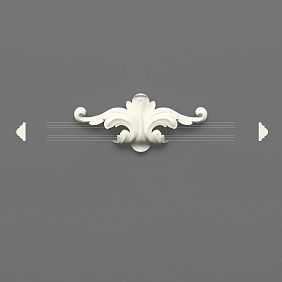
Overlays are small decorative elements ranging in size from 50×50 millimeters to 300×300 millimeters with carved ornamentation. They are attached to moldings at the corners of panels, in the center of horizontal or vertical sections, creating visual accents.
Corner overlays decorate the corners of frames. Instead of a simple 45-degree joint of two moldings, a decorative corner overlay with floral, geometric, or figurative ornamentation is installed. The corners become expressive and attract the eye.
Central overlays are placed in the middle of extended sections of moldings. They create rhythm, break a long line into segments, and make the composition more dynamic.
Thematic overlays can depict rosettes, medallions, cartouches, mascaron, or coats of arms. They turn a molding composition into a decorative panel that tells a story and creates a mood.
Ceiling stucco: from modest cornices to coffered systems
Ceiling moldingCeiling decoration is not limited to cornices and rosettes. Polyurethane elements allow for creating complex multi-level compositions, coffered ceilings, and imitations of beam structures.
Coffers: depth on a flat surface
A coffered ceiling is a grid structure of beams forming recessed panels (coffers) of square or rectangular shape. Traditionally, coffers were made of wood or plaster and required a significant reduction in room height.
Polyurethane moldings allow for imitating coffers without actual recessing. Moldings are glued onto a smooth ceiling, forming a grid. Visually, the effect of three-dimensional beams and recessed panels is created, but the ceiling height remains unchanged.
The size of coffers is determined by the area and proportions of the room. In a square room of 4×4 meters, coffers of 80×80 centimeters are optimal, forming a 5×5 grid of cells. In a rectangular room of 5×3 meters, rectangular coffers of 100×75 centimeters are appropriate.
Inside the coffers, additional decor can be placed—small rosettes, overlays, or painted in a contrasting color. Built-in spotlights in the center or along the perimeter of the coffers create impressive lighting that emphasizes the volume.
Beams: industrial aesthetics from polymer
Imitation of wooden beams made of polyurethane is a popular solution for interiors in loft, country, or chalet styles. Hollow polyurethane boxes, painted to look like wood or left white, are attached to the ceiling, creating the illusion of a beam structure.
The advantage over real wooden beams is weight. A polyurethane beam 4 meters long weighs 3-5 kilograms compared to 40-60 kilograms for a wooden one. It can be attached to a drywall ceiling without the risk of collapse.
Beams are placed parallel with a spacing of 60-100 centimeters, creating a rhythmic structure. The ceiling between the beams is painted in a contrasting color or left white. Built-in lighting along the beams emphasizes their volume and creates dramatic illumination.
Capitals and pilasters: vertical architecture
Polyurethane capitals and pilastersPilasters are vertical architectural elements that structure walls, creating the illusion of a columnar order.
Pilasters: columns living in the wall
A pilaster is a vertical projection on a wall that imitates a column. It consists of a base (foundation), a shaft (central part), and a capital (crowning element). The pilaster does not bear load; it is purely a decorative element.
Polyurethane pilasters are produced as separate sections—base, shaft of varying lengths, and capital. This allows assembling a pilaster of any height for a specific room. For a room with a 3-meter ceiling, a shaft 2.5 meters high, a base 30 centimeters high, and a capital 20 centimeters high are chosen. For a room with a 4.5-meter ceiling—a shaft 4 meters high.
Pilasters are installed along walls, frame door openings, and highlight zones. Two pilasters on either side of a fireplace create a portal. Pilasters in the corners of a room structure the space and create rhythm. A row of pilasters along a long wall divides it into segments, in each of which decor, furniture, or a painting can be placed.
Capitals: the crown of the vertical
A capital is the upper part of a column or pilaster, a decorative finish. There are several classical orders, each with its own type of capital.
Doric capital — simple, concise, consists of a round element (echinus) and a square slab (abacus). Suitable for strict, minimalist interiors.
Ionic capital — with characteristic scrolls (volutes) on the sides. More decorative, elegant, associated with classicism.
Corinthian capital — the most luxurious, decorated with stylized acanthus leaves, creating a lush crown. Used in rich, formal interiors.
Composite capital — a combination of Ionic volutes and Corinthian leaves, maximum decorativeness.
Polyurethane capitals accurately reproduce classical models but weigh several hundred grams instead of tens of kilograms like plaster or stone counterparts.
Molding decor in different interior styles
Relief Decorationis universal, but each style requires its own approach to selecting elements, their scale, and ornamentation.
Classicism: strict symmetry and antique motifs
A classical interior is built on symmetry, proportionality, and balance. Molding here is not a decoration but an architectural necessity.
Cornices with meander, egg-and-dart, rows of beads. Rosettes with palmettes, acanthus
leaves, symmetrical rosettes. Moldings of strict profiles create panels on walls. Pilasters with Ionic or Corinthian capitals structure the space.
Molding color — white-on-white for delicate relief or contrasting — white molding on colored walls (blue, green, terracotta). Gilding is used sparingly — only on accents, capitals, central rosettes.
Baroque: luxury without limits
Baroque interior — it's theater, drama, excess. Molding here dominates, covering walls and ceilings with a continuous pattern.
Cornices are wide, multi-level, with abundant ornamentation — scrolls, cartouches, putti figures. Rosettes are large, asymmetrical, with dynamic rocaille. Walls are covered with moldings, overlays, relief panels. Corners are decorated with corner overlays with floral garlands.
Color — white molding on colored walls or full gilding. Baroque knows no restraint; here gold can cover all the molding, creating dazzling luxury.
Art Deco: geometry and glamour.
Art Deco combines classical forms and modern geometry. Molding here is symmetrical but not antique, rather modernized.
Cornices with geometric meanders, zigzags, stepped profiles. Rosettes in the shape of stars, radial compositions, symmetrical geometric patterns. Moldings create strict rectangular panels. Instead of pilasters — vertical fluted strips.
Color — contrasting combinations of black and white, gold and black, silver and gray. Molding can be painted in metallic shades — silver, bronze, gold.
Modern minimalism: molding without ornament
Can molding be used in a minimalist interior? Yes, but it should be concise, without ornament.
Simple smooth cornices with one rounding. Rosettes in the form of concentric circles without decoration. Moldings of strict rectangular profiles. No overlays, scrolls, or plant motifs.
Color — monochrome. White molding on white walls and ceiling creates a delicate relief, noticeable only due to the play of light. Black molding on light surfaces — a graphic accent.
Molding in minimalism is not decoration but an architectural structure that creates the geometry of space.
Installation of polyurethane molding: accessible to everyone
One of the main advantages of polyurethane is ease of installation. Installing a cornice, rosette, or moldings can be done by a person without professional skills.
Surface preparation: cleanliness is the key to reliability
The surface on which the molding is mounted must be clean, dry, and degreased. Dust, dirt, and grease reduce the adhesive's adhesion, and the element may come off.
If the surface is painted with oil paint or varnished, it needs to be sanded with sandpaper to create roughness for better adhesion. Wallpaper is best removed in the areas where molding will be installed; glue directly onto plaster or drywall.
Surface irregularities are not critical — polyurethane is flexible and follows minor curvatures. But significant protrusions or depressions are better leveled with putty.
Glue selection: specialized or universal
For polyurethane moldings, special polyurethane- or acrylic-based adhesives are used. They provide reliable adhesion, set quickly, and do not damage the material.
Popular options include polyurethane glue like 'liquid nails,' acrylic mounting adhesive, and specialized glue for polyurethane moldings. It is important that the glue is white or transparent—colored glue may show through thin sections of the element.
Glue is applied to the back of the element in a zigzag or dotted line. For heavy elements (large rosettes, long cornices), the glue is applied in a continuous layer.
Installation process: press and wait
The element with applied glue is placed against the surface in the desired location and pressed. Polyurethane is lightweight, so holding it in place is not difficult. The glue sets in 5-10 minutes, with full polymerization occurring within 24 hours.
For heavy elements or ceiling installation, temporary supports—such as wooden blocks—are used to hold the element until the glue fully dries. The supports are removed after drying.
Joints between elements (e.g., between sections of a long cornice) are filled with acrylic sealant or putty, then sanded to make the joint invisible.
Cornice corners are cut at a 45-degree angle using a miter box and a fine-toothed saw. For complex profiles, ready-made corner elements can be used, eliminating the need for precise cutting.
Painting: the final touch
After installation, the molding is painted. Polyurethane accepts water-based acrylic and latex paints excellently. Alkyd and oil-based paints are also suitable but take longer to dry.
Before painting, it is advisable to prime the molding with acrylic primer to enhance paint adhesion. Paint is applied with a brush or roller in 2-3 coats for even coverage.
To create an aged or patina effect, special techniques are used—applying dark paint into the recesses of the relief and then wiping it off, creating wear marks, or gilding raised elements.
Where to buy polyurethane molding: criteria for choosing a manufacturer
The polyurethane molding market is saturated with offerings. How to choose quality products?
Polyurethane density: the foundation of quality
Polyurethane density determines strength, durability, and detail. Low-quality products are made from foamed polyurethane with a density of 300-400 kg/m³. They are lightweight but brittle, with blurred relief and unclear details.
Quality moldings are made from cast polyurethane with a density of 600-800 kg/m³. This material is strong, resilient, reproduces the finest relief details, and does not deform over time.
Relief detailing: art in every curl
The quality of the master model and mold determines the detailing of the finished product. Professional manufacturers commission master models from sculptors who work on museum restorations. Each element is hand-carved with jeweler-like precision.
Low-quality manufacturers copy others' samples and use simplified molds. The result is blurred relief, lack of fine details, and inaccurate symmetry.
When choosing, carefully examine a sample. Sharp, clear edges, deep shadows in recesses, and symmetrical elements are signs of quality.
Surface: smoothness without defects
The surface of quality polyurethane molding is smooth, without bubbles, pits, or drips. Surface defects indicate production technology violations—poor-quality raw materials, incorrect polymerization conditions, or mold wear.
Geometry: straight lines without warping
Long elements (cornices, moldings) should be straight, without warping. Round elements (rosettes) should be perfectly round. Geometry deviations complicate installation and create gaps in joints.
Range and availability: choice without limits
A wide range allows you to select elements precisely for your project. Stock programs ensure immediate shipment without waiting for production.
Frequently Asked Questions about Polyurethane Moldings
Is polyurethane safe for residential spaces?
Yes, polyurethane is completely safe. It is used in medicine for implants and in the production of children's toys. The material does not emit toxic substances, does not cause allergies, and is inert.
Can polyurethane molding be used in a bathroom?
Yes, polyurethane is completely moisture-resistant, not afraid of steam, condensation, or direct contact with water. It is ideal for wet areas — bathrooms, kitchens, swimming pools.
How long does polyurethane molding last?
With proper use — decades. Polyurethane does not crack, deform, or yellow (modern formulations with UV protection), maintaining its original appearance throughout the building's service life.
Can polyurethane molding be painted?
Yes, polyurethane paints excellently with acrylic, latex, and alkyd paints. You can create any colors, patina effects, metallic coatings, gilding.
Does polyurethane differ visually from plaster?
After installation and painting, it is impossible to distinguish polyurethane from plaster with the naked eye. Detailing, relief, and light play are identical. The difference is only in weight and strength.
Is it difficult to install polyurethane molding yourself?
No, installation is accessible to non-professionals. Elements are glued with mounting adhesive and do not require special tools. Basic repair skills are sufficient.
Can polyurethane molding be used on stretch ceilings?
Yes, cornices and moldings can be attached to the wall; the stretch ceiling fabric is tucked behind the cornice or brought flush. Ceiling medallions for stretch ceilings are attached to the base ceiling before installing the fabric.
How much does polyurethane molding cost?
Prices range from 200 rubles per linear meter for a simple cornice to 5000 rubles for a large medallion one meter in diameter. This is 10-20 times cheaper than plaster molding of similar quality.
Does polyurethane burn?
Polyurethane does not burn but melts at temperatures above 300 degrees. It does not support combustion; when the fire source is removed, melting stops. Flammability class G2-G3 — moderately flammable.
Does polyurethane molding require special care?
No, periodic dusting is sufficient. Polyurethane does not absorb dirt and cleans easily with a damp cloth. No special treatment is required.
Conclusion: Technology in the Service of Beauty
Polyurethane molding is not a compromise between classic and modern. It is a synthesis where centuries-old traditions of decorative art meet advanced polymer technologies. The result surpasses both — the beauty of classic molding without its drawbacks, the practicality of modern materials without loss of aesthetics.
The company STAVROS has been producing decorative elements for interiors for over two decades, combining deep respect for classical heritage with the use of advanced technologies. Its own 6000-square-meter production facility in St. Petersburg is equipped with modern equipment, allowing the creation of polyurethane molding of the highest quality.
Each STAVROS master model is the result of work by professional sculptors, many of whom have experience restoring museum interiors and historical buildings. Elements are hand-carved from wood with the finest detail, then high-precision silicone molds are taken from them. The polyurethane used for casting is a two-component European-made compound with a density of 720 kg/m³, ensuring strength, durability, and perfect detail reproduction.
The STAVROS range includes hundreds of polyurethane molding models. Cornices from minimalist 30-millimeter-high coves to luxurious ornamented profiles 250 millimeters high. Medallions from 200 millimeters to 1500 millimeters in diameter, from simple concentric circles to the most complex Baroque compositions. Moldings of all profiles and sizes for creating wall panels. Decorative overlays, corner elements, capitals, pilasters, brackets — a full spectrum of elements for creating a classic interior.
A large stock program ensures immediate shipment of popular items. Custom production allows for elements to be made to individual sizes and standard models to be adapted to specific project requirements.
STAVROS showrooms in Moscow and St. Petersburg are open for visits. Here you can see molding samples, assess material quality, relief detailing, and receive professional consultation on element selection, quantity calculation, and installation technology.
Delivery is carried out to all regions of Russia and CIS countries by transport companies. Goods are carefully packaged and protected from damage. Self-pickup from the warehouse in St. Petersburg is possible.
STAVROS is a guarantee of quality, proven by thousands of completed projects. Luxury apartments, country residences, hotels, restaurants, offices, museums — the geography of projects covers all of Russia. Each project confirms the reliability of the products, the professionalism of the team, and responsibility to clients.
Create interiors where classical beauty meets modern practicality. Choosepolyurethane molding from STAVROS — and your home will gain architectural expressiveness worthy of the best examples of world architecture. Technology in the service of beauty is not the future; it is the present, accessible to everyone.


