Article Contents:
- Interior foundation: tall wooden skirting as the basis of style
- Psychology of verticality: why the first 20 cm decide everything
- Skirting height: from minimalism to classic
- Skirting material: oak versus other wood species
- Baseboard profile: from simple to carved
- Walls: moldings for zoning and classic frames
- Horizontal division: creating levels
- Vertical frames: classic panels
- Combination of horizontal division and vertical frames
- Ceiling: cornices and rosettes as composition completion
- Ceiling cornice: the upper frame of space
- Ceiling Rosettes: Focal Point
- Corner elements and decorative overlays
- Color solutions: how to connect wood and polyurethane
- Skirting matching floor color: classic scheme
- Skirting contrasting with floor: modern scheme
- Monochromatic scheme: shades of one color
- Gilded moldings: luxury and palace grandeur
- Installation: step-by-step guide for installing all elements
- Stage 1: surface preparation
- Stage 2: wooden skirting installation
- Stage 3: wall molding installation
- Stage 4: ceiling cornice and rosette installation
- Stage 5: final finishing
- Frequently Asked Questions
- Conclusion: a system that works on all levels

Interior is built from bottom to top. Space perception doesn't begin from the ceiling, not from the walls, but from the line where floor and wall meet. This basic horizontal —wooden baseboard— sets the tone for everything above. From it, the gaze rises to the walls, whereMoldings made of polyurethanecreate frames, zone, structure verticals. Then the gaze reaches the ceiling, where cornices and rosettes complete the composition, closing the architectural system from above. Three levels — floor, walls, ceiling — are connected by a single logic, where each element knows its place, performs its function, works for the overall impression.Polyurethane moldingscombined with wooden skirting — is not just a set of decorative elements, it's a system that transforms a standard room into an architectural work. Wood provides naturalness, warmth, tactile richness. Polyurethane provides classic forms, architectural logic, affordable price. Together they create interiors that don't become outdated, don't grow tiresome, remain relevant for decades. In this article, we'll journey from foundation to peak: from choosing skirting height and profile to installing ceiling rosettes, from color solutions to step-by-step installation guide for all elements. Prepare for a systematic approach where nothing is accidental.





Interior foundation: tall wooden skirting as the basis of style




Psychology of the Vertical: Why the First 20 cm Decide Everything
Upon entering a room, a person scans the space from top to bottom with their gaze. In the first fractions of a second, the gaze glides across the ceiling, walls, then descends to the floor. The lower third of the wall is the zone perceived subconsciously, forming the basic sensation of quality, stability, and thoughtfulness. If this zone is carelessly finished (a thin 50 mm plastic skirting board, gaps between the skirting and the wall, uneven corner joints), the subconscious registers: the interior is cheap, poorly thought out, temporary. If the zone is finished substantially (a tall 140-160 mm solid oak skirting board with a classic profile, perfect joints, neat painting), the subconscious registers: the interior is expensive, well-thought-out, made to last.
A tall skirting board creates a visual weighting of the base, which is architecturally correct: a building stands on a foundation that is massive, heavy, and reliable. The interior repeats this logic: a heavy base (tall skirting), a middle zone (walls with moldings), and a light top (ceiling cornice, which is visually lighter than the skirting because it is higher up, partially outside the focus of attention).
A thin 50-70 mm skirting board does not create this effect. It gets lost, is not perceived as a base, and the interior seems unstable, hanging in the air. A tall 120-180 mm skirting board creates a foundation from which the walls confidently rise.
Our factory also produces:

Skirting Board Height: From Minimalism to Classic
A minimalist skirting board 60-80 mm — for modern interiors where visual lightness and absence of decorativeness are important. Such a skirting board is barely noticeable, performs a utilitarian function (covers the gap between the floor and the wall), and does not claim the role of a decorative element. Suitable for lofts, Scandinavian interiors, minimalism.
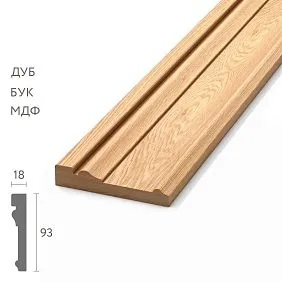
A classic skirting board 100-120 mm — a universal solution for most interiors. High enough to create a visual base, but not so high as to overload the space. The profile can be simple (rectangular cross-section with one rounding) or classic (ogee + bead). Suitable for neoclassical, modern classic, eclectic styles.
A tall skirting board 140-180 mm — for luxurious classic interiors where demonstrating taste, connection to tradition, and financial standing are important. A tall skirting board is perceived as a sign of an expensive interior because it requires more material (more expensive), more careful installation (more expensive labor), and pairs well with high ceilings (a sign of elite housing). The profile is necessarily complex: ogee + bead + straight shelf + decorative grooves. Suitable for classicism, empire, baroque, luxurious eclectic styles.
For a standard apartment with ceilings of 2.6-2.8 meters, a skirting board of 100-140 mm is optimal. For apartments with ceilings of 3.0+ meters, a skirting board of 140-180 mm is suitable. For country houses with ceilings of 3.5+ meters, a skirting board of 180-220 mm is possible.
Get Consultation
Skirting Board Material: Oak vs. Other Species
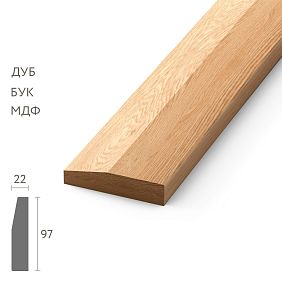
wooden skirting board purchaseSolid wood — means choosing a wood species. The species determines hardness (resistance to mechanical damage), color (natural wood shade), texture (grain pattern), and price.
Oak — the benchmark for skirting boards. Brinell hardness 3.7-3.9 (one of the hardest European species), meaning high resistance to scratches, impacts, and wear. Color ranges from light golden (young oak) to dark brown (bog oak). Texture is expressive: large pores, contrasting growth rings, medullary rays (silver stripes on a radial cut). Price 850-1400 rub/m depending on profile and finish. Service life 30-50 years.
Ash — a worthy alternative to oak. Hardness 4.0-4.1 (slightly higher than oak). Color is lighter than oak: white-yellow, white-gray. Texture is also expressive, but more contrasting (alternating light and dark stripes). Price 780-1200 rub/m. Ash is suitable for interiors where light wood with texture is needed.
Beech — hardness 3.8 (comparable to oak), color pink-beige, texture fine and uniform (small pores, weakly expressed growth rings). Price 680-1100 rub/m. Beech is suitable for interiors where a uniform texture without contrasting stripes is needed.
Pine — a softwood species (hardness 1.6-2.0), the most affordable (350-650 rub/m), but scratches quickly, dents from impacts. Suitable only for low-traffic areas (bedrooms, studies) or for opaque painting (where the grain is hidden).
For living rooms, hallways, and entryways, oak or ash is optimal. For bedrooms, children's rooms, beech is possible. Pine is a compromise option with a limited budget.
Baseboard Profile: From Simple to Carved
Profile — this is the cross-sectional shape of the skirting board, which determines the style and visual complexity.
Simple profile — rectangular cross-section 100×20 mm with one rounding on the top front edge. A laconic, minimalist shape, suitable for modern interiors. Cost 550-850 rub/m for oak.
Classic 'ogee' profile — a cross-section with a concave line (ogee) transitioning into a straight shelf. This is the basic classic profile used in European architecture since the 17th century. Suitable for neoclassical, classic interiors. Cost 750-1100 rub/m for oak.
Complex 'ogee + bead' profile — ogee (concave line) + bead (convex line) + straight shelf. A more expressive relief, creates play of light and shadow. Suitable for luxurious classic interiors. Cost 950-1400 rub/m for oak.
Carved profile — an ornament (geometric, floral) is carved on the surface of the skirting board. Maximum decorativeness, suitable for palatial interiors, baroque, rococo. Cost 1400-2200 rub/m for oak.
For most interiors, the classic 'ogee' profile or the complex 'ogee + bead' profile is optimal. They create sufficient visual complexity, do not overload, and combine well with polyurethane moldings on walls and ceilings.
Walls: Moldings for Zoning and Classic Frames
Horizontal Division: Creating Levels
A wall 2.6-2.8 meters high is perceived as a single vertical plane, monotonous, boring. Horizontal division with a molding at a height of 90-110 cm from the floor breaks this monotony, creating two levels: lower (from floor to molding) and upper (from molding to ceiling).
The lower level is traditionally darker than the upper. This is architectural logic: the base of a building (plinth, foundation) is darker than the top (walls, roof). In an interior, this logic is repeated: the lower part of the wall is painted dark gray, dark beige, terracotta; the upper part is painted light gray, light beige, cream. The molding between them is painted white, creating a clear boundary.
Such division visually expands the room (the horizontal line leads the eye along the wall), creates a sense of solidity (the dark base weighs down the foundation), and allows hiding dirt in the lower zone (dirt is less noticeable on a dark background).
The width of the molding for horizontal division is 60-90 mm. A narrow 60 mm molding creates a delicate boundary, suitable for modern, restrained interiors. A wide 80-90 mm molding creates an expressive boundary, suitable for classic interiors.
The installation height of the molding is determined by the proportions of the room. For rooms with a 2.6-meter ceiling, 90-100 cm from the floor is optimal (approximately one-third of the wall height). For rooms with a 3.0-meter ceiling, 100-120 cm is optimal. If the molding is installed too low (60-70 cm), the lower zone will seem squat. If too high (140-160 cm), the upper zone will seem cramped.
Vertical Frames: Classic Panels
Vertical frames made from moldings create classic wall paneling—one of the most recognizable techniques in European interior architecture. Rectangles measuring 80×120 cm, 90×140 cm, or 100×150 cm (width × height) are marked on the wall, depending on the scale of the room. A molding 50–80 mm wide is glued along the perimeter of each rectangle.
Inside the frames, the wall can be painted in a contrasting color (if the main wall is light gray, use dark gray inside the frames), covered with patterned wallpaper (damask, geometric, stripes), or upholstered with fabric (silk, velvet for luxurious interiors). The molding is painted white or in the color of the main wall (creating relief without color contrast).
The number and arrangement of frames are determined by the wall size. A single large frame (1.5×2.0 meters) in the center of the wall is for accent walls behind a sofa or bed headboard. Two to three frames in a row are for long walls in living rooms or dining rooms. Frames in two tiers (upper and lower) are for high walls in rooms with ceilings 3.0+ meters.
Frame proportions are important. Classic proportions: width-to-height ratio of 1:1.4 or 1:1.6 (approaching the golden ratio). Square frames (1:1) are perceived as static, while vertically elongated frames (1:2 and more) are dynamic and upward-reaching.
Combination of horizontal division and vertical frames
The most effective scheme is combining a horizontal molding at a height of 100 cm with vertical frames in the upper zone. The wall is divided horizontally by molding into two levels. The lower level (from the floor to the molding) is painted dark gray and remains smooth. The upper level (from the molding to the ceiling) is painted light gray, with two to three vertical molding frames placed on it. Inside the frames, the wall is painted medium gray (an intermediate shade between the dark bottom and light top).
Effect: a three-level color scheme (dark bottom, medium inside frames, light background of the upper zone) creates visual complexity, richness, and layering. The horizontal molding expands the room, while vertical frames raise the ceiling. The composition is balanced and works on all levels of perception.
In such a scheme, molding widths should be coordinated. Horizontal molding 80 mm, vertical frame moldings 60 mm (slightly narrower than the horizontal, creating a hierarchy: main horizontal, subordinate verticals). Or all moldings of the same width, 70 mm (creating unity, no hierarchy).
Ceiling: cornices and rosettes as the completion of the composition
Ceiling cornice: the upper frame of the space
Ceiling skirting and polyurethane moldingat the wall-ceiling junction create an upper frame that completes the composition, linking the verticals of the walls with the horizontality of the ceiling. A cornice 100–150 mm wide with a classic profile (cavetto, torus, dentils, sometimes modillions) is installed around the perimeter of the room.
Functions of the cornice: hides irregularities at the wall-ceiling junction (in standard houses, this junction is often uneven, with cracks, variations up to 10–15 mm), creates architectural logic (the transition from vertical to horizontal is not abrupt but smooth through a profiled cornice), allows for hidden lighting installation (LED strip placed on the top shelf of the cornice, light directed upward onto the ceiling, creating soft illumination).
The width of the cornice is determined by the room height and skirting size. Visual balance rule: the cornice should be 10–30 mm wider than the skirting. If the skirting is 120 mm, the cornice is 130–150 mm. If the skirting is 140 mm, the cornice is 150–170 mm. This creates a hierarchy: the top of the composition is slightly more massive than the bottom, which is architecturally logical (the cornice crowns, completes).
For rooms with low ceilings (2.4–2.6 meters), narrower cornices of 100–120 mm are used to avoid overwhelming the space. For rooms with high ceilings (3.0+ meters), wide cornices of 140–180 mm are suitable, emphasizing height and creating monumentality.
Ceiling rosettes: the focal point
polyurethane ceiling rosette moldingare installed in the center of the ceiling (or at several points if the ceiling is large), framing the chandelier mounting point. A rosette 60–120 cm in diameter with an ornament (acanthus leaves, roses, concentric circles, geometric patterns) is painted white (classic) or gilded (luxury).
Functions of the rosette: hides the mounting hole for the chandelier (wires, mounting hook), creates a compositional center for the ceiling (the eye, rising to the ceiling, finds a focal point—the rosette with the chandelier), enhances the impression of the chandelier (the rosette as a frame for the chandelier, emphasizing its significance).
The diameter of the rosette is determined by the room size and chandelier. For a room of 15–20 m², a rosette 60–80 cm in diameter is optimal. For a room of 25–35 m², 80–100 cm. For a room of 40+ m², 100–140 cm. A too-small rosette gets lost on a large ceiling; a too-large one overwhelms the space in a small room.
The style of the rosette ornament should match the profile of the cornice and wall moldings. If the cornice and moldings have a classic ornament (acanthus, palmettes), the rosette should also have a classic ornament. If the cornice and moldings are simple and smooth, the rosette can have a geometric ornament (concentric circles, radial rays) or no rosette at all (modern minimalist interiors).
Corner elements and decorative overlays
Corners between the ceiling cornice and walls (internal room corners)—places where the cornice changes direction by 90°. The standard finishing method is mitering the cornice at 45° on both sides and joining. But there are ready-made corner elements—decorative overlays sized 12×12 cm, 15×15 cm, which are installed in the corner, hide the joint, and enhance decorativeness.
Corner elements with ornament (leaves, scrolls, rosettes) suit luxurious interiors, where every corner is an opportunity for decoration. Simple corner elements (without ornament, just rounding) suit restrained classic interiors.
Decorative overlays on the cornice between corners—an additional level of decoration for palatial interiors. Overlays sized 10×15 cm with ornament are installed on the cornice at intervals of 80–120 cm, creating rhythm and enhancing the impression of abundant decoration.
For standard apartments and country houses, a perimeter cornice and one central rosette are sufficient. Corner elements and overlays are optional, for those who want maximum decorativeness.
Color solutions: how to link wood and polyurethane
Skirting matching the floor: classic scheme
The most common color scheme: wooden skirting is painted or stained to match the floor. If the floor is natural oak parquet, the skirting is oak with natural oil color. If the floor is dark walnut laminate, the skirting is oak stained dark walnut. The skirting is perceived as an extension of the floor, visually increasing the floor area and making the room more spacious.
Molding (wall moldings, ceiling cornice, rosettes) in this scheme is painted white. The contrast of the dark skirting (matching the floor) and white molding (on walls and ceiling) creates clear graphics and classic purity. Walls are painted in an intermediate color (gray, beige, any pastel).
This scheme works in 80% of interiors, is universal, safe, and does not require complex color matching.
Skirting contrasting with the floor: modern scheme
Alternative scheme: the baseboard contrasts with the floor. The floor is dark (wenge, stained oak), the baseboard is light (whitewashed oak, painted white or light gray). Or vice versa: the floor is light (whitewashed oak, ash), the baseboard is dark (toned walnut, painted graphite).
Contrast between the floor and baseboard creates a visual boundary that clearly separates the floor from the wall. This suits modern interiors where graphics, geometry, and the absence of smooth transitions are important. Molding in this scheme is painted the color of the baseboard (if the baseboard is white, the molding is white) or the color of the walls (if restraint and absence of contrast are desired).
Monochromatic scheme: shades of one color
Monochromatic scheme: baseboard, walls, molding in different shades of one color. Baseboard dark gray (toned oak), walls medium gray, molding light gray. Or baseboard dark beige, walls medium beige, molding light beige.
Monochromatic scheme creates restraint, elegance, and visual calm. The relief is perceived through shadows (molding protrudes from the wall, creating shadows), not through color contrast. Suitable for minimalist, Scandinavian, Japanese interiors where harmony and absence of visual noise are important.
Gilded molding: luxury and palatial grandeur
For luxurious classic interiors (Baroque, Empire, palace eclecticism), molding is painted not white, but gold. Gold paint is used (acrylic with metallic pigment) or gilding with imitation gold leaf (thin sheets of imitation gold leaf are glued onto the molding).
Gilded molding (cornice, moldings, rosette) against cream or light beige walls creates palatial luxury. The baseboard in this scheme is either natural oak (contrast of gold and wood) or toned mahogany (rhyming warm, noble tones).
Gilding is labor-intensive and expensive (gilding with imitation gold leaf costs 2500-4500 rubles per m² of molding), but the effect is disproportionate to the cost: the interior looks like a museum hall, a palace enfilade.
Installation: step-by-step guide for installing all elements
Stage 1: surface preparation
Before installing baseboards and molding, all surfaces (floor, walls, ceiling) must be ready. The floor is laid (parquet, laminate, tile), leveled. Walls are leveled with plaster or drywall, primed, painted in a base color (if a multi-color scheme is planned, painted different colors by zone). The ceiling is leveled, painted white (or another color if intended).
Important: installing baseboards and molding is one of the final stages of renovation. First floor, walls, ceiling, then baseboards and molding. Exception: if wallpaper is planned for the walls, baseboards and moldings are installed before wallpapering (the wallpaper is tucked under the baseboard from above, creating a neat joint).
Stage 2: installing wooden baseboard
Marking: determine the starting point (usually from the corner opposite the entrance), from it mark the joint locations of the baseboards around the room perimeter (baseboards are sold in 2.0-2.5 meter lengths, joined at 90° in corners or 180° on straight sections if length is insufficient).
Cutting corners: internal and external corners of baseboards are cut at 45° with a miter saw. Cutting accuracy is critical: a deviation of even 1-2° will create a gap in the corner. After cutting, parts are fitted to the corner, and the joint is checked. If there is a gap, the corner is adjusted (additional cut or sanding).
Fastening: apply construction adhesive (liquid nails) in a zigzag line to the back of the baseboard. The baseboard is pressed against the wall and floor, leveled horizontally (checked with a level), and held for 60-90 seconds. Additionally, it can be secured with screws (if the wall allows): screws are driven through the baseboard into the wall every 60-80 cm, heads are countersunk, holes are filled.
Joints: all joints (corner, end) are filled with acrylic sealant matching the baseboard color, smoothed with a wet finger. After drying, the sealant is sanded with fine sandpaper, becoming invisible.
Installation time: a 20 m² room (18 meters of baseboard perimeter) — 4-6 hours of work for one person.
Stage 3: installing wall moldings
Marking: mark lines for molding installation on walls (horizontal lines at a specified height, perimeters of vertical frames). Use a laser level or water level + chalk line (a stretched string with chalk that leaves a clear line on the wall).
Cutting moldings: moldings are cut to size with a handsaw or jigsaw. Corners are cut at 45° (for rectangular frames), at 90° (for molding joints on straight sections).
Gluing: apply polyurethane adhesive (special for polyurethane) in a thin line to the back of the molding. The molding is pressed against the wall along the marked line, held firmly for 30-60 seconds. The adhesive sets in 2-4 hours, fully cures in 24 hours. During drying, the molding can be secured with painter's tape (taped to the molding and wall, holding it pressed).
Sealing joints: all molding joints are filled with acrylic sealant, smoothed. After drying, the sealant is invisible (especially after painting).
Installation time: a 20 m² room with horizontal division (18 meters of molding perimeter) + three vertical frames (another 15 meters) = 33 meters of moldings — 6-9 hours of work for one person.
Stage 4: installing ceiling cornice and rosette
Cornice installation is similar to molding installation: marking (a line on the wall 10-15 cm below the ceiling, the lower edge of the cornice is aligned to this line), cutting, cutting corners at 45°, gluing with polyurethane adhesive, temporary fixation with painter's tape, sealing joints.
Rosette installation: find the center of the ceiling (intersection of diagonals from room corners), mark a circle with the rosette's diameter at the center. Apply adhesive in a circle and crosswise to the back of the rosette. The rosette is pressed against the ceiling, centered, and held firmly. If the rosette is heavy (80+ cm diameter), additionally secure with screws (4-6 pieces around the perimeter, driven through the rosette into the ceiling, heads countersunk, filled).
Installation time: cornice around a 20 m² room perimeter (18 meters) + rosette — 5-7 hours of work for one person.
Stage 5: finishing
After installing all elements and allowing the glue to dry (24-48 hours), the finishing work begins. The skirting board is coated with oil (2-3 coats with intermediate drying of 8-12 hours) or varnished (2 coats with intermediate drying of 6-8 hours). The molding is painted with acrylic paint (2 coats with intermediate drying of 4-6 hours). Between coats of paint, the molding is sanded with fine sandpaper (grit 220-320) for a perfectly smooth finish.
Finishing time: 3-4 days including drying time.
Total time from start of installation to finishing: 7-10 days for a 20 m² room with one person working.
Frequently asked questions
Is it mandatory to use a wooden skirting board or can MDF be used?
MDF skirting board is cheaper (300-650 rubles/meter vs. 550-1400 rubles/meter for oak), but less durable (service life of 10-15 years vs. 30-50 years for wood) and cannot be repaired if deeply damaged. For living rooms with a long-term perspective, wood is preferable.
What width of moldings is optimal for a standard apartment?
For horizontal division: 70-80 mm, for vertical frames: 60-70 mm, for ceiling cornice: 120-140 mm. These sizes create a balance: the elements are noticeable, expressive, but do not overload the space.
Can wooden wall moldings be combined with a polyurethane cornice?
Yes, if the profiles are similar in style. Wooden moldings with a classic profile pair well with a polyurethane cornice with a classic profile. Color unity is important: if the wooden moldings are painted white, the cornice should also be white.
How much does comprehensive finishing of a 25 m² living room with skirting boards and molding cost?
Materials: oak skirting board 140 mm, 20 meters × 1100 = 22000 rubles, moldings 50 meters × 650 = 32500 rubles, cornice 20 meters × 880 = 17600 rubles, ceiling rosette diameter 80 cm = 8500 rubles, installation materials = 4500 rubles. Total materials: 85100 rubles. Labor: 45000-65000 rubles. Total: 130000-150000 rubles.
Is a ceiling rosette necessary in a modern interior?
Not mandatory. In minimalist, Scandinavian, or loft interiors, a rosette is excessive. A cornice around the perimeter is sufficient. A rosette is appropriate in classic, neoclassical, or eclectic interiors where a connection to tradition is important.
How to care for a wooden skirting board and polyurethane molding?
Wipe the skirting board with a damp cloth once a month; renew the oil every 2-3 years (applying one coat). Wipe the molding with a dry or slightly damp cloth to remove dust; repaint as needed every 5-8 years.
Conclusion: A system that works on all levels
Perfect interior finishing is not a set of random elements, but a well-thought-out system where each level (floor, walls, ceiling) is connected to the others by a common logic. A wooden skirting board creates the base—warm, natural, and pleasant to the touch. Wall moldings structure the verticals, create frames, zone spaces, and turn flat surfaces into architectural compositions. The ceiling cornice and rosettes complete the system from above, connect the walls to the ceiling, and create a compositional center.
Wood and polyurethane are the perfect pair. Wood provides naturalness, texture, durability, but is expensive for total application. Polyurethane provides classic forms, lightness (7-10 times lighter than plaster), moisture resistance, and an affordable price. Together they create interiors that look expensive, feel high-quality, and last for decades.
STAVROS offers a full range of materials for comprehensive interior finishing at all levels. Solid wood skirting boards made of oak, ash, beech—heights from 60 to 220 mm, over 50 profiles from simple to carved. Skirting boards are dry (moisture content 8-12%), planed, sanded, ready for installation and finishing. Possibility to order any length (up to 3.0 meters), painting, tinting in any color. Cost: 550-1400 rubles/meter depending on wood species, height, profile.
Polyurethane molding: over 700 items—moldings of all widths from 20 to 150 mm, ceiling cornices, ceiling rosettes with diameters from 30 to 150 cm, decorative overlays, corner elements. All products are made of dense European-quality polyurethane (density 250-300 kg/m³), primed with white acrylic primer, ready for painting. Moisture-resistant (suitable for bathrooms, kitchens), lightweight (installation without special equipment), easy to cut (with a regular saw), glued with special polyurethane adhesive. Cost: 350-1400 rubles/meter depending on width, profile complexity, presence of ornament.
STAVROS design studio develops comprehensive interior finishing projects with 3D visualization. You see how the skirting board matches the floor, how moldings structure the walls, how the cornice completes the composition, how the rosette frames the chandelier. The project includes layout of all elements, material calculation accurate to the meter, estimate, step-by-step installation instructions with photos. Project cost for a 20-25 m² room: 8500-12000 rubles.
When ordering a set of materials (skirting boards + moldings + cornice + rosette) for room finishing totaling from 60000 rubles, STAVROS provides an 8% discount on all decorative elements. For orders from 100000 rubles—a 10% discount plus free delivery in Moscow and the Moscow region. For orders from 180000 rubles—a 12% discount plus free delivery across Russia plus a free project with 3D visualization. Savings: 7000-28000 rubles.
STAVROS installation teams are specialists in comprehensive interior finishing. Installation of wooden skirting boards with precise mitering, attachment with glue and screws, finishing (oil, varnish, enamel). Installation of wall moldings to create frames, horizontal division, sealing of joints. Installation of ceiling cornices and rosettes. Painting of all elements with intermediate sanding. Work in Moscow, St. Petersburg, travel to regions for projects from 150000 rubles, 3-year warranty on installation.
By choosing STAVROS, you get a partner in creating interiors where every level is thought out, where wood and polyurethane work together to create harmony, where the base and the top are connected by a single logic. Build interiors systematically. Start with the foundation, finish with the ceiling rosette. With STAVROS, it's accessible, high-quality, beautiful.