Article Contents:
- Price is not an indicator, but a consequence of parameters
- Dimensions: when millimeters determine the fate of a composition
- Element length: calculation without waste
- Profile width and height: spatial proportions
- Diameter and thickness of decorative elements
- Material: not all polyurethane is created equal
- Density: a criterion of strength and durability
- Material origin: geography of quality
- Polyurethane type: interior or facade
- Ornament detailing: relief that is visible and that disappears
- Relief depth: from 2 to 30 millimeters
- Detail clarity: casting versus extrusion
- Coating and installation readiness: save or pay extra time
- Without coating: cheaper but requires work
- Primed: optimal balance
- Painted: ready for installation
- Style compatibility: when molding kills the interior
- Style classification in the product card
- Collections and series: harmony of elements
- Installation: glue included or purchased separately
- Certificates and warranties: papers that protect
- Certificate of conformity: legality and safety
- Warranty: confidence in quality
- Customer reviews: the voice of experience
- What to look for in reviews
- Critical analysis of reviews
- Delivery and returns: logistics and rights
- Delivery terms: timelines and integrity
- Return conditions: buyer protection
- Additional services: consultation and calculation
- Calculating required quantity
- Selecting Compatible Elements
- Installation instructions
- How to read the product card: buyer's checklist
- Frequently Asked Customer Questions
- Conclusion: an informed purchase is a successful result
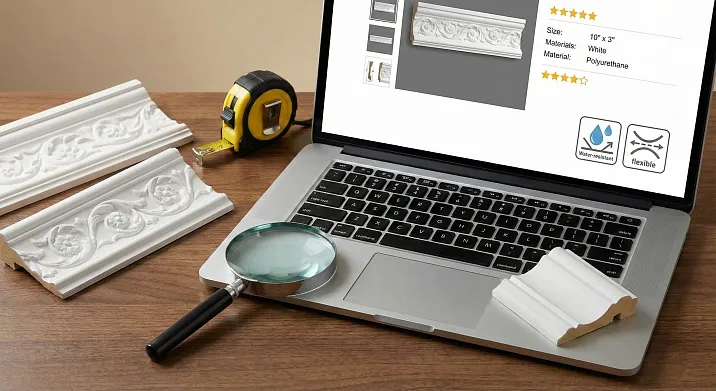
Online shopping has become a habit. A couple of clicks and the product is on its way to you. But when it comes to decor that will become part of your interior for decades, impulsiveness is dangerous. You ordered molding based on a photo, but received an element of the wrong size, color, or with unpredictable quality. Money is spent, time is lost, disappointment is guaranteed. How to avoid such a scenario? Learn to read the product card like a professional. Numbers, parameters, descriptions — these are not formalities, but encoded information about whether a particular product suits you. Let's break down what details to pay attention to when decidingYou can buy ready-made stucco matching the Baroque style. Calculate the quantity: linear meters of cornices and moldings, number of rosettes, pilasters, consoles, corner elements. Add a ten to fifteen percent allowance for trimming.so that the result exceeds expectations, rather than destroys them.
Price is not an indicator, but a consequence of parameters
The first thing most buyers look at is the price tag. The psychology is clear: the budget is limited, you want to stay within it. But the price itself says nothing about quality and suitability for your tasks. Molding for 300 rubles may be perfect for one project and useless for another. An element for 2000 rubles will be an overpayment if its characteristics are excessive.
Why do seemingly identical products differ in price by half? Material density, production technology, relief detailing, coating, country of origin — dozens of factors determine the cost. Cheap molding may be made of low-density polystyrene with rough relief, while expensive molding is made of high-density polyurethane with jewelry-like detailing. Visually, the difference is not noticeable in the photo. But in reality, the first will last 3-5 years and look mediocre, the second — 30-50 years, maintaining perfection.
Saving at the purchase stage turns into expenses for replacement, repair, repainting. Overpaying for excessive characteristics is money thrown away. Balance is achieved by analyzing parameters, not comparing price tags.




Dimensions: when millimeters decide the fate of the composition
The product card always contains dimensions. But many perceive them formally, not realizing the critical importance of accuracy.
Our factory also produces:


Element length: calculation without scraps
Polyurethane Itemsare supplied in standard lengths: 2000 mm, 2400 mm, less often 2500 or 3000 mm. The perimeter of a room is rarely a multiple of these values. A room 4.5 meters long will require three 2-meter segments (total 6 meters) with a remainder of 1.5 meters, which will go to waste or be useful for small inserts.
Planning rule: measure all walls accurately, add up the lengths, add 10-15% for trimming and possible errors. Divide by the standard element length — you get the number of segments. If the room has complex geometry with bay windows, niches, protrusions — make a separate calculation for each section.
Example: a room 4.2×5.8 meters. Perimeter 20 meters. Molding length 2.4 meters. Divide: 20 ÷ 2.4 = 8.3. Round up — 9 segments needed. Total 21.6 meters, reserve 1.6 meters. If you choose molding 2 meters long, you will need 10 segments (20 meters), but there will be minimal reserve — risky.
Get Consultation
Profile width and height: proportions of space
The width of molding or cornice is not an aesthetic whim, but the mathematics of proportions. A narrow element (30-50 mm) on a high ceiling gets lost, looks skimpy. A wide one (120-180 mm) in a small room overwhelms, visually and physically 'eats up' space.
Classic rule: the width of a ceiling cornice should be 1/20-1/15 of the ceiling height. For a 2.7-meter ceiling, a width of 90-120 mm is optimal. For a 3.5-meter ceiling — 120-180 mm. For low ceilings of 2.4 meters, 60-80 mm is sufficient.
Wall moldings obey the wall area. On a wall of 10-15 sq.m, moldings 60-80 mm wide look harmonious. On a wall of 25-30 sq.m, elements 80-120 mm are required, otherwise the composition falls apart visually.
Profile height (thickness) affects relief. Flat molding 5-8 mm high creates a barely noticeable volume. A deep profile 15-25 mm gives expressive play of light and shadow. For modern minimalist interiors, flat ones are suitable; for classic ones — volumetric ones.
In the product card, dimensions are indicated in millimeters in the format W×H×L (width×height×length). Do not confuse the order — an error will lead to the wrong choice.
Diameter and thickness of decorative elements
Polyurethane ceiling rosettesare marked by diameter: from 200 mm to 1000 mm and more. The choice depends on the size of the chandelier and the ceiling area. A chandelier with a diameter of 400 mm requires a rosette of at least 500-600 mm — the decor should extend beyond the contours of the light fixture by 100-150 mm in radius.
Ceiling area dictates the maximum size. On a 12 sq.m ceiling, an 800-1000 mm rosette will dominate, overwhelm. 400-600 mm is optimal. On a 30-40 sq.m ceiling, a 400 mm rosette will get lost — a 700-900 mm one or a composition of several elements is needed.
Rosette thickness (relief depth) affects visual massiveness. A flat rosette 10-15 mm thick looks light, airy. A volumetric one 30-50 mm thick — monumental, solid. The interior style determines the choice.
Material: not all polyurethane is created equal
The card says 'polyurethane,' but this term hides a range of quality.
Density: a criterion of strength and durability
Polyurethane density ranges from 150 to 400 kg/m³. The higher the density, the stronger, heavier, and more expensive the product. For interior decor, a density of 200-300 kg/m³ is optimal. For facade applications — 300-400 kg/m³.
How to determine density? Reputable manufacturers specify it in the product card's technical specifications. If this parameter is not indicated — it's a red flag. Possibly, the density is low (150-180 kg/m³), and the manufacturer is hiding it. Or cheap polystyrene foam is being used instead of polyurethane, passed off as polyurethane.
An indirect indicator of density is weight. A 2000×100×20 mm polyurethane molding with a density of 250 kg/m³ weighs about 1000 grams. If the product card lists a weight of 300-400 grams — it's either polystyrene or low-density polyurethane. Acceptable for residential areas with moderate load. For commercial spaces, corridors, high-traffic zones — insufficient.
Material origin: geography of quality
The country of production for polyurethane moldings is an indicator of quality. European manufacturers (Germany, Belgium, Italy) use high-quality raw materials, strict control, and modern equipment. Products are 30-50% more expensive but meet the stated characteristics.
Russian manufacturers occupy the mid-range segment. Quality varies from excellent (large factories with European equipment) to mediocre (small workshops with outdated technology). Focus on brand reputation, reviews, certificates.
Asian products (China, Turkey) are the most affordable, but quality is unpredictable. There are decent items, but more often — low density, rough detailing, inconsistent dimensions. If budget is critical, Asian decor is acceptable for temporary interiors or low-visibility areas.
In the product card, look for the manufacturer and country of origin. Lack of information is a reason to be cautious.
Polyurethane type: interior or facade
Polyurethane for interior work does not contain UV stabilizers or frost-resistant additives. It is lighter, cheaper, but on a facade, it will yellow within a year and crack within two.Facade decoration made of polyurethanecontains special modifiers, withstands temperatures down to -60°C, ultraviolet light, and rain.
The product card should clearly indicate the purpose: "for interior," "for facade," or "universal." Universal is 20-30% more expensive than interior-grade, but if you plan to use it on a facade, saving on interior-grade will result in replacement within a couple of years.
Ornament detailing: relief that is visible and that disappears
The photo in the product card shows the general appearance but does not convey the clarity of the relief. One molding has deep, clear grooves; another has barely hinted lines. After painting, the difference is even more noticeable: the first creates an expressive play of light and shadow, the second turns into an almost smooth surface.
Relief depth: from 2 to 30 millimeters
Simple moldings have a relief depth of 2-5 mm. These are barely noticeable ridges, coves, steps. Suitable for minimalist interiors where decor should be present but not conspicuous.
Medium relief of 5-15 mm creates expressiveness without overload. Flutes, medium-detail plant motifs, geometric patterns. Optimal for neoclassical, modern classical interiors.
Deep relief of 15-30 mm — Baroque, Empire, luxurious classicism. Multi-level ornaments, acanthus leaves, rosettes with petals. Such decor dominates, becoming the main hero of the interior.
Relief depth is rarely indicated in the product card. Rely on photos, style description (classicism usually implies deep relief, minimalism — flat), customer reviews. Request additional photos with side lighting — relief is better visible there.
Detail clarity: casting vs. extrusion
Production technology determines detailing. Pressure casting (polyurethane poured into silicone molds) reproduces the finest details of the original. Leaf veins, flower petals, ornament interweavings — everything is conveyed with photographic accuracy.
Extrusion (pushing material through a die) creates simple, repeating profiles. Coves, flutes, stepped moldings — anything with a constant cross-section. Detailing is limited by the technology.
For complex decorative elements — rosettes, overlays, corner blocks — casting is needed. For simple moldings and cornices, extrusion is sufficient. The technology is rarely indicated in the product card, but it can be inferred from the complexity of the ornament and price: cast elements are more expensive than extruded ones of comparable sizes.
Coating and readiness for installation: save or pay with time
Polyurethane decor is supplied in three variants: without coating (white material), primed, painted.
Without coating: cheaper, but requires work
Uncoated elements are 10-20% cheaper. But you receive white polyurethane that requires priming and painting. Priming is mandatory — it prevents material yellowing over time and improves paint adhesion. Without primer, paint applies unevenly, and spots may show through.
The priming and painting process takes 2-3 days including layer drying. Materials (primer, paint), tools (brushes, rollers), and skills are needed. Acceptable for a small volume (a few moldings). For a large-scale project (tens of meters of cornices, many decorative elements), labor costs are significant.
Advantage — freedom of color choice. You paint in any shade, apply decorative techniques (patination, gilding, aging effects).
Primed: optimal balance
Factory-primed elements are 15-25% more expensive but are ready for final painting. The primer is applied evenly, professionally, and dried under optimal conditions. You get a perfectly prepared surface.
Just apply paint in 2-3 coats — and the decor is ready. Saves time, guarantees preparation quality. For most projects, this is the optimal choice.
Painted: ready for installation
Fully painted elements are 30-50% more expensive. But this is a turnkey solution — install and it's done. The color is usually white (most universal), less often beige, cream, gold.
Disadvantage — limited color palette. If a non-standard shade is needed, you'll have to repaint, losing the point of the extra cost. Advantage — saves time, no painting mess, immediate result.
The product card specifies the surface condition. If information is missing, check with the seller — this is critical for planning work and budget.
Style compatibility: when molding kills the interior
Technical parameters are ideal, butpolyurethane molded decorit doesn't fit stylistically — the composition falls apart. A Baroque rosette in a minimalist loft, a laconic molding in a luxurious Empire style — visual dissonance.
Classification by styles in product card
Professionalmolding storesindicate the style affiliation of the element: Classic, Neoclassical, Baroque, Rococo, Art Deco, Modern, Minimalism, Contemporary. This is a guide for selection.
Classic — symmetrical floral ornaments, acanthus leaves, laurel wreaths, meanders. Medium detail, restrained luxury. Suitable for most interiors with classic features.
Baroque — excessive decorativeness, scrolls, putti, garlands, cartouches. Deep multi-level relief. For interiors where luxury is the main idea.
Neoclassical — simplified classical motifs, geometric clarity, restraint. Decor is present but not dominant. A universal solution for modern interiors with a classic touch.
Modern (Art Nouveau) — smooth asymmetrical lines, floral motifs with emphasized organicity, fluidity of forms. A specific style requiring unity of all elements.
Minimalism — simple geometric profiles without ornaments. Rectangular moldings, smooth cornices, barely noticeable relief. Decor structures the space but does not adorn.
If the style is not specified in the card, rely on visual perception and description. Look for terms: "classical ornament," "floral motif," "geometric profile," "smooth cove."
Collections and series: harmony of elements
Many manufacturers release decor in collections — sets of elements designed in a unified style. Moldings, cornices, baseboards, rosettes, overlays from the same collection harmonize with each other: profiles, ornaments, proportions match.
The product card indicates the collection affiliation. This is convenient: you pick one element, take the rest from the same series — a guarantee of stylistic unity. Mixing elements from different collections is risky — visual inconsistency may arise.
Installation: glue included or purchased separately
Some manufacturers include glue, fasteners, and instructions with the decor. Most sell only the products themselves — glue, sealant, primer, paint are purchased separately.
Check the package contents in the product card. If glue is included — convenient, no need to select a compatible compound. If not — the description or instructions should include recommendations on the type of glue.
For polyurethane, specialized polymer-based mounting adhesives are needed (Moment Montage, Orac Decofix, Quelyd Mastik). Universal PVA or wallpaper glue are not suitable — poor adhesion, risk of detachment. Liquid nails are acceptable for small elements, but for long moldings and heavy rosettes, professional adhesives are better.
Glue consumption is usually indicated: 1 tube 300-400 ml for 8-12 linear meters of molding or 5-8 medium-sized decorative elements. Calculate the required amount in advance.
Certificates and warranties: papers that protect
A conscientious seller indicates in the product card the availability of certificates of conformity, hygienic conclusions, and warranty obligations.
Certificate of conformity: legality and safety
The certificate confirms that the product complies with state standards, has passed tests, and is safe for health. For polyurethane decor, the following indicators are critical:
-
Emission of volatile substances — should be minimal (class E0 or E1)
-
Flammability — typically class G3 or G4 (combustible, but does not sustain combustion independently)
-
Hygienic certificate — confirms safety for residential premises
Availability of certificates is not necessarily indicated on each product card, but should be available upon request. If the seller refuses to provide documents — this is a warning sign. Possibly, the product is not certified, its origin is questionable, or its characteristics do not match the stated ones.
Warranty: confidence in quality
The warranty period for polyurethane molding is usually 1-3 years. This is the manufacturer's guarantee against production defects: cracks, deformations, coating peeling.
The warranty does not cover damage from improper installation, mechanical impacts, or misuse (e.g., interior decor used on the facade). But it protects against defects: if an element arrived with a defect or cracked without visible reasons during the warranty period — replacement is free.
Check the warranty terms on the product card. Lack of warranty is a bad sign. The manufacturer is not confident in the quality, or it is counterfeit.
Customer reviews: the voice of experience
The product card often contains reviews from real customers. This is an invaluable source of information that the manufacturer does not fully control.
What to look for in reviews
Compliance with description — do customers confirm the stated parameters? 'Size matches', 'high density, material is durable', 'relief is clear, details are visible' — positive signals. 'Turned out smaller than stated', 'material is soft, dents easily', 'relief is barely noticeable' — reason to be cautious.
Ease of installation — 'glued easily, holds firmly' or 'peeled off, had to secure additionally'? Difficulties during installation may indicate low material quality or non-compliance with recommendations.
Durability — recent reviews won't tell much, look for those written a year or two after purchase. 'After a year and a half, looks like new' — excellent sign. 'Yellowed/cracked after a year' — warning.
Appearance after painting — 'paint applied evenly, surface is smooth' or 'had to fill uneven spots, paint in three coats'? Surface quality affects the final result.
Critical analysis of reviews
Beware of generic enthusiastic reviews without specifics — likely paid. Genuine reviews contain details: 'used for a 15-meter hallway, installed myself, took 4 hours, holds excellently'. Fake ones are general: 'great product, recommend to everyone'.
Analyze negative reviews critically as well. Sometimes the problem lies in improper application (interior decor used on the facade), installation errors (wrong adhesive), or unrealistic expectations (expected gypsum-like detailing from budget polystyrene).
Delivery and returns: logistics and rights
Product card must contain delivery information and return conditions
Delivery conditions: timing and integrity
Polyurethane molding is fragile during careless transportation. Impacts, compression can cause cracks, chips. Check packaging conditions: professional sellers pack in multi-layer film, cardboard boxes, cushion with foam.
Delivery times vary from 1-3 days (from a warehouse in your city) to 2-4 weeks (order from a foreign manufacturer). Plan your renovation considering realistic timelines. Promised 'tomorrow' delivery often gets delayed.
Delivery cost for large-sized elements (columns, long moldings) may exceed the cost of the product itself. Clarify in advance. Sometimes it's more cost-effective to pick up yourself or order from a local supplier, even if the product price is higher.
Return conditions: buyer protection
Consumer protection law gives the right to return goods of proper quality within 7 days (for remote purchases — 14 days). However, decorative items cut to your sizes are non-returnable.
Check return conditions on the product card or store rules. Is return possible if the size doesn't fit? Who pays for return shipping? How quickly will the money be refunded?
Goods with manufacturing defects are subject to return or replacement within the warranty period. But you need to prove the defect is manufacturing-related, not caused during transportation or installation. Photograph unpacking, the product's condition before starting work — this protects your rights.
Additional services: consultation and calculation
Professional stores offer additional services that are not always explicitly stated on the product card but are available upon request.
Calculation of required quantity
Provide a floor plan with dimensions and a sketch of the desired composition — specialists calculate the exact number of elements, footage, and accessories. The service is often free for orders above a certain amount (e.g., from 20,000 rubles).
This protects against mistakes: you won't buy too little (requiring reordering, waiting, risking batch shade differences) or too much (overpaying, cluttering with leftovers).
Selection of compatible elements
You've chosen a cornice but are unsure which corner elements suit it, which moldings harmonize, which rosettes will fit. Consultants will suggest compatible items from the catalog and help create a unified composition.
Installation instructions
Detailed instructions with photos, videos, a list of necessary tools and materials. For DIY installation, this is invaluable — it reduces the risk of errors, making the process faster and better quality.
How to read the product card: buyer's checklist
Before adding an item to your cart, check:
-
Dimensions — Are the W×H×D specified accurately? Is the element length sufficient for your perimeter? Does the width match the room's proportions?
-
Material — Is the exact composition specified (polyurethane, density)? For interior or exterior use? Country of origin?
-
Weight — Does it match the stated density? A linear meter of 100×20 mm polyurethane molding at 250 kg/m³ should weigh about 500 grams.
-
Detailing — Is the ornament style described? Are there photos with side lighting showing the relief?
-
Finish — Unfinished, primed, painted? Does the color match your concept?
-
Style — Is the style/collection affiliation indicated? Is it compatible with your interior?
-
Package contents — What's included in the set? Are additional materials needed (adhesive, primer, paint)?
-
Certificates — Are there compliance certificates, hygienic approvals? Can documents be requested?
-
Warranty — What is the warranty period? What cases does it cover?
-
Reviews — What do real buyers say? Are there quality confirmations?
-
Delivery — Timeframes, cost, packaging conditions?
-
Returns — Is return possible if the item doesn't fit? Conditions and timeframes?
All points clarified — add to cart. Still have questions — write/call the seller. Better to spend 15 minutes clarifying than a week on returns and reorders.
Frequently asked customer questions
How does polyurethane differ from polystyrene?
Polyurethane is denser (200-400 kg/m³ vs. 25-65 kg/m³), stronger, more durable, more expensive. Polystyrene is lighter, cheaper, reproduces fine ornament details worse. For critical areas (living rooms, halls, facades) choose polyurethane. For secondary areas (storage rooms, technical spaces) polystyrene is sufficient.
Can polyurethane decor be painted?
Absolutely necessary! Without painting, the material yellows over time. Use acrylic, latex, or alkyd paints. Priming before painting is mandatory.
How long does polyurethane molding last?
Quality polyurethane lasts 30-50 years or more indoors, 20-30 years on facades with proper installation and maintenance.
How to check quality upon receipt?
Inspect for absence of cracks, chips, deformations. Check dimensions with a tape measure — deviation over 2-3 mm is unacceptable. Assess relief clarity — lines should be sharp, details legible. If in doubt, photograph, record unboxing video — this serves as evidence for claims.
What to do if an element doesn't fit in size?
If the item is standard (not custom-cut), you have the right to return it within 14 days. Clarify return conditions with the specific seller. Return shipping is usually at the buyer's expense unless the reason is a defect.
Can polyurethane decor be installed independently?
Yes, the process doesn't require special skills. Basic tools (handsaw, miter box, level, tape measure), adhesive, and patience are needed. Instructions are usually included or available on the manufacturer's website.
What glue to use?
Specialized mounting adhesives for polyurethane: Orac Decofix, Moment Montage, Quelyd Mastik Pro. Do not use PVA, wallpaper paste, or mounting foam (unless specified by the manufacturer).
Is additional fastening besides adhesive needed?
For small elements (moldings, baseboards, overlays), adhesive is sufficient. For heavy elements (large rosettes, columns, cornices wider than 150 mm), supplementary fastening with finishing nails or anchors is recommended.
Conclusion: An informed purchase leads to a successful result.
Choosing polyurethane molding is not a lottery, but an algorithm. The product card contains all necessary information, but you need to know how to read and interpret it. Dimensions, material, detailing, finish, style, certificates, reviews — each parameter affects the final outcome.
Price is an important, but not the only criterion. A cheap product may prove expensive to maintain due to low quality. An expensive one may be excessive for your needs. Balance is achieved by analyzing characteristics and their alignment with your requirements.
Purchasing from a professional store reduces risks. Detailed product cards, specialist consultations, warranties, return options — these protect your interests.
The company STAVROS offers one of the most comprehensive catalogspolyurethane products for interiors and facades. The assortment includes thousands of items: moldings, cornices, baseboards, ceiling rosettes, overlays,Columns and pilasters balustrades, facade decor.
Each STAVROS product card contains exhaustive information: precise dimensions in millimeters, weight, material density, purpose (interior/facade), stylistic affiliation, collection, photos from various angles, technical specifications, installation recommendations. Certificates of conformity and hygienic reports are available upon request.
STAVROS works directly with European and South Korean manufacturers, guaranteeing product authenticity and competitive prices. All decor is certified and complies with Russian safety standards. Polyurethane density of 250-350 kg/m³ for interior items, 350-400 kg/m³ for facade items — this represents the top tier of quality.
The company provides professional support at all stages: consultations on selecting elements considering interior style and technical requirements, free calculation of required materials for orders over 20,000 rubles, recommendations on installation and finishing, organization of delivery across Russia and CIS with cargo integrity guarantee.
The STAVROS stock program allows shipping popular items on the day of inquiry. For exclusive or facade elements, the delivery time is 2-4 weeks from order placement. Self-pickup is available from warehouses in Moscow and St. Petersburg.
STAVROS provides a 2-year warranty on all products. In case of manufacturing defects — free replacement. When ordering a full set of decor for a room, an extended 3-year warranty is provided.
By turning to STAVROS, you receive not just a product, but a comprehensive solution for creating your dream interior. Transparent information, professional consultations, quality guarantees, logistical support — all to ensure your purchase is informed and the result exceeds expectations.
Visit the STAVROS catalog, study the product cards, ask questions to the specialists. Your ideal decor is already waiting — you just need to choose it wisely.