












































































Article Contents:
- The philosophy of mixing: why one material is boring
- Monotony kills character
- Project economy without loss of quality
- Technological diversity
- Capital as an interior jewel
- What is a capital and why it is important
- Why the capital should be made of wood
- Choice of wood species: oak or beech
- Polyurethane molding: the lightness of being
- Why polyurethane has conquered the decor market
- Where polyurethane is better than wood
- Stylistic Diversity
- Mixing practice: how to combine materials
- Rule #1: Wood for leading roles
- Rule #2: Coordination by color and texture
- Rule #3: Technological compatibility
- Rule #4: Balance of economy and effect
- Application scenarios: from living room to facade
- Formal living room: classic in a modern interpretation
- Dining area: accent on architecture
- Entryway: First Impression
- House facade: mix for exterior
- Installation technology of mixed structures
- Preparation: everything starts with the project
- Material Acclimatization
- Installation of pilaster with mix materials
- Painting: creating unity
- FAQ: answers to important questions
- Will the difference between wood and polyurethane be noticeable?
- Can mix materials be used in wet rooms?
- How much does a project with mixed materials cost compared to a fully wooden one?
- How long does polyurethane decor last?
- Can I create a mix of wood and polyurethane myself?
- Which wood species pair best with polyurethane?
- Is special lighting needed for mix compositions?
- How to care for decor made from mixed materials?
- Can polyurethane be combined with materials other than wood?
- How to match the ornament of a capital and polyurethane decor?
- Conclusion: Author's Classic by STAVROS

Classical style in interiors is not about copying palace halls or blindly following the canons of bygone eras. True classicism today is the art of combining, matching, finding a balance between tradition and modernity, luxury and practicality. One of the most intriguing trends is the mix of materials: polyurethane moldings paired with wooden capitals, synthetic decor alongside natural carvings, the lightness of modern technology and the warmth of living wood.
furniture and decorCapital— the crowning element of a column or pilaster — requires maximum detail, noble material, tactile luxury. Wood handles this task perfectly. And decorative moldings, rosettes, cornices — elements abundant in interiors — benefit from the lightness, moisture resistance, and technological efficiency of polyurethane. The result of such a mix is an interior that looks more expensive than it costs and lasts longer than expected.




The philosophy of mixing: why one material is boring




Monotony kills character
Imagine an interior where absolutely everything — from cornices to furniture legs — is made from wood of the same species, same tone, same texture. Formally, it's classic. But visually — monotony that tires. The eye has nothing to latch onto, no contrasts, no play of textures. The space looks flat despite the abundance of decor.
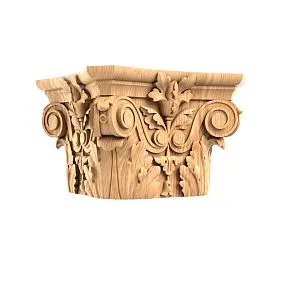
Now imagine the same space, but with accents.wooden capitalson the pilasters, warm, with the pronounced texture of oak or beech. And the cornices, wall moldings, ceiling rosettes — made ofpolyurethane, painted to match the wood tone, but more laconic, crisp. A hierarchy emerges: the primary elements are wood, the secondary ones are polyurethane. The eye reads this composition, finds focal points, and the space comes alive.
Our factory also produces:


Project economics without losing quality
Fully wooden decor in a large space means tens or even hundreds of kilograms of material. Complex installation, high demands on craftsmen's skills, significant load on walls and ceilings. The price tag is prohibitive for most projects.
Polyurethane moldingsweighs 5-10 times less than plaster or wood. It adheres with standard polymer glue, requiring no reinforced fasteners. The cost per square meter of decor is 3-5 times lower than carved wood. Yet visually, after quality painting, polyurethane is indistinguishable from plaster or wood to a non-specialist.
A sensible mix allows allocating the budget to truly important elements — capitals, pilaster bases, central rosettes — executing them in wood, and everything else in polyurethane. Savings of 40-60% of the budget while preserving visual luxury.
Get Consultation
Technological diversity
Wood and polyurethane are materials with different capabilities. Wood allows for deep multi-level carving, complex sculptural elements, unique textures. Polyurethane offers perfect geometry, crisp lines, and the ability to reproduce the finest ornamental details.
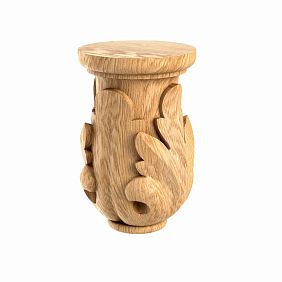
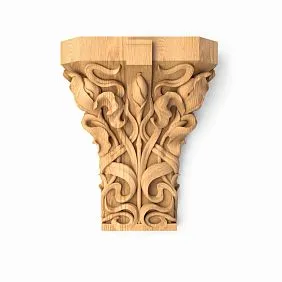
with acanthus leaves — the centerpiece of the composition. Crisp geometric moldings made of polyurethane — the structuring background. Together they create layering, a richness of forms unattainable with a single material.wooden capitalThe capital as the jewel of the interior
Capitals as Interior Jewels
What is a capital and why is it important
A capital (from Latin capitellum — 'little head') is the crowning part of a column, pilaster, or half-column. It is a transitional element between the vertical support and the horizontal entablature, between the wall and the ceiling. Structurally, the capital distributes load; visually — it creates compositional completeness.
can be quite laconic, the capital is always richly decorated. Corinthian acanthus leaves, Ionic volutes, Doric austerity — each architectural order has its own canon for capital design.pilastersIn modern interiors, the capital no longer serves a structural function. It is a purely decorative element. But it is precisely this that gives a column or pilaster completeness, legibility, and nobility. A pilaster without a capital looks unfinished, like a dress without a collar.
In classical architecture, the capital is the focal point of decoration. If the shaft
Why should the capital be made of wood
The capital is a focal point, an element that catches the eye. It is positioned at eye level or above, often well-lit. The material must withstand close scrutiny, be pleasing to the touch (if it can be reached), and be visually rich.
wooden capitalpossesses qualities that synthetics lack:
Natural texture. Annual rings, medullary rays (especially pronounced in oak), natural tonal variations—all create a depth that polyurethane, despite its merits, cannot replicate.
Tactile warmth. Wood feels warm to the touch. Polyurethane is cold. If a guest accidentally touches the capital—wood conveys a sense of an expensive, natural material. Polyurethane, even flawlessly painted, reveals its synthetic nature.
Depth of carving. Carvedsolid wood capitalcan feature multi-level carving with a depth of 30-50 mm. Acanthus leaves literally emerge from the background, creating sculptural volume. Polyurethane, cast in a mold, offers a maximum relief depth of 20-25 mm.
Prestige. Wood is associated with tradition, craftsmanship, and durability. In the era of mass production, natural materials are a luxury. A wooden capital signifies that the owner did not skimp on what matters most.
Choice of wood species: oak or beech
oak capitals—a classic choice. Oak is dense, durable, and has a pronounced texture. Its color ranges from light honey to dark brown depending on the wood's origin. An oak capital holds fine carving details well, does not chip, and darkens over time, acquiring a noble patina.
Beech is an alternative for those who prefer a more uniform texture and lighter tone. Beech has a fine-pored structure, a pinkish hue, and takes stains easily in any color. Carving on beech results in crisp, perfect edges. However, beech is less stable than oak—it reacts more strongly to humidity.
For rooms with normal humidity, both options are equally suitable. For kitchens, bathrooms, and conservatories, oak or a combination of wood with moisture-resistant coating is preferable.
Polyurethane molding: the lightness of being
Why polyurethane has conquered the decorative market
Just 20 years ago, molding meant plaster. Heavy, fragile, moisture-sensitive, and difficult to install. The alternative was polystyrene—lightweight but primitive, with a coarse-grained structure and low detail.
Polyurethane changed the game. It is a polymer with a unique set of properties:
Lightness. The density of polyurethane molding is 200-400 kg/m³, which is 4-5 times lighter than plaster. A 2-meter-long cornice weighs 1-2 kg compared to 8-10 kg for its plaster counterpart.
Detail. Pressure casting allows reproduction of the finest ornament details—as thin as 0.5 mm. Cast elements are absolutely identical, which is important for creating symmetrical compositions.
Moisture resistance. Polyurethane does not absorb water, does not swell, and does not rot.decorative polyurethane elementsIt can be used in bathrooms, kitchens, swimming pools—anywhere where plaster or wood would quickly deteriorate.
Ease of installation. It is glued with polymer adhesive, does not require mechanical fasteners (except for particularly large elements). It can be cut with a regular saw and sanded with sandpaper.
Paintability. It accepts any paints—water-based, acrylic, even oil-based. Effects like patina, gilding, and artificial aging can be created.
Where polyurethane is better than wood
For some decorative elements, polyurethane is not just an alternative—it is objectively better:
Long elements.Crown MoldingMoldings, baseboards 2-2.5 meters long made of polyurethane are easily installed by one person. Wooden counterparts require at least two installers due to their weight.
Curved elements. Polyurethane becomes flexible when heated with a construction heat gun. It can be used to frame arched openings, bay windows, and curved walls. Wood bends only with steam, a complex technology accessible to few craftsmen.
Thin-walled elements. Moldings 8-10 mm thick made of polyurethane are strong due to the material's elasticity. Wooden ones of the same thinness would be fragile.
Wet areas. For bathrooms, kitchens, and swimming pools, polyurethane is the only sensible choice. Wood requires complex moisture protection treatment and is still less reliable.
Stylistic diversity
Polyurethane moldingsavailable in hundreds of profiles and ornaments:
Classical orders. Profiles following Doric, Ionic, and Corinthian canons. Ideal for creating historically accurate interiors.
Baroque and Rococo. Opulent, with an abundance of scrolls, shells, and floral garlands. For luxurious interiors unafraid of decorative elements.
Empire. Strict, symmetrical, with military symbolism—laurel wreaths, torches, swords. For formal spaces.
Art Deco. Geometric, stepped, with zigzags and fan motifs. For interiors with a touch of 1920s glamour.
Modern classic. Concise profiles without ornamentation, with clear geometry. For those who love the structure of classicism but are not ready for decorative excess.
Mixing practice: how to combine materials
Rule #1: Wood takes the lead roles
Any composition must have a hierarchy.Capital—the main element of a pilaster or column, so it is made of wood. The base of the pilaster is also important and also made of wood. The shaftpilasterscan be either wooden (for maximum luxury) or polyurethane (for cost savings while maintaining the effect).
The central ceiling rosette—an accent, a focal point—logically should be made of wood. Other rosettes, decorative wall inserts—made of polyurethane.
Door portals—the grand entrance requires wooden pilasters with capitals. Interior doors can be framed with polyurethane architraves.
Rule #2: Coordination by color and texture
The mix of materials should not be obvious. The goal is to create the impression of a unified space where material differences are invisible to the untrained eye.
Unified painting. Wooden and polyurethane elements are painted in the same color, with the same paint. If wood is coated with oil or varnish, polyurethane should have a matte finish imitating natural texture.
Profile coordination. If a capital has a specific ornament (e.g., Corinthian acanthus leaves), then moldings and rosettes should be either neutral or repeat the same motif in a simplified form.
Scale of decor. Large elements—made of wood; medium and small—made of polyurethane. This creates visual logic: important elements are substantial, supplementary ones are light.
Rule #3: Technological compatibility
Wood and polyurethane react differently to temperature and humidity. This must be considered when designing structures where these materials come into contact.
Compensation gaps. If a wooden capital joins a polyurethane pilaster shaft, there should be a 1-2 mm gap filled with elastic sealant. This compensates for wood's thermal expansion.
Uniform fastening. Both wood and polyurethane adhere best to polymer adhesives (such as MS polymer, polyurethane adhesive). Using a single adhesive simplifies installation and ensures compatibility.
Finishing treatment. After installation, the entire structure is treated as a single unit: joints are filled, unevenness is sanded, primer and paint are applied. This neutralizes material differences.
Rule #4: Balance of economy and effect
The goal of mixing is to achieve maximum visual effect at optimal cost. Reasonable distribution:
-
20-30% of the decor budget—on wooden elements (capitals, bases, central rosettes).
-
70-80% of the budget—on polyurethane elements (cornices, moldings, secondary rosettes).
This ratio yields an interior that looks entirely wooden but costs 1.5-2 times less.
Application scenarios: from living room to facade
Formal living room: classicism in a modern interpretation
A 35 sq.m room with 3.2-meter high ceilings. The task is to create a classic interior without museum-like heaviness.
Solution:
-
FourPilasters made of woodin the corners of the room. The capitals are carved, Corinthian, made of oak. The shafts are smooth, with fluting (vertical grooves). The bases are also made of oak, with a classic profile.
-
Along the perimeter of the ceiling —a polyurethane cornice, a profile with acanthus ornament, painted to match the wood tone.
-
On the ceiling — a central wooden rosette, 80 cm in diameter, around the chandelier. Four smaller corner rosettes are made of polyurethane.
-
On the walls — polyurethane moldings creating rectangular panels. Inside the panels — decorative wallpaper or painting in a contrasting color.
Result: The interior looks expensive and traditional, yet is devoid of the heaviness of fully wooden decor. The high ceilings do not feel 'oppressive' thanks to the lightness of the polyurethane elements.
Dining area: focus on architecture
An open-plan kitchen-dining room, the dining area needs to be visually highlighted without breaking up the space.
Solution:
-
Twopilasterswith wooden capitals mark the entrance to the dining area. The capitals are carved but laconic, in a modern classic style.
-
Above the dining table — a wooden rosette on the ceiling, under the chandelier. The rest of the ceiling — with a simplepolyurethane cornice.
-
The wall behind the table is decorated with polyurethane moldings creating a panel.
Result: The dining area receives an architectural definition, becoming a 'room within a room,' while maintaining a connection with the kitchen.
Entryway: first impression
The hallway — the calling card of the house. Formality and decorativeness are appropriate here.
Solution:
-
The entrance door is framed by a portal with wooden pilasters.Capitalsare richly decorated, protrude 8-10 cm from the wall plane.
-
Along the perimeter of the hallway — a ceiling cornice made of polyurethane with ornament.
-
The mirror on the wall is framed by a polyurethane frame imitating carved wood.
Result: Upon entering, the guest sees a luxurious portal made of natural wood — the first impression is formed. The remaining decor supports the style but does not overload the small space.
House facade: a mix for the exterior
Facade decor is exposed to atmospheric influences — rain, snow, temperature fluctuations.
Solution:
-
The entrance group — a porch with columns. Capitals and bases — made of wood (pine or larch, treated with protective compounds). Column shafts — polyurethane, special facade series, resistant to UV and frost.
-
Window frames — architraves and pediments made of polyurethane. Wood on the facade requires regular maintenance, polyurethane practically requires no upkeep.
-
The pediment — a decorative tympanum with a polyurethane rosette, the cornice is also polyurethane.
Result: The entrance group looks traditional thanks to the wooden capitals. The rest of the facade is protected from the weather by polyurethane, which does not rot, crack, or require painting for years.
Installation technology for mixed constructions
Preparation: everything starts with a project
Before installation, a detailed project is required, indicating:
-
Which elements are made of wood, which are made of polyurethane.
-
Dimensions of all elements including joints.
-
Mounting points, type of fastener for each element.
-
Installation sequence (usually bottom-up: base → shaft → capital).
The project allows for precise calculation of material quantity, avoids ordering errors, and plans installation logistics.
Material acclimatization
wooden capitalsand polyurethane elements must lie in the installation room for at least 48 hours. They must acclimate to room temperature and humidity. This is critical for wood, which can warp under sudden environmental changes.
Installing a pilaster with mixed materials
Step 1: Marking. The vertical axis of the pilaster is marked with a laser level. Points for installing the base, shaft, and capital are marked.
Step 2: Installing the base.Wooden baseis glued with polyurethane adhesive. Additionally secured with finishing nails or screws (countersunk, holes filled).
Step 3: Installing the shaft. If the shaft is polyurethane, it is glued directly onto the base (ends pre-treated with adhesive). It is important to leave a 1-2 mm expansion gap, which will later be filled with sealant.
Step 4: Installing the capital. The wooden capital is the heaviest element. Glued with polyurethane adhesive, additional fixation with screws is mandatory (screwed from the side that will be hidden by the ceiling cornice).
Step 5: Sealing joints. All joints between elements are filled with acrylic sealant matching the material color. Excess is immediately removed with a damp cloth.
Step 6: Finishing. After the adhesive and sealant have dried (24-48 hours), the entire structure is sanded at the joints with fine sandpaper. Then primed and painted as a single unit.
Painting: creating unity
To prevent the mix of materials from being conspicuous, proper painting is critical:
Primer. All elements (both wood and polyurethane) are coated with a single primer – acrylic, deep penetration. This evens out the surface absorbency.
Base coat. The first coat of paint – acrylic or water-based – is applied with a brush, thoroughly covering all recesses of the relief.
Finish coat. The second coat of paint can be applied with a brush or spray gun. It determines the final color and texture.
Effects. To create an aging effect, patination can be used: dark paint (umber, burnt sienna) is applied with a fine brush into the recesses of the ornament, then partially wiped off. This creates the illusion of many years of the decor's 'life'.
FAQ: answers to important questions
Will the difference between wood and polyurethane be noticeable?
With professional painting, the difference is unnoticeable from a distance of more than 1 meter. Up close, the texture of wood differs, but this is perceived as a natural material variation, not as an error.
Can mixed materials be used in damp rooms?
Yes, but with caveats. Polyurethane is completely moisture-resistant. Wood requires thorough treatment with moisture-protective compounds (oil-wax, varnish). For bathrooms, it's better to minimize wooden elements, leaving them only on the capital (which is usually above the zone of direct contact with water).
How much does a project with mixed materials cost compared to a fully wooden one?
Savings amount to 40-60% depending on the material ratio. Fully wooden decor for a 35 sq.m. living room can cost 300-500 thousand rubles. A mix with wooden capitals and polyurethane cornices – 150-250 thousand.
How long does polyurethane decor last?
With proper installation and painting – for decades. Polyurethane does not rot, crack, or suffer biological degradation. Its service life is comparable to wood.
Is it possible to create a mix of wood and polyurethane on your own?
Technically yes, but experience is required. Cutting corners, joining elements, painting — each stage has its nuances. Without experience, there is a high risk of visible joints, unevenness, and color variations. It is recommended to entrust the work to professionals.
Which types of wood best complement polyurethane?
Oak and beech are universal. Oak provides a pronounced texture, beech — a more uniform surface. The choice depends on the desired effect. For interiors in warm tones — oak, in light neutral tones — beech.
Is special lighting needed for mix compositions?
It is advisable to plan lighting in a way that highlights the relief of the decor. Grazing light (wall sconces, hidden lighting behind cornices) creates a play of light and shadow on the relief, making the decor three-dimensional and expressive.
How to care for decor made from mixed materials?
Regular dry cleaning with a soft brush or vacuum cleaner with a soft attachment. Wet cleaning — with a wrung-out cloth, without aggressive cleaning agents. Every 5-7 years — refresh the paint (if necessary).
Can polyurethane be combined with materials other than wood?
Yes. Polyurethane pairs well with plaster (for particularly large central elements), with MDF (for lightweight structures), and even with metal (for Art Deco and industrial interiors).
How to match the ornament of a capital and polyurethane decor?
Either a complete match (capital and cornice with the same acanthus ornament) or contrast (carved capital + smooth geometric cornice). Avoid similar but different ornaments — this creates visual dissonance.
Conclusion: Author's Classic by STAVROS
A mix of materials is not a compromise, but a deliberate strategy for creating interiors that combine the best of tradition and modernity.wooden capital— the soul of the composition, tactile luxury, a connection to the craft tradition.Polyurethane moldings— a technological backdrop, lightness, practicality, economic rationality.
Together, these materials create an author's classic style — not a copy of historical interiors, but a modern interpretation of timeless principles of harmony, proportion, and decorativeness. An interior that looks more expensive than it costs. That lasts longer than expected. That delights the eye and warms the soul.
For over twenty years, STAVROS has been working with natural wood and modern composite materials, understanding the uniqueness of each and knowing how to unlock their potential.wooden capitalsSTAVROS is the result of the work of professional carvers, using high-precision equipment and select kiln-dried wood. Each capital undergoes multi-stage quality control, is treated with protective compounds, and is packaged with consideration for the fragility of the carved elements.
polyurethane decorSTAVROS is made from European two-component polyurethane on Italian high-pressure equipment. This guarantees structural density, relief clarity, and the absence of pores and cavities. Each element undergoes visual inspection, and defective products are not allowed for packaging.
The STAVROS range includes dozens of modelscapitalsin various styles: from classical Corinthian to minimalist modern. Hundreds of profilespolyurethane molding: cornices, moldings, rosettes, brackets. Everything needed to create a full-fledged classical composition.
STAVROS offers not just materials, but comprehensive solutions. The company's consultants will help select matching elements, calculate the required material quantity, and recommend trusted installers. Designers gain access to 3D models of all products for project visualization.
By choosing STAVROS products, you are investing in quality that has stood the test of time. In materials that won't disappoint after a year or require replacement after five years. In decor that transforms a house into a space with character, history, and soul.
wooden capitalanddecorative polyurethane elementsfrom STAVROS are tools for creating an author's classic style, where tradition meets innovation, where luxury combines with practicality, where every detail is in its place. Create interiors that will inspire admiration for decades.


