












































































Article Contents:
- Why Material Matters: Physics vs. Aesthetics
- Plaster: A Tradition Tested by Millennia
- Advantages of Plaster Molding
- Disadvantages of Plaster Molding
- Polyurethane: The Revolution of Affordable Elegance
- Advantages of polyurethane molding
- Disadvantages of Polyurethane Molding
- Comparison Table: Plaster vs. Polyurethane
- Where to Apply What: Practical Recommendations
- When to Choose Plaster
- When to choose polyurethane
- Can Plaster and Polyurethane Be Combined?
- Selection Process: Step-by-Step Algorithm
- Questions and answers: addressing doubts
- Can Polyurethane Molding Be Painted the Same Color as Plaster?
- How long does polyurethane stucco last?
- Is It True That Polyurethane Emits Harmful Substances?
- Can Plaster Molding Be Purchased for DIY Installation?
- Where to Buy Quality Molding in Moscow and St. Petersburg?
- How Does Cheap Polyurethane Molding Differ from Expensive?
- Is Special Surface Preparation Needed Before Installing Molding?
- Can Moldings Be Painted in Dark Colors?
- How Much Does Molding Installation Cost?
- Can molding be removed and reused?
- STAVROS: Your Guide to the World of Architectural Perfection
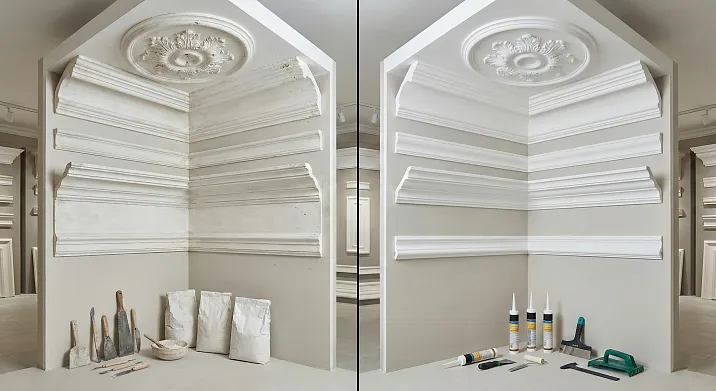
Facing a choice? Before you are catalogs with hundreds of decor options, consultants praising their products, and confusion in your head: what's better — classic plaster or modern polyurethane? This question arises for everyone who decides to transform an interior withstucco decoration. And the answer is not as simple as it seems. Because both materials have a right to exist, both are created for beauty, but they work differently, in different conditions, for different tasks.
When it comes tobuy plaster moldingor choose polyurethane alternatives, you need to understand the physics of materials, operational features, and technological nuances of installation. You need to honestly answer questions: for which room is the decor? What's the budget? Who will install — professionals or yourself? What is the interior style and how important is authenticity? Only after getting answers can you make an informed choice.
Why Material Matters: Physics vs. Aesthetics
Let's start with an inconvenient truth: there is no perfect material for all situations. Plaster is magnificent in some conditions, polyurethane is unbeatable in others. And trying to force one material to fit all tasks is a path to disappointment.
Gypsum moldingis the heir to ancient traditions, a material that adorned the palaces of Versailles, mansions of St. Petersburg, estates of Moscow nobility. Plaster has soul, history, authenticity. It can be sculpted by hand, creating absolutely unique ornaments found nowhere else in the world. A master plasterer works like a sculptor, shaping every detail with fingers, modeling tools, spatulas.
Polyurethane moldingsis an achievement of modern polymer chemistry, a 21st-century material created for mass application without loss of quality. Polyurethane reproduces any complexity of ornament through casting, guarantees the identity of each element, is not afraid of moisture, lightweight, and easy to install.
But here's the paradox: visually, high-quality polyurethane molding is indistinguishable from plaster. After painting, installed on a ceiling or wall, it is perceived by the eye the same as plaster. The difference lies elsewhere — in the material's behavior over time, in operating conditions, in the technology of working with it.




Gypsum: A Tradition Tested by Millennia
Gypsum is a mineral, calcium sulfate (CaSO₄·2H₂O), which, after calcination and grinding, turns into a powder. When mixed with water, it recrystallizes, hardens, and turns into stone. This chemistry has been used by humanity since the 3rd millennium BC — gypsum plaster is found in the pyramids of Egypt, in Greek temples, and in Roman baths.
Our factory also produces:


Advantages of Gypsum Molding
Absolute eco-friendliness. Gypsum is a natural mineral without synthetic additives. It does not emit toxins, does not cause allergies, and is safe even for children's rooms and medical facilities. Environmental safety certificates for gypsum products are not marketing but reality.
Vapor permeability. Gypsum 'breathes' — it allows water vapor to pass through its structure. In a room with gypsum finishes, condensation does not accumulate, and a healthy microclimate is maintained. If air humidity increases, gypsum absorbs excess moisture. When the air becomes dry, gypsum releases moisture back. It is a natural humidity regulator.
Fire resistance. Gypsum does not burn and can withstand temperatures up to 1200°C. In a fire, gypsum molding does not emit toxic gases, does not support combustion, and protects structures from destruction. This is critically important for public buildings where fire safety requirements are the strictest.
Possibility of manual fabrication. A master modeler can create absolutely any shape from gypsum. Need a unique ornament for the restoration of a historical building? Require a family coat of arms on the pediment of a mansion? Want an original composition that no one else has? Gypsum makes it possible to realize this. Polyurethane does not offer such freedom — it requires a mold, and a mold requires a production run to be cost-effective.
Restoration compatibility. If you are restoring a 19th-century building where gypsum molding already exists, new elements must also be made of gypsum. This is a requirement of the restoration code, a matter of historical authenticity. Polyurethane is unacceptable in such objects — it looks like an anachronism, like a plastic patch on antique fabric.
Durability under proper conditions. Gypsum molding installed in a dry room with normal humidity (40-60%) lasts for centuries without changes. It does not shrink, does not deform, and does not change color. Examples include the palace interiors of Peterhof, the Hermitage, and estates where gypsum decor has been preserved for 200-300 years.
Get Consultation
Disadvantages of Gypsum Molding
But if gypsum were perfect, polyurethane would not exist. Yet it does exist and is actively displacing gypsum from the mass market segment. Why?
Enormous weight. The density of gypsum is 800-1200 kg/m³. An 80 cm diameter ceiling rosette made of gypsum weighs 15-20 kg. A 2-meter long, 15 cm wide cornice — 10-12 kg. This creates problems at all stages: transportation requires special packaging and care, installation requires powerful mechanical fastening (anchors in concrete, screws in wood), and the load on the floors increases.
In old buildings with wooden floors, gypsum molding may be completely unacceptable due to the risk of exceeding permissible loads. A structural engineer's calculation is required before installation.
Critical fragility. Gypsum cracks easily upon impact, crumbles when dropped, and breaks when bent. Transportation is always a risk. Packaging must be multi-layered, with polystyrene foam pads protecting every projection of the ornament. Loading and unloading must be done only by hand, with no throwing. On the construction site, elements are stored in a protected place where they won't be bumped or dropped.
During installation, the slightest misalignment can cause a crack. If the wall is uneven, a gypsum element does not bend — it will either fit with gaps or crack when attempting to pull it to an uneven surface. Repairing chips and cracks is possible but requires skill and time.
Moisture sensitivity. Gypsum actively absorbs water. The water absorption coefficient is 5-10% by mass. Wet gypsum loses strength, softens, and may begin to crumble. When drying, stains, salt deposits remain on the surface, and mold may appear.
This makes gypsum unacceptable for wet rooms — bathrooms, swimming pools, saunas, kitchens with poor ventilation. Even in ordinary living rooms, gypsum molding requires a protective coating — primer, paint, varnish — which reduces water absorption and creates a protective barrier.
Complexity and cost of installation. Installing gypsum molding is a job for professionals. The elements are heavy, require precise positioning, powerful fasteners, filling seams with gypsum putty, and sanding joints. Installing a cornice around the perimeter of a 20 sq.m room takes 2-3 days for a team of two people.
The cost of labor is high — usually 100-150% of the material cost. If the cornice itself costs 5000 rubles per linear meter, installation will add another 5000-7500 rubles. Total: 10000-12500 rubles per meter of finished, installed molding.
Material price. High-quality gypsum molding with detailed ornamentation is expensive. Cornices — from 3000 to 10000 rubles per linear meter. Rosettes — from 5000 to 30000 rubles per piece. This is due to the labor-intensive manufacturing process: even serial elements require manual finishing, cleaning, and final processing.
Polyurethane: The Revolution of Affordable Elegance
Polyurethane is a polymer created by the reaction of polyol and isocyanate. The result is a material with a unique combination of properties: light as foam, strong as plastic, detailed as gypsum.
Polyurethane molding appeared in the 1970s as an alternative to expensive gypsum. At first, it was perceived as a cheap imitation, a surrogate for budget projects. But technologies evolved, quality grew, and todayPolyurethane moldings— it is a full-fledged architectural material chosen not for economy but for rationality.
Advantages of Polyurethane Molded Decoration
Phenomenal lightness. The density of polyurethane is 280-320 kg/m³ — 3-4 times less than gypsum. An 80 cm diameter rosette made of polyurethane weighs 1.5-2 kg instead of 15-20 kg for gypsum. A 2-meter cornice — 1-1.5 kg instead of 10-12 kg. This is a revolution.
Light elements do not create a load on the floors. They can be mounted even on drywall constructions, stretch ceilings (with caveats), and wooden walls. Transportation is simple — elements are packed in corrugated cardboard without massive protection; one person can easily carry a set of molding for an entire room.
Absolute moisture resistance. Polyurethane does not absorb water. The water absorption coefficient is less than 1%. An element can be submerged in water, kept there for a day — it will not swell, lose shape, or change properties. After removal, it is enough to wipe it and mount it.
This makes polyurethane ideal fordecorative moldingwet rooms: bathrooms, toilets, swimming pools, saunas (if the temperature does not exceed 80°C), kitchens. A polyurethane cornice in a bathroom will not become damp, will not become moldy, and will not lose strength.
Impact resistance. Polyurethane is plastic and elastic. Upon impact, it does not crack but slightly deforms and restores its shape. Dropped an element during installation? Most likely, it is intact; at most, there is a small dent that can be heated with a hairdryer and leveled.
This simplifies transportation (less breakage), installation (you can work without fear of cracking the element), and operation (an accidental impact won't cause a chip).
Ease of installation. Polyurethane molding is glued with special adhesive (polyurethane, acrylic) or liquid nails. No mechanical fasteners, drilling, or anchors are required. Installation process: apply adhesive to the back of the element, press it to the surface, hold for 30-60 seconds, secure with painter's tape until the adhesive sets (2-3 hours). That's it.
One person can install a cornice around the perimeter of a 20 sq.m. room in 4-6 hours. No assistants, scaffolding, or complex tools are needed. Required: a miter box for cutting corners, a fine-toothed saw, adhesive, painter's tape, a level. A person with basic skills can manage it independently.
Cost is 3-5 times lower than plaster. Polyurethane cornices cost 500-2000 rubles per linear meter depending on width and profile complexity. Rosettes — 800-5000 rubles. Moldings — 200-800 rubles per meter. This makes molding affordable for the mass consumer. The budget for decorating a 20 sq.m. room is 20,000-40,000 rubles instead of 100,000-150,000 for plaster.
Detail of ornament. Modern high-pressure casting technologies (up to 150 atmospheres) allow reproducing the finest ornament details with a depth of up to 0.5 mm. Floral swirls, geometric patterns, figured compositions — everything is conveyed with photographic accuracy.
After painting, polyurethane molding is visually indistinguishable from plaster. Test: show guests the interior and ask what the molding is made of. 90% won't guess correctly unless they touch it (polyurethane feels warmer to the touch, plaster feels cooler).
Geometric stability. Polyurethane does not shrink or deform with changes in temperature and humidity. An element manufactured a year ago has the same dimensions today. This simplifies installation — there's no need to compensate for dimensional changes, all joints are precise.
Disadvantages of polyurethane molding
It would be dishonest to claim that polyurethane is perfect. It has limitations.
Synthetic origin. For those who value absolute material naturalness, polyurethane is a compromise. It is a product of the chemical industry, albeit safe, certified, and not emitting harmful substances at room temperature. But it is not a natural mineral like plaster.
In children's rooms, spaces for allergy sufferers, eco-houses, some prefer to avoid polymers altogether. Here the arguments are more emotional than scientific, but they exist.
Flammability. Polyurethane burns. Flammability group G2-G3 (moderately flammable, normally flammable materials). In a fire, polyurethane supports combustion and releases toxic gases (cyanides). This limits its use in facilities with increased fire safety requirements: kindergartens, schools, hospitals, places of mass gatherings.
For residential premises, this is usually not critical (the area of molding is small relative to the total area of combustible materials — furniture, textiles), but in public buildings, coordination with fire supervision may be required.
Temperature limitations. Polyurethane softens at temperatures above 80-90°C. Under normal conditions, this is never reached. But in close proximity to powerful light fixtures (halogen lamps, spotlights), in saunas with high temperatures, near fireplaces, polyurethane can deform.
Solution: maintain a safe distance from heat sources (at least 30 cm from lamps with a power over 100 W), use LED lighting (LED does not heat up).
Impossibility of hand sculpting. Polyurethane is a material for casting, not for handwork. If you need an absolutely unique element created from a custom sketch in a single copy, polyurethane is not suitable. First, a mold (master model) must be made, which is only cost-effective for a run of 50-100 pieces or more.
For one-off authorial projects, polyurethane is not a competitor to plaster. But for 99% of tasks where standard or slightly modified elements are used, polyurethane is perfectly suitable.
Restoration incompatibility. In cultural heritage sites, architectural monuments, historical buildings, the use of polyurethane is often prohibited by restoration standards. A material analogous to the original is required. If a 19th-century building has plaster molding, the restoration must be in plaster.
This limitation is not technological, but legal and ethical. In ordinary residential and commercial buildings, such restrictions do not exist.
Comparison table: plaster vs. polyurethane
| Parameter | Plaster molding | Polyurethane molding |
|---|---|---|
| Weight | 800-1200 kg/m³, very heavy | 280-320 kg/m³, lightweight |
| Moisture resistance | Absorbs moisture, not applicable in wet areas | Completely moisture-resistant, suitable for bathrooms and kitchens |
| Strength | Brittle, cracks easily | Elastic, impact-resistant |
| Installation | Complex, requires professionals and fasteners | Simple, can be done independently |
| Material Cost | 3000-10000 ₽/m for cornices | 500-2000 ₽/m for cornices |
| Installation cost | 100-150% of material cost | 30-50% of material cost |
| Ecological | 100% natural mineral | Synthetic polymer (safe) |
| Fire resistance | Does not burn, up to 1200°C | Burns, G2-G3 |
| Detailing | Any, including hand modeling | High in casting, hand modeling impossible |
| Durability | Centuries under proper conditions | Decades, does not deform |
| Restoration | Possible, requires skills | Easier — replace the element |
Where to use what: practical recommendations
Theory is good, but how to choose for a specific project?
When to choose plaster
Restoration of historical buildings. If you are restoring a 19th-century estate, a mansion in a historic center, a heritage building — only plaster. This is a legal requirement, a matter of authenticity, and respect for history.
Author's projects with unique decor. Need a family coat of arms on the pediment? A bas-relief with a specific plot? A portrait medallion? Plaster allows you to create this by hand, without molds and mass production.
Interiors where environmental purity is important. If you are building a house from natural materials (wood, stone, clay), want to minimize synthetics, value wall breathability — plaster will fit organically into the concept.
Facilities with high fire safety requirements. Kindergartens, schools, hospitals, theaters — where fire regulations are strict, plaster passes without problems.
Prestigious interiors with unlimited budgets. In the premium segment (mansions, residences, luxury apartments) plaster stucco is a sign of status, demonstrating that no expense was spared, the best was chosen.
When to choose polyurethane
Residential apartments and houses with a normal budget. For 90% of residential projects, polyurethane is the optimal choice. It provides the desired visual effect at reasonable costs.
Wet areas. Bathrooms, toilets, pools, saunas, kitchens — only polyurethane. Plaster won't last long there.
Projects with DIY installation. If you are doing repairs yourself, polyurethane allows you to install stucco without hiring specialists. Savings on labor will be 50-70% of the total cost.
Commercial interiors (stores, offices, restaurants). Here, installation speed, cost, and moisture resistance (especially in restaurants and cafes) are important. Polyurethane solves all these tasks.
Buildings with wooden or lightweight floors. If the load is limited, heavy plaster stucco is unacceptable. Lightweight polyurethane does not create problems.
Facades. Exterior stucco is exposed to rain, snow, and temperature fluctuations. Plaster requires complex waterproofing and periodic restoration. Polyurethane is not afraid of moisture and frost, lasts for decades without maintenance.
Can plaster and polyurethane be combined?
An interesting question with no definitive answer. Technically — yes. Aesthetically — with caution.
Where the combination works:
-
Gypsum elements for dry areas (living room, bedroom, study), polyurethane for wet areas (bathroom, kitchen). The style is the same, the material is different, but no one will notice.
-
Custom gypsum element (e.g., a bas-relief in the center of the ceiling) + standard polyurethane cornices and moldings around the perimeter. The bas-relief is an accent, unique, handmade. The framing is functional, made of polyurethane.
Where the combination does not work:
-
Adjacent elements made of different materials with the same ornament. For example, a gypsum cornice on one wall, polyurethane on another. Upon close inspection, the materials differ in surface texture, thermal conductivity, and sound when tapped. This creates a sense of inconsistency.
Rule: if you combine, clearly separate zones or make elements functionally different (central accent + framing).
Selection process: step-by-step algorithm
How to make a decision? Follow the algorithm.
Step 1: Determine the type of room. Dry residential / wet residential / commercial / historical building?
Step 2: Assess the budget. How much are you willing to spend on material + installation? If the budget is limited to 50,000 rubles per room — definitely polyurethane. If the budget is 200,000+ — you can consider gypsum.
Step 3: Assess your skills. Will you install it yourself or hire professionals? If yourself — polyurethane is much easier.
Step 4: Determine the interior style. Classic, Baroque, Empire — both materials are suitable. Minimalism, Scandinavian, contemporary — polyurethane with simple profiles.
Step 5: Clarify fire safety requirements. If the facility requires approval from the Ministry of Emergency Situations — check if polyurethane is allowed.
Step 6: Consult with a designer or technologist. They can point out nuances you may have missed.
Step 7: Order samples of both materials (if possible). Touch them, assess the weight, detailing, paint a test color. This will give you an understanding at the sensory level.
Questions and Answers: Addressing Doubts
Can polyurethane molding be painted the same color as gypsum?
Yes, absolutely. Both materials are primed and painted with acrylic, latex, or alkyd paints. After painting, they are visually indistinguishable. Polyurethane molding is sold pre-primed, ready for painting.
How long does polyurethane molding last?
With proper installation and use — 30-50 years without changes. Polyurethane does not age, does not yellow (if painted with quality paint), and does not deform. Manufacturers' warranty period is usually 10 years, but the actual service life is significantly longer.
Is it true that polyurethane emits harmful substances?
Quality polyurethane, certified for interior use, is safe. It does not emit toxins at room temperature. Certificates of compliance with GOST, sanitary-epidemiological reports confirm this. Cheap polyurethane from China without certificates may contain harmful impurities — avoid it.
Can it bebuy gypsum molding for self-installation?
Theoretically yes, but practically difficult. Gypsum elements are heavy, require precise fastening, and special skills. A mistake during installation can lead to cracking of the element or its falling. If you have no experience working with gypsum, it's better to hire professionals.
Where to buy quality molding in Moscow and St. Petersburg?
Contact specialized salons and manufacturers. It's important to see samples in person, check the material density, and clarity of relief. Online purchase is possible, but for the first time, it's better to visit a showroom, touch the products, and get a consultation.
How does cheap polyurethane molding differ from expensive?
Material density, clarity of relief, quality of primer. Cheap molding (often Chinese-made) is made from low-density expanded polyurethane (150-200 kg/m³), the relief is blurry, and the primer is uneven. It is soft, easily deforms, and quickly loses shape. Quality molding (European manufacturers, Russian premium brands) is dense (280-320 kg/m³), with clear relief, even primer, and stable dimensions.
Is special surface preparation needed before installing molding?
Yes. The surface must be clean, dry, strong, and degreased. Old wallpaper, peeling paint, and dust are removed. The surface is primed with deep-penetration acrylic primer. This ensures adhesive adhesion. For gypsum molding, the requirements are stricter — the surface must be level, otherwise the element will have gaps.
Can molding be painted in dark colors?
Yes, any colors are available. But dark molding (black, graphite, dark blue) is visually heavier than light, creating a more dramatic effect. It is used in modern contrasting interiors, Art Deco, Gothic stylizations. For classic light interiors, white or pastel molding is better.
How much does molding installation cost?
For polyurethane: 300-600 rubles per linear meter for cornices and moldings, 1000-3000 rubles for installing a rosette. For plaster: 1000-2000 rubles per meter for cornices, 3000-8000 for a rosette. Prices depend on the region, complexity of the project, and ceiling height.
Can stucco be removed and reused?
Polyurethane — yes, if it was glued with acrylic adhesive or liquid nails. The element is carefully pried off with a spatula, removed, and adhesive residue is cleaned off. It can be reused. Plaster — practically impossible. It is installed with plaster putty and mechanical fastening, and breaks during removal.
STAVROS: your guide to the world of architectural perfection
When the realization comes that molding is not just decoration but a tool for creating space, the question arises: where to find materials that will bring your ideas to life? The answer is simple and complex at the same time. Simple — because there are companies with years of experience, impeccable reputation, and a wide range. Complex — because such companies are few among hundreds of decor sellers.
STAVROS has been working in the field of architectural decor for over twenty years, offering solutions for the most demanding projects.molding in interiorfrom STAVROS is not just elements on walls and ceilings. It is a system where each profile is connected to others through a unified style, scale, and quality of execution.
STAVROS's catalog featuresPolyurethane moldingsEuropean manufacturers — over 800 items of cornices, moldings, rosettes, overlays, and pilasters. Material density of 280-320 kg/m³ — a guarantee of rigidity and durability. Relief detailing up to 1 mm — what makes the ornament come alive. Primed surface — ready for painting without additional processing.
For projects where naturalness and authenticity are important, STAVROS offersSolid wood products— over 5900 items of moldings, baseboards, trims, cornices, and carved overlays. Oak, beech, ash of the highest grades, chamber-dried to 8-10% moisture, processed on European equipment. Each product is a work of woodworking art.
STAVROS works not only as a material supplier but as a partner in creating interiors. The company's professional designers help select elements for specific projects, considering style, room scale, and budget. They create visualizations, show how the interior will look with the chosen molding, and calculate the exact amount of materials.
The tinting service allows you to get elements in any color from the RAL catalog. Classic white, delicate cream, luxurious gold, modern graphite — any shade of your choice. Decorative effects like patination, gilding, aging — for exclusive projects where uniqueness is important.
Own showrooms in Moscow and St. Petersburg — spaces where you can see materials in person, touch them, and assess the quality of relief and density. Consultants explain the differences between profiles, show combination options, and provide installation recommendations. This is not conveyor-belt sales but professional consultation.
The stock program with constant availability of popular items ensures fast shipping — you can pick up the material on the day of order or receive delivery the next day. For non-standard elements, the production time is 7-14 days. Delivery to Moscow, Moscow Region, St. Petersburg, and Leningrad Region — materials are delivered to the site at a convenient time, carefully, with transportation conditions observed.
STAVROS understands that architectural decor is an investment in the beauty, comfort, and status of your home. Therefore, the company offers not individual elements but comprehensive solutions.moldings, cornices, baseboards, trims — everything is selected in a unified style so that the interior looks cohesive, thoughtful, and harmonious.
STAVROS's quality guarantee is the assurance that every element is manufactured without defects, with precise dimensions, clear relief, and stable geometry. If a defect is found — replacement without questions. Professional support at all stages — from selection to installation and finishing. This is a partnership where results matter more than immediate gain.
Working with STAVROS, you get not just materials but the confidence that your interior will become what you envisioned. Molding that lasts for decades without losing its beauty. Decor that impresses guests and delights you every day. Quality that requires no compromises.
Entrust the creation of your interior to STAVROS — and get a space that inspires, impresses, and stays with you for many years. Because beauty created with skill and attention to detail never goes out of style.


