Article Contents:
- What is Wall Molding
- Which Elements Belong to Wall Molding
- How Wall Molding Differs from Ceiling Decor
- When Wall Molding is Truly Appropriate
- What Types of Wall Molding Can Be Used
- Wall moldings
- Decorative Frames and Geometric Compositions
- Wall Panels and Accent Zones
- Rosettes, Inserts, and Decorative Elements
- Comprehensive wall decoration with molding
- For which interiors is wall molding suitable
- Classic style
- Neoclassicism
- Modern classicism
- Apartment interiors
- Private house interiors
- Commercial spaces
- How to choose wall molding based on the room
- living room
- for the bedroom
- For the hallway
- For Office
- For dining room or kitchen
- For stairwell halls and passage areas
- Which materials are suitable for wall molding
- Gypsum
- Polyurethane
- Duropolymer
- Decorative solutions from wood and MDF
- What to choose for a specific task
- How to decorate a wall with molding without overloading
- How to consider room size
- How to correlate decor with ceiling height
- How to choose the scale of elements
- Why symmetry and composition are important
- How to combine molding with lighting, furniture, and doors
- What to choose for different tasks
- For an accent wall
- For background decorative design
- For strict geometry
- For an expressive classic interior
- For calm neoclassicism
- When it's better to order molding according to the project
- If there is a design project
- If you need to decorate a large wall
- If you need symmetrical compositions
- If the decor should match the doors, ceiling, and furniture
- How to choose wall molding in Moscow
- What to look for when selecting
- Why it's important to consider not just one element, but the entire composition
- How to understand if the decor will suit your interior
- What to prepare before ordering or selecting
- Common mistakes when choosing wall molding
- Why it's important to select wall molding as part of the overall interior
- FAQ: Answers to Popular Questions About Wall Molding
- STAVROS: Wall Decor That Works

There comes a moment in renovation when the walls are ready, the paint is applied, the furniture is chosen — and suddenly you realize: something is missing. The space is technically correct, but bland. The walls are smooth, but silent. It is at this moment that most people start looking for wall molding in Moscow — and encounter a huge variety of elements in which it's easy to get lost.
Moldings, frame panels, decorative overlays, friezes, trims — all these are options for wall decor, each solving its own task. Decorating walls with molding is not about 'showing off wealth' and not about archaism. It's about the architectural quality of space, about proportions, about how a wall communicates with a person. In Moscow today, molded wall decor is used in apartments, mansions, restaurants, offices, and boutiques — everywhere they want to create an environment, not just a surface.
This article is a practical guide. No fluff, no lyricism for the sake of lyricism. Only what really helps to choose, select, and competently apply decorative elements for walls.




What is Wall Molding




Which Elements Belong to Wall Molding
Wall molding is a large and diverse class of decor that works specifically on vertical surfaces. These are not ceiling profiles or floor skirting boards (although they are often part of a unified system). We are talking about elements that structure, accentuate, and enrich walls.
Here's what this includes:
-
Moldings — profile strips of varying width, height, and geometry. They can run horizontally (dividing the wall into zones), vertically (creating rhythm), or form closed frames.Moldings for walls— the foundation of any wall decor.
-
Decorative frames — rectangular or square outlines made of moldings that transform a flat wall into a structured plane with inner fields.
-
Decorative panels — sectional elements that cover part of a wall with a textured or relief finish.
-
Friezes — horizontal strips with ornamentation or geometric patterns that run along the wall at a certain height.
-
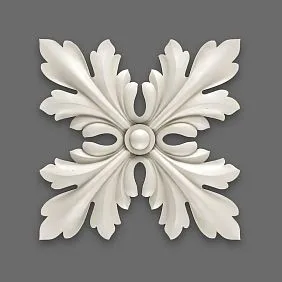
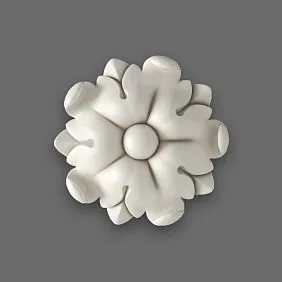
Overlay rosettes and medallions — accent elements used above doors, above sofas, in niches, or over fireplaces.
-
Wall panels and bas-reliefs — independent decorative objects with relief imagery.
-
Door and window trims — pilasters, architraves, keystones, profile frames around openings.
The combination of these elements forms whatprofessional molded decorcalls a 'wall styling system'.
Our factory also produces:




How does wall molding differ from ceiling decor?
The difference is fundamental: ceiling decor works with a horizontal plane and is perceived from below, thus emphasizing volume and height. Wall decor is what a person sees directly in front of them, at eye level. It influences the perception of a room's scale, creates rhythm, and imparts a sense of richness or conciseness.
A ceiling cornice connects the wall to the ceiling and completes the vertical—it belongs to both planes simultaneously. But moldings on the wall, frame panels, applied ornaments—these are purely wall elements. Here, a different logic of placement is important: not 'from where it is visible,' but 'what it does to the perception of the space as a whole.'
Get Consultation
When is wall molding truly appropriate?
Wall decor is always appropriate—provided it is proportionate and thoughtfully applied. The myth that molding is only needed in huge mansions has long been debunked by practice:Polyurethane decorative molding for wallstoday it is used in Moscow apartments with an area from 50 m²—and looks appropriate and luxurious.
The main criterion for appropriateness is the correspondence of the scale of the elements to the size of the room and the style of the interior. Two moldings forming a frame on an accent wall in the living room—this is not excessive, it's a precise hit. Thirteen frames of different sizes on the same wall—that's already chaos.
What types of wall molding can be used?
Wall moldings
Molding is the most flexible and versatile tool in the arsenal ofwall decorThis is a profile rail with one or several steps, bevels, arcs—depending on the style and task. Moldings are applied in different ways:
Horizontal wall division—the molding runs at a height of 90–110 cm from the floor, creating a 'lower belt' (dado) and an upper zone. The lower zone is painted in a darker color or finished with a panel, the upper zone in a lighter one. The technique is very old and yet eternally relevant.
Frame compositions—several moldings form rectangular or square frames on the wall. Inside the frame is one color, outside another, or wallpaper is pasted inside, or simply a more saturated shade of the same paint. The effect is immediate and obvious.
Framing doors and windows—moldings are laid along the perimeter of the openings, turning a simple door jamb into an architecturally designed portal.
Vertical posts—moldings running from bottom to top create a visual rhythm and visually raise the ceiling.
Decorative frames and geometric compositions
A decorative frame on the wall is a molding closed into a rectangle. One of the most in-demand techniques in neoclassicism and modern classicism. Why do frames work? Because they create structure where there was none: they break up a monotonous wall into meaningful fields, set rhythm and symmetry.
System of decorative wall finishing with moldingsassumes that all frames on one wall should be the same size, with the same indents—otherwise, instead of rhythm, you get a random set of squares.
For frame compositions, polyurethane moldings with a width of 30–70 mm are most often used—they provide a sufficiently expressive relief with a small mass.
Wall panels and accent zones
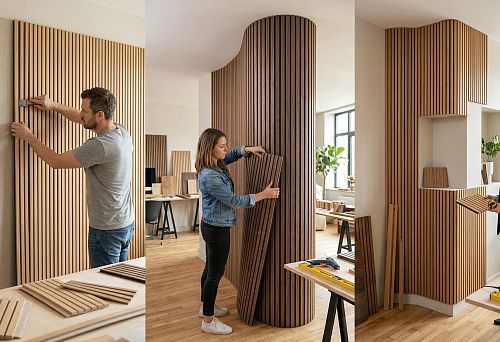
Panels are a larger format of wall decor. They cover a significant portion of the wall and create a strong visual effect.Decorative wall panels for apartment interiorsTypes include:
-
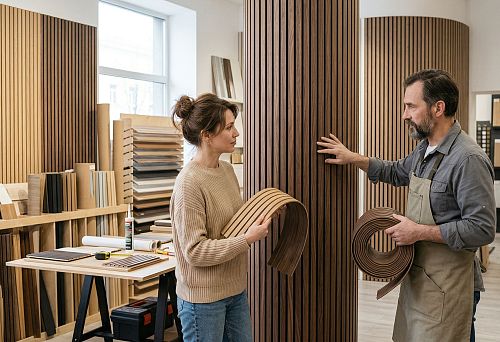
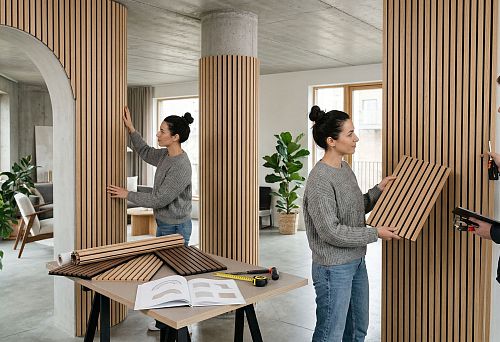
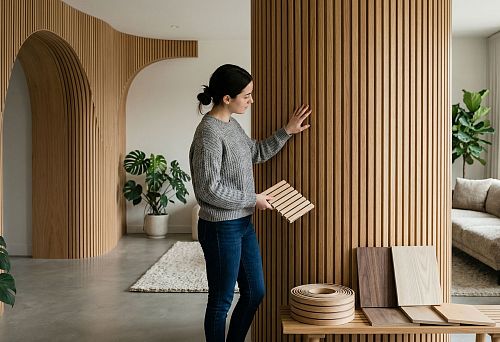
Slatted — made of natural wood or paintable MDF, creating a warm textured surface;
-
Framed — sectional rectangular fields framed with molding;
-
Relief — with three-dimensional ornamentation or geometric patterns.
Panels are most often used on an accent wall: behind the sofa in the living room, behind the headboard in the bedroom, in the hallway behind a console. This is a technique that instantly makes a room look more expensive and well-thought-out.
Rosettes, inserts, and decorative elements
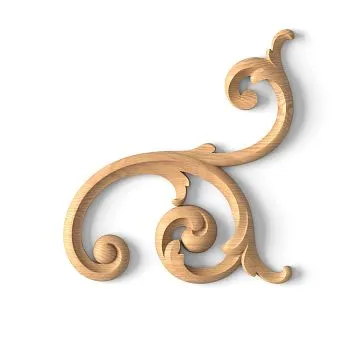
Overlay rosettes are not just ceiling decor. On walls, they appear where a pinpoint accent is needed: above a doorway as a keystone, in the center of a panel as a medallion, above a fireplace as a central ornamental element. Such inserts make a wall not just 'decorated,' but truly bespoke.
Brackets, consoles, cartouches, molded garlands, and bas-reliefs are individual elements for those interiors where decor is a full-fledged participant in the artistic concept.
Comprehensive wall decoration with molding
The most powerful option is a comprehensive system: baseboard at the bottom, horizontal molding at dado height, framed panels in the main field, frieze under the cornice at the top. This is the classic 'three-part' wall — the foundation of European interior tradition.Wall finishing with moldingsin such a system transforms an ordinary room into a space with character.
What interiors are suitable for wall molding
Classic style
Classicism is the native language of decorative molding. Everything is used here: framing systems, friezes, ornamental friezes, cornices with rich profiles, decorative medallions on walls. The key principles of classicism — symmetry, hierarchy of elements, expressive white relief on a colored background — are perfectly reproduced even in modern housing.
In a classic interior, wall molding should be rich but precise. Framed panels occupy most of the wall area, with clear, uniform spacing between them. No randomness. Only logic and proportions.
Neoclassicism
Neoclassicism is the classical vocabulary spoken in a quiet voice. The same moldings, frames, friezes, but without opulence. The profile is cleaner, the relief is lower, the color is calmer. The wall surface with moldings in neoclassicism can be entirely in one tone: light gray molding on a light gray background — and it already works.
Moldings in interior design 2026demonstrates exactly this approach: minimal color contrast, maximum formal perfection. A monochrome wall with framed moldings is a highly relevant solution.
Modern classic
Modern classic — perhaps the most in-demand style in Moscow apartments in recent years. Here, molding is applied selectively: one accent wall with frames, a cornice around the ceiling perimeter, moldings as zone dividers. Without friezes, without bas-reliefs, without overload.
Material — typically polyurethane. Color — white or matching the wall. Result — an interior that looks 'more expensive' than it actually is.
Apartment interiors
Wall molding in Moscow apartments has long ceased to be an exception. Moldings and frame panels fit perfectly even in rooms of 15–20 m² — with the right scale selection. A thin 30–40 mm molding, two or three frames on an accent wall, a 70–90 mm baseboard — and the apartment gains an architectural quality that wallpaper cannot buy.
An important point for apartments:decorative wall moldingshould be lightweight — literally by weight. Polyurethane is attached with adhesive without embedded elements, does not require floor reinforcement, and can be installed independently in one day.
Private house interiors
A private house with ceilings of 3.5–5 m is the ideal space for a full-fledged wall decor system. Here you can go all out: tall frame panels, wide 120–180 mm baseboards, horizontal dado molding at a height of 1.1–1.2 m, rich friezes.A wall with molding and relief panels— this is already full-fledged decorative architecture.
In private homes, wooden elements or plaster are more commonly used — they add genuine weightiness and tactile richness.
Commercial Spaces
Restaurants, hotels, executive offices, boutiques, premium-class medical centers — wall molding here creates an atmosphere. A guest enters and immediately reads: a serious place.interior wall decorfor commercial spaces is often executed according to an individual project — with brand-specific patterns, non-standard colors, large-scale frame systems.
How to choose wall molding based on the room
For the living room
Living room — a formal space where wall decor is most fully expressed.Decorating living room walls with moldings and cornices— is one of the most popular requests. The optimal minimum: an accent wall behind the sofa with frame moldings, a cornice along the ceiling perimeter. The maximum — a full system: frame panels on three walls, a frieze, a 120 mm baseboard, a 150+ mm cornice.
In a living room up to 25 m², an accent wall is sufficient. In a living room from 30 m², decor on three walls looks organic.
For the bedroom
Bedroom — a space where molding should create tranquility, not solemnity. A frame panel behind the bed headboard is the most effective and yet unobtrusive technique. A molding 40–50 mm wide, a frame height equal to 2/3 of the wall — and the accent is ready.
Additionally: a cornice at the ceiling with a simple profile, an 80–100 mm baseboard. No friezes with ornament — in the bedroom they create visual noise where silence is needed.
For the hallway
Hallway — the first room that greets guests. Here, wall decor works to create an interior 'showcase.' Pilasters by the entrance door, framing a mirror with molding, a cornice along the perimeter — even in a small hallway, this creates an instant impression of a well-thought-out space.
In narrow corridors — only vertical elements and a cornice: horizontal moldings visually shorten and narrow the space.
For an office
Study — a place of concentration and status. Here, moldings and overlays that create wall depthframed library panels, oak wood moldings, horizontal dado at 1.2 m height. A wall behind a desk or bookshelves with framed molding is a professional and expressive technique.
For a study, wooden elements or wood imitation are especially appropriate—they provide the necessary seriousness.
For dining room or kitchen
In the dining room, full wall decor is appropriate: framed panels, moldings, cornice. In the kitchen—only the functional minimum: a horizontal molding as a divider between the work and dining areas, a cornice near the ceiling. The material in the kitchen must be strictly polyurethane: it is not afraid of steam, grease, and occasional humidity.
For stair halls and passage areas
Stairs and halls are movement zones that are often underestimated in terms of decor. And in vain. Vertical moldings along the height of the staircase flight, decorative frames with equal spacing along the movement path, a cornice in a niche—this turns a 'passage' into a route with character.Interior moldings and profilesfor hall areas, choose those with a more saturated profile—they work well in conditions of high ceilings and large spaces.
What materials are suitable for wall molding
Plaster
Gypsum is a classic material with perfect relief detailing and absolute eco-friendliness. The surface of gypsum molding has a characteristic matte finish, well known to restorers and designers of historical interiors.
The main drawback of gypsum for walls is its fragility under mechanical impact and sensitivity to moisture. In an apartment with an active lifestyle, gypsum moldings in high-traffic areas are a risk. Where the wall is 'protected'—in a study, living room, or formal hall—gypsum is magnificent.
Polyurethane
Polyurethane is today the primary material for wall molding decor. It is lightweight (a 60 mm molding weighs grams), flexible during installation, moisture-resistant, cuts well, adheres with liquid nails or polyurethane glue, and can be easily painted any color.
The relief of polyurethane molding, when manufactured with quality, is in no way inferior to gypsum—it's a myth that 'foam' looks cheap. High-qualityPolyurethane wall decor—features clear relief, precise geometry, and a smooth surface ready for painting.
Duropolymer
Duropolymer is reinforced polyurethane with added chalk. It is denser, less elastic, and very precise in geometry. Ideal for commercial spaces and areas with high durability requirements.
Duropolymer is used not only for moldings but also for large decorative elements: corner trims, capitals, brackets. On the wall, duropolymer is practically indistinguishable from gypsum when properly painted.
Decorative solutions from wood and MDF
Wood on walls is a special topic. Oak moldings, ash slat panels, MDF frames for painting—all provide that 'living' texture that no synthetic material can replicate.
Wooden moldings and panels are especially suitable for studies, dining rooms with wooden furniture, libraries, and country homes with warm wooden interiors.Slat panels and molding-decorative moldings— a well-matched pair: the linear geometry of battens and the framed architecture of moldings complement each other.
MDF moldings for painting are a compromise option: they are more precise in geometry than wood, cheaper than solid wood, and take paint excellently.
What to choose for a specific task
| Task | Material | Why |
|---|---|---|
| Apartment, walls in living rooms | Polyurethane | Lightweight, moisture-resistant, affordable |
| Private house, study | Wood, MDF, plaster | Tactility, substantiality |
| Kitchen, hallway | Polyurethane | Resistance to moisture and wear |
| Commercial object | Duropolymer, polyurethane | Durability, geometric accuracy |
| Restoration, historical interior | Plaster | Authentic relief |
| Accent wall in the living room | Any | Tailored to the task and style |
How to decorate a wall with molding without overloading it
This is the main fear—and it is absolutely rational. Molding can either transform an interior or destroy it. It all depends on the measure.
How to consider room size
The rule is simple: the smaller the room—the thinner the moldings and the fewer the elements. In a room of 14–16 m², the maximum is one accent wall with two or three frames. In a room from 25 m², decoration can be extended to two or three walls.
Dividing a small wall with many small frames is a mistake. It creates an uncomfortable feeling of 'crampedness' and visual noise.
How to relate decor to ceiling height
Ceiling up to 2.7 m: moldings no wider than 40–50 mm, frames no higher than 2/3 of the wall height, no friezes.
Ceiling 2.7–3.2 m: moldings 50–80 mm, full-height panels, horizontal frieze possible.
Ceiling above 3.2 m: full system without restrictions — dado, framed panels, frieze, cornice.
How to choose the scale of elements
Golden rule: the width of the molding should not 'compete' with the width of furniture elements. If a door has a 60 mm casing — the moldings on the walls should be in the same width range. A mismatch in scale is what makes an interior look 'random'.
Why symmetry and composition are important
Symmetry is not conservatism. It is psychological comfort. When wall panels are arranged mirror-symmetrically relative to the room's axis, the eye is calmed. When panels are placed arbitrarily — the brain perceives it as disorder, even if each element is beautiful on its own.
Always do a layout on paper or in an editor before installation: how many panels, what size, with what margins from edges, from ceiling, from floor, from doors.
How to combine molding with light, furniture, and doors
Three rules:
-
The profile of wall moldings should echo the profile of door casings.
-
If the furniture is dark, the molding should be in a light tone (or contrastingly dark, if it's a design decision).
-
Lighting directed along a wall with moldings turns the relief into a work of art—especially in the evenings.
What to choose for different tasks
For an accent wall
An accent wall is usually the wall opposite the room entrance or the wall behind the main furniture group (sofa, bed). Suitable options for it include:
-
frame moldings (2–4 frames with equal spacing);
-
combining frames with a contrasting color inside;
-
decorative panels with relief;
-
combining slatted panels at the bottom and molding frames at the top.
For background decorative design
"Background" decor is molding that creates texture and depth but doesn't aim to be the main focus. Here, thin moldings matching the wall color, small unobtrusive frames, or a horizontal dado rail work well. Such decor acts as a "backdrop"—it doesn't stand out, but without it, the wall seems empty.
For strict geometry
If you need clear geometry, choose rectangular moldings with a flat profile. They create precise lines without unnecessary rounding or ornaments. Such decor is ideal for modern classic and minimalist neoclassical styles.
For an expressive classic interior
A rich classic interior requires a rich profile: moldings with multi-step sections, horizontal friezes with ornaments, decorative overlays in the corners of frames. It is preciselywall molding with expressive reliefthat creates that very 'depth' which cannot be achieved with any paint.
For calm neoclassicism
Neoclassicism favors restraint. Moldings are thin (25–40 mm), the profile has one or two transitions, frames are of medium height, no ornaments. Color is monochrome or similar shades. The result is a wall that 'sounds' quiet but confident.
When it's better to order molding according to the project
If there is a design project
Having a design project significantly simplifies the task: it already specifies the exact dimensions of all elements, their placement, and style. The manufacturer receives the technical specifications and produces the items with the required parameters. Molding elements—by length, frames—by internal and external dimensions, overlays—by shape and diameter.
If you need to decorate a large wall
A large wall—over 4 meters in length—requires a well-thought-out system. The number of frames, their proportions, spacing—all of this needs to be calculated in advance, and it's better to do this as part of a custom project rather than assembling from a ready-made assortment 'by eye'.
If symmetrical compositions are needed
Symmetry on two walls in the living room, symmetry around a fireplace, symmetry along a staircase—all of this requires elements manufactured with millimeter precision. Here, custom-made molding to size is the only correct choice.
If the decor must match the doors, ceiling, and furniture
When the interior is designed as a unified system—the moldings on the walls must be coordinated with the cornice on the ceiling, with door trims, with baseboards, and sometimes with furniture fronts. Achieving this with a ready-made assortment from several catalogs is practically impossible. Custom-made molding for the project is the only way to obtain a truly unified system.
How to choose wall molding in Moscow
What to look for when selecting
Before moving on to browsing the catalog, you need to answer a few questions:
-
What is the interior style? Classic, neoclassical, modern classic, art deco?
-
What is the ceiling height?
-
What is the area of the room?
-
Is there an accent wall or is full decoration planned?
-
What material is preferred: polyurethane, wood, plaster?
-
What color will be used for the molding?
Answers to these questions narrow the choice by three to four times and make the search targeted.
Why it's important to consider not just one element, but the entire composition
Molding detached from the interior is just a profile. Molding in the context of an interior is an architectural element. That's why experienced designers never choose molding 'by one element.' They first build the entire system: what cornice, what molding, what baseboard, with what offsets, in what color—and only then place the order.
How to understand if the decor will suit your interior
Three reliable methods:
-
Create a computer visualization with selected elements.
-
Order samples and attach them to the wall under natural and artificial lighting.
-
Consult with a designer or manufacturer specialist.
Never order a large batch without prior testing in the actual room.
What to prepare before ordering or selecting
-
Exact room dimensions (length and width of walls, ceiling height).
-
Marked positions of doors, windows, niches, protrusions.
-
Photographs of the room during daytime.
-
Information about the interior style.
-
If available — a design project or at least a fragment of it indicating decorative zones.
Common mistakes when choosing wall molding
Let's be direct — these mistakes are made by both private clients and inexperienced designers.
Too large decor in a small room. 100 mm molding in a 12 m² room doesn't create richness — it creates crampedness. Scale is the first parameter when choosing.
Too many frames on one wall. A wall divided into seven small rectangles looks chaotic. Two or three large frames are significantly stronger than seven small ones.
Mismatch between the profile of wall moldings and door casing profiles. This is a classic mistake during phased renovations. Doors with one molding, walls with another — and there's no system.
Ignoring ceiling height. Not every molding is good in every room. Rule: the lower the ceiling, the thinner and more modest the profile should be.
Mixing styles. A Baroque overlay above a minimalist door is not 'interesting eclecticism', it's a stylistic error. All decorative elements in a room should speak the same language.
Ordering elements without a preliminary layout. Buying molding of a liked type without knowing where to place it is a path to disappointment. First plan, then purchase.
Using a beautiful element that doesn't work in the overall composition. It happens that an individual element is beautiful, but looks alien in the context of the room. Decor is selected to match the interior, not the interior to match the liked decor.
Why it's important to select wall molding as part of the overall interior
This is not a matter of taste — it's a matter of result.
Wall molding decor works only in context. It interacts with the ceiling (cornice is the transition between wall and ceiling), with the floor (baseboard is the lower boundary of the wall plane), with doors (trims and casings are a continuation of the wall rhythm), with furniture (wall moldings dialogue with furniture facade profiles), with curtains (vertical moldings near windows should be coordinated with drapery).
When all this is coordinated — the interior looks rich and professional, even on a moderate budget. When elements were selected separately, without overall logic — it's immediately visible, regardless of material cost.
Exactly thereforeDecorative elements for wall finishingA professional designer always considers it as part of the overall project, not as an independent purchase.
Another subtle point: molding can 'manage' the perception of space. Horizontal moldings at low height visually shorten walls. Vertical stripes — raise the ceiling. Frames on an accent wall — create a sense of depth. Knowing these techniques allows using molding decor not just as 'decoration', but as a full-fledged tool for working with space.
FAQ: answers to popular questions about wall molding
What type of molding is best suited for walls?
For most living spaces — polyurethane moldings: lightweight, moisture-resistant, easy to install with adhesive. For studies and formal spaces — wooden or plaster elements.
Can wall molding be used in an apartment?
Yes, and this has long been a common practice in Moscow. With ceiling heights from 2.7 m and the correct choice of scale, wall molding fits perfectly into a city apartment.
What to choose for walls: moldings or panels?
Moldings are for framing systems and zoning. Panels are for an accent wall or large surfaces. The best result is their combination: frames made of moldings plus textured panels in the lower zone.
Is molding suitable for a modern interior?
It works if you choose the appropriate profile. For a modern interior — thin rectangular moldings without ornaments, a monochrome solution, precise geometry.
How to decorate an accent wall with molding?
Choose one wall (opposite the entrance or behind the main furniture), apply markings: two to four frames of the same size with equal spacing. Inside the frames, paint the wall a shade darker. Install the moldings. The effect is immediate.
What molding is best for a living room?
For a living room, a full system is optimal: a cornice at the ceiling, a horizontal molding at dado level (90–110 cm from the floor), framed panels on the accent wall. Material — polyurethane or plaster.
Can wall molding be used in a small room?
Yes. The main thing is to choose thin moldings (no wider than 40–50 mm), not to break up the wall into many small frames, and limit yourself to one accent wall.
What materials are best for wall molding?
Polyurethane - for most tasks. Plaster - for historical interiors and restorations. Wood and MDF - for warm interiors with natural materials. Duropolymer - for commercial projects.
How to avoid overloading the interior with molding?
Rule of three 'no's: no molding on all four walls without breaks; no small frames in large quantities; no mixing different styles of decorative molding in one room.
Where to find wall molding in Moscow?
From a specialized manufacturer with a large catalog, consultation options, and custom manufacturing. One of the best options is STAVROS.
STAVROS: wall decor that works
If you're seriously engaged in selectingwall molding in Moscow— the company STAVROS deserves special attention. For over twenty years, STAVROS has been producing decorative elements for walls, ceilings, and doors, working with both private clients and professional studios, architects, and finishing companies.
STAVROS's assortment includes moldings of all profiles and sizes, slatted panels made of natural wood and MDF, polyurethane decor, cornices, baseboards, decorative overlays, and frame profiles. Everything as a unified, coordinated system where each element complements the others.
What is especially important: STAVROS works with individual orders, helps select elements for specific interiors, and provides delivery throughout Russia. More than 246 confirmed reviews with the highest rating speak of the company's reliability better than any words.
View catalog and place order:www.stavros.ru