Article Contents:
- Before buying: what exactly are you choosing
- Slat material
- Structural type
- Slat profile
- Slat spacing
- Slat panel quality: eight parameters you can't ignore
- 1. MDF density
- 2. Slat spacing accuracy
- 3. MDF edge processing
- 4. Wood moisture stability (for oak panels)
- 5. Closedness of the slat face surface
- 6. Batch stability
- 7. Availability of agreed linear footage
- 8. Minimum shipment volume
- What to find out before purchasing slat panels for wall finishing
- Evaluate your surface geometry
- Determine the style and function of the surface
- Calculate the area
- Agree on the slat orientation
- Request physical samples
- Color and tinting: how to choose before purchase
- MDF for painting: determining the color
- Oak: choosing the tint
- Finishing system: what to buy together with panels
- Molding and cornice: the upper boundary of the system
- Floor skirting: the lower boundary of the system
- Extension strip for non-standard areas
- Decorative overlays for classic systems
- Elements for stairs
- Furniture handles
- Buy slatted panels for wall finishing: five scenarios for different tasks
- Scenario 1: Accent wall in the living room
- Scenario 2: Headboard wall in the bedroom
- Scenario 3: Hallway and corridor
- Scenario 4: Office and corporate space
- Scenario 5: Restaurant, cafe, commercial space
- Where to buy slatted panels for wall finishing: direct manufacturer or intermediary
- Calculating the number of modules: how to avoid mistakes when purchasing
- Interior styles and corresponding choices when purchasing
- Minimalism: monochrome system
- Scandinavian style: natural warmth
- Japandi: meditative horizon
- Modern classic: architectural panel system
- Loft: industrial wood
- Lighting when purchasing slatted panels: plan ahead
- Typical mistakes when buying slatted panels for wall finishing
- Questions to ask before purchasing
- About the Company STAVROS
- FAQ: Answers to Popular Questions

You've already seen them — in cafes with atmosphere, in hotels you didn't want to leave, in someone else's apartment you wanted to return to. Those very walls with rhythmic wooden relief where light lives differently than on a smooth surface. You already know what you want. Now the question is different: how to buy slatted panels for wall finishing correctly — without wasting money, without encountering poor-quality material, and without disappointment six months later.
The slatted panel market has grown many times over in recent years. This is good news: the choice is wide. This is also bad news: along with conscientious manufacturers, offers have appeared with loose MDF, unstable slat spacing, painted edges instead of primed ones. In catalog photos, everything looks equally good. The difference becomes apparent three months after installation.
This article is a systematic guide for those planning to buy slatted panels for wall finishing consciously. Everything is collected here: quality parameters, structural types, materials, finishing system, manufacturer selection criteria, quantity calculation, and decision-making sequence. Read to the end — each section eliminates one of the typical purchase mistakes.


Before buying: what exactly are you choosing
When a person first looks for where to buy slatted panels for wall finishing, they typically have a picture in mind—a specific visual image. But 'slatted panel' is not a single product. It's a large family of items with fundamentally different characteristics. Buying a 'slatted panel' without understanding the structural type is like buying a 'car' without knowing whether you need a sedan, an SUV, or a minivan.
Let's start with the key parameters that determine the choice.




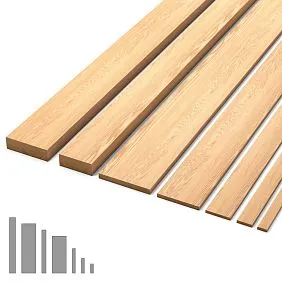
Material of the slats
Two fundamental options are MDF for painting and solid oak. These are different materials with different properties, applications, and price levels.
MDF with a density of 750–850 kg/m³ is homogeneous, defect-free, with a perfect surface for painting. Any RAL or NCS color. Can be repainted without dismantling. Ideal for monochrome solutions, corporate facilities, interiors with a strict color program. Lightweight—important for ceiling installation.
Solid oak with a density of 700–750 kg/m³ has a natural texture, tactile open pores, and a lively grain pattern. Each slat is unique. Toning from light honey to graphite—while preserving the natural pattern. For Scandinavian style, Japandi, organic minimalism, any spaces where natural material is a conscious choice.
Our factory also produces:
Structural type
Rigid panels on an MDF backing—standard format for straight walls. Precise factory spacing, flat geometry, easy installation. 90% of all applications.
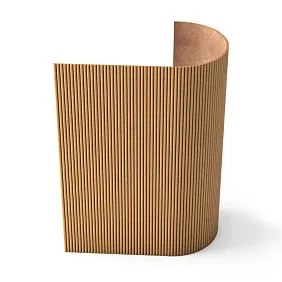
Flexible panels on a fabric base—for curved surfaces: columns, arches, rounded corners. The only professional solution for radius geometry.
Get Consultation
Profile of the slat
Rectangular (strictness and clarity), semicircular (softness and organic feel), trapezoidal (volume and decorative weight). The profile defines the character of light and shadow—and thus the atmospheric image of the surface.
Slat spacing
15–25 mm (dense, active rhythm), 30–40 mm (balanced, universal), 45 mm and more (airy, monumental). The spacing affects the visual 'density' of the surface and its perception in a specific room.
Quality of slatted panels: eight parameters you can't ignore
This is the most important section for those planning to buyslatted panels for wall finishingand get a result, not a problem. Eight parameters—eight questions to ask the manufacturer or seller.
1. MDF Density
Standard: 750–850 kg/m³. Below 700 kg/m³—loose material: swelling ends at the slightest humidity, poor fastening, deformation with temperature changes. 20–30% cheaper—problems in 6–12 months.
How to check: ask the manufacturer for the technical data sheet for the MDF specifying density. A conscientious manufacturer will provide it without hesitation.
2. Accuracy of slat spacing
Standard: deviation no more than 0.5 mm. It is the step accuracy that determines whether visible joints will appear when installing multiple modules side by side.
Why it's critical: joints with unstable step are visible under any lighting — and this is irreparable after installation. No installation master can compensate for manufacturing inaccuracy.
How to check: request samples of two modules from the same batch, place them tightly together and observe the rhythm of the slats across the joint. With 0.5 mm accuracy — the joint is invisible.
3. MDF edge processing
MDF edges are porous — when left open they absorb moisture and swell, paint on the edge 'lifts up'. Normal condition: edges are primed or covered with edge film during production.
How to check: look at the edge of the sample substrate. An open edge without primer is a sign of cost-cutting that will backfire.
4. Wood moisture stability (for oak panels)
Standard: 8–10% for solid wood. If oak arrives at production without drying in climate chambers — the slats 'warp' after installation: they bend as they equalize with the room's humidity. This is irreparable after installation.
How to check: ask the manufacturer if they have their own climate drying chambers. Or request moisture meter data.
5. Closedness of the slat face surface
Battens must have factory primer or finish coating. 'Bare' MDF battens without primer will require multi-layer treatment on site. Oak battens - minimum oil or varnish for protection before installation.
6. Batch stability
If you will be ordering additional panels - it is important that the MDF shade and oak texture remain consistent from batch to batch. Ask: 'If I order additional modules in three months, will they match the color of the first delivery?' An honest answer speaks volumes.
7. Availability of coordinated trim
A professional manufacturer offers not only panels, but also moldings, baseboards, and additional battens from the same production program. If trim is not available - you will have to select it separately and achieve visual matching on your own.
8. Minimum shipping volume
For residential projects, the ability to buy batten panels individually or in small batches is important. A manufacturer with a minimum shipment of one piece is a partner for a residential project. A minimum shipment of 50 sq.m - a manufacturer for builders, not for homeowners.
What is important to find out before buying batten panels for wall finishing
Before placing an order, go through the following checklist. Each item is a decision that determines the outcome.
Evaluate the geometry of your surface
Straight walls, partitions — rigid panels on MDF backing. Columns, arches, rounded corners — flexible panels on fabric backing. Mixed geometry (straight walls + column in a room) — both types, from one manufacturer with one pitch.
Determine the style and function of the surface
Minimalism, office, monochrome — MDF for painting, rectangular profile. Scandinavian, Japandi, organic — oiled oak, semi-circular profile. Classic, modern classic — tinted oak, rectangular or trapezoidal profile.
Calculate the area
Surface area (minus openings) ÷ area of one module = number of modules. Round up. Add 10–15% margin for cutting. Ordering later — risk of batch mismatch.
Agree on the slat orientation
Vertical — 'raise' the ceiling. Horizontal — 'expand' the room. This decision is made before ordering: for rigid panels, orientation is set during installation, but it's better to agree on it in advance with the manufacturer (for non-standard formats).
Request physical samples
No photograph conveys the real color of MDF and the live grain of oak. Before purchasing, request physical samples of several options and view them under the actual lighting conditions of your room.
Color and tinting: how to choose before purchase
MDF for painting: determining the color
Color is specified according to the RAL or NCS catalog. Selection strategies:
Monochrome. The panel is painted exactly to match the wall tone. The relief exists only through shadow. The highest level of minimalism — requires good side lighting.
Tonal accent. Walls — a light neutral tone, the panel — 2–3 tones deeper. The relief is perceived through color and shadow.
Saturated accent. Neutral walls, the panel in a deep color — anthracite, bottle green, dark blue, terracotta, burgundy.
Two-color system. Slats — one color, the backing (visible in the gaps) — another. White slats on a black backing — maximum graphic quality.
Oak: choosing the tint
Oak tinting preserves the natural grain pattern while changing the color. This is a key advantage over painting — the texture does not disappear.
-
Natural (without tinting) — warm honey-amber tone;
-
Light gray / whitewashed — Nordic, airy look;
-
Medium gray — Japandi, restrained Scandinavian classic;
-
Dark brown — classic, traditional luxury;
-
Graphite/smoky — loft, modern classic with character;
-
Fumed oak — deep natural gray-brown.
Finishing system: what to buy together with panels
This is a section often skipped on the first purchase — and later regretted. Slatted panels are maximally effective only as part of a coordinated system. Here's what to order simultaneously.
Molding and cornice: the upper boundary of the system
The upper end of the slatted field — a visible horizontal line. Without molding, it looks unfinished.Wooden molding and corniceFrom the same production program — an architectural horizontal, turning the slatted plane into a finished element. Oak of the same tint — natural consistency. MDF molding for painting in the same color — an invisible but architecturally precise boundary.
Floor baseboard: the lower boundary of the system
Solid oak wooden skirting boardnext to oak slatted panels — a unified natural image from the floor to the upper boundary of the panel. One material, one tint, one production — architectural monolithicity.— is a horizontal element that frames the room at the bottom of the walls where the wall meets the floor. Skirting boards perform several functions: they hide the technological gap between the wall and floor covering (necessary for thermal expansion), protect the lower part of the wall from mechanical damage, create visual completion, and may conceal wiring.for MDF systems — in the same RAL, seamless color transition.
Extension slat for non-standard sections
wooden plankfrom the same solid wood — an extension for corner transitions, window reveals, door frame trims. The same material, the same tint — an inconspicuous organic extension.
Decorative overlays for classical systems
In neoclassical and contemporary classicDecorative Insertscreate architectural framings for the slatted field: horizontal and vertical frames turn a beautiful wall into a full-fledged architectural panel system. They must be purchased simultaneously with the panels — from the same production program.
Elements for stairs
If slatted panels are mounted in a stairwell,balusters for staircasesFrom the same oak array, a unified wooden architectural theme is created. The slatted wall and wooden balusters of the same species form a natural narrative that leads from one level to another.
Furniture handles
If furniture fronts with slatted decor are updated simultaneously—Furniture Handlesin a coordinated material. Not a single random detail in the system.
Buy slatted panels for wall finishing: five scenarios for different tasks
Scenario 1: Accent wall in the living room
What to buy: rigid panels on MDF backing, 6–9 modules 0.6 × 2.4 m depending on the area. Material—oak with oil finish (for a natural character) or MDF for painting (for monochrome or an accent tone). Molding along the top edge, baseboard at the bottom from the same program.
Orientation: vertical—for standard room height, 'raises' the ceiling. Lighting: directional spotlights or LED behind the molding.
Scenario 2: Headboard wall in the bedroom
What to buy: 3–4 rigid modules. Profile—semi-circular. Material—honey-toned oak or MDF in a neutral warm color. LED strip along the lower perimeter. Molding and baseboard.
Slat spacing: medium, 30–35 mm. Wide spacing for a delicate atmosphere.
Scenario 3: Hallway and Corridor
What to buy: full-height rigid panels or insert panels (lower wall section). For narrow corridors — horizontal slat orientation. Material — paintable MDF (moisture-resistant coating for areas with variable humidity) or lacquered oak.
Add-ons: molding along the top edge of the panel, baseboard at the bottom.
Scenario 4: Office and Corporate Space
What to buy: MDF for painting in corporate RAL color. Rigid panels with rectangular profile. Exact color — according to RAL catalog. Order with 15% surplus — reorders later may differ in MDF shade.
Molding and baseboard in the same RAL — monolithic corporate system.
Scenario 5: Restaurant, Cafe, Commercial Space
What to buy: warm-toned oak, trapezoidal or rectangular profile, flexible panels for columns. Acoustic filling in the frame. Directional spotlights 2700 K.
Commercial facility — shipment in large batches, consistency of toning from batch to batch is important.
Where to buy slatted wall panels: direct manufacturer or intermediary
This question is practical. There are two types of suppliers on the market: direct manufacturers and resellers. The difference is significant.
Direct manufacturer — quality control at every stage, batch accuracy, ability to order non-standard formats, direct technical consultation, responsibility for compliance with stated specifications. Cost — without intermediary markup.
Intermediary / dealer — ready warehouse, fast shipment of small volumes, but: shifts responsibility for quality to the manufacturer, doesn't always know the actual material specifications, cannot answer technical questions about MDF density and step accuracy.
Recommendation: for a residential project with a clear design solution — direct manufacturer. The possibility of technical consultation and batch control is more important than the convenience of fast shipment.
Calculating the number of modules: how to avoid mistakes when purchasing
Correct calculation is another protection against unnecessary costs. Recalculation is possible, but ordering additional modules from another batch carries a risk of mismatch.
Step 1. Measure the area of each surface to be clad. Length × height = area. Subtract openings (doors, windows): width × height of each opening.
Step 2. Add up all areas. The total sum = cladding area.
Step 3. Divide by the area of one module. Standard module 0.6 × 2.4 m = 1.44 sq.m. Round the result up.
Step 4. Add 10–15% reserve for perimeter trimming.
Example. Living room: accent wall 4.2 × 2.7 m = 11.34 sq.m. Door opening 0.9 × 2.1 m = 1.89 sq.m. Cladding area: 11.34 − 1.89 = 9.45 sq.m. Number of modules: 9.45 / 1.44 = 6.56 → 7 modules. 15% reserve: total 9 modules.
When cladding multiple surfaces — calculate each separately. Trimming is specific to each wall.
Interior styles and corresponding selection when purchasing
Minimalism: monochrome system
MDF for painting, RAL 9010 or 9003 (white tones) — for white monochrome. Rectangular profile. Same RAL on molding and skirting. Side lighting — mandatory. Result: the surface exists only through shadow — the highest architectural elegance.
Scandinavian style: natural warmth
Oak with oil finish, natural or whitewashed. Semi-circular profile. Vertical slats. Solid wood skirting in the same tone. Warm lighting 2700 K.
Japandi: meditative horizon
Oak with gray tint. Horizontal slats. Rare spacing 40 mm. Rectangular profile. Minimal decor around.
Modern classic: architectural panel system
Oak with dark walnut or classic brown tint.Wooden moldingsAlong the upper and lower perimeter.Decorative InsertsFraming the slatted panel field.Classic FurnitureWith wooden elements nearby.
Loft: industrial wood
Oak with dark tint (graphite, wenge) or MDF in anthracite. Large rectangular profile.
Lighting when purchasing slatted panels: plan ahead
The most common mistake — lighting is planned after installation. The correct approach: lighting is designed before purchasing panels.
Directional spotlights at a 30–45° angle. Mounted on the ceiling or wall. The angle to the surface determines shadow intensity — and therefore, relief expressiveness.
LED strip behind the upper molding. The wire under the strip is laid before molding installation. Purchase molding with allowance for a 20–30 mm technical gap for the strip.
LEDs in the gaps between battens. The strip is mounted on a substrate before attaching the panel to the wall. The wire is routed into a service gap (in frame mounting).
Without lighting planning, the batten relief is almost invisible under uniform lighting. You'll buy panels, spend money on installation—and end up with a surface indistinguishable from wallpaper. Lighting is not an option but an essential element of the system.
Common mistakes when buying batten panels for wall finishing
Mistake 1. Buying without physical samples. The color on screen and the color in reality are fundamentally different. Always request physical samples.
Mistake 2. Buying without a surplus. 10% 'will definitely be enough'—won't be enough. 15% is the minimum surplus. Reordering from a different batch means a different shade.
Mistake 3. Buying panels without coordinated linear footage. Molding and baseboard separately = visual inconsistency in the system.
Mistake 4. Choosing cheap MDF without checking density. 650 kg/m³ instead of 750 — 20% savings, 100% problems.
Mistake 5. Buying rigid panels for a curved surface. Rigid MDF does not bend. Only flexible panels on a fabric base are suitable for columns and arches.
Mistake 6. Buying without clarifying step accuracy. With an unstable step, joints are visible. This is irreparable. Demand a step tolerance guarantee of ≤ 0.5 mm.
Mistake 7. Buying without considering lighting. Without side or directional lighting, the batten relief doesn't work.
Error 8. Buying from a middleman without technical documentation. Ensure you can get answers to specific technical questions: MDF density, step accuracy, solid wood moisture content.
Questions to ask before purchase
Prepare this list before calling or visiting the manufacturer. The answers will show the real level of the product.
-
What is the density of the MDF substrate and slats?
-
What is the guaranteed step accuracy of the slats?
-
Are the MDF substrate ends sealed at the factory?
-
Are there climate-controlled drying chambers for solid oak?
-
Is shipping possible from a single piece?
-
Does the assortment include coordinated trim (moldings, baseboards, additional slats)?
-
Is color match guaranteed for reorders after 3–6 months?
-
Do you provide physical samples before ordering?
About the company STAVROS
The right purchase starts with the right manufacturer. One that doesn't hide technical specifications, provides samples, guarantees pitch accuracy, and offers a complete finishing system—not just panels, but all coordinated moldings.
STAVROS is a Russian manufacturer of MDF and solid wood products for interior finishing and furniture production. Slat panels of all structural types (rigid on MDF backing, flexible on fabric base), all profiles (rectangular, semicircular, trapezoidal), all materials (MDF with density of 750–850 kg/m³, kiln-dried solid oak). Complete coordinated line of moldings: moldings and cornices, solid wood and MDF baseboards, extension slats, decorative overlays, stair balusters, furniture handles, classic furniture.
Over 4000 models. 20,000 modifications. 39 product groups. Pitch accuracy control ≤ 0.5 mm in each batch. Two-level quality control system (Standard and Prestige). Manual processing of decorative elements. Wood drying climate chambers. Shipping from one piece. Delivery across Russia. Professional consultation before placing an order—quantity calculation, system selection, recommendations for installation and lighting.
FAQ: Answers to popular questions
Where is the best place to buy slat panels for wall finishing?
Directly from the manufacturer—this guarantees technical specifications, the ability to request documentation, consultation, and samples. Intermediaries are convenient for urgent small volumes but cannot guarantee what they don't control.
What is the minimum volume one can purchase?
STAVROS ships from one piece—this is critically important for residential projects and private customers who need 5–10 modules.
Is it necessary to buy moldings at the same time as panels?
Highly recommended—from the same production program. This guarantees visual matching of material, toning, and geometry of the system elements.
How to choose between MDF and oak?
MDF — for precise color, monochrome, corporate projects. Oak — for a natural character, tactility, Scandinavian and Japandi styles. If you need white — MDF RAL 9010 is more accurate than any oak tint. If you need natural texture — only oak.
Can I buy samples before ordering?
Yes — and it's a mandatory step. View the samples under the real lighting conditions of your space: the color can differ significantly in daylight and artificial light.
How to calculate the number of modules yourself?
Surface area ÷ 1.44 sq.m (standard module) = number of modules. Round up. Add 15% reserve.
What to do if a panel is needed for a curved surface?
Order a flexible panel on a fabric base, specifying the minimum bending radius of your surface. A rigid MDF panel on curvature is a defect upon installation.