






































Article Contents:
- What molding can you buy in the Moscow region
- Interior molding
- Facade Molding
- Decorative elements for a comprehensive project
- What is better: buy ready-made molding or order custom for the project
- When ready-made elements are suitable
- When to choose custom molding in the Moscow region
- How to understand which option you need
- What types of molding are most often chosen
- Moldings
- Cornices
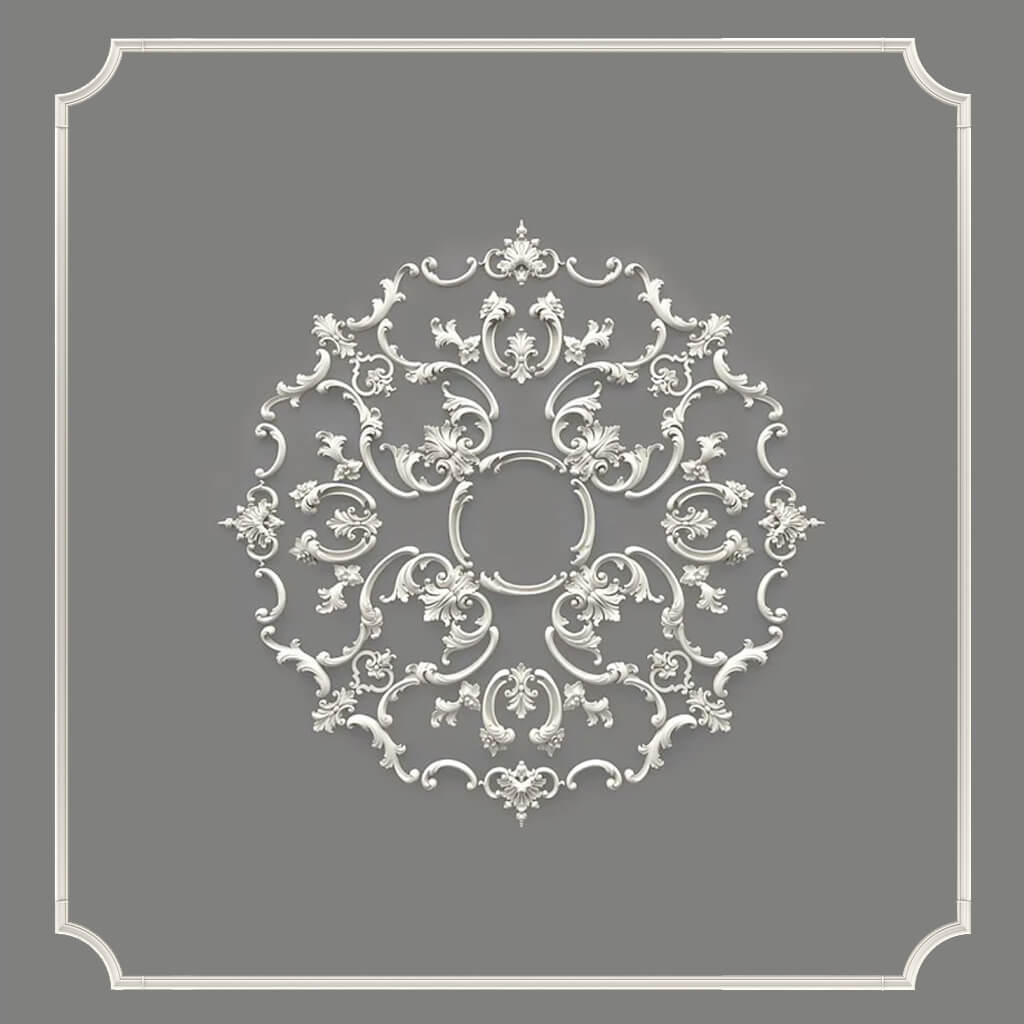
- Ceiling Rosettes
- Baseboards
- Inlays and Decorative Elements
- Facade decoration
- Elements for furniture, doors, and portals
- How to choose molding by application area
- For Apartments
- For Country Houses
- For a Cottage
- For facade
- For interior
- For furniture and decorative accents
- How to select molding to match the object's style
- Classic
- Neoclassicism
- Modern classicism
- Accent modern interior
- Traditional facade of a private house
- What to look for before buying or ordering molding
- Which material to choose for molding
- Molding for interior
- Facade stucco
- What's important when ordering for a project
- Common mistakes when buying and ordering stucco
- How to buy stucco in the Moscow region without making mistakes
- What can be selected together with stucco
- 10 practical tips
- FAQ: Answers to Popular Questions
- Conclusion
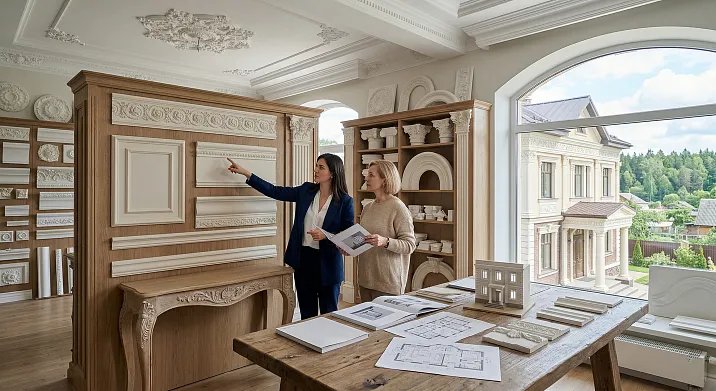
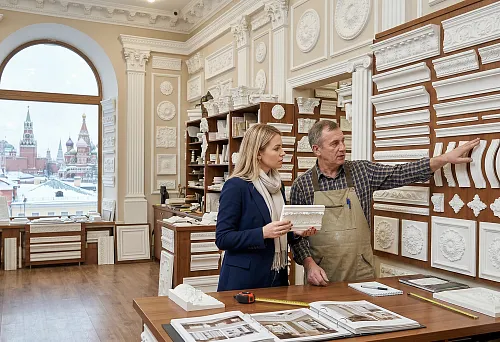
The Moscow region is not just the suburbs. It's thousands of cottages, country houses, and townhouses where owners are building not just housing, but spaces with character. These are apartments in Odintsovo, Khimki, Krasnogorsk, and Balashikha, where people renovate once—and want results that will last for decades. These are design projects in the Rublyovo-Uspensky corridor, where architects work with clients ready to invest in every detail. And everywhere—the same question: where to buy stucco in the Moscow region, how to avoid mistakes in selection, and is it worth ordering for a project?
Stucco in the Moscow region is in demand just as much as in the capital. Moreover—it's in the country format that it truly shines: a private house facade with classic cornices and pilasters, a living room in a cottage with ceiling rosettes and moldings, an elegant hallway with decorative door surrounds—all these are spaces where decor is not a detail, but the essence of the architectural statement.
This article provides an honest and practical breakdown: what exactly to buy, when it's better to order for a project, how to select decor to match the style and property, and why the right choice begins long before you open the catalog.


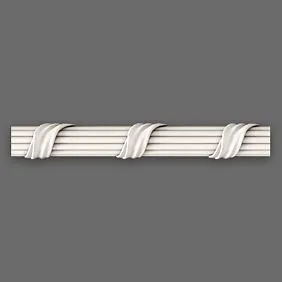


What kind of stucco can be bought in the Moscow region
Before discussing the choice, it's important to understand what exactly is included in the concept of 'molding' as it applies to a private house, apartment, and commercial property. This is not a homogeneous category. It is a broad system of decorative elements united by one principle: they structure surfaces, giving the interior and facade architectural logic and completeness.




Interior Molding
Interior molding is decor for interior spaces: walls, ceilings, doorways, furniture fronts. It is created with consideration for the conditions of residential and commercial premises: climate control, limited humidity, visual contact with a person at close range. Therefore, the precision of the relief, clarity of the profile, and quality of the surface for painting are especially important here.
interior moldingsincludes cornices for the ceiling, ceiling rosettes, wall and coffer moldings, baseboards, overlays for doors and furniture fronts. Each type of element solves its own task in the room's design system.
For walls — moldings and decorative frames, pilasters, horizontal friezes, applied ornamental elements. They structure vertical planes, divide the wall into zones, create rhythm and scale.
For ceilings — perimeter cornices, rosettes at central points, moldings for coffers. Ceiling decor sets the height and scale of the room, forming the upper architectural frame.
For doorways — architrave frames, corner overlays, side pilasters. A decorated doorway becomes a portal with character, not just a hole in the wall.
For furniture — carved overlays, corner elements, frame decor for the fronts of cabinets, dressers, kitchen sets.Decorative overlays for furniture and doorsmade of solid wood or polyurethane can radically change the appearance of the most ordinary case furniture.
Our factory also produces:
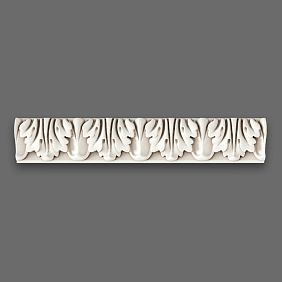


Facade moldings
Facade stucco is a completely different world. Elements for exterior use operate under atmospheric loads: rain, snow, ultraviolet light, temperature fluctuations from +40 to -30°C. They must maintain geometry, not crack, not absorb moisture, and hold the paint layer for years.
Polyurethane molding allows creating a stylish and presentable exterior of a house, while the material retains its qualities in any weather conditions.— facade cornices, window surrounds, corner elements, keystones, medallions, belts — these are what turn an ordinary private house facade into an architectural object with dignity.
For facades of cottages and country houses in the Moscow region, the following are especially in demand:
-
Cornice profiles — for crowning cornices and inter-floor belts
-
Surrounds — for framing window and door openings
-
Corner rusticated and smooth elements
-
pilasters and columns— for designing entrance groups and porticos
-
Capitals— for finishing columns and pilasters
-
Decorative medallions and rusticated inserts
Get Consultation
Decorative elements for a comprehensive project
The strongest interior and architectural solutions are those where the facade and interior form a unified stylistic whole. The facade cornice echoes the cornice of the interior living room. The columns of the portico 'converse' with the pilasters of the hall. The window casings outside correspond to the door frames inside.
STAVROS Decoration Catalogallows you to assemble precisely such a system: all elements within the collections are coordinated in style, proportions, and ornamental language.
What is better: to buy ready-made molding or to order custom for the project
This is a question that arises for almost every buyer. And the answer is not obvious — because it depends on the task.
When ready-made elements are suitable
Ready-made molding from the catalog is the right choice in most standard situations:
-
Typical tasks. To decorate a ceiling with a cornice and rosette, to divide walls with moldings into panels, to add a baseboard — these are tasks that are solved with ready-made elements without any compromises.
-
Quick selection. Ready-made collections allow you to form a complete set of coordinated elements in one visit to the catalog.
-
Proven proportions. The collection developers have already taken care of the harmony of sizes — the cornice, rosette, and molding within one series are proportionally coordinated.
-
In stock.Buy moldingfrom the catalog means getting it quickly, without waiting for production.
For most apartments, townhouses, and country houses, ready-made solutions fully meet the task.
When to choose custom molding in the Moscow region
There are situations when the standard catalog does not provide the desired result:
-
Non-standard dimensions. Very high ceilings (from 4 m), wide facade spans, atypical room proportions — all of this may require elements that are not available in the standard range.
-
Complex design solutions. Author's interiors with unique ornamental logic, historical restorations, objects with individual stylistics — here, elements created for a specific concept are needed.
-
Large-scale facades. Commercial objects, estates, apartment buildings with author's facade decor — tasks where architectural decor is created according to individual drawings.
-
Furniture and joinery projects.carved elements for furniture and doorscustom in the Moscow region is a separate direction that allows creating overlays strictly for a specific facade, door leaf size, or architectural context.
How to understand which option is right for you
Ask yourself a few questions:
-
Do I need standard elements in standard sizes — or for a project with non-standard parameters?
-
What is my budget for decor — is there a resource for custom production?
-
How important is speed — ready-made elements are available immediately, an order requires time.
-
Is this a standard renovation or an author's project with a designer?
In most cases, for apartments and standard cottages, ready-made collections give excellent results. Custom orders for a project are justified where standard doesn't fit.
What types of molding are most often chosen
Let's consider the main categories of products that are relevant for both interior and exterior.
Moldings are linear profiles used to create framed compositions, zone walls, and frame openings. They come in various widths (from 20 to 150 mm) and relief complexity — from smooth to richly decorated.
Moldings are a universal building material for decorators. They are used for wall frames, ceiling coffers, door architraves, furniture fronts.decorative moldingsRectangular cartouches on walls are a classic way to give a room architectural depth.
Molding width ranges from 15 to 120 mm and more. The profile varies from a simple bead to a multi-component ornamental section. The choice is determined by the scale of the room and the interior style.
Crown mouldings
A cornice is the transition between the wall and the ceiling. It is not just a decorative strip—it is an architectural accent that sets the tone for the entire space. For rooms with a height of 2.5–3 m, an optimal width is 80–130 mm. For high halls—160 mm and more.
Polyurethane ceiling cornicesThey are suitable for both residential premises and commercial properties, as well as entrance halls of country houses. They are installed quickly, cut with a regular handsaw, and painted together with the ceiling.
Ceiling Rosettes
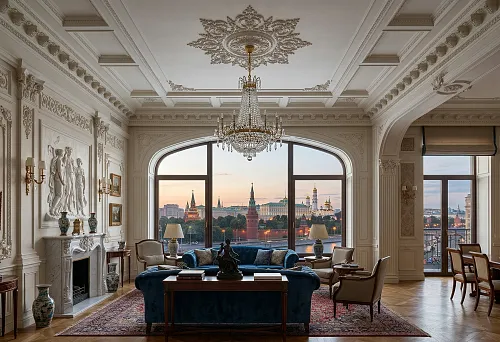
A ceiling medallion in the center of the ceiling is the visual axis of the entire space. A properly selectedCeiling rosettefor a chandelier creates completeness of the ceiling plane and enhances the perceived height of the room.
The diameter of the medallion is selected based on the room area: up to 15 sq. m—25–35 cm, up to 30 sq. m—40–55 cm, over 30 sq. m—from 60 cm. It is also important to consider the size of the light fixture.
Baseboards
A baseboard completes the vertical axis of the design from below. In a classic interior, the baseboard height is 100–160 mm. The profile is coordinated with the cornice and moldings: this is the 'lower echo' of the upper decor.
For a country house with high ceilings, a massive baseboard with an elaborate profile is not an excess but an architectural necessity. It gives the space stability and solidity.
Overlays and decorative elements
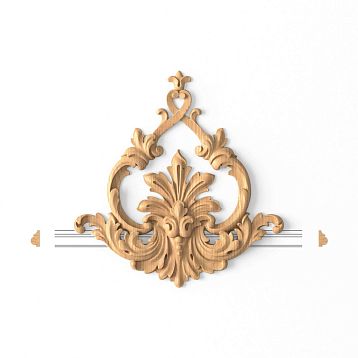
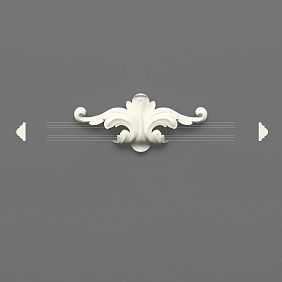
Decorative Inserts—corner elements for moldings, central ornamental inserts, frame decor for doors and furniture—these are details that elevate an interior from the category of 'good renovation' to the category of 'authorial project'.
Carved solid oak overlays on study doors. Ornamental inserts in the center of molding frames on living room walls. Decorative corner elements on kitchen fronts — all these are small details with big impact.
Facade Decoration
Facade molding for a country houseincludes cornice profiles, window casings, rusticated corner elements, decorative belts, keystones, medallions. For cottages in the Moscow region, this direction is especially in demand: buyers of country real estate want a facade that differs from neighboring ones — and decor is the main tool for individualization here.
Material for the facade — high-density polyurethane designed for exterior use. Density — 350–400 kg/m³, which corresponds to European standards for facade products.
Elements for furniture, doors, and portals
Pilasters, ColumnsandCapitals— this is a special class of products that operates at the intersection of interior and architecture. Wooden pilasters in the classic collection for decorating the entrance hall, capitals on columns in the library, decorative portals in the fireplace area — all these are elements that create the house's own architectural history.
How to choose molding by application area
For apartments
In an apartment, the main task is interior decor with the correct scale. Ceiling cornice, moldings for wall frames, rosette for a chandelier — a basic set that works both in a three-room economy-class apartment and in elite apartments. Dimensions — according to ceiling height. Style — according to the interior concept.
For apartments with low ceilings (2.4–2.6 m), the priority is thin moldings and a narrow cornice. For apartments with high ceilings — the scale can be significantly larger.
For a country house
A country house is both interior and facade. Therefore, the selection of decor begins with the architectural concept: what style is the house on the outside? Classic, neoclassical, traditional Russian style? This determines not only the facade molding but also the logic of interior decoration.
For a country house, the full spectrum of decor is appropriate:Facade moldingexterior, cornices and moldings in the living and dining rooms, decorative door surrounds, furniture overlays in the study. Unity of style inside and out is a sign of a well-thought-out project.
For a cottage
A cottage implies a higher level of decorativeness than a standard city apartment. Multi-level cornices, panel moldings with wide frames, developed baseboards, decorative pilasters in formal areas are justified here.
The facade of a cottage is a special story.Decor for a country housein the Moscow region includes window surrounds, cornice profiles, columns of the entrance group, rusticated corners. A properly designed cottage facade in the Moscow region is a competitive advantage and a visual magnet.
For the facade
When choosing facade stucco, the key parameters are the scale of the elements relative to the building's architecture, the facade style, the type of surface (plaster, brick, cladding) and climatic loads.
For a facade in the Moscow region, frost resistance is important: elements made of high-density polyurethane withstand years of alternating freezing and thawing without deformation. Wooden elements for exterior use require careful treatment with protective compounds and periodic maintenance.
For interior
Buy stucco decor for the interior— means betting on an architectural system, not on random decorations. Wall moldings + cornice + rosette + baseboard — this is a unified system that reads as a complete statement.
For the Moscow region interiors, classical and neoclassical solutions are especially relevant: high ceilings of country houses provide space for developed decor.
For furniture and decorative accents
Furniture moldings — carved overlays, corner elements, decorative inserts for facades — work subtly but effectively. A kitchen set with moldings on the facades and carved corner overlays is a completely different object than the same set without decor.Decorative wooden overlaysmade of solid oak or beech carry tactile and aesthetic value that no plastic imitator can reproduce.
How to choose moldings to match the style of the object
Style is not just an external appearance. It is an architectural language that your house or interior speaks. Violating this language means creating decorative dissonance that will be irritating, even if it's hard to explain why.
Classic
Classicism requires systematicity and scale. Wide cornices with dentils and acanthus leaves, complex ceiling rosettes with floral ornaments, panel moldings with developed profiles, pilasters withclassical capitals— all of this works in a classic interior as a single architectural score.
On the facade, classicism means strict cornice profiles, rusticated corners, architraves with keystones, columns with Ionic or Corinthian capitals.
Neoclassicism
Neoclassicism is ordered classicism. The ornament is restrained, the relief is precise, the lines are calibrated. Moldings with a clear rhythm, a cornice without excessive detailing, a rosette that is geometrically correct. This is a style where form is more important than opulence.
Pilasters in the style of the 'Classica' collectionwork perfectly in neoclassical projects as well — when they are placed with moderate frequency and do not overload the space.
Modern classic
Modern classicism is the most popular style among buyers in the Moscow region. Thin moldings without active ornamentation, a neat cornice, one rosette in the center, restrained door frames — this is enough for a finished, stylish space without archaism.
On the facade, modern classicism means simple cornice bands, geometrically clear architraves, minimal decorative accents in the entrance area.
Accent modern interior
A modern interior accepts stucco in a limited dose. A thin molding along the ceiling perimeter, a small rosette under the light fixture, a pinpoint detail on the wall — one accent instead of a system. This is an architectural pause that adds depth.
Traditional facade of a private house
For the traditional Russian country style — hewn window trims, cornice overhangs with ornamentation, decorative inserts in pediment tympanums.Custom carved elements for the facadeallow you to create a unique appearance for the house, which cannot be confused with any standard project.
What to look for before buying or ordering stucco
This is not just a checklist — it's insurance against costly mistakes.
Element dimensions. Always compare the stated dimensions with the actual parameters of the room. A cornice 150 mm wide, which looks elegant in a photo, may appear bulky in a room with a 2.5 m ceiling.
Proportions of the room or facade. The decor should be proportionate to the object. For a small room — thin elements. For a spacious country house — large-scale decor.
Surface type. Interior elements are mounted on drywall, plaster, MDF. Facade elements — on a plaster layer with mandatory mechanical fastening. Clarify the installation technology before purchase.
Compatibility of parts. All elements should belong to the same stylistic and ornamental code. Mixing collections of different styles is a typical mistake that negates even the most expensive elements.
Allowance for trimming. For cornices — 10–15%. For moldings — according to the layout scheme. For facade profiles — 15–20% accounting for cutting and installation errors.
Overall style. Determine the object's stylistic direction before starting the selection. This will save time and money.
Which material to choose for molding
Molding for interior
For interior tasks, polyurethane is the optimal choice.polyurethane moldingsIt is 5–7 times lighter than plaster, not afraid of moisture, accurately reproduces the profile, is easy to cut and glue, and can be painted with acrylic paints along with the ceiling.
Wooden carved elements — overlays, capitals, pilasters — are used where materiality is important: tactile contact, natural texture, the scent of real wood. For doors, furniture, portals, fireplace areas — wood is irreplaceable.
Molding for facade
Facade polyurethane with a density of 350–400 kg/m³ is the modern standard for exterior decor. It withstands years of freeze-thaw cycles, does not absorb water, and holds the paint layer.Polyurethane molding allows creating a stylish and presentable exterior of a house, while the material retains its qualities in any weather conditions.This is a durable solution that does not require restoration for 15–20 years with proper installation and painting.
What is important when ordering for a project
When ordering custom elements, it is necessary to provide precise drawings or parameters: width, height, relief depth, joint angle, ornamental pattern. This is not bureaucracy — it is a condition for obtaining a result that matches expectations.
Repeatability is also important: if a project requires 50 identical architraves, they must be identical in geometry. Molded production guarantees this.
Common mistakes when purchasing and ordering stucco
1. Choosing based solely on photos. Photos do not convey actual dimensions. A cornice that looks elegant in a picture may turn out to be too wide or too narrow for a specific room.
2. Confusing interior and facade elements. These are fundamentally different products. An interior molding is not intended for outdoor use, and a facade element may be excessively heavy for interior finishing.
3. Choosing decor without considering the dimensions of the room. Incorrect scale is the most common reason why beautiful elements look out of place.
4. Using an active pattern for a small space. A complex Baroque cornice in a 12 sq. m room with a 2.4 m ceiling creates a feeling of being caged.
5. Purchasing individual parts without an overall scheme. Stucco works as a system. One cornice without moldings, one molding without a baseboard — these are incomplete solutions.
6. Not considering the style of the house or interior. Decor should correspond to the architectural language of the object. Renaissance cornices in a high-tech interior — a conflict with no winner.
7. Not thinking through the combination with doors, windows, furniture. Decor does not exist in a vacuum. It lives together with the rest of the environment and must be coordinated with it.
8. Ordering without measurements. This is a fundamental mistake. Measure everything: ceiling height, perimeter, area, door opening dimensions, chandelier diameter.
9. Not including allowance for joining. Cornices are joined at 45° in corners. Mouldings are cut according to a pattern. Without allowance, leftovers will go to waste, and the necessary centimeters may be insufficient.
10. Comparing only appearance, not the system. The correct choice is not 'I like this element,' but 'this element works in my space.'
How to buy moulding in the Moscow region and not make a mistake
Step-by-step algorithm that works:
Step 1. Define the task. Apartment renovation? Cottage construction? Facade design? Furniture project? Each task has its own selection logic.
Step 2. Understand where the decor will be used. Interior, facade, or both? This determines the type of material and category of elements.
Step 3. Decide: ready-made solution or custom order. For standard tasks — catalog. For non-standard — custom order for the project.
Step 4. Define the style. Classic, neoclassical, modern classic, traditional facade? Style is a filter that eliminates unsuitable elements before they get into the estimate.
Step 5. Measure the object. Ceiling height, room area, perimeter, opening dimensions, height of facade elements — all this is needed before ordering.
Step 6. Create a layout plan. Especially for wall moldings and ceiling coffers. A plan on paper or in an editor is not a waste of time, but insurance against installation errors.
Step 7. Calculate the quantity with a margin. Cornices — perimeter × 1.15. Moldings — according to the plan + 10%. Facade profiles — taking into account the features of corners and joints.
Step 8. Order as a set. All decor — from one batch, one manufacturer, one style. This guarantees unity of material, color, and profile.
Order custom stucco in the Moscow Regionwith delivery throughout the Moscow region — this is a real and quick task if you work directly with the manufacturer.
What can be selected together with stucco
Stucco does not work in isolation. For a finished result, the following should be placed next to it:
-
Moldings for walls— frame decor for vertical planes
-
Ceiling Molding— horizontal architectural ceiling frame
-
ceiling rosettes— central accent under the chandelier
-
Baseboards — the lower finishing of the wall system
-
Decorative Inserts— for doors, furniture fronts, corner details
-
pilasters and columns— for entrance halls, libraries, fireplace areas
-
Capitals— for finishing pilasters and columns
-
Facade molding— cornices, architraves, rusticated elements, entrance group decor
-
STAVROS Carved Products Catalog— full range for interior and facade projects of any complexity
10 Practical Tips
-
Start not with searching for beautiful elements, but with taking measurements of the object and defining the style
-
For the facade, think about the entire building architecture, not just one architrave
-
For interiors, choose elements that can be easily assembled into a complete system
-
Do not mix styles and collections—it always shows
-
Create a layout diagram for moldings before ordering materials
-
Calculate the quantity with a 10–15% reserve
-
For standard tasks—use a ready-made catalog; for non-standard—order custom for the project
-
Coordinate facade and interior decor according to a unified style code
-
Check the actual dimensions of elements, not just photographs
-
Order the entire set from one manufacturer—this ensures material uniformity
FAQ: Answers to popular questions
Where to buy molding in the Moscow region for houses and apartments?
From a manufacturer with a full range in stock and delivery across the Moscow region and all of Russia.STAVROSdelivers from a single piece across all of Russia, including pickup in Moscow.
When is it better to choose custom-made molding rather than ready-made elements?
For non-standard room sizes, custom designer projects, complex facades, individual furniture solutions — in short, anywhere the standard catalog doesn't fully meet the task.
What can be decorated with molding in an interior?
Ceilings (cornices, rosettes, coffers), walls (moldings, frames, pilasters), doorways (architraves, trims), furniture fronts (overlays, inserts). The decor is suitable for any room — from the hallway to the formal living room.
Is molding suitable for the facade of a private house?
Yes, and it's one of the most popular applications. Facade molding made of high-density polyurethane withstands Russian climatic loads, is not afraid of frost and moisture, and holds paint for years.
Which elements are most often ordered for a cottage?
For the interior — cornices, moldings, baseboards, rosettes, pilasters. For the facade — cornice profiles, trims, rusticated corners, entrance group decor, capitals and columns.
What to choose for the ceiling: cornices or rosettes?
Both elements are used in pairs. The cornice forms the perimeter. The rosette holds the center. If there is a chandelier in the center of the ceiling, a rosette is mandatory. If not, you can limit yourself to a cornice.
Can I order molding according to a designer's project?
Yes.Custom carved elements— a separate direction for authorial interiors, complex facades, and furniture projects.
How to choose molding to match the style of the house?
Start with the facade style or interior concept. Classic — developed ornament, complex profiles. Neoclassical — clear lines, moderate relief. Modern classic — concise moldings, minimal ornament. Style is the main filter when choosing.
How to calculate the number of elements before ordering?
Cornices: room perimeter × 1.15. Moldings for frames: according to the layout scheme + 10%. Facade profiles: by the length of the perimeter, taking into account joints and corners. Overlays — piece by piece for facades.
How to avoid mistakes when buying molding in the Moscow region?
Measure the object, determine the style, create a layout, calculate the quantity with a margin, and order as a set from one manufacturer. Buying without measurements and without a layout is a guaranteed path to rework.
Conclusion
Buying stucco in the Moscow region is not a difficult task if approached systematically. The main thing is to understand for which object, in what style, on what scale, and for what purpose. Ready-made stucco from the catalog solves most tasks quickly and effectively. Custom orders are needed where standard solutions don't work. The main rule is decor as a system, not a set of random elements.
STAVROS is a Russian manufacturer of architectural decor made from polyurethane and solid wood. With over 20 years of experience, in-house production, and a 2000 sq. m warehouse with constant availability. The company offers a full range for interior and facade projects of any complexity:ceiling cornices and rosettes, Moldings, Decorative Inserts, pilasters and columns, Capitals, Facade moldingandcarved elements on order. Delivery across all of Russia starting from a single item. For private customers, designers, architects, and builders in the Moscow region, STAVROS is the manufacturer from whom you can buy custom stucco in the Moscow region with confidence in every product.