Article Contents:
- Vladivostok: features of ordering decorative materials with delivery
- Logistics: railway, sea, air
- Delivery optimization: consolidated cargo
- Importance of choosing a manufacturer with delivery experience to the Far East
- Facade polyurethane molding: resistance to maritime climate
- Polyurethane vs. gypsum and polystyrene
- Types of facade molding for Primorye houses
- Installation of polyurethane molding on the facade
- Wooden facade decor: traditions of Russian architecture in the Far East
- Wood species for facade decor in Vladivostok
- Types of wooden facade decor: house carving
- Installation and protection of wooden decor
- Porch balusters: wooden elements of the entrance group
- What are balusters and why are they needed
- Types of balusters: turned, carved, flat
- Installing balusters on the porch
- Facade composition: how to combine molding and wooden decor
- Option 1: Frame house in Russian style
- Option 2: Brick house in neoclassical style
- Option 3: Combined house (brick + wood)
- Frequently asked questions: addressing Vladivostok residents' doubts
- Conclusion: design your house facade in the Far East with STAVROS
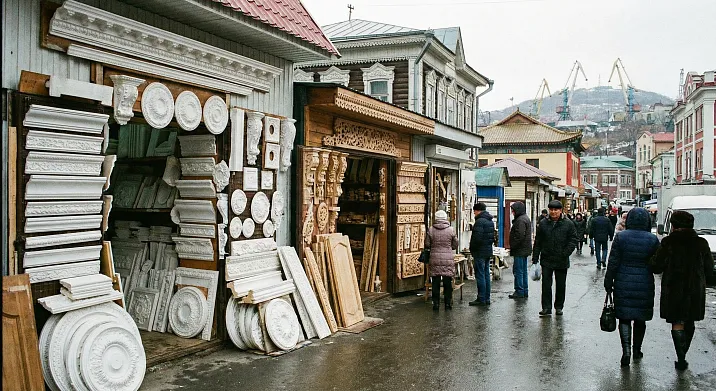
Vladivostok. The edge of the earth, where Russia meets the Pacific Ocean, where winds carry salty spray, and winter frosts give way to humid summers with fog. Building and designing a house here is not for the faint-hearted: materials must withstand sharp temperature fluctuations (from -25°C in winter to +30°C in summer), high humidity (80-90% in the coastal zone), salty sea air (corrosive to metal, wood, concrete), typhoons with hurricane-force winds. Ordinary gypsum molding will crumble in a season, wooden elements made of pine will rot within five years if not properly treated.Buy polyurethane molding in Vladivostok— a solution for a facade resistant to maritime climate: polyurethane does not absorb moisture, does not deteriorate from frost, does not fade in the sun, lasts 30-50 years without losing appearance.Wooden facade decormade of larch, oak, thermowood — a tradition of Russian architecture adapted to Far Eastern realities: carved window surrounds, eaves, gable boards,wooden window decortransforms a standard frame house into a traditional Russian wooden house, carrying the memory of roots and the beauty of wooden architecture.
This article is a complete guide for owners of houses, cottages, and dachas in Vladivostok and Primorsky Krai planning to decorate their facades with decorative elements. We will analyze how to order materials with delivery to the Far East (logistics, timelines, cost), which materials are suitable for maritime climate (polyurethane vs. gypsum, larch vs. pine), how to choose facade molding (cornices, moldings, overlays, columns), what types of wooden decor are used (house carving, window surrounds, eaves, gable boards), whybuy balustersfor porches and terraces (durability, beauty, safety), how to install elements yourself or with a crew.



Vladivostok: features of ordering decorative materials with delivery
The Far East is a region remote from Russia's main production centers (Moscow, St. Petersburg, cities in Central Russia). Most high-quality stucco and wooden decor is produced in the European part of the country. How to organize delivery so that materials arrive intact, on time, without astronomical overpayments?




Logistics: railway, sea, air
Railway transport: the main delivery method to Vladivostok. Cargo is shipped from Moscow or St. Petersburg in a container (20 or 40 feet — 6 or 12 meters long), travels via the Trans-Siberian Railway for 7-10 days, arrives at Vladivostok or Nakhodka station. The cost of delivering a 20-foot container (holds 20-25 m³ of cargo — stucco, wooden elements for an average house) is 80,000-120,000 rubles (depends on season, road congestion). Pros: reliability (cargo in a container is protected from weather), relative cheapness for large batches. Cons: slow (10-14 days including paperwork), need to order a full container or consolidate cargo with other customers.
Sea transport: an alternative for large batches. Cargo is shipped from St. Petersburg via the Suez Canal or the Northern Sea Route (in summer) to Vladivostok. Transit time 30-45 days. Cost is 20-30% lower than railway, but timelines are unacceptable for those building now.
Air: express delivery for urgent orders or small batches (small stucco — rosettes, small overlays weighing up to 100 kg). Cargo flies for 1 day, arrives at Vladivostok airport. Cost 300-500 rub/kg — expensive, but fast. Used rarely, only if construction is stalled waiting for a specific part.
Road transport: across the entire country (9000 km Moscow — Vladivostok) takes 10-14 days. More expensive than railway, but more flexible (can deliver a small batch without a container, deliver to the site, not just to the station). Cost of delivering a 20 m³ van — 150,000-200,000 rubles.
Our factory also produces:




Delivery optimization: consolidated cargo
For private customers ordering decor for one house, a full container is excessive (not enough cargo to fill 20 m³). The solution is consolidated cargo: the manufacturer or transport company collects orders from several clients from Vladivostok and Primorye into one container, divides the delivery cost proportionally by volume. Your order occupies 5 m³ — you pay 25% of the container cost (20,000-30,000 rubles instead of 100,000). Timelines are the same 10-14 days, but savings are significant.
Get Consultation
Importance of choosing a manufacturer with experience delivering to the Far East
Not all manufacturers work with the Far East (afraid of logistics, no established channels). Choose companies with experience shipping to Vladivostok, Khabarovsk, Yuzhno-Sakhalinsk — they know the nuances of packaging (so cargo isn't damaged over 9000 km of shaking), work with trusted transport companies, provide tracking (real-time cargo tracking), insure the cargo (if damaged — compensation).
Polyurethane facade stucco: resistance to maritime climate
WhyBuy polyurethane molding in Vladivostok— the right solution, not plaster or polystyrene? Let's compare materials.
Polyurethane vs. plaster and polystyrene
Plaster stucco: a traditional material used for centuries (European palaces, mansions). Beautiful, detailed, noble. But fragile (chips from impacts), heavy (a 2-meter long cornice weighs 15-25 kg — requires powerful fastening), hygroscopic (absorbs moisture — in Vladivostok's humid climate plaster gets wet, molds, deteriorates). Service life on a facade in Vladivostok — 5-10 years maximum, with regular repairs (painting, chip restoration). Price is high (custom-made, delivery expensive due to weight).
Polystyrene stucco: cheap (2-meter cornice — 300-600 rubles), lightweight (weight 500 grams), easy to cut (with a knife). But primitive (relief is unclear, blurry), fragile (crumbles from mechanical impact), short-lived (polystyrene deteriorates from ultraviolet light — yellows, cracks in 3-5 years in the sun), flammable (flammability class G3-G4 — burns with toxic gas emission). Looks cheap, reveals budget construction. Unacceptable for a house facade in Vladivostok (will crumble in 5 years).
Polyurethane stucco: a modern material combining the advantages of plaster (detailed relief, visual nobility) and plastics (lightness, moisture resistance, durability). Density 300-500 kg/m³ (quality polyurethane — 400+ kg/m³), weight of a 2-meter long cornice width 150 mm — 2-4 kg (5-7 times lighter than plaster). Moisture resistance absolute (polyurethane does not absorb water, water absorption coefficient less than 1% — can be left in rain for years, won't deteriorate). High frost resistance (withstands freeze-thaw cycles up to 200 times — critical for Vladivostok, where winter alternates with thaws). UV resistance (painted polyurethane does not fade for 10-15 years). Service life on a facade — 30-50 years without repair. Price medium (3-5 times more expensive than polystyrene, 2-3 times cheaper than plaster). Conclusion: for Vladivostok, polyurethane is the optimal choice.
Types of facade stucco for houses in Primorye
Eave cornices: elements framing the roof overhang (where the roof extends beyond the wall), width 100-300 mm, plank length 2.0 meters. The cornice hides the wall-roof joint, creates facade completeness, protects the wall from water running off the roof. For Vladivostok, choose a cornice with a drip edge (a protrusion on the lower part of the cornice directing water away from the wall).
Facade moldings: horizontal planks width 50-150 mm, framing windows, doors, dividing the facade by floors (inter-floor molding). Create rhythm, structure, classicism. For a wooden house, moldings imitate log masonry (wide, with relief).
Polyurethane window architraves: window framings width 100-200 mm, consist of the top part (pediment above the window), side planks, window sill molding. Architraves protect the window mounting seam from moisture, decorate the facade. For Russian style, architraves with carved decor (imitation of wooden carving, but made of polyurethane — more durable).
Corner elements (rustication): overlays on external house corners, width 100-200 mm, imitate stone masonry (like in old brick mansions — protruding stones on corners). Create monumentality, protect corners from mechanical damage.
Columns and half-columns: vertical elements framing the entrance group, supporting the porch canopy. Height 2.0-3.5 meters, diameter 200-400 mm. Consist of a base (foundation), shaft (smooth or with fluting — vertical grooves), capital (top part with ornament). For Vladivostok, half-columns (flat, attached to the wall) are preferable to full columns (round, free-standing) — less windage during typhoons.
Installation of polyurethane stucco on the facade
Fastening with polyurethane adhesive foam (professional mounting foam in tubes, applied with a gun) or liquid nails. Adhesive is applied to the back of the element in a zigzag pattern, the element is pressed against the facade, fixed for 5-10 minutes (foam expands, fills micro-irregularities, sets). For heavy elements (cornices wider than 200 mm, columns) additional fixation with dowels (plastic dowels 10×120 mm, heads are recessed into the element, filled with putty).
Joints between elements (connecting cornice planks, architrave corners) are filled with acrylic sealant (elastic, paintable), sanded after drying (the joint becomes invisible).
Painting with acrylic facade paint (weather-resistant, vapor-permeable, service life 7-10 years). Polyurethane is primed (acrylic primer), painted in 2 coats. Popular colors: white (classic), beige, gray, brown (wood-like).
Wooden facade decor: traditions of Russian architecture in the Far East
Wooden facade decor— the soul of a Russian house, connection with ancestors, beauty of carving created by a master's hands. But wood on a facade in Vladivostok is a demanding material: moisture (rain, fog, snow), sun (ultraviolet destroys lignin — wood grays, cracks), temperature fluctuations (wood expands/contracts, can warp). Which species will withstand, which elements to use, how to protect?
Wood Species for Facade Decoration in Vladivostok
Larch: the best choice for facades in a maritime climate. Density 650-700 kg/m³ (heavy, sinks in water), contains gum (natural resin that repels insects, fungi), biostability class 2 (high — larch does not rot even in contact with water, used for piles, piers). Color reddish-brown, texture expressive. Service life on a facade without treatment — 20-30 years, with oil treatment — 40-60 years. Price is 2-3 times higher than pine, but justified by durability.
Oak: a classic species, density 700-750 kg/m³, high biostability (class 2-3), noble texture. 30-50% more expensive than larch, used for premium homes. In Vladivostok, oak is used less frequently (high cost, larch is more accessible), but for those who don't economize — an excellent choice.
Pine, Spruce: coniferous species, cheap (price 3-4 times lower than larch), but soft (density 450-500 kg/m³), low biostability (class 4-5 — pine rots in 5-10 years on a facade without protection). For Vladivostok, pine on a facade is acceptable only with deep impregnation with antiseptics (in an autoclave under pressure — impregnation penetrates 10-20 mm), treatment with oil or paint every 3-5 years. Used for budget projects.
Thermowood: ordinary wood (pine, spruce, ash), treated with high temperature 180-240°C in an oxygen-free environment (structure changes, wood becomes stable, does not absorb moisture, does not rot). Color dark (brown, chocolate), biostability class 1-2 (like larch). Price is 2-2.5 times higher than ordinary pine, 20% lower than larch. For Vladivostok, thermowood is a compromise between price and quality.
Types of Wooden Decoration for Facades: House Carving
Window Casings: window frames consisting of vertical and horizontal slats (width 100-150 mm, thickness 20-30 mm), decorated with carving. The upper part of the casing — kokoshnik or sandrik (carved pediment) with openwork or blind pattern (geometric shapes, plant motifs, solar signs). The lower part — window sill board (drip edge, diverting water). Casings protect the window mounting seam, decorate the facade, give the house individuality.wooden window decor— a tradition preserved in villages, revived in modern cottages.
Eaves (Pricheliny): carved boards covering the ends of the rafters (logs supporting the roof overhang), hanging along the overhang. Width 150-250 mm, length up to 3-4 meters, thickness 25-40 mm. Pattern openwork (pierced carving — the board turns into lace) or applied (carved elements are applied to a smooth board). Eaves create airiness, lace-like quality, complete the roof image.
Gable Boards (Wind Boards): wide boards (width 200-300 mm), covering the gable (triangular part of the wall under a gable roof). Carved, with geometric or plant ornament, often with a central element (sun, rosette, coat of arms).
Pricheliny and Towels: vertical carved boards hanging from the roof ridge (towel) or running along the slope (prichelina). Length up to 1.5-2.0 meters, width 150-200 mm. Pierced carving, imitating lace, embroidery.
Corbels (Brackets): carved wooden elements supporting the canopy over the porch, balcony, roof overhang. Shape triangular or figured (scrolls, leaves), length 300-600 mm, thickness 40-60 mm. Carry functional (supporting the structure) and decorative (ornamentation) load.
Installation and Protection of Wooden Decoration
Fastening with stainless screws (galvanized or stainless — do not rust in maritime climate) length 60-100 mm (depends on element thickness). Screw heads are countersunk, filled with wood filler, painted over.
Protection is mandatory: impregnation with antiseptic (against fungus, mold, insects — 2-3 layers, penetrates 3-5 mm), coating with oil for exterior work (linseed, tung, specialized for facades — 3-4 layers, renewal every 3-5 years) or painting with facade paint (acrylic opaque — hides wood texture, but protection is maximum, renewal every 5-7 years).
Balusters for Porch: Wooden Elements of the Entrance Group
Porch — the face of the house, the first thing guests see.buy balustersfor porch and terrace fencing — practicality (handrails provide safety, support when ascending) plus beauty (carved or turned balusters turn a simple porch into a grand one).
What are balusters and why are they needed
Baluster — a vertical post supporting the handrail of a staircase or railing. Height from floor/step to handrail — 900 mm (safety standard according to building codes). Baluster cross-section 40×40 mm, 50×50 mm (square), diameter 40-60 mm (round turned). Distance between balusters — 100-150 mm (so a child cannot crawl through or get stuck). For a staircase 1 meter wide with 10 steps, 20-30 balusters are needed (1-3 balusters per step, depends on spacing).
Types of Balusters: turned, carved, flat
Turned Balusters: manufactured on a lathe from a round blank diameter 60-80 mm. Shape — alternating thickenings (beads, balls, vases) and thinnings (waists, necks). Patterns endless — from simple (2-3 beads) to complex (10+ elements, imitation of columns with capitals). Turned balusters are universal (suitable for classic, Russian, modern interiors), durable (wood fibers run along the baluster — does not break), relatively inexpensive (turning is faster than carving). Price of a turned baluster from pine height 900 mm — 300-600 rub/pc, from larch — 600-1200 rub/pc, from oak — 1000-2000 rub/pc.
Carved Balusters: manufactured manually or on a CNC machine with carving (manual or semi-automatic). Patterns three-dimensional — grape vines, leaves, flowers, geometry. Carved balusters are luxurious, exclusive, but expensive (manual carving — from 5000 rub/pc, CNC — from 2000 rub/pc). Used for premium homes, where every detail is a work of art.
Flat Balusters: cut from a board thickness 30-50 mm with a jigsaw or CNC. Shape silhouette (contour carving — the baluster profile is figured, inside there may be a cutout). Flat balusters are used in country, rustic, chalet style. Cheaper than turned (simplicity of manufacture), but less durable (fibers are cut — can break upon impact).
Installing balusters on the porch
Balusters are fastened from below to the step or porch decking, from above to the handrail. Fastening methods:
On dowels: holes diameter 8-10 mm depth 30-40 mm are drilled in the baluster from below and above, wooden dowels (dowels diameter 8-10 mm length 60-80 mm) are driven into the step and handrail. The baluster is placed on the lower dowel, glued (PVA wood glue), then placed on the upper dowel from above, glued. Connection hidden, strong, aesthetic.
On screws: the baluster is screwed with screws from below through the step (screw length 80-100 mm is screwed from below the step upward into the baluster — fastening invisible) and from above through the handrail (screw from above downward — head countersunk, filled).
On metal fasteners: special angle brackets (steel, zinc-plated) are fastened to the step and baluster with screws. Fast, reliable, but visible (hidden by decorative overlays or painted to match).
Handrails (railings) are placed on top of the balusters, fastened with screws from top to bottom. The handrail should be smooth (sanded to 220 grit), comfortable to grip (cross-section oval 60×40 mm or round diameter 50 mm), treated with oil or varnish (pleasant to the touch, does not splinter the hand).
Facade Composition: How to Combine Molding and Wooden Decoration
A house in Vladivostok decorated with polyurethane molding and wooden decoration combines modern technologies (durability of polyurethane) and traditions (beauty of wood). How to combine elements harmoniously?
Option 1: Frame house in Russian style
Facade: walls are clad with imitation timber (20 mm thick board, profile imitates logs), stained to resemble natural wood (light pine) or painted (white, beige). House corners are decorated with 150 mm wide polyurethane rustications, painted in a contrasting color (beige walls — brown rustications).
Windows: framed with carved wooden larch architraves (kokoshniks with openwork patterns, side planks with geometric carvings), painted in a contrasting color (light walls — dark architraves, or vice versa).
Roof: gable, covered with metal tiles (brown, green color), roof overhang is framed with larch soffits (openwork carving — lace border), polyurethane eaves (200 mm width, classic profile).
Porch: wooden, larch steps (anti-slip decking — textured, non-slip in winter), railing — turned larch balusters (900 mm height, 120 mm spacing), oak handrails (oval handrail, sanded, oiled). Porch canopy on carved wooden consoles (brackets with floral ornament).
Result: a house where modern frame technology (quick-build, energy-efficient) is dressed in the attire of a Russian terem — recognizable, beautiful, durable (polyurethane and larch will withstand Vladivostok's climate for 30-50 years).
Option 2: Brick house in neoclassical style
Facade: facing brick (red, brown, beige color), smooth masonry. Corners, window and door openings are decorated with polyurethane elements (150 mm wide rustications on corners, 120 mm wide window architraves with pediments), painted white (contrasting with brick).
Windows: without wooden architraves (already framed with polyurethane), but window sills are oak wooden (protruding, wide 200 mm, coated with yacht varnish).
Roof: hip (four-sloped), covered with flexible shingles (gray, brown color), polyurethane eaves (250 mm width, complex profile with dentils).
Porch: concrete with tile cladding (granite, porcelain stoneware), railing — polyurethane balusters (stone imitation, white), metal handrails (stainless steel, round, 50 mm diameter). Entrance is framed with polyurethane half-columns (2.5 meters height, 300 mm diameter, Corinthian capitals), supporting the canopy.
Result: a house in European style, where polyurethane stucco creates classical accents, brick — monumentality, absence of wood on the facade (except for window sills) — minimal maintenance (no need to renew wood coating every 3-5 years).
Option 3: Combined house (brick + wood)
First floor: facing brick, decorated with polyurethane stucco (moldings, rustications).
Second floor: wooden (imitation timber or block-house — imitation rounded logs), painted or natural with oil. Second-floor windows are framed with carved wooden architraves.
Porch: wooden with carved balusters.
Result: combination of stone strength (first floor) and wood warmth (second floor), visual diversity, coziness.
Frequently asked questions: answering Vladivostok residents' doubts
How much does delivery of stucco and wooden decor to Vladivostok cost?
Depends on order volume. Small batch (1-3 m³ — decor for one house's windows) — consolidated cargo, cost 15,000-25,000 rubles, timeframe 10-14 days. Medium batch (5-10 m³ — full set for a house: stucco, architraves, soffits, balusters) — half a container, cost 40,000-60,000 rubles, timeframe 10-14 days. Large batch (20+ m³ — several houses or a cottage community) — full container, cost 80,000-120,000 rubles, divided among all customers.
Will polyurethane stucco withstand typhoons that occur in Vladivostok?
Yes, if properly secured. Polyurethane is lightweight (low wind resistance), but fastening must be reliable: polyurethane adhesive foam (professional, strong adhesion) plus additional anchors (for elements wider than 150 mm, longer than 1 meter — every 50-70 cm along the length). Eaves, columns are additionally fixed with steel brackets (fastened from inside, invisible). There are known cases where polyurethane stucco remained in place after a typhoon, while the roof was partially torn off (polyurethane held stronger than the roofing).
Can pine architraves be used on the facade in Vladivostok, or is larch mandatory?
Possible, but with caveats. Pine must be autoclave-treated (pressure-treated with antiseptic, penetrates 15-20 mm — protection against rot for 10-15 years), coated with facade paint in 3 layers (opaque acrylic — hides texture, but maximum protection), coating renewal every 3-4 years. Larch is 2-3 times more expensive than pine, but lasts 30-50 years with oil renewal every 5-7 years — overall savings (no frequent painting, element replacement). For budget — pine, for long-term perspective — larch.
How quickly does wooden decor fade in the sun in Vladivostok?
Untreated wood grays in 6-12 months (lignin breaks down — wood loses color). Wood coated with oil containing UV filters (special facade oils with pigments blocking ultraviolet) retains color for 3-5 years, then oil is renewed (new layer applied without removing old — 1 day of work). Wood painted with opaque paint does not fade for 7-10 years (paint completely covers the wood).
WhereBuy polyurethane molding in VladivostokWhere to buy polyurethane stucco and wooden decor with delivery?
From manufacturers working with the Far East (established logistics, packaging experience, cargo insurance). Selection criteria: availability of a full catalog (dozens of eaves, molding, architrave profiles, hundreds of baluster, carved architrave models), custom manufacturing capability (non-standard sizes, individual carving), consultations (manager will calculate element quantity for your house, select combinations), guarantees (5-10 years on material, on delivery — insurance).
Can stucco and wooden decor be installed in winter in Vladivostok?
Polyurethane stucco — yes, down to -10°C temperature (adhesive foam works in frost, cures slower, but reliably). Below -10°C installation is not recommended (adhesive does not set). Wooden decor — better at temperatures above 0°C (wood is brittle in frost, may crack when drilled, screws are harder to drive). Optimal season for facade work in Vladivostok — May-October (temperature +10°C…+25°C, low humidity, less rain).
Conclusion: design your house facade in the Far East with STAVROS
Buy polyurethane molding in Vladivostokwith delivery — feasible, accessible, cost-effective when ordering from a manufacturer with experience working in the Far East. Polyurethane molding withstands the maritime climate of Primorye (humidity, frost, typhoons, salty air), lasts 30-50 years without repair, requires no complex maintenance (painting once every 10-15 years).Wooden facade decormade of larch, oak, thermowood — a tradition of Russian architecture revived in modern homes: carved window surrounds, eaves boards, fascia boards,wooden window decortransform a standard house into a terem, bringing warmth, coziness, and a connection to roots.buy balustersfor porches and terraces — practicality (safety, support) plus beauty (turned, carved, turning railings into works of art).
STAVROS Company — the largest Russian manufacturer and supplier of polyurethane molding, wooden decor, elements for facades and interiors, with years of experience delivering to Far Eastern regions (Vladivostok, Khabarovsk, Yuzhno-Sakhalinsk, Petropavlovsk-Kamchatsky).
STAVROS polyurethane molding — density 380-420 kg/m³ (high, clear relief, strength), absolute moisture resistance (water absorption coefficient less than 0.5% — does not get wet, does not swell), frost resistance over 200 cycles (critical for Vladivostok), UV resistance (painted molding does not fade for 12-15 years). Assortment: eaves cornices width 100-400 mm (50+ profiles from simple to Baroque), facade moldings width 50-200 mm (horizontal, vertical, corner), polyurethane window surrounds (sets — top, sides, bottom, carved pediments), corner rustications (width 100-200 mm, plank length 1.5 meters), columns and half-columns (height 2.0-3.5 meters, diameter 200-500 mm, bases, capitals in assortment), polyurethane balusters (imitation stone, wood — for terrace, porch railings). Color white primed (ready for painting with facade paint in any color) or factory-painted (white, beige, gray, brown). Price: cornice width 150 mm — 480 rub/m, molding width 100 mm — 380 rub/m, window surround set for window 1200×1400 mm — 4500 rub, baluster height 900 mm — 650 rub/pc.
STAVROS wooden facade decor — carved window surrounds made of larch, oak (kokoshniks with openwork carving, side planks with geometric or floral ornament, sets for window sizes 1000×1200 mm, 1200×1400 mm, 1500×1800 mm, price of larch set 8500-18000 rub, oak set 15000-30000 rub), eaves boards (fascia boards) openwork (width 200-250 mm, length up to 3 meters, larch, price 2500-4500 rub/m), carved gable boards (width 250-350 mm, length 2-4 meters, price 3500-6500 rub/m), carved corbels (brackets for canopies, length 400-600 mm, thickness 50 mm, price 2500-5500 rub/pc). Treatment: antiseptic impregnation (against fungus, mold, insects), primer coating (for customer painting) or facade oil (natural wood color, protection from moisture, UV — renewal every 5-7 years).
STAVROS balusters made of solid larch, oak, pine — turned (50+ models from simple to complex, height 900, 1000, 1100 mm, cross-section 50×50, 60×60 mm, pine price 320-650 rub/pc, larch 700-1500 rub/pc, oak 1200-2500 rub/pc), CNC-carved (floral ornaments, geometry, price 2000-4500 rub/pc), flat (cut from board, silhouette, price 450-950 rub/pc). Railing accessories: support posts (cross-section 100×100 mm, height 1200-1500 mm, turned or carved, price 2500-6500 rub/pc), handrails (rails) oak, larch (oval cross-section 60×40 mm, length up to 3 meters, price 850-1800 rub/m).
Delivery to Vladivostok — partnership with transport companies (PEK, Delovye Linii, Baikal-Service), experience in packaging goods for long-distance transport (polyurethane molding — shrink wrap, cardboard boxes, wooden decor — crating, protection from moisture, mechanical damage), cargo insurance (if damaged during transport — compensation or replacement), tracking (real-time cargo tracking — you know where your order is). Delivery times: consolidated cargo (volume up to 3 m³) — 12-16 days, half-container (5-10 m³) — 10-14 days, full container (20 m³) — 10-12 days. Delivery cost: calculated individually based on volume, weight, specified when placing the order.
Custom manufacturing — if the catalog does not have the desired cornice profile, window surround size, baluster model — we will manufacture individually according to your sketches, photos, dimensions. Hand carving (for exclusive window surrounds, eaves boards — master carves with chisels according to your pattern), CNC carving (for serial elements — precision, repeatability). Lead time for non-standard elements 3-6 weeks, standard delivery.
Choosing STAVROS, homeowners in Vladivostok and Primorsky Krai choose quality (materials that withstand maritime climate, tested on thousands of projects across Russia), variety (hundreds of molding, decor models — you'll find for any style), delivery reliability (experience shipping to the Far East, insurance, tracking), professional support (consultations, calculations, installation assistance).
Design your house facade, create a unique image combining modern technology and traditions of Russian architecture. With polyurethane molding, wooden decor, STAVROS balusters, your house on the Pacific coast will become a fortress, withstanding any weather whims, and a work of art, pleasing the eye for decades!