












































































Article Contents:
- Stage 1: Defining Requirements — What Exactly You Need
- Stage 2: Choosing a Manufacturer and Checking Reputation
- Stage 3: Checking Samples — Patterns, Symmetry, Reproducibility
- Stage 4: Checking the Batch Upon Receipt — Inspection Before Acceptance
- Stage 5: Inspection Before Installation — Final Check
- Stage 6: Working with the Manufacturer — Communication and Problem Resolution
- Conclusion: Purchase Checklist for Balusters

Buying balusters is not an impulsive decision or a spontaneous choice of a favorite image from a catalog. It is a multi-stage process where each step is critical to the final result. Buying attractive balusters is easy. Buying balusters that will fit your staircase exactly in size, match perfectly in profile across the entire batch, be made from quality wood, properly dried, and carefully finished — is a more complex task.
The problem is that defects and discrepancies are discovered not at the time of ordering, when you can still make changes, but during installation, when it’s already too late. The balusters arrived, were unpacked, and installation began — and it turned out: the profile does not match the sample, the height differs by 15 millimeters, half the balusters have knots, although the highest grade was ordered, the symmetry of the turned elements is broken, some balusters are darker than others. Repairs, returns, disputes with the supplier, missed deadlines, lost money and nerves.
The correct algorithm for buying balusters is a systematic approach, where each stage has clear criteria for inspection, where control tools (templates, stencils, measuring instruments) are used, where nothing is accepted on faith, where quality is confirmed by documentation and physical inspection. Only in this way can you guarantee that the purchased balusters will be exactly what your project needs.
This article is a detailed step-by-step algorithm for buying balusters, from formulating requirements to inspecting the finished batch. How to determine the parameters that balusters must meet. How to choose a reliable manufacturer. How to check samples before ordering the batch. How to use templates and stencils to control profile and symmetry. How to inspect the batch upon receipt. How to avoid hidden defects. After reading, you will know how to buy balusters correctly — the first time, without rework and disappointment.




Stage 1: Defining Requirements — What Exactly You Need
The first and most common mistake when buying balusters is starting with browsing catalogs and selecting "attractive" models. The correct approach is to begin with clearly formulating requirements for balusters based on the specific parameters of your staircase project. Requirements must be documented in writing — this is the foundation for communication with the manufacturer and the criterion for inspection upon receipt of the batch.
Technical Parameters of Balusters:
Height: Calculated by the formula: Height of railing (usually 900 mm) - Thickness of handrail - Depth of groove in handrail (if present) - Thickness of supporting strip (if present) + Allowance for beveling ends at an angle (20-30 mm). Record the exact value with tolerance (e.g., 850 ± 5 mm).
Cross-section: Square (40×40, 45×45, 50×50, 60×60 mm) or round (diameter 40, 45, 50, 60 mm). The choice depends on interior style, stair width, and spacing between balusters. Record the exact value.
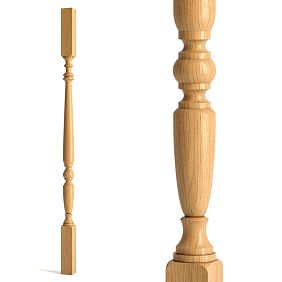
Profile: Description of the baluster shape — simple square with bevels, turned with two spheres and knobs, milled with grooves, carved with ornament. If selecting from the manufacturer’s catalog, specify the model number. If an individual profile, attach a sketch or reference photo.
Wood species: Oak, beech, ash, larch, pine, birch. The choice is determined by budget, usage conditions, interior style, and requirements for durability.
Wood grade: Extra (no knots or defects), A (individual healthy knots up to 10 mm in diameter), B (knots up to 20 mm, resin pockets and minor color variations are acceptable). The higher the grade, the more expensive, but also more stable in quality.
Wood moisture content: 8–10% — standard for items used in heated rooms. Balusters with moisture content above 12% after installation will dry out, leading to deformation and cracking. Require moisture content confirmation using a moisture meter.
Finish treatment: Unfinished (only sanded), transparent lacquer (number of coats, gloss level), oil-wax, staining with dye (specify shade), painting with paint (specify color by RAL or NCS catalog), patination. The choice affects price and manufacturing lead time.
Quantity: Calculated by the formula: (Staircase length between support posts / Spacing between balusters) + 1. Round up to the nearest whole number. Add a 5–10% reserve for potential defects during installation or future damage.
Packaging:
In addition to balusters, formulate requirements for accompanying elements:
Support posts: Number, cross-section (usually 80×80, 100×100, 120×120 mm), profile, type of finials (spheres, cones, decorative), same wood species and finish as balusters.
Handrail: Section length, profile (round, rectangular, decorative), presence of groove for balusters (groove width and depth must match baluster cross-section), wood species and finish identical to balusters.
Fastening kit: Dowels (diameter, length, quantity), carpenter’s glue (type, volume), post caps (type, quantity), self-tapping screws (if used), bolts for attaching handrail to posts.
Documenting Requirements:
Prepare a specification — a table listing all items, their characteristics, and quantities. The specification must be agreed upon with the manufacturer and signed by both parties. This is the basis of the contract and the acceptance criterion for the batch.
Example of a specification:
| Item Name | Dimensions, mm | Species | Grade | Profile | Finish | Quantity |
|---|---|---|---|---|---|---|
| Baluster | 50×50×850 | Oak | А | Article B-123 | 3-layer matte lacquer | 52 pcs |
| Support post | 100×100×1000 | Oak | А | Article C-45 | 3-layer matte lacquer | 4 pcs |
| Handrail | 60×80×3000 | Oak | А | With groove 52 mm | 3-layer matte lacquer | 2 pcs |
| Shanks | Ø10×50 | Beech | - | - | - | 200 pcs |
Why so many parts?
A clear specification eliminates misunderstandings. The manufacturer knows exactly what to produce. You know exactly what you will receive. In case of non-conformance, there is a document to justify a claim. Vague formulations ('beautiful oak balusters') lead to conflicts: you expected one thing, received another, and the manufacturer claims they fulfilled the order.




Stage 2: Choosing the manufacturer and checking reputation
Hundreds of companies produce balusters — from large factories with modern equipment to small workshops in garages. Product quality varies radically. Choosing the manufacturer is a critically important stage that determines the final quality of the balusters.
Criteria for choosing a manufacturer:
Presence of own production: The manufacturer must have real production capabilities — machines, drying chambers, storage facilities. Brokers reselling other manufacturers' products do not control quality, add their markup, and do not bear responsibility for defects.
How to check: Request photos of the production facility, address, and possibility of visiting. Serious manufacturers willingly show their production and conduct tours. Those with nothing to hide will not hide it.
Modern equipment: 70% of baluster quality is determined by equipment. CNC turning and milling machines ensure identical profiles for all balusters in a batch with precision down to fractions of a millimeter. Old manual machines result in profile variations, poor surface finish, and high defect rates.
How to check: Ask what equipment the manufacturer uses. Manufacturers with modern machines are proud of them, mention them in presentations, and display them on their websites.
Experience in operation: A company operating on the market for 10–15+ years has passed the test of time. Only manufacturers offering good price-to-quality ratios can survive in a competitive environment for decades. Newcomers may be either talented or incompetent — the risk is higher.
How to check: registration date in the EGRUL (public information), customer reviews with the year of order, portfolio of completed projects with dates.
Portfolio and references: a serious manufacturer has a portfolio of completed projects — photos of installed staircases, customer reviews with contacts (with customer permission). Absence of a portfolio is alarming: either the company is new and inexperienced, or the quality of work does not allow them to be displayed.
How to check: review the portfolio on the website, request additional photos, contact several customers from the references, ask about experience working with the manufacturer.
Documentary support: the manufacturer must provide documents confirming quality:
-
Certificates of compliance for wood
-
Moisture measurement protocols (each batch is checked with a moisture meter)
-
Technical passports of products indicating dimensions, species, grade
-
Warranty tags (warranty period of 12-24 months for absence of manufacturing defects)
Absence of documents — sign of handmade production.
Pricing transparency: the estimate must detail the cost:
-
Cost of balusters (price per unit × quantity)
-
Cost of posts
-
Cost of handrails
-
Cost of finishing (if ordered)
-
Cost of fastening kit
-
Cost of packaging
-
Delivery cost
Hidden markups, unexpected additional payments upon receipt — signs of unscrupulousness.
Warranty and return conditions: clear, specified in the contract conditions:
-
What the warranty covers (cracking and warping from under-dried wood, processing defects, deviation from stated dimensions)
-
What is not covered by warranty (damage during transport due to buyer’s fault, defects arising from improper use)
-
Warranty period
-
Return procedure (who pays for return shipping of defective items, replacement timelines)
Ability to check samples before ordering a batch:
A serious manufacturer provides samples — 1-2 balusters, handrail fragment, post fragment — for physical in-person inspection. Samples are sent at your expense (sample cost + shipping) or provided free of charge upon subsequent batch order.
Samples allow you to assess:
-
Actual color and wood grain texture (may differ from photos and in person)
-
Processing quality (smoothness, profile clarity, absence of defects)
-
Coating quality (uniformity, gloss/satin finish, coating thickness)
-
Actual dimensions (measure and compare with stated dimensions)
-
Profile match with catalog sample
Refusing to provide samples is a warning sign. Either the manufacturer is not confident in the quality, or the sample does not match what will be in the batch.
Sources of information about the manufacturer:
-
Official website (detail of information, portfolio, contacts, production address)
-
Reviews on independent platforms (Yandex Maps, Google Maps, industry forums)
-
Communities on social networks (manufacturer profiles, construction and repair groups)
-
Recommendations from acquaintances, builders, designers (personal experience is always more valuable than advertising)
Do not rely solely on reviews on the manufacturer's website — they may be fake or filtered (negative reviews are removed).
Our factory also produces:


Stage 3: Sample inspection — templates, symmetry, repeatability
Baluster samples have been obtained. Now comes the critical stage — detailed inspection of samples using measuring tools and templates. The goal is to ensure the sample matches the declared characteristics and expectations. If the sample fails inspection, the batch must not be ordered — the quality in the batch will not be better, and often worse than the sample.
Tools for checking samples:
-
Vernier caliper (for measuring cross-sections and diameters of profile elements with accuracy to 0.1 mm)
-
1000 mm metal ruler (for measuring overall height)
-
Carpenter's square (for checking right angles on square balusters)
-
Level (for checking straightness)
-
Profile template (made manually from the sample to check subsequent balusters)
-
Moisture meter (for checking wood moisture, if available)
-
Magnifying glass or macro lens (for detailed surface inspection)
Check dimensions:
Measure with vernier caliper:
-
Cross-section of baluster at several points along height (for square: width and thickness, for round: diameter). Cross-section must be constant with tolerance ±0.5 mm.
-
Diameters of profile elements (balls, rollers, fillets). Record values.
-
Wall thickness between profile elements (no thinning areas where baluster may break).
Measure with ruler:
-
Overall height of baluster from end to end. Compare with declared size, tolerance ±2 mm.
-
Distances between profile elements (if baluster is turned). For example, distance from bottom to center of first ball, from center of first ball to center of second. These distances must exactly repeat on all balusters in the batch.
Check with square:
-
Perpendicularity of ends relative to baluster axis. Ends must be strictly perpendicular; otherwise, baluster will not stand vertically.
-
Right angles on square balusters (90° between faces).
Check with level:
-
Straightness of baluster. Place baluster on flat surface, apply level along it. Baluster must not be bent or twisted (checked by rotating around axis).
Checking symmetry of turned balusters:
A turned baluster is a rotational body symmetric about its axis. Each element (sphere, spindle, cone) must be perfectly symmetrical. Any asymmetry indicates poor turning quality (handwork on an old lathe, poor workpiece centering).
Methods for checking symmetry:
Visual inspection: Rotate the baluster slowly while holding it horizontally at eye level against a plain background. An asymmetric element (oval sphere instead of round, cone with off-center apex) will appear as "wobbling" of the contour during rotation.
Measuring diameters in multiple planes: Measure the sphere's diameter with a caliper in three planes, rotating the baluster 120° between measurements. All three values must match within ±0.3 mm. Greater deviation indicates asymmetry.
Rolling on a flat surface: Place the baluster on a perfectly flat surface (glass or marble table) and roll it. A symmetrical baluster rolls smoothly; an asymmetrical one "bounces" and produces audible impacts.
Checking with a laser level: Mount the baluster vertically and direct a laser line along its axis. Rotate the baluster. The laser must always pass through the center of each profile element. Any laser deviation during rotation indicates asymmetry.
Creating a profile template:
A template is a tool for verifying the repeatability of the profile across all balusters in a batch. It is made from a sample, then used to check each baluster upon receipt of the batch.
Material for the template:
-
Thick cardboard (for single-use or small batch checks)
-
4-6 mm plywood (for repeated use)
-
Thin metal (aluminum, galvanized) — the most durable option
Template creation:
-
Place the baluster sample on a sheet of template material.
-
Trace the profile contour with a pencil or marker, pressing the template material firmly against the baluster.
-
Cut the template along the contour using a jigsaw, metal shears, or a cutter (depending on the material).
-
File the template edges until smooth.
-
Apply the template to the baluster sample and check for tight fit. The template must match the profile without gaps.
-
Label the template: "Baluster profile B-123, sample verified [date]".
Using the template:
When receiving a batch, apply the template to each baluster (or to a 10-20% sample if the batch is large). The template must fit the profile without gaps. Gaps exceeding 1-2 mm indicate profile deviation from the sample; the baluster is defective.
The template allows rapid (10-15 seconds per baluster) verification of profile identity without complex measurements.
Checking wood quality:
Inspect the baluster sample under good lighting:
Knots: Not allowed for Extra grade. For Grade A, individual healthy (light, dense) knots up to 10 mm diameter are permitted. For Grade B, knots up to 20 mm are allowed. Black, loose, rotten knots are unacceptable for all grades.
Cracks: Small end cracks (1-2 mm long, not extending deeper than 5 mm) are acceptable for Grades A and B. Through cracks, longitudinal cracks, or internal cracks are unacceptable.
Resin pockets (for coniferous species): For Grade A, individual small resin pockets (up to 5 mm) are permitted. For Grade B, up to 10 mm. Resin pockets may exude resin over time, staining the finish.
Color change: For higher grades, the wood must be uniform in color. Bluish, gray, or brown spots indicate fungal infection or improper storage and are unacceptable.
Borer holes: Evidence of wood-boring insects — absolute rejection. Even a single borer hole indicates infestation, possibly with further spread.
Moisture Check:
If a pin-type moisture meter is available, measure the sample's moisture. Insert the meter's pins into the baluster's end to a depth of 10–15 mm, then read the value. Moisture should be 8–10%, maximum 12%. Higher levels indicate the wood is under-dried and will shrink and deform after installation.
If no moisture meter is available, indirect signs of under-dried wood:
-
The baluster is heavier than it should be (wet wood is heavier than dry wood)
-
When tapped, the sound is dull (dry wood sounds clear)
-
Smell of fresh wood (dry wood practically has no smell)
Quality of Processing Check:
Run your hand over the entire surface of the baluster, paying attention to profile elements (ovolos, transitions, recesses):
Smoothness: The surface should be silky, free of roughness, abrasive marks, or protruding fibers. Roughness indicates insufficient or poor sanding.
Chips and gouges: Not allowed on any grade. Especially critical are chips on the edges of profile elements (corners of ovolos, protruding ridges) — they are brittle and easily damaged by poor-quality tools.
Tool marks: On a quality baluster, tool marks from the cutter or router should be completely removed by sanding. Visible circular marks from the cutter indicate insufficient sanding.
Profile clarity: Transitions between elements (from ball to ovolos, from ridge to cone) must be sharp and clear, without blurring. Blurred transitions indicate poor turning or excessive sanding that 'smeared' the details.
Coating Quality Check (if the sample is coated):
Uniformity: The coating (varnish or oil) must be applied evenly, without runs, streaks, or bubbles. Inspect the baluster under side lighting — defects are more visible.
Thickness: For varnish — 3–4 coats (total thickness around 0.1–0.15 mm, tactilely felt as a smooth film). For oil — 2–3 coats (thickness not felt, oil has been absorbed into the wood).
Coating in recesses: The coating in ovolos, recesses, and ends must match that on exposed surfaces. Uncoated areas indicate insufficient application technique.
Runs: Especially on the lower parts of the baluster if it was coated while vertical. Runs indicate application of too thick a layer without intermediate drying.
Gloss/flatness: Must match the order. If matte varnish was ordered but the coating is glossy — mismatch.
Color match: If toning or coloring to a specific color was ordered, compare the sample with the agreed color sample (color chart, RAL/NCS catalog). Deviation exceeding 1–2 tones — mismatch.
Decision Based on Sample:
After checking the sample, make a decision:
Sample fully meets requirements: All parameters are within normal limits, quality is satisfactory. You may order the batch, specifying in the contract that the batch must fully match the sample.
Sample has minor deviations: Dimensions differ by 1–2 mm, minor roughness, slight coating unevenness. Assess whether these deviations are critical. If not critical, you may order, but specify in the contract that batch deviations must not exceed sample deviations.
Sample has serious defects: Symmetry violation, cracks, rough processing, knots not matching grade, moisture above 12%. Do not accept the sample, do not order the batch. Either demand replacement with a quality sample or seek another manufacturer.
Get Consultation
Stage 4: Batch Inspection Upon Receipt — Pre-Acceptance Control
The batch of balusters has arrived. The most critical moment — inspect the batch before signing acceptance documents. After signing, proving that defects existed at delivery rather than appearing at your end is extremely difficult. Therefore, inspection must be thorough, with documentation of all discrepancies.
Organization of Inspection:
Inspecting the batch requires time — for 50 balusters, at least 1–2 hours. Inform the driver that acceptance will take time. If the driver is in a hurry, do not yield to pressure. Your right — inspect the goods before acceptance.
Inspection must be conducted under good lighting, in a dry room. If delivered in winter and balusters are cold, allow them to warm to room temperature (2–3 hours); otherwise, when brought into a warm room, condensation will form and the wood will become damp.
Packaging Inspection:
Inspect the packaging before opening:
Integrity: boxes must not be dented, torn, or show signs of impact or drop. Damaged packaging poses a risk of damaged balusters inside.
Moisture: boxes must not be wet or damp. Moisture risks wood swelling, coating damage, and mold growth.
Marking: boxes must have marking corresponding to your order (name, quantity, order number).
If damage to the packaging is detected — document it (photo, note in delivery note), carefully unpack, and inspect each baluster for damage.
Check completeness:
Unpack all boxes and recount balusters. The quantity must exactly match the order. Shortages are unacceptable. Surpluses (manufacturer added reserve) are acceptable but must be documented in the delivery note.
Check for presence of all ordered items: balusters, posts, handrails, hardware kit. Everything must be available according to specifications.
Selective detailed inspection:
It is physically impossible to inspect each baluster individually in a large batch. A statistical approach is used — a random sample of 10-20% of balusters is inspected in detail. If defects exceeding the acceptable level (usually 2-3%) are found in the sample, the entire batch is subject to full inspection or return.
Sample inspection algorithm:
-
Randomly select 5-10 balusters from the batch (10 for a batch of 50, 15-20 for a batch of 100).
-
Inspect each selected baluster against all criteria (dimensions, symmetry, wood quality, finish, coating) as thoroughly as the sample was inspected.
-
Use the profile template to check conformity to the sample.
-
Record results: how many balusters in the sample meet specifications, how many have defects, and what specific defects they have.
Sample evaluation criteria:
-
All balusters in the sample are defect-free: batch is of good quality, can be accepted. It is recommended to additionally visually inspect the remaining balusters for obvious defects (cracks, chips, knots).
-
1-2 balusters out of 10 have minor defects (slight roughness, single small knot within acceptable limits): acceptable level, batch can be accepted, documenting defective balusters as reserve or for installation in less visible areas.
-
3 or more balusters out of 10 have defects, or critical defects (cracks, symmetry violation, dimensional mismatch): batch is of unsatisfactory quality. Demand either replacement of defective balusters or return of the entire batch.
Check for profile consistency within the batch:
Use the profile template made from the sample. Apply the template to 5-10 balusters from different boxes. The template must fit the profile of all balusters without gaps (tolerance ±1-2 mm).
If the template does not fit the profile (gaps of 3-5 mm or more) — the balusters' profile does not match the sample. This is a critical defect: balusters from different batches or manufactured using a different machine program. Installed on stairs, they will visually differ. The batch cannot be accepted.
Check for identity of balusters within the batch:
Take two balusters from different boxes, place them side by side on a flat surface, and compare:
Height: must be identical with accuracy ±2 mm. Measure with a ruler or place ends together on a flat surface.
Color: must be identical. Minor tonal variation (1-2 tones) is acceptable for natural wood, but no more. Strong color difference (some balusters light, others dark) is unacceptable and indicates wood from different batches or different staining levels.
Profile: must match. Use the template or visual comparison — profile elements must be at the same heights and identical sizes.
Coating: must have identical gloss/matte finish, thickness, and application quality.
Differences between balusters (different height, color, profile) — critical batch defect making it impossible to use them together on one staircase.
Check end markings (if present):
Some manufacturers mark the ends of balusters (with pencil, chalk, or label) with information: batch number, manufacturing date, grade. Check that the marking on all balusters is identical (one batch). Different marking indicates balusters from different batches, possible variations.
Check humidity (if a moisture meter is available):
Check the humidity of 3-5 balusters from different boxes. Humidity should be 8-12%, deviations between balusters should not exceed 1-2%. Humidity above 12% or significant variation between balusters — risk of deformation, accept the batch with reservations.
Defects recording:
All detected defects must be recorded in writing before signing the delivery note:
-
Prepare an acceptance act listing defects: "In a batch of 50 balusters, the following were found: 2 balusters with cracks, 3 balusters with symmetry defects, 5 balusters with color not matching the sample".
-
Photograph defective balusters alongside normal ones for visual confirmation.
-
The acceptance act is signed by you and the driver (or the supplier's representative if present).
-
The delivery note records: "Goods accepted with defects, acceptance act prepared".
The acceptance act serves as the basis for filing a claim with the manufacturer, requesting replacement of defective balusters or refund of money.
Batch decision:
The batch meets the sample quality, no defects or only minor individual ones: accept the batch, sign the delivery note without reservations (or with a reservation regarding individual defects if they exist).
The batch has significant defects (more than 10% of balusters are defective): do not accept the entire batch. Options:
-
Require replacement of defective balusters (if defects are localized, part of the batch is of good quality)
-
Return the entire batch (if defects are systemic, affecting most balusters)
-
Accept the batch with a discount compensating for defects (if defects are non-critical, you are willing to use the balusters but at a lower price)
Any decision other than unconditional acceptance must be recorded in writing and agreed upon with the manufacturer.
Prohibition of forced acceptance:
The driver or supplier's representative has no right to force you to accept the batch if you have detected defects. Your right is to inspect the goods and refuse to accept substandard items. Pressure, threats, refusal to wait for inspection completion — are illegal. Record your refusal in writing, contact the manufacturer, and resolve the issue.
Stage 5: Pre-installation inspection — final check
Batch accepted, balusters on site. Before starting installation — final inspection, last opportunity to detect defects not noticed during acceptance. Especially important for balusters stored for some time after delivery — deformation may have occurred due to improper storage.
Storage conditions for balusters prior to installation:
Balusters must be stored horizontally on a flat surface, with spacers between layers (to prevent direct contact). In a dry room with temperature 15-25°C and humidity 40-60%. Vertical storage, especially with support on only one end, may cause warping. Storage in humid or unheated rooms — leads to swelling or shrinkage.
Before installation, balusters must be acclimatized — placed in the room where they will be installed for 3-7 days to equalize moisture content with room humidity. This minimizes further deformation after installation.
Baluster sorting:
Lay out all balusters on a flat surface, inspect, and sort into groups:
Group A — perfect: no defects, ideal symmetry, clean surface, even finish. These balusters are for the most visible areas of the staircase — start of the run, central section, visible from the hall.
Group B — minor defects: single small knot, slight roughness, minor color difference. These balusters are for less visible areas — distant parts of the run, upper landings.
Group C — defective: cracks, chips, major defects. These balusters are not installed, kept as spares in case of damage during installation or in the future, or returned to the manufacturer.
Sorting allows distributing balusters so that the staircase visually appears perfect, even if some balusters have minor defects.
Final size check:
Select 5-10 balusters at random, measure their height. All balusters must have the same height within ±2 mm. If the variation is greater — problem: balusters of different heights will create an uneven handrail, requiring individual trimming of each baluster (increasing installation labor).
If a large variation (±5 mm or more) is detected, sort balusters by height, install groups of equal height on different sections of the staircase, trimming them in groups.
End face inspection:
Inspect the ends of all balusters:
Perpendicularity: the end must be strictly perpendicular to the baluster’s axis. Check with a square, placing it against the end and side face. A non-perpendicular end will cause the baluster to sit at an angle, requiring trimming.
Cleanliness: the end must be smooth, free of chips or protruding fibers. A rough end will make it difficult to secure with dowels and reduce fit quality.
Marking: if the ends are marked (top/bottom), verify that the marking is legible. Incorrect orientation of a baluster (top installed downward) may be imperceptible on simple profiles but is critical on asymmetric ones.
Test assembly:
Before installing all balusters, perform a test assembly of 3-5 balusters on a separate section or temporary structure:
-
Install balusters with the same spacing that will be used on the staircase.
-
Install a handrail segment.
-
Visually assess: balusters of equal height, handrail horizontal (or uniformly inclined across its entire length), uniform gaps between balusters, identical profiles of all balusters.
If the test assembly reveals issues (unequal baluster heights, mismatched profiles, uneven gaps), resolve them before beginning installation on the staircase. Corrections on the staircase are much more difficult and costly.
Marking templates:
Template — a tool for accurate and quick marking of baluster installation locations on treads, ensuring uniform spacing and equal distance from tread edges.
Template fabrication:
-
Take a strip of plywood, MDF, or dense cardboard, 100-150 mm wide and as long as the stair run (or section between support posts).
-
Calculate the spacing between balusters (typically 120-150 mm between centers).
-
Mark points for baluster installation on the strip with calculated spacing. First point — 50-100 mm from the edge (offset from support post), then at uniform intervals.
-
Drill holes of 3-5 mm diameter at the marked points.
-
Label the template: "Baluster marking, spacing 150 mm, run 1".
Template usage:
Place the template on the tread along the baluster installation line (usually at the tread’s center or 50-80 mm from the outer edge). Using the template’s holes, mark the tread with a pencil to indicate installation points. Repeat for all treads. All points on all treads will be at equal distances, ensuring uniform gaps between balusters.
The template eliminates manual marking errors and saves time (instead of 5-10 minutes per tread — 30-60 seconds).
Baluster marking:
If balusters are sorted into quality or height groups, mark them (with pencil or chalk on the bottom end): A1, A2... for group A, B1, B2... for group B. On the staircase plan, indicate which balusters go where. This prevents confusion during installation.
Preparation of fastening kit:
Check the presence and quality of all fasteners:
-
Dowels: recount, ensure the diameter matches drilled holes (check on one baluster — the dowel should fit snugly but without excessive force).
-
Adhesive: check the expiration date (on the package), consistency (should not be thickened or separated).
-
Screws, bolts: correct diameter and length, sufficient quantity.
-
Spindles: check the thread (spindles should screw in without jamming), absence of deformations.
Purchase any missing or substandard fasteners before starting installation. Stopping installation due to lack of two balusters or three screws results in lost time and workflow rhythm.
Stage 6: Working with the manufacturer — communication and problem resolution
Even with the most careful inspection, problems may arise: hidden defects discovered during installation, a baluster accidentally damaged, need to purchase additional balusters. The quality of work with the manufacturer is determined by how it resolves these issues.
Warranty obligations:
Serious manufacturers provide a 12–24 month warranty for:
-
Wood cracking and warping due to insufficient drying
-
Coating peeling due to application defects
-
Size mismatch with declared dimensions
-
Processing defects (scratches, chips) not detected during acceptance
Warranty does NOT cover:
-
Damage during transportation due to buyer’s fault
-
Defects from improper storage (humidity, temperature)
-
Damage during installation or operation
-
Color change of wood due to natural aging or ultraviolet exposure
Warranty claim procedure:
-
If a defect is found — document it (photo, description).
-
Contact the manufacturer (phone, email), describe the problem, attach photos.
-
The manufacturer evaluates whether the defect qualifies as a warranty case.
-
If yes — the manufacturer arranges replacement of the defective baluster (manufacturing and delivery at their own expense).
-
If no — explain the reason for refusal.
Warranty claim review period — typically 3–7 business days. Manufacturing and delivery time for replacement — 10–20 days.
Purchasing balusters:
If additional balusters are needed during installation or operation (damaged, spare, staircase expansion), contact the same manufacturer from whom you purchased the main batch.
Important: inform the manufacturer of your original order number and the production date of the batch. The manufacturer must produce balusters identical to the first batch (same wood, same profile, same finish). However, 100% color match cannot be guaranteed — wood is a natural material, each batch of lumber slightly differs in shade.
To minimize differences, order balusters with a reserve during the initial purchase (5–10% more than calculated quantity). Store spare balusters under the same conditions as installed ones.
Claims:
If a dispute arises with the manufacturer (refusal to replace defective items, poor quality, non-compliance with contract), follow this procedure:
-
Submit a written claim (registered mail with acknowledgment or email with delivery confirmation). In the claim: description of the problem, reference to contract clauses, request (replacement, refund, compensation), response deadline (usually 10 days).
-
Attach evidence: photos/videos of defects, copies of documents (contract, invoice, acceptance act with defect documentation), expert report (if applicable).
-
The manufacturer must respond within the specified timeframe. The response may be: satisfaction of the claim (replacement, refund), partial satisfaction (compensation), or refusal (with justification).
-
If there is no response or it is unsatisfactory — proceed to court (for amounts up to 100,000 RUB — magistrate court, above — district court). A claim is a mandatory pre-trial step; without it, the court will not accept the lawsuit.
Choosing a manufacturer with good service:
When selecting a manufacturer, pay attention not only to the quality of balusters, but also to the service:
-
Presence of warranty (term, conditions)
-
Availability of stock (possibility of quick reordering or replacement)
-
Speed of response to inquiries (if the manufacturer replies to email within 3-5 days, problem resolution will be delayed)
-
Feedback on handling complaints (how the manufacturer resolved issues for other customers)
A manufacturer that provides quality products but has poor service (does not respond to inquiries, refuses warranty obligations) will create problems whenever any issues arise.
Conclusion: purchase checklist for balusters
buy balustersCorrect — means completing all stages of the algorithm without skipping or compromising. Each stage is a filter eliminating potential problems. Skipping a stage or superficial checking opens the door to defects and discrepancies that will be discovered at the most inconvenient time — during installation or after installation.
Purchase checklist for balusters:
Stage 1: Defining requirements
-
✓ Height of balusters calculated taking into account all structural elements
-
✓ Section, profile, species, grade, moisture content, finish defined
-
✓ Exact quantity of balusters calculated + 5-10% reserve
-
✓ Written specification prepared with all parameters
-
✓ Associated elements defined (posts, handrails, fasteners)
Stage 2: Choosing the manufacturer
-
✓ Presence of own production verified
-
✓ Equipment used by the manufacturer clarified
-
✓ Portfolio reviewed, customer reviews read
-
✓ Readiness to provide documents (certificates, moisture test protocols) verified
-
✓ Warranty and return terms reviewed
-
✓ Samples requested and received for verification
Stage 3: Sample inspection
-
✓ All dimensions checked with calipers and ruler
-
✓ Symmetry of turned elements verified using multiple methods
-
✓ Profile template created for batch inspection
-
✓ Wood quality checked (bark, cracks, moisture, color)
-
✓ Surface finish quality checked (smoothness, absence of chips)
-
✓ Coating quality checked (uniformity, thickness, color consistency)
-
✓ Decision made: sample meets requirements
Stage 4: Batch inspection upon receipt
-
✓ Packaging inspected for damage and moisture
-
✓ Number of balusters recounted, completeness verified
-
✓ Random detailed inspection performed on 10-20% of balusters
-
✓ Profile conformity checked against sample using profile template
-
✓ Profile consistency checked within batch (baluster identity)
-
✓ Color uniformity verified across all balusters
-
✓ Wood moisture checked with moisture meter (8-12%)
-
✓ Detected defects recorded in acceptance act
-
✓ Decision made: accept batch / request replacement / return
Stage 5: Pre-installation inspection
-
✓ Balusters acclimatized in room for 3-7 days
-
✓ Sorted into quality groups (A, B, scrap)
-
✓ Baluster height uniformity verified (deviation not exceeding ±2 mm)
-
✓ End perpendicularity and cleanliness verified
-
✓ Test assembly performed on 3-5 balusters
-
✓ Template created for marking installation locations
-
✓ Balusters marked by quality groups
-
✓ Fastener kit checked (presence, quality, compatibility)
Stage 6: Work with manufacturer
-
✓ Warranty obligations reviewed (term, conditions)
-
✓ Warranty claim procedure known
-
✓ All documents preserved (contract, delivery note, acceptance acts, receipts)
-
✓ Purchase procedure for additional balusters from same batch known
-
✓ Claim submission procedure known if necessary
Final Quality Matrix for Balusters:
| Parameter | Norm | Inspection Method | Criticality |
|---|---|---|---|
| Height | ±2 mm from declared | Ruler | High |
| Cross-section | ±0.5 mm | Caliper | High |
| Profile Symmetry | Deviation ≤0.3 mm | Diameter Measurement | High |
| Moisture | 8-12% | Moisture Meter | Critical |
| End Face Perpendicularity | ±0,5° | Square | Medium |
| Profile Reproducibility | Gap with Template ≤2 mm | Template | High |
| Color Match | Color Variation ≤2 Tones | Visually | Medium |
| Surface Quality | Without Roughness | Tactilely | Medium |
| Wood Defects | By Grade | Visually | High |
| Coating Quality | Even, without pooling | Visually | Medium |
STAVROS Company offers a quality guarantee system when purchasing balusters:
Pre-sale preparation:
-
Consultation with a technologist to determine baluster requirements for a specific project
-
Detailed specification prepared with all parameters indicated
-
Accurate quantity calculation with reserve allowance
-
Sample provision for inspection (1-2 balusters shipped for physical evaluation)
Production under control:
-
Manufacturing on CNC machines ensuring identical profiles (accuracy ±0.1 mm)
-
Moisture control of each blank using a moisture meter (protocols attached)
-
Multi-stage quality check at processing stages
-
Defective items rejected before packaging
Packaging and labeling:
-
Individual protective wrapping for each baluster (prevents scratches during transport)
-
Packaging in sturdy cardboard boxes with padding (securement, impact protection)
-
Box labeling: name, quantity, order number, batch number, manufacturing date
-
Moisture-resistant packaging for long-distance transport
Document package:
-
Delivery note with detailed specification
-
Wood compliance certificate
-
Batch moisture measurement protocol
-
Product technical passport
-
Warranty card (12 months)
-
Storage and installation instructions
Receiving inspection system:
-
Batch acceptance instruction (checklist for inspection)
-
Recommendation for selective inspection (what percentage of balusters to inspect in detail)
-
Acceptance act form for defect documentation
-
Contact details for immediate communication upon problem detection
Warranty obligations:
Warranty applies to:
-
Wood cracking due to insufficient drying (moisture at shipment is documented)
-
Baluster warping due to proper storage (temperature 15-25°C, humidity 40-60%)
-
Coating peeling off due to defects in application technology
-
Size mismatch with declared (deviation more than ±2 mm)
-
Profile mismatch with sample (gap with template more than 2 mm)
Warranty does not cover:
-
Damage during transportation, if packaging was compromised after acceptance
-
Deformations due to improper storage (humidity above 70%, temperature below +5°C or above +35°C, vertical storage)
-
Damage during installation or operation
-
Color change due to ultraviolet (natural aging process of wood)
Warranty claim procedure:
-
Defect detection — photo/video recording, parameter measurement
-
Contact within warranty period (email, phone, WhatsApp)
-
Technician review — 1-3 working days
-
Decision taken: warranty case / non-warranty / expert review required
-
Replacement manufacturing — 7-10 working days
-
Replacement delivery at the manufacturer's expense
Service for additional purchase:
The opportunity to purchase balusters from the same batch remains for 6 months (manufacturer reserves wood and machine settings). After 6 months, purchase is possible, but 100% color match cannot be guaranteed — wood is a natural material, shade varies from batch to batch of lumber.
Recommendation: when placing the initial order, purchase balusters with a 5-10% reserve. Spare balusters will be useful:
-
In case of accidental baluster damage during installation
-
In case of future baluster replacement (damage during operation)
-
In case of staircase expansion (adding a landing, additional flight)
Full service cost:
Base baluster cost (depends on species, profile, size) + additional services:
-
Technical consultation and specification preparation: free
-
Samples for verification: 500-1500 rubles per sample + shipping (deducted from order cost upon placement)
-
Custom sketch manufacturing: +20-40% of base cost
-
Finishing treatment (lacquer, oil, tinting, painting): +100-500 rubles per piece depending on complexity
-
Fastening kit: 50-150 rubles per baluster (shanks, glue, proportionally)
-
Delivery within Moscow and its region: from 2000 rubles depending on distance and volume
-
Delivery within Russia: calculated by transportation company
Typical timelines:
-
Manufacturing standard balusters (from stock blanks): 3-7 working days
-
Manufacturing non-standard balusters (custom sizes): 10-15 working days
-
Manufacturing balusters according to custom sketch: 15-25 working days (including CNC machine program development, sample production, approval, and serial production)
-
Delivery within Moscow: 1-2 days after completion
-
Delivery across Russia: 3-10 days depending on region
Common mistakes when purchasing balusters and how to avoid them:
Error 1: Purchasing without clear specifications
Consequences: you receive something different than needed (incorrect height, cross-section, profile)
Solution: draft a written specification, coordinate with the manufacturer, and fix it in the contract
Error 2: Ordering without checking samples
Consequences: batch does not meet expectations (color, surface finish quality, coating)
Solution: always request and inspect samples before ordering the batch
Error 3: Accepting batch without detailed inspection
Consequences: defects are discovered during installation, and proving they existed at delivery is impossible
Solution: allocate time for batch inspection, use a checklist, document defects before signing the delivery note
Error 4: Purchasing exact quantity without reserve
Consequences: if 1-2 balusters are damaged during installation or later, there’s nothing to replace them, and reordering may not match the color
Solution: order 5-10% more than calculated quantity
Error 5: Choosing manufacturer solely by price
Consequences: low price often means under-dried wood, poor processing, and no warranty
Solution: evaluate price-to-quality ratio, check manufacturer’s reputation, and require warranty
Error 6: Ignoring wood moisture content
Consequences: balusters with moisture above 12% after installation will shrink, deform, crack, and fasteners loosen
Solution: require moisture measurement confirmation with a moisture meter, include measurement protocol in documentation
Error 7: Incorrect storage until installation
Consequences: balusters deform due to moisture or bend due to improper positioning
Solution: store horizontally, in dry room at 15-25°C, with spacers between layers
buy balustersDoing it right means investing time in preparation, selection, and inspection. Every hour spent studying the manufacturer, checking samples, and thoroughly inspecting the batch pays off for years of trouble-free operation. Every minute saved on these stages may turn into hours of rework, days of waiting for replacements, and dissatisfaction with the result.
Step-by-step algorithm for selection and quality check — this is not bureaucracy or overcaution. It’s a professional approach that guarantees your money is spent on quality products, that installation proceeds smoothly, and that installed balusters will last decades, maintaining strength, beauty, and safety. This is the difference between a 'good enough' result and an 'ideal' result.
Templates and stencils — not complicating the process, but tools for precision. A profile template in 10 seconds shows whether the baluster matches the sample. A marking stencil in one minute marks the step with perfect accuracy. Checking symmetry with a caliper in 30 seconds reveals a defect visually invisible but which, after installation, would create a visual imbalance.
Profile consistency within a batch is a criterion of professional manufacturing. All balusters must be identical to the millimeter. Variation in profiles, heights, colors — is a sign of handmade production, where each baluster is made "by eye," without precise equipment settings or quality control. On a staircase, such balusters create visual chaos, disrupting harmony.
A batch of balusters is not a set of individual items, but a set of elements of a single system. They must work together, creating a rhythmic visual pattern, uniform coverage, and a sturdy structure. Even one baluster differing from the others (in height, profile, color) breaks the rhythm, draws attention, and disrupts the integrity. Therefore, controlling the uniformity of the batch is critical.
By choosing a manufacturer, you are choosing not only balusters, but also service: technical support during parameter calculation, quality warranty, the possibility of replacing defective items, the possibility of purchasing additional pieces from the same batch. A manufacturer with good service becomes a partner for the entire lifespan of the staircase — you know whom to contact in case of repair, replacement of an element, or consultation regarding maintenance.
Documents (specifications, humidity protocols, warranty certificates, acceptance acts) — are not mere paper formalities, but tools for protecting your interests. They record the manufacturer's obligations, confirm product quality, and serve as grounds for claims if necessary. Verbal agreements are forgotten or interpreted differently. Written documents — are unequivocal.
Investing in quality balusters from a reputable manufacturer, adhering to all inspection stages — is an investment in peace of mind. You know you have purchased exactly what you need. That installation will proceed without surprises. That installed railing will serve for decades. That the manufacturer will support you with warranty and service if needed. This is worth the time spent on selection and the small additional cost for quality compared to cheap alternatives.
Every time you ascend the staircase or lean on the handrail, you will thank yourself for the right choice — for choosing a step-by-step algorithm, for choosing careful inspection, for choosing quality and professionalism.


