Article Contents:
- Wood moisture: an invisible parameter with visible consequences
- Wood grade: when beauty is measured in millimeters of knots
- Profile match: when a millimeter decides everything
- Surface finish quality: from roughness to silkiness
- Geometric accuracy: millimeters matter
- Batch packaging: when every item matters
- Packaging and transportation: the journey from manufacturer to site
- Delivery: logistics without compromising quality
- Quality check upon receipt: the moment of truth
- Warranties and returns: protection of buyer's rights
- Frequently Asked Questions
- Conclusion

Buying wooden balusters — not a trip to the store for bread. This is a decision that will determine the safety of your staircase for decades, its visual harmony, ease of installation, and durability of the structure. Standing before a choice among hundreds of offers, it’s easy to get lost. Some manufacturers promise oak at the price of pine, others guarantee perfect quality without the possibility of seeing a sample, while others offer "promotional" balusters without explaining why they suddenly became cheaper. Behind beautiful catalog photos may hide wood with defects, behind low prices — items made from inadequately dried wood that will warp and crack within half a year.
Quality — means understanding what to pay attention to, what questions to ask the seller, how to check the goods upon receipt, what to do if defects are found. This is knowledge of selection criteria, understanding of production technology, ability to read between the lines of catalog descriptions. Saving money at the purchase stage may result in multiple expenses during installation and operation — rework, replacement of defective elements, additional trips to get missing balusters. A correct purchase — is an investment in peace of mind and confidence that, a year or ten years later, your staircase will still look as good as the day it was installed.
Buy wooden balustersQuality means understanding what to pay attention to, which questions to ask the seller, how to inspect the item upon receipt, and what to do if defects are found. This includes knowledge of selection criteria, understanding of manufacturing technology, and the ability to interpret the subtleties of catalog descriptions. Saving money at the purchase stage may result in multiple expenses during installation and operation — rework, replacement of defective components, additional trips to acquire missing balusters. A correct purchase is an investment in peace of mind and confidence that, one year or ten years later, your staircase will still look as good as the day it was installed.


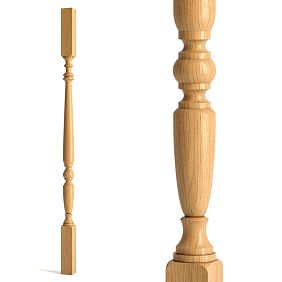


Wood moisture: an invisible parameter with visible consequences
Wood is hygroscopic — it constantly exchanges moisture with the surrounding air, absorbing it when humidity increases and releasing it when humidity decreases. This process is accompanied by changes in size: wood swells when it absorbs moisture and shrinks when it dries. The magnitude of size change depends on the species, direction of fibers, and, critically, on the initial moisture content of the wood at the time of manufacturing.
Freshly cut wood has a moisture content of 40-80% depending on the species and time of year of cutting. This is so-called free moisture, filling the cell cavities. As the wood dries, free moisture evaporates, and the moisture content decreases to the fiber saturation point — around 30%. During further drying, bound moisture from the cell walls begins to evaporate, accompanied by shrinkage — a reduction in the size of the wood.
Equilibrium moisture — is the moisture at which wood is in equilibrium with the surrounding air, neither absorbing nor releasing moisture. For heated residential rooms, equilibrium moisture is 8-12% depending on climate and season. In winter, with intensive heating, the air is dry, and equilibrium moisture can drop to 6-8%. In summer, with higher air humidity, equilibrium moisture rises to 10-12%.
The correct moisture level for balusters installed in heated rooms — 8-10%. This is the moisture level at which wood is stable, does not deform, and retains its dimensions. Achieving this moisture level requires proper kiln drying — a process taking from several days to several weeks depending on the species and initial moisture content.
Moisture check is performed using a moisture meter — a portable device with two needle electrodes inserted into the wood. The moisture meter measures the electrical resistance of the wood, which depends on moisture content, and displays readings in percentages. When purchasing balusters, request moisture measurement using a moisture meter in your presence. Readings should be within the 8-10% range for all balusters in the batch, not selectively for one.
Moisture content is checked using a moisture meter — a portable device with two needle-shaped electrodes inserted into the wood. The moisture meter measures the electrical resistance of the wood, which depends on moisture, and displays readings in percentages. When purchasing balusters, request moisture measurement using the moisture meter in your presence. Readings must be within the 8–10% range for all balusters in the batch, not just for one or a few.
Visual signs of inadequately dried wood: dark spots on ends (areas of higher moisture), uneven surface color (wet wood is darker than dry wood), heavy weight (wet wood is significantly heavier than dry wood of the same species). If a baluster seems unusually heavy for its species and size — it is likely inadequately dried.
The consequences of installing inadequately dried balusters do not appear immediately. The first months may look normal. Then, 3-6 months after installation, when the wood has dried under room conditions, problems begin: cracks along the grain, warping, screw loosening, weakened fasteners. Repair requires dismantling, replacing balusters, and reinstallation — costs far exceed the savings from cheap inadequately dried balusters.
Therefore, when purchasing, always request documented proof of moisture. Serious manufacturers provide test protocols indicating the moisture content of the batch. If the seller cannot provide moisture information or refuses to perform a moisture meter test — this is a warning sign, reason to refuse purchase from this supplier.




Wood grade: when beauty is measured in millimeters of knots
Wood is a natural material, and absolutely flawless trees do not exist. Any tree has knots (branch growth sites), resin pockets (in coniferous species), color variations, mechanical damage. The task of sorting — to divide wood by the quantity and nature of these natural features.
Wood sorting is regulated by state standards, which specify clear criteria for each grade. For furniture production — to which baluster manufacturing belongs — the classification is by grades: Extra (or Premium), Grade A (First Grade), Grade B (Second Grade), Grade C (Third Grade).
Grade Extra — wood without visible defects. Only small healthy knots up to 3-5 mm in diameter are allowed, invisible after final finishing. Texture is uniform, color is even, without spots or streaks. Resin pockets are not allowed. Cracks, rot, mechanical damage are excluded. Extra grade balusters look perfect, suitable for elite interiors where every detail is visible. Price is correspondingly higher — 50-80% more than Grade A.
Grade A (First Grade) — wood with minimal defects. Healthy joined knots up to 10 mm in diameter are allowed, light resin pockets up to 30 mm long (for coniferous species), minor color variations. Unjoined and falling knots are not allowed. Cracks, rot, mechanical damage are excluded. Grade A balusters have a natural appearance with species-specific features, suitable for most interiors. Price-to-quality ratio is optimal.
Grade B (Second Grade) — wood with noticeable defects that do not affect strength. Knots up to 25 mm in diameter are allowed, including unjoined ones (provided they do not fall out), resin pockets, spots, streaks, small cracks not exceeding 1/3 of the item's length. Rot is not allowed. Grade B balusters have a "rustic" appearance, suitable for country and rustic styles where knotty texture is valued as a sign of naturalness. Price is 30-50% lower than Grade A.
Grade C (third grade) — wood with significant defects. Large knots, loose knots (holes are plugged), extensive resin pockets, cracks up to half the length, and decay spots (provided strength is not critically reduced). Grade C balusters are rarely used, mostly for painting with opaque paints that conceal defects, or for budget projects where aesthetics are secondary.
When purchasing balusters, it is critically important to understand what grade of wood was used. Unfortunately, many sellers intentionally do not specify the grade or use their own marketing terms ("standard," "economy," "luxury"), which mean nothing. Demand clear indication of the grade according to GOST or, at least, a detailed description of allowable defects.
Visual assessment of grade upon receipt: inspect each baluster. Count the knots, measure their diameter. Check if knots are fused (try pressing — a loose knot will sink inward). Examine ends for cracks. Evaluate color uniformity — large dark or light spots may indicate rot or damage. If you find a mismatch with the declared grade, this is grounds for return or a discount request.
Important nuance: the wood grade is a characteristic of the rough stock from which the baluster is made. After turning or carving, defects may partially disappear (if they were in the removed layer) or, conversely, become apparent (if the knot was inside and exposed during processing). Therefore, professional manufacturers build in a grade allowance: for Grade A balusters, they use rough stock no lower than Grade A, preferably Extra.
Buy wooden balustersSpecify the grade in the contract or invoice. This protects you from receiving substandard products and provides grounds for complaints if necessary.
Our factory also produces:


Profile matching: when a millimeter decides everything
Imagine: you install 20 balusters on a staircase, and suddenly you discover that one is slightly thicker than the others, another has a ball shifted up by a centimeter, and the third has a different radius on its collar. Visually, this cuts the eye, creates a sense of unevenness, unprofessionalism, and cheapness. And this is not nitpicking — the human eye detects deviations in rhythmic, repeating elements even at the level of several millimeters.
Profile matching within a batch — a critical quality parameter that distinguishes products made on modern equipment from handmade ones. The baluster's profile is its shape in cross-section and longitudinal direction. For turned balusters, this is the diameters and positions of all elements (balls, shafts, cones, collars) along the height. For milled balusters, it is the sizes of the edges, radii of fillets, and depth of grooves.
Ideal profile matching — when all balusters in a batch have exactly the same profile to the nearest tenth of a millimeter. Such precision is achieved only when manufactured on CNC machines, where the profile is programmed and executed automatically. The human factor is eliminated, and each baluster is an exact copy of the previous one.
Manual turning, even performed by an experienced master using a template, inevitably results in variation. The master may press the tool slightly harder, linger slightly longer on one element, or turn the hand slightly differently. The result — deviations of several millimeters, which are imperceptible on a single baluster but become obvious when compared with others in a row.
Checking profile matching: when purchasing a batch of balusters, ask to lay several side by side on a flat surface. Visually compare: are all balls at the same height, are the diameters identical, do transitions match? Take a tape measure and measure key dimensions on several balusters — the diameter of the thickest element, the distance from the end to the first ball, total length. Deviations exceeding 2–3 millimeters — a sign of low manufacturing quality.
Another way to check — press two balusters together with their side surfaces. With ideal profile matching, they should fit together along the entire length without gaps. If gaps are visible in certain places — the profiles do not match. This test works only for balusters with symmetrical rotational profiles.
Consequences of mismatched profiles appear after installation. A row of balusters looks uneven, even though each is installed vertically. The eye picks out the outliers — slightly thicker or thinner balusters, with misaligned balls. A handrail resting on the top ends of balusters may have unevenness due to differing heights of balusters. This cannot be corrected after installation — only replacement of mismatched balusters.
When ordering large batches, require all balusters to be manufactured on the same machine, in the same run, by the same master (if production is not automated). This guarantees maximum matching. If balusters are manufactured at different times on different machines — the risk of mismatch increases. Ask to mark each baluster in the batch with the same number, so that if additional purchase is needed, you can request manufacturing according to the same template.
Professional manufacturers using modern equipment guarantee profile matching with accuracy to 0.5 millimeter. This is the quality standard that products for furniture and staircase manufacturing must meet. Lower accuracy is acceptable only for items that will be painted with opaque paint, concealing minor irregularities.
Get Consultation
Surface finish quality: from roughness to silkiness
The baluster's surface — this is what hands touch, what is seen up close, what determines tactile and visual impressions. Quality finishing transforms wood into a silky, warm, pleasant surface. Poor finishing leaves roughness, burrs, fiber tears, irregularities, creating a sense of cheapness and handmade quality.
Stages of baluster surface finishing include: rough turning or milling (creating shape with allowance for final finishing), fine turning or milling (creating final profile with accuracy to tenths of a millimeter), sanding (removing tool marks, creating smooth surface). Quality of each stage affects the final result.
Sanding — key stage determining surface quality. Sanding is performed with abrasive materials of varying grit, from coarse (80–100 grit) to fine (240–400 grit). The process proceeds sequentially — first, coarse abrasive removes large irregularities, then medium smooths out marks from coarse abrasive, then fine creates final smoothness.
Well-sanded surface — absolutely smooth, without visible scratches, roughness, or fuzz. Running your hand over it, you feel no irregularities. Looking along the surface against the light, no scratches or marks are visible. Wood shines with natural luster, texture is clearly visible without cloudiness.
Poor sanding leaves scratches — parallel marks from abrasive, visible at certain lighting angles. Insufficient sanding leaves fuzz — microscopic fibers protruding above the surface, perceptible as roughness by hand. Fiber tears — areas where the tool ripped fibers instead of cleanly cutting them — leave indentations and rough patches.
Check surface finish quality: run your hand slowly along the entire length of the baluster, paying attention to tactile sensations. Smooth, silky surface — sign of quality. Roughness, irregularities, scratches felt by hand — sign of insufficient finishing. Examine the baluster under oblique lighting — rotate it so that light glides along the surface. Under such lighting, even the smallest scratches, irregularities, and finishing defects become visible.
Pay special attention to profile recesses — collars, transitions between elements. These areas are harder to sand, and often tool marks or undersanded areas remain. Run your finger over all recesses — they should be just as smooth as the protruding parts.
Burrs — sharp, protruding fibers that can embed into the hand upon contact. Absolutely unacceptable for balusters, especially if there are children in the house. Check for burrs: run a cloth over the entire surface. If the cloth catches and leaves threads — there are burrs. Well-finished wood leaves no catches.
Baluster ends — often an overlooked aspect of quality. Ends must be perpendicular to the baluster’s axis (deviation no more than 1 degree), smoothly sanded, without chips along the edges. Check perpendicularity: place the baluster end-down on a flat surface, apply a square — the end must be perpendicular to the side surface.
If balusters are supplied with a pre-applied finish (primer, lacquer, oil), inspect the finish. It must be uniform, without runs, drips, skips, bubbles, or "orange peel" effect. The finish must not hide the wood’s texture (if it is a transparent finish) or finishing defects — attempting to conceal poor sanding with a thick layer of lacquer is always noticeable.
buy wooden balusters for the staircaseCheck only after verifying surface finish quality. Do not hesitate to carefully inspect and feel each baluster — this is your right as a buyer and the only way to avoid disappointment.
Geometric accuracy: millimeters matter
A baluster may be made from high-quality wood, perfectly sanded, and have a beautiful texture — but if its geometry is inaccurate, installation becomes a nightmare, and the result will be far from ideal. Geometric accuracy — is the conformity of the baluster’s actual dimensions and shapes to specified values with tolerances no more than 1–2 millimeters.
Key geometric parameters of a baluster: total length (from end to end), diameter or thickness at key points, end perpendicularity, straightness of axis (absence of curvature), roundness of circular elements (absence of ovality), parallelism of edges (for square-section balusters).
Baluster length must match the declared length with accuracy ±1 millimeter. Greater deviations cause problems during installation. If balusters have different lengths, the handrail will lie unevenly, requiring trimming of longer ones or adding shims under shorter ones. Check: measure the length of several balusters from the batch with a tape measure. All must have identical lengths with deviations no more than 1–2 millimeters.
The perpendicularity of the ends is critical for a tight connection with the handrail and step. If the end is not perpendicular to the baluster's axis (beveled), the baluster will be tilted when installed, creating a gap between the end and the handrail. Check: place the baluster on a flat surface and look along its length — the axis must be strictly vertical. Or, place a square against the end and side surface — the angle must be exactly 90 degrees.
Straightness of the axis — absence of bending along the baluster's length. Even a slight bend (2-3 millimeters per meter) will be noticeable after installation — the baluster will appear curved, disrupting the vertical rhythm of the railing. Check: place the baluster on a flat surface and roll it — a bent baluster will rock. Or, look along the baluster with one eye, as when aiming — the bend will be visible.
Cylindricity — for round-section balusters, all cross-sections at the same height must be circular, not oval. Ovality arises from inaccurate setup of the blank in the machine or from deformation of the wood after processing. Check: measure the diameter at several points along the baluster's length, rotating the caliper 90 degrees. The diameter in perpendicular directions must be identical.
Parallelism of faces — for square or rectangular-section balusters, opposite faces must be parallel. Non-parallelism (trapezoidal cross-section) creates problems when connecting to the handrail — the handrail's groove is rectangular, but the baluster is trapezoidal, resulting in a loose connection. Check: measure the width of the face at the top and bottom of the baluster — it must be identical.
Profile symmetry — for turned balusters with a symmetrical profile, all elements must be symmetrical relative to the axis. Check: measure the distance from the top end to key elements (ball, transition) on several balusters — it must be identical. Asymmetry means the elements are misaligned, and balusters installed side by side will appear inconsistent.
Geometric defects often occur when using inadequately dried wood. The baluster is made from raw wood, which appears geometrically correct. Then the wood dries, deforms, and the geometry is compromised. Therefore, moisture and geometry are linked — quality geometry is only possible with proper drying.
When receiving a batch of balusters, check the geometry randomly, at least 10% of the batch. If deviations are found, inspect the entire batch. Balusters with geometric defects must be replaced by the supplier. Do not attempt to correct the geometry yourself — it is usually impossible or significantly reduces the product's quality.
Batch composition: when every piece matters
Purchasing balusters requires precise calculation of quantity. Even a shortage of a few pieces means an incomplete project, additional time and money spent on reordering, risk of mismatched batches. Excess — frozen funds in unused material. Therefore, batch composition must be accurate and include not only the balusters themselves but also all necessary components.
The calculation of baluster quantity is based on the length of the stair run and the baluster spacing. The formula is simple: number of balusters = (run length / spacing) + 2 support posts. For example, a 3-meter run with a 150 mm spacing: 3000 / 150 = 20 balusters + 2 support posts = 22 elements.
But this is an ideal calculation, not accounting for reality. In practice, you must allow for a reserve:
-
5-10% for defects and damage during transport and installation
-
1-2 spare pieces for future replacements (a baluster may crack after a year, or get damaged during furniture rearrangement)
-
Round up (better to have 2 extra balusters than to be short by 1)
For the staircase from the example above, the optimal configuration is: 20 balusters + 10% spare = 22 balusters + 2 support posts = 24 elements. The overpayment for 2 extra balusters is incomparable to the cost in time and money for purchasing additional ones if there is a shortage.
Support posts (newels) — heavy elements installed at the start and end of the run, at turns, and on landings. They have larger cross-sections (usually 80×80, 100×100, 120×120 mm), often greater height, and may have finials — decorative elements crowning the post. Number of support posts: minimum 2 per run, plus 1-2 per landing, plus 1 per turn.
Handrails — horizontal elements attached to the top ends of balusters, which are held by hand. Handrail length = run length + 600 mm (300 mm overhang beyond the first and last step). Handrails are sold by the linear meter or as pre-assembled sections. Important: the handrail must be from the same batch of wood as the balusters to ensure color and texture match.
Baluster supports — horizontal planks installed between balusters in some designs, providing additional rigidity and filling gaps. Not always used, depends on design. If the design includes baluster supports, their quantity and length are calculated separately.
Fasteners — dowels, self-tapping screws, bolts, washers, glue, filler — everything needed for installing balusters. Professional suppliers offer fastener kits designed for a specific number of balusters. This ensures you have all the correct type and size fasteners needed.
Batch completeness is checked upon receipt. Re-count all elements: balusters, support posts, handrails, fasteners. Compare with the delivery note. Any shortage must be documented with an act upon receipt — otherwise, proving it later will be difficult. Do not sign the receipt documents until you have re-counted everything down to the last piece.
Marking elements in the batch helps during installation and future reordering. Serious manufacturers mark each batch with a unique number, recorded in documents. When reordering, you specify the batch number, and the manufacturer produces balusters that closely match the original in color, texture, and profile. Without marking, reordering is like a lottery — new balusters may noticeably differ from the old ones.
Baluster packaging in the batch must protect against damage during transport. Each baluster is wrapped in protective film or paper. Balusters are packed in cardboard boxes or wooden crates with padding between layers. Fragile elements (carved details, thin profiles) require special protection — individual wrapping, soft padding, rigid crates.
Buy wooden balustersMust be purchased in full with a reserve. Saving a few balusters at the purchase stage may result in multiple reordering costs if there is a shortage or if a couple of balusters turn out to be defective.
Packaging and transportation: the journey from manufacturer to site
Quality balusters can be damaged by improper packaging and transportation. Wood is a fragile material, sensitive to impacts, moisture, and temperature fluctuations. The journey from manufacturer to site may take days or weeks, involve multiple handling, and be exposed to various climatic conditions. The packaging's task is to protect balusters from all these threats.
Packaging requirements for balusters are regulated by standards for wooden products. Each baluster must be individually protected from contact with other balusters (to avoid scratches) and from external influences (impacts, moisture, dirt). Various materials are used: polyethylene film, bubble wrap, corrugated cardboard, kraft paper.
Individual packaging: each baluster is wrapped in protective material along its entire length, at least one layer. For balusters with protruding elements (carvings, thin profiles), double or triple wrapping is used. Ends are especially carefully protected — corner protectors or additional material layers prevent chipping.
Group packaging: several balusters (usually 5-10 pieces) are bundled together with stretch film or tape. Bundles are placed in cardboard boxes or wooden crates. Corrugated cardboard or polystyrene is placed between baluster layers to prevent mutual pressure. Boxes are filled so that balusters do not move during transport — voids are filled with sawdust, polystyrene beads, or corrugated cardboard.
Outer packaging — cardboard boxes or wooden crates — must be strong, withstand the weight of contents, and stackability (if packages are stacked one on top of another). Packaging must be marked: "Fragile," "This Side Up," "Do Not Tip," "Keep Away from Moisture," with quantity and weight indicated.
Protection from moisture is critical if transportation occurs in rainy weather or through high-humidity regions. Outer packaging is wrapped in polyethylene film, creating a waterproof barrier. Important: moisture may condense inside airtight packaging during temperature fluctuations. Therefore, airtight packaging is only suitable for short-term transport. For long-term (more than a week) transport, breathable packaging is required to prevent condensation.
Transport methods depend on distance and urgency. Self-pickup — the most reliable method, as you control loading, transportation, and unloading. Delivery by the supplier’s transport — the supplier is responsible for cargo safety until the destination. Delivery by a freight company — the cargo is handed over to the freight company, which bears responsibility for delivery according to the contract.
When transporting long items (balusters longer than 1.5 meters), it is important to place them correctly in the transport. Balusters must lie horizontally on a flat surface, supported along their entire length. It is not allowed to place balusters supported only at the ends — sagging under their own weight may cause deformation. It is not allowed to place heavy items on top of baluster packaging — pressure may crush the packaging and damage the balusters.
Cargo acceptance upon delivery — a critical moment. Before signing documents of receipt, you must:
-
Check the integrity of the outer packaging — are there damages, punctures, signs of moisture?
-
Recount the number of places — does it match the delivery note?
-
Open several packages randomly — inspect balusters for damage
-
If damage is found — prepare an act in the presence of the freight company’s representative
Signing delivery documents without inspection means accepting responsibility for any damage. Even if the packaging appears intact, the balusters inside may be damaged. The freight company will refuse to compensate for damage if you signed confirming receipt of the cargo in good condition.
Storage of balusters until installation must occur in a dry room at 15-25 degrees Celsius and 40-60% humidity. Balusters should be stored horizontally on a flat surface, preferably in original packaging. Packaging should be removed immediately before installation. Storage in damp, cold, unheated rooms may cause changes in wood moisture, warping, and mold growth.
Delivery: logistics without compromise on quality
Organizing baluster delivery is not just about moving cargo from point A to point B. It involves ensuring product integrity, meeting deadlines, convenience for the customer, and clear documentation. Proper logistics are part of quality service that distinguishes professional suppliers from casual sellers.
Delivery options depend on distance, urgency, cargo volume, and site infrastructure. Each option has its advantages and limitations.
Self-pickup from the supplier’s warehouse — the optimal option for customers with their own transport who wish to personally oversee the process. Advantages: opportunity to personally inspect and accept goods, no risk of damage during third-party transport, savings on delivery costs. Disadvantages: need for suitable transport (long balusters do not fit in a passenger car), time spent on travel, self-loading/unloading.
Delivery by the supplier’s transport — convenient for customers unable to self-pickup. The supplier arranges delivery using their own or rented transport, bears responsibility for cargo safety, and ensures professional loading/unloading. Advantages: minimal effort for the customer, supplier’s responsibility for the entire process, ability to agree on convenient delivery times. Disadvantages: delivery cost is added to the product price, availability depends on the supplier’s geographic coverage.
Delivery by a freight company — universal option for long distances and regions where the supplier does not organize direct delivery. The supplier hands over the cargo to a freight company, which delivers it to the customer’s city terminal or address. Advantages: delivery to any region, extensive terminal network, online tracking. Disadvantages: risk of damage during overloading, delivery times depend on the freight company’s schedule (usually 3-7 days), need to collect cargo from the terminal or arrange delivery from the terminal to the site.
Express delivery by courier services — option for urgent cases and small batches. Courier services deliver cargo to the door within 1-3 days across Russia. Advantages: speed, precise delivery to address, tracking. Disadvantages: high cost, weight and size restrictions (usually up to 30 kg and 2 meters in length), not suitable for large batches.
Delivery cost depends on method, distance, cargo volume, and weight. Approximate costs: self-pickup — free (only fuel and time costs), delivery by supplier’s transport within Moscow and its region — 1000-3000 rubles depending on distance, delivery by freight company across Russia — 30-50 rubles per kilogram (a 50 kg batch of balusters — 1500-2500 rubles), express delivery — from 500 rubles per kilogram.
Delivery timelines: self-pickup — on the day of request (if stock is available), delivery by supplier’s transport — 1-3 days after order readiness, delivery by freight company — 3-10 days depending on region, express delivery — 1-3 days.
Cargo insurance — an option worth considering for expensive shipments. Most freight companies offer insurance against damage and loss. Insurance cost — typically 1-3% of declared cargo value. In case of damage, the insurance company compensates according to the contract terms. Without insurance, the freight company bears limited liability (usually no more than 50-100 rubles per kilogram), which is incomparable to the real cost of quality balusters.
Documents upon delivery: delivery note (indicates sender, recipient, list and quantity of cargo units, weight, cost), certificate or declaration of conformity (confirms product compliance with quality standards), installation instructions (if provided by the manufacturer), warranty card (if warranty is provided).
Receiving cargo: check documents (data accuracy), check quantity of units (against delivery note), check packaging integrity (no damage), randomly open packages and inspect balusters. If everything is in order — sign the acceptance documents. If damage is found — prepare an act, photograph damage, do not sign documents until the situation is resolved.
Organizing delivery to site: ensure the site has access for transport (width of access, height of gates, strength of surface for heavy vehicles), space for unloading, personnel for unloading (or agreement with freight company for unloading), space for storing balusters until installation.
Professional suppliers, such asSTAVROS, offer comprehensive logistics: selecting the optimal delivery method based on order specifics, organizing transportation while meeting all requirements for wooden goods, quality packaging, insurance for valuable cargo, deadline control, and customer notification at every stage. This relieves the customer of hassle and guarantees that balusters arrive intact and on time.
Quality check upon receipt: the moment of truth
Receiving a batch of balusters — a critical moment when reality is assessed against expectations. This is the last opportunity to identify defects and request replacements before installation begins. After signing acceptance documents and starting installation, proving that defects existed from the start — rather than arising during your work — will be extremely difficult.
Quality check algorithm upon receipt:
Step 1. Check completeness. Recount all cargo units. Verify quantity against the delivery note. If fewer units are present — immediately document the shortage with an act. Open packages, recount balusters, support posts, handrails, fasteners. Verify against order and delivery note. Any discrepancies must be documented in writing.
Step 2. External packaging inspection. Inspect all packages for damage: cardboard punctures, dents, moisture stains, torn film. Damaged packaging indicates high risk of damaged contents. Such packages should be opened and inspected first.
Step 3. Visual inspection of balusters. Remove balusters from packaging. Inspect each one for obvious defects: cracks, chips, wood tears, large knots, mold spots, warping. Lay several balusters side by side — compare profiles, ensure consistency. Inspect surfaces under angled lighting — identify risks, unevenness, sanding defects.
Step 4. Tactile inspection. Run your hand slowly over each baluster with pressure. Feel the roughness, unevenness, and imperfections. A quality baluster should be silky smooth with no noticeable defects. Pay special attention to the profile grooves — they should be just as smooth as the protrusions.
Step 5. Measuring key parameters. Measure with a tape measure or caliper: length of several balusters (should be identical ±1-2 mm), diameter or thickness at several points (to check roundness or parallelism of edges), distance from end to key profile elements (to check symmetry). Significant deviations are grounds for a claim.
Step 6. Checking end perpendicularity. Place the baluster on a flat surface. Look from the side — the axis should be vertical. Or place a square against it — the end should be perpendicular to the side surface. Non-perpendicular ends cause problems during installation.
Non-perpendicular ends cause problems during installation.
Step 7. Checking straightness. Place the baluster on a flat surface and roll it. A bent one will rock. Or look along the baluster — the bend will be visible. Bent balusters must be replaced.
Step 8. Measuring moisture. If you have a moisture meter or can request one from the supplier — measure the moisture of several balusters. Readings should be in the 8-10% range. Moisture above 12% indicates under-dried wood, risking deformation.
Step 9. Evaluating wood grade. Count and measure knots, assess presence of resin pockets, stains, cracks. Compare with the declared grade. Non-conformance to grade is grounds for a claim or discount request.
Step 10. Checking finish (if balusters have finish). Inspect finish for uniformity, absence of pooling, streaks, gaps, bubbles. Finish should not hide texture (if transparent) or have defects (if opaque).
Documenting defects: if defects are found — immediately record them in writing. Prepare an act in the presence of the supplier’s or transport company’s representative (if delivered by transport company). In the act, describe each defect: type, location, number of damaged items. Photograph defects from multiple angles, including general views and close-ups of defects. Photos are crucial evidence in dispute resolution.
Do not sign acceptance documents until you have inspected the goods. A signature means you accept the goods and waive any claims. After signing, proving defects at the time of receipt is nearly impossible — the supplier will claim defects occurred at your end, and legally they will be correct.
Actions upon discovering defects: contact the supplier immediately, describe the problem, provide photos and the act. Demand replacement of defective items or refund, or a discount (if defects are minor and you are willing to accept the goods with a discount). Reputable suppliers replace defective items without issue — this is part of normal service. If the supplier refuses to resolve the problem — it signals unreliability, grounds for filing a lawsuit or complaint with regulatory authorities.
Claim period is typically 3-7 days from receipt of goods (stated in the supply contract). Do not delay inspection — the sooner you detect and report defects, the easier it will be to prove they existed at the time of receipt.
Warranties and returns: consumer rights protection
Buying balusters — purchasing a product subject to consumer rights legally established. Understanding your rights and mechanisms for their protection is essential for confident purchasing and resolving issues if they arise.
Warranty for wooden items: reputable manufacturers provide warranties against manufacturing defects. Typical warranty period — 1 year from sale date. Warranty covers: cracks and splits not caused by mechanical damage or improper use; warping and deformation if wood was properly dried; finish peeling (if balusters were sold with finish), if applied properly.
Warranty does NOT cover: mechanical damage (scratches, cracks from impacts); deformation due to storage or use in extreme humidity or temperature conditions; color changes from light exposure (natural process); damage from improper installation; finish wear from intensive use.
Warranty card must include: sale date, item name and quantity, serial number or batch number, warranty terms, manufacturer/seller contact information for inquiries. Keep the warranty card and receipt — they are required for warranty claims.
Warranty service procedure: upon discovering a defect you believe is covered under warranty, contact the seller or manufacturer. Describe the issue and provide photos. If the defect is deemed warranty-covered, the item will be replaced or repaired at the seller’s/manufacturer’s expense. If there is dispute over the nature of the defect (manufacturing vs. usage), an expert assessment may be conducted. The party whose position is not confirmed pays the expert fee.
Return of goods of acceptable quality: according to the "Consumer Rights Protection Law", goods of acceptable quality that do not fit in form, dimensions, style, color, size, or configuration may be returned within 14 days (excluding the day of purchase) if unused, original condition, packaging, and labels are preserved. However, wooden items belong to the category of custom-made goods and may be excluded from return if manufactured to your specific dimensions. Catalog items are typically returnable, custom-made ones are not.
Return of goods of unacceptable quality: if goods have defects not disclosed at the time of sale, you have the right within the warranty period (or, if no warranty is provided — within a reasonable period, but not exceeding 2 years): demand replacement with a similar brand item; demand replacement with a different brand item with price adjustment; demand proportional price reduction; demand immediate free repair of defects; recover costs for defect repair; refuse the contract and demand a refund.
Claim must be submitted in writing: describe the issue, your demands (replacement/refund/repair), attach copies of documents (receipt, warranty card, contract), photos of defects. The claim must be sent to the seller by registered mail with acknowledgment or delivered personally with signature. The seller must consider the claim and respond within 10 days (for replacement/refund) or 45 days (for repair).
If the seller refuses to satisfy the claim or fails to respond within the deadline — next step: file a complaint with Rospotrebnadzor (online via website or local office) or file a lawsuit. For filing a lawsuit, prepare: copies of all documents (contract, receipt, warranty card, claim, response or absence thereof), evidence of defects (photos, expert report), calculation of claim amount. For claims under 100,000 RUB, file with a magistrate court; over 100,000 RUB — with a district court. Consumers are exempt from paying court fees for claims related to consumer rights protection.
Recommendation: purchase balusters from verified suppliers with clear warranty and return terms specified in the contract. Reputable companies value their reputation and resolve customer issues without litigation. Low price and lack of warranty are signs of an unreliable seller — saving money on such a seller may result in legal fees and stress.
Frequently asked questions
How to check baluster moisture if I don’t have a moisture meter?
Cannot determine moisture level precisely without a meter, but there are indirect signs. Under-dried wood is heavier (noticeable when weighing or lifting), has uneven color (wet areas darker), dark spots on ends. Dry wood sounds crisp when tapped; wet wood sounds dull. These are approximate methods. Better to request moisture measurement from the seller at purchase.
Which wood grade to choose for balusters to be painted?
If balusters will be painted with opaque paint hiding texture, grade B or even C can be used — paint will conceal knots and defects. This allows saving money without compromising final product quality. Important: defects must not affect strength (cracks and rot are unacceptable even under paint), only appearance.
How many balusters should I order with a reserve?
It is recommended to order 5-10% more than calculated. This covers possible defects, damage during transport and installation, calculation errors. Plus 1-2 balusters as long-term reserve for replacement several years later. Better to have 2-3 extra balusters than to be short one and search where to buy more.
Can balusters be purchased later if there aren't enough?
Yes, but there is a risk of mismatch. Even from the same manufacturer, different batches may vary in color (wood from different trunks), finish tone, or minor profile details. If the batch number is retained and the manufacturer can produce a similar batch using comparable wood, the chances of matching are high. However, there is no guarantee. Therefore, it is better to purchase with a reserve right away.
What to do if you discover a crack in the baluster upon receipt?
Do not sign acceptance documents. Prepare a defect report in the presence of a representative from the transportation company or supplier (if delivered by the supplier). Photograph the defect. Contact the supplier and demand replacement of the defective baluster. A reputable supplier will replace it without problems. If the supplier refuses, this is grounds for a complaint and return of money through court.
How to store balusters until installation?
In a dry, heated room at 15-25°C and 40-60% humidity. Balusters should be stored horizontally on a flat surface, supported along their entire length (not just at the ends). Ideally, keep them in their original packaging until installation. Do not store in damp basements, cold unheated rooms, or under direct sunlight — this may alter the wood’s moisture content and cause deformation.
How much does delivery of balusters to regions cost?
It depends on the delivery method, distance, and weight. Approximately: by Russian transport company — 30-50 rubles per kilogram. A 50 kg batch of balusters will cost 1500-2500 rubles. Express delivery is more expensive — from 500 rubles per kg. The exact cost is calculated by the supplier or transport company based on cargo parameters and delivery address.
Is it necessary to insure the cargo during delivery?
Not mandatory, but recommended for expensive batches. Without insurance, the transport company bears limited liability (usually 50-100 rubles per kg), which is incomparable to the real cost of quality balusters. Insurance costs 1-3% of the cargo value. This is a small fee for peace of mind — if the cargo is damaged, the insurance will compensate the full cost.
What documents should the seller provide when selling balusters?
Sales contract or sales receipt, delivery note (if delivered), certificate or declaration of conformity (quality confirmation), warranty card (if provided), installation instructions (optional). Lack of documents is a sign of an unreliable seller — better avoid doing business with them.
What is profile matching and why is it important?
Profile matching means uniformity of shape for all balusters in a batch. All diameters, heights of elements, transitions must match with precision to the millimeter. Mismatch becomes noticeable after installation — a row of balusters appears uneven, individual elements stand out. Matching is guaranteed by manufacturing on CNC machines. Handmade production results in visible variation, noticeable to the eye.
Conclusion
Buy wooden balusters Quality means approaching selection consciously, armed with knowledge of quality criteria and set composition. Wood moisture content of 8-10% — guarantee of stable dimensions and absence of deformation. Grade A or Extra wood — visual purity of the product without large knots, stains, or cracks. Profile matching within a batch to the millimeter — guarantee that a row of balusters will look even and harmonious, without protruding elements.Surface processing quality determines tactile sensations and visual perception. Silk-smoothness without roughness, splinters, or tool marks — sign of professional manufacturing. Geometric accuracy — perpendicularity of ends, straightness of axis, dimensional precision — ensures easy installation and quality of the finished structure.
Batch composition requires careful calculation with a 5-10% reserve for defects, damage, and future replacements. Shortage of even one or two balusters turns the project incomplete, requiring additional purchase with the risk of mismatch in color and profile between new and old batches. A correct batch includes not only balusters but also support posts, handrails, and all necessary fasteners — a complete set for installation without additional trips to acquire missing elements.
Packaging protects items from damage during transit. Each baluster must be wrapped in protective material, placed in a sturdy box with padding between layers. Fragile elements require special protection — double packaging, rigid boxes. Marking the cargo as "Fragile," "Top," "Keep away from moisture" is not formality but necessity.
Delivery is organized considering distance and urgency. Self-pickup provides maximum control over the process. Delivery by the supplier’s transport shifts responsibility for cargo safety to the seller. Transport company — option for distant regions, requiring insurance of valuable cargo. Insurance cost 1-3% of price — small fee for peace of mind.
Quality check upon receipt — critical moment of truth. Before signing acceptance documents, recount all items, inspect packaging for damage, open several packages randomly, inspect and feel balusters, measure key parameters. If defects are found — prepare an act, photograph, do not sign documents until the issue is resolved. Signature means accepting responsibility for any damage, even hidden inside packaging.
Manufacturer warranties protect against manufacturing defects during the warranty period, usually 1 year. Warranty covers cracks, warping, and finish peeling that occur not due to misuse. Keep the warranty card and receipt — they will be required for claims. Legal right to return defective goods is protected — demand replacement, refund, or repair of defects.
Quality criteria are interrelated. Correct moisture content is impossible without proper drying. Precise geometry is impossible with under-dried wood, which deforms after processing. Profile matching is achieved only with modern CNC equipment or exceptional lathe skill. All this requires professional production, modern technical infrastructure, and quality control at every stage.
Purchasing from random sellers offering suspiciously low prices leads to disappointment. Low prices usually hide under-dried wood, low grade, rough processing, profile mismatch, and lack of warranty. Saving money at the purchase stage results in multiple expenses for defect repair, replacing defective balusters, additional trips, stress, and lost time.
Professional manufacturers value their reputation. They use properly dried wood with documented moisture content. They select top-grade blanks without critical defects. They manufacture balusters on modern CNC machines ensuring identical profiles. They carefully polish each item to silk-smooth finish. They check geometry before packaging. They securely package for transport. They provide warranties and resolve customer issues without court proceedings.
STAVROS — professional manufacturersolid wood productsspecializing in stair components for over 20 years. Production is equipped with modern European equipment: CNC lathes for identical profiles, four-sided planers for precise geometry, modern drying chambers for correct 8-10% moisture content.
STAVROS wood undergoes strict incoming control — only top grades are used. Each baluster is checked before packaging for geometry, processing quality, and absence of defects. The catalog features balusters in oak, beech, birch, larch, and pine — classic turned, modern milled, exclusive carved styles. Various finish options: lacquered, oil-finished, tinted, patinated, painted.
STAVROS offers a comprehensive approach: assistance in calculating required baluster quantities with reserve, selection of optimal wood species for operating conditions, recommendations for finish treatment, custom design manufacturing, delivery organization to any region of Russia, provision of samples for quality assessment.
STAVROS consultants will answer all questions, help avoid selection errors, ensure full installation kit. Documented wood moisture content, conformity certificates, warranty cards — all this is standard company practice. Quality packaging, insurance of valuable cargo, delivery time control, information at every stage — logistics without compromise on quality.
Wooden balusters for stairsSTAVROS — an investment in safety, longevity, beauty. It is wood that has undergone proper drying and quality control. It is precision manufacturing on modern equipment. It is a wide selection of species, styles, profiles, and finish options. It is professional consultation and reliable service. It is the assurance that in one year, ten years, your staircase will still look flawless, as on the day of installation.
Correct baluster selection is the key to a successful staircase project. Knowledge of quality criteria, understanding the importance of set composition, careful inspection upon receipt, and collaboration with a professional manufacturer — these are the components of this choice. Do not save on quality for dubious savings. Invest in reliability, safety, beauty. Purchase balusters from those who value their reputation and are responsible for the quality of their products. Your staircase will serve for decades, delighting the eye and ensuring safety. And every time you ascend it, you will thank yourself for the right choice.