












































































Article Contents:
- Baluster height: calculation from step to handrail
- Baluster spacing: balancing safety and aesthetics
- Handrail profile: compatibility with balusters
- Fastening kit: from dowels to toe caps
- Matching interior style: when form follows function and aesthetics
- Conclusion

A staircase is not a standard catalog item. Each staircase is unique: its own incline angle, its own tread width, its own rise height, its own number of steps, its own turns or lack thereof. And balusters for a staircase are not a universal product that you can buy 'approximately suitable' and somehow adapt later. Balusters must be precisely selected to match the parameters of a specific project; otherwise, installation becomes a nightmare, and the result will fall far short of expectations.
Buying balusters randomly, relying only on a catalog image — a path to disappointment. Purchased balusters may turn out to be too short or too long, incompatible with the chosen handrail, or unsuitable in style to already installed treads. Modifications, additional purchases, lost time, stress — typical consequences of an unplanned purchase.
buy wooden balusters for the staircaseRandomly, relying only on the picture in the catalog — a path to disappointment. Purchased balusters may turn out to be too short or too long, incompatible with the chosen handrail, stylistically mismatched with already installed steps. Repairs, additional purchases, lost time, stress — typical consequences of an unplanned purchase.
The correct approach — first, precise calculation of all project parameters, then selection of balusters fully matching these parameters, then selection of a fastening kit ensuring secure installation. Only this way can you guarantee that installation will proceed smoothly and the result will meet expectations in terms of safety, functionality, and aesthetics.
This article is a detailed guide to precisely selecting balusters for a specific project. How to calculate the required baluster height. How to determine the optimal spacing between balusters. How to select balusters compatible with the profile of the chosen handrail. What fastening kit is required for your type of staircase. How to ensure style compatibility. After reading, you will understand how to buy balusters that will perfectly suit your staircase.


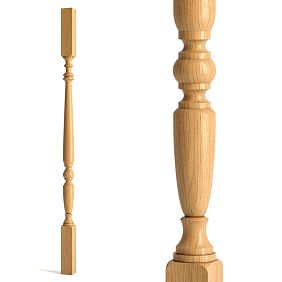


Baluster height: calculation from step to handrail
Baluster height is not an arbitrary parameter chosen for aesthetic reasons. It is a precisely calculated value determined by safety regulations, ergonomics, and staircase construction. An error in calculating height by just 20-30 millimeters can make the railing uncomfortable or non-compliant with standards.
According to GOST 25772-83 and construction norms, the standard railing height for residential staircases is 900 millimeters, measured from the top surface of the tread to the top of the handrail. This height, proven over decades of use, ensures safety and comfort for most people. For childcare facilities, the norm increases to 1200 millimeters. For outdoor staircases and staircases in public buildings — 1000-1200 millimeters.
The height of the baluster differs from the railing height by the thickness of the elements located above and below the baluster. If the baluster is mounted directly on the tread and fits into the handrail groove, the calculation formula is:
Baluster height = Railing height - Handrail thickness - Groove depth
Example: railing height 900 mm, handrail thickness 40 mm, groove depth 20 mm. Baluster height = 900 - 40 - 20 = 840 mm.
If the baluster is mounted on a handrail support (horizontal board lying on the treads to which balusters are attached), subtract the thickness of this board:
Baluster height = Railing height - Handrail thickness - Support board thickness - Groove depths
Example: railing height 900 mm, handrail 40 mm, support board 20 mm, handrail groove 15 mm, support board groove 15 mm. Baluster height = 900 - 40 - 20 - 15 - 15 = 810 mm.
The incline angle of the tread affects the required baluster length. On a straight tread with an incline of 30-45 degrees (typical range), balusters are usually installed vertically, i.e., perpendicular to the floor, not perpendicular to the treads. This means that the top and bottom ends of the balusters must be beveled at an angle corresponding to the tread incline to ensure tight fitting against the tread and handrail.
If the tread incline is 35 degrees, the baluster ends are beveled at 35 degrees to the vertical axis of the baluster (or 55 degrees to the horizontal plane of the tread). After such beveling, the effective baluster height (vertical distance from tread to handrail) decreases. The reduction coefficient depends on the angle:
-
Angle 30°: coefficient 0.987 (loss of 13 mm per meter)
-
Angle 35°: coefficient 0.982 (loss of 18 mm per meter)
-
Angle 40°: coefficient 0.976 (loss of 24 mm per meter)
-
Angle 45°: coefficient 0.970 (loss of 30 mm per meter)
For an 840 mm tall baluster on a 35° incline, the loss will be approximately 15 mm. That is, the raw material should be 855 mm tall before beveling the ends.
Practical approach to determining height:
-
Determine the standard railing height for your building type (usually 900 mm for residential buildings).
-
Measure the thickness of the selected handrail (usually 35-50 mm).
-
Determine the method of attaching the top ends of balusters (in the handrail groove, on baluster pins, or with screws from above) and calculate how many millimeters the attachment occupies.
-
Determine the method of attaching the bottom ends (directly to the tread, on a toe board) and account for its thickness if present.
-
Measure the incline angle of the stair run (using a level with an inclinometer or a mobile app).
-
Calculate the required baluster height using the formula and add a margin for trimming the ends at an angle.
Standard heights of ready-made balusters for sale: 800, 850, 900, 1000, 1100 millimeters. If your calculated size is close to a standard (±30 mm), choose the nearest larger standard and trim on-site. If your calculated size significantly differs from the standards, order custom-height balusters (most manufacturers offer this service at an additional cost of 10-20%).
Tolerances and allowance: always order balusters with a height allowance of 20-30 mm. It is easy to trim a baluster on-site, but it is impossible to extend a too-short baluster without compromising strength and aesthetics. It is better to spend 10 minutes trimming 50 balusters than to discover that all balusters are 10 mm shorter than needed.
Check before ordering: draw a scaled diagram: tread, baluster, handrail. Mark all dimensions. Visually assess proportions. A 900 mm guardrail height should appear harmonious relative to the stair run width and tread height. If proportions seem incorrect, consider adjusting the guardrail height (in private homes, 850-1000 mm is permitted).




Baluster installation spacing: balance of safety and aesthetics
The spacing between balusters is the distance between the centers of adjacent balusters, measured horizontally along the stair run line. This parameter determines how many balusters are needed for your staircase, how densely the railing will be filled, and how safe the structure will be.
Regulatory requirements: according to building codes, the gap between vertical railing elements (balusters) must not exceed 100-120 mm for general-use buildings and 100 mm for childcare facilities. This requirement is based on safety: a gap exceeding 120 mm allows a child to push their head between balusters, which may result in entrapment and injury.
The gap is not the spacing between balusters, but the free distance between the surfaces of adjacent balusters. If balusters have a square cross-section of 50×50 mm and the spacing between them is 150 mm (between centers), the gap will be 150 - 50 = 100 mm, which meets the standard.
Calculating the number of balusters for the stair run:
Formula: Number = (Run Length / Spacing) + 1
Run length is the length of the line along which balusters are installed, measured between support posts. For a straight run, this is the distance between the lower handrail post (at the start of the run) and the upper handrail post (at the end of the run) along the inclined line of the stair run.
Example: distance between support posts 3000 mm, planned spacing 150 mm. Number = (3000 / 150) + 1 = 20 + 1 = 21 balusters.
Gap check: baluster cross-section 50×50 mm, spacing 150 mm, gap = 150 - 50 = 100 mm. Meets the standard.
Typical baluster spacing:
-
100-120 mm (gap 50-70 mm for 50×50 mm balusters): maximum density, used in childcare facilities, staircases in homes with young children, projects requiring visually dense filling. Requires a large number of balusters, costs are high.
-
120-150 mm (gap 70-100 mm for 50×50 mm balusters): optimal range for most residential staircases. Ensures safety, compliance with standards, reasonable number of balusters, harmonious visual rhythm.
-
150-180 mm (gap 100-130 mm for 50×50 mm balusters): maximum allowable range for homes without young children. Saves on baluster quantity, but the gap at the upper limit or exceeds the standard, requires careful consideration.
-
180+ mm: violates safety standards for residential staircases. Permissible only for railings with additional horizontal filling (toe boards, panels, glass).
Baluster placement on treads:
There are three main approaches to placing balusters relative to treads:
One baluster per tread: a baluster is installed at the center of each tread. Simple and visually clear rhythm. Suitable for wide treads (tread depth 280-350 mm) and medium-section balusters (50×50 mm). With a tread depth of 300 mm and 50×50 mm balusters, the gap will be 250 mm — exceeding the standard. Requires additional filling.
Two balusters per tread: two balusters are installed on each tread symmetrically or with a specific spacing. Creates dense filling and ensures compliance with safety standards. With a tread depth of 300 mm, two balusters can be placed with a 150 mm spacing (gap 100 mm for 50×50 mm balusters) — meets the standard. Requires twice as many balusters, higher costs.
Uniform spacing regardless of treads: balusters are installed with constant spacing (e.g., 120 or 150 mm), regardless of how many balusters fall on a single tread. This is the most professional approach, creating a uniform visual rhythm. On some treads, there may be one baluster, on others — two, on others — a baluster at the junction of two treads. Requires precise marking, but the result is visually harmonious.
Visual rhythm and proportions:
Baluster frequency should match the staircase scale. On a wide stair run (width 1200-1500 mm) with substantial treads, sparsely placed balusters (spacing 180 mm) will appear proportionate. On a narrow stair run (width 800-900 mm) with elegant treads, frequent balusters (spacing 100 mm) will create a sense of overloading.
Golden rule: the baluster spacing to stair run width ratio should be approximately 1:6 to 1:8. For a 1000 mm wide stair run, the optimal baluster spacing is 125-166 mm. For an 800 mm wide stair run — 100-133 mm.
Savings without compromising safety:
If budget is limited, but safety standards must be met:
Use a mid-rail — a horizontal rail at mid-height of balusters. This allows increasing the spacing between balusters to 200-250 mm (saving 30-50% of balusters), while the clearance above and below the mid-rail remains within standard (100-120 mm).
Combine balusters with other types of infill: glass panels, metal rods, wooden panels. Balusters are installed less frequently (spacing 300-500 mm), serving as support elements, while the main infill is created using other materials.
Calculation for your project:
-
Measure the length of the stair run between support posts (along the slope).
-
Determine the baluster section (usually 50×50 or 45×45 mm).
-
Calculate the maximum allowable spacing: Spacing = Clearance + Baluster Section. For a 100 mm clearance and 50×50 mm balusters: Spacing = 100 + 50 = 150 mm.
-
Calculate the number of balusters: (Run Length / Spacing) + 1.
-
Round up to the nearest whole number (better to have slightly more balusters than fewer).
-
Check the final clearance: (Run Length / (Number - 1)) - Baluster Section.
Our factory also produces:


Handrail profile: compatibility with balusters
Handrail (rail) — a horizontal or sloped barrier element, held by hand. The handrail profile is the shape of its cross-section. The profile of the handrail affects not only aesthetics and grip comfort, but also the method of baluster attachment, compatibility with selected balusters, and installation complexity.
Types of handrail profiles:
Round handrail (diameter 40-60 mm) — classic option, comfortable to grip, pleasant for the hand. Made by turning from solid wood or by gluing laminates followed by turning. Bottom side is flat or has a longitudinal groove for installing balusters. Compatible with round turned balusters and square balusters.
Baluster mounting: in groove on bottom side of handrail (groove depth 15-20 mm), on dowels (holes on bottom side of handrail), with screws from above with masking (holes filled with putty or plugs).
Rectangular handrail (section 40×60, 50×70, 60×80 mm) — modern option, minimalist, suitable for minimalist interiors. Made by planing from solid wood. Bottom side has a longitudinal groove for installing balusters or is flat for mounting on dowels/screws.
Baluster mounting: in groove on bottom side (most common method for rectangular handrails), on dowels, on metal clamps (for disassemblable structures).
Decorative handrail (complex profile with rounded edges, moldings, protrusions) — decorative option, emphasizing classical or historical style. Made by milling from solid stock. Top surface has a shape convenient for gripping (rounded top, ergonomic curves). Bottom side is usually flat with a groove for balusters.
Baluster mounting: in groove (mandatory, as complex profile does not allow other methods without compromising aesthetics), on dowels with additional fixation by glue.
Handrail with metal insert — combined option, where wooden casing surrounds a metal profile (usually aluminum or steel). Metal provides additional rigidity, wood — aesthetics and tactile comfort. Used on long spans (over 3 meters), where wooden handrail without reinforcement may sag.
Baluster mounting: in groove in lower part of wooden casing, sometimes balusters are mounted to metal profile via special brackets (for metal balusters).
Groove in handrail: dimensions and placement
Groove for installing balusters — a longitudinal recess on the bottom side of the handrail, into which the top ends of balusters are inserted. The groove ensures rigid and aesthetic connection: balusters and handrail function as a single structure, fasteners are hidden, visual cleanliness is maximized.
Groove dimensions:
-
Width: corresponds to baluster thickness with 1-2 mm clearance. For 50×50 mm balusters, groove width is 51-52 mm. For round balusters with 50 mm diameter, groove width is 50-51 mm.
-
Depth: 15-25 mm. The deeper the groove, the more secure the mounting, but the less wood remains under the groove (risk of cracking with thin bottom). Optimal: 18-20 mm.
-
Placement: centered on bottom side of handrail for symmetrical profiles, offset toward inner side of stair run for asymmetrical profiles.
Groove is milled during handrail manufacturing. Important: when ordering a handrail, specify exact baluster section (round or square, what size) to ensure correct groove milling. Mismatch between groove and balusters (groove 48 mm, balusters 50 mm) makes installation impossible without modification.
Compatibility of handrail and baluster profiles:
-
Round polished handrail + round polished balusters: classic harmony, visual unity of form, optimal choice for traditional interiors.
-
Rectangular handrail + square balusters: modern minimalism, clean lines, suitable for minimalism, Scandinavian style, loft.
-
Decorative handrail + intricate balusters: classic, baroque, empire — styles where ornamentation is valued, each element has a complex shape.
-
Round handrail + square balusters: acceptable combination creating a contrast of forms. The handrail remains traditionally comfortable to grip, while balusters are minimalist and modern.
-
Rectangular handrail + round balusters: less harmonious combination, rarely used. Visual dissonance between the straight lines of the handrail and rounded balusters.
Order a set of handrail + balusters:
Optimal option — order the handrail and balusters from one manufacturer within a single order. This guarantees:
-
Matching wood species (color, texture from the same batch of lumber).
-
Correct mortise size in the handrail to accommodate baluster cross-section.
-
Stylistic unity (handrail profile and baluster profile designed as a single collection by the designer).
-
Identical finish (if ordering with finish, lacquer or oil applied with the same compound, color is identical).
If ordering from different suppliers, precisely coordinate all parameters: wood species, grade, moisture content, baluster cross-section, mortise dimensions in the handrail, type and color of finish. Even minor discrepancies (oak from different suppliers may differ by several tones) will be noticeable.
Handrail length and jointing:
The length of a straight stair run often exceeds the maximum handrail length made from solid wood (typically 3-4 meters due to lumber length limitations). For long stair runs, the handrail consists of several sections joined end-to-end.
Handrail jointing is performed:
-
On support posts: ends of two handrail sections are inserted into the post from opposite sides, forming a rigid joint. The joint is hidden inside the post and visually unnoticeable.
-
Between balusters: ends are joined at a 45-degree angle (mitered joint), glued, and additionally secured with dowels or laminates. The joint is visible but, with proper execution, remains barely noticeable.
-
Special connectors: metal or wooden inserts joining handrail sections from within. Ensure strength and minimal visibility of the joint.
When planning to purchase a handrail, calculate the required length including overhangs beyond support posts (typically 150-300 mm on each side for comfortable gripping). If the length exceeds the maximum section, plan the joints in advance and choose joint locations (on posts are preferable).
Get Consultation
Fastening kit: from dowels to post caps
The reliability of the railing is 50% determined by baluster quality and 50% by fastening quality. The strongest oak balusters, secured with a single weak self-tapping screw, will loosen within a few years. Spruce balusters secured with a combination of dowels, glue, and bolts will last for decades. The fastening kit is not a minor detail to save money on. It is the foundation of longevity.
Composition of a complete fastening kit for balusters:
For lower attachment of balusters to treads:
-
Wooden dowels (diameter 8-10 mm, length 40-60 mm) — 1-2 dowels per baluster
-
Wood glue PVA or polyurethane — 1 liter per 40-60 balusters
-
Self-tapping screws (diameter 5-6 mm, length 70-100 mm) — 1-2 screws per baluster if fastening from below through the tread
-
Metal post caps (for support posts) — one per post
For upper attachment of balusters to the handrail:
-
Wooden dowels (if handrail has no mortise) — 1-2 dowels per baluster
-
Wood glue — for securing balusters in the handrail mortise and on dowels
-
Furniture screws (diameter 4-5 mm, length 50-70 mm) — for mounting from above through the handrail with concealment
-
Wooden dowels (diameter 8-10 mm) — for concealing screw holes in the handrail
For mounting the handrail to posts:
-
Furniture bolts (diameter 8-10 mm, length 100-150 mm) with nuts and washers — 2-4 bolts per handrail-post connection
-
Metal brackets or special handrail fittings — for reinforcing connections
-
Reinforced dowels (diameter 12-14 mm, length 60-80 mm) — for embedding the handrail into posts
For mounting support posts to floor/step:
-
Adjustable or non-adjustable metal shoe brackets — one per post
-
Anchor bolts (diameter 10-12 mm, length 100-150 mm) — for mounting shoe brackets to concrete floor
-
Wood screws (diameter 6-8 mm, length 100-150 mm) — for mounting shoe brackets to wooden floor
-
Threaded rods (diameter 10-12 mm, length 100-150 mm) — for shoe brackets with threaded rods
Auxiliary materials:
-
Wood putty in the color of balusters — for filling holes, chips, and gaps
-
Sandpaper (grit 180-240) — for sanding after puttying
-
Finish coating (varnish or oil) in the color of balusters — for covering repair areas and fasteners
Calculating the amount of fasteners:
Example: staircase with 50 balusters and 4 support posts, balusters mounted with dowels from below and above, posts mounted on shoe brackets.
Balusters (50 pcs):
-
Dowels: 50 balusters × 2 dowels (bottom) + 50 × 2 dowels (top) = 200 dowels
-
Adhesive: 1-2 liters (with reserve)
-
Screws (additional for reinforcement): 50 pcs
Posts (4 pcs):
-
Shoe brackets: 4 pcs
-
Anchor bolts (if mounting to concrete): 4 × 2 = 8 bolts
-
Bolts for mounting handrails to posts: 4 posts × 2 connections (bottom and top of flight or two flights per post) × 3 bolts = 24 bolts
Handrail:
-
Bolts for joining sections (if flight length requires joining): 2-4 bolts per joint
Total: 200 dowels, 2 liters of adhesive, 50 screws, 4 shoe brackets, 8 anchors, 24 furniture bolts. Plus auxiliary materials.
Fastener quality matters:
Cheap dowels from softwood (spruce, aspen) compress under load, weakening the connection. Quality dowels from hardwood (oak, birch) with grooved surface provide strong connections for decades. Price difference — 50 rubles per hundred, reliability difference — critical.
Construction-grade PVA glue (for wallpaper and tiles) is unsuitable for structural connections. Carpenter-grade PVA glue, class D2 (for interior use) or D3 (water-resistant) — minimum required level. Polyurethane glue (e.g., Titebond) — maximum strength, water resistance, longevity. Price difference — 200-400 rubles per liter, reliability difference — long-term.
Black oxide screws for drywall rust, weaken, and break. Yellow galvanized screws for wood with partial thread provide strong fastening without rusting. Price difference — 100–150 rubles per hundred, reliability difference — yes/no.
Chinese-made thin steel (1.5–2 mm thick) spacers bend under load and strip threads. Russian or European-made spacers from 3–4 mm thick steel withstand any household loads. Price difference — 200–400 rubles per piece, reliability difference — critical for support posts.
Where to buy quality fasteners:
Specialized stores for carpenters and furniture makers offer professional fasteners: beech dowels with grooves, class D3 carpentry glue, furniture screws, quality spacers. Prices are 20–30% higher than in construction hypermarkets, but quality is many times better.
Online fastener stores: wide assortment, detailed specifications, ability to order exact quantities without paying for extras. Delivery in 2–5 days.
Manufacturers of balusters often offer ready-made fastener kits designed for a specific number of balusters. This is convenient: no need to calculate and select individually, everything needed is in one package. Kit price is usually 10–15% lower than buying components separately.
Installation tools:
Tools required for quality baluster installation:
-
Drill or impact driver with a set of wood drill bits (diameters 3, 5, 8, 10 mm)
-
Forstner bits (for neat blind holes for dowels and dowel joints)
-
Rubber mallet (for driving balusters onto dowels without damage)
-
Level (for checking baluster verticality)
-
Clamps (for holding elements during gluing)
-
Circular saw or jigsaw (for trimming balusters and handrail at an angle)
If you don’t have this tool, consider the cost of purchasing or renting it, or hiring professionals for installation. Fastener kit costs 3000–8000 rubles for a standard staircase, but quality installation costs 10000–30000 rubles for labor.
Style matching: when form follows function and aesthetics
Balusters are not only functional railing elements. They are visible, active participants in interior design, defining the character of space. Balusters are in plain sight, touched, and seen daily. Mismatch between balusters and interior style creates visual dissonance, a sense of 'something is off,' even if it’s hard to articulate exactly what the problem is.
Classic style: heavy balusters from oak, turned profile with spheres, barrels, cones, dark staining or natural color with transparent lacquer, round handrail with rounded top, support posts with carved finials (spheres, acorns, cones), 50×50 or 60×60 mm baluster cross-section, creating a sense of solidity. Species: oak, ash, beech. Finish: semi-matte lacquer or oil, emphasizing texture.
Modern minimalism: simple square-section balusters 40×40 or 45×45 mm with minimal processing (rounded corners, chamfers), light species (ash, bleached oak, birch), rectangular handrail with sharp or slightly rounded corners, square-section support posts without finials or with flat caps, matte finish (oil, matte lacquer) or white/grey paint, hiding texture.
Scandinavian style: light balusters from pine or spruce, simple profile (square or round thin sections 35×35 or diameter 35–40 mm), natural light color or bleaching, round or rectangular light-toned handrail, matte transparent finish (oil, wax), creating a sense of naturalness and warmth. Emphasis on eco-friendliness, naturalness, lightness.
Loft/industrial: combination of wood and metal. Rough-section wooden support posts (100×100 or 120×120 mm) from solid beams, preserving natural texture and defects (knots, cracks as part of aesthetics), metal baluster rods (round or square section, diameter/section 12–16 mm, black or grey paint), wooden or metal handrail. Wood species: oak, dark-stained or brushed larch.
Provence/country: balusters from light species (pine, birch), painted in pastel colors (white, cream, light blue, lavender) or with aged effect (patina, wear), simple turned profile with soft shapes, round or rounded rectangular handrail, painted to match balusters, support posts with decorative finials, matte finish creating an effect of natural wood under paint.
Art Deco: luxurious balusters from noble species (oak, walnut, exotic), complex profile with geometric elements (rhombuses, zigzags, vertical grooves), deep dark staining (wenge, mahogany, black oak), glossy lacquer creating shine and depth, possible metallic inlays (brass or bronze inserts), handrail with metallic elements, heavy support posts with geometric finials.
How to determine if balusters suit your interior:
Collect references — photos of interiors in your style where staircases are visible. Pay attention to:
-
Massiveness of elements (thick or thin balusters, heavy or light handrail)
-
Profile complexity (simple geometric shapes or complex decorative processing)
-
Wood color (light, medium, dark; natural or painted)
-
Texture (emphasized by transparent finish or hidden by paint)
-
Proportions (ratio of baluster thickness, handrail, posts)
Compare the characteristics of balusters you plan to buy with references. Do they match in mass, profile complexity, color, texture? If yes — likely, the balusters will suit. If there are discrepancies — assess how critical they are, or look for other options.
Sample creation:
If in doubt, order one baluster sample, one newel post sample, a small handrail segment (300–500 mm). Bring them to the site, temporarily install (lean against the wall, place on steps), evaluate in person under natural lighting in the context of your interior. Color, texture, proportions may look completely different in person than on catalog photos. Sample costs (2000–5000 rubles) are incomparable with the risk of buying a full set of balusters that won’t match the style.
Consultation with a designer:
If the interior is designed by a designer, definitely coordinate baluster selection with them. Provide catalogs, manufacturer links, samples. The designer will assess style compatibility and may suggest alternatives you hadn’t considered. If there’s no designer but budget allows, consider a one-time baluster selection consultation (3000–10000 rubles, depending on region and specialist level). Choosing incorrectly may cost tens of thousands for replacement — consultation is cheaper.
Flexibility and adaptability:
If the interior style is still forming or allows different interpretations, choose neutral balusters suitable for a wide range of styles. Light oak or beech balusters with a simple turned profile, natural color with matte lacquer — a universal option compatible with classic, modern, and Scandinavian styles. Extremes (complex carving, exotic species, bright staining) limit flexibility and require a clear stylistic context.
Conclusion
buy wooden balusters for the staircaseExactly matching the project — means approaching selection systematically, with understanding of parameters, requirements, and interdependencies. Baluster height is calculated based on standard railing height, handrail thickness, mounting method, and stair incline angle. An error of 20–30 mm makes the railing uncomfortable or non-compliant with norms. Correct calculation with allowance for trimming guarantees precise fit.
The spacing between balusters is determined by safety requirements (clearance no more than 100–120 mm), aesthetics (harmonious rhythm, proportions relative to stair width), and economics (balance between baluster quantity and cost). Uniform spacing regardless of steps creates a professional visual rhythm, compliance with norms ensures safety for all family members, including children.
Handrail profile determines baluster mounting method and element compatibility. Round handrail with groove + round turned balusters — classic harmony. Rectangular handrail with groove + square balusters — modern minimalism. Ordering a handrail + baluster set from one manufacturer guarantees matching species, groove dimensions, stylistic unity, and identical finish.
Mounting hardware — the foundation of railing reliability. High-quality beech dowels, class D3 carpentry glue, furniture screws, sturdy washers ensure decades of durability. Saving on hardware — false economy, leading to loosening, squeaking, and repair needs within a few years. Full calculation of required hardware, purchasing with 10–15% reserve, using professional tools or hiring specialists — the path to quality results.
Stylistic harmony transforms balusters from functional elements into an organic part of the space. Heavy carved oak balusters in classic interiors, minimalist square balusters, light stained balusters in Provence, wood-metal combinations in lofts — each style has its characteristic solutions. Collecting references, creating samples, consulting with a designer helps avoid stylistic dissonance and select balusters that complement and complete the interior.
Company STAVROS offers a full range of services for precise baluster selectionfor your specific staircase projectTechnical consultation for calculating baluster height considering all parameters of your staircase, selecting optimal installation spacing for compliance with safety norms and harmonious aesthetics, selecting a handrail profile compatible with chosen balusters, precisely milling the handrail groove to match baluster cross-section, equipping with mounting hardware (dowels, glue, washers, bolts) in required quantities, recommendations for stylistic compatibility of species, profile, and finish to your interior.
Balusters available in various heights (standard 800, 850, 900, 1000, 1100 mm and custom orders), cross-sections (35×35 to 80×80 mm for square, 35–80 mm diameter for round), profiles (simple square, turned classic with 2–5 elements, carved decorative), species (spruce, birch, larch, beech, ash, oak). Handrails of all profiles with capability to mill groove for any baluster cross-section. Newel posts with cross-sections from 80×80 to 150×150 mm with various finials.
Manufacturing on modern CNC equipment ensures dimensional accuracy (tolerance ±0.5 mm), identical profiles across all balusters in a batch, high-quality surface finishing. Kiln-dried wood (moisture 8–10%, documented), premium grades (A, Extra) without critical defects. Any finish type: transparent lacquering, oil-wax, toning, patina, staining — or delivery without finish for self-finishing.
Technical support includes specialist on-site visit (for complex projects in Moscow and surrounding area), staircase parameter measurements, precise calculation of required balusters and hardware, specification with complete list of required elements and materials, installation recommendations considering your staircase construction. For self-installation, detailed instructions and phone consultations are provided. For professional installers and construction companies — technical documentation, connection node drawings.
12-month warranty against manufacturing defects: wood cracking and warping (if caused by insufficient drying), dimensional mismatch, defects in processing and finish. Upon discovering defects — free replacement of defective elements with delivery to site.
Professional approach — precise calculation of all parameters, selection of elements fully matching the calculation, quality mounting hardware, careful installation per technology. Result: railing where each baluster stands perfectly vertical, uniform spacing between balusters, railing height compliant with norms and comfortable for all family members, handrail tightly connected to balusters without gaps, identical color and texture of all elements, style harmonizing with interior. Such railing serves for decades without loosening, squeaking, deformation, pleasing the eye, ensuring safety.
Professional approach — precise calculation of all parameters, selection of elements fully matching the calculation, high-quality fastening, careful installation according to technology. Result: a railing where each baluster stands perfectly vertical, the spacing between balusters is uniform, the railing height meets standards and is comfortable for all family members, the handrail is tightly connected to the balusters without gaps, the color and texture of all elements are identical, the style harmonizes with the interior. Such a railing serves for decades without loosening, creaking, or deformation, pleasing the eye and ensuring safety.
Investing time in precise calculation and selection (2–4 hours of consultations, measurements, selection) pays off in peace of mind and confidence that everything is done correctly. Investing in quality balusters, handrails, and hardware from a reputable manufacturer (20–40% more than cheap analogs) pays off in longevity and absence of problems. Every time you ascend the stairs or simply admire their elegance, you’ll thank yourself for the right choice — for precise project matching, for quality and professionalism.


