












































































Article Contents:
- What is wooden molding and why round profile is in demand
- Wood species for production of 50 mm round molding
- Pine: Budget Option with Limitations
- Beech: the golden mean of strength and price
- Oak: the king of durability and prestige
- Ash: Strength and Elasticity
- Larch: coniferous alternative with high moisture resistance
- Production technologies: from log to perfect cylinder
- Wood drying
- Selection and gluing of lamellas
- Turning on lathes
- Sanding
- Quality Control
- Application of 50 mm round molding in stair structures
- Handrails for straight stairs
- Wall-mounted handrails
- Balusters
- Decorative application: from cornices to columns
- Curtain Cornices
- Decorative columns and pilasters
- Furniture and door handles
- Elements of terrace and balcony railings
- Processing and coating of round molding
- Priming
- Oil: natural protection and tactile feel
- Varnish: maximum protection
- Stain and Tinting
- Enamel: opaque coating
- Where to buy quality round balusters in St. Petersburg
- Supplier selection criteria
- Cost of 50 mm round molding: what affects the price
- Wood Species
- Wood grade
- Construction
- Finishing and coating
- Order volume
- Installation of round molding: tips and recommendations
- Preparation of molding
- Cutting
- Mounting Handrails
- Joining segments
- Final finishing
- Care for round molding during operation
- Regular Cleaning
- Recoating
- Controlling microclimate
- Protection from Mechanical Damage
- Frequently asked questions about 50 mm round molding
- How does solid molding differ from glued molding?
- Can 50 mm baluster be used for outdoor elements?
- What length of molding is available?
- Can the molding be tinted to the desired color?
- How to Choose Wood Species for a Handrail?
- How much does a linear meter of high-quality oak molding cost?
- Can the molding be bent for curved sections?
- How quickly can the molding be obtained after ordering?
- What wood grade should be chosen for visible elements?
- Does the molding need to be coated before installation?
- Conclusion: Quality and traditions from STAVROS company

What isRound handrail SPBand why do carpentry professionals and interior designers not imagine their work without this material? A 50-millimeter diameter round wooden profile is not just a cylindrical blank. It is a fundamental element used in creating stair handrails, balusters, decorative columns, cornices, furniture handles, and hundreds of other structural and decorative elements. In Saint Petersburg, a city with a rich architectural history and demanding craftsmen, the demand for high-quality wooden molding is always consistently high. Why has the 50-millimeter diameter become the standard? What wood species are used for production? Where and how is the round profile applied? All of this is covered in a detailed article that will help you make the right choice and understand the value of this versatile material.


What is wooden molding and why is round profile in demand
Molding is a general term for wood products that are measured and sold by the linear meter. Moldings include baseboards, casings, glazing beads, cornices, trims, bars, and profiles of various cross-sections. Round molding is a cylindrical profile of constant diameter, made from solid wood or laminated wood.
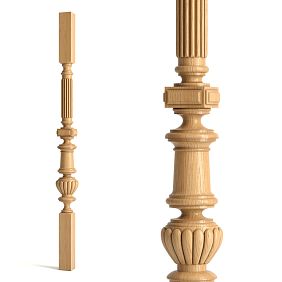
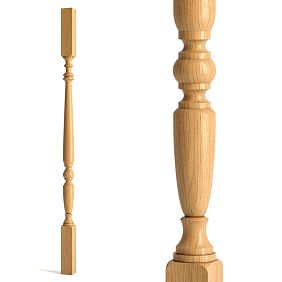
The 50-millimeter diameter holds a special place in the range of round profiles. It is large enough for creating load-bearing and support elements, but not excessively massive, making it versatile for most architectural tasks. Handrails for stairs, vertical fence posts, decorative columns, cornices for heavy curtains — these are all areas of applicationRound baluster 50 mm.
Why the round shape? Firstly, ergonomics. The cylindrical surface is ideal for hand grip — even load distribution, absence of sharp corners, natural feel. Secondly, manufacturability. Round profile is easier to process on lathes, less prone to cracking compared to square bars, as there are no corners — areas of internal stress concentration. Thirdly, aesthetics. The round shape is classic, timeless, organically fits into any style — from classical to contemporary.




Wood species for producing 50 mm round molding
The choice of wood species determines the strength, durability, appearance, and cost of the finished product. Both coniferous and deciduous species are used for producing 50-millimeter diameter round molding.
Our factory also produces:


Pine: a budget option with limitations
Pine is the most affordable species. Its density is about 500 kilograms per cubic meter, making it relatively soft and easy to work with. The color is light yellow with a pleasant coniferous aroma. Pine contains resins that give the wood natural resistance to moisture and rot.
The use of pine molding is limited due to its low hardness. It is suitable for decorative elements without significant mechanical loads — cornices for light curtains, decorative strips, temporary structures. For stair handrails, pine is not recommended — it wears out quickly, and dents appear on the surface from constant contact with hands.
The advantage of pine is its low price. Pine molding costs two to three times less than oak. For projects with a limited budget or temporary structures, this is an optimal solution.
Get Consultation
Beech: the golden mean of strength and price
Beech is a hard deciduous species with a density of about 650 kilograms per cubic meter. The structure is fine-grained, uniform, without large pores. After quality sanding, beech molding becomes silky smooth.
The color of beech varies from light pink to creamy beige. This neutral palette makes beech products versatile for most interiors. Beech is easily tinted, allowing it to be given almost any shade — from bleached to dark chocolate.
Beech is strong and durable. It is excellent for stair handrails, balusters, furniture elements. The drawback is sensitivity to moisture. Beech is not recommended for use in rooms with unstable microclimate or outdoors without special treatment.
The cost of beech molding is average — more expensive than pine, but cheaper than oak and ash. This is an optimal balance of price and quality for residential interiors.
Oak: the king of durability and prestige
Oak is an elite species with a density of 700–800 kilograms per cubic meter. It is one of the hardest and most durable woods available for mass use. Oak molding is practically eternal — it serves for centuries without losing functional properties.
The texture of oak is expressive, with large pores and clear annual rings. The color varies from light honey to dark brown. With age, oak naturally darkens, acquiring a noble patina.
Oak is resistant to moisture, mechanical damage, and wear. It is ideal for stair handrails in public buildings with intensive use, exterior elements (with proper treatment), and prestigious interiors.
The drawback of oak is one — high price. Oak molding costs two to three times more than beech. But this price is justified by the exceptional characteristics of the material.
Ash: strength and elasticity
Ash is comparable to oak in density and hardness but has greater elasticity. The texture is expressive, with contrasting stripes. The color ranges from light gray to light brown.
The elasticity of ash allows creating bent elements — curved handrails for spiral staircases, arched cornices. For complex architectural forms, ash is an ideal solution.
The cost of ash molding is close to that of oak. This is a premium category of materials for demanding projects.
Larch: A Coniferous Alternative with High Moisture Resistance
Larch is a unique coniferous species that surpasses pine in hardness and approaches beech. Density is about 600 kilograms per cubic meter. Larch contains a large amount of resin, making it exceptionally resistant to moisture and rot.
Larch has a reddish-brown color and expressive texture. Larch molding is ideal for exterior elements, terraces, gazebos, and high-humidity areas. It lasts for decades without special treatment.
The cost of larch is moderate—more expensive than pine, cheaper than oak. For exterior applications, it is the optimal choice in terms of price-to-performance ratio.
Production Technologies: From Log to Perfect Cylinder
Producing high-quality round molding requires high-precision equipment and adherence to technological standards.
Wood Drying
The first and critically important stage is drying. Freshly cut wood contains 40–80 percent moisture. For molding production, moisture must be reduced to 8–12 percent. This is achieved through kiln drying in special drying chambers where temperature and humidity are controlled with high precision.
Proper drying prevents cracking, warping, and deformation of finished products. Under-dried wood will 'move' after installation—cracks, bends, and dimensional changes will appear. Over-dried wood becomes brittle and may crack during mechanical processing.
Selection and Gluing of Lamellas
For manufacturing long, straight profiles (over 3 meters), the technology of gluing lamellas is used. Boards are sawn into thin strips—lamellas—which are sorted by color and texture. The lamellas are then glued together under pressure using moisture-resistant adhesive.
A glued construction is more stable than solid wood. Gluing reduces internal stresses in the wood, preventing cracking and warping. High-quality glued molding is not inferior in strength to solid wood and even surpasses it in stability.
For short lengths (up to 3 meters), solid wood is used—a block sawn from a single piece of wood. Solid wood is more aesthetic—the texture is uniform along the entire length, with no visible joints.
Turning on Lathes
The prepared block or glued blank is mounted on a lathe. Modern CNC lathes ensure high processing precision—diameter deviation does not exceed 0.3–0.5 millimeters.
Cutters sequentially remove layers of wood, forming a perfect cylinder. Rotation speed, cutter feed, and cutting depth—all are controlled by automation to achieve maximum surface quality.
Sanding
After turning, the blank is sanded with abrasive materials of various grits. Coarse sanding (grit 80–120) removes cutter marks and irregularities. Finish sanding (grit 220–320) creates a perfectly smooth surface.
Quality sanding is not just about smoothness. Proper sanding reveals the wood's texture, making it expressive and three-dimensional.
Quality control
Each batch of molding is checked for dimensional compliance, straightness, and absence of defects. Straightness is measured with a taut string or laser level—deviation should not exceed 2 millimeters over 3 meters of length.
The absence of cracks, chips, knots (for Extra and A grades), blue stain, and rot is verified. Only items that pass inspection are packaged and sent to the warehouse.
Application of 50 mm Round Molding in Staircase Structures
The main area of applicationround molding buy St. Petersburgwith a diameter of 50 millimeters is creating stair handrails. This is a universal diameter suitable for an adult's hand grip.
Handrails for Straight Stairs
For straight stair flights, straight lengths of molding of the required length are used. The handrail is installed on balusters or attached to the wall using brackets. Installation height is 900 millimeters from the step level.
Oak or beech molding provides the necessary strength and durability. Coating with oil or varnish protects the wood from moisture and dirt while preserving pleasant tactile properties.
Wall-Mounted Handrails
For stairs located along a wall, round molding is attached using special brackets. The distance from the wall to the center of the handrail is 50–60 millimeters, providing free space for the hand.
Brackets can be metal or wooden, open or concealed. Concealed brackets are hidden inside the handrail, creating a visual effect of a 'floating' element.
Balusters
Round molding with a diameter of 50 millimeters is used to make simple cylindrical balusters. Such balusters are characteristic of modern and minimalist interiors. They are laconic, functional, and do not overload the space with decoration.
For classic interiors, balusters are turned on lathes with decorative elements such as thickenings, recesses, and balls. However, the base is always a cylindrical profile with a diameter of 40–60 millimeters.
Decorative applications: from cornices to columns
In addition to staircases,Buy round wooden trim in St. Petersburgit is widely used for decorative purposes.
Curtain valances
A round wooden cornice with a diameter of 50 millimeters is a classic solution for heavy drapes and multi-layered curtains. Wood supports significant fabric weight without sagging, looks noble and natural.
The cornice is attached to the wall or ceiling using brackets. The ends are finished with decorative tips—balls, cones, carved elements. The coating is selected to match the interior—natural oil, walnut or wenge stain, white enamel.
Decorative columns and pilasters
For creating decorative columns, round molding with larger diameters—80, 100, 120 millimeters—is used. However, for small columns and half-columns, a diameter of 50 millimeters is quite suitable.
Columns are installed near fireplaces, in doorways, as elements for zoning space. They can be smooth or with carved elements, natural or painted.
Handles for furniture and doors
Furniture and door handles are made from round molding. A wooden handle is pleasant to the touch, does not heat up or cool down, and is eco-friendly. Hardwoods such as oak, ash, and beech are used for handles.
The handle can be a simple cylinder or have decorative thickenings at the ends. Oil or wax coating preserves the tactile naturalness of the wood.
Elements for terrace and balcony railings
For outdoor railings, round molding made from moisture-resistant woods—oak, larch—is used. Handrails, horizontal crossbars, vertical posts—all are made from round profiles.
Treatment with antiseptics and protective coatings for outdoor use is mandatory. Varnish or oil with UV filters prevents fading and cracking of the wood due to sun and precipitation.
Treatment and coating of round molding
Wooden molding requires protective treatment to preserve its appearance and functional properties.
Priming
Primer evens out the wood's absorbency, improves adhesion of the finish coating, and enhances the grain. Water-based or alkyd primers are used depending on the type of finish coating.
After applying the primer, the product is dried, then the surface is lightly sanded with fine abrasive (320–400 grit) to remove raised fibers.
Oil: natural protection and tactile feel
Oil coating penetrates the wood structure without forming a surface film. Oil highlights the grain, provides a matte or semi-matte sheen, and preserves the tactile naturalness of the wood.
For interior work, natural oils—linseed, tung, oil with added wax—are used. For exterior work, special oils with UV filters and moisture-resistant additives are used.
The drawback of oil coating is the need for periodic renewal every one to two years. The procedure is simple: light sanding, dust removal, application of a fresh layer of oil.
Varnish: maximum protection
Varnish forms a hard protective film on the wood surface. Varnish provides maximum protection against moisture, scratches, and dirt. For round molding, polyurethane varnishes with increased hardness are used.
Varnish can be matte, semi-matte, or glossy. Matte varnish preserves the natural look of the wood, while glossy varnish adds a luxurious shine and enhances color saturation.
The drawback of varnish is the change in tactile properties. A varnished surface is less pleasant to the touch, giving a 'plastic' feel.
Stain and tinting
Stain is used to change the color of the wood without losing the visibility of the grain. Light pine can be tinted to resemble walnut or wenge, while beech can be given a reddish or chocolate hue.
Stain is applied with a brush, sponge, or sprayer. After drying, the surface is coated with oil or varnish for protection.
Enamel: opaque coating
The enamel completely conceals the wood grain, creating a uniform painted surface. It is used to create white, gray, black, or colored elements in modern interiors.
The enamel provides high protection but requires quality surface preparation—priming, sanding, and removal of all defects.
Where to buy quality round balusters in Saint Petersburg
Saint Petersburg is a city with a rich carpentry tradition and many manufacturers of wooden products. However, product quality varies greatly. How to choose a reliable supplier?
Supplier selection criteria
Production base. The company must have its own production with modern equipment—CNC lathes, drying chambers, sanding lines. This ensures quality control at all stages.
Range of wood species. A good supplier offers millwork from several species—pine, beech, oak, ash, larch. This allows choosing the optimal solution in terms of price and characteristics.
Wood grade. For visible interior elements, choose Extra or A grade—without knots, cracks, or blue stain. For hidden elements, grade B with small knots is acceptable.
Dimensional accuracy. The diameter must match the stated specification with an accuracy of ±0.5 millimeters. Straightness—deviation no more than 2 millimeters per 3 meters of length.
Wood moisture content. Moisture content should be 8–12 percent, confirmed by a certificate. Under-dried wood will warp after installation.
Stock program. Availability of finished products in the warehouse allows receiving millwork on the day of request. This is critical for urgent projects.
Custom manufacturing capability. Non-standard lengths, special processing, tinting—all of this should be available upon request.
Delivery. A quality supplier organizes delivery within the city and region, ensuring reliable packaging and cargo safety.
Cost of 50 mm round millwork: what affects the price
Pricebuy round wooden millwork in St. Petersburgvaries widely depending on several factors.
Wood Species
Pine—150–300 rubles per linear meter. Beech—400–600 rubles. Oak—800–1200 rubles. Ash—900–1300 rubles. Larch—500–700 rubles.
Wood grade
Extra grade is 30–50 percent more expensive than grade A. Grade B is 20–30 percent cheaper than grade A.
Construction
Solid wood is 20–30 percent more expensive than glued construction. Finger-jointed millwork (glued from short pieces with mini-tenons) is 15–20 percent cheaper than solid wood.
Treatment and coating
Unfinished millwork (sanded)—base price. With oil finish—plus 100–200 rubles per linear meter. With varnish finish—plus 150–300 rubles. With tinting and finish—plus 200–400 rubles.
Order volume
When ordering large volumes (from 100 linear meters), discounts of 10–20 percent are possible. Wholesale buyers receive special terms.
Installation of round millwork: tips and recommendations
Proper installation ensures reliability, durability, and aesthetics of the finished structure.
Preparation of millwork
Before installation, the millwork must acclimate—lie in the room where it will be installed for at least 24 hours. This allows the wood to adapt to temperature and humidity, preventing warping after installation.
Check for straightness, absence of cracks and defects. Perform additional sanding if necessary.
Cutting
Measure the required length considering all turns and connections. Use a miter saw for precise cuts at the required angle. Sand the cuts with fine-grit abrasive.
Handrail fastening
For attaching to balusters, use wood glue and screws. Screws are driven from below or the side, countersunk flush, and filled with wood filler.
For wall mounting, use brackets spaced 60–80 centimeters apart. Brackets are attached to the wall using dowels or anchors depending on the wall material.
Joining sections
If the run length exceeds the length of the molding, joining will be required. The joint is made at a 45-degree angle, glued, and additionally secured with dowels or pins.
The joint area is sanded, filled if necessary, and then coated with a protective finish matching the main coating color.
Final finishing
After installation, check the reliability of the fastenings and the absence of play. If the molding is installed unfinished, perform final treatment—apply oil, wax, or lacquer according to the technology.
Care for round molding during use
Proper care extends service life and preserves the aesthetics of wooden molding.
Regular cleaning
Wipe the surface with a soft, damp cloth once a week to remove dust and dirt. Do not use aggressive detergents, abrasives, or solvents.
Recoating
Oil finishes require renewal every one to two years. Lacquer finishes are more durable but require local repair or complete refinishing if scratches appear.
Microclimate control
Maintain stable indoor humidity at 40–60 percent. Use humidifiers in winter and dehumidifiers in summer. Sudden humidity fluctuations can cause wood cracking.
Protection from mechanical damage
Avoid impacts from heavy objects; do not place hot or wet items on wooden handrails. If scratches appear, perform local repair—sand the damaged area and apply fresh coating.
Frequently asked questions about 50 mm round molding
How does solid molding differ from laminated?
Solid molding is turned from a single piece of wood; laminated is glued from several lamellas. Solid is more aesthetic (no visible joints) but may crack. Laminated is more stable, does not crack, and can be produced in long lengths without joints. In terms of strength, they are identical when manufactured to high quality.
Can 50 mm baluster be used for outdoor elements?
Yes, but with proper wood species selection and treatment. Larch or oak are optimal (moisture-resistant). Treatment with antiseptic and coating with oil or exterior lacquer with UV filters is mandatory. Renew the coating every one to two years. Pine and beech are not recommended for exterior elements.
What lengths of molding are available?
Standard lengths are 2, 3, and 4 meters. Custom lengths up to 6 meters are possible (laminated construction). Solid wood is limited to 3–4 meters.
Can the molding be tinted to the desired color?
Yes, stain allows changing the wood color from light to dark shades. A protective coating is applied after tinting. Opaque enamel painting in any color is also possible.
How to choose wood species for a handrail?
For residential spaces, beech is optimal (balance of price and quality). For premium interiors and public buildings—oak. For budget projects—pine. For damp areas and outdoors—larch or oak.
How much does a linear meter of quality oak molding cost?
In Saint Petersburg, the price ranges from 800 to 1200 rubles per linear meter depending on the grade (Extra is more expensive), construction type (solid is more expensive), and the presence of a finish.
Can molding be bent for curved sections?
Theoretically yes, but steaming and forming on a template are required. The risk of cracking is high. It is easier to order ready-made curved molding from the manufacturer—they will produce it from laminated wood with the required bend radius.
How quickly can molding be received when ordered?
If in stock—on the day of request. For custom orders (non-standard length, wood species, treatment)—5–10 business days depending on production workload.
Which wood grade to choose for visible elements?
For visible interior elements, choose Extra or A grade—free of knots, cracks, and blue stain. B grade is acceptable for hidden elements or temporary structures.
Should molding be coated before installation?
Depends on the task. If you plan a complex finish (multi-layer tinting, lacquering), it is more convenient to treat before installation. For simple oil finishes, you can treat after installation.
Conclusion: Quality and Traditions from STAVROS Company
Choosing high-quality wooden moldings is an investment in the durability, safety, and aesthetics of your interior. The right wood species, precise dimensions, professional processing, and reliable installation—all these are components of a successful project, whether it's a staircase in a private home or decorative elements in a public building.
The company STAVROS has been producing high-quality solid wood products for staircases, interiors, and architectural decor for over twenty years. The company's history began in 2002 as a small creative workshop of artists Andrey Ragozin and Evgeny Tsapko. After successful participation in the reconstruction of the Konstantinovsky Palace in Strelna, the company gained recognition and began working with cultural heritage sites such as the Hermitage, Alexander Palace, Trinity-Izmailovsky Cathedral, and the Sheremetev Mansion.
Today, STAVROS offers a full range of round moldings with a diameter of 50 millimeters made from beech, oak, ash, and other noble wood species. Production is located in St. Petersburg, ensuring prompt manufacturing and delivery. A large stock program allows for receiving products on the day of request. If necessary, the company manufactures custom moldings—non-standard lengths, special processing, tinting, and coating.
Every STAVROS product undergoes strict quality control. Wood moisture content is 8–12 percent and is confirmed by a certificate. Diameter accuracy is ±0.5 millimeters. Straightness—deviation no more than 2 millimeters over 3 meters in length. Sanding is performed to a grit of 220–320, ensuring a perfectly smooth surface.
At STAVROS showrooms in St. Petersburg and Moscow, you can see product samples, receive professional consultation from specialists with years of experience, and select the optimal solution for your project. The company guarantees adherence to production deadlines, product quality without complaints, and delivery across all of Russia starting from a single piece.
By choosing round moldings from STAVROS, you choose quality tested by time and thousands of completed projects. Natural wood, craftsmanship, attention to detail—these are the values the company embodies in every product for over two decades. STAVROS is your reliable partner in creating strong, beautiful, and durable wooden structures.


