Article Contents:
- Beech as a Material for Round Molding: Scientific Justification for the Choice
- Structural Characteristics of Beech Wood
- Mechanical Properties: Numbers and Facts
- Formability of Beech: A Unique Property for Round Molding
- Size Range of Round Beech Molding: From Miniature to Massive
- Thin Molding 10-15 mm: Dowels and Decorative Elements
- Medium Molding 20-40 mm: Universal Structural Elements
- Large Molding 50-100 mm: Handrails and Architectural Elements
- Professional Applications of Round Beech Molding: From Carpentry to Architecture
- Staircase Manufacturing: Balusters and Handrails
- Furniture Manufacturing: Frames and Decorative Elements
- Interior Design: Decorative Partitions and Panels
- Musical Instrument Manufacturing: Resonance Properties
- Sports Equipment: Strength and Elasticity
- Production Cycle: From Raw Material to Finished Product
- Raw Material Selection and Sorting: The Foundation of Quality
- Chamber Drying: Moisture Control
- Planing and Calibration: Creating Square Cross-Section
- Rounding on Round Bar Machines: Forming the Cylinder
- Sanding to Perfect Smoothness: Final Finishing
- Quality Control: Multi-Stage Inspection
- Installation Technology for Round Beech Molding: Professional Secrets
- Attaching Balusters with Dowels: Classic Technology
- Metal Fasteners: Speed and Reliability
- Handrail Installation: Ensuring Continuity
- Decorative Molding Installation: Frame Method
- Finishing Treatment of Beech Molding: Protection and Aesthetics
- Oils and waxes: natural protection
- Varnishes: Long-Lasting Protection
- Coloring: Color Solutions
- STAVROS Company: A Professional Partner for Working with Beech

Professional construction and woodworking craftsmanship require materials that meet the highest quality standards.Wooden round battenBeech solid wood has earned a reputation as a versatile material that works equally effectively in structural assemblies, decorative compositions, and furniture production. In 2026, the demand for beech round rods continues to grow — architects, designers, furniture makers, and stair craftsmen choose this material for its predictable behavior, stability of characteristics, and aesthetic appeal. But what makes beech round molding so in demand? What technical parameters ensure its superiority? How to correctly choose the diameter and length for specific tasks? In this article, we will reveal professional secrets for working with beech round rods, share technological nuances, and show real application scenarios.


Beech as a Material for Round Molding: Scientific Justification for the Choice
Oriental beech (Fagus orientalis) and European beech (Fagus sylvatica) are the two main species used for producing round molding. Both possess similar physical and mechanical properties, making them ideal for cylindrical products.
The density of beech wood at 12% moisture content is 620-680 kg/m³, classifying it as a hardwood. This density provides high mechanical strength with relatively low weight. A round rod with a diameter of 20 mm made of beech weighs approximately 200 grams per linear meter — sufficient for structural rigidity without creating excessive load on supporting elements.




Structural Characteristics of Beech Wood
The microscopic structure of beech explains its excellent performance qualities. The wood consists of small, uniform vessels with a diameter of 50-100 microns, evenly distributed throughout the volume. The absence of large vessels, characteristic of oak or ash, creates a dense, homogeneous structure.
Annual rings are weakly pronounced — the transition between earlywood and latewood is smooth, without sharp boundaries. This ensures isotropy of mechanical properties — strength is practically the same in all directions, regardless of fiber orientation. This is critically important for round molding.
Medullary rays in beech are well-developed, visible as light streaks and spots on the radial section. They create the characteristic 'silver grain' texture, giving beech its decorative quality. In round rods, medullary rays form a subtle moiré pattern that changes with the viewing angle.
Our factory also produces:


Mechanical Properties: Numbers and Facts
The compressive strength of beech along the grain is 62 MPa — this is 7% higher than oak and 15% higher than birch. For round rods working in compression (posts, balusters, supports), this means high load-bearing capacity with a smaller diameter.
The bending strength reaches 120 MPa — an absolute record among European species. Beech handrails with a diameter of 50 mm withstand a load of 150 kg without residual deformation. Balusters with a diameter of 30 mm reliably function at an installation spacing of 100-120 mm, ensuring safe stair railings.
The modulus of elasticity of beech is 14,000 MPa, characterizing the material's stiffness. A high modulus of elasticity means that beech rods bend less under load, maintain geometry, and do not sag. This is especially important for long elements — handrails spanning 3-4 meters, decorative rods for ceiling structures.
The Brinell hardness is 3.8 kN — beech is 5-10% harder than oak. High hardness ensures surface wear resistance. Beech handrails do not wear down from constant hand contact, maintaining smoothness for decades. Balusters are not damaged by accidental impacts or scratches.
Get Consultation
Formability of Beech: A Unique Property for Round Molding
Beech possesses exceptional formability after steaming. At a temperature of 100-110°C and relative humidity close to 100%, beech wood becomes plastic, allowing the creation of bent elements with a minimum radius of 6-8 diameters without fiber breakage.
Forround wooden rodsFor rods with a diameter of 30 mm, this means the possibility of bending with a radius from 180-240 mm. Such plasticity is indispensable for manufacturing curved handrails for spiral staircases, arched structures, curvilinear furniture elements, and decorative spirals.
The bending technology involves steaming the workpiece in a special chamber for 30-60 minutes depending on the diameter. Then, the softened rod is quickly placed into a mold, clamped, and left until completely dry. The process takes 24-48 hours, after which the product permanently retains its given shape.
After forming, beech wood retains 90-95% of its original strength. A slight loss is compensated by increasing the diameter by 10-15%. Curved beech handrails with a diameter of 50 mm are absolutely reliable, withstanding all normative loads.
Size Range of Round Beech Rods: From Miniature to Massive
The production of round molding covers a wide range of diameters, each intended for specific tasks.
Thin rods 10-15 mm: Dowels and decorative elements
Diameter 10 mm — these are dowels for furniture joints, decorative elements, miniature balusters for modeling. Length is typically 30-100 mm. Application — hidden joining of furniture parts, reinforcement of glued joints, decorative inserts.
Dowels with a diameter of 10 mm are installed into blind holes 20-30 mm deep, drilled into the ends of the parts to be joined. Glue is applied to the dowel and into the hole, and the parts are tightly joined. The strength of such a joint reaches 80-90% of the strength of a solid part.
Diameter 12 mm — a universal size for furniture production. Dowels 40-60 mm long fasten panels, table aprons, chair frames. The joint strength allows it to withstand significant loads — up to 500 kg in shear for beech dowels.
Diameter 15 mm — the boundary between dowels and decorative rods. Used for reinforced joints, tool handles, thin decorative grilles.round birch planksRods with a diameter of 15 mm and a length of 2-3 meters are used for vertical elements of decorative partitions, balcony railings, radiator grilles.
Medium rails 20-40 mm: universal structural elements
Diameter 20 mm — the most popular size for stair balusters, decorative partitions, furniture fronts. Optimal balance of strength and visual lightness. Weight of 200 g/m allows creating large-scale structures without overloading.
Balusters with a diameter of 20 mm are installed with a spacing of 100-120 mm, ensuring safe stair railings. A standard load of 100 kg applied horizontally to the handrail is distributed across the balusters without failure. The safety factor exceeds the required by 2-2.5 times.
Diameter 25 mm — a reinforced option for stairs with increased loads (public buildings, commercial facilities). Also used for furniture handles, rails, decorative interior elements. The ergonomics of a 25 mm diameter is optimal for hand grip.
Diameter 30 mm — the standard for stair balusters in private houses. More massive, solid, withstand any operational loads. Used for partition posts, furniture supports, small-diameter decorative columns. Weight of 450 g/m requires reliable fastening joints.
Diameter 40 mm — transition to large-sized millwork. Used for stair railing posts, gazebo support posts, furniture frames. Strength allows use as load-bearing elements with a design compressive load of up to 300 kg.
Large rails 50-100 mm: handrails and architectural elements
Diameter 50 mm — standard size for stair handrails. Ergonomics ideal for hand grip, diameter corresponds to the natural palm grasp. Handrails of this diameter create a sense of reliability, comfortable to use.
Round millwork 50 mm is used for veranda, balcony, terrace railings. Horizontal elements 3-4 meters long do not sag, maintain geometry. Vertical supports with a diameter of 50 mm withstand distributed loads up to 500 kg without deformation.
Diameter 60-70 mm — stair railing posts, canopy supports, decorative columns. Massive, monumental, create a sense of solidity. Used in classic interiors where solidity and weightiness of elements are important.
Diameter 80-100 mm — architectural columns, gazebo support posts, load-bearing elements of wooden structures. Production of such millwork requires special equipment, cost is significantly higher than thin rails. Application is limited to specific architectural tasks.
Professional application of round beech rails: from joinery to architecture
Round beech millwork finds application in many professional fields, each with specific requirements for the material.
Stair production: balusters and handrails
Staircase craftsmen — the main consumers ofround wooden rail to buywhich is necessary for creating safe and beautiful railings. Round beech balusters combine strength, aesthetics, and affordable cost.
A typical stair railing structure includes balusters with a diameter of 25-30 mm, installed with a spacing of 100-120 mm, and a handrail with a diameter of 50 mm. Balusters are fastened to steps and the handrail using dowels, metal studs, or adhesive joints.
Beech balusters undergo special preparation. Tenons with a diameter of 12-15 mm and length of 40-50 mm are turned on the ends for fastening. The surface is sanded with P180-P240 abrasive to perfect smoothness. Final coating — oil, varnish, or enamel depending on interior design.
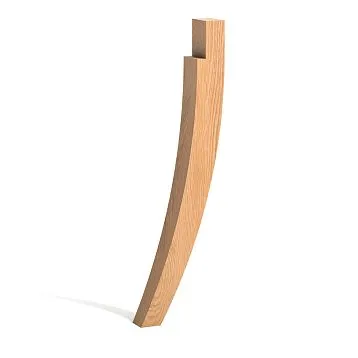
Bent handrails for spiral staircases — the pinnacle of staircase craftsmanship. Beech rail after steaming is bent in a spiral, following the trajectory of the stair flight. A bending radius of 400-600 mm is typical for spiral stairs with a diameter of 1.5-2.0 meters. Forming is done on a special template ensuring geometric accuracy.
Curved handrails for spiral staircases represent the pinnacle of staircraft mastery. After steaming, beech battens are bent into a spiral that follows the staircase's trajectory. A bending radius of 400-600 mm is typical for spiral staircases with diameters of 1.5-2.0 meters. The shaping is performed on a special template to ensure geometric precision.
Furniture production: frames and decorative elements
Furniture makers use round beech rails to create frames for chairs, armchairs, tables. A structure based on round millwork is lightweight, strong, and aesthetic. Viennese chairs — a classic example of furniture based on bent beech elements.
A typical chair frame includes 4 legs with a diameter of 25-30 mm, rails with a diameter of 20-25 mm, braces with a diameter of 15-20 mm. Joints are made with dowels reinforced with glue. Frame strength ensures a load of up to 150 kg without deformation.
Chair backs are often created from bent beech rails. The characteristic smooth shape is achieved by molding after steaming. A bending radius of 300-500 mm creates ergonomic back support, comfortable for prolonged sitting.
Furniture handles — another application of round beech. Rails with a diameter of 15-20 mm are cut into segments 120-200 mm long, ends are processed, holes are drilled for mounting screws. Beech handles are more tactilely pleasant than metal or plastic counterparts.
Interior design: decorative partitions and panels
Interior designers actively use round beech rails to create decorative compositions. Vertical or horizontal rails with a diameter of 15-25 mm and spacing of 80-120 mm form airy partitions, zoning space without solid walls.
A typical construction — vertical rails with a diameter of 20 mm, fixed between horizontal frame bars with a cross-section of 40×60 mm. Partition height 2.0-2.5 meters, width arbitrary. Rail fastening — with glue reinforced by finish nails or hidden brackets.
The light color of beech is ideal for Scandinavian style. Rails are painted white or light gray, preserving the visible wood texture. Such a partition transmits light, creates a visual connection between zones, but clearly defines spatial boundaries.
Ceiling structures made of round beech slats create a three-dimensional texture, conceal irregularities of the base ceiling, and mask utilities. Slats with a diameter of 20-30 mm are attached to a suspended frame, forming a regular or irregular structure depending on the design concept.
Musical instrument manufacturing: resonance properties
Beech is used in the production of string instrument bodies, keyboard mechanisms, and pickups. Its homogeneous, dense structure ensures predictable acoustic properties. The speed of sound propagation in beech is 4100 m/s — an optimal value for resonating elements.
Round beech slats with a diameter of 8-12 mm are used in grand piano and upright piano mechanisms — for axles, pins, and guides. High hardness ensures durability under constant friction. Dimensional stability is critical for the precision of the mechanism's operation.
Electric guitar necks are sometimes made of beech as a budget alternative to maple. Hardness and density are similar, while the cost is 30-40% lower. A beech neck is stable, does not warp, and withstands string tension without deformation.
Sports equipment: strength and elasticity
Gymnastic parallel bars, horizontal bars, and ballet barres are traditionally made from beech round stock with a diameter of 40-50 mm. The combination of hardness and elasticity provides a comfortable grip and safety during intensive training.
Ballet barre handrails are slats with a diameter of 50 mm, mounted on brackets at a height of 800-1100 mm from the floor. Requirements include perfect smoothness, absence of chips, and comfortable ergonomics. Beech meets all criteria, ensuring the longevity of the equipment.
Handles for sports equipment — jump ropes, expanders, gymnastic sticks — are often made from beech slats with a diameter of 25-30 mm. The material withstands intensive loads, does not delaminate, and does not form splinters. The surface remains smooth even after thousands of use cycles.
Production cycle: from blank to finished product
The quality of round beech is determined by the technological process, which includes many critical operations.
Raw material selection and sorting: the foundation of quality
The process begins with the selection of merchantable logs. For round stock, trunks with a diameter from 300 mm are used — straight, without knots, rot, or cracks. The tree age is 60-80 years, ensuring an optimal combination of density and structural homogeneity.
Sawing is performed using radial or semi-radial methods. Such sawing ensures maximum dimensional stability and minimal warping with humidity changes. Tangential sawing is unacceptable for round stock — high shrinkage would lead to oval cross-sections.
Blanks are sorted by quality. The highest grade — free of knots, heartwood spots, cracks, and resin pockets. The first grade allows small, sound knots up to 5 mm in diameter. The second grade contains visible defects and is used for painted products.
Chamber drying: humidity control
Freshly sawn wood contains 50-80% moisture. For stock, a moisture content of 8-12% is required. Drying is carried out in specialized chambers with a controlled climate for 2-4 weeks, depending on the cross-section of the blanks.
The drying regime for beech is gentler than for oak. Temperature is maintained at 50-60°C, air humidity is gradually reduced from 80% to 45%. A slow regime prevents cracking, preserves the wood color, and minimizes internal stresses.
Humidity control is performed using electronic moisture meters. Measurements are taken at several points on each blank. The moisture difference between the surface and the core should not exceed 2-3%. Uniformity is critical for geometric stability.
After drying, the blanks are acclimatized in a warehouse for 1-2 weeks, reaching equilibrium moisture content with the surrounding air. Skipping acclimatization leads to warping of the finished slats after several months.
Planing and calibration: creating a square cross-section
Dried boards are sawn into square bars with a cross-section 10-15% larger than the final diameter. Four-sided planers process the bars, creating a perfectly even square cross-section with a tolerance of ±0.1 mm.
The quality of planing determines the final quality of the round slat. Dull knives tear fibers, creating fuzz that cannot be completely removed by sanding. Professional manufacturers sharpen knives every 4-6 hours of operation.
Straightness control is performed visually and with measuring tools. The bar must be perfectly straight without twisting, bending, or warping. Curved blanks are rejected — it is impossible to obtain quality round stock from them.
Rounding on dowel machines: forming a cylinder
Square blanks are fed into a dowel machine — specialized equipment for producing cylindrical items. Rotating milling heads cut off the corners of the square, forming a perfect cylinder of the specified diameter.
Modern CNC machines control the diameter in real-time with an accuracy of ±0.1 mm. Laser sensors scan the profile, adjusting the feed and rotation speed of the cutters. This ensures consistent diameter along the entire length of the slat, regardless of the natural heterogeneity of the wood.
Processing speed depends on the diameter. Thin slats of 10-20 mm are processed at a speed of 8-12 m/min. Larger ones of 50-100 mm require reducing the speed to 4-6 m/min for quality processing without scorching or chipping.
Cutting tool cooling is performed with an air flow. Water cooling is unacceptable — moistening the wood would lead to warping. Effective aspiration removes chips, preventing tool clogging.
Sanding to perfect smoothness: finishing
After rounding, the rods proceed to grinding machines with cylindrical brushes covered with abrasive belts. Multi-stage grinding with abrasives of grit P120-P180-P240 creates a perfectly smooth surface.
For rods with a diameter of up to 40 mm, automatic grinding lines are used, passing the rod through a sequence of grinding heads. Productivity reaches 10-15 meters per minute with high processing quality.
Large moldings with a diameter of 50-100 mm require an individual approach. Grinding is performed on specialized machines with adjustable abrasive pressure. The operator controls the process visually, adjusting parameters for each workpiece.
Final grinding with P320-P400 abrasive creates a silky surface, pleasant to the touch. Such processing is necessary for handrails, handles, decorative elements—anything that comes into contact with hands. For hidden structural elements, P180-P240 is sufficient.
Quality control: multi-stage inspection
Each batch of finished battens undergoes multi-stage quality control. Diameter is checked with calipers at 5-10 points along the length—variation must not exceed ±0.2 mm. Straightness is verified by rolling on a flat surface—the batten must roll without wobbling.
Visual inspection reveals surface defects—chips, scratches, dents, bark remnants, resin pockets. A quality rod has uniform color, smooth surface without defects. Minor medullary rays are acceptable—they are natural for beech.
Moisture content is controlled with a pin-type moisture meter. Measurements are taken on the rod ends. The permissible range is 8-12%, deviation of more than 2% from the target value leads to batch rejection. Excessive moisture will cause shrinkage and warping after installation.
Packaging is done in shrink film in bundles of 20-50 pieces depending on diameter. The film protects against contamination, mechanical damage, atmospheric moisture during transportation and storage. Each bundle is labeled with diameter, length, grade, production date.
Installation technology for round beech rods: professional secrets
Proper installation ensures durability and reliability of structures made from round beech.
Fastening balusters with dowels: classic technology
Doweling is a traditional method for installing round balusters on staircases. A blind hole 12-15 mm in diameter and 40-50 mm deep is drilled in the baluster end. A similar hole is drilled in the tread and handrail.
A beech dowel 80-100 mm long is coated with PVA wood glue or polyurethane glue. The dowel is driven into the baluster hole to half its length with a rubber mallet. The protruding part enters the tread hole when installing the baluster.
Positioning accuracy is critical. Hole deviation from vertical by more than 1-2° will cause baluster misalignment. Use a drill press or hand drill with a level to control verticality. A plywood template with guide bushings ensures repeatability.
Glue setting time is 4-6 hours for PVA, 2-3 hours for polyurethane. Until fully cured, the baluster is secured with clamps or temporary braces. Full joint strength is achieved after 24 hours.
Metal fasteners: speed and reliability
To speed up installation, metal studs M8-M10 with threads are used. A hole 8-10 mm in diameter and 60-80 mm deep is drilled in the baluster end. The stud is screwed into the hole with epoxy glue or threaded into a pre-installed threaded insert.
A through hole 12-14 mm in diameter is drilled in the tread. The baluster is installed, the stud passes through the hole, and a nut with a wide washer is tightened from below. The connection becomes detachable, which is convenient for maintenance and repair.
For concealed fastening, threaded couplings are used. A coupling with internal thread M8-M10 is installed in the baluster end. A corresponding stud is screwed into the tread. The baluster is threaded onto the stud, and the connection is tightened from inside with a special wrench. The fastener is completely invisible from the outside.
Handrail fastening: ensuring continuity
Handrails longer than 3 meters are assembled from several sections. Joining is done with glue reinforced with a wooden or metal dowel 20-25 mm in diameter. Section ends are cut strictly perpendicular to the axis, fit must be perfect.
Coaxial holes 80-100 mm deep are drilled in the ends. A beech dowel 150-180 mm long is coated with glue, inserted fully into one hole. The second section is fitted onto the protruding part of the dowel. The joint is clamped until the glue sets.
An alternative is a metal threaded stud M12-M16. The stud is installed in one section with epoxy glue, the second is threaded onto it. The connection is tightened until the ends make tight contact. The seam is practically invisible.
Handrail fastening to balusters is done with 5×70 mm screws, driven at an angle through the handrail into the baluster end. Screw holes are pre-drilled 3 mm in diameter. Screw heads are countersunk 5-8 mm, holes are sealed with wooden plugs glued in.
Decorative rod installation: frame method
Decorative rods 15-30 mm in diameter are fastened to a wooden or metal frame. The frame is mounted to the wall or ceiling, rods are fixed to the frame. Such a design provides a ventilation gap and allows replacement of individual elements.
A wooden frame made of 40×40 mm battens is attached to the wall with 8×60 mm anchors spaced 400-500 mm apart. Battens are placed perpendicular to the rods—for vertical rods, the frame is horizontal. Frame batten spacing is 400-600 mm.
Rods are fastened to the frame with finishing nails 1.5×40 mm, driven at a slight angle. The nail head is countersunk 1-2 mm, becoming almost invisible. An alternative is 3×30 mm screws with pre-drilled 2 mm diameter holes.
Concealed fastening with clips provides a perfectly clean surface. A groove 5-8 mm deep is routed on the back of the rod, where a metal clip plate is inserted. The clip is fastened to the frame, the rod is fitted onto the clip with its groove. The fastener is completely invisible.
Finishing Treatment of Beech Dowels: Protection and Aesthetics
Proper finishing treatment ensures durability and highlights the beauty of beech.
Oils and waxes: natural protection
Oil-wax compositions based on linseed oil and beeswax are a traditional treatment for beech. The oil penetrates the wood structure to a depth of 2-5 mm, strengthens the surface layer, and emphasizes the grain. The wax creates a protective film that repels moisture and dirt.
Application is done with a brush or pad in 2-3 coats with intermediate drying of 8-12 hours. The first coat is absorbed completely, not forming a film. The second creates a matte surface. The third enhances protection and creates a light silky sheen.
Each coat is sanded with P320-P400 abrasive to remove raised fibers. After the final coat dries, the surface is polished with a soft cloth to a light sheen. Oil-treated wood retains its tactile feel and remains pleasant to the touch.
Coating renewal is required every 12-18 months depending on the intensity of use. The surface is cleaned, a thin coat of oil is applied, and it is polished. The process takes 1-2 hours and does not require special skills.
Varnishes: Durable Protection
Varnish coating creates a strong protective film on the wood surface. Water-based acrylic varnishes are eco-friendly, dry quickly, and are odorless. Application in 2-3 coats creates a matte or semi-matte surface with a pleasant texture.
Polyurethane varnishes provide maximum wear resistance. They are resistant to abrasion, moisture, household chemicals, and mechanical impacts. Used for stair handrails, balusters, furniture — elements with intensive contact.
Varnish application requires thorough surface preparation. The wood is sanded with P240-P320 abrasive, dust is removed, and primer is applied. After the primer dries (2-4 hours), the first coat of varnish is applied, drying for 4-6 hours, intermediate sanding with P400, then the second coat.
The final coat is applied in a thin, even layer without drips. The quality of application determines the appearance. Use high-quality brushes with natural bristles or a spray gun for flawless results.
Staining: Color Solutions
Staining allows adapting beech dowels to any color palette. Preliminary tinting with stains creates rich shades from light honey to dark chocolate, while preserving the visibility of the wood grain.
Water-based stains are eco-friendly, easy to apply, and dry quickly. Application with a brush or pad in 1-2 coats until the desired color intensity is achieved. After the stain dries, the wood is sanded with P320 to remove raised fibers.
Opaque enamels completely hide the wood grain, creating a uniform colored surface. Used for modern interiors where color concept is important. Water-based acrylic enamels are eco-friendly; polyurethane enamels are more wear-resistant.
Staining is performed in 2-3 coats with intermediate drying and sanding. The first coat is a primer, leveling absorbency. The second is the base, creating the main color. The third is the finish, providing color depth and protection.
STAVROS Company: A Professional Partner for Working with Beech
STAVROS Company is a leading Russian manufacturer of solid beech round moldings since 2002. Production facilities are equipped with the latest generation European equipment, ensuring perfect quality for each product.
The range includesround birch planksall standard diameters from 10 to 100 mm. Standard lengths are 2000, 2500, 3000 mm; any sizes up to 6000 mm are manufactured to order. Wood moisture is strictly controlled at 8-12%, ensuring geometric stability.
Quality is confirmed by certificates of conformity, sanitary-epidemiological reports, and test protocols. Each batch undergoes multi-stage control, guaranteeing the absence of defects. All products come with a 12-month manufacturer's warranty.
A wide stock program ensures shipment of popular items on the day of request. Own warehouses in Moscow and St. Petersburg with constant availability of common diameters. Delivery across all of Russia by transport companies with cargo safety guarantee.
For professionals — stair craftsmen, furniture makers, construction companies, interior designers — a loyalty program is available. Individual terms, priority production of non-standard diameters, technical project support, assistance in material calculations.
Production capabilities allow manufacturing custom non-standard diameter round moldings to order. Minimum order — from 100 linear meters. Production time is 10-14 working days depending on order volume and complexity.
STAVROS consultants possess deep expertise in the field of round moldings. They will help select the optimal diameter for specific tasks, calculate the exact amount of material, and provide recommendations for installation and treatment. Call toll-free 8 (800) 555-46-75.
Showrooms are open for visits. Samples of all diameters are presented here; you can assess the quality of processing and compare various finishing options. Experienced specialists will provide consultation and help with your choice.
By orderingbuy wooden round dowelfrom STAVROS, you choose proven quality, confirmed by thousands of successful projects. Material that will last for decades, preserving strength and beauty. A partner you can rely on to realize the most ambitious ideas.
Create reliable, durable structures with round beech moldings from STAVROS! Implement professional projects where material quality determines success. Trust a proven manufacturer with an impeccable reputation. Start working with the best materials today!