












































































Article Contents:
- Anatomy of Round Molding: More Than Just a Cylinder
- Diameter: From Thread to Log
- Length: Solid and Joined
- Surface Treatment: From Rough to Polished
- Wood Species: Character in a Cylinder
- Functional Versatility: Where Round Moldings Work
- Structural Elements: When Molding Bears Weight
- Decorative Elements: When Molding Creates Beauty
- Furniture Elements: Functionality and Aesthetics
- Creative and Hobby Projects: Material for Idea Realization
- Stylistic Adaptation: Round Molding in Different Interiors
- Scandinavian Minimalism: Light and Simplicity
- Japanese Minimalism: Zen Geometry
- Loft: Industrial Honesty
- Country and Rustic: Rural Simplicity
- Classical and Neoclassical: Elegant Precision
- Modern minimalism: geometric purity
- Eco and Biophilic Design: Nature in the Home
- Technological aspects: from production to installation
- Production: How Wood Becomes a Cylinder
- Installation: How to Secure Round Molding
- Treatment and Care: How to Preserve Beauty
- Protection from external factors
- Maintenance and care
- Trends 2026: Where Round Molding is Heading
- Diameter Combinations: Rhythmic Complexity
- Gradient Coloring: Color Transitions
- Technology Integration: Smart Moldings
- Biopositive Materials: Certification and Transparency
- Hybrid Constructions: Wood + Other Materials
- Practical Questions and Answers
- Conclusion: The Circle as an Archetype of Universality
- STAVROS: Mastery of Round Molding

There are shapes that seem too simple to be interesting. Square. Rectangle. Circle. First-grade geometry, basic elements from which everything begins. But it is in this simplicity that universality is hidden.wooden round batten— not just a cylindrical piece of wood. It is an archetype, a form that the human hand holds naturally, that the eye perceives softly, without the aggression of corners. It is a tool that works everywhere: in interiors as a decorative element, in furniture as a structural component, in architecture as a functional element, in creativity as a material for realizing ideas.
The year 2026 returns us to fundamental forms. After decades of experimenting with broken lines, asymmetry, and deliberate complexity, design seeks a fulcrum in basic elements. The circle is one such point.Round-section moldingdoes not shout about itself. It exists, performs a function, creates visual and tactile harmony. In an era of visual noise, where every surface demands attention, round molding offers calm, clarity, honesty of material and form.
What makes the cylindrical shape so universal? The absence of a preferred orientation. Square or rectangular molding has a top, bottom, sides — its position in space is always fixed. Round molding is the same from all sides — it can be rotated, turned, mounted at any angle without changing the visual effect. This is freedom of application, flexibility of use.
The tactility of the round shape is exceptional. The hand glides over the smooth cylindrical surface without snags, irregularities, or sharp edges. Psychologically, this creates a feeling of comfort and safety. It is no coincidence thatWooden handrails for stairsare always round in section — a shape optimal for gripping, distributing pressure evenly across the palm. Round molding is ergonomics embedded in geometry.


Anatomy of round molding: more than just a cylinder
When we say 'round molding,' we imply a wooden cylinder of constant diameter along its entire length. But behind this simplicity lies a variety of parameters that determine its application.




Diameter: from thread to log
The range of diameters for round molding is vast — from miniature six millimeters to monumental two hundred. Each size range has specific applications.
Thin moldings 6-12 mm — these aretrim, dowels, decorative elements. Used for fixing glass in frames, as dowels in joinery connections, for creating small decorative grilles. Flexible, easily bent to small radii, cut with ordinary tools.
Medium moldings 15-30 mm — a universal size range. Used for creating decorative partitions, rods in cabinets, furniture elements (table and chair legs, bed headboards), gazebo railings, elements of children's play complexes. Strong enough for structural functions, light enough for decorative ones.
Large moldings 40-60 mm — these arestair railings, fence posts, canopy supports, massive decorative elements. The optimal diameter for hand grip — 45-50 mm. The hand fully encircles such a molding without strain, distributing weight evenly.
Posts 80-200 mm — support columns for verandas, gazebo posts, decorative pilasters in interiors. These are no longer moldings, but small-scale architecture. Massiveness, solidity, structural necessity.
The choice of diameter is determined by function. A decorative element can be of any diameter — the visual proportion to the surrounding space is important. A structural element is calculated for load — diameter determines strength, the ability to withstand weight, bending, torsion.
Our factory also produces:


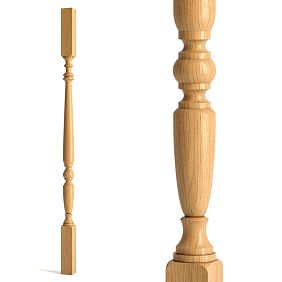

Length: solid and spliced
The standard length of round molding from solid wood is two to three meters. This is limited by the size of the raw material (the length of the log from which the molding is milled). For longer products, splicing is used — joining short segments into a long molding.
Solid wood — visually and structurally preferable. No joints, no visual breaks in the grain, maximum strength. But length is limited. For projects requiring moldings up to three meters, solid wood is optimal.
Spliced wood — allows obtaining moldings up to six meters long or more. Short segments are joined with a tenon joint using waterproof glue, the joint area is sanded smooth. With quality execution, the joint is practically invisible visually (grain is matched), the strength of the joint is comparable to solid wood. Used for long stair handrails, canopy crossbars, elements where significant length is required.
The choice between solid and spliced is a compromise between aesthetics and practicality. For visible decorative elements, where the molding is viewed up close — solid wood is preferable. For functional elements, where length is important — spliced is quite appropriate.
Get Consultation
Surface treatment: from rough to polished
The degree of surface treatment of round molding varies from rough (visible milling marks) to polished (mirror smoothness).
Rough treatment — molding after milling without additional sanding. The surface is relatively even, but fine scoring, irregularities are felt. Used for technical purposes (frames, invisible structural elements), for projects in a rustic style, where deliberate roughness is part of the aesthetic.
Sanded surface — the molding has been sanded with medium-grit sandpaper (120-180 grit). The surface is smooth to the touch but retains visible wood grain. Standard treatment for most applications.
Polished surface — multi-stage sanding (from 180 to 400 grit), sometimes polishing with felt wheels and paste. The surface is silky, almost glossy even without varnishing. Used for elements frequently touched by hand (handrails, furniture handles), for decorative elements where visual refinement is important.
Finish coating (oil, wax, varnish) is applied after sanding. Oil and wax soak into the wood, emphasize the grain, preserve tactility. Varnish forms a protective film, can provide gloss, but makes the surface less tactilely pleasant. Paint completely hides the grain, turning the molding into a colored cylinder.
Wood species: character in a cylinder
The choice of wood species determines the visual (color, texture) and physical (hardness, weight, moisture resistance) properties of the round batten.
Pine is the most affordable wood species. Light-colored wood with contrasting texture, soft, easy to work with. Its resinousness protects against moisture but requires special preparation before painting (deresination). Pine batten is the choice for budget projects, technical applications, and garden structures. Disadvantage — low hardness, prone to dents.
Birch is a light, uniform wood. Creamy-white color without pronounced annual rings, fine-grained structure. Hardness is higher than pine but lower than oak. Birch batten is versatile — suitable for interior projects, furniture, decorative elements. Takes paint and stain well. Disadvantage — hygroscopic, requires protection from moisture.
Beech is a light, fine-grained wood with a pinkish tint. High hardness makes beech batten wear-resistant. Excellent for bending after steaming — used for curved furniture elements. Takes paint, stain, and patina well. Disadvantage — sensitive to humidity fluctuations, requires stable conditions.
Oak is the classic of strength. Dark wood with pronounced texture, very hard, heavy, noble. Oak batten is massive, solid, lasts for decades. Resistant to moisture, mechanical damage, pests. Used for stair handrails, premium-class furniture elements, architectural details. Price is 2-3 times higher than pine, but reputation and durability justify it.
Ash is a strong, light-colored wood. Expressive texture, fibers are clearly visible, creating a wavy pattern. Hardness comparable to oak, but color is lighter. Ash batten is the choice for those who want the strength of oak without its dark color. Handles loads well, does not deform.
Larch is a coniferous species with unique properties. Density and hardness are higher than pine, approaching those of deciduous species. High resin content makes larch exceptionally resistant to moisture, rot, and pests. Used for outdoor structures, elements in contact with water (handrails on terraces by pools, pier railings). Color ranges from yellow-brown to reddish-brown.
Walnut is premium luxury. Color ranges from milk chocolate to dark brown with almost black veins. Complex, marble-like texture, each batten is unique. Walnut is hard, processes excellently, holds details. Used for exclusive projects — handmade furniture, decorative elements for luxury interiors. Price is 4-5 times higher than pine.
Functional versatility: where round battens work
The cylindrical shape is so versatile that round battens are used practically everywhere — from construction to crafts.
Structural elements: when the batten bears weight
Stair handrails — the most common application of round molding with a diameter of 45-50 mm. The shape is ideal for hand grip, distributes pressure evenly, prevents palm fatigue during prolonged contact. Material — hardwoods (oak, ash, beech) that withstand constant loads and do not wear down from thousands of touches.
Balusters — vertical posts in stair, balcony, and veranda railings. Roundbalustersbalusters are easier to manufacture than carved figured ones but create a clear rhythm and elegant simplicity. A diameter of 30-40 mm ensures structural strength and visual proportionality.
Support posts — for canopies, gazebos, terraces. Round posts with a diameter of 100-150 mm withstand significant vertical loads and are resistant to lateral impacts (wind). The shape is streamlined, does not retain snow, and minimizes wind load.
Crossbars and braces — horizontal elements of frame structures. Round cross-section is optimal for handling bending loads — strength is uniform in all directions, with no weak axes (unlike rectangular cross-section).
Closet rods — bars for hangers. A round wooden rod with a diameter of 25-30 mm supports the weight of dozens of kilograms of clothing, and hangers slide freely on the smooth surface. Aesthetically, wood surpasses chrome-plated pipe — warmth, naturalness, compatibility with classic and eco-interiors.
Decorative elements: when the batten creates beauty
Partitions and screens — vertical or horizontal battens installed at intervals create semi-transparent structures. They zone space without completely isolating it. Light and air pass through the gaps, but the zones are visually separated.Round battens in interiorcreate a soft rhythm without the aggression of rectangular slats.
Decorative wall panels — compositions of round battens arranged parallel or in complex geometric patterns. Create volumetric texture, play of light and shadow. Especially effective with side lighting — each batten casts a shadow, creating depth.
Ceiling structures — suspended ceilings made of round battens with gaps. Conceal engineering utilities (ventilation, wiring), create architectural expressiveness. Spotlights and acoustic systems are installed between the battens. Effect of airiness, visual lightness despite wooden massiveness.
Frames and borders — round battens are used as frames for mirrors, paintings, decorative panels. The shape is more delicate than traditional flat moldings, creating a soft transition between the image and the wall.
Lattices and screens — decorative structures made of round battens arranged at an angle, intersecting, forming geometric patterns. Used for screening radiators (conceal utility, allow convection), creating decorative screens, and designing built-in cabinet facades.
Curtain rods — round wooden batten with a diameter of 25-35 mm with brackets and rings. A classic solution for heavy drapes. Wood supports the weight of fabric without sagging, and rings slide smoothly on the polished surface. Visually more solid than metal and plastic rods, creates classic elegance.
Furniture elements: functionality and aesthetics
Table and chair legs — round turned legs are a classic of furniture design. From simple cylindrical to complex ones with thickenings, collars, decorative grooves. Round cross-section ensures even load distribution and stability in all directions.
Chair and bed backs — horizontal and vertical battens forming the frame. Round battens are comfortable for the back (no sharp edges), create visual lightness (transparency of the structure), characteristic of Scandinavian and country styles.
Bed rails — round battens framing the perimeter of children's beds, creating a safe enclosure. Smooth surface without sharp corners minimizes the risk of injury.
Hooks and holders — wall-mounted coat racks made from round dowels with hooks. Towel holders for bathrooms. Kitchen towel and pot holder racks. The simplicity of form makes these elements universal, suitable for any style.
Open shelving elements — vertical posts or horizontal crossbars made of round rods. Create a graphic, lightweight structure that visually doesn't overload the space. Characteristic of loft and industrial interiors.
Creative and hobby projects: material for implementing ideas
Picture and photo frames — round dowels as an alternative to traditional flat moldings. They create unconventional framing, soft and voluminous. They look especially interesting in gallery-style arrangements with many frames of different sizes.
Macramé and weaving — horizontal round dowels as a base for wall panels in macramé technique. Threads are attached to the dowel and woven downward, creating textile compositions. The wooden dowel adds naturalness and contrast with the textile.
Suspended structures — mobiles, hanging shelves, swings. Round dowels can withstand hanging, distribute load, and are visually light. Children's swings made from smooth wooden dowels are safer than metal chains.
Children's toys and furniture — round dowels as a structural material for homemade toys (rocking horses, blocks, construction sets), children's furniture (tables, chairs, coat racks). The eco-friendliness of wood, absence of sharp edges, and tactile pleasantness are all critical for children's products.
Garden structures — trellises for climbing plants, tomato supports, decorative lattices for zoning the area. Round dowels made from larch or treated pine last for years outdoors, create a natural look, and don't visually conflict with garden greenery.
Pergolas and gazebos — load-bearing beams and decorative elements made from large round dowels (80-120 mm). They create characteristic cylindrical architecture, referencing classical colonnades but in a modern interpretation.
Stylistic adaptation: round dowels in different interiors
The versatility of the round form allows it to exist in any style, adapting through material, treatment, and color.
Scandinavian minimalism: light simplicity
Scandinavia values functionality, naturalness, and lightness.wooden round battenRound dowels made from light wood species (birch, pine, ash) with a natural finish or painted white are the perfect element.
Application is restrained — a partition made of vertical dowels between the hallway and living room, a wall-mounted coat rack made from round dowels, table and chair legs. Medium diameters (20-30 mm), simple forms without decorative thickenings. The effect — lightness, airiness, functional beauty.
Japanese minimalism: zen geometry
Japanese philosophy values emptiness, simplicity, and naturalness. Round dowels are used to create screens (shoji — traditional sliding partitions), decorative lattices, frames for low furniture.
Wood species — light (birch, maple) with a natural finish. Small diameters (15-25 mm), creating elegance and visual thinness. Orientation is often vertical or horizontal without diagonals — calmness, orderliness. The effect — meditativeness, contemplativeness, harmony of emptiness and form.
Loft: industrial honesty
Loft values openness of structures, honesty of materials, contrast of textures. Here, round dowels are massive (40-60 mm), made from dark wood species or aged light wood.
Application — open shelving with round posts, partitions made of thick dowels with wide gaps, furniture with rough cylindrical legs. Treatment is deliberately simple — the texture is visible, traces of processing and knots are possible (as an element of naturalness). Coating — oil or wax, emphasizing the wood, or painting in industrial colors (graphite, rust, patina).
The effect — brutality, materiality, contrast of warm wood and the cold concrete/metal of the surrounding space.
Country and rustic: rural simplicity
Rural style values craftsmanship, naturalness, coziness.Round-section moldingRound dowels here often retain knots, have uneven texture, and simple processing.
Application — furniture frames (tables, benches, chairs with round legs), coat racks, porch railings, gazebo elements. Wood species are accessible (pine, spruce), treatment is simple (medium-grit sanding), coating preserves naturalness (oil, wax, stain in natural tones).
The effect — warmth, homeliness, connection to craft traditions, respect for the simplicity of the material.
Classical and neoclassical: elegant precision
Classicism requires proportionality, symmetry, and quality execution. Here, round dowels become turned columns, balusters with decorative turnings, handrails with perfect sanding.
Wood species are noble (oak, beech, walnut), treatment is impeccable (multi-stage sanding, polishing), coating can be natural (emphasizing the wood) or painted (white, cream, with patination, gilding on protruding elements).
Application — staircase handrails with decorative balusters, columns in fireplace portals, elements of classical furniture, cornices for heavy curtains. The effect — solidity, respectability, connection to architectural traditions.
Modern minimalism: geometric purity
Minimalism values simplicity of form, absence of decoration, and functional beauty. The round batten is the perfect element: maximally simple geometry, without embellishments.
Application — partitions made of thin battens (15-20 mm) with a sparse rhythm, creating graphic lines without bulkiness. Hangers, shelves, furniture elements made from round battens painted in monochrome colors (white, black, gray). Wood species do not matter (the texture is hidden by paint), geometric precision is important.
Effect — visual lightness, purity of lines, functionality without excess.
Eco and biophilic design: nature in the home
The ecological style seeks to maximize the presence of natural materials and create a connection with nature. Round battens here are one of the main elements, imitating branches, trunks, and natural forms.
Application — partitions made of battens of different diameters, imitating a grove (vertical battens of varying thickness and height). Furniture made from roughly processed battens with preserved knots, irregularities, and natural bends. Supports for climbing plants in the interior — battens become part of the living decor.
Any wood species with natural finish that emphasizes the texture. Combining different colored species in one structure is possible, mimicking forest diversity. Effect — organic quality, connection with nature, feeling of being in a natural environment.
Technological Aspects: from Production to Installation
The quality of a round batten is determined by the entire chain — from wood selection to the finishing treatment.
Production: how wood becomes a cylinder
Raw material selection — blanks from solid wood with square or rectangular cross-section. Uniform moisture content is important (8-10% for interior use, 12-14% for exterior), absence of large knots, cracks, rot, pest damage.
Milling — the square blank is processed on a round dowel machine or a four-sided milling machine with circular knives. The blank rotates, the knives cut off the corners, forming a cylinder. Modern CNC machines ensure perfect roundness along the entire length — deviation no more than 0.1 mm.
Sanding — primary sanding on a machine removes milling marks and creates a basic smoothness. For elements requiring high quality (handrails, furniture parts), hand sanding is performed — the batten is sanded by hand with sandpaper of sequentially increasing grit (from 120 to 320-400 grit). This is labor-intensive but creates a silky surface.
End trimming — cutting the ends at a right angle, removing defective sections. Ends must be smooth and perpendicular to the batten axis — a crooked end will create problems during joining.
Finishing treatment — application of a protective-decorative coating. Oil penetrates the wood, emphasizes the texture, preserves tactility. Wax creates a matte silky surface. Varnish forms a protective film, can be matte or glossy. Paint completely hides the texture, creates a uniform color.
Quality production requires control at every stage. Checking wood moisture, controlling geometry after milling, visual inspection after sanding, testing the coating on a small area before applying to the entire batch.
Installation: how to fix a round batten
The fastening method depends on the function of the batten and the installation location.
For structural elements (handrails, balusters, supports) — rigid fastening that withstands loads. Used:
-
Tenon joints — a tenon (protrusion) is cut on the end of the batten, a mortise (recess) is made in the receiving element. The tenon enters the mortise with glue, creating a strong joint. Classic joinery technique, reliable, aesthetic (fasteners are not visible).
-
Metal brackets — special holders for round battens, fastened to the wall/floor/ceiling with screws. The batten is inserted into the bracket and secured with a screw. Quick installation, possibility of disassembly, but brackets are visible (suitable for loft and industrial styles where visible fasteners are part of the aesthetic).
-
Flanges — round metal or wooden discs with a hole in the center. The flange is fastened to the base (floor, ceiling), the batten is inserted into the hole and secured with a side screw or glue. Creates a decorative framing of the batten end.
For decorative elements (partitions, screens, panels) — less loaded fastening, aesthetics are important.
-
Hidden mounting on a frame — first, a frame is created from horizontal or vertical battens, then the round battens are fastened to the frame. Fastening from the back side (screws, nails are driven through the frame into the batten), fasteners are not visible from the outside.
-
Adhesive mounting — battens are glued to the base (wall, panel) with special adhesive (construction adhesive, polyurethane adhesive, epoxy for heavy elements). Fast, aesthetic (no visible fasteners), but not removable.
-
Decorative fasteners — battens are fastened with visible elements that become part of the decor. Leather straps wrapping around the batten and fastened to the wall. Metal clamps (copper, brass) at certain points. Ropes, cords suspending horizontal battens.
For furniture elements — precise joinery joints.
-
Tenon (dowel) joints — a round tenon (dowel) on the end of the batten enters a round hole in the receiving element. Strong, precise, aesthetic.
-
Dowelled joints — wooden round pins (dowels) connect the batten with other elements. Holes are drilled in both parts, the dowel is inserted with glue into both holes, creating a connection invisible from the outside.
Installation precision is critical. An unevenly installed batten catches the eye and ruins the composition. Levels, plumb bobs, laser levels are used to control verticality/horizontality.
Treatment and care: how to preserve the beauty
Wooden dowel is a living material that requires proper handling.
Protection from external factors
Moisture is wood's main enemy. Round dowels in rooms with normal humidity (40-60%) last for decades without issues. In high-humidity rooms (bathrooms, kitchens, saunas), special protection is required—moisture-resistant species (oak, larch, teak) and coating with yacht varnish or water-repellent oils.
For outdoor structures, impregnation with antiseptics (protection against fungi, mold, insects) and hydrophobic compounds (repelling water) is mandatory. Without protection, wood outdoors darkens, cracks, and rots within 2-3 years. With protection, it lasts 10-15 years.
Ultraviolet—sunlight fades wood, destroying lignin (the binding substance of fibers). Natural wood grays, painted wood fades. Protection—varnishes with UV filters, oils with UV protection. For outdoor structures—awnings, canopies that minimize direct sun exposure.
Mechanical damage—round shape is less vulnerable to impacts (no sharp edges that chip easily), but dents and scratches are possible. Hardwoods (oak, ash) are more resistant than softwoods (pine, linden). For elements subject to intensive contact (handrails, furniture parts), hardwoods and durable coatings (varnish, hard oil) are preferred.
Care and Maintenance
Regular cleaning—wipe with a dry or slightly damp soft cloth to remove dust. Do not use abrasive sponges (scratch the surface) or aggressive cleaning agents (damage the coating).
Coating renewal—oil and wax require periodic renewal (every 1-2 years for interior elements, annually for outdoor). Old coating is lightly sanded with fine sandpaper (320-400 grit), a new layer is applied. Varnish lasts longer (3-5 years) but requires complete removal during renewal (sanding or chemical stripping).
Repairing damage—minor scratches are sanded with fine sandpaper and coated with appropriate compound. Dents in softwoods can be 'pulled out' by steaming (damp cloth on the damage, hot iron on top—fibers swell, dent evens out). Deep damage is filled with wood putty matching the tone, sanded, and coated.
Room humidity control—sudden humidity fluctuations (dry from heating in winter, humid in summer) cause wood to swell/shrink, creating stress and cracks. Maintaining stable humidity of 40-60% (humidifiers in winter, dehumidifiers in summer if needed) extends the life of wooden elements.
Trends 2026: Where Round Molding is Heading
Diameter combination: rhythmic complexity
Moving away from monotony of identical dowels. Compositions of round dowels of different diameters in one structure—thin (15 mm) alternating with thick (40 mm), creating visual dynamics, irregular rhythm. Imitation of a natural forest, where tree trunks vary in thickness.
Gradient coloring: color transitions
Dowels in one structure are painted in shades of one color, smoothly transitioning into each other. For example, vertical dowels of a partition: dark blue at the bottom, gradually lightening towards the top, becoming light blue. Creates a color gradient effect, visual depth, artistry.
Technology integration: smart dowels
LED lighting built inside hollow round dowels. The dowel becomes a linear lamp—light exits through the ends or through milled holes along the length. Motion sensors activate lighting upon approach. Tactile sensors on handrails turn on staircase lighting.
Acoustic systems integrated into large-diameter round dowels (80-100 mm with internal cavity). The dowel becomes a speaker, creating immersive sound without visible speakers.
Biophilic materials: certification and transparency
Buyers demand proof of eco-friendliness. FSC wood certification becomes mandatory. Coatings only water-based, without VOCs, with full disclosure of composition. Transparency of the entire chain—from logging to finishing.
Use of reclaimed wood (reclaimed from old buildings) valued for unique patina, history, and eco-friendliness of reuse.
Hybrid structures: wood + other materials
Round wooden dowels combined with other materials in one structure. Wooden dowels with metal (aluminum, copper, steel) rods—contrast of warm and cold. Wooden dowels with transparent acrylic rods—play of opaque and transparent, matte and glossy.
Wooden dowels with textile elements (ropes, straps, fabrics stretched between dowels)—combination of hard and soft, creating tactile and visual diversity.
Practical questions and answers
How much do round wooden dowels cost?
Price depends on species, diameter, length, processing. Pine dowels 20 mm diameter, 2 meters long, untreated—from 80-120 rubles each. Beech 30 mm, sanded—200-300 rubles. Oak 50 mm, polished with oil coating—800-1200 rubles. Walnut exclusive—2000+ rubles.
Can round dowels be bent?
Yes, but depends on species, diameter, bend radius. Thin dowels (up to 15 mm) of softwoods (pine, linden) bend to small radii cold. Thicker or hardwoods require steaming or soaking—wet wood becomes pliable, bends, retains shape after drying. Beech is especially good for bending. For complex radii, special technologies are used (lamination—gluing thin layers on a form).
What makes round dowels better than rectangular ones?
Ergonomics—round dowel is more comfortable to hold. Orientation versatility—can be rotated without changing appearance. Visual softness—no aggressive corners. Uniform strength—equal in all directions. But rectangular ones are easier to mount (have flat surface for attachment), often cheaper (less waste in production).
Is it suitable for outdoor use?
Yes, with the right choice of wood species and treatment. Larch is the best choice (high resin content, rot resistance). Oak is also good (hardness, density). Treatment with antiseptics and hydrophobic impregnations is mandatory. Regular renewal of the coating (every 1-2 years) extends the service life.
How to choose the diameter for a stair handrail?
The optimal diameter for an adult is 45-50 mm. The hand fully wraps around such a handrail, comfortably, without strain. For children, a smaller diameter (30-35 mm). A handrail that is too thin (less than 30 mm) is uncomfortable; the hand cannot fully grasp and lean on it. One that is too thick (more than 60 mm) requires finger strain, leading to quick fatigue.
Can a round batten be made independently?
Difficult without special equipment. Milling a cylinder requires a dowel-making machine or a router with cylindrical cutters. You can roughly process a square blank with a plane, removing the corners, then sand for a long time by hand, but the result will be far from factory-made. It's wiser to buy ready-made battens — the price is not high, quality is guaranteed.
How to join round battens at an angle?
More difficult than rectangular ones. The ends are cut with a miter saw at the required angle (usually 45 degrees for 90-degree corners). But a cylindrical cut at an angle is an ellipse, resulting in a loose joint. The solution is to use corner connectors (metal or wooden elements of a special shape into which the batten ends are inserted) or to make mortise and tenon joints with fitting.
Does the diameter change with humidity?
Yes, wood is hygroscopic — it absorbs moisture, swells, releases it — and shrinks. The diameter can change by 2-5% with humidity fluctuations. Therefore, kiln drying to equilibrium moisture content (8-10% for interior use) is critical — a properly dried batten in stable conditions practically does not change size.
Are wooden battens eco-friendly?
Maximally. Wood is a renewable natural material, biodegradable, and does not release toxins. When choosing, pay attention to FSC certification (responsible forest management) and eco-friendly coatings (natural-based oils and waxes, water-based varnishes without VOCs).
How to distinguish a quality batten?
Visually — an even cylinder without ellipticity (when viewed from the end, a circle, not an oval), a smooth surface without scoring or waves, clean ends without chips. Tactilely — pleasant smoothness, absence of roughness. Geometry check — the batten should roll on a flat surface without wobble, rotate in the hands evenly. A quality batten has stable moisture content (measured with a moisture meter) — 8-12% for interior use.
Conclusion: The circle as an archetype of universality
The circle is the first form mastered by humanity. The wheel, pot, hoop — the cylinder and sphere lie at the foundation of civilization.wooden round batten continues this tradition, combining the archaic simplicity of form with modern production technologies.
What makes a round batten indispensable? Functional universality. It works everywhere — from a child's toy to a load-bearing column, from a decorative panel to a stair handrail. The material is one, the form is one, but the applications are hundreds. It is a tool that adapts to the task, not a task forced to fit the tool.
Tactile harmony. In a world of sharp corners, aggressive shapes, synthetic surfaces, touching a smooth wooden cylinder is a return to the natural. The hand remembers this form at a genetic level — the tree branch held by ancestors for millions of years. This memory creates comfort, psychological safety.
Visual neutrality. A round batten does not shout about itself. It exists as an element of composition, plays its role without drawing attention. In an era of visual overload, this restraint is a value. An interior built on round battens is calm, balanced, not tiring.
Ecological honesty. Wood in a cylindrical form remains wood — the texture is visible, the warmth is felt, the scent is present. No imitation, no pretense. This is the authenticity of the material, which is becoming a rarity in a world of plastics and laminates.
The year 2026 confirms: round wooden millwork has not become obsolete and will not. A form that has existed for millennia is not subject to fashion. It is fundamental, like the circle, square, triangle.Round-section molding will be in demand as long as wood exists as a material and humans as creators of spaces.
STAVROS: The craftsmanship of round millwork
When choosing wooden elements, the manufacturer is critical.Round wooden batten buy can be done anywhere, but quality determines everything — from geometric precision to durability.
STAVROS has been working with wood for 23 years. This is not just a number — it is accumulated expertise, refined technologies, a deep understanding of the material. Participation in the restoration of historical sites (Konstantinovsky Palace, Hermitage, Alexander Palace) required reproducing historical elements with museum precision. This experience is directly transferred to the production of modern millwork.
Production capabilities — high-precision dowel-making machines mill battens with diameters from 6 to 200 millimeters. Diameter deviation along the length is no more than 0.1 mm — a perfect cylinder. Sanding equipment creates a smoothness ready for use without additional processing or for final coating.
Quality control begins with raw materials. Wood only with FSC certification. Kiln drying to 8-10% moisture content. Geometry control after milling — each batten is checked for roundness, absence of ellipticity. Visual control after sanding — scoring, waves, and unevenness are not allowed.
The assortment covers all needs. Diameters range from thin glazing beads of 8 mm to massive posts of 150 mm. Lengths are standard (2-3 meters) and custom (joined solid wood up to 6 meters). Species range from budget pine to premium oak, ash, and walnut. Finishes include untreated (for self-finishing), sanded, polished, oiled/varnished, and painted.
Custom manufacturing — non-standard diameters, special finishes, turned elements with decorative swellings and waists. Production capabilities allow for the realization of complex designer projects.
Comprehensive approach — round dowels, rectangular profiles, moldings, baseboards, casings, handrails, balusters — all from the same wood, with the same finish. Guarantee of color and texture matching when assembling a project.
Stock program — popular diameters and species are available in warehouses in Moscow and St. Petersburg. Order today — receive tomorrow. This is critical for urgent projects.
Delivery across Russia — packaging protects the dowels during transport. Long dowels are packed in wooden crates to prevent bending and breakage. Dowels arrive in perfect condition.
Consultation support — assistance in choosing the diameter for a specific application, calculating the required quantity, recommendations for installation, finishing, and care. If difficulties arise — phone consultation to find a solution.
Loyalty program — special terms for designers, architects, furniture makers, and construction companies. Volume discounts, priority production, access to new developments.
Environmental responsibility — FSC-certified wood, water-based finishes, waste-free production (waste is used for fuel briquettes). Every stage considers environmental impact.
Choosinga round wooden railfrom STAVROS, you don't just get a wooden cylinder. You get the result of 23 years of experience, the embodiment of quality standards, geometric precision, and respect for the material and the customer. Every dowel is a fragment of your project, be it a staircase, furniture, a decorative partition, or a creative realization.
Create spaces that last for decades. Choose materials that are honest in their simplicity. LetRound battens in interiorfrom STAVROS become the tool for realizing your ideas — functional, decorative, creative. A circle has no beginning or end. Similarly, the application possibilities for round dowels are endless — limited only by imagination.


