Article Contents:
- Classification of round elements: from function to form
- Ceiling Rosettes: Framing Light
- Wall medallions: vertical accents
- Decorative circles: modular systems
- Oval elements: circle in motion
- Ornamental systems of round elements: from center to edge
- Concentric belts: classic scheme
- Radial rays: dynamics and centripetality
- Floral garlands: naturalism and lushness
- Geometric patterns: order and strictness
- Combination of round and rectangular elements: dialogue of forms
- Circle in square: classic composition
- Square in circle: reverse logic
- Circles at rectangle corners: accenting intersections
- Alternation of circles and rectangles in borders
- Size selection: diameter according to room
- Ceiling rosettes: calculation formula
- Wall medallions: panel proportions
- Decorative circles: modularity and spacing
- Installation of round elements: mounting technology
- Installation of ceiling rosette around chandelier
- Installation of wall medallion
- Installation of decorative circles on doors or furniture
- Creating compositions: symmetry and asymmetry
- Symmetric compositions: classic harmony
- Asymmetric compositions: modern dynamics
- Painting and Decorating: From Monochrome to Gold
- Monochrome: circle in base color
- Contrast: white circle on colored background
- Gilding: Palace Luxury
- Patination: patina of time
- Frequently asked questions about round molding
- Can a ceiling rosette be installed if the chandelier is already hanging?
- What diameter of the central hole in the rosette is needed?
- Can a rosette be glued onto a stretch ceiling?
- Will the rosette detach under its own weight?
- How to cut a hole in a rosette if it is too small or absent?
- Should the rosette be painted before or after installation?
- Conclusion: the circle as a symbol of completeness

The circle is the first form that humanity recognized as perfect. The sun, the moon, the pupil of the eye, annual cycles, temple mandalas, cathedral domes, wells, amphitheaters. The circle has no beginning or end; it symbolizes completeness, harmony, eternity. In architecture, circular elements serve as visual anchors—they attract the eye, organize the space around themselves, and create compositional centers.Polyurethane round moldingtransfers this ancient symbolism into modern interiors: ceiling rosettes around chandeliers, wall medallions above fireplaces and doors, decorative circles in boiserie compositions, round overlays on furniture and doors.
Why are circular elements so in demand? Perception psychology: the circle is perceived as a friendly, soft shape (unlike the sharp angles of triangles or the strictness of rectangles), it calms and focuses attention. Circular symmetry is universal—a circular element looks equally good from any viewing angle (a 1° rotation does not change perception, unlike a rectangle or oval). The radial composition of the ornament (from the center to the edges) creates dynamics, movement within a static form—the eye follows the lines from the periphery to the center or vice versa.
This article is a complete guide to circular elements of polyurethane molding. We will examine typology (ceiling rosettes, wall medallions, decorative circles—how they differ, where they are used), size gradation (from miniature 80 mm to monumental 1500 mm—how to choose a diameter based on ceiling height and room area), ornamental systems (concentric rings, radial rays, floral garlands, geometric patterns), combination with rectangular elements (how circles and squares work in one composition), installation technology (on ceilings, walls, doors, furniture), creating symmetrical and asymmetrical compositions (one circle, three circles, five circles—placement rules), finishing (painting in one color, two-color scheme, gilding, patination). The goal is to provide a tool for using circular forms to create harmonious, complete interiors.
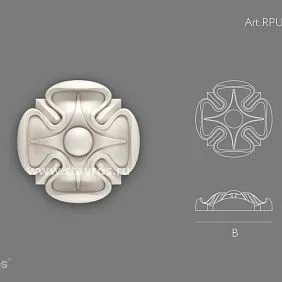


Classification of circular elements: from function to form
Polyurethane round rosettesare not just decorations. Each type performs a specific function and occupies a specific place in space.




Ceiling Rosettes: Framing the Light
Ceiling rosette—a round decorative element installed in the center of the ceiling (or at other points—more on that later) around a chandelier, pendant light, or wiring outlet.
Functions:
Decorative framing of the light fixture—the rosette visually increases the scale of the chandelier (a 60 cm diameter chandelier on an empty ceiling looks small, the same chandelier on an 80 cm diameter rosette looks significantly larger), creates a smooth transition from the ceiling plane to the volumetric light fixture (without a rosette, the chandelier seems to hang in a void; with a rosette, it organically integrates into the architecture).
Concealing the mounting assembly—the rosette hides the wiring outlet, mounting plate, and ceiling defects around the mounting point (often during chandelier installation, plaster chips and cracks form around the hole—the rosette completely covers them).
Architectural accent—even without a chandelier, the rosette functions as a compositional center of the ceiling (in bedrooms, studies where a central chandelier is not needed, the rosette remains—creating a decorative focal point, filling the ceiling void).
Size gradation:
Small (diameter 200-400 mm)—for standard ceilings 2.5-2.7 meters high, rooms up to 20 m², chandeliers 40-60 cm in diameter. Simple ornament (1-3 concentric bands), weight 0.3-0.8 kg, price 1500-3500 rubles.
Medium (diameter 400-700 mm)—for ceilings 2.7-3.2 meters, rooms 20-40 m², chandeliers 60-90 cm. Medium complexity ornament (3-5 bands, floral elements), weight 0.9-2.2 kg, price 3500-8000 rubles.
Large (diameter 700-1200 mm)—for high ceilings 3.2-4.5 meters, spacious rooms 40-80 m², large chandeliers 90-150 cm. Complex ornament (5-8 bands, three-dimensional relief, acanthus leaves, garlands), weight 2.5-6.0 kg, price 8000-18000 rubles.
Monumental (diameter 1200-1800 mm and more)—for palace halls, ceilings above 4.5 meters, areas 80+ m², monumental chandeliers. Maximum complexity ornament (multi-level, deep relief up to 40 mm), weight 6.5-15 kg, price 18000-45000 rubles.
Diameter selection rule: the rosette diameter should be 1.3-1.8 times the chandelier diameter. Chandelier 70 cm → rosette 90-125 cm. If the rosette is smaller (ratio 1:1 or less), it gets lost and fails to perform its framing function. If the rosette is too large (ratio 2:1 or more), it overwhelms the chandelier and becomes an end in itself.
Our factory also produces:


Wall medallions: vertical accents
Medallion—a round or oval decorative element installed on a wall. Unlike a ceiling rosette (which is always round), a medallion can be round, oval (elongated vertically or horizontally), or polygonal (hexagon, octagon with an inscribed circle).
Application:
Above fireplaces—a medallion in the center of the mantelpiece or on the wall above the fireplace (instead of a painting or mirror). Diameter 300-600 mm, ornament—coats of arms, monograms, floral compositions, classical rosettes.
Above doors—in the wall space between the top of the door opening and the ceiling (if the wall space height is 40-80 cm). The medallion fills the void, creates a vertical axis of symmetry. Diameter 200-400 mm.
In centers of wall panels—if the wall is decorated with boiserie (rectangular panels made of moldings), a medallion is installed in the center of each panel. Diameter depends on panel size (rule: 0.15-0.25 of the panel's smaller side; panel 80×120 cm → medallion diameter 12-20 cm).
In niches and alcoves — a round medallion in the upper part of the niche (under the arch or in the center of the niche's back wall). Creates a focal point, completes the composition.
On staircase walls — medallions are installed on the wall along the staircase (at equal intervals — every 2-3 steps), forming a rhythmic row that directs the gaze upward.
Ornamental specificity: wall medallions often contain narrative or symbolic elements (unlike ceiling rosettes, where the ornament is abstract — garlands, leaves, geometry). Medallions can depict: profiles of ancient heroes or philosophers, lion heads (symbol of strength, protection), eagles (power, grandeur), laurel or oak wreaths, coats of arms, monograms of the house owner, musical instruments (for music salons), theatrical masks (for home theaters), astrological signs.
Get Consultation
Decorative circles: modular systems
Decorative circle — a simple round element without complex ornamentation (smooth, with minimal relief — concentric rings, a simple bead along the perimeter), used as a module in compositions.
Application:
Boiserie and wall panels — circles are installed in the corners of rectangular panels (at the intersection of moldings), creating accents. Diameter 50-120 mm.
Friezes and borders — a row of identical circles, placed at equal distances (spacing 30-60 cm), forms a horizontal or vertical ornamental border.
Ceiling compositions — circles of different diameters (a large one in the center, 4-8 small ones symmetrically around) create a multi-center composition (for rooms without a single central chandelier, but with several light fixtures).
Doors and furniture — round overlays on door panels (4-6 circles, placed symmetrically), on cabinet fronts, on table panels.
Sizes: small 50-100 mm (weight 20-60 grams, price 150-400 rub./pc.), medium 100-200 mm (weight 80-180 grams, price 400-900 rub./pc.), large 200-400 mm (weight 200-600 grams, price 900-2500 rub./pc.).
Oval elements: circle in motion
Oval — a circle elongated along one axis, preserving the smoothness and completeness of a circle, but adding dynamism, direction.
Oval proportions: ratio of major axis to minor — 1.2:1 (close to a circle, barely perceived as an oval), 1.5:1 (classic oval, harmonious), 2:1 (elongated oval, dynamic), 3:1 and more (ellipse, strongly elongated, rarely used).
Orientation: vertical oval (major axis vertical) — for walls, doors, stretches space upward. Horizontal oval (major axis horizontal) — for friezes, above fireplaces, expands space.
Application: above mirrors (oval medallion above an oval mirror — a classic composition), on chair and armchair backs (oval overlays in the centers of backs), on furniture fronts (vertical ovals on cabinet doors).
Ornamental systems of round elements: from center to edge
The ornament of round elements is organized radially — from the center to the periphery or vice versa. This structure creates visual movement, guides the eye.
Concentric belts: classic scheme
The center of the rosette contains the main element (rosetta — stylized flower, star, sun, medallion). From the center, concentric belts of ornament radiate (circular bands, each with its own pattern).
Typical structure of a ceiling rosette with a diameter of 600 mm:
Center (diameter 80 mm) — rosetta with 12 petals, relief 15 mm.
First belt (width 60 mm) — smooth ring or pearl molding (a row of beads).
Second belt (width 80 mm) — acanthus leaves (8 leaves, placed radially, tips toward the center).
Third belt (width 70 mm) — garland of flowers and leaves, tied with ribbons.
Fourth belt (width 50 mm) — dentils (small rectangular teeth).
Outer rim (width 40 mm) — bead (semi-circular projection) or wreath.
Principle of alternation: smooth belts alternate with ornamental ones (creates rhythm, does not overload perception). The complexity of the ornament decreases from the center to the edge (center — most detailed, periphery — simpler) or vice versa (center simple, main ornament on the second-third belt).
Radial rays: dynamism and centripetality
The ornament is not annular, but radial — elements radiate from the center like sun rays.
Structure:
Center – a round medallion (diameter 60-100 mm).
Rays (12-24 pieces) – elongated elements (leaves, flames, arrows) radiating from the center to the edge. Ray length 100-250 mm (depends on the rosette diameter).
Outer rim – a circular frame that confines the rays.
Effect: dynamism, energy, movement from the center outward (or conversely – toward the center, depending on the direction of the rays). Suitable for Baroque and Art Nouveau interiors (styles that value dynamism and expression).
Application: ceiling rosettes in ceremonial halls (diameter 800-1500 mm), wall medallions above fireplaces (imitating the sun, hearth, source of light and warmth).
Floral garlands: naturalism and lushness
The ornament consists of garlands – chains of flowers, fruits, leaves, tied with ribbons, arranged along the circumference.
Composition:
Center – a rosette or basket of flowers.
Garlands – 4-8 garlands, suspended from the center to the outer rim (like draped fabric), sagging in arcs. Each garland contains 5-10 flowers (roses, lilies, poppies), leaves, ribbons.
Suspension points – at the locations where the garlands attach to the rim, smaller rosettes (diameter 30-50 mm) or bows are placed.
Style: Baroque, Rococo, Classicism (styles that actively use floral motifs). Suitable for feminine, elegant, romantic interiors (bedrooms, boudoirs, living rooms).
Geometric patterns: order and strictness
The ornament consists not of floral elements, but of geometric shapes – circles, squares, triangles, polygons, meanders, lattices.
Structure:
Center – a circle or polygon (hexagon, octagon).
Bands – alternating geometric patterns (first band – meander, second – a row of squares, third – zigzag, fourth – round medallions).
Outer rim – a simple frame (bead, rectangular projection).
Style: Empire (geometry, strictness, symmetry), Art Deco (geometric abstractions), minimalism (simplest geometric forms). Suitable for masculine interiors (studies, libraries), modern spaces.
Combination of round and rectangular elements: dialogue of forms
Circle and square (or rectangle) – basic geometric opposites. Their combination creates contrast, tension, dynamism.
Circle in a square: classic composition
A rectangular wall panel (formed by moldings), with a round medallion placed at its center. Proportions: the circle's diameter is 0.15-0.25 of the rectangle's shorter side.
Example: panel 80×120 cm, medallion diameter 16 cm (0.2 × 80 cm). The medallion is placed precisely at the geometric center of the panel (measure the diagonals, the intersection point is the medallion's center).
Effect: the circle softens the strictness of the rectangle, creates a focal point, fills emptiness, breaks the monotony of the plane. The classic boiserie composition – dozens of panels on walls, each with a central medallion, forms a rhythmic system.
Square in a circle: reverse logic
A round ceiling rosette, inside which (at the center) a square or diamond-shaped element (star, cross, square medallion) is inscribed.
Application: rare, used in eclectic or Art Nouveau interiors (where unexpected combinations are valued). Effect: geometric play, an intellectual accent.
Circles at the corners of rectangles: accentuating intersections
Rectangular panels on walls, with small round elements (diameter 50-80 mm) placed at the four corners of each panel (at the intersections of the moldings).
Function: the circles mark the corners, create additional accents, enhance the panel's framed quality. Without circles, the corners are simply molding joints (visually may be unexpressive, especially if the moldings are thin). Circles make the corners explicit, articulated.
Ornament of the circles: usually simple (smooth, with a bead, with a cross) so as not to compete with the central medallion (if present). If there is no central medallion, the corner circles can be more complex (rosettes with petals).
Alternation of circles and rectangles in borders
Horizontal frieze (border) on a wall, consisting of alternating elements: circle — rectangle — circle — rectangle.
Example: circles with a diameter of 100 mm (rosettes with flowers), with rectangular inserts 80×150 mm between them (with floral ornament or inscriptions). The repetition pitch (from the center of one circle to the center of the next) is 400 mm. The frieze runs along the perimeter of the room under the ceiling or at a level of 1.5-1.8 meters from the floor.
Effect: rhythm, guiding the eye along the wall, filling a horizontal strip with decoration (without a frieze, the wall may appear empty, monotonous).
Size selection: diameter relative to the room
How to choose the diameter of a circular element so it doesn't get lost or overpower?
Ceiling rosettes: calculation formula
Basic rule: the diameter of the rosette depends on the ceiling height and the area of the room.
Formula: rosette diameter (cm) = (ceiling height (m) + √room area (m²)) × 15.
Calculation examples:
Room 20 m², ceiling 2.7 m: diameter = (2.7 + √20) × 15 = (2.7 + 4.47) × 15 = 7.17 × 15 ≈ 107 cm. Recommended diameter 100-110 cm.
Hall 50 m², ceiling 3.5 m: diameter = (3.5 + √50) × 15 = (3.5 + 7.07) × 15 = 10.57 × 15 ≈ 158 cm. Recommended diameter 150-160 cm.
Bedroom 15 m², ceiling 2.6 m: diameter = (2.6 + √15) × 15 = (2.6 + 3.87) × 15 = 6.47 × 15 ≈ 97 cm. Recommended diameter 90-100 cm.
Adjustment: if the interior style is minimalist or modern, reduce the calculated diameter by 20-30% (the rosette should not be too accent-heavy). If the style is Baroque, Empire, or Classic — use the calculated diameter or add 10-20% (luxury requires scale).
Wall medallions: panel proportions
If a medallion is installed in the center of a wall panel, its diameter depends on the size of the panel.
Rule: medallion diameter = shorter side of the panel × (0.15-0.25).
Examples:
Panel 60×90 cm: medallion diameter = 60 × 0.20 = 12 cm. Choose a medallion with a diameter of 10-14 cm.
Panel 100×150 cm: diameter = 100 × 0.20 = 20 cm. Medallion 18-22 cm.
Panel 50×70 cm (small, for narrow wall sections): diameter = 50 × 0.18 = 9 cm. Medallion 8-10 cm.
If the medallion is above a fireplace (not in a panel, but on an open wall), base it on the width of the mantelpiece. Medallion diameter = 0.3-0.5 of the mantelpiece width. Mantelpiece width 120 cm → medallion 36-60 cm.
Decorative circles: modularity and pitch
If circles are used in borders or rows (several circles at equal distances), the pitch — the distance between the centers of adjacent circles — is important.
Rule: pitch = circle diameter × (3-5).
Examples:
Circles with a diameter of 80 mm: pitch 240-400 mm (24-40 cm). On a 6-meter wall, 15-25 circles will fit (600 cm ÷ 24 cm = 25 pcs. at minimum pitch, 600 cm ÷ 40 cm = 15 pcs. at maximum).
Circles with a diameter of 150 mm: pitch 450-750 mm (45-75 cm). On a 6-meter wall — 8-13 circles.
Choose the pitch so that the total number of circles is even (for symmetry) or creates a rhythm (every 3-5 circles — an accent circle of larger diameter or different ornament).
Installation of circular elements: mounting technology
Circular elements are mounted with adhesive (screws are not used because the circular shape does not provide convenient points for fasteners; screw holes would disrupt the symmetry of the relief).
Installing a ceiling rosette around a chandelier
Preparation:
Dismantle the chandelier (turn off the electricity, remove the shades, unscrew the body from the ceiling). The wires will remain protruding from the ceiling.
Clean the ceiling around the wire exit (radius equals the radius of the rosette + 5 cm margin). Remove dust, grease, whitewash (if the ceiling is whitewashed — wash off the whitewash with a damp cloth, otherwise the adhesive will not set).
Mark the center of the rosette (must align with the wire exit). Draw a circle on the ceiling with a diameter equal to the outer diameter of the rosette (use a pencil tied to a string — hold the string at the center, draw the circle with the pencil and taut string).
Fitting:
Place the rosette against the ceiling (the central hole of the rosette must align with the wire exit). If the rosette has no central hole (some rosettes are solid), drill one using a drill with a hole saw diameter of 40-60 mm (the hole diameter must allow pulling through the wires and the chandelier's mounting plate).
Installation:
Apply adhesive to the back of the rosette (use polyurethane adhesive Cosmofen Plus or acrylic mounting adhesive Tytan). Apply the adhesive along the perimeter of the rosette in a continuous line (line width 5-8 mm) + crosswise along the diameters (two lines through the center). Adhesive consumption: for a rosette diameter of 600 mm — 150-200 ml of adhesive.
Pull the chandelier wires through the central hole of the rosette.
Place the rosette against the ceiling, align it with the markings, press evenly over the entire area (press with palms, not fingers, to avoid imprinting the relief).
Secure the rosette for the adhesive drying time (2-4 hours). Securing method: set up a temporary prop from the floor to the center of the rosette (a wooden block or telescopic drywall prop), the prop rests against the center of the rosette, holding it pressed to the ceiling. Additionally, you can apply painter's tape around the perimeter of the rosette (tape one end to the rosette, the other to the ceiling, pull taut to draw the rosette tight).
Remove excess adhesive squeezed out along the edges of the rosette with a damp cloth immediately (do not wait for it to dry).
Finishing:
After 4 hours (when the adhesive has set) remove the prop and tape.
Install the chandelier (the mounting plate is attached to the ceiling with screws through the central hole of the rosette, the chandelier body is hung on a hook or plate, the shades are put back in place).
Fill the joint between the rosette and the ceiling (if there are small gaps) with acrylic sealant (white), smooth with a wet finger.
Paint the rosette (if needed) with acrylic paint to match the ceiling color or a contrasting color (see the painting section for details).
Wall medallion installation
Preparation:
Determine the installation location (above the fireplace, above the door, in the center of a panel). Mark the center of the medallion (measure distances to the edges of the panel or fireplace, find the geometric center).
Clean the wall (dust, grease, peeling paint or wallpaper). If the wall is wallpapered — remove the wallpaper at the medallion installation site (area slightly larger than the medallion area), glue the medallion onto bare plaster or filler (on wallpaper the medallion may peel off after a month-year because wallpaper adhesive is weaker than mounting adhesive).
Installation:
Apply adhesive to the back of the medallion (solid line along the perimeter + crosswise).
Place against the wall, align with the center marking, press for 2-3 minutes.
Secure with painter's tape (strips of tape crosswise over the medallion, ends on the wall, pull taut to draw the medallion tight). Hold for 2-4 hours.
Remove the tape, excess adhesive, fill gaps with sealant (if any).
Installation of decorative circles on doors or furniture
Preparation:
The door leaf or furniture front must be painted or primed (do not glue onto untreated wood — the adhesive will soak in and will not hold).
Mark the positions of the circles (symmetrically). For a door: typically 4 circles (two at the top symmetrically, two at the bottom symmetrically) or 6 circles (three pairs vertically). For a cabinet front: 1 circle in the center or 4 circles at the corners.
Installation:
Apply adhesive to the circle (along the perimeter + a drop in the center), glue to the door, press with a weight or tape for 2-3 hours.
After the adhesive dries (24 hours) paint the circles (to match the door color for monochrome or contrasting for graphic effect).
Creating compositions: symmetry and asymmetry
One circle is an accent. Several circles are a composition, a system requiring placement rules.
Symmetrical compositions: classical harmony
One circle in the center of the ceiling: classic. The circle (rosette) is installed exactly in the geometric center of the ceiling (intersection of diagonals). Chandelier in the center of the circle. Everything else (cornices, moldings, furniture) is arranged symmetrically relative to this center.
Five circles (one central + four at the corners): central circle large (diameter 600-800 mm), in the center of the ceiling. Four circles small (diameter 200-300 mm), at the corners of the ceiling (at a distance of 50-80 cm from the walls). In the central circle — chandelier, in the corner ones — spotlights or simply decorative circles without lights.
Application: spacious rooms (from 40 m²), high ceilings (from 3.2 m). Effect: opulence, formality, absolute symmetry (calming, creates order).
Three circles in a row: for elongated spaces (dining rooms, corridors, galleries). Three circles of the same diameter (or the central one slightly larger than the side ones) are positioned along the central axis of the room (along the long wall or in the center of the ceiling). The spacing between the centers of the circles is uniform (measured from the center of the first circle to the center of the third, divided by three, resulting in the step).
Nine circles (3×3 grid): for square halls (area 60-100 m², ceiling 4+ meters). Circles of the same diameter (400-600 mm) are positioned at the nodes of a 3×3 grid. The distances between rows and columns are equal (forming a perfect lattice). Each circle contains a light fixture (or the central 5 circles have fixtures, the corner 4 are decorative).
Asymmetric compositions: modern dynamics
Offset circle: a circle not in the center of the ceiling, but offset towards one of the walls (e.g., above a dining table placed against a wall, not in the center of the room). The chandelier in this circle illuminates the table.
Application: modern interiors (loft, contemporary), where classical symmetry is not required, functionality is important (lighting over a work area).
Circles of different diameters in a chaotic arrangement: 5-7 circles with diameters from 200 to 500 mm are placed on the ceiling or wall without a visible system (not centered, not at equal distances, not on a single axis). Creates an effect of spontaneity, lightness, playfulness.
Application: children's rooms, creative spaces (workshops, studios), interiors in boho, eclectic styles.
Painting and decorating: from monochrome to gold
Round elements are supplied white primed. Painting is the final touch that determines perception.
Monochrome: circle in the base color
The ceiling rosette is painted the color of the ceiling, the wall medallion the color of the wall. The element is revealed only by its relief (play of light and shadow on the edges of the ornament), not by color.
Technique: acrylic paint in the base color (white for a white ceiling, beige for a beige wall), two coats, short-nap roller for smooth areas + brush for the ornament. First coat - primer, seals the pores of the polyurethane. Second coat - finish, creates an even coating.
Effect: restrained elegance, classic taste, the element is integrated into the architecture (doesn't stand out, doesn't shout, works subtly).
Contrast: white circle on a colored background
The rosette remains white, the ceiling is painted a color (gray, blue, beige, even black in some modern interiors). Or a rosette on a gray ceiling, colored wall, white medallion.
Effect: graphic quality, clarity, the circle is highlighted brightly, becomes a dominant feature. Suitable for contemporary, neoclassical, Scandinavian style.
Gilding: palace luxury
The ornament of the rosette or medallion is gilded (acrylic metallic gold paint or imitation gold leaf - finest sheets of imitation gold).
Technology:
Paint the rosette with the base color (white, ivory, light beige). Let dry.
Take gold paint (acrylic metallic), apply with a brush using the dry brush technique to the raised parts of the ornament (tops of leaves, edges of petals, beads). The gold will only settle on the upper planes, the recesses will remain the base color.
Result: the gold shines in the light, emphasizes the volume, creates luxury. Don't overdo it (a completely gold rosette is overkill, looks cheap, like a gilded souvenir figurine; gilding should be accentual, 10-30% of the ornament area).
Coat with matte acrylic varnish (removes excessive shine, makes the gold noble, not garish).
Patination: a patina of time
Creating an aging effect - a dark patina in the recesses of the relief (imitation of centuries-old dust, oxidation).
Technology:
Paint the rosette a light color (white, ivory, light gray). Let dry.
Dilute dark paint (umber, burnt sienna, black) with water 1:3-1:5 (milk-like consistency).
Apply generously with a brush over the entire surface of the rosette. Immediately (without waiting for it to dry) wipe the raised parts of the ornament with a damp cloth - the paint will wash off the raised areas, remaining in the recesses.
Result: raised areas are light, recesses are dark, an effect of age, antiquity, noble aging. Suitable for classic interiors in historical buildings, interiors in Provencal, shabby chic style.
Frequently Asked Questions about round moldings
Yes, but it's more difficult. You'll need to temporarily remove the chandelier (turn off the electricity, take it down), install the rosette (threading the wires through the central hole), and rehang the chandelier. If removal is impossible (the chandelier is antique, fragile, has a complex mounting) - order a rosette in two halves (the manufacturer will cut the rosette along the diameter, you install the halves on either side of the chandelier, fill the seam with sealant, after painting the seam is unnoticeable).
Possible, but more complicated. You'll need to temporarily dismantle the chandelier (turn off the electricity, remove it), install the socket (running wires through the central hole), and reinstall the chandelier. If dismantling is not possible (the chandelier is antique, fragile, or has a complex mounting) — order a two-part socket (the manufacturer will cut the socket along its diameter, you install the halves on either side of the chandelier, fill the seam with sealant, and after painting, the seam will be unnoticeable).
What diameter central hole is needed for the rosette?
Depends on the type of chandelier mounting. If the chandelier is on a hook (a hook protrudes from the ceiling, the chandelier hangs on it) — a hole with a diameter of 80-120 mm (so the hook can pass through). If the chandelier is on a mounting plate (the plate is attached to the ceiling with screws, the chandelier is suspended from the plate) — a hole of 60-100 mm (so the plate can pass, or the plate is installed over the rosette if the rosette is thin). If unsure — take a rosette with a 100 mm hole (universal size).
Can a rosette be glued to a stretch ceiling?
No, directly it is not possible (a stretch ceiling is a PVC film or fabric stretched under the main ceiling, glue does not hold on the film). Solution: install a mounting platform under the stretch ceiling (a wooden or plastic ring is attached to the main ceiling before stretching the film, a hole is cut in the film, the edges of the film are glued to the ring), then glue the rosette to the platform. But it's easier — abandon the stretch ceiling in favor of a regular one (plaster, paint), then the molding can be mounted freely.
Will the rosette detach under its own weight?
No, if properly glued (quality glue, applied over the entire area, ceiling prepared — cleaned of dust and whitewash). A rosette with a diameter of 600 mm weighs 1.5-2.5 kg, the contact area with the ceiling is 2800 cm² (πr², where r = 30 cm). Glue holds 5-15 kg per cm² (depending on type), resulting in a load-bearing capacity of 14000-42000 kg — a 2 kg rosette is held with a multiple safety margin. Problems arise if there is too little glue (applied only around the perimeter, without lines through the center — the center sags), or the surface is not prepared (whitewash, dust — the glue adheres not to the ceiling but to the whitewash, the whitewash peels off, the rosette falls).
How to cut a hole in a rosette if it is too small or absent?
Use a drill with a hole saw (annular drill bit) of the required diameter. Place the rosette face down on a flat surface (table, sheet of plywood), mark the center, drill the hole with the drill at low speed (500-800 rpm, without hammer mode). Smooth the edges of the hole with sandpaper P120-180 (remove burrs, make the edge smooth).
Depends on convenience. It's easier to paint before installation (the rosette lies on the table, you paint with a roller and brush from all sides conveniently, paint drips on the table, not on the ceiling or floor). But sometimes they paint after installation (if you need to paint the rosette to perfectly match the ceiling color — paint the ceiling and rosette simultaneously in one pass, the color is guaranteed to be identical). If painting before installation — let the paint dry completely (24 hours), then install.
Depends on convenience. It's easier to paint before installation (the socket lies on the table, you can paint all sides comfortably with a roller and brush, paint drips onto the table, not the ceiling or floor). But sometimes painting is done after installation (if you need to paint the socket to perfectly match the ceiling color — paint the ceiling and socket simultaneously in one pass, ensuring the color is guaranteed identical). If painting before installation — let the paint dry completely (24 hours), then install.
Conclusion: The circle as a symbol of completeness
Round medallionsand polyurethane rosettes are not just decorations, but architectural tools for creating interior completeness. The circle closes the composition (creates a center around which everything else is organized), attracts the eye (becomes a focal point, a dominant), softens geometry (balances the straight lines of cornices, moldings, room corners), introduces symbolism (the circle — eternity, harmony, sun, cosmos — cultural meanings subconsciously perceived).
Decorative polyurethane circlesin the range of modern manufacturers cover all sizes (from miniature 50 mm for furniture to monumental 1800 mm for palace halls), all ornamental systems (concentric rings of classicism, radial rays of baroque, plant garlands of rococo, geometric patterns of empire and art deco), all levels of complexity (from smooth decorative circles without ornament to multi-level rosettes with three-dimensional relief up to 40 mm deep).
The company STAVROS has been producing round polyurethane molding elements since 2002, accumulating 24 years of experience in casting technologies, ornament design, and mold creation. The STAVROS catalog features 180+ round elements: ceiling rosettes with diameters from 200 to 1500 mm (40 models — from simple concentric ones for minimalist interiors to lush baroque ones with garlands and putti, prices 1800-32000 rubles depending on diameter and ornament complexity), wall medallions with diameters from 100 to 600 mm (60 models — round, oval, with thematic elements — lions, eagles, coats of arms, plant compositions, prices 800-12000 rubles), decorative circles with diameters from 50 to 400 mm (80 models — smooth, with simple relief, with rosettes, for panel corners, for borders, for doors and furniture, prices 150-2500 rubles).
Quality of STAVROS round elements: polyurethane density 350-380 kg/m³ (premium segment, relief is clear, ornament details worked out to 1 mm — leaf veins, flower petals, pearl beads are clearly visible), three-layer snow-white primer (thickness 0.15 mm, factory application robotic, uniformity ideal), dimensional accuracy ±1 mm (stated diameter 600 mm — measure with calipers, get 599-601 mm, critical for symmetrical compositions where several circles must be identical), weight optimized (a rosette with a diameter of 600 mm weighs 1.8-2.2 kg — light enough for simple glue mounting, but massive enough not to be perceived as fragile, cheap).
Ornaments of STAVROS round elements are developed by professional designers based on historical samples (classicism — rosettes with acanthus and egg-and-dart based on samples from French and Russian palaces of the 18th-19th centuries, baroque — garlands and putti based on samples from Italian palazzos of the 17th century, empire — geometric patterns and military symbolism based on samples from the Napoleonic era), adapted for modern polyurethane casting technologies (details simplified where casting cannot reproduce the finest elements, but the overall style is absolutely preserved).
The STAVROS assortment includes exclusive series of round elements: the "Versailles" collection (baroque rosettes with diameters of 700-1200 mm with lush garlands, cupids, shells, relief depth up to 35 mm, prices 12000-28000 rubles, for palace interiors), the "Athena" collection (classicist rosettes with diameters of 400-900 mm with concentric belts of acanthus leaves, dentils, egg-and-dart, prices 4500-14000 rubles, for strict classic interiors), the "Modern" collection (asymmetric medallions and rosettes with plant shoots, irises, dragonflies, diameters 300-700 mm, prices 3200-11000 rubles, for interiors in modern style and eclecticism).
STAVROS service when working with round elements: designer consultations (help select rosette diameter based on ceiling height and chandelier size, calculate the number of medallions for wall panels, offer compositional schemes for placing several circles), samples (send fragments of rosettes or small circles free or for 300-500 rubles — you physically assess the quality of relief, polyurethane density, whiteness of primer before the main order), mounting recommendations (instructions on adhesives, installation technology, fixation during drying — text manuals and videos on the website), 24-month warranty (if a rosette detaches during proper installation due to material defect — free replacement, but such cases have not occurred in the company's 24 years of operation).
Choose STAVROS — choose round elements embodying the ancient symbol of perfection in modern material, affordable in price (Russian production without import markups), high quality (European level of detail, strength, durability 25-40 years), diverse (180+ models — you will find a rosette or medallion for any style, size, budget). Your interior deserves completeness — STAVROS round molding creates it, turning ceilings and walls from empty planes into architectural compositions with clear centers, rhythm, harmony.