












































































Article Contents:
- Scenario One: Molding Frames – Graphics and Symmetry
- What It Looks Like
- Advantages of Molding Frames
- Disadvantages of Molding Frames
- For which beds is it suitable
- Practical recommendations
- Scenario Two: Soft Panels – Continuation of the Headboard
- What It Looks Like
- Advantages of Soft Panels
- Disadvantages of Soft Panels
- For which beds is it suitable
- Practical recommendations
- Scenario Three: Wallpaper in a Frame – Controlled Ornament
- What It Looks Like
- Advantages of Wallpaper in a Frame
- Disadvantages of Wallpaper in a Frame
- For which beds is it suitable
- Practical recommendations
- Scenario Four: Mirror Inserts – Illusion of Space
- What It Looks Like
- Advantages of Mirror Inserts
- Disadvantages of Mirror Inserts
- For which beds is it suitable
- Practical recommendations
- Scenario Five: Wooden Carved Panels – Luxury of Material
- What It Looks Like
- Advantages of Wooden Carved Panels
- Disadvantages of Wooden Carved Panels
- For which beds is it suitable
- Practical recommendations
- Scenario Comparison Table
- Frequently Asked Questions
- Can Multiple Scenarios Be Combined?
- Which Scenario is Suitable for a Small Bedroom?
- Which Scenario is Easiest to Update?
- Is Professional Installation Needed?
- Which Scenario is the Most Durable?
- How to Choose a Scenario for a Specific Bed?
- Conclusion: The Wall as the Bed's Partner

The wall behind the bed is not just a vertical surface painted in a neutral color. In a classic interior, it is a canvas on which classic beds are revealed in their full splendor, where the headboard becomes not a separate element, but part of an architectural composition. A bare wall makes even a luxurious carved bed look like an orphan, torn from its context. A decorated wall turns the bed into a compositional center, around which the entire bedroom is built.
How to decorate the wall behind the headboard? There are many approaches, each with its own aesthetic, budget, and implementation complexity. From moldings creating graphic frames to soft panels continuing the textile theme of the headboard, from patterned wallpaper in a carved frame to mirror inserts visually expanding the space, from wooden carved panels turning the wall into a work of art — let's examine five key scenarios, their advantages, disadvantages, and logic of application.
It's important to understand: the choice of scenario depends not only on personal preferences, but also on the bed's style, room size, budget, and readiness for complex installation or maintenance.Classic Furniturerequires an architectural context that enhances its expressiveness, rather than competes with it. Let's consider how to create this context practically, with examples, calculations, and recommendations.


Scenario one: molding frames — graphics and symmetry
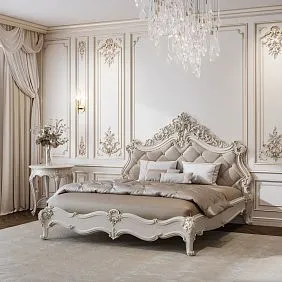
Moldings on the wall are a classic technique that creates architectural structure where there is none. Rectangular frames made of moldings around or behind the bed's headboard turn a flat wall into a panel system that echoes traditional boiserie (wooden wall panels of palaces and mansions from the 18th-19th centuries), but is cheaper and easier to install.




What it looks like
The wall behind the bed is divided into rectangular panels using moldings — decorative strips 6-12 cm wide, attached to the wall and creating relief frames. There can be one panel — large, the size of the bed's headboard, or several — symmetrically arranged vertically or horizontally.
Inside the panel, the wall is painted in a contrasting color (if the main wall is light — the panel is dark, and vice versa) or covered with patterned wallpaper, textured plaster, or fabric. The contrast creates depth, making the frame appear three-dimensional, not like a flat sticker.
Moldings can be made of solid wood (oak, beech) — an expensive, noble option; MDF with veneer or paint — mid-range in price; polyurethane — budget-friendly, lightweight, easy to install. The choice depends on budget and durability requirements.
Our factory also produces:



Advantages of molding frames
-
Stylistic versatility: moldings work in any classic style — from strict Empire to lavish Baroque, from restrained Neoclassicism to romantic Provence. By changing the molding profile (simple, carved, with ornament), you adapt the decor to a specific aesthetic.
-
Budget flexibility: polyurethane moldings cost from 200 rubles per linear meter, oak wooden ones — from 1500 rubles. You can create an impressive decor even with a limited budget.
-
Ease of installation: moldings are glued to the wall with special adhesive or fastened with screws (wooden), requiring no complex tools or professional skills. Installing one wall takes 4-6 hours.
-
Update potential: if you tire of the color inside the panel, it's easy to repaint or re-wallpaper without touching the moldings. This makes the interior adaptable, not frozen forever.
-
Visual space correction: vertical panels visually increase ceiling height, horizontal ones — widen a narrow wall. Moldings are a tool for optical correction.
Get Consultation
Disadvantages of molding frames
-
Risk of cliché: molding frames are a popular technique that has been used extensively, especially in the 2000s-2010s. If proportions, color, and placement are not thought through, the result may look generic, not unique.
-
Maintenance: dust accumulates on the relief surfaces of moldings, especially if the profile is complex, carved. Regular wet cleaning with a soft cloth or special brushes is required.
-
Complexity of joints: molding corners must be cut at 45 degrees, joints perfectly fitted. If installation is amateurish, joints will be visible, reducing the perceived quality.
-
Scale limitations: in a small bedroom (10-12 sq.m), large moldings and big panels can visually overload the wall, making the room feel smaller. A sense of scale is required.
For which beds it suits
Molding frames are universal, but especially good for beds with wooden carved headboards, where the carving is complex, rich. Moldings on the wall repeat the carving's ornament (e.g., if the headboard has acanthus leaves, choose a molding with a similar motif), creating stylistic unity.
Forbeds in baroque stylewith a high carved headboard, molding frames create an architectural background that enhances grandeur, solemnity. For a bed in Neoclassical style with a laconic headboard, moldings add structure without overloading with decorativeness.
Practical Recommendations
-
Choose moldings at least 8 cm wide — narrow moldings (4-5 cm) look flimsy, not creating sufficient visual mass.
-
The panel behind the headboard should be 10-15 cm wider and taller than the headboard itself, so the bed does not overlap the frame but sits inside it.
-
Paint moldings and the wall in contrasting or tonal shades (e.g., molding white, wall cream, inside panel — dark gray). Monochrome (all white or all gray) reduces the depth effect.
-
If the wall is large, create several panels — for example, three vertical rectangles, the central one behind the bed, the side ones — for symmetry. This creates rhythm and structures the wall.
Scenario two: soft panels — continuation of the headboard
A soft panel on the wall is a textile upholstery that turns a hard surface into a tactile, cozy, sound-absorbing one. The wall becomes an extension of the bed's soft headboard, creating a unified textile environment where boundaries between furniture and architecture are blurred.
What it looks like
A panel is mounted on the wall behind the bed — a wooden or plywood board covered with fabric (velour, velvet, linen, eco-leather) with a soft backing of foam or synthetic padding 3-5 cm thick. The panel can be flat (smooth upholstery) or with tufting (capitonné) — a technique where the fabric is pulled in with buttons covered in the same fabric, creating a diamond or square relief.
The panel is installed from the floor to the midpoint of the wall (120-150 cm high) or from the headboard to the ceiling, creating a vertical focal point. The panel can span the entire width of the wall or be narrow (headboard width + 20-30 cm on each side).
The color and texture of the fabric either match the upholstery of the bed's headboard (complete unity) or contrast with it (light bed — dark panel, or vice versa), creating expressiveness.
Advantages of soft wall panels
-
Tactile comfort: a soft wall is pleasant to the touch, you can lean against it, it creates a sense of security and coziness that a cold, hard surface does not provide.
-
Sound absorption: textiles and soft backing absorb sound, reduce echo in the bedroom, and create comfortable acoustics, especially in rooms with high ceilings or hard floors.
-
Visual warmth: textiles add color, texture, and depth, making the interior feel warm and lived-in rather than cold. Velvet creates luxury, linen adds a natural feel, and faux leather brings modernity.
-
Uniqueness: soft panels are custom-made to specific dimensions, fabric, and tufting. This is not a standard solution but an individual one that makes the interior unique.
-
Concealing wall defects: a soft panel covers unevenness, cracks, and old finishes, eliminating the need for perfect wall preparation before installation.
Disadvantages of soft wall panels
-
Cost: custom-made soft panels cost 8000-15000 rubles per sq.m, depending on fabric, tufting, and complexity. This is more expensive than moldings or wallpaper.
-
Maintenance: textiles accumulate dust and require regular vacuuming with a soft brush attachment. Button tufting is more difficult to maintain—dust collects in the folds between the buttons.
-
Risk of staining: fabric can be damaged by liquids and stains, especially light-colored fabrics. Care is required, or fabrics with protective coatings should be chosen.
-
Visual bulkiness: a floor-to-ceiling soft panel can visually weigh down the wall, making the room feel smaller and darker, especially if the fabric is dark and the tufting is deep.
-
Difficulty of updating: if you tire of the color or the fabric is damaged, updating requires reupholstering the entire panel, which is more expensive and complex than repainting a wall or replacing wallpaper.
For which beds it suits
Soft panels are ideal for beds with soft headboards, creating textile unity. If the headboard is upholstered in velvet with button tufting, the wall behind it, covered in the same velvet with the same tufting, creates a monolithic composition where the bed seems to grow out of the wall.
For beds with carved wooden headboards, a soft panel creates a contrast of textures—hard wood against soft textiles. This works if the textile is neutral (linen, cotton) rather than overly decorative (velvet with gold ornamentation).
Practical Recommendations
-
Choose fabrics with protective coatings (Teflon coating) that repel dust and liquids. This will extend the panel's lifespan.
-
Button tufting is impressive but difficult to maintain. If you're not prepared for regular cleaning, choose smooth upholstery.
-
A soft panel doesn't have to cover the entire wall. A panel 150-180 cm high, starting from the floor or the headboard level, creates an accent without overwhelming the space.
-
Combine a soft panel with moldings—a molding frame around the soft panel creates structure, making the panel not a random patch but an architectural element.
Scenario three: wallpapered frame—ornament under control
Wallpaper with patterns—damask, monograms, floral motifs—creates decorativeness, richness, and a historical feel. But wallpaper covering an entire wall can be excessive and overwhelming. Wallpaper inside a molding frame is a compromise where the pattern is present but localized, under control, and not dominant.
What it looks like
The wall behind the bed is painted in a base color (white, cream, gray). Moldings are mounted on the wall, creating a rectangular frame slightly larger than the bed's headboard. Inside the frame, wallpaper with a classic pattern—damask, stripes, floral designs, or geometry—is applied.
The moldings are painted in a contrasting color (white on a gray background, gold on cream) or in the same tone as the wall, creating tonal relief. The wallpaper inside the frame creates a color and pattern accent that draws attention without overwhelming the entire wall.
Wallpaper can be paper, vinyl, or textile (on a fabric base)—the choice depends on budget and durability requirements. Textile wallpaper is the most expensive (from 3000 rubles per sq.m) but creates luxury, tactility, and color depth.
Advantages of wallpapered frames
-
Controlled decorativeness: the pattern is present but not dominant. This allows the use of bright, saturated, or complex wallpapers that would be excessive on an entire wall.
-
Visual focal point: the framed wallpaper creates a compositional center that draws the eye, structures the wall, and makes it feel organized rather than empty.
-
Budget efficiency: few wallpapers are required (2-3 sq.m), allowing you to buy expensive, high-quality wallpapers (textile, hand-printed) that would be prohibitively expensive for an entire wall.
-
Flexibility for updates: if you tire of the pattern, the wallpaper inside the frame can be easily replaced without touching the moldings or the main wall finish. This refreshes the interior without a major renovation.
-
Compatibility with furniture: the wallpaper pattern can be chosen to match the carving on the bed headboard (for example, a floral pattern on both the wallpaper and the carving), creating stylistic unity.
Disadvantages of framed wallpaper
-
Difficulty of selection: the wallpaper pattern must match the style of the bed, moldings, and the overall aesthetic of the bedroom. A mistake in choice (too bright, too small, wrong style) creates dissonance.
-
Risk of becoming outdated: patterns go out of fashion. Damask, popular in the 2010s, is now perceived as outdated in many contexts. Framed wallpaper can date an interior.
-
Maintenance: wallpaper, especially textile wallpaper, accumulates dust, fades in light, and can be damaged by moisture. Requires delicate care and protection from direct sunlight.
-
Style limitations: patterned wallpaper works in classic styles (Baroque, Empire, Provence), but not in minimalism or contemporary styles, where ornamentation is inappropriate.
For which beds it suits
Framed wallpaper is ideal for beds with high carved headboards in Baroque, Rococo, Victorian styles, where ornamentation is the norm. The wallpaper pattern echoes the carving on the headboard, enhancing decorativeness and creating the atmosphere of a historical interior.
For beds with a soft headboard, wallpaper creates a contrast of textures—a flat wallpaper pattern against a voluminous textile upholstery. This works if the wallpaper is not too bright and the headboard is a neutral color.
Practical Recommendations
-
Choose wallpaper with a large, clear pattern that is readable from a distance. A small pattern inside a frame blends in and loses expressiveness.
-
The color of the wallpaper should harmonize with the color of the bed and textiles (bedspread, curtains), but does not necessarily have to match. Contrast (a light bed with dark wallpaper) can be expressive.
-
The frame made of moldings should be wide enough (8-12 cm) so that the wallpaper inside does not look like a random sticker but is perceived as an architectural element.
-
Protect wallpaper from direct sunlight—use blackout curtains or roller blinds that block UV rays, preventing the pattern from fading.
Scenario four: mirror inserts—illusion of space
A mirror on the wall is a technique that visually doubles the space, reflects light, creates depth and dynamism. Mirror panels or inserts on the wall behind the bed are a bold solution that makes the bedroom not intimate but spacious, bright, and theatrical.
What it looks like
Mirror panels are mounted on the wall behind the bed—solid sheets of mirror measuring 100x200 cm, 60x180 cm, or custom sizes, secured to the wall with special fasteners or adhesive. Mirrors can cover the entire wall (a full-length mirror from floor to ceiling) or be inserts within molding frames (a mirror inside a rectangular frame).
Mirrors can be ordinary (clear reflection), tinted (gray, bronze mirror), aged (mirror with patina, wear, creating a vintage effect), or beveled (the edges of the mirror are cut at an angle, creating a decorative frame from the glass itself).
Frames around mirrors—carved wooden, metallic gold or silver, painted polyurethane—turn the mirror from a utilitarian object into a decorative element.
Advantages of mirror inserts
-
Visual expansion: a mirror doubles the visual volume of the bedroom, makes a small room feel more spacious, a narrow one wider, and a low one taller (if the mirror is vertical).
-
Light reflection: a mirror reflects light from the window and from light fixtures, making the bedroom brighter, especially if the window is small or faces north.
-
Decorative effect: a mirror in a carved frame, an aged mirror, a beveled mirror—this is not just a functional element but an art object that attracts attention and creates a focal point.
-
Modernity and historicity simultaneously: mirrors were used in palace interiors (Versailles, Peterhof), where mirror galleries created the illusion of infinite space. This is a historical technique that also works in a contemporary context.
Disadvantages of mirror inserts
-
Maintenance: a mirror requires regular cleaning—fingerprints, dust, and moisture streaks are immediately visible. Requires special glass cleaner, soft cloths, and regularity.
-
Risk of visual noise: a mirror reflects everything in front of it—the bed, textiles, clutter. If the bedroom is not perfectly tidy, the reflection creates visual noise and doubles the chaos.
-
Psychological discomfort: not everyone sleeps comfortably seeing their reflection in a mirror opposite the bed. In some cultures (feng shui), a mirror opposite the bed is considered unfavorable.
-
Cost and fragility: mirror panels are expensive (from 2000 rubles per sq.m), require professional installation, and are fragile—scratches and chips are difficult to repair.
-
Difficulty of removal: a mirror glued to the wall is difficult to remove without damaging the wall or the mirror itself. This is not a temporary solution but a long-term one.
For which beds it suits
Mirror inserts work for beds with a laconic headboard—soft without excessive decor, simple wooden, or minimalist. A complex carved headboard against a mirror creates visual overload—the carving is doubled by the reflection, making the decorativeness excessive.
For beds in Art Deco, Hollywood Regency, or glamour styles, mirror inserts are organic—these are styles where mirrors, shine, and theatricality are the norm. For strict Empire or restrained Neoclassicism, a mirror may be excessive.
Practical Recommendations
-
Use a mirror within molding frames, not a full-wall mirror. The frame structures the mirror, turning it into an architectural element rather than a random insert.
-
An aged mirror (with patina) softens the sharpness of the reflection, creates a vintage effect, and suits classic interiors.
-
If a mirror opposite the bed is psychologically uncomfortable, use a tinted mirror (bronze, graphite) that reflects less clearly, creating softness.
-
Mount the mirror professionally—using special mounts or double-sided mirror tape (not regular glue, which can damage the amalgam).
Scenario five: wooden carved panels—the luxury of material
Wooden panels on the wall represent the pinnacle of decorativeness, where the wall becomes a work of art. Carving, panels, tinting, and patina transform a flat surface into a three-dimensional composition that creates the atmosphere of a palace, estate, or library.
What it looks like
Solid oak or beech wooden panels, 2-3 cm thick, with carved elements—panels (framed constructions with a recessed center), carved overlays (rosettes, cartouches, floral motifs), and profiled edges—are mounted on the wall behind the bed. The panels cover the wall from floor to mid-height (120-150 cm) or full height to the ceiling.
Panels are tinted in a chosen shade—natural oak, dark walnut, whitewashed, graphite—or painted (white, gray, dark blue) with subsequent patina (artificial aging), which creates depth and a sense of history.
Panels can be symmetrical (identical panels arranged rhythmically) or compositional (a central panel with a carved medallion, side panels simpler), depending on the style.
Advantages of wooden carved panels
-
Material luxury: solid wood is a noble material that creates a sense of quality, durability, and investment. This is not wallpaper that you replace in 5 years, but an architectural element for decades.
-
Tactility and scent: wood is pleasant to the touch, warm, and textured. Solid oak has a light scent that creates a natural atmosphere.
-
Sound absorption: wooden panels absorb sound, reduce echo, and make the bedroom acoustics comfortable, especially in rooms with high ceilings.
-
Uniqueness: carved panels are custom-made, each detail is individual. The wood texture, carving, and tinting make the panels one-of-a-kind.
-
Restoration possibility: wood can be restored—re-sanded, re-tinted, or a damaged element replaced. This provides long-term value not found with wallpaper or paint.
Disadvantages of wooden carved panels
-
Cost: solid oak wooden panels cost 15,000-25,000 rubles per sq.m, including manufacturing, carving, tinting, and installation. This is the most expensive of the five scenarios.
-
Visual massiveness: dark-colored wooden panels with deep carving can visually shrink the bedroom, make it darker, especially if the room is small or has a north-facing window.
-
Installation complexity: panels are heavy and require professional wall mounting (screws into the wall, sometimes a wooden frame). Installation takes 1-2 days.
-
Maintenance: carving accumulates dust and requires regular cleaning with a soft brush or vacuum. Wood treated with oil needs periodic coating renewal (every 2-3 years).
-
Irreversibility: installed panels are difficult to remove without damaging the wall. This is not a temporary solution but a long-term one, requiring confidence in the choice.
For which beds it suits
Wooden panels are ideal for solid wood beds with carved headboards, creating material and stylistic unity. The carving on the panels repeats the carving on the bed, the tinting matches, forming a monolithic composition where furniture and architecture are inseparable.
Forclassic bedsIn Baroque, Empire, and English classic styles, wooden panels are a natural choice that aligns with the historical authenticity of these styles.
Practical Recommendations
-
Choose panels with panels, not solid carving. Panels create structure and rhythm without overwhelming the eye.
-
The tinting of the panels should match the tinting of the bed. If the bed is dark, the panels should be dark or medium. Contrast (light bed—dark panels) works less often.
-
Panels don't have to cover the entire wall height. Panels from floor to 150 cm with painted or wallpapered wall above create a balance between decorativeness and lightness.
-
UseFurniture decor—carved overlays, rosettes, friezes—from STAVROS, which are mounted on panels, adding extra volume and richness to the composition.
Comparative table of scenarios
| Scenario | Cost (RUB/sq.m) | Installation Difficulty | Care | Visual effect | Suitable for styles |
|---|---|---|---|---|---|
| Molding frames | 500-2000 | Low | Medium | Graphics, structure | All classic |
| Soft panels | 8000-15000 | Medium | High | Cozy, tactile | Baroque, neoclassical |
| Wallpaper in a frame | 1000-3000 | Low | Medium | Ornamentality | Baroque, Provence |
| Mirror inserts | 2000-5000 | High | High | Space, light | Art Deco, glamour |
| Wooden panels | 15000-25000 | High | Medium | Luxury, materiality | Baroque, Empire, English classic |
Frequently asked questions
Can multiple scenarios be combined?
Yes, combinations enhance expressiveness. A soft panel inside a molding frame combines textile and structure. A mirror in a carved wooden frame combines reflection and material. Wallpaper inside wooden panels combines ornament and wood. The main thing is not to overload, maintain balance.
Which scenario is suitable for a small bedroom?
Molding frames or wallpaper in a frame are visually light, don't consume space. Mirror inserts visually expand. Soft panels and wooden panels visually weigh down, suitable for bedrooms from 15 sq.m.
Which scenario is easier to update?
Molding frames and wallpaper in a frame are the most flexible. Repainting the wall inside the frame or re-wallpapering is easy. Soft panels require reupholstering, mirrors and wooden panels are practically irreversible without serious intervention.
Is professional installation needed?
Moldings and wallpaper can be installed independently if you have skills. Soft panels, mirrors, wooden panels require professional installation — mistakes will be visible, correction is expensive.
Which scenario is the most durable?
Solid wood panels — decades of service, possibility of restoration. Wooden moldings are also durable. Wallpaper — 5-10 years before replacement. Soft panels — depends on fabric, 5-15 years. Mirrors are durable but fragile.
How to choose a scenario for a specific bed?
Look at the material and style of the headboard. Carved wooden — wooden panels or moldings. Soft textile — soft panels or moldings. Laconic minimalist — mirrors or moldings. Ornamental baroque — wallpaper in a frame or wooden panels.
Conclusion: The Wall as the Bed's Partner
classic bedsrequire an architectural context that does not compete with but rather enhances their expressiveness. The wall behind the headboard is not a neutral background but an active partner that creates depth, scale, and atmosphere. The five scenarios considered—molding frames, soft panels, framed wallpaper, mirror inserts, and wooden carved panels—offer different paths to creating this context, each with its own advantages, disadvantages, aesthetics, and budget.
The choice depends on the style of the bed, room size, budget, willingness to undertake complex installation or maintenance, and personal preferences. Moldings are universal, budget-friendly, and simple. Soft panels are cozy, tactile, and sound-absorbing. Wallpaper is ornamental and historically authentic. Mirrors expand space and create theatricality. Wooden panels are luxurious, material, and durable.
Classic Furnitureby STAVROS is designed for integration with architectural decor. The carving on bed headboards echoes the carving on moldings, wooden panels, and overlays. The proportions of the furniture are coordinated with the proportions of architectural elements.Furniture decor—moldings, cornices, carved overlays, panels—are produced in the same workshop, from the same wood, with the same toning, ensuring stylistic unity.
Company STAVROS has been creatingclassic bedsand architectural decor made of solid oak and beech, combining traditions of carpentry craftsmanship and modern technologies. Each product undergoes quality control, each carving detail is crafted by masters who possess techniques passed down through generations. STAVROS offers not just furniture but comprehensive solutions for creating classic interiors where furniture and architecture work together, enhancing each other.
Decorating the wall behind the headboard is not a decoration but a necessity that transforms the bed from a separate object into the compositional center of the bedroom. Choose a scenario that matches your bed, your space, and your vision of home—and create a bedroom worthy of spending a third of your life in.


