












































































Article Contents:
- The Bed as an Architectural Object: Why Size and Shape Are Everything
- Bed Size: From Function to Composition
- Headboard: The Vertical Element That Defines Style
- Headboard Material and Decor
- The Wall Behind the Bed: Creating an Architectural Background
- Accent Wall Painting: Color as a Frame
- Panel System: Moldings and Panels
- Symmetrical Side Panels
- Vertical Elements: Pilasters and Columns
- Wallpaper and Fabric Upholstery
- Nightstands: Symmetry as a Rule
- The Rule of Pairing
- Size and Proportions
- Style and Decor
- Functionality
- Lighting: Symmetrical Light
- Paired Table Lamps
- Wall sconces
- Ceiling Chandelier: Centered or Off-Center?
- Textiles: The Soft Shell of the Composition
- Bedding and Bedspread: Color and Fabric
- Decorative Pillows: Layers of Texture
- Curtains: The Vertical Frame
- Rug: Tactile Comfort
- Bedroom Furniture Decor: Additional Elements
- Dresser or Vanity Table
- Bench or Ottoman at the Foot of the Bed
- Wardrobe: Solid Wood or Built-In
- Compositional Schemes: From Classic to Modern
- Scheme 1: Symmetrical Classic
- Scheme 2: Neoclassical Restraint
- Scheme 3: Baroque Opulence
- Frequently Asked Questions
- Conclusion: The Bedroom as a Sanctuary

The bedroom begins with the bed. Not with the walls, not with the textiles, not with the lighting—with the bed, which defines everything else.Solid wood bedsNoble wood species become the compositional center around which the entire system of interior decor is built. The headboard sets the height, massiveness, and style. It dictates how to decorate the wall behind it, which moldings to choose, where to place the lights, and which textiles to use. The bed is not an object that fits into a ready-made interior, but a nucleus that generates the interior around itself. This article is about how to turn a bedroom into a zone of absolute comfort, where every element works towards one goal: to create a space for deep rest, relaxation, and recovery.


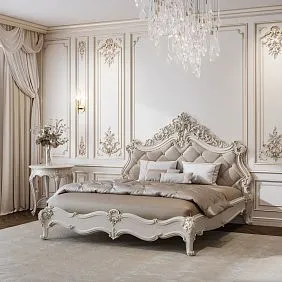
The Bed as an Architectural Object: Why Size and Shape Decide Everything
The bed is the largest piece of furniture in the bedroom, occupying 30-40% of the floor area and a significant part of the visual volume. Its size, height, and headboard shape create a scale to which all other elements must correspond.




Bed Size: From Function to Composition
Single (90x200 cm) — minimum, suitable for children's rooms, guest rooms, small spaces. Double (120x200 cm) — comfortable for one adult or two compactly. Queen (160x200 cm) — standard for a marital bedroom. King-size (180x200 cm or 200x200 cm) — maximum comfort, but requires a spacious room of at least 16 m².
The larger the bed, the larger the bedside tables, lamps, and decorative elements around it should be. A large 200x200 cm bed with small 40x40 cm bedside tables looks unbalanced. Tables of at least 50x50 cm, preferably 60x60 cm, are needed.
Bed height (from floor to top of mattress) affects the sense of space. A low bed (40-45 cm) creates a sense of spaciousness, airiness, suitable for low ceilings, modern interiors. Medium (50-55 cm) — classic standard, convenient for sitting and getting up. High (60-70 cm) — monumental, status, requires high ceilings, creates the impression of a throne.
Our factory also produces:


Headboard: The Vertical That Defines Style
The headboard is the bed's calling card, the element visible from the bedroom threshold. Its height, shape, and decor set the style of the entire room.
Low headboard (80-100 cm from floor) — restrained, modern, does not overload the space. Suitable for minimalist, Scandinavian, modern classic interiors. Medium height (120-140 cm) — classic standard, high enough to create a vertical accent but not overwhelming. High (150-200 cm) — theatrical, baroque, creates the effect of a throne or altar. Requires high ceilings (from 3 meters), spacious room.
Headboard shape influences the character of the bedroom. Rectangular — strict, graphic, modern or neoclassical. Arched (top semicircular) — soft, romantic, referencing Gothic or Renaissance. Figurative (with carved waves, curls, breaks) — baroque, rococo, maximum decorativeness. With side wings (headboard protrudes at the sides, creating a semi-volume) — protective, cozy, English or American classic style.
Get Consultation
Headboard Material and Decor
Solid wood with carving —Classic Furnitureof the highest order. A carved headboard made of oak, beech, walnut with floral ornaments, geometric patterns, cartouches turns the bed into a work of art. The depth of relief, fineness of detail, quality of wood determine the status.
baroque bedwith a lush carved headboard, decorated with acanthus leaves, grapevines, curls, often with gilding or patination, — the pinnacle of decorativeness. Such a bed requires appropriate surroundings: rich fabrics, gilded lights, saturated wall decor.
Upholstered headboard — covered with fabric (velvet, velour, leather, linen), often with tufting (capitonné), where buttons pull the fabric, creating a diamond relief. An upholstered headboard is comfortable for reading in bed, visually warmer than wood, but less monumental.
Combined headboard — wooden frame with carved decor + central part upholstered. The best of both worlds: wood decorativeness + upholstery comfort.
Wall Behind the Bed: Creating an Architectural Background
The wall to which the headboard adjoins is the main wall of the bedroom. It should not compete with the bed, but support it, creating an architectural context in which the bed looks even more expressive.
Accent Painting: Color as a Frame
The simplest solution is to paint the wall behind the bed a color different from the other walls. If three walls are white or beige, the wall behind the bed can be gray, blue, green, even dark graphite. This creates a color frame, highlights the bed area, adds depth.
The color of the accent wall should harmonize with the color of the bed and textiles. Dark walnut bed + dark blue wall — elegant, cool palette. White bed + pastel pink wall — delicate, romantic. Gray bed + graphite wall — modern, strict.
Panel System: Moldings and Panels
A more complex and noble solution is to create a panel system of moldings on the wall behind the bed, which repeats or complements the architecture of the headboard.
Classic scheme: central panel behind the headboard, framed by moldings. Panel size slightly larger than bed width (if bed is 180 cm, panel 200-220 cm), height 130-180 cm depending on headboard height. The panel can be highlighted by color (if walls are white, panel gray or painted a contrasting color), texture (wallpaper with pattern, fabric covering), material (wood panel, mirror insert).
Moldings framing the panel should resonate with the bed's decor. If the headboard has moldings of a certain profile, wall moldings can repeat this profile on a larger scale. If the headboard is carved with floral motifs, carved corner appliqués with the same motif can be placed in the corners of the panel, creating a visual rhyme.
Symmetrical Side Panels
If the wall is wide (4-5 meters), the central panel behind the bed can be complemented by two smaller side panels. This creates a triptych — a large central panel + two symmetrical side panels. The side panels are places for wall sconces, paintings, decorative consoles.
Important: the side panels should not be equal in width to the central one. The classic proportion: the central panel is 60-70% of the wall width, the side panels are 15-20% each. This creates a visual hierarchy where the center dominates.
Vertical elements: pilasters and columns
For tall bedrooms (ceilings from 3 meters), vertical elements can be used — pilasters on the sides of the central panel. Two pilasters framing the bed area create a portal composition, where the bed is perceived as an altar or throne.
Pilasters can be smooth, fluted (with vertical grooves), or decorated with carved overlays. The capitals (upper parts of the pilasters) should match the style of the bed: Corinthian (lush, with acanthus leaves) for Baroque, Ionic (with volutes) for Classicism, Doric (simple) for Neoclassicism.
Wallpaper and fabric wall upholstery
An alternative to moldings is wallpaper with a pattern or fabric wall upholstery. Wallpaper with a large floral or geometric pattern creates a rich background against which the bed looks even more expressive. Important: the wallpaper pattern should not clash with the bed's decor. If the headboard is ornately carved, the wallpaper should be more restrained (small pattern, monochrome). If the headboard is simple, the wallpaper can be bolder.
Fabric wall upholstery — fabric (linen, cotton, velvet) is stretched over the wall like a giant soft headboard. It creates acoustic comfort (the fabric absorbs sound), tactile warmth, and a luxurious atmosphere. The fabric color should harmonize with the bed textiles.
Nightstands: symmetry as a law
Nightstands are an essential element of a classic bedroom, functionally necessary (a place for a lamp, book, phone, alarm clock, glass of water) and compositionally critical.
The rule of pairing
Two identical nightstands on either side of the bed — a fundamental requirement of symmetry inbedroom interior decor. They must be identical: same size, shape, color, decor, hardware. Even if only one person sleeps in the bedroom, two nightstands are maintained — symmetry is more important than functional necessity.
Different nightstands (one taller, the other shorter; one with three drawers, the other with a door; one dark, the other light) break symmetry, create visual imbalance, and violate classical canons. The only permissible difference — one nightstand may have an additional top drawer if more storage is needed on one side of the bed. But the form and decor must be identical.
Size and proportions
Nightstand width — 40-60 cm. Narrow (40 cm) for compact bedrooms, wide (60 cm) for spacious ones, under large beds. Depth — 35-45 cm, so the nightstand does not protrude beyond the bed line or protrudes minimally.
The nightstand height should match the mattress height or be 5-10 cm lower. If the mattress is at 55 cm, a nightstand of 50-55 cm is convenient; the hand easily reaches the top, no need to bend or stretch. A significantly lower nightstand (40 cm with a 60 cm mattress) looks squat and disproportionate. A nightstand higher than the mattress blocks the view, creating a visual wall.
Style and decor
Nightstands should be in the same style as the bed. If the bed is carved Baroque, the nightstands are also carved Baroque. If the bed is Neoclassical with straight lines and fluted pilasters, the nightstands have the same pilasters. A stylistic break (Baroque bed + minimalist nightstands) destroys the ensemble.
The color and finish of the nightstands should logically match the bed. A bed made of solid oak, nightstands made of solid oak with the same stain. A white bed with gold patina, white nightstands with gold patina. Contrast is possible (dark bed + light nightstands) but requires thoughtfulness and support in other interior elements.
Functionality
A nightstand should have at least one drawer or a door with a hidden shelf for storage. The top surface — for a lamp (mandatory), a decorative vase, a photo frame, a book. An outlet in the wall behind the nightstand (or built into the nightstand itself) — for charging a phone, connecting a lamp.
Nightstands on legs look lighter, do not visually overload the space, and make floor cleaning easier. Nightstands on a plinth (solid base to the floor) — more substantial, solid, but visually heavier.
Lighting: symmetrical light
Bedroom lighting is multi-level: general (ceiling chandelier or spotlights), local (bedside lamps, dressing table), decorative (hidden niche lighting, picture lights). In the context of the composition around the bed, bedside lamps are critical.
Paired table lamps
The classic option — two identical table lamps on the nightstands. They provide light for reading, create symmetry, and complement the composition.
Lamp height (from the tabletop to the top of the shade) — 50-70 cm. The shade should be at eye level of a person sitting in bed or slightly lower, so the light does not glare. The lamp base — ceramic, wood, metal — should resonate with the bedroom's materials and colors. A brass base for warm classic with gold, chrome for cold Neoclassical, wood matching the bed color.
Shade — fabric (linen, silk, cotton), creating soft diffused light. Shade color: white, cream (neutral light), colored (adds a warm or cool tint to the light). Shape: cylinder, cone, drum — depends on the style.
Wall sconces
An alternative to table lamps — wall sconces, mounted on the wall above the nightstands or slightly higher, at a height of 120-150 cm from the floor. Sconces save space on the nightstand top, create a more graphic, architectural look.
Two identical sconces symmetrically on either side of the bed — a classic scheme. Distance from the center of the bed to the sconce — 70-90 cm (so that the light falls on the nightstand and the edge of the bed, but does not disturb the partner). Sconces can be on brackets (swivel, adjustable) or fixed.
The style of sconces should match the style of the chandelier and the overall aesthetic. Baroque sconces with crystal pendants under a Baroque chandelier. Neoclassical with simple shades under a restrained chandelier. Modern minimalist ones — if the bedroom is in a modern classic style.
Ceiling chandelier: center or offset?
Traditionally, a ceiling chandelier hangs strictly in the center of the ceiling. But in a bedroom, the center of the ceiling does not coincide with the visual center (which is the bed, usually placed against a wall). A chandelier in the center of the ceiling ends up over the middle or even the foot of the bed, not over the headboard.
Two approaches: either keep the chandelier in the center of the ceiling (the mathematical center is more important than the visual one), or offset the chandelier towards the headboard so it hangs over the bed area, creating a local lighting accent. The second option is less traditional but visually more logical.
The size of the chandelier should correspond to the size of the room and the bed. In a 16 m² (4x4 m) bedroom with a 180x200 cm bed, a chandelier with a diameter of 50-70 cm is proportional. A 40 cm diameter is a bit small, 90 cm is excessive. The height of the chandelier from the floor (the lowest point of the pendants) — minimum 210 cm, to avoid hitting your head.
Textiles: the soft shell of the composition
Textiles in the bedroom — bedding, bedspread, pillows, curtains, rug — create tactile and visual comfort, add color, texture, and complete the composition.
Bedding and bedspread: color and fabric
Bedding is only partially visible (usually the set is covered with a bedspread), but its quality and color affect the feeling of comfort. Natural fabrics — cotton, linen, silk — are breathable, pleasant to the touch, and regulate temperature. Synthetic fabrics (polyester) are cheaper, less demanding to care for, but worse for sleep.
Bedding color: white, cream, pastel — classic, versatile, visual purity. Dark shades (gray, blue, burgundy) — more dramatic, hide stains, create an intimate atmosphere. Colored bedding with patterns — accent, requires support in other interior elements.
Bedspread — a decorative fabric used to cover the bed during the day. It should be significantly larger than the mattress, hanging 20-40 cm over the sides, covering the bed base and part of the nightstands. Bedspread fabric: velvet, velour (luxurious, heavy, for cold seasons), cotton, linen (light, for warm seasons), silk, satin (smooth, shiny, elegant).
Bedspread color — an opportunity to introduce an accent or, conversely, create a neutral background. A bedspread matching the wall color dissolves the bed, making it less massive. A contrasting bedspread (dark against light walls) highlights the bed, emphasizing its central position.
Decorative pillows: layers of texture
Decorative pillows (in addition to functional ones for sleeping) — layers of texture and color that make the bed visually richer. Classic scheme: 4-6 decorative pillows, arranged symmetrically in front of the sleeping pillows.
Sizes: large square (50x50 cm or 60x60 cm) at the back, medium (40x40 cm) in the center, small rectangular (30x50 cm) or round at the front. Fabrics: velvet, silk, linen with embroidery, jacquard with patterns. Colors: either matching the bedspread (monochrome palette) or contrasting (adding an accent color).
Pillows should not overload the bed. More than 8 pillows — excessive, reminiscent of a furniture store, not a living bedroom. Fewer than 4 — ascetic, the bed looks empty.
Curtains: vertical frame
Curtains — a vertical textile element that frames the window, regulates light, and creates privacy. In the bedroom, curtains should be dense, blackout (light-blocking), to ensure darkness for sleep.
Classic scheme: two layers. Inner — tulle, voile, organza (light transparent fabric, letting in daylight, hiding from outside view). Outer — dense drapes (velvet, jacquard, blackout fabric), which are closed at night.
Curtain color should harmonize with the overall palette. Curtains matching the wall color make the window less noticeable, dissolve it into the wall. Contrasting curtains highlight the window, making it an architectural element. Curtains matching the bedspread color create a color connection between the bed and the window.
Curtain length: to the floor (classic option, elongates walls, creates verticality) or with a 5-10 cm puddle on the floor (luxurious option, fabric lies on the floor in folds, creating richness). Short curtains (to the windowsill) are acceptable only if there is a radiator or furniture under the window.
Rug: tactile comfort
A rug in the bedroom — not mandatory, but a desirable element. It creates tactile comfort when getting out of bed (pleasant to step barefoot on soft pile, not cold floor), acoustic comfort (absorbs footsteps), and visual warmth.
Rug placement: either under the bed (rug larger than the bed by 40-60 cm on each side, protruding at the sides and foot, you step on it when getting up), or in front of the bed at the foot (rug 150x200 cm or 200x250 cm, which you step on when getting up).
Rug color: either matching the floor (rug dissolves, creates a visual continuation of the floor, expands space), or contrasting (rug stands out, becomes a decorative accent). Neutral shades (beige, gray, cream) are universal, work with any palette. Colored or patterned rugs — accent, require support in textiles or decor.
Furniture decorBedroom: additional elements
Besides the bed and nightstands, additional furniture pieces may be present in the bedroom, which should be coordinated with the main composition.
Dresser or vanity table
A dresser (for storing clothes, linens) or a vanity table (for cosmetics, jewelry, with a mirror) is often placed opposite the bed or to the side. They should be in the same style as the bed and nightstands, but not necessarily identical. If the furniture set (bed, nightstands, dresser) is from the same collection — ideal. If assembled from different sources, matching style, color, and decorative character is important.
Dresser height — 80-100 cm, width 80-120 cm. Vanity table is lower (70-75 cm, height for sitting), width 90-120 cm. The vanity table mirror can be tabletop (placed on the surface) or wall-mounted (hangs above the table). A wall-mounted mirror in a frame that resonates with the furniture decor creates a visual connection.
Bench or pouf at the foot of the bed
A bench (a low upholstered seat, with or without storage) or pouf (a soft backless seat) at the foot of the bed is a functional and decorative element. It's convenient to sit on the bench to put on shoes, place clothes, or a blanket that is removed at night.
The bench width should be 20-40 cm less than the bed width (if the bed is 180 cm, the bench should be 140-160 cm) to look proportional and not block the bed. Height: 40-50 cm. It's logical to choose the bench upholstery to match the headboard upholstery (if it's soft) or the bed textiles.
Wardrobe: freestanding or built-in
A wardrobe for clothes is a necessary but often visually overwhelming element. A large freestanding wardrobe (width 150-250 cm, height up to the ceiling) occupies a significant part of the wall. If it's in the same style as the bed (carved fronts, paneled doors, classic hardware), it supports the overall concept. If stylistically alien, it ruins it.
A built-in sliding-door wardrobe (doors slide, the body is built into a niche or occupies the entire wall from wall to wall) is more neutral. Fronts can be mirrored (visually expand the space), matte, or with a pattern. Mirrored fronts are practical but create an infinity effect, which not everyone likes in a bedroom.
The ideal option is a built-in wardrobe with classic fronts (paneled, with moldings) that look like part of the wall architecture, not a separate piece of furniture.
Compositional schemes: from classic to modern
Scheme 1: Symmetrical Classic
Bed: King-size 200x200 cm, solid oak, carved headboard 150 cm high with floral ornament, walnut stain, gold patina.
Wall: Accent panel behind the headboard 220x160 cm, framed by profiled oak moldings stained walnut. Inside the panel: wallpaper with a damask pattern in gray-gold. At the corners of the panel: carved corner overlays repeating the headboard ornament.
Nightstands: Two identical, 55x45x60 cm (width-depth-height), solid oak, one drawer with a carved overlay on the front, gilded bronze hardware.
Lighting: Two table lamps with brass bases and cream fabric shades. Central ceiling chandelier, brass with crystal pendants.
Textiles: Dark blue velvet bedspread, decorative pillows — 4 large (blue velvet), 2 medium (golden silk). Two-layer curtains: cream tulle, dark blue velvet drapes. Persian rug with floral ornament, red-blue, under the bed, protruding 50 cm on the sides.
Result: A classic bedroom where every element supports the other. Walnut with gold unites the furniture and wall. Blue textiles add color depth. Symmetry is absolute. The atmosphere is respectable, solemn, status-oriented.
Scheme 2: Neoclassical Restraint
Bed: Double 180x200 cm, painted matte white, headboard 130 cm high with fluted pilasters on the sides and a central soft part upholstered in gray velour with tufting.
Wall: Painted light gray. White moldings, simple rectangular profile, create three vertical panels: central behind the bed 200x140 cm, two side panels 60x140 cm each. In the center of each side panel: a wall sconce.
Nightstands: Two identical, 50x40x55 cm, matte white, one drawer, tapered legs, chrome bracket handles.
Lighting: Two wall sconces with chrome brackets and white conical shades. Ceiling recessed spotlights (no chandelier).
Textiles: Gray quilted bedspread, pillows — 4 pieces, gray and white. Light gray blackout curtains, single-layer, on a hidden rod. Light gray solid-color rug, in front of the bed at the foot.
Result: A restrained, modern classic. White and gray create a cool, calm palette. The absence of carving and gold makes the interior minimalist, but maintaining classic proportions and symmetry keeps it classic. The atmosphere is light, airy, relaxing.
Scheme 3: Baroque Luxury
Bed:baroque bed180x200 cm, solid beech, painted white with rich gold patina. Headboard 180 cm high, lavishly carved (acanthus leaves, cartouches, scrolls), with side wings.
Wall: Painted pale pink. Central panel behind the headboard 210x200 cm with wide profiled moldings (ogee + bead), painted white with gold patina. Inside the panel: fabric upholstery (pale golden silk). At the corners and in the center of the upper part of the panel: large carved overlays with Baroque ornament, white with gold.
Nightstands: Two, 60x50x60 cm, white with gold patina, two drawers with carved fronts, curved cabriole legs, gilded hardware.
Lighting: Two table lamps with porcelain bases (white with gold pattern) and golden fabric shades. Ceiling Baroque chandelier, white with gold, multi-tiered, with many arms and crystal pendants.
Textiles: Golden satin bedspread, decorative pillows — 6 pieces (white satin, golden velvet, pink silk with embroidery). Heavy curtains, jacquard with gold pattern on pale pink background, with lambrequins (decorative drapery at the top). Cream-golden rug with Baroque ornament, under the bed.
Result: A maximally decorative, luxurious bedroom. White with gold and pink creates a delicate but rich palette. Carving, gilding, satin, crystal — everything works to create an impression of palace luxury. The atmosphere is theatrical, festive, slightly excessive, but that is the essence of Baroque.
Frequently asked questions
What is the optimal headboard height for a standard bedroom with a 2.7 m ceiling?
120-140 cm from the floor to the top of the headboard is optimal for typical apartments. This creates sufficient vertical emphasis without overwhelming the space. A headboard taller than 150 cm with a 2.7 m ceiling may appear disproportionately large.
Is an accent wall behind the bed mandatory?
Not mandatory, but desirable. An accent wall (with color, panels, wallpaper, or textiles) highlights the bed area and creates a visual focal point. Without an accent, the bed can get lost against uniform walls, especially if it's not very tall or decorative.
Can the bed be placed not against a wall, but in the center of the room?
Yes, if space allows (room from 20 m²). An island bed, accessible from three sides, requires additional space (minimum 70 cm on each side for passage). In this case, the headboard should be particularly expressive, as the bed is visible from all angles.
Which textiles are changed seasonally?
Bedspreads and decorative pillows are easy to change with the seasons. Winter — heavy velvet, warm tones. Summer — light cotton, linen, light tones. Curtains and bed linens are changed less frequently, usually remaining year-round.
Is a mirror necessary in the bedroom and where should it be placed?
A mirror is functionally necessary (to assess appearance before leaving). Placement: above a dresser or vanity table (classic option), on a wardrobe door (practical), on the wall opposite the window (reflects light, expands space). Avoid placing a mirror opposite the bed — according to feng shui it's bad, and it's psychologically uncomfortable to see your reflection when waking up at night.
How many light sources are needed in a bedroom?
Minimum three levels: general (chandelier or spotlights, bright light for cleaning, getting ready), local (bedside lamps for reading, soft directional light), night (dim nightlight in an outlet or LED strip under the bed, to avoid tripping at night).
How to choose a bedroom color for sound sleep?
Cool, muted shades are calming: gray, blue, lavender, mint. Warm tones are activating: red, orange, bright yellow — not for the bedroom. Neutral tones (beige, cream, light brown) are universal. Avoid colors that are too dark (oppressive) and too bright (stimulating).
Can styles be mixed in a bedroom?
Carefully. If the bed is classic carved and the rest of the furniture is minimalist modern — conflict. But modern classic (classical forms, simplified decor) can be combined with elements of modern or art deco. The presence of a common thread is important — color, material, proportions.
What size rug is needed for a 180x200 cm bed?
If the rug is under the bed: minimum 260x300 cm (extends 40 cm on the sides and 100 cm at the foot). If the rug is in front of the bed at the foot: 150x200 cm or 200x250 cm. A small rug (120x180 cm) under a large bed looks disproportionate.
Is it necessary to hide heating radiators in the bedroom?
If the radiators are old, unaesthetic — desirable. Decorative screens (carved wood, perforated panels) hide the radiator but allow heat to pass through. If the radiators are modern, flat, white — they can be left exposed, they don't spoil the look.
Conclusion: The Bedroom as a Sanctuary
The bedroom is not a passage room, not a place to show off to guests, but a personal space where a person spends a third of their life.Solid wood bedsNoble woods — oak, beech, ash — form the foundation of this space, defining its character, scale, and aesthetics. A carved headboard transforms the bed into a work of art, a compositional center around which everything else is organized.
The wall behind the bed, decorated with moldings and panels, becomes an architectural backdrop that emphasizes the beauty of the bed, rather than competing with it. Symmetrical bedside tables, paired lamps, and thoughtful textiles complete the composition, creating visual order and balance that calm the psyche and set the mood for rest.
Company STAVROS has been creatingclassic furnitureSTAVROS produces furniture of the highest quality, where beds hold a special place. Each STAVROS bed is crafted from solid wood of select species, dried to 8-10% moisture content, guaranteeing stability, absence of deformation, and durability for decades. Carving is performed on high-precision CNC machines with subsequent manual finishing, ensuring depth of relief, clarity of detail, and liveliness of form unattainable with fully machine production.
The STAVROS bed catalog includes dozens of models — from restrained neoclassical to opulent baroque, from compact double to monumental king-size. Custom manufacturing is possible to individual dimensions, with unique decor, in any finish — natural wood with oil, tinting to any color, enameling with patina (gold, silver, bronze, antique), combined finish (wooden frame + upholstered headboard in any fabric of your choice).
STAVROS offers not only beds but everything necessary to create a harmonious bedroom composition: bedside tables, dressers, vanities, benches, wardrobes — all in a unified style, from the same material, with coordinated decor.Furniture decorArchitectural elements for wall decoration — moldings, panels, carved overlays, pilasters — allow creating an architectural context in which the furniture looks even more expressive.
STAVROS consultants help design the bedroom as a unified composition. You come with a room plan, photos, and style preferences. A specialist selects a bed, calculates the sizes and placement of bedside tables, suggests options for decorating the wall behind the headboard, selects moldings and overlays, and advises on a color scheme. You see a 3D visualization of the future bedroom, make adjustments, and approve the project. STAVROS manufactures everything turnkey, delivers, assembles, and installs.
With STAVROS, the bedroom ceases to be just a room with a bed and transforms into a zone of absolute comfort — a space designed for deep rest, where every detail works towards one goal: to give you the best sleep, the best morning, the best recovery. Where the bed is not just a place to sleep, but a personal sanctuary, where beauty and comfort merge into a harmonious whole, where every night is an immersion in luxury, and every morning is an awakening in perfection.


