Article Contents:
- Mechanics of cantilever structures: why brackets are indispensable
- Bracket typology: from minimalism to baroque opulence
- Simple corner brackets: structural honesty
- Profiled brackets: classical architecture
- Carved brackets: decor as art
- Combined brackets: wood and metal
- Furniture supports: verticals shaping the silhouette
- Turned supports: symmetry and rhythm
- Carved supports: sculptural plasticity
- Straight profiled supports: geometry with nuances
- Tapered supports: narrowing creates lightness
- Materials: wood versus alternatives
- Solid wood: the quality standard
- Polyurethane: imitation with limitations
- MDF with coating: the middle option
- Load-bearing capacity calculation: engineering behind beauty
- Load on bracket
- Material strength
- Cross-section dimensions
- Number of brackets
- Bracket installation: reliability technology
- Assessment of wall load-bearing capacity
- Marking and drilling
- Fastener installation
- Installing a shelf
- Load test
- Application in interior: where brackets are indispensable
- Bookshelves in libraries and studies
- Kitchen shelves for dishes and decor
- Console in hallway
- Bathroom
- Architectural Decoration
- Frequently Asked Questions
- Conclusion: Brackets as a Philosophy of Quality from STAVROS

What makes a space feel complete? Not the size of the room, nor the cost of the finishes. The secret lies in the details—those very supports, brackets, consoles, and stands that connect horizontals and verticals, create functionality, and simultaneously become architectural accents. A shelf hanging on invisible fasteners gets lost in the space. The same shelf on carved brackets becomes the compositional center of the wall.
Furniture Bracket— is an engineering structure that works in bending and compression, distributing the weight of cantilevered elements onto a vertical surface.Decorative Bracket— transcends mere utility, becoming a sculptural object that can be appreciated as an independent work of art.buy furniture leg— today means choosing between mass-produced standard and handcrafted quality, between plastic and natural wood, between a temporary solution and an investment for decades.


The Mechanics of Cantilever Structures: Why a Bracket is Indispensable
A shelf attached to a wall creates a cantilever—an element fixed only on one side. The physics of a cantilever is unforgiving: every kilogram of load on the edge of the shelf creates a bending moment that tries to tear the structure away from the wall. The longer the cantilever and the heavier the load, the stronger this moment. Without additional support, the shelf will either sag or pull the fasteners out of the wall.
A bracket solves the problem elegantly. It creates a triangle—the most rigid geometric shape. The vertical arm attaches to the wall, the horizontal arm supports the shelf, and the diagonal brace connects them, converting the bending moment into a compressive load along the brace and a tensile load at the wall attachment. Wood excels in compression. A properly designed bracket can withstand loads dozens of times its own weight.
The size and shape of a bracket are determined by the length of the cantilever and the intended load. For a decorative shelf with light vases, a compact bracket with a depth of one hundred fifty to two hundred millimeters is sufficient. For a bookshelf, a bracket with a depth of two hundred fifty to three hundred millimeters is required. For a cantilevered countertop, work surface, or bar top, powerful brackets with a depth of four hundred to six hundred millimeters and a massive brace are needed.
The brace angle is critical for efficiency. The optimal angle is forty-five degrees. At this incline, the vertical and horizontal components of the load are equal, and the brace works primarily in compression. A steeper brace (sixty to seventy degrees) resists bending less effectively, though it frees up more space under the shelf. A shallower brace (thirty to thirty-five degrees) creates excessive horizontal forces that try to pull the bracket away from the wall.




Bracket Typology: From Minimalism to Baroque Opulence
The world of furniture and decorative brackets is diverse. Each architectural style has developed its own forms, reflecting the aesthetic ideals of the era and the available processing technologies.
Our factory also produces:
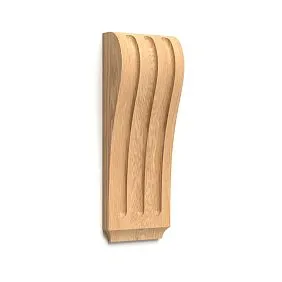


Simple Corner Brackets: Honesty of Construction
A minimalist bracket consists of three bars, joined at right angles or with slight rounding at the joints. No decoration, just pure geometry and function. Such brackets are typical of Scandinavian style, industrial interiors, and contemporary minimalism.
Material—light ash, whitewashed oak, sometimes painted wood. The bar cross-section is rectangular or square, edges can be sharp or slightly rounded. Dimensions are proportional; all three elements (vertical, horizontal, brace) are roughly the same thickness—thirty-five by thirty-five, forty by forty millimeters.
Installation is simple: the vertical post is attached to the wall with three or four screws or bolts, the horizontal shelf is laid on top, sometimes additionally secured from below. The brace is cut at a precise angle to fit snugly against the vertical and horizontal without gaps.
Get Consultation
Profiled Brackets: Classical Architecture
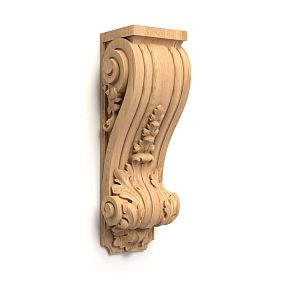
A classical bracket inherits architectural forms—pilasters, consoles, modillions. The vertical post may have a base (widening at the bottom) and a capital (decorative finish at the top). The horizontal shelf is profiled—coves, beads create a play of light and shadow. The brace is not just an inclined plank, but a curvilinear element—an S-curve, volute, stylized acanthus scroll.
Such brackets are characteristic of neoclassical interiors, English traditionalism, American colonial style. Material—oak, walnut, beech. Finish—natural tone with clear varnish, light tinting, sometimes painting in noble colors (cream, gray, olive) with patination in recesses.
Manufacturing requires milling to create profiles, sometimes manual finishing with chisels. Element joints are made with mortise and tenon with glue or dowels, ensuring structural integrity. After assembly, the bracket is sanded and coated with a finish.
Carved Brackets: Decoration as Art
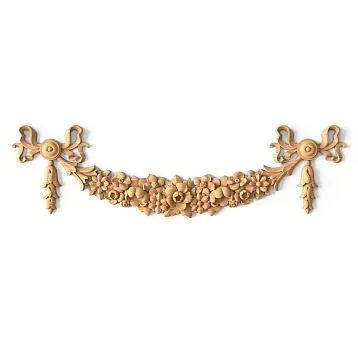
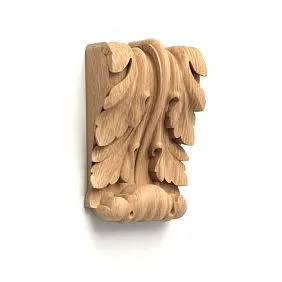
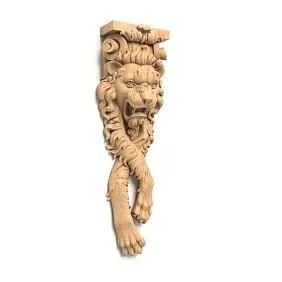
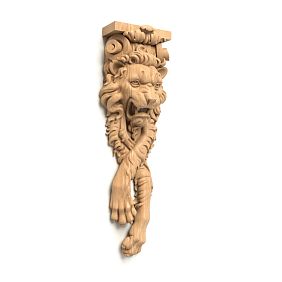
A carved bracket is the pinnacle of furniture and architectural decoration. The brace becomes an object of sculptural elaboration: acanthus leaves wrap around the line, floral garlands intertwine, cherubs peek out from scrolls. The vertical and horizontal elements are also adorned with carving—geometric patterns, egg-and-dart, beads, fluting.
Baroque brackets are maximally saturated with decoration. The carving is deep, volumetric, multi-layered. The brace can be pierced—through holes create a lace-like structure. Material—linden (softer for complex carving), oak, walnut. Finish—gilding (partial or full), patination, polychrome painting.
Rococo brackets are lighter than Baroque ones, asymmetrical, with a motif of a stylized shell. The carving is elegant, with fine details. Art Nouveau brackets use plant motifs—irises, lilies, climbing stems—but stylized, flat, with smooth lines.
The manufacture of carved brackets begins with creating a base form on a CNC milling machine from a 3D model. Then a carver manually refines the details, creates depth transitions, and sands the surface in recesses. Final finishing includes multiple coats of varnish or applying gilding to the raised parts of the carving.
Combined Brackets: Wood and Metal
A modern approach combines materials, using their strengths. A metal frame (forged steel, brass, bronze) provides load-bearing capacity; wooden elements add warmth and decorativeness. The brace is made of metal—it is thinner but stronger than wood. The vertical and horizontal arms are made of wood, with or without carving.
Such brackets suit styles like Provence, country, industrial loft, eclectic interiors. The combination of textures creates a rich visual palette. Oxidized copper with aged oak, matte black steel with whitewashed ash, polished brass with walnut wood—the combinations are endless.
Installation of combined brackets requires consideration of material differences. Metal expands differently than wood. Connections are made with gaps compensating for thermal deformations. Wall mounting is through the metal part, as it is stronger.
Furniture supports: verticals that shape the silhouette
If the bracket supports cantilevered elements, thenFurniture support— is a vertical post bearing weight from above. Tables, dressers, beds, wardrobes — all case furniture stands on supports. The shape, material, and decorativeness of supports define the item's style no less than the case form.
Turned supports: symmetry and rhythm
Turned supports are created on a lathe from a cylindrical blank. The cutting tool removes material, forming a sequence of balls, disks, rings, rollers, cones. The classic baluster-like shape includes a base (wide lower part for stability), a body with alternating convexities and constrictions, a neck (narrow part in the upper third), and a capital (upper widened part adjacent to the tabletop or apron).
Turned supports are universal, combining with classical, neoclassical, Victorian, and Provence interiors. Material — beech (ideal species for turning, homogeneous structure), oak, ash. Diameter — from thirty millimeters for light tables to one hundred millimeters for massive dining tables. Height — from one hundred fifty millimeters for low cabinets to seven hundred millimeters for bar tables.
Finishing of turned supports can be any. Clear varnish emphasizes texture and profile. Toning changes color while preserving visible texture. Painting creates a monochrome surface — white legs are typical for Provence and Scandinavian style, black — for Art Deco and modern classic.
Carved supports: sculptural plasticity
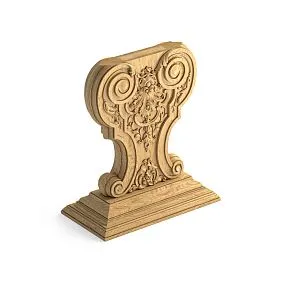
Carved supports are cut from a solid rectangular-section block. This allows creating asymmetrical, curvilinear forms. Cabriole — an S-shaped curved support, typical for Baroque and Rococo, visually lightens heavy furniture, creating a sense of dynamics. The termination of a cabriole is a stylized animal paw (lion, griffin) or scroll.
Herms — supports in the form of tapering downward columns with a capital and sometimes anthropomorphic details (mascarons, female busts) — are characteristic of Empire style. They are monumental, creating a sense of solidity, connection with ancient architecture.
Carved supports with plant decor — stylized stems, leaves, flowers — are typical for Art Nouveau. The form is organic, without straight lines and sharp angles. The cross-section changes smoothly, creating fluidity of silhouette.
Manufacturing carved supports is labor-intensive. The blank is processed on a CNC milling machine or manually with cutters and chisels. Complex forms like cabriole require multi-axis machining. Final sanding is done manually, following all curves and reliefs. Carved supports are the most expensive type of furniture legs, but also the most expressive.
Straight profiled supports: geometry with nuances
A straight support of square or rectangular cross-section seems simplest, but profiling the faces turns it into a decorative element. Chamfers — corners cut at forty-five degrees — soften the form, create additional facets. Flutes — concave grooves along the faces — add depth. Panels — recessed panels on wide faces — create architectural complexity.
Such supports suit Mission style, Shaker, Japanese minimalism, modern classic. Material — any, but expressive texture (oak, ash with contrasting annual rings) is emphasized by profiles. Cross-section — from forty by forty millimeters for light furniture to eighty by eighty for massive.
Profiling is performed on a four-sided planer or milling machine. Precision is critical — all four faces must be identical, otherwise the support looks crude. Final sanding with fine sandpaper (grit 220-320) creates a smooth surface ready for coating.
Tapered supports: narrowing creates lightness
A tapered support — a cylinder or prism narrowing from top to bottom — is typical for mid-twentieth-century Scandinavian furniture. The narrowing visually lightens furniture, creates a sense that the item stands on elegant legs, not heavily rests on massive pillars.
The taper angle is usually small — three to five degrees. Too steep a cone looks unstable, too shallow is unnoticeable. Cross-section — round (turned tapered support) or square (milled). Material — teak, walnut, ash in natural tone. Height — medium, one hundred fifty to four hundred millimeters.
Tapered supports are often installed with a slight outward tilt. This increases the support area, improves stability, creates a dynamic silhouette. Tilt angle — five to ten degrees from vertical.
Materials: wood versus alternatives
Brackets andfurniture legsare produced from different materials: solid wood, MDF, polyurethane, metal, plastic. Each material has its characteristics determining application area and durability.
Solid wood: the benchmark of quality
Natural wood possesses a unique combination of properties. High compressive strength makes wooden brackets and supports capable of bearing significant loads. An oak support with a cross-section of sixty by sixty millimeters withstands over a ton of weight without deformation. A beech bracket three hundred millimeters deep supports a shelf with a load up to fifty kilograms.
The elasticity of wood allows elements to slightly deform under load, then return to their original state. This cushions impacts, prevents brittle fracture. A polyurethane bracket under similar load cracks, metal bends without returning.
The workability of solid wood opens limitless possibilities for shaping. Milling, turning, carving, bending — any technology is applicable to wood. This allows creating elements of any complexity, from simplest to Baroque masterpieces.
Eco-friendliness is critical for living spaces. Wood does not emit toxins, is hypoallergenic, regulates air humidity. Polyurethane may emit volatile compounds, especially when heated. Plastic accumulates static electricity, attracts dust.
The durability of solid wood is measured in decades. Oak supports last a century without loss of load-bearing capacity. Beech brackets withstand constant loads for fifty or more years. If damaged, elements are repaired — scratches are sanded, chips restored, coating renewed.
Polyurethane: imitation with limitations
Polyurethane brackets are molded in ready-made dies, which is cheaper than hand-carved wood. Externally, they imitate carving, but are inferior to solid wood in tactile and visual qualities. The surface is too smooth, uniform, lacking the variability of live carving. Weight is significantly less — polyurethane is lightweight, which simplifies installation but reduces the feeling of solidity.
The strength of polyurethane is sufficient for decorative elements with low load. A polyurethane bracket can support a decorative shelf with light vases. Under a bookshelf or a worktop, it will sag or crack. Such elements perform poorly as load-bearing components — they are decor, not structure.
Durability is limited. After ten to fifteen years, polyurethane yellows (especially white), becomes brittle, and may detach. If damaged, repair is impossible — only replacement. In terms of lifecycle cost, polyurethane is not cheaper than solid wood.
Use is justified in high-humidity environments (bathrooms, saunas) where wood requires enhanced protection. Polyurethane is moisture-resistant, does not rot, and does not deform. Polyurethane elements are also suitable for temporary solutions, budget projects, and spaces with low quality requirements.
MDF with coating: a middle-ground option
MDF brackets and supports are milled from high-density boards, then coated with veneer, laminate, or paint. Strength is higher than polyurethane but lower than solid wood. MDF performs worse in bending than wood — a long bracket may sag. For short consoles (up to two hundred millimeters) and medium loads, MDF is acceptable.
Moisture resistance is problematic. Standard MDF swells and loses shape with prolonged moisture contact. Moisture-resistant MDF is more stable but more expensive. The coating (laminate, veneer) may peel if damaged, exposing the unattractive wood-fiber structure.
Cost is lower than solid wood, higher than polyurethane. MDF elements are a compromise solution when the budget is limited but better quality than plastic is desired.
Load-bearing capacity calculation: engineering behind beauty
The decorative aspect of a bracket should not come at the expense of strength. An element that sags under load or pulls fasteners out of the wall is dangerous and useless. Proper calculation of load-bearing capacity is the foundation of reliability.
Load on the bracket
Total load consists of the weight of the shelf itself, the weight of its contents, and dynamic loads (leaning with a hand, accidental impacts). For a decorative shelf with vases, the design load is ten to fifteen kilograms. For a bookshelf — thirty to fifty kilograms. For a worktop — seventy to one hundred kilograms.
Load distribution along the shelf length is uneven. Heavy items are usually placed closer to the wall, where support is more reliable. The edge of the console is less loaded, but that is where the bending moment is maximum. Calculation is based on the worst-case scenario — the entire load at the front edge of the shelf.
Material strength
Wood performs excellently in compression, well in bending, and worse in tension. In a bracket, the brace primarily works in compression — an ideal mode for wood. The upper part of the horizontal works in tension, the lower in compression, and the middle fiber is neutral. With proper design, the strength of solid wood is sufficient with a multiple safety margin.
Oak and beech with a density of seven hundred to seven hundred twenty kilograms per cubic meter withstand compression up to fifty megapascals. Pine with a density of five hundred kilograms per cubic meter — up to thirty megapascals. For typical furniture loads, stiffness — the ability to resist deflection — is more critical than ultimate stress.
Cross-section dimensions
The cross-section of the bracket is determined based on load and console length. For shelves up to six hundred millimeters long with light load, a bracket with a cross-section of forty by forty millimeters is sufficient. For shelves eight hundred millimeters long with books, a cross-section of fifty by fifty or sixty by sixty millimeters is required. For console worktops with a depth of four hundred to five hundred millimeters — seventy by seventy, eighty by eighty millimeters.
Section height (perpendicular to the load direction) affects stiffness cubically. Doubling the height increases stiffness eightfold. Width affects it linearly. Therefore, it is rational to make the bracket tall (in the plane perpendicular to the wall) and relatively narrow (parallel to the wall).
Number of brackets
For a shelf up to eight hundred millimeters long, two brackets at the edges are sufficient. For shelves one to one and a half meters long, a third central bracket is required, otherwise the shelf will sag in the middle. For long shelves over one and a half meters, bracket spacing is six hundred to eight hundred millimeters.
Bracket distribution is symmetrical. The outer brackets are set back one hundred to one hundred fifty millimeters from the shelf ends. This prevents chipping and cracks at the shelf edges and provides a safety margin.
Bracket installation: reliability technology
Installation quality determines the actual load-bearing capacity. The strongest bracket is useless if it pulls fasteners out of a weak wall or is installed misaligned.
Assessing wall load-bearing capacity
Brick and concrete walls are reliable. Anchors with a diameter of eight to ten millimeters and a length of eighty to one hundred millimeters hold a load of up to one hundred to one hundred fifty kilograms each. With three fastening points per bracket, the total load-bearing capacity is three hundred to five hundred kilograms, which with a multiple safety margin exceeds furniture loads.
Drywall partitions are problematic. A standard anchor in drywall holds five to ten kilograms. Special butterfly or molly anchors — up to twenty to thirty kilograms. For heavy shelves, attachment to the metal frame of the partition through the drywall or installation of embedded elements (wooden blocks, metal profiles) during partition construction is necessary.
Wooden walls (log, timber, frame with sheathing) are ideal. Screws sixty to eighty millimeters long are screwed directly into the wood, ensuring maximum reliability. It is critical to hit a load-bearing element (beam, frame stud), not just the sheathing.
Marking and drilling
Marking begins with determining the horizontal. Use a laser level — it projects a perfectly horizontal line at any distance. Mark the height of the shelf's lower edge or the bracket's upper edge. Place the bracket against the wall, align it with the horizontal line, and mark drilling points on the wall through the fastener holes.
Drilling is done with a hammer drill (for concrete and brick) or a drill (for wood and drywall). The drill bit diameter must exactly match the dowel diameter. The drilling depth should be ten millimeters greater than the dowel length, so that construction dust does not prevent the dowel from seating to its full depth. Drill strictly perpendicular to the wall — an angled hole reduces reliability.
Fastener Installation
Dowels are driven into the holes with light hammer blows until fully seated. The dowel should not protrude above the wall surface. Then, place the bracket, align its holes with the dowels, and screw in the screws. Tighten evenly, starting with the top screw, then the bottom, then the middle one (if present). This prevents misalignment.
Tightening should be sufficient but not excessive. Under-tightening leaves play, causing the bracket to wobble. Over-tightening can split the bracket's wood or crush the dowel in the wall. Use a screwdriver with adjustable torque or tighten manually with a screwdriver, controlling the force.
Shelf installation
After mounting the brackets, place the shelf on them. Check for levelness with a spirit level. If the shelf is slightly tilted, place a thin shim (a wood chip, cardboard) under one of the brackets to level it. For secure fixation, the shelf can be fastened to the brackets from below with screws through the bracket's horizontal shelf into the shelf. The screw length should be three to five millimeters less than the total thickness to prevent them from protruding on the front side of the shelf.
For decorative shelves without fastening, the shelf simply rests on the brackets. Weight creates sufficient friction for fixation in the absence of strong vibrations and impacts. For shelves with valuable or fragile items, hidden fastening is recommended.
Load Test
After installation, conduct a load test. Start with a small weight — a few books, a couple of vases. Leave for a day, check if there is any shelf sag, if the brackets are wobbling, or if cracks have appeared in the wall near the fasteners. Gradually increase the load to the design load, each time checking the condition of the structure.
If sagging of the shelf appears under load (more than two to three millimeters per meter of length), it means either the shelf is not thick enough, or the distance between brackets is too large. The solution is to add an intermediate bracket or replace the shelf with a thicker board.
Application in Interior: Where Brackets are Indispensable
Decorative bracketsare used in a wide variety of areas of residential and public spaces, each time solving functional tasks and creating aesthetic accents.
Bookshelves in Libraries and Studies
Open shelves on brackets are visually lighter than closed shelving units. They create a sense of airiness, make books accessible, and allow for displaying collections. Bookshelves require sturdy brackets — books are heavy, and the load per linear meter can reach fifty to seventy kilograms.
Shelf material — solid oak or ash board, thirty to forty millimeters thick. Brackets — from the same wood species, classic or carved. Distance between brackets — six hundred to seven hundred millimeters to prevent sagging. Height between shelves — two hundred eighty to three hundred twenty millimeters for standard books, four hundred to four hundred fifty millimeters for albums and folios.
Kitchen Shelves for Dishes and Decor
Open shelves in kitchens are functional and decorative. Beautiful dishes, spices in glass jars, ceramic containers create a warm atmosphere of a home hearth. Brackets must be moisture-resistant — the kitchen is an area of high humidity, grease, and temperature fluctuations.
Material — oak or larch with multi-layer varnishing. Shape — from simple corner brackets to carved ones, depending on the kitchen style. For a classic kitchen, carved brackets that echo the decor of the cabinet fronts are suitable. For a modern one — laconic geometric ones.
Shelf depth — two hundred fifty to three hundred millimeters, sufficient for plates and cups. Height above the work surface — five hundred to six hundred millimeters, to avoid hitting your head but easily reach the contents. Number of shelves — two to three, creating a rhythmic composition.
Console in the Hallway
A console table on brackets instead of a traditional one with four legs creates lightness in a narrow hallway. The tabletop is attached to the wall on powerful brackets, with free space underneath visually widening the passage. A key holder, vase, or phone is placed on the tabletop. Shoes or a basket are placed under the tabletop.
Console depth — three hundred to four hundred millimeters. Brackets — massive, carved, becoming a decorative accent in the hallway. Material — oak, walnut, with a finish that harmonizes with the doors and flooring. Console height — seven hundred fifty to eight hundred fifty millimeters, comfortable for leaning an arm on.
Traditionally, a mirror in a carved frame is placed above the console. The console brackets and the frame's carving echo each other in ornament, creating a unified composition — an architectural ensemble for the entrance area.
Bathroom
Shelves in the bathroom on brackets replace bulky cabinets. Open shelves are visually lighter, creating an impression of spaciousness even in a cramped room. Towels, cosmetics, and decorative elements are stored on the shelves.
Material — moisture-resistant. Oak with yacht varnish, larch with oil coating, tropical woods (teak, merbau). Bracket shape — simple, without small recesses where moisture accumulates and mold develops. Coating — multi-layer, to be renewed every two to three years.
Placement — outside the zone of direct splashes from the shower. Height — convenient for access, usually at eye level for a standing person. Shelf depth — two hundred to two hundred fifty millimeters for towels, one hundred fifty to two hundred millimeters for cosmetics.
Architectural decor
Brackets are used not only to support shelves but also as purely decorative architectural elements. They support the cornices of furniture cabinets, creating a transition from the body to the crowning cornice. They are placed under ceiling beams, imitating a load-bearing function for decorative purposes. They frame niches, creating architectural decoration for wall recesses.
In such applications, the load-bearing function is minimal, the decorative one dominates. Brackets can be as elegant as possible, intricately carved, with openwork. Material — linden for complex carving, oak for classic forms. Finish — gilding, patination, painting in architectural colors of the interior.
Frequently asked questions
Can Wooden Brackets Be Used for Outdoor Awnings?
Yes, but special protection is required. Wood is exposed to atmospheric precipitation, ultraviolet light, temperature and humidity fluctuations. Use resistant species — larch, oak. Treatment — antiseptic treatment, multi-layer coating with yacht varnish or facade paint. Regular maintenance — inspection once a year, renewal of the coating if damage appears. The service life of outdoor brackets is twenty to thirty years with proper care.
How Many Brackets Are Needed for a Shelf Two Meters Long?
Minimum three – two at the ends, positioned one hundred to one hundred fifty millimeters from the edges, and one central. For significant loads (books, heavy dishes), four brackets spaced six hundred to seven hundred millimeters apart are better. This prevents shelf sagging and distributes the load evenly.
Can brackets be installed on a drywall partition?
For lightweight decorative shelves (up to ten kilograms total load) – yes, using special drywall anchors (molly bolts, butterfly anchors). For bookshelves or worktop countertops – not advisable. The optimal approach is to plan shelf placement during the partition construction stage, installing wooden blocks or metal profiles into the frame at the future bracket mounting points.
How to choose a bracket size for the shelf depth?
The bracket depth should be seventy to ninety percent of the shelf depth. For a three-hundred-millimeter shelf – a bracket of two hundred to two hundred fifty millimeters. A bracket too deep (equal to the shelf) protrudes, creating a risk of bumping into it. One too shallow (less than sixty percent) does not provide sufficient support; the shelf may tip if the front edge is loaded.
Can unpainted wooden brackets be painted?
Absolutely. Unpainted brackets are supplied without a finish specifically to allow painting in any color. The wood is sanded, primed (for oak, a tannin-blocking primer is mandatory, otherwise they will bleed through white paint), then painted with acrylic enamel or alkyd paint in two to three coats with intermediate sanding. It can also be stained and varnished to preserve the grain.
What load can one oak bracket sized 300×300 millimeters support?
When properly mounted to a solid wall – fifty to seventy kilograms. The limiting factor is not the strength of the bracket itself (it is significantly higher), but the strength of the wall attachment and the rigidity of the structure (deflection under load). For a shelf, the recommended working load per bracket is thirty to forty kilograms with a safety factor.
What is the difference between a furniture bracket and a decorative bracket?
Terminologically, there is no distinction – both terms refer to the same type of product. Conventionally, furniture bracket emphasizes function (supporting furniture elements – shelves, countertops), while decorative bracketdecorative bracket
emphasizes aesthetics (interior decoration, intricate carving). In practice, any quality bracket combines both functions.
includes over two hundred items. Height from eighty millimeters (for low cabinets) to two thousand one hundred millimeters (for bar tables, high consoles). Shapes: turned baluster-like, carved cabriole, straight profiled, tapered. Cross-section from thirty to one hundred twenty millimeters depending on the intended load.An interior is built from details. You can use hidden fasteners, minimalist shelves on invisible brackets – and get a functional but characterless space. Or you can choose quality Final finishing is done with professional compounds from European brands. Osmo and Biofa oils deeply penetrate the wood, highlight the grain, and create a matte, velvety surface. Sayerlack and Sirca varnishes form a durable film with adjustable sheen from matte to glossy. Tikkurila enamels create a flawless painted surface in any color from the RAL or NCS catalog.
The comprehensive approach of STAVROS allows for designing an interior in a unified style. In addition to brackets and supports, the company produces the full range of furniture and interior decor: carved overlays, moldings, cornices, baseboards, casings, balusters, posts, columns, pilasters, consoles, finished furniture. All elements are coordinated in style, material, and processing quality.
The company STAVROS has been creating products from solid wood for professionals and connoisseurs of quality for over twenty years. Specialization in architectural and furniture elements has allowed achieving perfection in this niche, creating collections covering all styles from historical classics to contemporary minimalism.
In STAVROS production, select wood of European origin is used. Oak and beech undergo kiln drying to a moisture content of eight to ten percent, ensuring the geometric stability of the products. Pine and larch – to twelve percent, optimal for coniferous species. Each batch is checked for the absence of critical defects – rot, cracks, resin pockets.
Modern equipment guarantees processing precision. CNC milling machines cut the most complex three-dimensional shapes from digital models. Positioning accuracy – hundredths of a millimeter. This is critical for joining elements that must fit together perfectly. Lathes create symmetrical supports with profile repeatability across all items in a series.
At the same time, manual finishing is preserved. Carvers refine elements cut on CNC, giving them liveliness and individuality. Sanders manually process complex surfaces inaccessible to automated systems. Inspectors check each product, rejecting items with the slightest deviations.bracketsThe STAVROS catalog features over three hundred models of
The STAVROS collectionfurniture supportsbrackets
– from simple corner brackets to Baroque carved masterpieces. Sizes from one hundred fifty to eight hundred millimeters in console depth. Styles: Classic, Neoclassical, Baroque, Rococo, Art Nouveau, Art Deco, Scandinavian Minimalism, Contemporary Classic. Materials: oak, beech, ash, pine, larch. Each model is available in several finish options.
legs and supports catalog
The
Professional consultants will help you select optimal solutions. They will calculate the required load-bearing capacity of brackets for your specific task. They will recommend wood species and finishes. They will select models that harmonize with your existing interior. They will advise on installation, care, and operation. The team knows the product deeply—many have worked at STAVROS for decades.
Delivery is organized throughout Russia and CIS countries. Brackets and supports are packaged in protective materials that prevent damage during transportation. Large orders are assembled on pallets. Logistics are well-established, deadlines are met, and shipments arrive intact.
Pickup is available from warehouses in Moscow and St. Petersburg. Showrooms display the main collections, allowing you to assess the quality of carving, profile precision, and the beauty of the wood. You can take samples of different wood species and finishes to compare at home in your own lighting.
STAVROS prices reflect the true quality of the products. The company operates as a manufacturer, without intermediary markups. It does not skimp on materials, equipment, or staff qualifications. The result is an optimal balance of price and value. STAVROS products are an investment that pays off over decades of flawless service.
ChoosingBracketsandsupportChoosing STAVROS means choosing quality tested by time. It's a solution for those who understand the difference between temporary and permanent, between imitation and authenticity, between mass-produced standards and handcrafted artistry. The right supports transform furniture into works of art, shelves on brackets into architectural compositions, and interiors into spaces where every detail has meaning and significance.