












































































Article Contents:
- Versailles armchair: anatomy of a classic form
- Wall behind the armchair: creating an architectural background
- Decorative panels: texture and depth
- Moldings: lines and rhythm
- Floor lamp: light as a compositional element
- Console: functionality and decor
- Rug: defining zone boundaries
- Lighting: multi-level and functional
- Additional elements: completing the composition
- Color palette: from neutral to expressive
- Symmetry or asymmetry: composition principles
- Practical aspects: placement and ergonomics
- Frequently Asked Questions
- What size wall panel behind the armchair is optimal?
- Can different decor styles be combined around a classic armchair?
- How many light sources are needed for a relaxation zone?
- What color upholstery is best to choose for a living room armchair?
- Is a console needed if there is a coffee table?
- How often should the decor of a relaxation zone be updated?
- Conclusion

A relaxation zone is not just a place where you put an armchair and a floor lamp. It is a carefully constructed composition where every element works to create an atmosphere, where the eye finds anchor points, where the body relaxes, and the soul finds peace.A classic chair, especially one as expressive as Versailles, can become the center of this composition—but only if its surroundings are thought out to the smallest detail. The wall behind the armchair's back should not be empty, the space nearby should not be bland, and the lighting should not be random.
How to turn an armchair into a focal point of the living room? WhatLiving room interior decorwill enhance its status, emphasize its lines, and create an architectural environment? Panels behind the back, moldings on the walls, a floor lamp with a classic lampshade, a console for books and decorative objects—all these are tools that transform a standalone piece of furniture into a cohesive zone that attracts attention and invites you to stay.

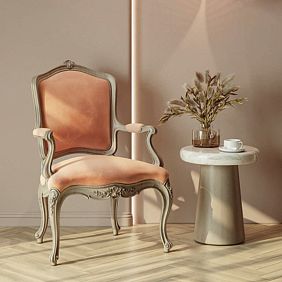


Versailles armchair: anatomy of a classic form
Versailles is not just a name, but a stylistic manifesto. A carved armchair inspired by the era of Louis XV embodies everything associated with classicism: smooth curves, floral ornaments, elegant proportions. A frame made of solid oak or beech guarantees strength and durability, while hand carving gives uniqueness to each piece. The high back with soft upholstery provides comfort, and the wide armrests offer support for the hands.
The shape of the armchair determines what decor will harmonize with it. Curved legs require support in the form of soft, rounded elements on the walls—arched moldings, panels with rounded corners, round or oval mirrors. The carved ornament on the back and armrests dictates the use of similar motifs in wall overlays, picture frames, and console decor. The color of the upholstery—whether it's deep emerald velvet or light jacquard fabric—sets the tone for the entire color palette of the relaxation zone.
It is important to understand that an armchair of this caliber does not tolerate random surroundings. It requires a background worthy of its status. An empty white wall behind the back will make the armchair lonely, lost in space. But a wall adorned with a thoughtful composition of moldings, panels, and overlays will turn the armchair into the main character of a scene, where every detail works to enhance its grandeur.




Wall behind the armchair: creating an architectural background
The wall behind the armchair is the canvas on which the visual story unfolds. The most effective solution is to create a panel of moldings, within which the armchair is positioned as if in a frame. Moldings form a rectangle or a more complex geometric shape, framing the relaxation zone and highlighting it from the general living room space.
The molding profile should echo the lines of the chair. If the chair has pronounced curves, the molding can be wavy, with botanical motifs. If the chair is more restrained, with straight lines, the molding can also be geometric, strict. The width of the molding is determined by the scale of the chair — a massive chair requires wide, expressive moldings, an elegant one — thinner, more delicate ones.
Inside the panel, various filling options are possible. Painting in a contrasting color creates an accent, highlighting the relaxation area. Wallpaper with a pattern adds decorativeness, richness. Fabric wall upholstery is a luxurious solution, suitable for classic interiors where tactility, softness, and a sense of comfort are important. Wooden panels create material unity with the chair, especially if the chair frame is made of oak or beech.
The height of the panel is determined by the proportions of the wall and the chair. The panel can occupy the entire wall from floor to ceiling, creating a monumental backdrop. It can be positioned only behind the chair back, highlighting this area without overloading the entire wall. It is important to find a balance so that the panel does not overwhelm the chair with its massiveness, but also does not get lost against its background.
Our factory also produces:
Decorative panels: texture and depth
interior wall decorin the form of wooden panels adds depth, texture, and materiality to the relaxation area. Solid oak panels with carved ornamentation, installed behind the chair, create a luxurious backdrop that emphasizes the status of the furniture. The relief of the panels creates a play of light and shadow, making the wall not flat but volumetric, alive.
The shape of the panels can vary. Rectangular raised panels are a classic solution, suitable for symmetrical, orderly interiors. Panels with an arched top are for more lush, Baroque spaces. Geometric panels with square or diamond-shaped sections are for Neoclassicism, where strictness and rhythm are important.
The color of the panels determines the character of the zone. Natural wood with a wax finish creates a warm, organic atmosphere. Painted panels in light tones — white, cream, gray — make the space airier, visually expand it. Dark panels — chocolate, anthracite — add drama, create an intimate, cozy atmosphere suitable for a relaxation area.
Panels can be complemented with carved overlays — floral motifs, scrolls, geometric elements — that echo the carving on the chair. This creates a visual connection between the furniture and the architecture, uniting them into a single composition. Overlays are installed at the corners of the panels, in the center, along the perimeter — depending on the desired effect.
Get Consultation
Moldings: lines and rhythm
Moldings are the most versatile tool for creating an architectural context around a chair. Vertical moldings running from floor to ceiling along the edges of the chair visually elongate the space, creating a sense of height. They work like columns framing the relaxation area, turning it into a kind of portal or niche.
Horizontal moldings at the level of the chair back create a visual support, a horizontal axis around which the composition is built. They can run along the entire wall or only on the section behind the chair, depending on the size of the room and the desired effect. Horizontal lines expand the space, make the relaxation area more stable, substantial.
A combination of vertical and horizontal moldings creates complex compositions — panels, frames, geometric structures. Inside such frames, aClassic Furniture, paintings, mirrors, sconces can be placed. This creates a multi-layered interior where each element has its place, its visual frame.
The molding profile should be chosen considering the style of the chair and the entire living room. For Baroque interiors, moldings with botanical ornaments, scrolls, and rocaille are suitable. For Neoclassicism — strict, geometric, with minimal decoration. For modern classic — very laconic, with a rectangular or slightly rounded profile.
The color of the molding works on contrast or on unity. White moldings on a colored wall create a clear structure, highlight the relaxation area. Moldings in the same tone as the wall create a soft volume, barely noticeable but tangible due to the play of light and shadow. The contrasting option is more expressive, the monochrome one is more delicate.
Floor lamp: light as an element of composition
A reading chair, a relaxation chair, a chair for contemplation requires proper lighting. A floor lamp on a tall stand with a classic shade is the ideal companion for aclassic chair. It creates local lighting, sufficient for reading, but not too bright, not destroying the atmosphere of coziness and tranquility.
The design of the floor lamp should echo the style of the chair. If the Versailles chair is made with delicate carving and smooth lines, the floor lamp can have a carved wooden base, a curved leg, a shade made of fabric with a classic pattern. The color of the floor lamp — gold, bronze, patinated — emphasizes its belonging to the classic style.
The placement of the floor lamp is critical. It should not stand directly behind the chair, blocking the view of the panel or panels. The optimal position is to the side of the chair, slightly behind, so that the light falls over the shoulder of the seated person. This creates comfortable conditions for reading, while the floor lamp remains a visible element of the composition, complementing the chair, not hiding behind it.
The height of the floor lamp should correspond to the height of the chair back. A floor lamp that is too low will not provide enough light, one that is too high will look disproportionate. Ideally, the shade is approximately at the level of the seated person's head or slightly above. This ensures optimal light distribution and visual balance.
The floor lamp shade can be made of fabric, glass, paper. Fabric shades create soft, diffused light, suitable for a relaxation area. Glass ones — brighter, more directional light, suitable for reading. The color of the shade can echo the upholstery of the chair, creating a color connection between the elements.
Console: functionality and decor
A console — a narrow table on elegant legs — is a natural addition to a chair in a relaxation area. On the console, you can place books, magazines, decorative objects — vases, figurines, clocks. The console also serves as a stand for a table lamp if a floor lamp is not used, or for additional lighting.
The style of the console should match the chair. Carved legs, botanical ornaments, elegant proportions — all this makes the console part of a classic composition. The material — solid oak or beech — creates material unity with the chair. The color — natural wood, white, cream, patinated — is determined by the overall palette of the relaxation area.
Placement of the console is possible in several options. Behind the chair, against the wall, under the panel — the console becomes part of the background, complements the wall decor. To the side of the chair — the console serves as a side table, becomes a functional element. Opposite the chair, against the opposite wall — the console works as a visual axis around which symmetry is built.
On the console, decorative objects are placed that enhance the style of the zone. A vase with flowers adds liveliness, organicity. A figurine or bust — classic charm. A stack of books in leather bindings — intellectuality, respectability. A mirror above the console — if it is against a wall — visually expands the space, adds light.
The height of the console is usually about 80-90 cm, which corresponds to the height of the chair armrests. This creates visual unity, a horizontal line that unites the elements into a composition. The length of the console can vary — a narrow console takes up minimal space, a wide one creates a more expressive accent.
Rug: defining the boundaries of the zone
The rug under and around the armchair defines the boundaries of the relaxation zone, visually separating it from the rest of the living room space. In a classic interior, a rug is not just a practical covering but also a decorative element that should harmonize with the furniture and finishes.
Rug size is critical. A small rug on which only the front legs of the armchair stand looks incomplete and fails to perform its zoning function. The optimal choice is a rug on which the armchair, floor lamp, and possibly a console table are fully placed. This creates a unified zone, visually distinct from the space.
The color and pattern of the rug should echo the upholstery of the armchair and the wall decor. A rug with a floral pattern suits Baroque interiors, while one with a geometric pattern suits Neoclassical styles. A solid-colored rug in a neutral shade is a universal solution that doesn't overload the composition and serves as a background for the furniture.
The material of the rug is also important. A hand-woven wool rug is a luxurious option suitable for high-end classic interiors. A silk rug is even more refined but requires careful handling. A synthetic rug with a classic design is a practical solution for everyday life.
The shape of the rug is determined by the configuration of the relaxation zone. A rectangular rug is the most common option, suitable for most cases. A round rug is a more unexpected solution, creating a soft, centered composition around the armchair. An oval rug is an intermediate option, combining fluidity and structure.
Lighting: Multi-level and Functional
The relaxation zone requires multi-level lighting, where each light source serves its own function. General lighting—a chandelier or ceiling lights—provides a basic level of light in the living room. Local lighting—a floor lamp or table lamp on a console—creates comfortable conditions for reading and relaxation. Accent lighting—a wall sconce, picture light—highlights decorative elements and creates atmosphere.
As mentioned, the floor lamp is a key element of the relaxation zone's lighting. But it can be complemented by other light sources. Wall sconces behind the armchair, directed upward, create soft, diffused lighting and emphasize the texture of panels or artwork. LED strips behind moldings or cornices create a floating effect, visually expanding the space.
The color temperature of the light determines the atmosphere. Warm light—2700-3000K—creates coziness and relaxation, suitable for a relaxation zone. Cool light—4000K and above—is brighter and more invigorating, not suitable for evening relaxation. The ability to adjust brightness—a dimmer—allows adapting the lighting to different times of day and moods.
The direction of light is also important. Light directed onto the armchair from above creates a dramatic effect but can be uncomfortable for reading. Light from the side, over the shoulder, is optimal for reading and work. Light from below, from floor lamps, creates an intimate, cozy atmosphere but doesn't provide enough light for functional tasks.
Additional Elements: Completing the Composition
The relaxation zone around the armchair can be complemented by other elements that complete the composition, making it more complex and interesting. A mirror in a carved frame above the console reflects light and visually expands the space. A painting in a classic frame on the wall behind the armchair—if there is no artwork—creates a visual center, a focal point.
Live plants in classic planters add organic life. A large plant in a floor planter next to the armchair creates a green accent, softening the strictness of classic furniture. Small plants on the console—flowers in a vase, succulents—complement the decor and add color.
Decorative pillows on the armchair—if the design allows—create additional comfort and a color accent. The fabric of the pillows can echo or contrast with the armchair's upholstery, creating visual interest. The pattern of the pillows—floral, geometric—should match the interior's style.
A throw, casually draped over the arm of the chair, creates a sense of a lived-in space, coziness, and habitation. The color of the throw can be neutral or accent, depending on the desired effect. The material—wool, cashmere—adds tactility, inviting touch and comfortable settling in.
A side table next to the armchair—if space allows—adds functionality. You can place a cup of tea, a book, or a tablet on it. The table should be proportional to the armchair—not too large, not too small. The style of the table—carved legs, classic tabletop—should match the armchair and console.
Color Palette: From Neutral to Expressive
The color scheme of the relaxation zone determines its character—calm and relaxing or expressive and dramatic. A neutral palette—white, beige, gray, natural wood—creates a calm, airy atmosphere. An armchair in light upholstery against cream walls with white moldings is a classic solution that never goes out of style.
An expressive palette—deep, saturated colors—creates a dramatic, luxurious atmosphere. An armchair in velvet upholstery of emerald or sapphire shades against dark panels is an effective solution for spacious living rooms with high ceilings. Gold or bronze accents—floor lamp, frames, overlays—enhance the sense of luxury.
An intermediate option is a combination of a neutral base with color accents. An armchair in beige or gray upholstery is complemented by bright pillows, colored accessories on the console. Walls are neutral, but moldings or panels are painted in a contrasting color. This creates a balance between calmness and expressiveness.
It is important to consider lighting when choosing colors. In rooms with plenty of natural light, you can use more saturated, dark colors—they won't look gloomy. In rooms with insufficient light, it's better to stick to a light palette to avoid a sense of crampedness and heaviness.
Symmetry or Asymmetry: Principles of Composition
Classic interiors lean towards symmetry, and the relaxation zone is no exception. The armchair can be the central element of a symmetrical composition, where identical floor lamps, consoles, and plants are placed on both sides. The artwork on the wall behind the armchair is symmetrical relative to the vertical axis of the armchair. This creates a sense of order, stability, and classic harmony.
However, strict symmetry can look boring and predictable. A slight break in symmetry creates dynamism, interest, and a modern interpretation of classic style. A floor lamp on one side of the armchair and a console on the other—an asymmetrical but balanced composition. A painting on the wall is offset from the center but balanced by a plant or another element.
An asymmetrical composition requires a more refined sense of balance. The elements don't have to be identical but should have comparable visual weight. A large floor lamp on one side can be balanced by a console with decorative objects on the other. It's important to avoid a sense of chaos or randomness—each element should be in its place.
The choice between symmetry and asymmetry depends on the overall interior style and personal preferences. Symmetry is better suited for strict, formal living rooms. For more relaxed, lived-in spaces—asymmetry. A hybrid option is also possible, where the main structure is symmetrical but the details are asymmetrical.
Practical Aspects: Placement and Ergonomics
Creating a relaxation zone requires not only aesthetic sense but also an understanding of practical aspects. The distance between the armchair and the wall behind it should be sufficient to avoid a cramped feeling but not too large to lose visual connection. Usually, 10-20 cm is the optimal distance.
The distance between the armchair and the console or side table should provide convenient access to items on them. 30-40 cm is a comfortable distance, enough to reach without getting up. The floor lamp should not stand too close to the armchair to avoid interference when standing up, but not too far away for the light to fall effectively.
The height for installing wall sconces is determined by the height of the armchair's back. Ideally, sconces should be at eye level of the seated person or slightly higher. This creates comfortable lighting without glare. The distance between sconces in a symmetrical composition should be proportional to the width of the armchair—usually the width of the armchair plus 50-100 cm on each side.
The ergonomics of the chair are also important. Seat height, backrest tilt angle, seat depth — all of these should ensure comfort during prolonged sitting. Classic chairs typically have well-proportioned dimensions based on centuries of experience. It's important to ensure that a specific model suits you personally — sit down and assess its comfort.
Frequently asked questions
What size wall panel behind the chair is optimal?
The panel should be proportional to the chair and the wall. If the chair is about 1 meter wide, the panel can be 1.5-2 meters, creating a visual frame around the chair with margins on the sides. In height, the panel can run from floor to ceiling or occupy 2/3 of the wall height — depending on ceiling height and the desired effect.
Can different decor styles be combined around a classic chair?
A classic chair requires a classic setting for harmony. Mixing styles is possible in neoclassicism, where classic forms are combined with modern materials and restrained decor. However, a Baroque chair with minimalist decor will look out of place and lose its expressiveness.
How many light sources are needed for a relaxation area?
At least two — general living room lighting and a local floor lamp by the chair. Ideally three to four — add a wall sconce or panel lighting to create multi-level illumination. This allows adapting the light for different situations — reading, relaxation, evening ambiance.
What color of chair upholstery is best to choose for a living room?
Depends on the overall interior palette. Neutral colors — beige, gray, cream — are universal and easily combined with various decor. Saturated colors — emerald, sapphire, burgundy — create a bright accent and require support in accessories. Light upholstery is practical for formal living rooms, dark — for daily-use living spaces.
Is a console needed if there is a coffee table?
A console and a coffee table serve different functions. A console against the wall is a decorative element, a stand for lamps and ornaments. A coffee table in front of the chair is a functional surface for a cup, a book. In a spacious living room, both elements are appropriate; in a compact one, you can limit yourself to one.
How often should the decor of a relaxation area be updated?
A classic composition is long-lasting and does not require frequent changes. You can update textiles — pillows, a throw — seasonally or according to mood. Decorative items on the console — vases, figurines — can be changed every few months for freshness. Main elements — the chair, moldings, panels — last for decades without changes.
Conclusion
The relaxation area around classic chair — is the art of creating a composition where every element is in its place, every detail works towards the overall idea. Living room interior decor not only adorns the walls, it creates an architectural context in which furniture is revealed most fully, becomes the center of attention, attracting the eye.
Panels behind the chair back create a background worthy of its status. Moldings form structure, visual frames, and highlight the area from the general space. A floor lamp provides light necessary for comfort and simultaneously serves as a decorative element. A console adds functionality and the possibility to place personal items, books, ornaments. All together, this creates a corner where you want to stop, sit down, and stay.
Creating such an area requires an understanding of proportions, a sense of color, and knowledge of materials. It's important not to overload the space, to preserve airiness, but also not to leave it empty, devoid of character. The balance between excess and asceticism — that is the key to a successful composition. Classic Furniture requires an appropriate setting — not random, but thoughtful, precise, refined.
STAVROS Company offers everything necessary for creating classic relaxation areas — from Versailles chairs with hand carving and noble upholstery to decorative elements made of solid wood — moldings, panels, overlays, consoles. Each product is created with attention to detail, with respect for the traditions of classic furniture art. In-house production allows controlling quality at all stages, creating custom solutions for specific projects, and quickly responding to the requests of designers and private clients. Natural materials — oak, beech, valuable wood species — guarantee durability and aesthetic value. Hand carving, traditional joinery techniques, professional upholstery — all this makes STAVROS products the choice of those who value true quality and understand that classic is eternal. Let your living room become a space where every detail speaks of taste, where a chair is not just furniture, but the center of a composition, inviting you to stop, rest, and enjoy the beauty and comfort created by your hands and your vision.


