Article Contents:
- Evolution of Solid Furniture Materials: From Antiquity to the Present Day
- Historical Perspective on Materials Science
- Modern Requirements for Materials
- Wood Composites — The Foundation of Modern Solid Furniture
- Particle Board: Technology and Properties
- MDF: Precision Technology of Fiberboards
- OSB and Other Oriented Materials
- Solid Wood in Solid Furniture
- Wood species and their characteristics
- Solid Wood Processing Technologies
- Stabilization and Protective Treatment
- Metal Components in Solid Furniture
- Steel Structures and Profiles
- Hardware and Fasteners
- Surface Finishing and Decorative Materials
- Laminating and Its Technologies
- Natural Veneer Application
- Coating finishes
- Innovative materials and technologies
- Composite materials of new generation
- Nanotechnologies in Finishing Materials
- Ecological Aspects of Solid Furniture Production
- Formaldehyde Emissions and Their Control
- Secondary recycling and disposal
- Certification and Environmental Standards
- Production Technologies for Solid Furniture
- Cutting and Preparation Operations
- Drilling and Fixing Operations
- Milling Operations and Profiling
- Quality Control and Material Testing
- Incoming Raw Material and Component Inspection
- Testing of Finished Products
- Ecological Testing and Certification
- Trends in Development of Solid Furniture Materials
- Digitalization of Production and Industry 4.0
- Personalization and Mass Customization
- Smart Factory: Digital Transformation of Furniture Production
- End-to-end digital chain
- Flexible logistics and "smart" warehouse
- Ecological contour
- Future of furniture: synergy of technology and creativity
- Economy of customization: benefits for client and manufacturer
- Conclusion
- FAQ
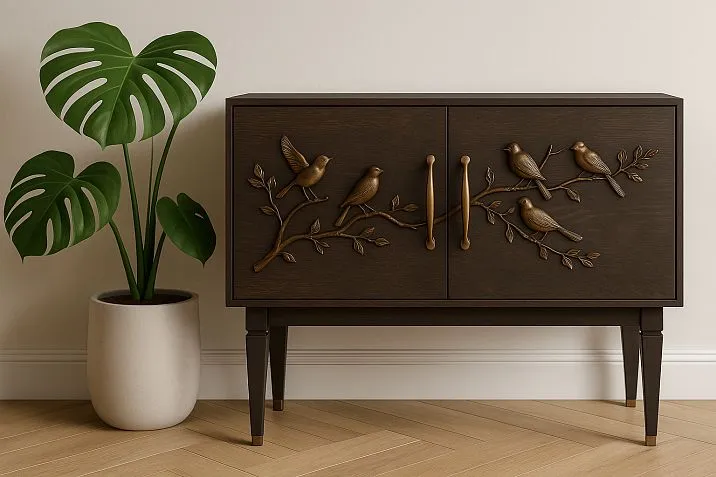
Cabinetry furniture — the basis of modern living and working spaces. Cabinets, chests, sideboards, shelves — all these items share one thing: they have a frame construction with clearly defined dimensions. But what lies behind this simple formulation? What materials and technologies underlie quality cabinetry furniture? Question What is cabinet furniture made of? Seems simple, but behind it lies a whole world of engineering solutions, chemical technologies, and manufacturing processes.
Unlike soft furniture, where fillers and upholstery play the main role, cabinetry furniture is primarily about construction. Here, each element must perform a strictly defined function: carry load, provide rigidity, resist deformation. At the same time, modern requirements for cabinetry furniture go far beyond simple functionality — it must be aesthetic, ecological, durable, and economically justified.


Evolution of cabinetry materials: from antiquity to the present day




Historical perspective of materials science
When analyzing modern approaches to cabinetry furniture production, it is important to understand how materials and technologies have evolved over centuries. Ancient craftsmen worked exclusively with solid wood, creating items many of which have survived to this day. However, mass production of quality furniture became possible only with the advent of composite materials in the mid-20th century.
The revolution in furniture production began with the invention of particleboard in the 1940s. For the first time, it became possible to use wood waste to create a homogeneous sheet material with predictable properties. This fundamentally changed the economics of furniture production, making quality furniture accessible to a broad segment of the population.
The next important stage was the introduction of MDF (Medium Density Fiberboard) in the 1960s. This material combined the best properties of solid wood and composite panels: uniform structure, dimensional stability, and the ability to be finely processed. MDF opened up new possibilities for designing facades and decorative elements.
The modern stage of development is characterized by the emergence of high-tech materials with defined properties. Water-resistant panels, fire-resistant composites, antibacterial materials — all of this is the result of targeted scientific research.
Our factory also produces:


Modern requirements for materials
Today's quality standards for cabinetry furniture take into account numerous factors that were previously not considered. Ecological safety has become not just a desirable property, but a mandatory requirement. Formaldehyde emissions must meet E1 or E0 class standards, which requires the use of special binding components.
Mechanical characteristics have also become significantly stricter. Modern cabinetry furniture must withstand significant loads while maintaining geometry and functionality. Standard tests include cyclic loads on shelves, checking the strength of joints, and tests for the durability of hinges and guides.
Aesthetic requirements have grown exponentially. Consumers expect not just functional furniture, but interior items capable of decorating a space. This requires materials to have not only technical characteristics, but also decorative capabilities.
Get Consultation
Wood composites — the basis of modern cabinetry furniture
Particleboard: technology and properties
Particleboard remains the most widely used material for producing cabinetry furniture due to its optimal price-to-quality ratio. Modern particleboard production technology is fundamentally different from processes from 50 years ago. The use of oriented particles of different fractions, multi-layer layup, precise dosing of binding components — all this ensures stable characteristics of the finished panel.
The base of particleboard consists of wood particles of certain sizes. Large particles (up to 25 mm in length) form the load-bearing middle layer, providing the main strength of the panel. Fine particles (5–15 mm in length) are used to form outer layers, creating a smooth surface for subsequent laminating.
Binding components play a critical role in determining the properties of particleboard. Traditionally, urea-formaldehyde resins are used, but modern ecological requirements are driving the development of alternative binders. Melamine-formaldehyde resins provide increased water resistance, while isocyanate binders virtually eliminate formaldehyde emissions.
The pressing technology determines the final characteristics of particleboard. Temperature 180–220°C, pressure 2–4 MPa, holding time 4–8 minutes — these parameters are carefully controlled to ensure product quality. Modern presses with individual temperature control for each panel allow achieving exceptional material uniformity.
MDF: precision technology of fiber panels
MDF represents the next level of development of wood composites. Using wood fibers instead of particles ensures a more uniform structure and improved mechanical properties. Materials for Furniture MDF allows creating items of complex shapes with high dimensional accuracy.
MDF production begins with preparing wood raw material. Wood is ground in refiners to the state of individual fibers. This process requires precise temperature and humidity control, since overheating can damage fibers, while insufficient processing leads to structural inhomogeneity.
Binding components for MDF have their own specificity. Urea resins with paraffin additives are most commonly used to improve water resistance. The amount of binder is 8–12% of the dry raw material mass, which is significantly less than in particleboard. This ensures better ecological characteristics and reduces production costs.
MDF molding occurs by dry pressing at a temperature of 170–220°C. High pressure (up to 5 MPa) is required to achieve the required density of 600–800 kg/m³. Precise control of pressing parameters ensures uniform properties across the entire panel area.
OSB and other oriented materials
Oriented Strand Board (OSB) occupies a special niche in the production of furniture. The use of large flakes oriented in specific directions provides high strength at relatively low density. OSB is especially effective in bending applications — back panels of cabinets, drawer bottoms, shelves.
OSB production technology involves forming three layers with different flake orientations. The outer layers have longitudinal flake orientation, while the inner layer has transverse orientation. This structure ensures anisotropy of properties: high strength in the longitudinal direction and sufficient stiffness in the transverse direction.
Modern OSB is classified by moisture resistance and mechanical properties. OSB-2 is intended for dry conditions, OSB-3 — for humid conditions, OSB-4 — for heavily loaded structures in humid environments. For furniture, OSB-3 is most commonly used as the optimal combination of properties and cost.
Solid Wood in Furniture
Wood species and their characteristics
Despite the widespread use of composite materials, solid wood retains an important place in the production of high-quality furniture. Different wood species have unique properties that determine their application in specific structural elements.
Coniferous species — pine, spruce, larch — are characterized by relatively low density (400–600 kg/m³) and good workability. Resinous substances provide natural protection against biological damage, but may cause problems during finishing. Coniferous species are optimal for hidden structural elements — drawer frames, internal partitions, support beams.
Hardwood species — oak, beech, ash — are distinguished by high density (650–800 kg/m³) and strength. These species are ideal for manufacturing facades, countertops, visible structural elements. However, their high cost and processing complexity limit their use in mass production.
Softwood species — linden, aspen, poplar — occupy an intermediate position in terms of properties and cost. They are often used for manufacturing internal furniture elements where a combination of strength and economy is required.
Solid Wood Processing Technologies
Modern processing of solid wood for furniture includes numerous technological operations, each affecting the quality of the finished product. Drying is the first and critically important stage. Kiln drying ensures uniform moisture removal to an optimal level of 8–12%. Violating drying regimes leads to warping, cracking, and internal stresses.
Planing and sizing ensure dimensional accuracy and surface quality. Modern four-sided machines allow processing of blanks with accuracy ±0.1 mm. Planing quality depends on blade sharpness, feed rate, and wood moisture content.
Gluing blanks into furniture panels is a complex technological process requiring precise parameter adherence. Polyvinyl acetate adhesives provide bonding strength exceeding the strength of the wood itself. It is important to ensure even glue application, optimal pressing pressure (0.8–1.2 MPa), and adherence to dwell time.
Stabilization and Protective Treatment
Solid wood is susceptible to dimensional changes with air humidity fluctuations. The volumetric change coefficient can reach 12–15% when humidity changes from 0 to 30%. Such changes are unacceptable for furniture, so various stabilization methods are applied.
Impregnating with stabilizing compounds reduces wood hygroscopicity. Polyethylene glycols, synthetic resins, and special waxes create a barrier against moisture penetration. Impregnation depth should be at least 3–5 mm to ensure effective treatment.
Protective treatment prevents biological damage to wood. Borate-based, quaternary ammonium, and copper-based antiseptics provide long-term protection. It is important to ensure even treatment of all surfaces, including ends and hidden cavities.
Metal Components in Furniture
Steel Structures and Profiles
Metal plays an increasingly important role in modern furniture. Steel frames provide exceptional strength and durability, especially in office and public furniture. Cold-rolled profiles of various cross-sections allow creating lightweight yet strong structures.
The thickness of steel sheet for furniture varies from 0.8 to 2.0 mm depending on load. Metal thickness calculation considers maximum loads, safety factors, and deformation requirements. Modern calculation programs allow optimizing the structure for weight and cost.
Methods of connecting metal elements affect the strength and aesthetics of the structure. Spot welding provides strong connections with minimal heating of parts. Riveted connections allow creating disassemblable structures. Threaded connections provide maximum versatility and repairability.
Protective coatings are critically important for the longevity of metal elements. Galvanizing provides cathodic protection of steel against corrosion. Powder coatings create durable, attractive finishes resistant to mechanical damage. Anodizing aluminum parts increases corrosion resistance and provides a decorative effect.
Hardware and Fasteners
Furniture hardware Determines the functionality and longevity of furniture. Modern hardware consists of complex mechanisms ensuring smooth operation, reliable fixation, and long-term durability.
Furniture hinges vary by construction, load capacity, and opening angle. Surface-mounted hinges are used for light doors, recessed hinges — for heavy structures. Hinges with closers ensure smooth closing and reduce noise. Modern hinges are designed for 80–100 thousand open-close cycles.
Drawer slide guides are another critical element. Ball-bearing guides ensure smooth operation under loads up to 40–60 kg. Full-extension guides allow using the entire drawer volume. Guides with closers prevent slamming when closing.
Fasteners must ensure reliable connections under repeated loads. Conformers (Euro screws) create strong connections for panel materials. Eccentric clamps allow creating high-strength disassemblable connections. Shanks ensure precise positioning of parts during assembly.
Surface Finishing and Decorative Materials
Laminating and its Technologies
Laminating is the primary decorative finishing method for panel materials in furniture. Modern laminates are multi-layer materials, where each layer performs a specific function. The base is kraft paper impregnated with phenolic resins, providing mechanical strength. The decorative layer contains a printed pattern of any complexity. The protective layer (overlay) made of melamine film protects the decor from abrasion and contamination.
The laminating process occurs under high pressure (25–40 MPa) at a temperature of 140–180°C. Precise adherence to parameters ensures strong laminate adhesion to the base and absence of deformations. Modern presses allow laminating panels up to 5×2 meters with ideal surface quality.
Lamination quality is determined by several factors. Adhesion between the laminate and the base must ensure no delamination under normal use. The surface must be free of bubbles, wrinkles, foreign inclusions. The colorfastness of the laminate guarantees preservation of the appearance throughout the furniture's service life.
Natural veneer
Natural veneer gives furniture the noble look of solid wood while retaining the advantages of composite materials. Modern veneering is a high-tech process requiring precise adherence to multiple parameters.
Veneer preparation includes conditioning by humidity, selection by color and texture, and removal of defects. The veneer's humidity must match the base's humidity to prevent deformation. Modern conditioning systems allow precise humidity control with accuracy ±1%.
The veneer bonding process can be performed in various ways. Cold pressing using PVA adhesives ensures high quality but low productivity. Hot pressing with thermoplastic adhesives significantly speeds up the process. Membrane pressing allows bonding of parts with complex shapes.
Paint and varnish coatings
Modern lacquer coatings for furniture must provide not only decorative function but also protection against mechanical damage, moisture, and ultraviolet radiation. Polyurethane lacquers form a hard, wear-resistant coating with excellent adhesion to the base.
Lacquer coating application technology requires strict adherence to conditions. Air temperature and humidity, surface cleanliness, and evenness of application — all affect coating quality. Modern spray systems ensure uniform coating thickness with minimal material loss.
Multi-layer coatings provide the highest surface quality. Primer fills base pores and ensures adhesion. Base layer creates the color foundation. Lacquer layers provide protection and gloss. Each layer must fully dry before applying the next.
Innovative materials and technologies
New-generation composite materials
The development of polymer chemistry opens new opportunities for creating materials with specified properties. Wood-polymer composites (WPC) combine the ecological nature of natural raw materials with the technological advantages of synthetic materials. The base consists of wood fibers (50-80%) bound by thermoplastic polymers.
WPC production occurs by extrusion at a temperature of 160-200°C. The molten polymer matrix uniformly coats wood fibers, creating a homogeneous structure. The possibility of introducing various additives — UV stabilizers, flame retardants, pigments — allows obtaining materials with required properties.
Advantages of WPC include water resistance, biostability, and recyclability. The material does not require protective treatment and is easily processed by standard woodworking equipment. Disadvantages include higher cost and limited color range.
Nanotechnology in finishing materials
The application of nanotechnology in furniture production is currently limited, but prospects are vast. Titanium dioxide nanoparticles in lacquer coatings provide self-cleaning properties under UV exposure. Nano-silver imparts antibacterial properties to surfaces.
Nanocomposite coatings surpass traditional materials in hardness, wear resistance, and chemical resistance. Incorporation of silica nanoparticles increases coating hardness several times. Carbon nanotubes improve electrical conductivity and strength.
Nanocoating application technologies require specialized equipment and high production standards. Sol-gel processes allow coating application at relatively low temperatures. Plasma technologies enable formation of coatings with unique properties.
Ecological aspects of furniture production
Formaldehyde emissions and their control
Formaldehyde remains the main ecological problem of wood composites. Emission sources are urea-formaldehyde resins widely used in the production of particleboard and MDF. Modern regulations set strict limits on formaldehyde emissions — no more than 0.1 mg/m³ for E1 class.
Emission reduction methods include using low-emission resins, optimizing pressing regimes, and applying formaldehyde acceptors. Melamine-formaldehyde resins emit significantly less free formaldehyde compared to urea analogs.
Alternative binders completely eliminate the formaldehyde problem. Polyurethane binders based on isocyanates provide E0 emission class. Lignosulfonate binders use natural wood polymers. The cost of such materials remains high, but the trend toward wider application is evident.
Secondary recycling and disposal
The problem of furniture disposal becomes increasingly urgent with rising consumption and shorter service life. Furniture made from composite materials is difficult to recycle due to the complexity of separating components. However, technologies for mechanical and chemical recycling are being developed.
Mechanical recycling involves grinding furniture waste for subsequent use in producing low-grade panels. Process efficiency depends on raw material purity and grinding degree. Metallic inclusions must be removed by magnetic separation.
Chemical recycling allows extracting valuable components from waste. Pyrolysis at 400-600°C breaks down polymer binders, leaving clean wood fibers. Solvent extraction recovers resins for reuse.
Certification and ecological standards
Ecological certification is becoming an important factor in selecting materials for furniture. The FSC (Forest Stewardship Council) system guarantees wood origin from sustainably managed forests. PEFC (Programme for Endorsement of Forest Certification) is another international forest certification system.
GREENGUARD — an American standard setting strict requirements for chemical emissions. Products certified under GREENGUARD Gold are recommended for schools and hospitals. The European EPD (Environmental Product Declaration) standard provides complete information on product environmental impact.
The Russian voluntary certification system is also developing in the direction of ecological requirements. GOST R 53595 sets requirements for emissions of harmful substances. The "Ecological Materials" certification system evaluates products based on a complex of ecological criteria.
Production technology of furniture
Cutting and fabrication operations
Modern furniture production begins with high-precision cutting of panel materials. CNC format-cutting machines ensure accuracy of ±0.1 mm at processing speeds up to 60 m/min. Optimization software minimizes material waste, which is critically important for production economics.
Cutting quality is determined by several factors. Sharpness of saw blades affects cut cleanliness and absence of chipping. Proper material feed prevents vibrations and deviations from specified dimensions. Dust extraction system ensures visibility of the cutting zone and air quality in the working area.
Edge banding machines apply protective-decorative edge trim to the ends of parts. Modern machines ensure application of edge trim with thickness 0.4–3 mm with perfect joint quality. Preliminary end milling, glue application, edge pressing, excess trimming, radius milling — all operations are performed automatically.
Drilling and pilot hole operations
Accuracy of drilling holes for hardware is critically important for the quality of assembled furniture. Modern CNC drilling and pilot hole machines perform dozens of operations in a single pass of the part. The coordinate system ensures positioning accuracy of ±0.05 mm.
Drill types and their characteristics affect hole quality. Spiral drills produce clean holes in solid wood. Forstner drills are used for drilling deep holes with large diameter. Forstner drills create holes with flat bottoms for installing hinges.
Tool lubrication and cooling systems extend drill life and improve processing quality. Minimum cutting fluid feed prevents chip adhesion and tool overheating. Dust extraction systems maintain workplace cleanliness.
Milling operations and profiling
Milling gives furniture parts their final shape and creates decorative elements. Moldings and other decorative profiles are produced on specialized milling machines with a set of form milling cutters.
Four-sided longitudinal milling machines process blanks from four sides in one pass. This ensures high productivity and dimensional accuracy. Each spindle can be equipped with different tools to perform specific operations — planing, profiling, chamfering.
Copying milling machines create parts of complex shape according to a template. The copying system ensures accurate reproduction of the template shape on the workpiece. Modern CNC machines allow processing parts according to 3D programs without physical templates.
Quality control and material testing
Incoming control of raw materials and components
The quality of finished furniture is established during the incoming control of raw materials. Each batch of panel materials undergoes comprehensive control of geometric parameters, physical-mechanical properties, and appearance. Thickness deviations must not exceed ±0.3 mm to ensure assembly quality.
Material moisture is controlled by electrical moisture meters. Optimal moisture content for MDF and particleboard is 6–10%. Excessive moisture may cause warping during drying, while low moisture leads to brittleness. Solid wood should have moisture content of 8±2% to ensure dimensional stability.
Material strength characteristics are tested on standard samples. Bending modulus of elasticity characterizes material stiffness. Bending strength determines maximum load. Edge shear strength is important for evaluating adhesive layer quality.
Testing of finished products
Finished furniture undergoes comprehensive tests for compliance with standards. Strength tests simulate real operating conditions with multiple exceedance of normative loads. Shelves are tested under uniformly distributed load with safety factor 3–5.
Cyclic tests of hardware check mechanism durability. Doors are opened and closed a specified number of times (usually 25–50 thousand cycles) with control of opening force and smoothness of movement. Drawers are tested for withdrawal under load exceeding nominal value.
Climate tests check furniture stability under temperature and humidity changes. 'Humidity-dryness' cycles reveal susceptibility to warping and cracking. Temperature cycles check adhesive joint strength and coating stability.
Ecological tests and certification
Formaldehyde emission determination — mandatory procedure for furniture made of wood composites. Various methods are used: chamber method (most accurate), desiccator method (fast), gas analyzer method (for production control). Results must comply with emission class E1 or E0.
Studies on heavy metal and other hazardous substance content are conducted by accredited laboratories. Special attention is paid to lead, mercury, and chromium content in coatings. Migration of hazardous substances must not exceed established norms.
Radiological studies check natural radionuclide content in materials. This is especially relevant for materials with mineral fillers. Specific activity of radionuclides must not exceed 370 Bq/kg for materials in residential spaces.
Trends in development of furniture materials
Digitalization of production and Industry 4.0
Modern furniture production is undergoing a revolution linked to the adoption of digital technologies. Automated design systems are integrated with production processes, ensuring error-free data transfer from designer to machine. Each part receives a unique code tracking the entire production process.
Internet of Things (IoT) enables real-time monitoring of production parameters. Sensors for temperature, humidity, and pressure transmit data to a central control system. Artificial intelligence analyzes data and optimizes technological modes to ensure maximum product quality.
Production process automation reduces manual labor share and improves product quality. Robot manipulators perform assembly operations with precision unattainable by humans. Machine vision systems monitor quality at every production stage.
Personalization and mass customization
Consumers increasingly seek individual solutions that seamlessly fit into their lifestyle, aesthetics, and apartment layout. Mass customization technologies allow uniquely combining individuality with the economics of serial production. How does it work?
- Modular systems. Each cabinet, chest of drawers, or shelving unit is assembled from standardized block components. During the design phase, the client configures the number of sections, their height, and contents: shelves, drawers, clothing rods. The manufacturer produces standardized panels, back panels, and fronts, while the point of customization — that very 'individual spark' — is shifted to the very end of the production line. Consequently, all cutting, edge banding, and drilling stages are performed in a continuous flow, and uniqueness emerges only during assembly of a specific order.
- Online configurators. A digital showcase allows customers to change color, texture, and hardware in real time, view cost calculations, and automatically check if the cabinet fits into the niche down to the millimeter. Such a tool sharply reduces returns and increases satisfaction: the customer sees the final result even before payment.
- Parametric design. The designer sets mathematical dependencies: shelf thickness — based on expected load, base height — based on the type of vacuum cleaner under the cabinet, guide rail length — based on niche depth. Changing one parameter instantly rebuilds the entire project. This generates thousands of combinations based on just a dozen original parts.
- Augmented reality. The user points their smartphone camera at a room wall and sees how the selected set of furniture "tries on" the real interior: if the texture doesn't suit, they can instantly replace it with wall decor mimicking microconcrete or natural oak, then order this variant with just a few clicks.
- Flexible production cells. Robot repositioners, automated tile magazines, laser edge banding lines, and intelligent order sorting allow daily production of thousands of unique parts without losing the flow's takt speed.
- Late customization economics. The later a product becomes individualized, the fewer warehouse leftovers and the higher capital turnover. The manufacturer stores semi-finished goods, not hundreds of cabinets in different colors. This reduces costs and makes the price of a personalized item almost the same as a standard series product.
Smart Factory: Digital Transformation of Furniture Production
End-to-end digital chain
Future cabinet furniture is designed, produced, and delivered based on a single digital model. From a 3D scene in the browser to the last screw during assembly — seconds pass: the configurator forms the order, the ERP system distributes operations among machines, and loading robots pre-assemble the hardware kit into a box.
● IoT sensors on the press monitor pressure and temperature, transmitting data to the cloud. If the temperature during pressing moisture-resistant MDF panels shifts by one degree, the system automatically adjusts feed speed to avoid under-pressing.
● Predictive maintenance. The algorithm analyzes tool wear at the tool center; before the cutting edge begins to chip, the operator receives a notification: "Tool replacement in 350 linear meters." Defects are eliminated, and demanding customers won't receive cabinets with burrs.
Flexible logistics and "smart" warehouse
Ready panels arrive at an automated warehouse-lift. A robot-shuttle picks up orders in the sequence optimal for delivery routes. Priority kitchens are shipped first, while less urgent orders wait — without risk of getting lost in boxes.
Ecological loop
● Closed circulation loops for wood dust convert cutting waste into briquettes, immediately fed into a heat generator. It heats drying chambers and the office.
● Second life for furniture. When the product's service life ends, it is disassembled into modular panels; clean hardware is returned to circulation, and panels are ground and pressed into new sheets.
Future of cabinet furniture: synergy of technology and creativity
- Plant-based materials. Composites from hemp fibers and cornstarch already compete with E0-grade MDF. They are lighter, stronger, and fully biodegradable.
- Electronic integration. An 18-mm laminated panel contains wireless gadget charging, LED shelf lighting, and touch switches — all connected to a USB bus embedded within the panel's thickness.
- Self-healing coatings. Microcapsules of polymer embedded in the lacquer layer open upon scratches and level micro-defects. Even after decades of active use, no visible signs of wear remain.
Customization economics: benefits for the customer and manufacturer
|
Indicator |
Traditional mass production |
Mass customization |
|
Minimum batch |
300–500 pcs. |
1 pc. |
|
Delivery time |
45–60 days |
7–14 days |
|
Warehouse turnover |
3–4 turns/year |
12–18 turns/year |
|
Return rate |
8–10% |
< 1% |
|
Product cost |
basically low |
5–7% higher than standard |
In the end, the buyer pays a little more, but receives furniture perfectly suited in size, style, and function, while the manufacturer reduces capital expenditures and improves liquidity.
Conclusion
The modern market demands: cabinet furniture must be simultaneously technological, ecological, and individual. Proper material selection, flexible automated production, and digital services turn the client's dream into reality without unnecessary delays. And if you are thinking, What is cabinet furniture made of? specifically for your project, the answer is simple: use materials optimal for you, whether natural oak veneer, eco-friendly MDF, or ultra-modern nanolaminate.
Add to this thoughtful decorative accents: where to buy decor for fronts, stylish Moldings for Decoration or ready-made solutions for wall decoration — and you will get a set that will delight the eye and serve for decades.
STAVROS is a team that combines innovative materials and cabinetmaker craftsmanship, so every section of your cabinet, every shelf of your unit, and every line of the front will work flawlessly. We implement the best technological practices and stay in tune with global trends to offer you solutions you can only dream of today.
FAQ
Can one combine solid wood and MDF in one project?
Yes. Usually, the cabinet is made from high-quality E0 laminated board, while the fronts are made from solid wood or veneer; this achieves a balance of price and aesthetics.
What material can withstand the load of deep drawers?
For drawers wider than 800 mm, choose moisture-resistant MDF 18–22 mm thick, ball-bearing guides rated for 45 kg, and steel drawer bottoms.
What to cover the edge to avoid water damage?
Use 2 mm ABS edge, applied by laser: the seam is sealed, and the material is resistant to temperature and water.
I want to install LED strips in the cabinet. Is it difficult?
No. Cable channels are milled into the board, and power is supplied via a hidden power block. Such a cabinet is fully ready for plug-and-play installation.
How many times can modular sections be moved?
All joints are designed for at least 20 assembly/disassembly cycles; with careful use, the set will withstand relocation without losing its geometry or appearance.
Create furniture where every millimeter works for you, and we at STAVROS will ensure its flawless quality and limitless customization options.