Article Contents:
- Three-part Structure: Foundation of Architectural Harmony
- Base — Foundation of Stability
- Shaft — Carrier of Artistic Concept
- Capital — Crown of Composition
- Material Science Aspects of Construction
- Wood Species and Their Influence on Construction
- Coniferous species: economy without compromise
- Forming Technology Processes
- Turning: The Genre’s Classic
- Milling: Precision and Productivity
- Decorative Techniques and Artistic Processing
- Wood Carving: Peak of Craftsmanship
- Mechanized Carving: Technologies of the Future
- Connecting Elements and Fastening Systems
- Traditional joinery
- Modern fastening systems
- Proportional Systems and Modular Grids
- Classical Orders Systems
- Modern Modular Systems
- Technologies of Protective and Decorative Finishing
- Surface Preparation
- Protective Coatings
- Decorative finishes
- Quality Control and Standardization
- Geometric parameters
- Strength characteristics
- Economic Aspects of Production
- Material Optimization
- Production process automation
- Trends and innovations
- Eco-Friendly Materials
- Digital technologies
- Conclusion
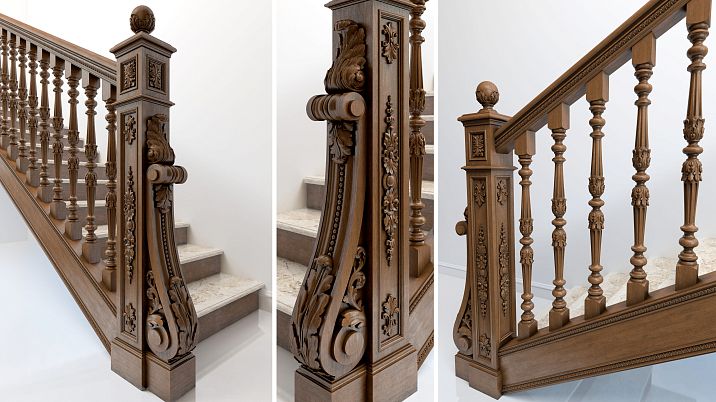
A staircase without elegant vertical balusters is like a symphony without melody — technically functional, but devoid of soul and character. Baluster Elements represent a complex architectural system where each detail plays its role in creating a harmonious whole. Understanding the structure of these components opens boundless opportunities for creative self-expression and technical perfection for the craftsman.
Modern staircase construction requires a deep understanding not only of aesthetic principles but also of the constructive features of each element. A professional approach to designing and manufacturing balusters begins with a detailed analysis of their constituent parts, material characteristics, and functional requirements.


Three-part Structure: Foundation of Architectural Harmony




Base — Foundation of Stability
The lower part of the baluster, called the base or foundation, performs a critically important function of load distribution and ensuring the stability of the entire structure. This component requires special attention to proportions and technical characteristics, as it is here that maximum stresses from dynamic and static loads are concentrated.
The classical base includes several profiled elements: plinth, torus, scotia, and astragal. The plinth is a square or rectangular plate that provides maximum contact area with the base. Its dimensions are usually 20-30% larger than the cross-section of the baluster's main shaft, creating visual stability and technical reliability.
The torus is a convex profile located above the plinth, serving as a transitional element between the geometric strictness of the base and the decorative nature of the central part. Its radius of curvature is calculated based on the overall proportions of the baluster and the stylistic requirements of the project.
Our factory also produces:


Shaft — Carrier of Artistic Concept
The central part of the baluster, called the shaft or stem, represents the greatest scope for the craftsman's creative self-expression. It is here that the main decorative elements are realized, defining the stylistic affiliation and aesthetic value of the product.
The geometry of the shaft may vary from simple cylindrical forms to complex multi-profile compositions. Classical order systems prescribe specific proportional relationships between different parts, based on mathematical principles of the golden section and modular systems.
Decorative treatment of the shaft includes numerous traditional elements: flutes, entasis, returns, bosses, grooves. Flutes are vertical grooves that create play of light and shadow, visually lightening the massiveness of the element. Entasis is a barely noticeable thickening in the middle section, compensating for the optical illusion of concavity of straight lines.
Get Consultation
Capital — the crown of the composition
The upper part of the baluster, the capital, completes the composition and ensures transition to the handrail. This detail requires special precision in execution, as any defects here are most noticeable and critical to the overall perception of the item.
Structurally, the capital consists of an abacus — the upper plate directly contacting the handrail — and decorative elements ensuring a smooth transition from the baluster body. The abacus dimensions must correspond to the handrail cross-section, accounting for assembly tolerances.
Material science aspects of construction
Wood species and their influence on construction
The selection of wood for manufacturing balusters determines not only the aesthetic characteristics of the finished product but also the structural features of each element. Different species require individual approaches to profile design, load calculation, and selection of processing technologies.
Oak, due to its exceptional strength and dimensional stability, allows creating thin, elegant profiles without compromising structural reliability. Oak density of 700–800 kg/m³ ensures excellent machinability and high surface quality after sanding.
Ash features a distinct grain and high impact toughness, making it ideal for elements subjected to dynamic loads. The contrasting annual ring structure creates a natural decorative effect, especially pronounced in radial sawing.
Beech is characterized by uniform structure and neutral coloration, offering broad possibilities for staining and decorative finishing. Its density of 650–750 kg/m³ ensures excellent dimensional stability when properly dried.
Coniferous species: economical without compromise
Spruce remains the most popular material for mass production of balusters due to its optimal price-to-quality ratio. Modern drying and protective treatment technologies enable achieving high service performance while maintaining affordable cost.
Larch surpasses most coniferous species in strength and durability. Its natural resinous nature provides protection against rot and insects without additional chemical treatment. Beautiful grain with distinct annual rings creates an attractive decorative effect.
Siberian cedar is characterized by ease of processing and pleasant aroma with phytoncide properties. Its soft structure requires careful approach to designing thin elements but allows creating complex carved compositions.
Forming technological processes
Turning: the classic of the genre
Turning remains the primary method for manufacturing balusters with complex shapes. Modern CNC machines enable reproducing the most intricate profiles with precision down to hundredths of a millimeter, ensuring identical elements in a series.
Blank preparation begins with selecting high-quality material free of wood defects. Moisture content must not exceed 8–10% to ensure dimensional stability of the finished product. The blank is trimmed with 10–15 mm allowance along length and 5–10 mm along cross-section for subsequent processing.
Rough turning is performed with feed rate 0.5–1.0 mm/rev at cutting speed 150–200 m/min. Finish turning requires reducing feed to 0.1–0.2 mm/rev while increasing speed to 250–300 m/min. These regimes ensure high surface quality and minimal roughness.
Milling: precision and productivity
Milling allows creating complex profiles and decorative elements with high productivity. Modern CNC machining centers capable of multi-axis processing can create volumetric compositions of any complexity.
Selection of milling tools depends on the profile being machined and surface quality requirements. End mills with diameter 6–12 mm are used for roughing, form mills for profile shaping, and grinding heads for final finishing.
Cutting regimes for milling wood require careful selection. Feed rate 3–8 m/min at spindle speed 12000–18000 rpm ensures optimal processing quality for most wood species.
Decorative techniques and artistic finishing
Wood carving: the pinnacle of craftsmanship
Hand carving remains the unmatched method for creating unique artistic pieces. Each element crafted by a master carver carries the imprint of individuality and uniqueness unattainable through machine production.
Geometric carving is based on combining simple geometric elements — triangles, rhombuses, circles — to create complex ornamental compositions. This technique requires precise marking and confident tool handling, but is accessible even to beginners.
Floral carving reproduces motifs of living nature — leaves, flowers, fruits, branches. Realism of the image depends on the carver’s skill and quality of the tools used. The best examples of floral carving impress with their detail and lifelike forms.
Mechanized carving: technologies of the future
Modern CNC machines open new possibilities for creating complex carved compositions. Three-dimensional modeling allows calculating all details of the future product in advance and optimizing the technological process.
Laser engraving enables creating the finest ornamental details with precision down to fractions of a millimeter. Non-contact processing eliminates mechanical damage to wood and allows working with the most fragile elements.
Sandblasting creates interesting textural effects that highlight the natural wood structure. Various abrasive materials allow achieving surfaces of different roughness and expressiveness.
Connecting elements and fastening systems
Traditional joinery
Dowel joints remain the most reliable method for assembling wooden structures. Straight dowel ensures maximum joint strength, while the birdsmouth joint prevents loosening under load.
Pin dimensions are calculated based on the thickness of the connected parts. The pin length should be 0.6–0.8 times the thickness of the part, and the width should not exceed 1/3 of the stock width. These proportions ensure optimal stress distribution in the joint.
Preparing a pin joint requires high precision. Dimensional deviations must not exceed ±0.1 mm to ensure a tight fit without gaps. A quality joint assembles with light force and does not require additional fitting.
Modern fastening systems
Conformers and euro screws provide quick and reliable assembly of baluster elements. These fasteners are especially effective when working with panel materials and allow multiple disassembly and reassembly cycles without loss of joint strength.
Metal studs with a diameter of 8–12 mm are used to connect elements subjected to tension. Threaded connections allow adjustment of tightening degree and compensate for temperature-induced wood deformation.
Adhesive joints based on polyurethane and epoxy compositions provide strength exceeding that of the wood itself. Modern adhesives contain no formaldehyde and are safe for use in residential spaces.
Proportional systems and modular grids
Classical order systems
Ancient orders laid the foundations for proportioning architectural elements, still relevant today. The Doric order is characterized by strict forms and minimal decorative elements. The baluster height is 6–8 base diameters, creating a sense of stability and monumentality.
The Ionic order features more refined proportions. Baluster height increases to 8–10 diameters, and decorative elements become more delicate. Characteristic volutes of the capital require high craftsmanship.
The Corinthian order represents the pinnacle of decorative antiquity. The complex capital with vegetal motifs requires virtuoso carving skills. Proportions become even more elongated — up to 10–12 diameters in height.
Modern modular systems
Modular design is based on using a base size — the module — to which all other element dimensions are multiples. A standard 100 mm module allows creating harmonious compositions and simplifies calculations during design.
Parametric modeling using computer programs allows quickly calculating multiple options and selecting optimal proportions. Changing one parameter automatically recalculates all related dimensions, significantly speeding up the design process.
The golden ratio, expressed as the number 1.618, creates the most harmonious proportions, perceived by the human eye as ideal. Applying this principle to baluster elements guarantees aesthetic perfection of the result.
Protection and decorative finishing technologies
Surface preparation
Sanding is a critically important stage determining the quality of the final finish. The process begins with coarse grinding using 80–100 grit abrasive to remove marks from mechanical processing and level the surface.
Intermediate sanding is performed with 150–180 grit abrasive to eliminate scratches from the previous operation. Final finishing with 220–240 grit abrasive creates a perfectly smooth surface ready for coating application.
Dust removal after each sanding stage is critically important for coating quality. Industrial vacuum cleaners and anti-static cloths are used to completely remove fine wood dust particles.
Protective coatings
Priming ensures even absorption of the final finish and improves its adhesion to the surface. Special primers are used for coniferous species, blocking resin exudation and preventing stains.
Antiseptic treatment protects wood from biological damage — fungi, mold, insects. Modern formulations deeply penetrate the wood structure, providing long-term protection without altering the appearance.
Fire-retardant impregnation increases the fire resistance class of wood and slows flame spread. Special formulations form an expanding layer on the surface, preventing oxygen access to the wood.
Decorative coatings
Varnish coatings provide maximum protection and highlight the natural beauty of wood. Polyurethane varnishes are characterized by high strength and durability, while acrylics offer environmental safety and quick drying.
Oil-based coatings penetrate the wood structure, emphasizing its texture and creating a natural appearance. They are easily repairable for local damage and do not form a film on the surface.
Wax compositions impart a silk-like surface and pleasant tactile sensations. Wax is applied in a thin layer and polished to achieve a uniform matte sheen.
Quality control and standardization
Geometric Parameters
The accuracy of baluster element dimensions is controlled using precision measuring tools. Calipers with 0.02 mm accuracy are used to control diameters and linear dimensions. Protractors check the correctness of taper and profile angles.
Surface roughness is measured using profilometers, providing an objective assessment of surface quality. The Ra parameter should not exceed 1.25 microns for surfaces under transparent finishes and 2.5 microns for surfaces under opaque coatings.
Deviation from straightness is controlled using straightedges and feeler gauges. Permissible deviations are 0.5 mm per 1000 mm for first-grade elements and 1.0 mm for second-grade elements.
Strength characteristics
Bending tests determine the load-bearing capacity of balusters under operational loads. Samples are loaded to failure with deformation diagrams recorded. The modulus of elasticity must match the characteristics of the wood species used.
Compression tests along the grain assess the ability of elements to withstand vertical loads. The compressive strength limit for coniferous species is 40-50 MPa, for hardwoods — 50-80 MPa.
Pull-out connection tests determine the reliability of fasteners. The pull-out force must exceed the calculated operational loads by a safety factor of at least 2.5.
Economic Aspects of Production
Material optimization
Rational cutting of timber allows reducing production waste to 15-20% of the original raw material volume. Computerized cutting optimization programs take into account the dimensions of blanks, wood defects, and surface quality requirements.
Using short offcuts for manufacturing individual baluster elements reduces material cost and enables recycling waste from the production of other items. Adhesive joints provide strength equal to solid wood.
Standardizing element sizes simplifies the production technology and reduces product cost. Standardized profiles allow using standard tools and fixtures, reducing equipment setup time.
Automation of production processes
CNC machines ensure high productivity and stable product quality. Program-controlled operation eliminates human factor influence and allows working in automatic mode with minimal operator involvement.
Robotic systems for feeding and removing blanks increase workplace safety and equipment productivity. Automatic tool change reduces setup time and enables performing complex operations without stopping the machine.
Automatic quality control systems detect defects at early production stages, preventing defective product release. Laser scanners check the geometry of items with accuracy down to hundredths of a millimeter.
Trends in development and innovation
Eco-Friendly Materials
Composite materials based on wood fibers and biopolymers combine the ecological nature of natural wood with improved performance characteristics. They are resistant to rot, do not deform under moisture, and require no special maintenance.
Wood modified under high pressure and temperature acquires increased density and dimensional stability. This material matches tropical species in durability but is produced from local raw materials.
Recycling wood waste allows creating high-quality materials for baluster production. Modern pressing and bonding technologies provide high strength at an affordable cost.
Digital technologies
Virtual reality allows the client to see the future product in the interior even before production begins. Interactive programs enable real-time changes to color, texture, and shape of elements.
Artificial intelligence optimizes technological processes by analyzing multiple parameters and selecting optimal processing modes. Machine learning enables the system to improve with each new product.
The Internet of Things connects all elements of the production chain into a single system ensuring full traceability of products from raw materials to finished goods. Sensors monitor microclimate parameters, wood moisture levels, and equipment operating modes.
Conclusion
World baluster elements Represents a remarkable combination of engineering precision and artistic craftsmanship, where every detail has its purpose and significance. A deep understanding of structural features, material science principles, and technological processes opens boundless opportunities for the craftsman to create unique works of architectural art.
Modern technologies do not replace traditional principles of beauty and harmony, but merely provide new tools for their realization. Combining classical proportions with innovative materials and processing methods allows creating items that will delight the eye and serve faithfully for many decades.
Investments in quality baluster elements pay off not only in the durability and reliability of the structure, but also in the unique atmosphere of comfort and beauty they create in the home. Each element, crafted with understanding and love for the craft, becomes part of the family’s history, passed down from generation to generation.
The future of staircase construction lies in integrating traditional craftsmanship with digital technologies, eco-friendly materials, and personalized approaches to each project. Baluster elements remain and will continue to be the connecting link that unites functionality with beauty, technology with art.
STAVROS Company embodies the finest traditions of carpentry craftsmanship, enhanced by modern technologies and innovative solutions. Our long-standing experience and deep understanding of client needs enable us to create baluster elements that surpass the highest expectations in terms of quality, beauty, and durability. Choosing STAVROS products means investing in the future of your home and the well-being of your family.